Visual Daily Programme to implement the National Curriculum Framework: a case of rural early childhood care and education centres
Abstract
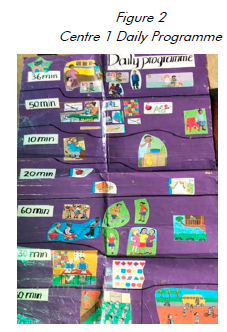
The daily programme outlines the sequence and time allocations for directing learning per curriculum expectancies in Early Childhood Care and Education. This article explores the adoption of a visual representation of activities in a daily programme to enhance young children's development. A qualitative case study of three rural centres that employed such envisioning of the daily programme is located within the critiques of communities of practice. Data collected from semi-structured interviews and document analysis revealed the innovative capacities of rural teachers to activate a collaborative learning endeavour. Examining collaborative efforts delves into the power dynamics that drove the underlying intentions within the integrated policy-practice dialogue. Whilst challenging the pedagogy beyond superficial policy compliance, the paper concludes with a commentary on breeding dependence within benevolent partnerships to question the goal of teachers as autonomous curriculum agents. The study recommends more teamwork for teachers to take a stronger role in the ownership of their professional growth.
Visual representation; daily programme; rural centres; Early Childhood Care and Education; teachers
 Thumbnail
 Thumbnail