Information-seeking behaviour among private higher education undergraduate students in a fourth industrial revolution era
Abstract
The Fourth Industrial Revolution (4IR) era is continuously transforming the higher education landscape. This transformation includes how students access, evaluate, and use information in their academic activities. Despite this, little is known about undergraduate students' information-seeking behaviour, particularly their competence, confidence, and emotional well-being. This descriptive survey investigates this phenomenon at a selected private higher learning institution in South Africa. Data were collected from 145 undergraduate students using a structured questionnaire administered on Google Forms. The findings revealed that 62% of undergraduate students experience uncertainty and anxiety at the beginning of their information-seeking behaviour and that 96% rely on popular search engines like Google rather than scholarly databases. The reason for this is the limited digital literacy skills, such as advanced domain-specific search techniques and unfamiliarity with Boolean logic operators. Despite the growing popularity of artificial intelligence tools in the 4IR era, only 31% of students admitted to using AI tools like ChatGPT for academic information, which highlights the underutilisation of emerging 4IR tools. To address these gaps, the study recommends integrating comprehensive information literacy programmes into the institution's curriculum. Such programmes should focus on improving students' confidence and competencies in utilising advanced search techniques. This should include skills in how to use Boolean logic operators, domain-specific search strings and emerging AI tools for their academic information needs. Equipping students with these skills will enhance their ability to search and evaluate academic information effectively in the 4IR era.
information literacy; digital literacy; information-seeking behaviour; Fourth Industrial Revolution (4IR); academic libraries; students' emotional well-being
INTRODUCTION AND BACKGROUND
Finding relevant academic information in the era of the Fourth Industrial Revolution (4IR) can be elusive, as the acquisition of relevant information heavily depends on the methods employed in information-seeking behaviour (ISB). The success of ISB, particularly among students, is influenced by external context, cognitive approach and internal context factors (Meratian & Chang, 2012). To keep up with this, libraries continuously adopt 4IR innovations to support and improve students' ISB (Ocholla & Ocholla, 2020). This includes the continuous integration of advanced digital technologies to make library resources, services and spaces more accessible, interconnected and adaptable (Ocholla & Ocholla, 2020). Despite making information resources available, the academic libraries' role in equipping students with valuable information literacy remains relevant (Lawal, 2021). Information literacy skills are meant to help students survive an increasingly complex and information-rich environment influenced by 4IR and open-access initiatives (Ali et al., 2022; Moyo, 2022).
To ensure that academic libraries provide relevant information literacy programmes, it is important to assess the current ISB of users. This is particularly crucial for undergraduate students who often struggle with critical thinking, information and digital literacy skills essential to survive the information explosion influenced by 4IR (Durodolu & Mojapelo, 2020; Ocholla & Ocholla, 2020; Abodering & Havenga, 2023; Lubinga et al., 2023).
Within the South African context, research about information literacy and ISB has predominantly been conducted in public higher learning institutions, while overlooking the perception of Private Higher Education Institutions (PHEIs) (Moyo & Okemwa, 2020; Nkomo et al., 2012; Noll & Brown, 2019). Hence, it is critical to explore this oversight, as cultural and educational dynamics, including resource allocations in PHEIs, differ from those in public institutions (Stander & Herman, 2017). This difference may potentially lead to distinct ISBs among students from either type of institution.
This study targeted two campuses from a selected PHEI in South Africa, which has well-resourced information centres referred to as academic libraries within this study. These academic libraries are managed by qualified information specialists (academic librarians) with a minimum NQF of seven or eight qualifications in information science, as recognised by the Library and Information Association of South Africa (Library and Information Association of South Africa, n.d.). As part of their core roles, the information specialists provide users with frequent information literacy workshops throughout the academic year. This is to ensure that all users have efficient skills to access and engage with information in the 4IR era.
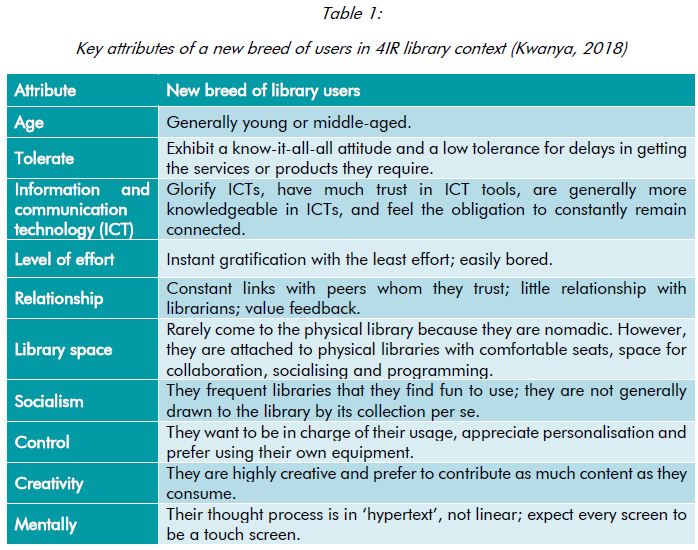
The information literacy workshops are conducted either in the classroom or online via learning management systems, and self-paced tutorial videos are also shared with students. These information literacy workshops focus on intellectual integrity, academic writing skills, how to navigate library physical and electronic databases, the use of Boolean operators, domain search strings and available credible open-access materials. Additionally, academic librarians have open individual consultations where students have the opportunity to consult on how to scientifically search for information and other information literacy topics. These interventions are put in place to meet the information needs of current users who are perceived to be 'bored easily, demand synthesised information with the least effort, and are intolerant to any form of delay', as further described in the adopted Table 1 by Kwanya (2018, p. 1389).
Despite current interventions that are rolled out in PHEIs, it is uncertain whether some students in PHEIs are well-equipped to handle the demands of information and digital literacy in the 4IR era. Thus, this study explored various factors, such as emotions, gender, level of study, and the faculty on undergraduate students' academic ISB at PHEIs. By using Kuhlthau's (1991) information-seeking process (ISP) model, this study put into perspective the search strategies and current information resources preferred by undergraduate students in their academic ISB. Conceptualising undergraduate students' ISBs is critical to gauge the challenges they encounter during their academic journey. Such understanding will help academic libraries to better equip students with relevant skills in locating, evaluating and using information ethically in a rapidly evolving 4IR environment (Moyo & Okemwa, 2020; Ocholla & Ocholla, 2020; Adigun et al., 2024).
Evolution of information-seeking behaviour
Historically, ISB within academic libraries has been heavily reliant on physical resources such as books, journals and other print materials, highlighting users' physical interaction with library materials and librarians for assistance (McKay et al., 2017; Parveaz & Khan, 2022). As scholarly attention expanded, the scope of research focused on influences of information seeking such as library visibility, information literacy and user demographics (Ganaie & Khazer, 2015). This further led to model developments which integrated various interdisciplinary perspectives from psychology, sociology and library science (Wildemuth & Case, 2010).
The current influence of 4IR requirements transforms how users seek and access information (Ocholla & Ocholla, 2020; Shamila et al., 2020; Subaveerapandiyan et al., 2024). As academic libraries continue to adapt to 4IR technological advancement, there is an integration of robotics, the Internet of Things (IoT), artificial intelligence (AI) tools such as chatbots and advocacy to open science movement to meet the demands of current smart users (Ocholla & Ocholla, 2020; Moyo, 2022).
Kwanya (2018) concurs that the shift from print to digital resources introduced a new variant in ISB, as users rely on online databases, electronic resources and institutional repositories more than hard copies. Kwanya (2018) further attributed this to the reasons given in Addison and Meyers (2013) conceptualise information literacy as the acquisition of 'information age' skills, cultivation of habits of mind and ethical engagement in information-rich social practices. As universally agreed upon, information literacy skills are a set of abilities that enable individuals to locate, evaluate and effectively use needed information (American Library Association, 2024).
Table 1, as new users perceive library space as a social area, prefer to be in control, and are easily bored, although they are creative. This then challenges the ongoing discussion on the traditional conceptualisation of ISB, which is continuously influenced by the level of information literacy skills, particularly within the South African context.
Information literacy
Addison and Meyers (2013) conceptualise information literacy as the acquisition of 'information age' skills, cultivation of habits of mind and ethical engagement in information-rich social practices. As universally agreed upon, information literacy skills are a set of abilities that enable individuals to locate, evaluate and effectively use needed information (American Library Association, 2024).
In understanding the information gap, scholars such as Bopape et al. (2017) and Kundu (2017) define information need as a state in which individuals feel that their current knowledge is insufficient, which motivates them to seek additional information. Wilson (2024) posits that information needs can be physical, cognitive and emotional, which supports the role of information literacy in fulfilling information needs in a 4IR environment. Hence, academic libraries must embrace opportunities and challenges presented by the 4IR through expanding their information services support (Ocholla & Ocholla, 2020; Moyo, 2022).
Influence of Kuhlthau's ISP model in 4IR
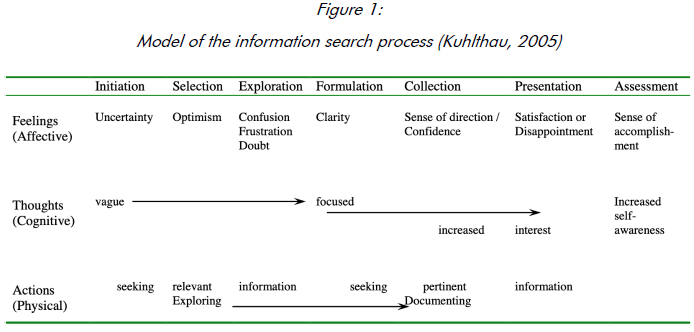
The evolution of ISB has been extensively studied through various theoretical models (Ikoja-Odongo & Mostert, 2006; Kundu, 2017). A prominent ISB model developed by Kuhlthau (1991), shown in Figure 1, refined the understanding of ISP by proposing a six-stage process that individuals go through when seeking information. Kuhlthau (1991, p. 367) identifies 'initiation, selection, exploration, formulation, collection, and presentation' as stages in which each is associated with specific emotions, thoughts and actions. These aspects provide a comprehensive framework for understanding the cognitive, affective and physical dimensions of ISB.
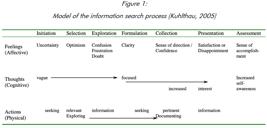
A review by Kuhlthau et al. (2008) confirms the relevance of the ISP model in understanding the progression of feelings, thoughts, and actions experienced by individuals during the information-seeking process in the 4IR environment. However, Taylor (2012) reported that while Kuhlthau's ISP model is still relevant, students were observed to differ from its expectations. This was due to students progressing randomly through search stages and only prioritising readily accessible sources like Wikipedia instead of prioritising quality information (Taylor, 2012; Luo & Nahl, 2019).
To concur with Taylor (2012), scholars Buba et al. (2021) found that despite adequate knowledge of information literacy programmes, students often experience uncertainty due to inconsistent information and challenges related to open access. A similar notion by Laeeq (2024) highlights that current students have a strong preference for digital information systems over traditional library resources. Laeeq (2024) further states that students are emotionally self-sufficient and capable of using stress as a motivator in their research activities.
Other researchers integrated data literacy into Kuhlthau's ISP model to emphasise the need for strategic support at specific stages to improve students' research processes (Jefferson et al., 2020). Hence, Jefferson et al. (2020) further emphasise the importance of collaboration between librarians and data providers to address the emotional challenges students face during the information search process.
Search strategies, structures and approaches
Information search strategies are positively evolving, although various challenges exist in retrieving academic information. Some of the challenges include a lack of clarity on where to start when searching for information, difficulty understanding complex academic text, and limited access to relevant resources or databases (Durodolu & Mojapelo, 2020; Florescu, 2023). In addition, students often experience emotions such as uncertainty, frustration and confusion, which impact their ISB (Orlu, Mafo & Tochukwu, 2017).
With the integration of digital tools, keyword-based search engines such as Google remain the most used search engines and trusted sources among students because of the complexity of navigating academic databases (El-Maamiry, 2020; Lowe et al., 2018). This is persistent, regardless of the existence of semantic search engines such as DuckDuckGo, which was proven to retrieve relevant search query-related documents compared to keyword-based search engines such as Google, which heavily relies on synonyms of keywords for precise results (Roy et al., 2019).
Reading strategies in information-seeking behaviour
During the information-seeking process, students employ both surface and deep reading strategies to select, organise, connect and evaluate information (Lopatovska & Sessions, 2016). In surface reading, students quickly skim through the text to grasp the basic ideas and information without delving into the details. In contrast, in deep reading, students approach the text thoroughly by engaging and interrogating the text critically and analytically (Lopatovska & Sessions, 2016). Therefore, despite an overabundance of information, students tend to skim through sources to identify key points relevant to fulfilling information needs (Kwanya, 2018).
Furthermore, students also engage in discussions with peers and their lecturers to share their perspectives and for clarity on the ambiguous information they encounter (Kwanya, 2018; Shamila et al., 2020; Given, 2023). This approach complements the apomediation information search strategy of current information users who deploy an information search strategy that bypasses formal gatekeepers and acts independently, with the guidance of peers and ICT tools to find credible and relevant information (Kwanya, 2018). This supports the notion that students' ISB is continuously evolving, where readily synthesised and available information supersedes the notion of quality gate-kept information (Thomsett-Scott & Reese, 2012; Wisneski, 2024).
METHODOLOGY
This study adopted a descriptive survey design to investigate the ISB of undergraduate students at a PHEI. The data were collected using a structured questionnaire administered through Google Forms, which probed various dimensions of ISB, including emotional responses, information access methods, search strategies and challenges experienced by undergraduate students during their ISB. Demographical factors were presented as descriptive statistics in the form of percentages and frequencies. Furthermore, cross-tabulations run on the Statistical Package for Social Sciences (SPSS) were utilised to explore the relationship between demographics such as gender and level of study against questions which represented aspects of ISB (emotional responses, preferred methods of accessing information, and search strategies utilised). The chi-square test of independence was utilised to assess patterns, variations and associations, thus providing insights into the academic ISB among undergraduate students.
Ethical clearance
The researchers obtained the ethical clearance for this study from The IIE's Research Ethics Committee. Invitations to participate were extended on a voluntary basis, and all participants provided explicit informed consent. Prior to data collection, participants received comprehensive information about the study's objectives and no coercion was employed in the recruitment process. All data collected was treated with confidentiality and anonymised to protect the identity of the respondents.
FINDINGS
Demographic summary
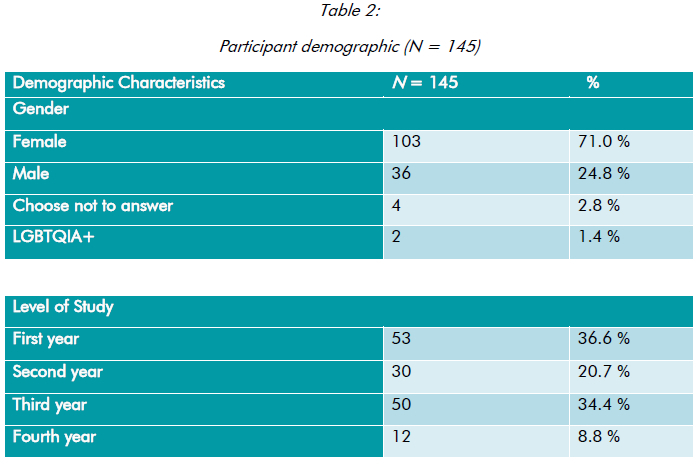
In the analysis of the demographic profile of respondents, Table 2 shows the total number of respondents, which was 145, with the majority of the sample being females (71%), followed by males with 24.8%. A small percentage, 1.4% of the sample, identified as members of the LGBTQI community, and 2.8% of the participants chose not to reveal their gender.
Table 2 further shows that the respondents included 36.6% first-year students, 20.7% second-year students, 34.5% third-year students and the smallest 8.8% fourth-year students. This is a relatively equivalent spread between the first- and third-year students, though the fourth-year students were a smaller representation.
Affective aspects (Emotional Dimensions)
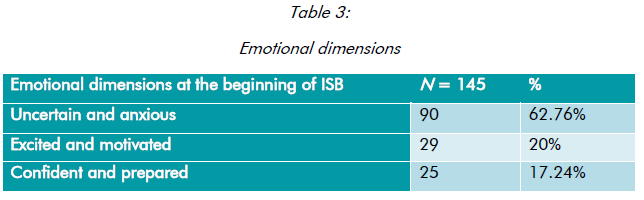
When assessing the undergraduate students' emotional dimensions, the findings presented in Table 3 show that at the beginning of the ISP, 62.76% of respondents were uncertain and anxious, 20% felt excited and motivated, while only 17.24% were confident and prepared. Furthermore, the relationship between gender and questions on emotional feelings was not significant (χ2=11.55; p=0.073). The strength of this relationship was also moderate (V=0.20). These demonstrate that gender does not have a huge effect on students' feelings at the beginning of their ISP. Similarly, the year of study also did not indicate an effect on emotional dimensions at the beginning of their ISP (χ2=4.19; p=0.65), with a negligible association (V=0.12; p=0.65).
Search strategies
In the context of this study, search strategies referred to the methods and techniques used by undergraduate students to locate, retrieve, and evaluate information from various information sources to fulfil information needs.
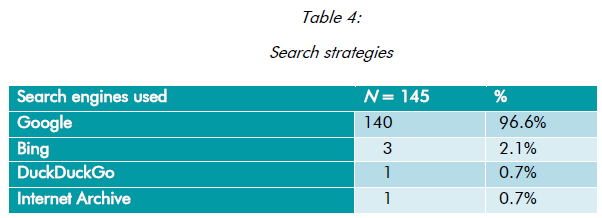
Table 4 shows that only four search engines were selected by the sample, with Google being selected the most with 96.6%, followed by Bing with only 2.1% of the sample, and DuckDuckGo and Internet Archive with 0.7% each.
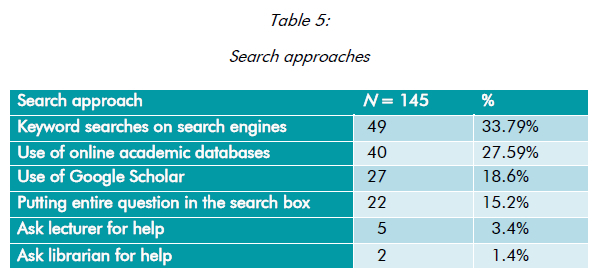
Furthermore, students were asked about key strategies employed to retrieve relevant academic information during their ISP. Table 5 shows that 33.79% respondents relied on the use of keyword searches as a strategy on search engines. Another 27.59% of respondents preferred online academic databases as their key strategy to retrieve relevant academic information. A total of 18.6% preferred to use Google Scholar, while 15.2% put their whole question in the search box. Table 5 further reveals that a noteworthy proportion of 3.4% preferred to start searching by asking their lecturer for help, while only 1.4% preferred to ask librarians for help. This choice of search strategies was not significantly associated with the year of study (χ2=21.05; p=0.13). This association was also moderate but insignificant (V=0.20; p=0.13).
Sources of information
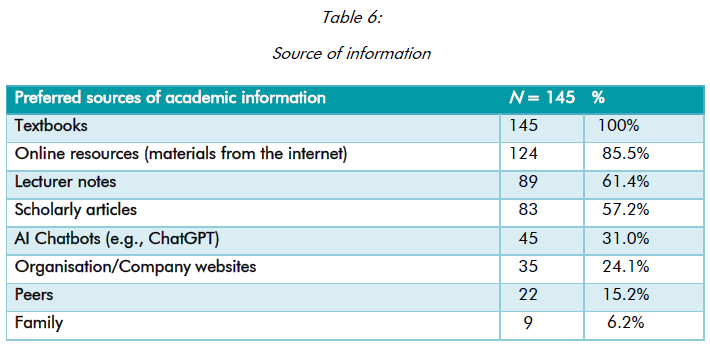
Table 6 indicates findings about sources of information which respondents preferred to use when exploring relevant academic information for their information needs. This question was a multiple-choice question with respondents able to select more than a single option, and an interesting finding indicates that 100% of undergraduate students in this sample still depend on textbooks. This was followed by 85.5% of the sample who also preferred online resources in the form of materials from the internet, while 61.4% preferred lecturer notes and 57.2% relied on scholarly articles. Interestingly, the interest in AI chatbots (ChatGPT) was selected by 31.0%, something the researchers hoped would have been higher due to the adoption of 4IR advancement in academia. While specific organisation/company websites were hinted at by 24.1% of the respondents as a source of academic information, 15.2% relied on their peers, and 6.2% on their family as a source of academic information.
Evaluating information
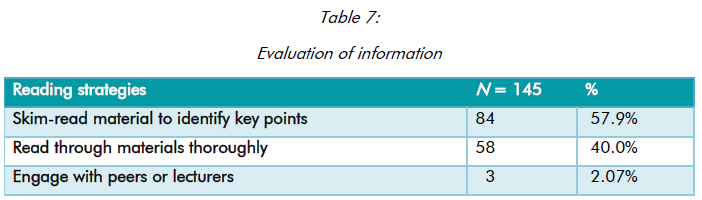
With regard to reading strategies, Table 7 indicated that over half the respondents (57.9%) skim-read material to quickly identify key points related to their information needs, while 40% read through the materials thoroughly to gain a comprehensive understanding. The least-used approach was that of engaging with peers or lecturers to gain insights into the information, which amounted to 2.07% of the sample. This question showed a non-significant association with a negligible association with year of study (χ2=9.20; p=0.15) and (V=0.17; p=0.15), which suggests that these preferences are consistent across the level of study.
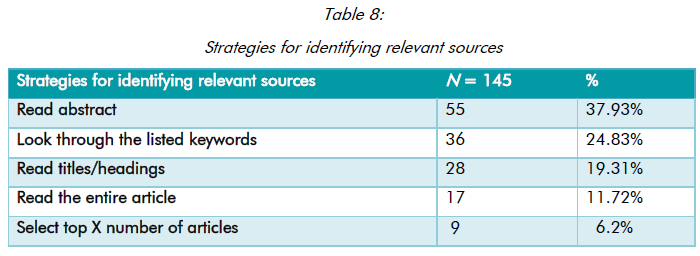
Furthermore, to understand the behaviour of students' strategies to effectively identify sources they deemed to be relevant, it was discovered that 37.93% of the students in the sample read the abstracts of identified materials, whilst 24.83% looked through the listed keywords of the article before judging the relevancy of the article. A further 19.31% of respondents read through titles/headings, while only 11.72% read the whole article. Interestingly, only 6.2% of the respondents indicated selecting the top-ranked articles in the search results. In addition, the chi-square test showed a non-significant relationship between reading strategies and gender (χ2=15.12; p=0.24), with a small effect size (V=0.17; p=0.24). This suggests that gender had no significant influence on students' reading strategies.
Satisfaction with library services and familiarity with advanced search techniques
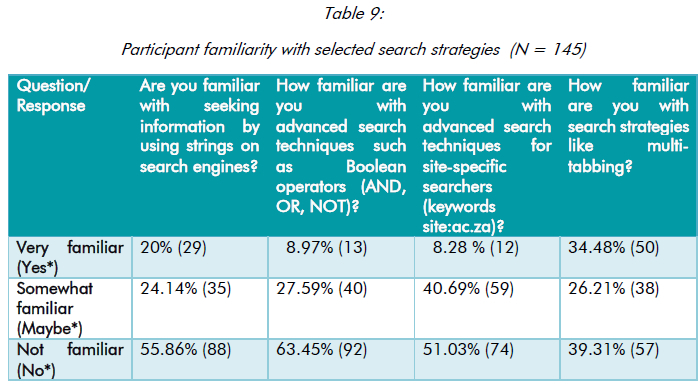
A concern from the findings was the level of satisfaction with the library services and familiarity with advanced search techniques. Interestingly, 39.31% (n = 57) of the respondents were neutral about the library services, while 30.34% (n = 44) were somewhat satisfied, and only one-fifth of the respondents, 20% (n = 29), were very satisfied. In terms of participant familiarity with the advanced search techniques summarised in Table 9, the findings indicated that more than half of the respondents (55.86%) were not familiar with the use of strings on search engines. Furthermore, 24.1% of the respondents indicated being somewhat familiar, and only 20% indicated being familiar with retrieving academic information by use of search strings on search engines. Regarding the search techniques, 63.45% of the sample also admitted that they were not familiar Boolean operators such as 'AND, OR, NOT' operators. In addition, about 27.6% of the sample indicated that they were somewhat familiar, and only 9% indicated that they were very familiar.
Furthermore, 51.03% of the respondents were also not familiar with advanced domain search techniques to retrieve published content from South African academic institutional repositories through the use of 'keywords site:ac.za'. About 40.7% indicated being somewhat familiar, while only about 8.3% indicated being very familiar. Although the spread for the responses to the question, 'How familiar are you with search strategies like multi-tabbing', was almost even, the highest proportion of respondents (39.3%) still reported 'not familiar', whereas 34.48% reported being 'very familiar' with this strategy, and only 26.2% reported being 'somewhat familiar'.
Challenges associated with undergraduate students ISB in the 4IR era
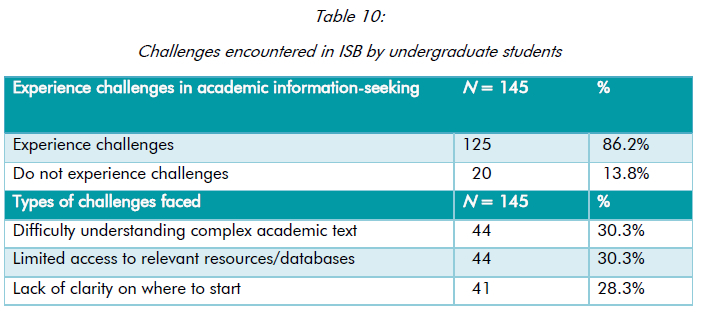
As alluded to in Table 3, some of the emotional dimensions that were prevalent in the sample were uncertainty and anxiety, as opposed to those who were confident and prepared. In addition to this, Table 10 shows that 86.2% of the respondents encountered challenges when seeking relevant information, whereas only 13.8% said they did not experience challenges and could have the confidence needed to embark on their ISP.
The challenges encountered when seeking the relevant information were 'difficulty in understanding complex academic texts', which was selected by 30.3%, and 'limited access to relevant resources or databases', which was also selected by 30.3% of the respondents. Only 28.3 % indicated that their challenge is a 'lack of clarity on where to start'.
DISCUSSION
The primary goal of this study was to assess students' ISB at a PHEI in South Africa. This was done by understanding undergraduate students' emotional dimensions at the beginning of their ISP, search strategies, preference of sources and various information evaluation techniques employed by undergraduate students. The study revealed a notable level of anxiety among undergraduate students at the beginning of their ISP, with only a small fraction feeling confident and prepared. According to Kuhlthau (2005), such feelings are prevalent in the initiation and exploration stages due to the overabundance of available information to explore.
The high level of negative emotions, such as uncertainty and anxiety during ISP, further suggests a lack of confidence and possible cognitive challenges experienced by undergraduate students. This is supported by a notable challenge identified by undergraduate students' difficulty in understanding complex academic text, not knowing where to start when searching academic information and limited access to relevant resources or databases. Such challenges often evoke negative emotions during the ISP, thus influencing students to prioritise readily synthesised information, which could be untrustworthy (Orlu et al., 2017; Khan et al., 2021).
The study further found an over-reliance on popular search engines such as Google instead of other search engines like Bing and DuckDuckGo at the beginning of academic information search (Lowe et al., 2018; El-Maamiry, 2019). This trend reflected Kuhlthau's ISP exploration stage, where individuals rely on broad, unstructured search strategies before refining their information needs (Kuhlthau, 2005). This trend fitted the profile of the current students who start their information searches with search engines instead of librarians and library catalogues (Kuhlthau, 2005; Kwanya, 2018). While this behaviour correlates with the exploration stage, these findings may raise concerns about the students' exposure to and knowledge of a variety of available search engines, which could enhance research outputs. A similar notion was raised by Howlader and Islam (2019), who state that undergraduate students exhibit inadequate information literacy skills, affecting their ability to navigate academic resources effectively.
In support of existing literature, the study also found that students preferred search engines when accessing academic information due to the complexity of navigating academic databases (Lowe et al., 2018; El-Maamiry, 2020; Okocha & Owolabi, 2020; Alazemi, 2023). However, Buba et al. (2021) suggest that inadequate subscriptions to academic databases result in users' inability to fulfil their information needs. Therefore, the majority of students resort to skimming materials to quickly identify key points as a strategy to cope with information overload influenced by open-access initiatives in the 4IR context (Malapela et al., 2020; Shamila et al., 2020; Khan & Shafi, 2024).
This information explosion may lead to students relying on alternative infomediaries, such as peers and lecturers, to affirm the accuracy of the information rather than reference librarians (Kwanya, 2018; Shamila et al., 2020). This deviation contradicts Kuhlthau's ISP model, which suggests that librarians support students with refining and gathering credible sources in the formulation and collection stages (Kuhlthau, 2005). The lack of familiarity with advanced search techniques, such as Boolean logic and domain-specific search techniques, among students in this study is concerning. This unfamiliarity may prevent students from refining their search strategies in the formulation stages, as suggested by Kuhlthau's ISP (Kuhlthau, 2005). This highlights a gap in digital literacy, which should be addressed through focused training that equips students with practical aspects of Boolean logic operators, domain-specific search and other emerging search strategies.
While Boolean logic operators, as a traditional foundation for database searches, are diminishing as search engines advance towards search models that process natural language queries (Chimah & Ude, 2020), they remain critical for filtering results in structured databases (Kwanya, 2018; Ugwu & Opah, 2023). Therefore, the use of domain search strings, such as keywords site:ac.za OR keywords site:ac.* in search engines may also be vital in the 4IR era, as they further contribute to the use of research output archived in institutional repositories.
The study also found surprisingly low use of AI tools, such as ChatGPT chatbots, for accessing academic information, compared to a strong preference for textbooks and online library resources, which contradicts researchers' expectations provided by 4IR advancements. These findings partially concur with a study by Subaveerapandiyan et al. (2024), which found that students still prefer online databases, search engines and a growing increase in preference for AI chatbots. Other studies reported that students use AI tools such as ChatGPT in academics, but mainly for academic writing, generating ideas and finding clarity on complex information (Khoso et al., 2023; Johnston et al., 2024). As it is evident that the use and familiarity of Boolean logic operators are diminishing, it is critical for academic librarians to maintain the importance of keywords in searches, domain search strings and AI chatbot model prompting skills in information literacy programmes (Sanusi et al., 2020; Akakpo, 2024).
While a slight majority of undergraduate students indicated that they were not satisfied with the resources and support provided by their library, the findings indicate a strong value in the use of textbooks, substantiated by online library resources. This questions the current personality traits of librarians in the 4IR era, while also suggesting a need for diverse resources and the implementation of a Summon system to aggregate all various online library databases, including their catalogue. Through this implementation, it will be a step closer for PHEI academic libraries to adhere to 4IR requirements in understanding students' ISB needs (Bano et al., 2019; Ocholla & Ocholla, 2020; Bernard, 2024). These findings align with Kuhlthau's ISP model, which emphasises that students often combine multiple resources during the collection and formulation stages of the information-seeking process (Kuhlthau et al., 2008; Meyer & Fourie, 2017). Therefore, institutions should continue to provide access to diverse resources while enhancing the digital literacy required in the 4IR era.
CONCLUSION AND RECOMMENDATIONS
This study highlights challenges faced by undergraduate students' academic ISB at a selected PHEI in South Africa. The study concludes that undergraduate students experience anxiety and uncertainty at the beginning of their academic ISB. This is due to the information explosion and difficulties in understanding complex scholarly information, particularly published in academic databases. Students' dependence on readily available information through the Google search engine and the lack of familiarity with advanced search techniques highlight gaps in students' digital literacy. Furthermore, low usage of AI tools such as ChatGPT points to a gap between 4IR advancements and students' academic practices.
Therefore, this indicates that there is a need for compulsory information literacy interventions integrated into the curriculum, which should equip students with traditional and emerging research competencies relevant to the 4IR context. Strengthening digital literacy will elevate students' confidence and evaluation of information skills in academic ISB, which is elusive in the 4IR era. Information literacy programmes should teach students practical elements of prompting AI chatbots as well as critical thinking on evaluating the credibility of their information against peer-reviewed publications. Additionally, academic libraries within PHEIs should invest in discovery systems such as Summon, which aggregate accessibility of various library resources.
LIMITATIONSDespite the study providing valuable insights about ISB, the sample size was adequate but does not fully represent a broader population of undergraduate students across both private and public South African higher learning institutions. While the frequencies yielded valuable insights into undergraduate students' ISB, demographic data such as gender, level of study and faculty name did not show any significant variances. Furthermore, the survey study relied on self-reported data, which could result in respondents misrepresenting their ISB. Future research should aim to include a larger sample size, expand on survey questions to capture additional elements of ISB and deploy various research methods to provide an in-depth understanding of the ISB in an evolving 4IR environment. This study was grounded in the Kuhlthau ISP model; therefore, future studies could expand on this by exploring the presentation stage, which could be linked to the ethical use of information and academic writing processes.
REFERENCES
LITERATURE REVIEW
- Aboderin, O. S., & Havenga, M. (2024). Essential skills and strategies in higher education for the fourth industrial revolution: A systematic literature review. South African Journal of Higher Education, 38(2), 24-43. https://doi.org/10.20853/38-2-5430
- Addison, C., & Meyers, E. (2013). Perspectives on information literacy: A framework for conceptual understanding. Information Research: An International Electronic Journal, 18(3), 1-14. https://eric.ed.gov/?id=EJ1044643
- Adigun, G. O., Ajani, Y. A., & Enakrire, R. T. (2024). The intelligent libraries: Innovation for a sustainable knowledge system in the fifth (5th) industrial revolution. Libri, 1-13. https://doi.org/10.1515/libri-2023-0111
- Ali, N., Shoaib, M., & Abdullah, F. (2022). Information literacy and research support services in academic libraries: A bibliometric analysis from 2001 to 2020. Journal of Information Science, 49(6), 1593-1606. https://doi.org/10.1177/01655515211068169
- Bano, S., Mehraj, M., & Rehman, I. (2019). Librarians and their distinctive personality traits in the 21st-century digital era. Library Philosophy and Practice, 1-12. https://digitalcommons.unl.edu/cgi/viewcontent.cgi?article=5972&context=libphilprac
- Bernard, S. (2024). Investigating curriculum-integrated information literacy. The Journal of Academic Librarianship, 50(1), 1-8. https://doi.org/10.1016/j.acalib.2023.102839
- Buba, A. A., Song, U. M., & Abdullahi, Z.M. (2021). Information literacy skills and use of e-resources by undergraduate students in Nigeria in relation to Kuhlthau's Model of Information Search Process (ISP). Library Philosophy and Practice (e-journal), 1-22. https://digitalcommons.unl.edu/libphilprac/4992
- Chimah, J. N., & Ude, F. I. (2020). Current trends in information retrieval systems: review of fuzzy set theory and fuzzy Boolean retrieval models. Journal of Library Services and Technologies, 2(2), 48-56. https://doi.org/10.47524/jlst.v2i2.5
- Durodolu, O. O., & Mojapelo, S.M. (2020). Contextualisation of the information literacy environment in the South African education sector. Electronic Journal of e-Learning, 18(1), 57-68. https://eric.ed.gov/?id=EJ1245090
- El-Maamiry, A. A. (2019). Cultural factors affecting information-seeking behaviour: Case Study of GCC Universities. In A. Kaushik, A. Kumar, & P. Biswas, (Eds.), Handbook of research on emerging trends and technologies in library and information science, pp.313-331. IGI Global Scientific Publishing. https://doi.org/10.4018/978-1-5225-9825-1.ch0214018/978-1-5225-9825-1.ch021
- Ganaie, S. A., & Khazer, M. (2015). Diversity of information sources in the digital age: An overview. Journal of Advancements in Library Sciences, 2(2), 13-26 https://doi.org/10.37591/joals.v2i2.388
- Given, L. M., Case, D. O., & Willson, R. (2023). The complex nature of information behaviour. In Looking for information: Examining research on how people engage with information, 71-119. https://doi.org/10.1108/S2055-53772023003
- Howlader, A. I. & Islam, M. A. (2019). Information-seeking behaviour of undergraduate students: A developing country perspective. IFLA Journal, 45(2), 140-156. https://doi.org/10.1177/0340035219842312
- Jefferson, C. O., Stierholz, K., Fontichiaro, K., & Hoelter, L. (2020). Considering data literacy using Kuhlthau's Information Search Process: Implications for librarians and data providers. Journal of Business & Finance Librarianship, 25(3-4), 197-229. https://doi.org/10.1080/08963568.2020.1847556
- Johnston, H., Wells, R. F., Shanks, E. M., Boey, T., & Parsons, B. N. (2024). Student perspectives on the use of generative artificial intelligence technologies in higher education. International Journal for Educational Integrity, 20(1), 2-21. https://doi.org/10.1007/s40979-024-00149-4
- Khan, N. A. & Shafi, S. M. (2024). Open access theses and dissertations: current status and perspectives. Global Knowledge, Memory and Communication, 1-13. https://doi.org/10.1108/GKMC-01-2024-0024
- Khan, S., Anwar, M. A., & Naveed, M. A. (2021). Prevalence and levels of information seeking anxiety among business students. Library Philosophy and Practice (e-journal), 1-14. https://digitalcommons.unl.edu/libphilprac/4622
- Kuhlthau, C. C. (1991). Inside the search process: Information seeking from the user's perspective. Journal of the American society for information science, 42(5), 361-371. https://doi.org/10.1002/(SICI)1097-4571(199106)42:5%3C361::AID-ASI6%3E3.0.CO;2-%23
- Kuhlthau, C. C. (2005). Information search process. Hong Kong, China, 1-18. https://citeseerx.ist.psu.edu/document?repid=rep1&type=pdf&doi=cbca92070d1975494696f342b4e2e163b2b171dd
- Kuhlthau, C. C., Heinström, J., & Todd, R. J. (2008). The 'information search process' revisited: Is the model still useful. Information Research, 13(4), 13-28. https://informationr.net/ir/13-4/paper355.html
- Kundu, D. K. (2017). Models of information seeking behaviour: A comparative study. International Journal of Library and Information Studies, 7(4), 393-40. https://dx.doi.org/10.2139/ssrn.4289303
- Kwanya, T. (2018). Information seeking behaviour in digital library contexts. In Library Science and Administration. IGI Global, 1384-1408, https://doi.org/10.4018/978-1-5225-3914-8.ch066
- Laeeq, M. (2024). Information behaviour of business higher degree research students: Understanding affective, cognitive and physical aspects of information-seeking. Doctoral dissertation. Macquarie University, Australia. https://doi.org/10.25949/25494049.v1
- Library and Information Association of South Africa. n.d. The professional body for librarians and information workers. [Online]. Retrieved on 30 September 2024 at https://www.liasa.org.za/page/what_is_pb (30
- Lowe, M., Maxson, B., Stone, S., Miller, W., Snajdr, E., & Hanna, K. (2018). The Boolean is dead, long live the Boolean! Natural language versus Boolean searching in introductory undergraduate instruction. College & Research Libraries, 79(4), 517-534. https://doi.org/10.5860/crl.79.4.517
- Lubinga, S. N., Maramura, T. C. & Masiya, T. (2023). Adoption of fourth industrial revolution: challenges in South African higher education institutions. Journal of Culture and Values in Education, 6(2), 1-17. https://repository.up.ac.za/handle/2263/94027
- Malapela, T., Chisita, C., & Hadebe, Z. C. (2020). The status of the electronic thesis and dissertations (ETDs) outputs amongst the institutional repositories in South African universities: Part 1. Cadernos BAD, 144-157. https://www.africabib.org/htp.php?RID=A00006203
- McKay, D., Chang, S., & Smith, W. (2017). Manoeuvres in the dark. In Proceedings of the 2017 ACM Conference on Conference Human Information Interaction and Retrieval (pp. 47-56). New York, USA: https://openaccess.city.ac.uk/id/eprint/23626/
- Meratian, E. L., & Chang, S. (2012). Factors impacting information seeking behaviour of international students: Towards a conceptual model. 23rd ISANA International Education Association Conference Proceedings, (1-11). https://isana.org.au/wp-content/uploads/2025/01/isana2012Final00044.pdf
- Meyer, A., & Fourie, I. (2017). Thematic analysis of the value of Kuhlthau's work for the investigation of information behaviour in creative workspaces in academic libraries. Information Research, 22(1), 1-19. https://informationr.net/ir/22-1/isic/isic1626.html
- Moyo, M. (2022). The shifting and changing research landscape and the academic librarian's response. In A. J. Vun Vuren (Ed). Academic libraries reflecting on crisis, the fourth industrial revolution the way forward (pp.77-93). Johannesburg: University of Johannesburg Press. https://library.oapen.org/bitstream/handle/20.500.12657/59096/9781776402304.pdf?sequence=1#page=87
- Moyo, M., & Okemwa, E.O. (2020). Students' perceptions of information literacy at two South African universities. Library Philosophy and Practice (e-journal), 1-4. https://digitalcommons.unl.edu/libphilprac/6821/
- Noll, S. D., & Brown, C. (2019). Re-thinking information literacy in a postgraduate class at a South African higher education institution. Mousaion: South African Journal of Information Studies, 36(2), 1-26. [Online]. https://doi.org/10.25159/2663-659X/4769
- Ocholla, D. N., & Ocholla, L. (2020). Readiness of academic libraries in South Africa to research, teaching and learning support in the Fourth Industrial Revolution. Library Management, 41(6-7), 355-368. https://doi.org/10.1108/LM-04-2020-0067
- Orlu, A. D., Mafo, I. H., & Tochukwu, N. T. (2017). Perceived emotions in the information seeking behaviour of Manchester Metropolitan University students. Library Philosophy & Practice, 1-39. https://digitalcommons.unl.edu/libphilprac/1534
- Roy, S., Modak, A., Barik, D., & Goon, S. (2019). An overview of semantic search engines. International Journal of Research, 6(10), 73-85. https://www.ijrrjournal.com/IJRR_Vol.6_Issue.10_Oct2019/IJRR0012.pdf
- Sanusi, Y. M., Ajibola, A., & Oluyemi E. A. (2020). A domain-specific search engine: A case of University of Abuja. International Journal of Advances in Scientific Research and Engineering, 05(12), 122-131. http://doi.org/10.31695/IJASRE.2019.33651
- Shamila, M. S., Wan, A. W. Y., Azma, A. A. H., Husain, H. W. Y., Shuhaida, M. S., & Norizan, A. (2020). Information-seeking behaviour among millennial students in higher education. Social and Management Research Journal, 17(1), 1-16. https://doi.org/10.24191/smrj.v17i1.8136
- Stander, E., & Herman, C. (2017). Barriers and challenges private higher education institutions face in the management of quality assurance in South Africa. South African Journal of Higher Education, 31(5), 206-224. https://doi.org/10.20853/31-5-1481
- Subaveerapandiyan, A., Vijay Kumar, R., & Prabhu, S. (2024). Marine information-seeking behaviours and AI chatbot impact on information discovery. Information Discovery and Delivery, 1-11. http://dx.doi.org/10.1108/IDD-10-2023-0119
- Wildemuth, B. M., & Case, D. O. (2010). Early information behaviour research. Bulletin of the American Society for Information Science and Technology, 36(3), 35-38. https://doi.org/10.1002/bult.2010.1720360309
- Wilson, T. D. (2024). Curiosity and information-seeking behaviour: a review of psychological research and a comparison with the information science literature. Journal of Documentation, 80(7), 43-59. https://doi.org/10.1108/JD-09-2023-0173
Reviewed: 14 January 2026
Accepted: 01 March 2026