Beyond structure: Cultivating a culture-driven doctoral programme
Abstract
For decades, concerns have been raised about the dominance of one-on-one or co-supervision models of postgraduate education in the Humanities and Social Sciences in South Africa. These concerns highlight poor throughput and retention, financial constraints, supervisor capacity challenges, and the isolation experienced by both candidates and supervisors. Using an Appreciative Inquiry lens, this article examines the design of a programme in which 10 university staff members undertook PhD studies focused on social justice and quality in higher education. The programme incorporated coursework, supervision panels, 'Doc Weeks', online communities, and regular progress presentations and reporting. The article argues that while such curriculum structures are important, they are insufficient on their own to address challenges in postgraduate education. Instead, the cultural norms and values embedded in the programme, and the ways in which these were made explicit, were central to its success. The findings offer practical insights into structuring a PhD programme and, more importantly, demonstrate the need for these structures to be underpinned by a shared culture. Key values included spaces for testimonial justice, collective rather than solely individual success, and spaces for failure without fear, recognising error as part of learning.
doctoral education; Appreciative Inquiry; supervision models; postgraduate curriculum design; culture
INTRODUCTION AND BACKGROUND
The landscape of doctoral education globally has undergone significant transformation in recent years, with increasing recognition that traditional models may not adequately serve the diverse needs of postgraduate students and the evolving demands of the academic environment. In South Africa, particularly, the dominant one-on-one or co-supervision model in the Humanities and Social Sciences has been subject to mounting critique (Manabe et al., 2018). Reports from bodies such as the Council on Higher Education (CHE, 2009; 2023; 2025) and the Academy of Science of South Africa (ASSAf, 2010) have consistently identified challenges with this model, including poor throughput rates, inadequate supervision capacity, financial constraints, and the isolating nature of the doctoral journey for both students and supervisors. Research such as that by Cloete, Mouton and Sheppard (2015) echoes the concerns raised in such reports.
This has prompted a reconsideration of postgraduate education models, with growing interest in more structured approaches that incorporate cohort-based learning, supervision panels, coursework components, and regular milestone assessments. However, as this article argues, structural changes alone are insufficient to address the complex challenges of doctoral education. The cultural dimensions of the doctoral experience, that is the values, norms, relationships, and shared understandings that underpin the programme, play an equally crucial role in determining outcomes.
This article explores the design and implementation of a specific PhD programme focused on social justice and quality in higher education, involving 10 candidates who are all employed full time in universities across South Africa. Through the lens of Appreciative Inquiry, it reports how structural elements such as coursework, 'Doc Weeks', online communities, and regular progress reporting were integrated into the programme. More importantly, it also reflects on the candidates' experiences of the cultural foundations that enabled these structures to function effectively, creating an environment conducive to both intellectual development and personal growth.
The findings contribute to ongoing conversations about the transformation of postgraduate education in South Africa and beyond. They offer insights into practical programme design considerations while emphasising that sustainable improvement in doctoral education requires attention to both structural and cultural dimensions. By examining the interplay between these elements, the article aims to provide a nuanced understanding of what constitutes an effective, supportive, and intellectually rigorous doctoral programme.
METHODOLOGY
The use of Appreciative Inquiry was employed to examine the specific PhD programme. While shortcomings in the programme are identified, the analysis is guided by a commitment to understanding how postgraduate education can be experienced as empowering and positive, and to considering the extent to which this programme achieved those aims.
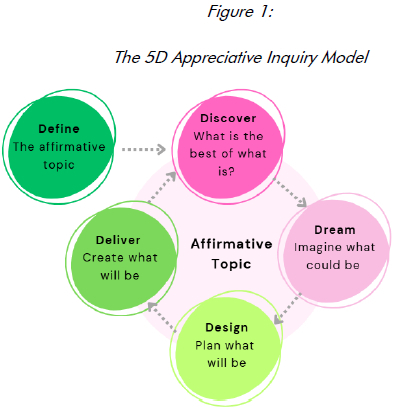
The 5D cycle of Appreciative Inquiry was used as the basis for this reflection. This model was initially developed by Cooperrider and Srivastva in 1987 to enhance organisational life but has been adapted by many people and adopted across varied contexts since then. In keeping with all Appreciative Inquiry approaches, the 5D model is a strengths based approach that looks at how positive attributes of individuals, relationships and systems can be enhanced to create a desirable future. Appreciative Inquiry is participatory in that the 'researcher' cannot reach conclusions or implement initiatives without engaging deeply with other stakeholders. It is also action-oriented and iterative; the aim of Appreciative Inquiry research is not to simply describe the status quo but to enable enhancements, and this is not seen as a once-off activity but rather it is expected to become part of the systems ongoing activity (Whitney & Trosten-Bloom, 2010).
The 5D cycle of Appreciative Inquiry has five steps: Define, where the system or 'problem area' is framed in a way that appreciates the intention of that system; Discover, where the status quo is investigated to ascertain the strengths in the current system; Dream, where the possibilities for the future are explored; Design, where transformations and enhancements are considered; Deliver, where these transformations and enhancements are implemented. At the end of this cycle, there is once again a 'Discover' stage, where the new context is interrogated with the possibilities for future enhancements to be dreamed, designed, and delivered.
The affirmative topic in the 'Define' phase of the Appreciative Inquiry cycle examined in this article involved the project lead, Sioux McKenna, who identified key elements required for a PhD programme that could respond to concerns in the literature regarding the 'lonely scholar' model of doctoral education. Following this, the 'Discover' phase involved reflection with colleagues and sustained engagement with the literature on alternative approaches to doctoral education. This informed the 'Dream' phase, during which a conceptual vision for the programme was developed and funding was sought. The 'Design' phase entailed the formal structuring of the programme through a funding application and the collaborative development of coursework modules with colleagues.
The programme was subsequently implemented, and the Deliver phase forms the primary focus of this article, whereby the 10 doctoral candidates reflect on their experiences during their studies. Ethical clearance for the study was sought and granted through the institution at which the doctoral candidates were registered, and interviews were conducted independently with a research assistant in order to avoid compromising the supervisor-student relationship. These reflections include a collective analysis such interview transcripts generated midway through the project. Analysis of these transcripts, together with reflections produced on completion of the PhD programme, enabled a detailed consideration of the strengths and weaknesses of the programme's delivery.
For the purposes of this article, Sioux McKenna authored the sections corresponding to the Define, Discover, Dream, and Design phases, while the 10 doctoral candidates undertook the analysis of reflective data and collaboratively authored the 'Deliver' phase.
Step One: Define
The Appreciative Inquiry began by clearly defining the topic: the dominance of the one-on-one or co-supervision model that has been identified as problematic in doctoral education in South Africa. This model, while traditional and widely practiced, has increasingly come under scrutiny for its limitations in addressing the complex needs of doctoral candidates.
The traditional doctoral education model in South Africa has typically featured no set curriculum. Meanwhile, globally, there has been a significant shift toward more structured approaches to doctoral education (Ngulube & Ukwoma, 2019; Maloshonok & Terentev, 2019). These include supervision panels and team models, cohort and project-based approaches, coursework components with examinations and milestones, short courses and seminars, progress presentations with guest lectures, and formal integration of support for writing and methods development into doctoral programmes.
Despite these global shifts, doctoral education in the Humanities and Social Sciences in South Africa has largely remained traditional, characterised predominantly by one-on-one and co-supervision models without substantial structured support. Where such support does exist, it is often ad hoc and voluntary rather than systematically integrated into programme curriculum. This concern is evidenced in publications such as the National Report on Doctoral Review (CHE 2022), which argued that while cohort approaches may not be suitable for all candidates and all departments, the model offers significant opportunities to nurture graduate attributes and to make students aware of transdisciplinarity.
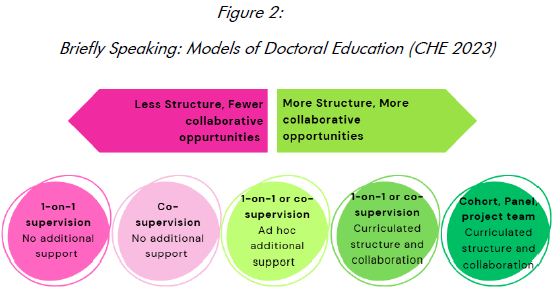
In a review on the literature on doctoral education around the world (McKenna & Van Schalkwyk), and a short piece written for the CHE (2024), McKenna argues that there are actually a continuum of models of doctoral education, and that even within the one-on-one and co-supervision models are varied levels of curriculated support for the candidate and supervisors. This is illustrated in Figure 2 below.
It is thus important to note that the 'problem' being defined at this stage of the 5D Appreciative Inquiry cycle was not necessarily with the one-on-one or co-supervision model itself, but rather with the extent to which this model is sometimes the only pedagogical space available to doctoral candidates. When candidates have either no additional spaces for intellectual engagement or must rely on ad hoc opportunities for these, the limitations of this approach become particularly apparent.
Step Two: Discover
The 'Discover' phase focused on appreciating the best of 'what is' in doctoral education in South Africa. There have been notable achievements, including increased growth in doctoral numbers, enormous gains in demographic transformation (both gender and race) in doctoral education, and increased deliberations about postgraduate education, which is no longer considered peripheral to the university's core activities.
Between 2005 and 2020, the number of doctoral candidates graduating in three years increased from 18% to 40%; and for those graduating within six years, the number of doctoral graduates increased from 40% to 66% (CHE, 2025). And of these graduates, the percentage who were black increased over the same period increased from 41% to 72%. At a national level, there is thus much to be celebrated.
At a more local level, in 2010, the Centre for Higher Education Research, Teaching and Learning (CHERTL) at Rhodes University introduced a PhD programme in higher education. This programme included three 'Doc Weeks' on campus each year where candidates presented their progress and engaged with presentations by various international speakers alongside workshops targeting specific areas of content. The programme also featured a vibrant online platform with a forum to discuss key issues in the higher education sector. Details about the programme have been published elsewhere (McKenna, 2017; Wilmot & McKenna, 2023; Wilmot, 2024).
Over the first 10 years, within the larger PhD programmes of CHERTL, there had been two thematically focused project teams, one on social inclusion and the other on institutional differentiation; both funded by the National Research Foundation. Despite the CHERTL programme's student body comprising those regularly identified as being most at risk of dropping out - older, part-time, and in the field of Education (CHE, 2022; 2025) - it has achieved excellent retention and completion rates, with 55 candidates graduating in the 15 years of the programme's existence. It is important to note though that, in keeping with national statistics for part-time studies (CHE, 2022), completion took an average of six years. The 'Social Justice and Quality in Higher Education' project drew from these experiences, building on the successes while addressing identified areas for improvement.
Together with colleagues, particularly fellow supervisors in CHERTL, Sioux McKenna engaged in Step Two: 'Discover'. In keeping with the collaborative principles of Appreciative Inquiry, much of what emerged during this phase arose through dialogue and shared reflection, rather than through solitary work.
Step Three: Dream
The 'Dream' phase involved imagining 'what could be' for doctoral education within the CHERTL PhD programme in higher education research. This led to the conception of the 'Social Justice & Quality in Higher Education' project, which envisioned a more formalised structured approach to doctoral education than that which had already been implemented in other projects described above. The programme would include Doc-weeks, progress reports, writing retreats, and international and national conference attendance and presentations. It would feature clearer milestones and explicit progress expectations with deadlines, all underpinned by an intentionally nurtured culture of collaboration and support. It would also include two years of online coursework1 consisting of eight modules. The first year of coursework modules introduced candidates to the debates around social justice and quality and the purposes of universities in society, and the second year focused on developing a literature review, methodology, proposal and ethical clearance application for their own study.
The dream was twofold. Firstly, that every candidate in the project would have a sense of connection and value and understand the team's shared commitment to their study. Secondly, that every candidate would not only gain the knowledge and skills needed to make an 'original contribution at the frontiers of the field' (CHE, 2013: 41) in their own studies but that they would also have a good understanding of the key debates in the field and recognise their responsibilities as critical citizens to ensure that higher education served as a public good. The axiological intention was thus central to the initial dream and served to drive the embedding of culture into the programme design.
Step Four: Design
The design phase involved careful consideration of how to structure the programme to achieve the vision outlined in the 'Dream' phase. This included decisions about the frequency and format of Doc Weeks, the nature of supervision arrangements, the content of coursework components, approaches to progress monitoring, and strategies for building a supportive community among candidates. The design was shaped both by the project lead's vision and by practical constraints, including funding limitations, institutional requirements, and the diverse needs and circumstances of candidates.
Seed funding was initially obtained from the British Council which enabled CHERTL supervisors to work with colleagues at University of Venda and Lancaster University in the United Kingdom to think through the programme design together. These ideas were then developed into a full funding proposal submitted to the Department of Higher Education and Training (DHET).
This project was successful in securing funding from the DHET University Capacity Development Grant, specifically the collaborative initiative designed to support academics in earning doctorates. Funding was received for 10 academics, who had to meet various requirements of the funders around age, race, gender, and nationality.
Most importantly, this step was where the project lead worked with nine potential supervisors to discuss how they could co-develop and teach the coursework modules and take on supervision roles. This was a challenging phase as there needed to be 'buy in' to the planned project and a shared commitment to its roll-out. In the end, while all nine potential supervisors participated in the development and roll out of the coursework modules, only six became supervisors of the 10, with an additional two supervisors being brought in to co-supervise studies where their expertise was deemed essential.
Step Five: Deliver
The 'Deliver' phase represents the creation of 'what will be' - the actual implementation and outcomes of the PhD programme. This section of the article presents the reflections by the PhD candidates about their experiences in the project, organised around five key themes that emerged from a collective analysis.
FINDINGS AND DISCUSSIONS
People Building People: The PhD is more than Research
As indicated, in the Humanities and Social Sciences in South Africa, the PhD is portrayed as a solitary and highly specialised journey, primarily defined by an individual's relationship with their supervisor with a clear focus on producing a research project. This framing reduces the PhD to a final output, overlooking its broader potential as a transformative process for the doctoral candidate. In contrast, the structured programme described here adopted an alternative approach; one that valued interpersonal connection, peer learning, and the holistic development of the 'person behind the PhD' in an attempt to address some of the unseen, intrinsic qualities required from the doctoral degree.
In the delivery of the programme, purposeful opportunities were created for us to engage beyond our individual research through writing retreats, peer feedback, and sessions focused on both academic and personal development. We came to experience the PhD as a shared intellectual and human journey rather than a solitary pursuit. As one of us put it,
It's the people behind the PhD which have made the programme a success.
This sentiment reflects how the relationships and human connections within the group were as significant to us as the research itself.
This connection was nurtured through experiences that fostered a culture of care and collaboration. Shacham and Od-Cohen (2009) advocate for integrating communities of practice into doctoral learning, enabling candidates to see themselves as part of a broader scholarly collective rather than as isolated individuals. The programme's cohort-based structure, regular shared sessions, and opportunities for reflection echoed this approach, helping us to develop a sense of belonging whilst building their academic community.
In our conversations about the programme, an issue that repeatedly emerged was the importance of interpersonal support. One of us, recalling a group session in which one of the supervisors shared openly about their own struggles during the completion of their PhD, said:
And I remember... having a session on our mental well-being... she spoke about her own experience of the PhD... The one thing about this group is that they don't show the perfection of the journey. They show the imperfections of the journey.
This open sharing helped to challenge the myth of the infallible academic. By acknowledging the non-linear, often messy nature of doctoral work, the programme normalised uncertainty and personal growth. This in turn created space for vulnerability, which helped to foster resilience, trust in the process, and a growing sense of identity as an emerging scholar. As another one of us noted:
When you're doing a doctorate, you are becoming a certain kind of person and that is easier when it is part of the programme to actually talk about that.
This comment underscores the personal growth integral to the PhD journey, growth that is essential for developing the reflective and critical capacities expected of a doctoral graduate. It also highlights the inseparability of the PhD as both a research project and a formative journey for the emerging scholar, one that requires criticality, reflection, and personal growth. Xia, Sun, and Gao (2025) stress the importance of supporting doctoral candidates not just as researchers, but as reflective professionals and emerging teachers and leaders. In this programme, identity work was not an incidental by-product but an intentional and integrated design element.
Robel (2022) similarly observes that collective reflection within research groups fosters both leadership and personal growth. The programme's structured interactions, through face-to-face Doc Weeks, monthly progress presentations, and conference attendance offered spaces for us to reflect on our academic values and develop confidence in our scholarly voice:
I think that it's [the PhD] changed the way I see myself as an academic... I'm becoming stronger, even a little bit of an activist.
I think it's [the PhD] supposed to humble one and show them the complexity of society... and see how they can not necessarily change society but be themselves, the difference, and hope that one or two people are going to learn something from who they are.
These reflections speak to the deep impact of a culture that values human connection. In our shared reflections, we regularly reflected on how we had grown not only as scholars but also as socially conscious individuals, more aware of our identities, responsibilities, and roles within both the academy and society.
Stubb, Pyhältö, and Lonka (2014) found that doctoral students' conceptions of research are shaped by the environments and relationships around them. When students feel supported, they view research as collaborative and meaningful. This was evident in the programme described here, where the structure and culture combined to create a space of shared effort and growth.
In contrast to traditional doctoral models, in which students often work alone and may struggle silently, this programme demonstrated what becomes possible when people are supported not just to produce research, but also to become the kinds of researchers they want to be.
Beyond the Individual: The PhD as a Community Effort
The culture of human connection and support beyond just research were further evident in the sense of community that the was experienced. For many doctoral candidates, particularly in structured or team-based programmes, the experience is far more communal than individual. The generated data affirmed that a PhD, when situated within a culture-driven, community oriented framework, becomes a deeply collective endeavour on an emotional, social, and academic level. This aligns with research that emphasises the transformative potential of doctoral communities built on shared practices and relational support (Shacham & Od-Cohen, 2009; van Rooij et al., 2021).
A recurring theme in our reflections was the sense of care and emotional safety we experienced through peer interactions. As one of us said, 'I felt real genuine care throughout this process', highlighting the shift from isolation to connection. This feeling of being 'held' by a community speaks directly to what Shacham & Od-Cohen (2009) describes as the rethinking of PhD learning through the lens of communities of practice. In such communities, learning is social and identity-forming; candidates, in this case doctoral candidates, are active contributors to a shared learning process, an aspect that proved important to building emotional resilience.
This sense of shared experience emerged repeatedly in the data of our interview transcripts from two years ago and our current reflections. One of us observed,
I sometimes feel totally out of my depth...and then you talk to other people and they're going through the same thing. They're also feeling intimidated or overwhelmed...and just knowing that you're not the only one that's feeling like that, makes it all worthwhile.
Here, the community becomes a site of emotional mirroring and validation. Rather than suffering in silence, students come to see their struggles as part of a broader doctoral narrative, marked by common challenges and shared growth. This creates a space where we could feel safe and supported, yet also a space where ideas can be challenged to enable new ways of thinking.
Indeed, 'Knowing you're not alone' became a refrain, with one of us adding,
I wish that many projects like this existed, and people don't feel like they are doing their PhD in silence.
Doctoral communities provide opportunities for scholars to support one another and to push or 'nudge' each other forward. McKenna (2017) explains that the relational dynamics of a group can support scholars in moving through epistemological and identity-based shifts. The emergence of a strong scholarly identity occurs not in isolation but in dialogue with others through feedback, discussion, and collective reflection.
Crucially, our community was never merely functional or task oriented. They were emotionally rich spaces of collegiality, joy, and humanity. One of us described it as:
You're working as part of a group. We can make jokes together; we can have fun together.
This sense of belonging is another success factor of the project, as it contributes to retention and ultimate successful completion of a PhD (van Rooij et al., 2021).
In this way the doctoral journey, when embedded within a community of practice, becomes more than a process of knowledge production; it is a process of collective becoming. The structured, culture-driven doctoral team programme did more than facilitate our research projects, it fostered care, collegiality, a sense of belonging, and mutual transformation. Rather than facing conceptual, emotional, and academic challenges alone, we found strength in numbers, solidarity in shared stories, and success in community.
Cultivating Criticality: Finding a Voice
The development of an authentic scholarly voice emerged as a significant theme in our reflections on the programme. The structured yet supportive environment created conditions in which we could develop confidence in our own thinking and articulation of ideas:
It also shows us that you need your own voice.
For many of us, the programme strengthened our critical faculties in ways that extended beyond our research into aspects of our daily work. As one of us reflected:
It's strengthened my levels of criticality, levels of feedback I can give to what I teach on and making reference to broader topics in my teaching.
The journey toward finding one's voice was not always straightforward. Many of us described initial self-doubt and hesitation in expressing our thoughts. One of us shared this experience eloquently:
I always doubted...the validity of my own thoughts and ideas...And then we would have a discussion and I would be having this thought, and I'd think, 'Oh, but what about that?' But I'd be too shy to express it. And then somebody else would raise it... And I'd go, 'Okay... so you're not so dof [stupid]... you do have good ideas and thoughts. And my thoughts are valid.' So the programme gave me a lot more confidence in my voice.
The modelling of respectful academic discourse by supervisors played an important role in this process. We noted how supervisors engaged in scholarly debate that demonstrated both intellectual rigour and collegial respect:
I don't see the one supervisor trying to call the other one out or trying to be better than the other one. But they do disagree and debate all the time. It's interesting in Doc Weeks to see them taking different positions on something and like respectfully challenging each other and laughing about it.
This modelling of academic debate as a constructive rather than combative process helped us to understand how to engage critically with ideas while maintaining relationships of respect. The overall effect was transformative:
The support given, the space given, I've just really found my voice... and that's been incredibly rewarding. And I get to see all my peers go through that same process as well. And hearing their voices strengthen.
This finding highlights the importance of doctoral programmes that explicitly attend to the development of scholarly voice and critical engagement, recognising these as essential outcomes of doctoral education rather than as incidental byproducts.
Funding: Both an enabler and a tool to spark tensions
Funding has consistently been identified as the primary barrier to student success and degree completion in South African higher education, with numerous studies and national reports repeatedly highlighting financial constraints as the leading reason for poor completion rates (Mouton et al., 2015; CHE 2022). After the end of apartheid in 1994, the government introduced funding mechanisms such as the Tertiary Education Fund of South Africa (TEFSA), later converted to the National Student Financial Aid Scheme (NSFAS) in 1999, to support financially disadvantaged undergraduate students. Despite these efforts and the introduction of various postgraduate funding instruments, such as the South African Research Chairs Initiative (SARChI), the DAAD-NRF In-Country Scholarship, and the Mandela Rhodes Scholarship, funding challenges persist, particularly at the postgraduate level (CHE, 2025). It is within this context that the DHET's University Capacity Development Grant (UCDG) collaborative project was initiated, aiming specifically to support academics in completing their PhDs.
This UCDG collaborative grant was responding to the National Development Plan Vision 2030 (2011), which set the goal of 75% of academics holding doctorates. Despite great strides in this regard, at the time of writing 49% of permanent academics have doctorates, making hitting this target by 2030 unlikely (CHE, 2025).
Many of us had been funded by some or other state funding for our previous studies. We thus came into this programme with experiences of being the 'beneficiary of funding' that developed initial expectations of how the money would be administered. One of us commented:
There should have been more discussion about how this is project money, not individual money. It could open the transparency if we talked about this more. People have misconceptions.
Each year it was communicated what the money would be spent on, for example, flights, transport, accommodation, and a stipend during the Doc Weeks and other learning opportunities such as the Rhodes University's Annual Postgraduate conference, and the payment of books and research needs. However, initially some candidates still understood that this as being their individual money and that if they did not participate in a particular funded initiative, they should be reimbursed in their bank accounts or as credit in their university accounts:
Some people have different ideas and expectations around the funding. Some people in the group think 'This is my money' so if they don't take up an opportunity then they should get that money.
The remaining amount, where is it going? So the question would be around where does... the money that I did not use at Doc Week because I could not come, where did it go?
The nature of individualised funding has in the past been associated with undesirable outcomes for postgraduate students, in that it is attached to the individual student who likely manages their study progress on their own. Previous funding experience which funded candidates on an individual basis was particularly difficult to spend constructively in a way that supported collaborative teaching and learning experiences. Having the funding as a collective enabled arrangements to be made for the benefit of the whole team, including some supervisors, to attend the writing retreats, for example.
The design and delivery of this programme was structured in a way that ensured that the money was spent constructively on the programme as a whole. The nature of the funding being kept in one 'basket' and managed by the project lead allowed us to focus on the learning. The structured learning opportunities encouraged a greater focus on building the CoP and access to input from multiple supervisors, including those who were not actually formally appointed as supervisors.
The positive aspects of the funding model were acknowledged by many:
Having a writing retreat, all expenses paid? Yes! [of course] I did go!
But I'm happy...we have got quite a lot of activities that uses money. Travelling from here to Cape Town, it's money. And accommodation, money. Stipend, it's money.
The financial part of it, it's like somebody else is paying for me to go overseas... It's like kind of awesome.
The lesson to be learned is that the discussion about the way the funding was to be managed was needed earlier in the project. But we believe that these reflections highlight the tension between individualised funding models that give candidates control over their financial resources but may reinforce isolation, and collective funding approaches that may offer richer experiences, but require transparent discussions with the project lead as to how the funding is detailed in the project proposal, how it is used, and how it is reported on to the funders.
Comparison: The Maker or Breaker
The cohort-based nature of the programme inevitably led to comparisons among candidates, particularly regarding progress. While the community aspect of the programme was generally experienced positively, the visibility of some individuals' advancement could sometimes create pressure or anxiety for others. Several of us reflected on this experience:
I'm way behind but I'm still in the programme.
Yoh! So-and-so has already done this, or already done that, and I'm only here. So, it can also be intimidating when you feel like you are behind everybody else, but yet you started together.
I don't want to be left now the only one in this WhatsApp group,2 and I'm forced to become the administrator because I'm the last person who's still here.
The different pace at which we progressed through the programme created both challenges and opportunities:
We were no longer all on the same path or trajectory, so some people were falling behind slightly more, some people were ahead more.
However, the programme's culture of support meant that differences in pace were often met with understanding rather than judgment:
If you are very slow, like more like a chameleon, they can pick up and say, 'Ah no, this one is very slow. How best can we assist him?' And they support.
These reflections highlight the importance of managing the potentially double-edged nature of cohort-based doctoral programmes. While the visibility of peers' progress can motivate and provide useful reference points, it can also create unhelpful pressure and comparisons. The programme's success in navigating this tension appeared to stem from its explicit culture of mutual support and recognition that there are many different paths through the doctoral journey.
CONCLUSION: THE NEXT CYCLE
There is a strong worldwide trend towards more structure and collaborative approaches to doctoral education. Reflecting on the lessons learned from the 'Social Justice and Quality in Higher Education' project makes clear why this is the case. But alongside the many benefits of working in a group and sharing experiences is a concern that shifts in doctoral education often come about because of managerial efficiency discourses. These understandings of doctoral education privilege notions of throughput in regulation time over concerns about the quality of the knowledge project and the development of the candidate as a critical researcher. Taking on these very positive shifts therefore needs to be undertaken with an explicit articulation of the purposes of the doctorate as a public good and as a space for nurturing responsible graduates.
What was most evident in our collective reflections of the project, using the 5D Appreciative Inquiry cycle, has been the significance of the culture of such an endeavour. Introducing coursework, panel supervision, regular seminars and progress presentations, and other such structural initiatives offers no guarantee of the kind of doctoral programme that we collectively dream about. Explicit engagement throughout the programme around core values of respect for various forms of knowledge and for all those involved in the programme was essential.
Similarly, discussing the importance of trying things out, taking risks, failing, and messing up was a significant part of the project's success. Reflecting on issues of power and the intersection between power and experience was also an ongoing activity, with discussions about who gets to speak and when and with what authority, alongside an agreement that academic titles would not be used in the programme lest it created an understanding that some had a right to more voice than others in the room.
As the doctoral candidates in this project graduate and go on to be doctoral supervisors themselves, it is anticipated that their experiences in the project and their reflections shared in this article will help them to shape empowering, emancipatory programmes of their own. As part of a new 'Dream' stage, the project lead is currently developing a new doctoral project, this time considering more structure and more explicit deliberations around issues of identity respect, academic humility, the importance of failure, and the value of group learning.
Academy of Science of South Africa. (2010). The PhD Study: An Evidence Based Study on how to Meet the Demands for High-Level Skills in an Emerging Economy. Pretoria, South Africa.
REFERENCES
- Cloete, N., Mouton, J., & Sheppard, C. (2015). Doctoral Education in South Africa: Policy, Discourse and Data. Cape Town: African Minds.
- Cooperrider, D. L., & Srivastva, S. (1987). Appreciative inquiry in organizational life. In R. W. Woodman, and W. A. Pasmore (Eds.), Research in Organizational Change and Development Stamford, CT: JAI Press.
- Council on Higher Education & CREST. (2009). Postgraduate Studies in South Africa: A Statistical Profile. Pretoria, South Africa.
- Council on Higher Education. (2012). Higher Education Qualifications Sub-Framework. Pretoria, South Africa.
- Council on Higher Education. (2022). Public Higher Education Funding, Postgraduate Students And Research Output 2020. Supplement to Vital Statistics 2020. Pretoria, South Africa.
- Council on Higher Education. (2023). National Review of South African Doctoral Qualifications 2020-2021: Doctoral Degrees National Report. Pretoria, South Africa.
- Council on Higher Education. (2024). Briefly Speaking #25: Models of Postgraduate Supervision. Pretoria, South Africa.
- Council on Higher Education. (2025). Changing Trends in the Size and Shape of Postgraduate Programmes in the Public Higher Education System in South Africa, 2005-2020. Higher Education Monitor #17. (Ahmed Essop). Pretoria, South Africa.
- Maloshonok, N., & Terentev, E. (2019). National Barriers to the Completion of Doctoral Programs at Russian Universities. Higher Education, 77(2), 195-211.
- Manabe, Y. C., Nambooze, H., Okello, E. S., Kamya, M. R., Katabira, E. T., Ssinabulya, I., Kaddumukasa, M., Nabunnya, Y., Bollinger, R. C., & Sewankambo, N. K. (2018). Group Mentorship Model to Enhance the Efficiency and Productivity of PhD Research Training in Sub-Saharan Africa. Annals of Global Health, 84(1), 170-175. https://doi.org/10.29024/aogh.25
- Stubb, J., Pyhältö, K., & Lonka, K. (2014). Conceptions of research: the doctoral student experience in three domains. Studies in Higher Education, 39, 251-264.
- van Rooij, E., Fokkens-Bruinsma, M., & Jansen, E. (2021). Factors that influence PhD candidates' success: The importance of PhD project characteristics. Studies in Continuing Education, 43(1), 48-67.
- Whitney. D. & Trosten-Bloom, A. (2010) The Power of Appreciative Inquiry: A Practical Guide to Positive Change (2nd edition). Berrett-Koehler: Oakland California
- Wilmot, K. & McKenna, S. (2023). Collaboration, collegiality, and commitment: Cultivating critical hope in a doctoral programme. In E. M. A. Samuel, & H. Mariaye (Eds.), Transforming postgraduate research in Africa. UKZN Press.
- Wilmot, K. (2024). Structured doctoral programmes for developing the scholar and the scholarship: Lessons from practice. Critical Studies in Teaching and Learning, 12(1), 1-21.
- Xia, J., Sun, S., & Gao, X. (2025). The other side of PhD education: A systematic review of research on PhD students' development as university teachers. Review of Education, 13, e70024. https://doi.org/10.1002/rev3.70024
Reviewed: 04 February 2026
Accepted: 11 March 2026
2 The WhatsApp group was managed by the 10 candidates and didn't include the supervisors. It was a space for the candidates to speak among themselves.