Sustainable interactive remote teaching and online learning: A reflexivity case study
Abstract
A key concern in creating accessible and sustainable tertiary education is the practicalities of remote teaching and online learning in an unequal society. These complexities challenged us to reflect on our professional practices to enhance students' experiences and to better understand our actions in the use of digital learning platforms. This article is conceptual and exploratory and shares the experiences of two lecturers. A reflective practice approach was adopted, and our experiences with Microsoft Teams as a pedagogical tool are presented and analysed. Additional references were collected from reliable sources to situate this paper in relevant contemporary research and triangulate data sources. We found that Microsoft Teams as an education enabler afforded lecturer-to-student engagement, student-to-student collaboration, and student-to-content interaction. This article contributes to the literature on virtual conferencing tools, such as Microsoft Teams, and how it can be used as a learning management system and a pedagogical tool.
digital pedagogical tool; sustainability; remote teaching; online learning; MS Teams
INTRODUCTION AND BACKGROUND
During times of disruption, like pandemics and student unrest, lecturers are challenged to continue teaching and maintain a professional presence in the digital education paradigm. The rapid shift from physical face-to-face teaching to remote teaching and online learning environments 'push education into uncharted areas', and higher education institutions (HEIs) globally must match their digital innovations to students' needs (Alenezi et al., 2023: 2). According to Hopwood (2023: 2), learning 'assumes a socially constructed process that is influenced by the learning environment and its associated norms, as well as by the interactions between the learner(s) and others within it'. The intersection of technology, in this case virtual platforms, with pedagogy and content is important to reach an acceptable level of pedagogical integration of digital innovations in teaching and online learning. Digital innovations create new possibilities to improve teaching and enhance learning, but one of the biggest challenges is that lecturers lack knowledge of digital technologies, digital pedagogies, and instructional design principles (Dlamini & Ndzinisa, 2020; Mhlongo et al., 2023).
The shift to digitalisation initiates the adoption of remote teaching and online learning, resulting in lecturers in HEIs globally investing time and expending effort to prepare content and learning activities conducive to a remote teaching and online educational environment. During this preparation, lecturers must ensure the design and delivery of the online course do not forgo access and inclusivity at the HEI. Yet, there is evidence that digital tools and learning platforms provide an integrated platform that supports technology-orientated education and is an enabler for active learning (Dlamini, 2022). Hence, inclusivity and epistemic access became our lens in this reflexivity case study. This meant focusing on student academic diversity and social identities in our lesson design and development and the remote facilitation of our courses. Along the reflexivity line was pragmatism 'that encourages us to seek out the processes and do things that work best to help us achieve desirable ends' (Sharma et al., 2018: 1549). Reflexivity is aimed at 'exploring the problematic issues emerging from educational practices and processes; creating connections among different educational actions; inscribing specific educational situations and experiences within a systemic frame of reference' (Striano, 2017: 184). Thus, it was imperative for us to rethink our instructional practices beyond the technocratic processes of modernisation. As a result, reflexivity became an enabler to simplify the increasing levels of complexity in equitable access to tertiary education to redress the injustices of the past. The fundamental premise, acknowledging the diversity of the students and their context, was lecturers considering a variety of tools, methods, and applications to ensure equitable access to continuous learning for all students.
In South Africa, the top priority is
improving how digital technology is used in teaching and learning, acquiring the knowledge and abilities needed to live and work in the digital age, and enhancing education through improved data analysis and foresight (Alenezi et al., 2023: 2).
One of the tools used in the transition to remote teaching and online learning is Microsoft (MS) Teams. MS Teams is a virtual conferencing tool with high usability. Usability refers to 'the extent to which a product can be used by specified users to achieve specified goals with effectiveness, efficiency, and satisfaction in a specified context of use' (Barnum, 2020: 11). MS Teams became an education enabler by affording the continuation of the academic year during the pandemic by providing ubiquitous access to lecture sessions and seminar conferences and enhancing student-to-student and lecturer-to-students interactivity, engagement, and collaboration (Roque-Hernández et al., 2021).
According to Mahmud and Wong (2023: 385), virtual learning platforms emphasise 'collaboration, real-time interactions and discussions between educators and students, mobile-accessible online lectures, and timely feedback'. Therefore, the intersection of virtual learning platforms and virtual conferencing tools supported the transition to remote teaching and ubiquitous learning. Consequently, lecturers must plan, design, and develop online learning experiences in an appropriate educational platform to 'address educational imbalances to create equal education opportunities' (Dlamini, 2022: 14). Importantly, digital learning platforms 'extend beyond the ideology of learning management systems and massive open online course platforms' (Mhlongo & Dlamini, 2022: 11). We initially used MS Teams only as a virtual conferencing tool to provide lectures and seminars, but while learning about the multiple affordances of MS Teams through an iterative and incremental process, it has now become an integral part of teaching and learning. In everyday lecturing, the delivery of multimodal content and ubiquitous learning has been enabled through the MS Teams platform (Ma et al., 2021).
Therefore, through self-reflexivity (Ruby, 1980), the study aimed to generate insights into MS Teams as a pedagogical tool during pandemics and student unrest to enable multimodal instruction, lecturing and student interaction, classroom organisation, and presentations. We used our practical experiences as a data generation approach and as tools for reflective practice analysis to share our digital solution to remote teaching and online learning. As lecturers responding to the complexities arising during times of disruption, we needed a reflexive approach so academic staff can position their technological knowledge to intersect with content and pedagogical knowledge. The reflexive approach served as a barometer for our classroom practices to adapt teaching because digitalisation is no longer an option imposed by pandemics but an education solution to achieve inclusivity and ubiquitous learning. The following questions guided this study:
What are some of the affordances of MS Teams?
How can MS Teams be used as a pedagogical tool in remote teaching and online learning?
How can MS Teams be used to afford disciplinary, pedagogical, practical, fundamental, and situational learning?
CONTEXT OF THE STUDYThe shutdown of South African HEIs as a result of the #FeesMustFall movement (Maringira & Gukurume, 2016; Naicker, 2016) and the COVID-19 lockdown revealed the need for flexible and resilient education systems (Ali, 2020) and a pedagogical shift from traditional teaching methods to online education (Mishra et al., 2020), in other words, a digitalised curriculum (Khoza & Mpungose, 2022). During the pandemic, educational institutions adopted remote teaching and online learning to ensure teaching continuity for both conceptual/theoretical-related and practical-related courses at undergraduate and postgraduate levels. Teaching theoretical components of a subject was perceived to be simple, but it was more complex to strike the balance between theory and practice in an online environment, specifically, the pedagogy of teaching digital education and information technology-related courses with concepts of information and communication technologies integration, programming (an algorithmic problem-solving subject), web design, and development.
Digital tools such as MS Teams and learning management systems (LMSs) became central to the transition, and according to Reddy et al. (2020), information and communication technology tools have been denoted as key drivers for achieving the United Nations' Sustainable Development Goals. MS Teams can be described as a chat and collaborative platform because it offers chat, meeting, and attachment functionality for groups to communicate and collaborate (Poston et al., 2020). The functionality of MS Teams affords a virtual interactive teaching and learning environment, allowing lecturers to create virtual interactive environments where students learn, engage, communicate, share ideas, and collaborate to gain a better understanding and construct their knowledge (Vygotsky, 1978). Vygotsky's (1978) work is foundational in understanding social learning and knowledge construction, and its core principles remain highly relevant to contemporary educational contexts, although the specific technological area has evolved significantly since it was written. His emphasis on social interaction, social learning, and scaffolding is particularly applicable to virtual learning environments where students collaborate and construct knowledge through interaction with peers and the teacher. In addition to the consideration of social learning, the Sustainable Development Goals 'are a blueprint for addressing the global challenges like poverty, inequality, climate, environmental degradation, prosperity, peace and justice and achieving a better sustainable future' (Reddy et al., 2020: 69). While conducting this research, we were cognisant of the digital inequalities, and therefore, drew on pedagogical research and best practices to design multimodal content and engaging instructional activities.
Related literature reviewed
In recent years, the landscape of education has undergone a significant transformation with the advent of digital education (Alenezi et al., 2023). Digital education is the use of digital pedagogies and technologies to enhance teaching and learning and can be used to deliver instruction (Jha et al., 2024), provide access to resources, and facilitate communication and collaboration between students and academics (Garrison & Anderson, 2003). While published in 2003, Garrison and Anderson's work remains influential in defining the core elements of online learning environments, particularly in terms of the importance of interaction, presence, and community. Their conceptualisation of these elements continues to be relevant in understanding the dynamics of contemporary digital education. Digital education encompasses a wide range of digital pedagogical methodologies and technologies, including computers, tablets, smartphones, the internet, and LMSs, that are crucial components of modern educational systems. This shift in modern educational systems has been driven by the need for more accessible, flexible, and sustainable educational practices (Goh & Abdul-Wahab, 2020).
Digital education affords a scalable solution beyond time and space that breaks down geographical barriers using remote teaching and online learning (Dlamini, 2022; Mhlongo et al., 2023). Remote teaching can be delivered through a variety of technologies, including video conferencing and LMSs. This mode of instructional delivery has become increasingly popular due to the rise of digital technologies and the increasing demand for flexibility in education. The #FeesMustFall movement (Maringira & Gukurume, 2016) and the COVID-19 pandemic further revealed the need for flexible and resilient education systems (Ali, 2020) and the critical importance of remote teaching and online learning. These crises highlighted the resilience and adaptability of digital education, demonstrating its capacity to ensure continuity of learning in times of disruption. Remote teaching and online learning not only provide a safety net during times of disruption for instructional continuity but also offer a flexible and convenient mode of instructional delivery of education that accommodates various schedules, preferences, and circumstances, thereby reinforcing the sustainability of educational systems.
Remote teaching and online learning, enabled by virtual conferencing platforms and LMSs, can play a key role in making education more accessible and sustainable. Virtual conferencing platforms can be described as applications or systems that facilitate virtual gatherings among individuals over the internet (Al-Samarraie, 2019). Virtual video conferencing allows lecturers to create meeting sessions and groups for tutorials and to provide learning resources to their students (Ismail & Ismail, 2021; Simamora et al., 2020). The affordances of virtual conferences in the context of the remote teaching and online learning space include:
(i) accommodating interactions between large numbers of people
(ii) allowing communication with colleagues, students, and social groups
(iii) providing a platform for attendance of and engagement with lectures and seminars
(iv) providing a platform for students to consult with lecturers
(v) encouraging collaboration with peers
(vi) 'real-time' meetings
(vii) post-class lecture recordings, and (8) promoting interactive and collaborative online learning (Hacker et al., 2020; Ismail & Ismail, 2021; Simamora et al., 2020).
Pather et al. (2023: 25) defined online learning as 'learning experiences that occur in synchronous, asynchronous, and hybrid learning environments using different devices that require internet access'. During times of disruption, it is necessary to produce equitable multimodal instruction to handle the complexities of online education and meet and achieve course objectives for students to have an overall great learning experience (Mishra et al., 2020). This can be done using virtual conferencing tools.
MS Teams is an example of a virtual conferencing tool. It is a product of Microsoft and is described as an integrated virtual conferencing, communication, and collaborative platform. LMSs are an important educational innovation that offer great opportunities for social constructivist pedagogy and ubiquitous learning (Dlamini & Ndzinisa, 2020). MS Teams contains a variety of functionalities, such as online chats, meetings, and file sharing and can be used in face-to-face, hybrid, and online contexts (Martin & Tapp, 2019; Poston et al., 2020; Sobaih et al., 2021). Silva et al. (2022) found that MS Teams is used mainly as a video conferencing tool, for file sharing, and for its chat functions.
However, MS Teams offers many more affordances, and we use it to present and share teaching materials, create groups, and discuss with students through chat. Video conferencing can be used to supplement the LMS (Mpungose, 2021). MS Teams works well to complement the LMS used at the HEI, and at times, acts as a LMS as it offers functionality to share files, develop content, and foster discussions (Lusitania & Anindya, 2021; Rojabi, 2020), which promote an interactive teaching and learning environment. Some of the affordances we experienced, and use are discussed in the following subsections. The video and audio-conferencing functionality of MS Teams enables lecturers to create virtual classrooms for lectures and seminars and to mostly manage these as traditional face-to-face classrooms (Sobaih et al., 2021). Like face-to-face teaching, when there is a timetable, lecturers can use MS Teams to deliver live virtual lessons for many students during a particular time slot (Pal & Vanijja, 2020).
The virtual classrooms allow smooth interactions between lecturer and students and between students and students, and the enhanced efficient organisation and effective management add to an astounding teaching and learning experience (Olugbade & Olurinola, 2021). It allows students to participate in extensive interactions and discussions (Poston et al., 2020), and importantly, increases their social presence in an online environment (Aldosari et al., 2022). Francisco (2022) stated that it is imperative to ensure there are many opportunities for student interactions as student engagement within online environments is critical.
THEORETICAL UNDERPINNINGSThe ideological inconsistencies in digital education and online learning prompted much reflection on our part as information technology lecturers. A reflexivity approach was used as reflexivity occurs when researchers 'systematically and rigorously reveal their methodology and themselves as the instrument of data generation' (Ruby, 1980: 157). Reflexivity is an ongoing critical self-awareness of the researcher's assumptions, biases, and positionality, and how these factors may influence the research process and outcomes (Finlay & Gough, 2008). Pragmatism suits reflexivity and is based on two principles, namely '(i) education should have a social function, and (ii) education should provide real-life experience to the child' (Sharma et al., 2018: 1549). Our principle was experimentation and the adoption and appropriation of MS Teams as an enabler of interactive remote teaching and online learning.
As lecturers we have a dual role as educators and learners, and hence, it was important for us to continuously experiment with various digital technologies to restructure our instructional activities. Hence, a reflective practice approach was adopted and conceived in terms of theory and methodology to advance virtual teaching and online learning. Pragmatists 'want to construct a flexible, dynamic and integrated curriculum which aids the developing child and the changing society more and more as the needs, demands, and situation require' (Sharma et al., 2018: 1552), and therefore, we had to embrace inclusivity and an epistemic access lens that acknowledged students' diversity and context as we explored MS Teams as a virtual teaching and online learning tool.
This was premised on a reflective practice approach being based on life situations and experiences within the context of professional practice, which provides a significant means for persons to learn and promotes continuous development. Central to this value is the potential of reflective practice to enable practitioners to develop digital expertise to achieve instructional equity. Instructional equity requires education practitioners to employ intellectual standards for reasoning to devise pedagogical strategies and tools that enhance student learning and practice in a global context (Lay & McGuire, 2010). Our dual role in the transition to remote teaching and online learning was premised on Dewey's four distinct criteria for the reflection process, namely '(a) meaning making, (b) disciplined inquiry, (c) interaction, and a (d) desire for growth' (McGuire & Lay, 2020: 522). Our day-to-day interactions of incorporating MS Teams as an enabler of virtual teaching, online engagement, and social interactions allowed us to understand students' unique learning requirements, and in the process, reduced the need for physical classroom resources.
RESEARCH METHODOLOGICAL APPROACHThe current study employed the pragmatism research paradigm, which acknowledges the value of multiple perspectives and emphasises the practical application of knowledge in addressing complex research questions (Peirce, 1905). Pragmatism allows for the integration of diverse methods and encourages researchers to adapt their approaches based on the specific needs of the study (Creswell & Creswell, 2017). A qualitative reflexive approach was adopted to delve deeply into the experiences and perspectives of the authors and their use of MS Teams as a pedagogical tool. To inform the study, a scoping review was conducted to map out the existing research literature in the area. Self-reflexivity was integrated in the research process to critically examine the researchers' influence on the study and the data interpretation. This combination of these research approaches allowed for a comprehensive exploration of the research topic. The study strongly emphasised the practical application of virtual teaching and online learning to provide insights and recommendations that can directly inform the effective use of MS Teams as a video conferencing tool, LMS, and overall education enabler. By focusing on practical applications, this study aimed to offer actionable digital pedagogical strategies for academics to enhance teaching and learning experiences using MS Teams as a digital pedagogical tool.
Data for this study were primarily collected using our reflexive research diaries. The diaries served as a tool for us to record personal reflections, observations, and insights throughout the research process that relate to various experiences using different digital technologies such as MS Teams and the LMS (Fort, 2022). This method allowed for the immediate documentation of thoughts and emotions, providing a rich source of qualitative data that capture the researchers' evolving perspectives and experiences. Additional references were collected to put this study in perspective of relevant contemporary research and triangulate data sources to confirm or corroborate our experiences. This was done by searching ISI, Department of Higher Education and Training (DHET) accredited databases, and Google Scholar for the keywords 'MS Teams in education', 'affordances of MS Teams', 'learning management system', 'reflective practice', 'remote teaching', 'online engagement', 'online learning', and 'instructional equity'.
The data from previous literature identified through a scoping review and the data recorded in our diaries between February 2022 and June 2023 were thematically analysed following a process of open and axial coding (Strauss & Corbin, 1998). While published in 1998, Strauss and Corbin's approach remains a foundation of qualitative data analysis. Their framework for identifying patterns and developing theoretical constructs continues to be widely used and adapted by researchers across disciplines. This paper adopted their core principles to uncover the underlying themes within the data. The initial codes were generated through a close reading of our diary entries to identify recurrent themes, patterns, and emerging concepts. These codes were then organised into broader categories and refined through an iterative process of constant comparison. Through this paper, we share our reflections on adhering to instructional design principles and the affordances of digital tools by drawing on empirical studies and our experiences as academics and information technology practitioners to illustrate the complexities of remote teaching and online engagement.
While this methodology was designed to capture the dynamic nature of the phenomenon under study, it is important to acknowledge potential limitations, such as the subjective nature of reflective data. To ensure the trustworthiness of the findings, the quality criteria that were used included dependability, transferability, confirmability, and credibility. To implement this criterion, the following strategies were implemented: (i) prolonged engagement and discussion between the authors, (ii) persistent observation during lesson sessions and post lesson reflections, (iii) detailed documentation through reflexive journaling, (iv) triangulation of findings against literature, (v) member checking that involved seeking feedback from students across different courses that were taught using MS Teams as a pedagogical teaching tool to validate the interpretations of the data (Lincoln & Guba, 1985), and (vi) peer debriefing that involved engaging in discussions with colleagues with diverse backgrounds, perspectives, and expertise who were not directly involved in the research but who also used MS Teams to provide a broader range of feedback so we could gain additional perspectives and insights (Creswell & Creswell, 201 7). These measures aimed to ensure the rigour and trustworthiness of the findings. As data were not collected from participants but rather through reflexive journaling, the ethics considerations revolved around researcher integrity in terms of acknowledging bias and transparency. To address and mitigate these, during our prolonged engagement and discussions as authors, we regularly questioned our assumptions and interpretations and received feedback from each other on alternative perspectives.
Our journey to MS Teams as a pedagogical tool
Given the affordances discussed and demonstrations that follow, it is evident that MS Teams can be used as a pedagogical tool for virtual teaching and online learning. MS Teams provides the necessary features to achieve the four elements of online learning, namely 'interaction; social presence; structure; and satisfaction' (Ismail & Ismail, 2021: 2). It became important for us to study various studies on learners' engagement to design and develop interactive teaching resources to ensure effective facilitation. Some of the mundane activities such as attendance were automated using the 'auto-generated function of attendance list' (Ismail & Ismail, 2021: 4). The meeting room in MS Teams expanded learning opportunities, discussion, and collaboration among students that were not constrained by time and space.
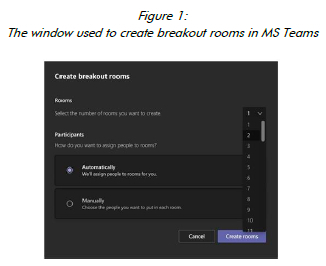
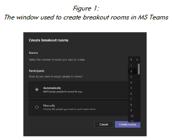
There is an opportunity to create multiple smaller private virtual areas to allow smaller groups of students to interact, collaborate, build an understanding of concepts, increase knowledge, and work on assignments (Krašna & Pesek, 2020). Roque-Hernández et al. (2021) concluded that interactive communication positively influences student engagement. When using MS Teams, the lecturer can request that it automatically creates breakout rooms with the number of suggested students per room provided by the lecturer or the lecturer can manually assign students to each of the breakout rooms, as illustrated in Figure 1. This functionality becomes applicable when strategically distributing students into groups by aligning them to their common areas of expertise or teaching subjects, thus avoiding the bystander tendency of randomly assigned students (Hopwood, 2023).
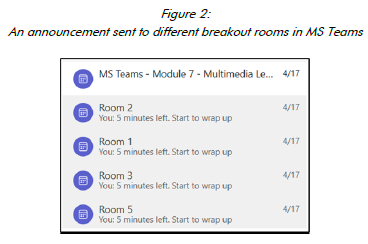
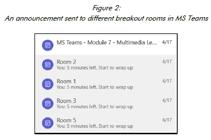
As students work in their smaller groups, the lecturer can move between the various smaller virtual groups in their separate breakout rooms and facilitate learning by ensuring the students are moving in the correct direction. This is like a teacher walking around a conventional classroom during group work discussions and activities. The lecturer can also post announcements to all the breakout rooms at the same time. Like the chat function, posting the announcement gets stored in the chat area of each breakout room, as shown in Figure 2.
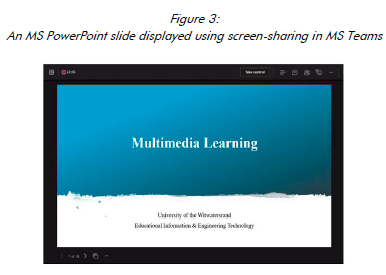
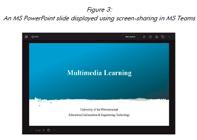
Moreover, the virtual consultations and meetings feature allows lecturers to hold virtual consultations and meetings with students. These can include providing additional 'contact' time for students to discuss content and close knowledge gaps or correct misconceptions they may have, and meetings and supervisory consultations between students and supervisors to complete research conceptualisations and reports. The consultations can either be one-on-one between the lecturer and a student or between a lecture and multiple students. Screen-sharing is used during lectures and seminars to present course materials, such as displaying an MS PowerPoint presentation, for teaching and discussing topic concepts (Figure 3). The interactive whiteboard is used to increase interaction during explanations and discussions (Phan & Huynh, 2021).
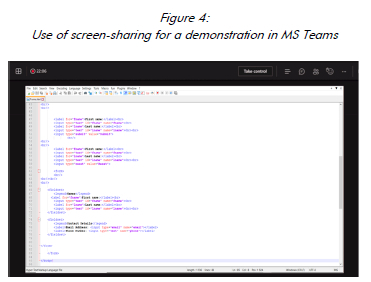
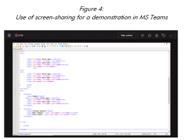
As some students are new to computers and programming/web development and require additional support, walkthroughs and demonstrations can be provided by duplicating and sharing the lecturer's entire computer screen lecturer to display the process. This makes explanations easier as students can see what the lecturer is explaining and can follow step by step, even when moving between different applications and screens (Figure 4). This is like a face-to-face demonstration where a projector displays a screen at the front of the computer lab and students learn and work on their computers.
Lecturers and students can share information and learning resources, such as files, images, notes, and links (Pal & Vanijja, 2020), by adding files to certain folders and subfolders and sharing the location with participants of the course. It is also possible to share a link to access cloud storage (Krašna & Pesek, 2020). Participants can then access information and learning resources shared by their lecturers and fellow students during and outside of class times, which has a good impact on knowledge construction and a positive learning experience (Sobaih et al., 2021). In other words, it is accessible both synchronously and asynchronously and works well in both these modes (Pal & Vanijja, 2020). In addition, shared documents can be accessed and updated by multiple participants at the same time, thus encouraging knowledge construction through interactive and collaborative activities.
Other critical features in MS Teams are recordings, the chat functionality, assessment, and attendance. MS Teams allows the host and other participants to record the session, depending on how it is set up. Lecturers can record sessions for their students to engage with the lecture recording after the session (Pal & Vanijja, 2020). These recordings are saved in an audio-video file like a podcast or vodcast, which participants can access after the session is complete should they need to watch it repeatedly or revise a certain concept, or even if they missed the session due to other commitments or disruptions such as load shedding or poor network connectivity (Gumede & Badriparsad, 2022; Sevnarayan & Mohale, 2022). Students who are unable to attend an online class because of load shedding and/or poor network connectivity can access the recording and engage with the session content as soon as it is convenient.
The chat functionality allows one-on-one communication between students and between the lecturer and students (Krašna & Pesek, 2020). One of the more prominent functions is that all chats are stored in a central place and that the chat history can be accessed, allowing lecturers or students to access previous communications and important points. This is advantageous to summarise key points that students can access when they are revising the covered content.
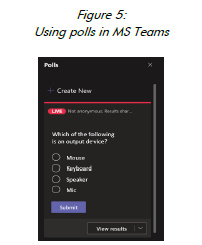
MS Teams provides an assessment functionality. Assessments can be developed for the participants, and MS Teams can automatically mark the assessment based on predefined criteria and parameters (Pal & Vanijja, 2020). While we have not used the full functionality of the affordances of assessments in MS Teams, we conducted quick concept checks and asked questions through the chat function using the poll functionality (Baker & Spencely, 2020). This can be seen in Figure 5.
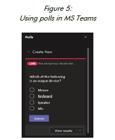
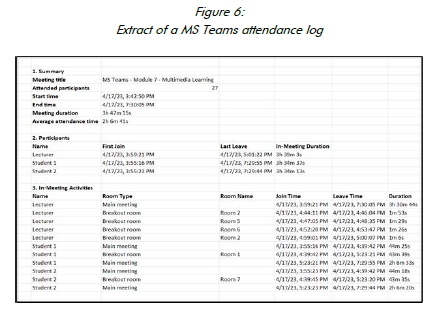
The poll functionality allows for real-time responses and results, allowing the lecturers to identify any misconceptions or misunderstandings that students have of concepts being taught and to immediately resolve them. Moreover, this function is used for evaluation purposes for the lecturer to improve their pedagogical practices or the course design. Occasionally, we also used third-party apps, such as Slido, MS Forms, or Google Forms, to conduct quick assessments or for question-and-answer scenarios. A link to the third-party apps can be shared with the students through the MS Teams chat platform to allow them to access the apps. MS Teams creates a digital footprint for a timestamped attendance log containing all participants' movements to and from the virtual online session (Leonardi, 2021). It contains a summary of the virtual session's details, the participants in attendance, and their movement within the virtual session itself (Figure 6). This information can be downloaded into an MS Excel spreadsheet.
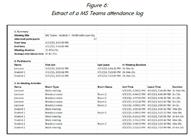
The spreadsheet in Figure 6 is helpful for attendance registers for students to help determine their Due Performance/Satisfactory Participation or even for attendance registers on various research projects. Our experience is that students log into a session and then multitask. Therefore, in addition to using the attendance log to measure attendance, students are provided with interactive and/or collaborative activities during the sessions that must be completed to contribute towards their understanding of concepts and their attendance status. Lastly, MS Teams is a multi-device application that allows for timely communications (Roque-Hernández et al., 2021) and interactions with the lecturer and other participants in the course, enhancing interactions between course participants.
DISCUSSION
As we considered the challenge to educate students beyond the physical spaces bounded by time, we realised that although we have been explicit about our use of MS Teams, we have not fully articulated how we aligned with the five types of learning, namely disciplinary, pedagogical, practical, fundamental, and situational learning (DHET, 2015). The reflexive practice required us with our dual identity of educators and lifelong learners to go beyond the well-researched technological affordances and to focus on the students' context and institutional practices. This was possible because reflexivity 'involves the ability to understand how one's social locations and experiences of advantage or disadvantage have shaped the way one understands the world' (Landy et al., 2016: 1). Hence, when exploring the affordances of MS Teams, it became important to look at the dynamic interplay of instructional delivery in online environments with the five types of learning, which collectively provide comprehensive categories for the various dimensions of learning, ultimately shaping the effectiveness and experience of education in virtual modalities.
Disciplinary learning
Disciplinary learning refers to disciplinary or subject-matter knowledge that looks at the acquisition of knowledge, skills, and competencies within a specific academic discipline. This involves having a thorough comprehension and mastery of subject-specific methodologies or techniques and content. Within this sphere of learning, MS Teams can be used to provide online lectures and content delivery through synchronous lectures, the provision of asynchronous recordings or videos, and teaching materials that cover the core subject content through screen-sharing, slides, and other related shared content. We were able to conduct live coding sessions during which we wrote programs in real-time while explaining the concepts and breaking down and describing each part of the code in the program for the students. As we taught, the MS Teams polls functionality was integrated to assess students' understanding of the subject content. We also used breakout rooms to facilitate smaller group discussions or complete collaborative activities, allowing students to delve deeper into the topic or module-specific content.
Hopwood (2023) found that it is necessary to create smaller student groups using breakout rooms because it is more conducive to debate and discussion. She also stated that students working with randomly assigned students create bystander tendencies as the students are not familiar with each other, leading to students being intimidated and uncomfortable. Therefore, it is important to invest time in planning lessons and designing the content, activities, and groups in such a manner that it enables interaction and engagement. In addition to the breakout rooms, we also created online discussion forums through our university's LMS that allow students to engage in in-depth conversations about a specific module or topic.
Pedagogical learning
Pedagogical learning focuses on the principles, techniques, and strategies related to teaching and learning. It involves understanding how to effectively deliver information, engage learners, and facilitate their understanding (DHET, 2015). The importance of pedagogical content knowledge (Shulman, 1987) is highlighted here. Within the sphere of pedagogical learning, MS Teams can be used to provide virtual workshops on effective online teaching techniques and pedagogies, including classroom management, student engagement, curriculum design, assessment strategies, and teaching methods. These can also be displayed or taught to students through the lecturer's teaching while demonstrating some teaching techniques or displaying effective practices while conducting their class. While we teach our students, we demonstrate how effective methods can be used to teach programming concepts using live demonstrations.
Furthermore, through our Teaching Methodology courses, we engage in discussions on teaching strategies, lesson planning, and assessment methods applicable to programming. Students are also given the opportunity to present their lessons during virtual sessions where both lecturers and fellow peers can observe and provide constructive feedback on their techniques. Additionally, students can create videos of themselves teaching that can be shared with the lecturer and peers for asynchronous review and feedback. Either method can lead to a deep discussion of strengths and developmental areas in the student's teaching.
Practical learning
Practical learning emphasises the application of theoretical knowledge in real-world contexts (DHET, 2015), and includes acquiring practical skills, problem-solving capabilities, and the capacity to apply knowledge in real-world scenarios. Within this sphere of learning, MS Teams was used by leveraging screen-sharing and interactive tools to share code snippets or projects for review and to debug code together as a class. We also used simulations of coding environments using online integrated development environments or platforms like Eclipse or NetBeans for practical questions and activities. In courses like science, this can be used to implement virtual labs and simulate experiments that allow students to conduct virtual experiments or engage in online practical activities. Students can work together in their assigned groups and virtually solve problems. Breakout rooms can again be used to facilitate group work, collaborative assignments, or practical assignments.
In instances where students need to meet face-to-face for surgery practice or a lab practical, for example, mixing chemicals for a chemical reaction, a blended approach is advised to allow students to use the virtual simulation to see which components should be mixed, which reactions should occur, and what could happen. This will allow students to be better prepared for the experiment and to better understand the result of the experiment when they conduct it. We provided opportunities to students to conduct code reviews and pair programming sessions by working together in pairs or groups. The presentation and discussions of case studies of real-life instances were done using shared documents and the whiteboard feature in MS Teams; these tools can also be used during brainstorming sessions. Other collaborative digital tools and applications like Google Docs were also used.
Fundamental learning
Fundamental learning refers to the development of foundational skills that are essential for academic success and lifelong learning and includes 'learning to converse competently in a second official language, the ability to use information and communication technologies competently, and the acquisition of academic literacies' (DHET, 2015: 1 3). Again, it is important to plan and design lessons well in this sphere of learning.
We used MS Teams breakout rooms or third-party discussion forums to facilitate language exercises during which learners analyse and discuss concepts. Digital technologies like Google Docs, Google Slides, or Jam Board afford real-time collaborative editing, fostering the use of information and communication technologies and promoting information literacy. Our students also shared language-specific code snippets for analysis, emphasising fundamental programming concepts like if statements, loops, and data structures.
Situational learning
Situational learning acknowledges that learning takes place outside traditional classroom environments, and includes the knowledge gained from everyday experiences, work, and life circumstances (DHET, 2015). MS Teams affords interactions and communication across time and space, meaning that lecturers can invite guest speakers or have webinars with experts in the field who can provide advice and share best practices in the industry, and even practical applications of theoretical knowledge. A practical example of this is us inviting a guest lecturer who specialises in the module's content for a topic taught in the Digital Education programme. There were no extra travel expenditures or too much time spent on organising the event because the guest lecturer was able to conveniently log in at the time of her presentation to present the content and leave her details should any student have questions or wish to engage further, and once done, she effectively left the session.
Furthermore, virtual networking events or discussions can be facilitated to help students connect with industry professionals and other peers in the field. We provide students with coding projects and assignments that mirror real-world scenarios or are part of current or previous case studies as it requires them to use problem-solving skills commonly used in the industry. There are also instances where students can locate virtual opportunities for freelance work or make contributions to open-source projects or questions asked by others on the internet. For subjects like science, third-party applications and screen-sharing can be used to create virtual trips or visit relevant sites.
CONCLUSION
There is evidence that digital innovation facilitates social pedagogy and fosters a deeper integration of digitalisation in higher education, 'leading to the modernization of educational content, pedagogical technologies, and the learning environment' (Chernysh et al., 2023: 1 64). Despite the many challenges in the adoption and appropriation of digital technologies in HEIs, integrating new technology and adopting new educational approaches enable skills revolutions that are underpinned by digital innovations to ensure inclusive and equitable quality education (African Union, n.d.). Therefore, the capacity for reflexivity is critical in the improvement of teaching and various dimensions of learning in the digital education paradigm. MS Teams as an integrated virtual conferencing, communication, and collaborative platform can be used for online, hybrid, and blended courses. The features we see as important in MS Teams is its integration with the MS Office suite, such as Word, Excel, PowerPoint, and OneNote, file sharing, grouping, and real-time meetings.
MS Teams is an education enabler with a fully interactive learning environment that affords a variety of lecturer-to-student communications, interactions, and engagement. It offers student-to-student collaboration and communication, increasing overall social presence in an online environment. It allows lecturers to synchronously and asynchronously present course content to students in small or large numbers across multiple locations in different time zones. Given its affordances, it can be used as a pedagogical tool in virtual teaching and online learning for both conceptual/theoretical-related and practical-related courses at undergraduate and postgraduate levels, covering all five types of learning, namely disciplinary, pedagogical, practical, fundamental, and situational learning.
Digital technologies have led to transformative pedagogy that helped HEIs overcome teaching complexities, particularly with the use of virtual conferencing platforms. During the COVID-19 lockdown, the use of virtual conference platforms in remote teaching and online learning became the modus operandito reduce the loss of teaching and learning time. Thus, MS Teams was used as it supports a student-centred remote teaching and learning environment. It is an appropriate tool for ubiquitous teaching and also expands learning opportunities for students not bounded by time and space. Importantly, the recording feature allows students to have continuous access to presentations and pedagogical activities beyond the scheduled time and promote active learning.
African Union. (n.d.). Linking Agenda 2063 and the SDGs. https://au.int/agenda2063/sdgs
REFERENCES
- Aldosari, A. M., Alramthi, S. M. & Eid, H. F. (2022). Improving social presence in online higher education: Using live virtual classroom to confront learning challenges during COVID-19 pandemic. Frontiers in Psychology, 13, 7048.
- Alenezi, M., Wardat, S. & Akour, M. (2023). The need of integrating digital education in higher education: Challenges and opportunities. Sustainability, 15(6), 4782.
- Ali, W. (2020). Online and remote learning in higher education institutes: A necessity in light of COVID-19 pandemic. Higher Education Studies, 10(3), 16-25.
- Al-Samarraie, H. (2019). A scoping review of videoconferencing systems in higher education: Learning paradigms, opportunities, and challenges. International Review of Research in Open and Distributed Learning, 20(3), 122-140.
- Baker, L. A. & Spencely, C. (2020). Blending Microsoft Teams with existing teaching environments to increase access, inclusivity and engagement. Journal of the Foundation Year Network, 3, 3-20.
- Barnum, C. M. (2020). Usability testing essentials: Ready, set... test!. Burlington, MA: Morgan Kaufmann.
- Chernysh, V., Melnyk, A., Konotop, O., Meljnyk, K. & Matkovska, N. (2023). Integration of the latest information and communication technologies into pedagogical practice: Impact analysis, effectiveness and challenges on the way to sustainable implementation in higher education. Cadernos de Educaçâo Tecnología e Sociedade, 16(1), 163-172.
- Creswell, J. W. & Creswell, J. D. (2017). Research design: Qualitative, quantitative, and mixed methods approaches. Sage publications.
- Department of Higher Education and Training. (2015). Policy on the minimum requirements for teacher education qualifications. PretoriaL Government Gazette.
- Dlamini, R. (2022). Towards a critical perspective on digitalisation and initial teacher education: Moving beyond the brick and mortar. Proceedings of the 14th Annual AIS SIG GlobDev Pre-ICIS Workshop, Copenhagen, Denmark, Saturday December 10, 2022. https://aisel.aisnet.org/globdev2022/14
- Dlamini, R. & Ndzinisa, N. (2020). Universities trailing behind: Unquestioned epistemological foundations constraining the transition to online instructional delivery and learning. South African Journal of Higher Education, 34(6), 52-64.
- Finlay, L., & Gough, B. (Eds.). (2008). Reflexivity: A practical guide for researchers in health and social sciences. John Wiley & Sons.
- Fort, E. (2022). Managing our personal traits in the field: Exploring the methodological and analytical benefits of mobilizing field diaries. International Journal of Social Research Methodooogy, 25(3), 345-356.
- Francisco, M. J. R. (2022). Perceptions on the use of Microsoft Teams as a platform for learning English in terms of interaction and learning environment: A quantitative study. International Journal on Integrated Education, 5(4), 16-30.
- Garrison, D. R. & Anderson, T. (2003). E-learning in the 21st century: A framework for research and practice. Routledge.
- Goh, P. S. C. & Abdul-Wahab, N. (2020). Paradigms to drive higher education 4.0. International Journal of Learning, Teaching and Educational Research, 19( 1), 159-171.
- Gumede, L. & Badriparsad, N. (2022). Online teaching and learning through the students' eyes-Uncertainty through the COVID-19 lockdown: A qualitative case study in Gauteng province, South Africa. Radiography, 28(1), 193-198.
- Hacker, J., vom Brocke, J., Handali, J., Otto, M. & Schneider, J. (2020). Virtually in this together-how web-conferencing systems enabled a new virtual togetherness during the COVID-19 crisis. European Journal of Information Systems, 29(5), 563-584.
- Hopwood, I. (2023). Peerless? How students' experience of synchronous online teaching can disrupt the development of relationships to peers, teachers, subject and self. Research and Practice in Technology Enhanced Learning, 18, 007.
- Ismail, S. & Ismail, S. (2021, May). Teaching approach using Microsoft Teams: Case study on satisfaction versus barriers in online learning environment. Journal of Physics: Conference Series, 1874(1), 012020.
- Jha, S., Jha, M. & Xu, J. (2024). Teaching and Learning in the Digital Era: Opportunities and Challenges. Teaching and Learning in the Digital Era: Issues and Studies, 51-85.
- Krašna, M. & Pesek, I. (2020). Influence of Moodle and MS Teams on teaching-learning-studying (TLS) processes. In 2020 43rd International Convention on Information, Communication and Electronic Technology (MIPRO) pp. 612-616. IEEE.
- Leonardi, P. M. (2021). COVID-19 and the new technologies of organizing: Digital exhaust, digital footprints, and artificial intelligence in the wake of remote work. Journal of Management Studies, 58(1), 249.
- Lincoln, Y. S. & Guba, E. G. (1985). Naturalistic inquiry. Sage Publications.
- Lusiyani, R. & Anindya, W. D. (2021). Choosing and using learning media during remote teaching: Teachers' thought. Journal of English Language Teaching and Linguistics, 2(6), 407-423.
- Ma, X., Azemi, A. & Buechler, D. (2021, October). Integrating Microsoft Teams to promote active learning in online lecture and lab courses. In 2021 IEEE Frontiers in Education Conference (FIE) (pp. 1 -9). IEEE. Mahmud, M. M. & Wong, S. F. (2023).
- Through the lens of students: MS Teams as a sustainable pedagogical tool. In 2023 11th International Conference on Information and Education Technology (ICIET) (pp. 385-390). IEEE.
- Maringira, G. & Gukurume, S. (2016). 'Being Black' in #FeesMustFall and #FreeDecolonisedEducation: Student protests at the University of the Western Cape. In M. Langa (Ed.) #Hashtag: An analysis of the #FeesMustFall Movement at South African universities pp.35-48. Centre for the Study of Violence and Reconciliation.
- McGuire, L. E. & Lay, K. A. (2020). Reflective pedagogy for social work education: Integrating classroom and field for competency-based education. Journal of Social Work Education, 56(3), 519-532.
- Mhlongo, S. & Dlamini, R. (2022). Digital inequities and societal context: Digital transformation as a conduit to achieve social and epistemic justice. In Innovation Practices for Digital Transformation in the Global South: IFIP WG 13.8, 9.4, Invited Selection pp.1-15. Springer International Publishing.
- Mhlongo, S., Mbatha, K., Ramatsetse, B. & Dlamini, R. (2023). Challenges, opportunities, and prospects of adopting and using smart digital technologies in learning environments: An iterative review. Heliyon, 9(6), e16348.
- Mishra, L., Gupta, T. & Shree, A. (2020). Online teaching-learning in higher education during lockdown period of COVID-19 pandemic. International Journal of Educational Research Open, 1, 100012.
- Mpungose, C. B. (2021). Lecturers' reflections on use of Zoom video conferencing technology for e-learning at a South African university in the context of coronavirus. African Identities, 21(2), 1-17.
- Naicker, C. (2016). From Marikana to #feesmustfall: The praxis of popular politics in South Africa. Urbanisation, 1(1), 53-61.
- Pal, D. & Vanijja, V. (2020). Perceived usability evaluation of Microsoft Teams as an online learning platform during COVID-19 using system usability scale and technology acceptance model in India. Children and Youth Services Review, 119, 105535.
- Pather, S., Lawack, V. & Brown, V. (2023). Key indicators informing students' perceptions of online learning and academic performance during the COVID-19 pandemic. The Independent Journal of Teaching and Learning, 18(1), 22-38.
- Peirce, C. S. (1905). What pragmatism is. The Monist, 161-181.
- Phan, T. N. T. & Huynh, T. N. D. (2021). Improving non-majored students' fluency in the English speaking skill in the online environment via MS Team. In Proceedings of the AsiaCALL International Conference (Vol. 533, pp.97-105). AsiaCALL.
- Poston, J., Apostel, S. & Richardson, K. (2020). Using Microsoft Teams to enhance engagement and learning with any class: It's fun and easy. https://encompass.eku.edu/pedagogicon/2019/guidinggrading/6/
- Reddy, P., Sharma, B. & Chaudhary, K. (2020). Digital literacy: A review of literature. International Journal of Technoethics, 11(2), 65-94.
- Rojabi, A. R. (2020). Exploring EFL students' perception of online learning via Microsoft Teams: University level in Indonesia. English Language Teaching Educational Journal, 33(2), 163-173.
- Roque-Hernández, R. V., Díaz-Roldán, J. L., López-Mendoza, A. & Salazar-Hernández, R. (2021). Instructor presence, interactive tools, student engagement, and satisfaction in online education during the COVID-19 Mexican lockdown. Interactive Learning Environments, 31(2), 1-14.
- Ruby, J. (1980). Exposing yourself: Reflexivity, anthropology, and film. Semiotica, 30(1-2), 153 179.
- Sevnarayan, K. & Mohale, N. E. (2022). Overcoming transactional distance through implementing podcasts and vodcasts: Perceptions from an open distance and e-learning university. International Journal of Pedagogy and Teacher Education, 6(2), 116-125.
- Sharma, S., Devi, R. & Kumari, J. (2018). Pragmatism in education. International Journal of Engineering Technology Science and Research, 5(1), 1549-1554.
- Simamora, R. M., De Fretes, D., Purba, E. D. & Pasaribu, D. (2020). Practices, challenges, and prospects of online learning during COVID-19 pandemic in higher education: Lecturer perspectives. Studies in Learning and Teaching, 1(3), 185-208.
- Sobaih, A. E. E., Salem, A. E., Hasanein, A. M. & Elnasr, A. E. A. (2021). Responses to COVID-19 in higher education: Students' learning experience using Microsoft Teams versus social network sites. Sustainability, 13(18), 10036.
- Strauss, A. & Corbin, J. (1998). Basics of qualitative research techniques. Sage Publications.
Date of Review Outcome: 24 July 2024
Date of Acceptance: 13 September 2024