
 A child with a special future! How the understanding of the noun גבר enriches the translation
Abstract
Gird your loins and answer God like the 'hero of faith' (•”— [geber]) you claim to be! According to some scholars in both divine speeches, God challenges Job to get ready and reply, according to Job's claim of being a 'hero of faith' (•”— [geber]). If it is true that Job is a 'hero of faith' (•”— [geber]), then a whole new dimension can be brought to light in the translation of the Hebrew lexeme geber in Job 3:3. This would have profound implications for how to translate Job 3:3 where Job is referring to himself, cursing the night when it was announced that a 'hero of faith'(•”— [geber]) is conceived! This study contests the claim that this reference would be the only instance in the Bible where •”— [geber] would carry the nuanced meaning of male child, or 'baby boy' (NIV). If geber indeed emphasises that Job is a child with a special future, then in most translations, the carefully construed Hebrew emphasis is lost. This relates to most mainline Bible translations, as well as vernacular translations, which just follow suit, i.e. translating Job 3:3 just like previous translations have done. CONTRIBUTION: The fact that most occurrences of •”— [geber] are in poetic literature helps us to get a fuller understanding of •”— [geber], since that literature uses parallel structures.
Hebrew; Job; Elihi; Bible Translation; man; lexicon; Kosmala; geber
Introduction
Mother Teresa was born in 1910 in Albania (Slovicek 2007:3).
Semantically this is not 100% correct. Agnes Bojaxhiu was born in 1910 in Albania, but she became known as Mother Teresa. Saying Pope Francis was born on 17 December 1936 is also not correct. Jorge Mario Bergoglio was born on 17 December 1936, and he became known as Pope Francis (ed. Bermœdez 2013). These announcements apply anachronistic information and presuppose it to their date of birth. This is also commonly done regarding other well-known people like presidents and other iconic people. The title or characteristic of how they became known is anachronistically inserted into references regarding their date of birth.
Thus, from a literary point, we are studying the book of Job to see what kind of person he was, and how that influenced the way the author referred to his birth.
From a spiritual point of view, we are asking the question of whether the reference to Job's birth was used as an anticipatory prophetic declaration of who he would become.
This study tests the hypothesis that the quality of a translation can be enriched with a fuller understanding of the senses of a specific original lexeme, and how it was used in the original contexts. Quite often translations merely replicate how a previous translation rendered a certain lexeme.
Typical interpretation of the noun גבר [geber] in Job
In this article, all the occurrences of the biblical Hebrew noun גבר [geber] in the book of Job are examined to establish a fuller understanding of its senses in all the contexts in which it occurs. Since the body of the book of Job is written in poetic form, a comparison with other Hebrew lexemes in parallel poetic expressions also contributes to a fuller understanding of a certain lexeme, in either a synonymous or antithetic way. According to Jamieson, Fausset and Brown (1997), Job 3:3 is the opening of the formal poetic body of the book of Job.
The question that comes to mind is why the original author made a cognitive decision to describe a certain person in a certain context as a גבר [geber], and not for instance as אדם [adam], or איש ['ish]. Why was it not stated that a נער [na'ar] boy, lad, youth or a בן [ben] boy, son or ילד [yeled], a baby was born?
The book of Job does often use the most common word for man (אִ֛ישׁ ['ish]) for instance to introduce Job in Job 1:1:
NASB: There was a man in the land of Uz whose name was Job.

Just a bit later when God and Satan had their second conversation, the Lord asked whether he had seen a person as blameless and upright as Job. Here the Hebrew word for person or man is the expected man (אִ֛ישׁ ['ish]).
NASB: … there is no ןאִ֛י one like him on the earth, a blameless and upright (Job 1:8)

When Job is introduced at the beginning of the book of Job, the author refers to his sons and daughters. In this instance, the most common Hebrew word for son is used, namely בֵּן [ben].
NASB: Seven sons (and three daughters) were born to him:

Stein (2020) refers to Genesis 4:1 where the noun, man (אִ֛ישׁ ['ish]), is applied to a newborn and he states:
[S]ome interpreters construe אִ֛ישׁ in this verse as 'a 'male child' but this is unjustified because the text makes no contrast on the basis of sex - and anyway the conventional way to express a newborn's male sex is the noun bēn 'son'. (p. 6)
Stein (2020) also refers to the usage of גבר [geber] in Job:
Granted, in Job 3:3 geber seems to be employed in that anticipatory manner in a similar birth-announcement setting - but then that prompts the question as to why that label was not used here, instead of אִישׁ. (p. 6)
I wholeheartedly agree with his question! It could either be anticipatory or anachronistic. Looking at this reference from a literary point of view, it can be described as an anachronistic insight from the author, since every 'biography' is written after the person has been known. From Job's life, it is clear that on the night of birth more than a mere male child was born. Even God singles him out to Satan as one who will be faithful even if all his earthly blessings are taken away (Job 1:8; 2:3). The other option for believers is that this is an anticipatory prophetic way of indicating what kind of male child he would be.
What influence did the poetic nature of the book of Job play in describing this male child as a גבר [geber]?
Kosmala (1975) makes an important observation of how the word גבר [geber] is used in Job:
The book of Job is particularly instructive concerning the changed meaning of the word geber. It deals with the problem of the right relationship with God, and finally answers the question of how a geber proves himself to be such before God. (p. 380)
Since Job is mostly written in poetic form, the typical feature of parallelism is quite prevalent. This is especially important since most of the instances of גבר [geber] occur in parallel structures, comparing a גבר [geber] with an אדם [adam], or emphasising some aspects of a גבר [geber] in the comparison, either in synonymous, antithetic, or synthetic parallel expressions. Quite often, when גבר [geber] occurs in synonymous comparisons, he is compared with a joyful person, a person trusting God. When it occurs antithetically, it is said that he is not like a liar or an evil person.
These poetic parallelistic structures help us to understand which possible senses of the lexeme גבר [geber] are in focus, in any given passage.
VanGemeren (ed. 1997) refers to גבר [geber] in parallel expressions:
The phrase 'blessed (or cursed) is the man (גֶּבֶר)' occurs frequently in wisdom statements (Ps 34:8 [9]; 40:4 [5]; 94:12; 127:5; Jr 17:5, 7). In such instances, אַשְׁרֵי הַגֶּבֶר may be a poetic synonym for אַשְׁרֵי־הָאִישׁ (Ps 1:1). If ideas of strength are still residual in the nom., then the reference is to spiritual rather than physical strength. Some of this emphasis on the spiritual strength of the גֶּבֶר is transparent in the frequent uses of the nom. in Job (Job 3:3, 23; 4:17; 10:5; 14:10, 14; 16:21; 22:2; 33:17, 19; 34:7, 9, 34; 38:3; 40:7). (p. 816)
VanGemeren also quotes Kosmala (ed. 1997):
It will not help us to a correct understanding of the term גֶּבֶר if we see it only as another word for man. Already in the OT, we have a clearly defined group of statements on the גֶּבֶר which show him as a man of particular spiritual qualities. (p. 169)
The conclusion that he draws is significant. 'If ideas of strength are still residual in the nom., then the reference is [referring] to spiritual rather than physical strength' - this should be highlighted to show that a גבר [geber] is someone with particular spiritual qualities!
The ESV translated all of the 15 occurrences of גבר [geber] in Job as man, without any indication that a sense, other than the qualities of the man (אדם [adam]), might be in focus in a given context.
From the 15 occurrences of גבר [geber] in Job, the NIV translated גבר [geber] as follows:
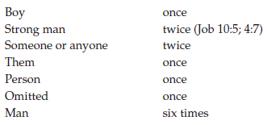
The NIV at least recognised that in some contexts, the quality of the translation can be enhanced by not translating גבר [geber] concordantly as man, but by explicating the sense in focus. At least twice, in Job 4:7 and 10:5, they translated גבר [geber] other than just a general man or person, namely as a strong man.
The NASB translates Job 22:2 where the גבר [geber] is challenged as to whether he can be of any use to God, as a vigorous man:
Can a vigorous man be of use to God, or a wise man be useful to himself?
The NET Bible also indicates the original has another word than the most common word, by translating גבר [geber] as: a strong man.
The NET Bible makes a similar choice to the NIV:
Is it to God that a strong man is of benefit?
Is it to him that even a wise man is profitable?
Job 34:7-9: Job, act like a man!
In view, it could be more than qualities, rather also character. One of the key passages referring to Job's character is found in Job 34:7-9. Here Job is accused by his friend Elihu that he is not acting like a גבר [geber]; but this very fact is not visible in any mainstream translation. For example, the ESV translation impoverished the well-construed parallel construction that is built into the Hebrew text:
7 What man is like Job,
who drinks up scoffing like water,
8 who travels in company with evildoers
and walks with wicked men?
9 For he has said, 'It profits a man nothing
that he should take delight in God.'
What is not visible, is the fact that the word גבר [geber] occurs twice in this passage. Below, I rewrote the passage by inserting the word גבר [geber] to show how it was constructed in the original:
7 What geber is like Job,
who drinks up scoffing like water,
8 who travels in company with evildoers
and walks with wicked men?
9 For he has said, 'It profits a geber nothing
that he should take delight in God.'
In verse 9 Elihu refers to Job, who is calling himself a גבר [geber], and if that is the case he, Job, should not act like an evil person by being in the company of evil people, because it is unacceptable for a גבר [geber] to do something like that! From these parallel references, it is clear that a גבר [geber] is seen as 'more than a man', rather as 'a godly person', as someone special who should be held to a higher standard.
In his commentary, Clines (2006) discusses Job 34:7 and makes it clear that Job is a man set apart:
Elihu has not yet finished citing Job (he will continue in v. 9), but now that he has brought himself to utter two Joban sentences, he cannot restrain himself from delivering an evaluation of Job's character. Eliphaz had said in 15:16 that humans are naturally disposed to 'drink iniquity like water', but for Elihu Job is a man apart ('Was ever a fellow like Job? He gulps mockery like water', more prosaically neb 'Was there ever a man like Job with his thirst for irreverent talk?'. (p. 770)
In the UBS handbook, W.D. Reyburn (1992) discusses Job 34:7 in stating:
In asking What man is like Job, Elihu uses Job's name for the second time. Elihu's question is equivalent to 'Is there anyone like Job?' or 'What kind of a man is Job?'. (p. 627)
The suggested glossing of this phrase once again loses what is in the underlying Hebrew text. The irony, the paradox is missed and translated out of Elihu's speech. Just imagine how much stronger the translation will mean if it says: Is it at all possible that a 'hero of faith' (indicating a man in a close relationship with God) will act like that? It is impossible for a hero of faith to drink scorn like it is nothing, to blaspheme God as if it is just drinking water.
In his discussion of Job 34:7, Keil and Delitzsch (1996) highlights the godly character of a Job, of a גבר [geber]:
The attributive clause refers to Job; 'to drink scorn (here: blasphemy) like water', is, according to Job 15:16, equivalent to give one's self up to mockery with delight, and to find satisfaction in it. (p. 625)
Why is this important? It is important because it contradicts the character of a godly person, a גבר [geber].
The NIV commentary (ed. Carson 2018) gets a bit closer to the focus of the meaning of the noun גבר [geber] by realising that this passage is about whom Job is supposed to be:
Another description of Job (cf. Eliphaz's description of Job in 22:5-9). It is totally the opposite of who Job is, according to the prologue. (p. 855)
It is a pity though, that most commentaries do not highlight or discuss the Hebrew word behind the text, that is underlining the sense that Carson is referring to!
Mounce (2006) refers to the fact that גבר [geber] occurs 15 times in the book of Job. In his general discussion of the word גבר [geber], he indicates that גבר [geber] is usually translated as man, but in the following detailed discussion, he relates it to the cognate verb and highlights the fact that it indicates strength; not only physical strength, in contrast to women, but also spiritual strength. 'Blessed is the geber who takes his refuge in the Lord' (Ps 34:8) (Mounce 2006:134).
This is in line with what Elihu is doing. Hartley (1988) also confirms that גבר [geber] connotes a powerful man. The fact that a גבר [geber] is a strong person, physically and also spiritually, is a significant observation of Mounce! He substantiates this by referring to passages like Psalm 40:4 where it is said that the one blessed by the Lord, is a spiritual man גבר [geber]. Mounce (2006) highlights the fact that this is also visible in Psalm 34:8 and other places: 'Taste and see that the Lord is good; blessed is the geber who takes refuge in him' (cf. Ps 18:25; 40:4; 128:4; Pr 24:5) (Mounce 2006:134).
In the classic Brown, Driver, Briggs (1996) lexicon גבר [geber] has the following possible meaning:
גֶּבֶר n.m. man - man as strong, disting. fr. women, children, and non-combatants whom he is to defend, chiefly poetic.
They, however, do not point out the strength in spiritual relationships or being in a closer relationship with God.
Job 34:9 also alludes to the idea that a גבר [geber] is in a close relationship with God, but the statement by Elihu loses its edge because it is translated as: 'It profits a man nothing that he should take delight in God'.
But when it is made clear that it is an oxymoron for a גבר [geber] not to profit from his relationship with God, the quality of the translation is certainly improved.
Job 38:3-4 states, 'Job, gird up your loins like a man!'
Another example that supports the insight of Job 34:7-9 can be found in Job 38, where God is replying to Job who indicates that he is a גבר [geber], in a good relationship with God. If Job claims to be a גבר [geber], then he should get himself ready to fight like a גבר [geber], a warrior, defending himself against the accusations of God. Job 38:3 and 4 (NASB) reads:
Now gird up your loins like a man,
And I will ask you, and you instruct Me!
Where were you when I laid the foundation of the earth?
Tell Me, if you have understanding, …
The strength of the appeal that God is making would be so much stronger if the underlying concept, that God is not only calling him to pull himself together like a man but to pull himself together like a גבר [geber], is explicated!
Kosmala (1975) highlights the fact that Job regards himself as:
[A] righteous geber which can clearly be ascertained from his birth onwards. He is a man, according to his own testimony, that has always lived a perfect life before God from the very beginning. (p. 380)
In Job 16:21 Job calls himself a גבר [geber].
In his discussion of the noun גבר [geber], Balentine (2015:290) also refers to the two addresses of God in Job 38:3 and 40:7 and he appropriately points out that both times God refers to Job as a גבר [geber]. 'Both divine speeches begin with the question that challenges Job to 'gird up his loins' and answer God like the 'hero' (גבר [geber] [Job 38:3 and 40:7] he claims to be'.
Job's friends make fun of him because he calls himself a spiritual man גבר [geber] but he is suffering so much. According to Elihu, Job's life is not what a spiritual man's גבר [geber] life should be. A גבר [geber] must be someone in a special relationship with God, a hero of faith, or a godly person. According to their worldview Job should only experience divine favour. This is the standard his friends are calling him to uphold.
This brings us to the next section: How is גבר [geber] translated in Job 3:3?
גבר [geber] in Job 3:3
May the day of my birth perish,
and the night that said, 'A boy is conceived!' (NIV)
I once discussed the hypothesis of this study with a colleague. His very first comment regarding the usage of גבר [geber] in Job 3:3 is that it is just an alternate form for man because it is in poetic literature. My question would then be, does the fact that גבר [geber] occurs in poetic literature disqualify the hypothesis that גבר [geber] could emphasise that Job is a mighty man, a godly person, or does that contribute to a better understanding of what aspect of the word גבר [geber] is actually in focus? Jamieson et al. (1997) confirms that Job 3:3 does fall in a poetic part of the book of Job:
Verse 3 is the opening of the formal poetic body of the Book of Job. Job begins his curses by attacking the day of his birth and the night of his conception. The Hebrew is composed of two half-lines that are semantically parallel. The verb phrase Let … perish in … Let the day perish wherein I was born serves double duty since it must also be applied to line b. By not repeating the verb in line b, the poet has more line space in the Hebrew text to extend the birth image: A man-child is conceived. Through this technique of ellipsis, the two Hebrew lines are kept compressed. (n.p.)
In Job 3:3, Job curses the night of his conception as well as the day of his birth.
NET 08 translates it:
Let the day on which I was born perish,
and the night that said, 'A man has been conceived!'
Even though the NET Bible (Biblical Studies Press 2006) translated גבר [geber] as man, they showed remarkable insight in a footnote on Job 3:3 by pointing out that translating גבר [geber] as boy misses the point:
8 tn The word is גֶּבֶר (gever, 'a man'). The word usually distinguishes a man as strong, distinct from children and women. Translations which render this as 'boy' (to remove the apparent contradiction of an adult being 'conceived' in the womb) miss this point.
They wanted to convey the true meaning of the lexeme גבר [geber], but they did not discuss it far enough by indicating that גבר [geber] is neither a boy, nor a man, but a godly person, a hero of faith.
This makes me realise that breaking from the tradition of how a certain lexeme has been translated is very difficult, even though they had the insight that the current translation does not indicate what the Hebrew is saying.
Hartley (1988) refers to Job 3:3 and highlights the fact that Job is a man of strength (גבר [geber]), a distinguished person who is shamed by misfortune:
In this verse Job refers to himself as a male [geḇer]. The several Hebrew words for 'man' emphasize various aspects of his being, e.g., ʾîš, his strength, or ʾāḏām, his earthiness and limitedness (cf. ʾăḏāmâ, 'earth, ground'), but geḇer connotes a powerful man, particularly in contrast to a child or a woman. In the darkest hour of his crisis, Job refers to himself as a full-blooded, stalwart person. Thus, his curse is not designed to eliminate from the human race a weakling unworthy of dignity. Rather he views himself as a distinguished person who has been shamed by misfortune. (n.p.)
According to lexicons and most translations, Job 3:3 is the only instance in the Scriptures where גבר [geber] carries the meaning of (baby) boy, a male child. The most common meaning and translation equivalent for גבר [geber], is man, even though the cognate verb גבר [gabar] has meanings like 'to prevail, to be strong, to be superior' (Kosmala 1969:160).
Clines (2006) comments on Job 3:3 'it is doubtful that it has any special overtones of "strength", like the verb גבר "be strong", or of a man in a relationship with God' (Kosmala 1975:377) (p. 82)
The study of Coetsee (2021:133) confirms that there is a component of strength by referring to the noun גבר [geber]and other cognates of the verb גבר [gabar]. He describes these cognate forms as 'derived from the root גבר, which has the basic meaning of "to be superior" or "to be strong"'. He also describes the adjectival form of the noun in terms of strength and superiority: the adjective גבוֹר 'manly', 'vigorous', 'powerful'. I was surprised that when he glossed the noun גבר [geber], he fell back on the typical dictionary gloss, namely man, without referring to any sense of strength, power, or superiority. The non-verbal and adjectival forms derived from this verb carry the meaning of strong, mighty, manly, vigorous, vital, powerful, warrior, hero, superior, et cetera. In other words, special in one sense or another.
Another example of where Job is described as someone in a special relationship with God can be found in Job 3:23. This is the second reference to Job as a גבר [geber]. Job asks why God would give light to a גבר [geber] and hedge in his way. This expression is mostly seen as a negative expression. It is unthinkable that God would act like that with someone in a close relationship with him. I agree with Clines. He (1989), on the other hand, feels that the hedging is a positive act of God: 'There was no malice or cynicism in that remark, but a frank recognition of God's protectiveness' (p. 101). Thus confirming that this reference to גבר [geber] highlights a special relationship with God.
Like most commentaries, Barry (2012) interprets the phrase 'being hedged in' in Job 3:23 as a negative expression, but then he is reminded of a similar phrase in Job 1:10, and he states:
This phrasing is an ironic twist of the Satan figure's words in 1:10, where he accuses God of putting a wall of protection around Job. In any case, Satan then confirms that Job is in a special relationship with God. He gets God's special protection. (n.p.)
In the Theological Wordbook of the Old Testament, Waltke (1999:148) highlights the fact that a גבר [geber] is a distinct person. גֶּבֶר [geber]: Man. As distinct from more general words for man, such as ʾāāʾšʾen, et cetera, this word specifically relates to a male at the height of his powers.
In line with what has been highlighted above, Oswalt (1999) similarly points out that a גבר [geber] is more than just a mere man, he is full of strength, at the height of his strength:
גֶּבֶר [geber]. Man. As distinct from such more general words for man as ʾāām, ʾšʾôš, etc., this word specifically relates to a male at the height of his powers. As such it depicts humanity at its most competent and capable level. (p. 148)
This is also confirmed by Strong's (2009) Lexicon:
Word H1397 indicates that the lexeme geber has in its very basic meaning the sense of strength: H1397 גבר geber gheh'-ber From H1396; properly a valiant man or warrior; generally, a person simply - every {one} {man} X mighty.
What Kosmala (1975:377) is saying about a גבר [geber] seems to be quite an appropriate way to conclude this section, as he said in 1969:
Geber does not simply mean a man like adam or enosh. Of course, the word geber also contains the element of strength especially in the general sense. A geber without power is a self-contradiction. …This word is only once used of a newborn, (male) child (Job3:3) but this is a child with a promising future. (p. 160 author's emphasis)
In most contexts in which גבר [geber] has been used, the emphasis is on some aspect of this outstanding person being in a close relationship with God. It seems to be clear that a גבר [geber] is often someone special, someone superior, someone in a closer relationship with God. One can thus conclude that even though the general trend is to render גבר [geber] a man, most scholars acknowledge that גבר [geber] does mean more than just a mere man, or baby boy (NIV) in Job 3:3; this is a child with a promising future!
Improved understanding!
Like Mother Teresa, Job was not known as a special, outstanding person at birth, but it became known what calibre of person he became. When this biography regarding Job was written down, it did not seem out of place to refer to this newborn baby as a גבר [geber], as an outstanding person, a 'superman' of faith, as a hero of faith, or a godly person in close relationship with God; but for us as believers, this is an anticipatory prophetic announcement of who this boy child is going to be! He surely was a boy with a special future!
Peake (1904:70) already said more than a 100 years ago, that the term גבר [geber] is 'looking at what he essentially is, not at the stage of developments he has reached'. Kosmala (1975:377) confirms that. Therefore, what they say about a גבר [geber] is quite applicable to conclude with: Job is not just a baby boy. He is a child with a special future.
Conclusion
I contend that the quality of the translation will be improved if we can make it explicit that the baby boy called Job is more than just a little boy child, more than an ordinary person! He is a male child with a special future, a warrior of faith, and in a close relationship with God. He is a child with a special future - he is a גבר [geber]!
Competing interests
The author declares that he has no financial or personal relationships that may have inappropriately influenced him in writing this article.
Author's contribution
R.v.d.S. is the sole author of this research article.
Ethical considerations
This article does not contain any studies involving human participants performed by the author.
Funding information
This research received no specific grant from any funding agency in the public, commercial, or not-for-profit sectors.
Data availability
Data sharing does not apply to this article as no new data were created or analysed in this study.
Disclaimer
The views and opinions expressed in this article are those of the author and are the product of professional research. It does not necessarily reflect the official policy or position of any affiliated institution, funder, agency, or that of the publisher. The author is responsible for the results, findings and content of this article.
Acknowledgements
This research article is an extension of the conference paper: Van der Spuy, R., 2023, 'More than Just a Baby Boy! Could a Better Understanding of the Noun גבר (geber) in Job Enrich the Quality of the Translation?', The biannual Bible Translation Conference, International Linguistics Center, Dallas, US, 13-17 October 2023. Available at https://btconference.org/2023-proceedings/more-than-just-a-baby-boy-could-a-better-understanding-of-the-noun-geber-in-job-enrich-the-quality-of-the-translation.
References
- Balentine, S.E., 2015, Have you considered my Servant Job? Understanding the biblical archetype of patience, University of South Carolina Press, Columbia, SC.
- Barry, J.D., Mangum, D., Brown, D.R., Heiser, M.S., Custis, M., Ritzema, E. et al., 2012, Faithlife Study Bible, Lexham Press, Bellingham, WA.
- Bermœdez, A. (ed.), 2013, Pope Francis: Our brother, Our friend: Personal recollections about the man who became Pope, Ignatius Press, San Francisco, CA.
- Biblical Studies Press, 2006, The NET Bible, First Edition Notes, Biblical Studies Press, Richardson, TX.
- Brown, F., Driver, S.R., Briggs, C.A., Gesenius, W. & Robinson, E., 1996, The Brown-Driver-Briggs Hebrew and English Lexicon, Hendrickson Publishers, Leiden.
- Carson, D.A. (ed.), 2018, NIV Biblical Theology Study Bible, Zondervan, Grand Rapids, MI.
- Clines, D.J.A., 1989, Job 1-20, Word, Incorporated (Word Biblical Commentary), Dallas, TX.
- Clines, D.J.A., 2006, Job 21-37, Thomas Nelson Publishers (Word Biblical Commentary), Nashville.
-
Coetsee, A., 2021, 'YHWH's Greatness', Old Testament Essays 34(1), 114-140. https://doi.org/10.17159/2312-3621/2021/v34n1a8
» https://doi.org/10.17159/2312-3621/2021/v34n1a8 - Hartley, J.E., 1988, The book of Job, Eerdmans, Grand Rapids, MI.
- Jamieson, R., Fausset, A.R. & Brown, D., 1997, Commentary, a critical and explanatory commentary on the whole Bible, Logos Research Systems, Inc., Oak Harbor, WA.
- Keil, C.F. & Delitzsch, F., 1996, Commentary on the Old Testament, Hendrickson, Peabody, MA.
- Kosmala, H., 1969, 'The term geber in the Old Testament and in the Scrolls', in G.W. Anderson (ed.), Congress volume, Rome 1968, pp. 159-169, Brill, Leiden.
- Kosmala, H., [1975] 1999, 'VI. Gebher', in G.W. Bromiley (ed.), Theological Dictionary of the New Testament, vol. 2, pp. 377-382, Eerdmans, Grand Rapids, MI.
- Mounce, W.D., 2006, Mounce's complete expository Dictionary of the Old & New Testament Words, Zondervan Academic, Grand Rapids, MI.
- Oswalt, J.N., 1999, '310 GBR', in R.L. Harris, G.L. Archer Jr & B.K. Waltke eds., Theological wordbook of the Old Testament, p. 148. Moody, Chicago, IL.
- Peake, A.S., 1904, Job: Introduction, rev. version with. notes and index, Nelson, London.
- Reyburn, W.D., 1992, A handbook on the Book of Job, United Bible Societies, New York, NY.
- Slovicek, L., 2007, Mother Teresa: Caring for the world's poor, Infobase Publishing 200, Chelsea, MA.
- Stein, D.E.S., 2020, Relational Meanings of the Noun אִישׁ ('îš) in Biblical Hebrew, dissertation, Stellenbosch University.
- Strong, J., 2009, Strong's exhaustive concordance of the Bible, Hendrickson, Peabody, MA.
- VanGemeren, W. ed., 1997, New International Dictionary of the Old Testament Theology & Exegesis, vol. 1, pp. 816-817, Zondervan, Grand Rapids.
Accepted: 02 Oct. 2024
Published: 10 Dec. 2024
