Elements of the universe in Philo's De Vita Mosis: Cosmological theology or theological cosmology?
Abstract
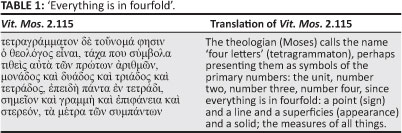
It is the intention of this article to investigate how Philo's understanding of the universe, and particularly its four basic elements as taught by the Greek philosophers, influenced his description of the God of Israel's world in which the Moses narrative unfolds. Given the fact that Philo was a theologian par excellence, the question can be asked whether Philo's approach is closer to what one might call 'theological cosmology' or rather closer to 'cosmological theology'? After a brief survey of Philo's inclination to interpret Jewish history in the light of Greek cosmology, the study proceeds with his universe as symbolised in the high priest's vestments. The τετρακτύς with its 10 points of harmony is a key to Philo's symbolism and numerology. The article concludes that Philo is not writing cosmology per se in his De Vita Mosis, but he is rather writing a theology that sketches the cosmic superiority and involvement of Israel's God against the backdrop of Greek cosmology as it was influenced by Pythagoras' geometry and numerology as well as by Plato's philosophy. In this sense his account in the De Vita Mosis is closer to a cosmological theology. He utilises the cosmological picture of the Greco-Hellenistic world in order to introduce and present the powerful nature and qualities of Israel's God.