The enigmatic Hebrew word ‘אפים ‘ in 1 Samuel 1:5
Abstract
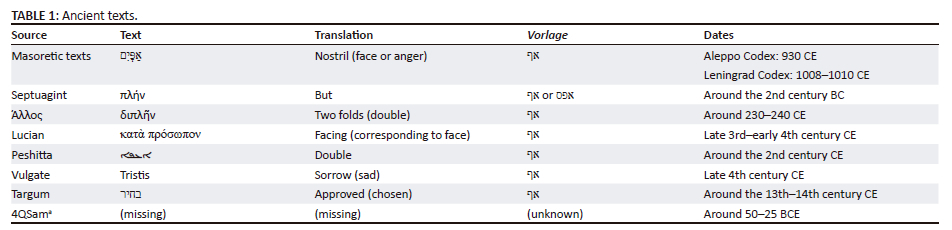
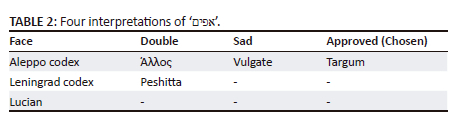
The Hebrew word '”–•–' in Samuel 1:5 presents significant challenges for both ancient translations and modern English translations of the Bible. In ancient texts, the Masoretic text presents '”’–’’•’–' or 'nostrils' (face or anger). The Aramaic Targum offers a different perspective, rendering it as '”••—' or '(one) approved (portion)', while the Syriac Peshitta opts for '´·¶´' or 'double'. The Latin Vulgate provides a thought-provoking interpretation, using the word 'tristis' or 'sad'. The LXX, however, prefers 'πλήν'. In modern English Bible translations, the Jewish Publication Society renders it as one portion (cf. New Living Translation [NLT] 'only one choice portion'), whereas the New Revised Standard Version, English Standard Version, New American Standard Bible (NASB) and New International Version (NIV) describe it as a double portion. The King James Version (KJV), on the other hand, interprets it as a worthy portion. CONTRIBUTION: Consequently, this research attempts to unveil this mysterious Hebrew word with textual criticism as its methodology.
Old Testament; textual criticism; 1 Samuel; –•–; translation