Text, theory and methodology: Ruminations from the horizon of a reader from the south
Abstract
This article marks the tenth year of Welile Mazamisa's passing, as a proverbial burning down of a library. It contains a recollection of lessons gleaned from memory of his own ruminations as he lived and mused from his horizon as a reader from the south. In his own dialectic fashion, a reflection on the text, theory and methodology is discussed as a possible lesson and perhaps, also a quo vadis question to the contemporary biblical scholar and theologian in South Africa, concerning these categories of scholarship. It seems fair to say that among lessons to still be learned from Mazamisa, is this lesson: a critical reader is to be mindful of the centrality of the text, the urgency of theory and the necessity of methodology in the process of reading and appropriating the reading of the text. In conclusion, an application is made to the decolonisation project and the credibility of theology as an academic discipline in South Africa (SA). CONTRIBUTION: This article contributes to the discourse of hermeneutics and decolonisation and also to the discourse of hermeneutics and the question of the credibility of theology as an academic discipline in South Africa
hermeneutics; literary theory; exegesis; structural linguistics; discourse analysis; socio-linguistics; historical-sociological approach; reception theory and reader-response approaches
Introduction
In his own self-justification for reading the supposedly exhausted Luke (10:25-37) for his doctoral thesis in New Testament (NT) exegesis and hermeneutics, Welile Mazamisa finds that the said readings, for the most part, have been undertaken by readers from the north and perhaps not yet by a reader from the south. Ordinarily, readers from the north have 'identified more with the 'charitable' Samaritan than with the wounded man on the side of the road' (Mazamisa 1987:9). Conversely, Mazamisa makes his own original contribution to knowledge in the scholarly study of this parable, as a reader from the south, by identifying himself, as a reader, with the man who has fallen into the hands of robbers, been attacked and left lying by the side of the road, bleeding to death. This self-understanding alludes to Mazamisa's own first-hand experience of apartheid in South Africa (Mazamisa 1987:7).
There are at least two component features to Mazamisa's self-conscious hermeneutical horizon as a reader from the south. Firstly, he identifies himself with a theology from below, perhaps in the fashion of Jürgen Moltmann, as related to Martin Luther's theologia crucis in contrast to theologia gloriae (Moltmann 1974:65-75). A theology premised on God's own suffering with the hopeless as the basis of hope for the helpless, thereby empathising with the poor in spirit, who oftentimes also happen to be the scum of the earth (Fanon 2004:97); socio-economically, politically and structurally insignificant people in society; the marginalised and the downtrodden persons in their personal daily struggles (Cone 1975/1997:16-28).
Secondly is the dialectica reconciliae, a resolute striving for the ethics of balance in reflexive ruminations and critical interactions of the reader. It is a painstaking reconciliation of conflicting ideas, which steers away from extremes (Hombana 2024:1-8). Consequently, this horizon is often decidedly and profoundly different from either the ideologically right or left horizon. Rather, it is an aspiration to Hans-Georg Gadamer's hermeneutical ideal, as Gadamer (1997) himself says:
'Hermeneutics is above all a practice, the art of understanding and making something understood to someone else. It is the heart of education that wants to teach how to philosophise. In it what one has to exercise above all is the ear, the sensitivity for perceiving prior determinations, anticipations, and imprints that reside in concepts.' (p. 17)
While these two components may be easily reduced to 'approaches' by readers from the north, to Mazamisa, as a reader from the south, they are ancient features of a spirituality of justice, the spirituality of abantu, which is often modelled through unreserved reception, hospitality and grace towards a stranger, despite the odds (Mazamisa 1987:162).
Writing his doctoral thesis in the 1980s, which is certainly a decade of important advances in hermeneutics here in South Africa, Mazamisa weighs in on a problem of the day. The problem of the shifting focus from the text to the reader. It was a tension between discourse analyses and the emerging reception theory, along with reader-response approaches. At the height of this tension, Mazamisa sought to mediate the conflicting perspectives through his dialectic. Therefore, this article re-examines Mazamisa's hermeneutical conception of the text, theory and methodology within the context of the 1980s as a subversive quo vadis question to the contemporary South African biblical scholar and theologian concerning the text, theory and methodology. The subject of this article could also be phrased as: What lesson can contemporary South African hermeneutics possibly still learn from Mazamisa about the text, theory of the text and methodology of reading the text in relation to the reader of the text?
Text
Describing the hermeneutical atmosphere of the 1980s in South Africa, the NT scholar Bernard Lategan (1984) says:
'The present hermeneutical debate is dominated by questions relating to the interaction between text and reader… this is a result of a gradual shift of focus - first from production to text mediation and finally to text reception.' (p. 1)
This shift might have been on the rise from the 1970s already in South Africa, but by the 1980s, it could no longer be ignored - it had become explosive. While the shift described by Lategan could, in the historical development of NT scholarship in the global north, be traced back to the rise and fall of historical-critical methods, South Africa was still pre-critical and conservative at the time.
Therefore, many of the critical events of historical-critical methods did not affect South African scholarship as much as the scholarship of other areas (Le Roux 1993:14, 26). Rather, South Africa was first awakened from its critical slumber by its excitement with structural linguistics, which became the basis of South African discourse analysis that preoccupied the New Testament Society of South Africa (NTSSA) and the Old Testament Society of South Africa (OTSSA) in the 1970s. The 1980s, therefore, became a difficult time for both NT and Old Testament (OT) scholarship, as the royal carpet of discourse analysis was being pulled out from under its feet by this shift from the text to the reader.
Orientation
About this first shift, Lategan (1984) says:
'The first real 'paradigm switch' occurred with the advent of structuralism and its emphasis on the auto-semantic nature of texts. The text itself becomes the focal point. By deliberately excluding 'antecedal' and 'external' relationships from consideration, the intention is to avoid both the 'genetic fallacy' (explanation from origins) and the 'referential fallacy' (explanation in terms of extra-textual reality). Synchronic interests replace diachronic preoccupations.' (p. 3)
Johannes Petrus Louw, followed by Andries Bernardus du Toit (NT) and Willem Sterrenberg Prinsloo (OT), are the thought leaders of this shift. However, the text-to-reader paradigm shift was such that by 1984, Louw and his colleague, American Linguist Eugene A. Nida, were exploring socio-linguistics. They sought to take the social aspect of the text more seriously, concerned that it had been hitherto overlooked by South African practitioners of discourse analysis. This neglect had by this period become an undeniable accusation against discourse analysis.
Disorientation
Describing the second shift, Lategan (1984) goes on to say that:
'This movement is fed from a variety of sources and pursued with diverse objectives in mind. Nonetheless, it is gaining momentum and will certainly dominate questions of interpretation for quite some time. The unifying factor is the interest in the final phase of the communication process. The focus is on the relationship text-reader, in the realisation that reading is far from merely a passive acceptance of the message, but a very productive activity. In a certain sense it was inevitable that reception would sooner or later become the object of methodological reflection.' (p. 4)
Lategan also notices that this stimulates a renewed interest in the historical problem, perhaps not quite the same as those in earlier historical-critical methods but rather in sociological production of the text (Lategan 1984:4, 8-10). In OT scholarship, this can also be observed in Ferdinand Deist's work, where he develops a sociological interest in his historical approach, which soon opens up concerns about contemporary socio-ethical questions. Seemingly, interests in historical-sociological production of texts cannot be genuinely detached from interests in sociological circumstances of the contemporary reader, necessitating a socio-economic ethical dimension to reception and appropriation of texts (Deist 1983:26-48).
Reorientation
If the attention shifts from the text to the reader and therefore also to the historical-sociological production of the text, there is a greater chance that the text might be overshadowed. Lategan predicted that for the foreseeable future, from the time of his writing (1984), the reader would become the preoccupation. Unfortunately, this development could also suggest a perpetually overshadowed text, as interest is rather consumed by the discussion between the material concerns of the reader and the historical-sociological production of the text. Comparing the attention Mazamisa gives to the text (1987) and contemporary biblical scholarship in South Africa, it would not be a mistake to assume, in the fashion of Friedrich Nietzsche, that the text is virtually dead in much of contemporary biblical scholarship in SA.
Addressing the issue of the overshadowed text, Mazamisa declares that 'Our contention, undergirded by the exegesis of the parable of the present study, is that the reader must not overshadow the text' (Mazamisa 1987:174).
Paul Ricoeur expresses a similar concern in hermeneutics. Among other contributions Ricoeur makes in this regard, of which Mazamisa is well aware (Mazamisa 1987:209) and agrees with, is his memorable essay 'What is a text? Explanation and understanding.' In this essay, at the end of his introduction, Ricoeur (2016) writes:
'[B]efore unfolding the new concepts of explanation and understanding, I should like to pause at a preliminary question which in fact dominates the whole of our investigation. The question is this: what is a text?' (p. 107)
About the text, Ricoeur (2016) says that it:
'[D]ivides the act of writing and the act of reading into two sides, between which there is no communication. The reader is absent from the act of writing; the writer is absent from the act reading. The text thus produces a double eclipse of the reader and the writer. It thereby replaces the relation of dialogue, which directly connects the voice of one to the hearing of the other.' (p. 108)
The text is therefore not only central between the writer and the reader but is also the primary problem in the exercise of reading and interpretation. Its exegetical detail should not be overshadowed.
In a Scriptura article in 1990, Anton A. Van Niekerk also appeals to Ricoeur, cautioning biblical scholars and theologians against deviation from the text. Marking Ricoeur's contribution in this regard, Van Niekerk's article is aptly titled 'Textuality and the human sciences: An appraisal of Paul Ricoeur'. An enthusiastic follower of H.W. 'Hennie' Rossouw, Van Niekerk (1990) writes:
'The meaning and significance of the concept of a 'text' remains one of the most enigmatic contributions of hermeneutics to the intellectual culture of the latter part of the twentieth century.' (p. 1)
Van Niekerk (1990) continues to remark that:
'It could, in fact, be argued that the contribution of Paul Ricoeur to hermeneutic philosophy … represents a poignant rediscovery of the central significance of the 'text' to hermeneutic reflection, particularly if we take into consideration all the developments and deviations which hermeneutic philosophy has undergone since the hermeneutic problem was first conceived of as a philosophical problem in the work of Friedrich Schleiermacher. Long before it was conceived of as a philosophical problem, hermeneutics had its origin in a reading situation, that is, in dealing with texts.' (p. 1)
This is the philosophical framework within which Mazamisa (1983:174) perceives the centrality of the text and thereby justly contends that 'the reader must not overshadow the text'. Rather, it is to be recognised and dealt with as the primary problem of interpretation. Otherwise, there cannot be an interaction between the reader and the probabilities of the sociological production of the text. According to Mazamisa, the text is the primary problem, the reader is the secondary problem and the sociological production is the tertiary problem. Therefore, a text should not be undermined in the process of reading; rather, it should be given its own owed exegetical respect as a dialogical phenomenon, as it forms the basis of the exchange between the reader and the sociological production of the text. The text is '…a screen or grid through which we see the fundamental lines of the teaching of Jesus' (Mazamisa 1987:11). Without its exegetical detail, there is neither a screen nor a grid to figure out its message reasonably.
Theory
Considering that the text is primary to the exercise of reading, the theory of the text is what distinguishes responsible scholarly reading of the text from ordinary reading. It is also through such distinctive scholarly theories that trained readings of the text are differentiated from one another and outcomes are compared for effective study. As much as the reader influences the meaning of the text, the reader must also allow the text to influence the meaning that the reader attributes to the text. The text is an independent entity to be reckoned with on its own terms. It is itself not without a suggestion to its own reader and her theoretical determinations about itself (Figal 2010:xii). Therefore, a reader's theory of the text is not to be made up without the text; rather, it is formulated in conversation with the nature of the text itself (Mazamisa 1987:52-84).
In his study of Luke (10:25-37), Mazamisa carefully articulates his own working theory of this text. In Mazamisa's terms, the importance of a reader's theory of a text cannot be overstated because of its major influence on the outcomes of reading. At the end of his study, he writes:
'Throughout this work our premise has been that the biblical text is a literary, sociological and theological product. We have essayed to avoid atrophying any one element of the text and its signification. However, we maintain that if the underlying theology of parabolic text is not mined, then the whole enterprise of literary analysis might end up as a pointless theoretical exercise.' (Mazamisa 1987:164)
Text as literary
Following Madeleine Boucher, Mazamisa conceives of the text as a speech act. Therefore, the text encapsulates a three-dimensional disposition: the speaker or author, the spoken word or message and the hearer or reader (Figure 1).
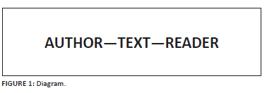
In Mazamisa's observation, the text could be 'autotelic', meaning that the text can be seen and taken to be autonomous, independent of either the author or the reader, with a life of its own. However, Mazamisa is also quick to admit that the text can simultaneously be regarded as 'heterotelic'. Meaning, its existence presupposes a purpose of communication, which therefore implicates its producer (author) and its consumer (reader).
Mazamisa acknowledges the linguistic character of the text in its sound and meaning. The text can be neither written nor read without language because language is at the core of its formation and reception. Following Boucher, he identifies in the text at least four elements that comprise its 'linguisticality'. That is, grammar, logic, rhetoric and aesthetics. The principles of organisation of the first three of these elements are said to be 'external to the speech', in a heterotelic sense, because they are derived from the 'social purpose' of the speech. The fourth element is internal, in an autotelic sense, as he says, 'for its derivation is sounds and meanings themselves. The aesthetic should therefore be regarded as structural coherence' (Boucher 1977:14-15; Mazamisa 1987:82-84) of a text/speech itself.
Grammar
Quoting Joachim Jeremias's Die Gleichnisse Jesu, 'Es war unvermeidlich, dass bei der Übertragung in das Griechische gelegentlich nicht nur der Wortlaut, sondern auch das Anschauungsmaterial in hellenistische Verhältnisse "übersetzt" wurde' (Jeremias 1977:22), Mazamisa (1987:123) distinguishes between the irretrievable ipsissima verba Jesu on which the text has been modelled and the sensus ipsissimus Jesu of the textus receptus. This sensus ipsissimus has been constructed into the language and grammar of the present text, forming this basic element of the text.
Logic
Mazamisa maintains that language presupposes logic, and therefore, the text, which presents itself to the reader in language, is logical. A reader is, for this reason, not only to account for the grammar of the text but also its logic. Whatever the observations of the reader, they must at least be logically justifiable. Accordingly, throughout his study of Luke (10:25-37), Mazamisa labours tirelessly for a logically justifiable interpretation of the text at hand. In his own words, Mazamisa (1987:82) says that 'logical organisation orders language toward the goal of communicating that is specifically logical.'
Rhetoric
Another important element of the text is rhetoric, which is perhaps an element most reminiscent of James Muilenburg's famous 1969 SBL inaugural presidential address, which provided the impetus for rhetorical criticism in biblical studies. The genius of his observation was pointing out the deficiency of form criticism in attending to 'the actuality of the particular text', because 'it is this concreteness which marks the material with which we are dealing' (Muilenburg 1969:18). The persuasive element of the text could no longer be ignored. The rhetorical element of the text, therefore, for Mazamisa (1987:82), is this 'artistic arrangement of language in such a way that it will achieve the goal of persuasiveness, of moving the addressee to decision or action.'
Aesthetic
The aesthetic element of the text is the text's own innate coherence. It is what holds together sounds and referential meanings of the text, from which grammar, logic and rhetoric can be appreciated. Boucher says that 'the producer simply creates patterns of sounds and patterns of meanings, which are there only to be contemplated by the receiver'. It is the intrinsic coherence of these patterns that suggests the meaningfulness of the text, grammatically, logically and rhetorically. In Boucher's observation, the aesthetic 'is structure of language for its own sake' and 'coherence of structure as such' (Boucher 1977:14, 15).
Wrapping up these literary elements of the text, Mazamisa reiterates the two sidedness of the text as innate and extraneous. The innate is, of course, the aesthetic, and the extraneous is the rhetorical, which is the culmination of its grammatical and logical elements. The aesthetic and the rhetorical become the literary focus of his reading of the text, considering the coherence of the linguistic structure of the text and balancing it with the rhetorical effect on the receptor of the text. This thought will be explained further below (3.3. Text as Theological).
Text as sociological
Owing to challenges of translating and making biblical texts accessible in local languages, sociological interest grew stronger in the 1980s. It was permeated by a desire to make translations intelligible to everyday-language readers and speakers. The inextricable relationship of language and the social setting in which it is spoken could no longer be overlooked. The study of the social aspect of language became necessary. With these sociolinguistic concerns, sociological study of the text spread widely (Lategan 1984:8). Some observations of this development can be noted through the works of Gerd Theissen and Itumeleng Mosala, both of whom Mazamisa also references.
Gerd Theissen
Gerd Theissen, the German NT scholar and theologian, was among the international champions of the development of sociological approaches (Mazamisa 1987:41), followed by South African scholars. Theissen's perspective is indicative of the nature and extent of the relationship between historical-critical methods and sociological approaches. He describes the relationship as characterised by a degree of 'continuity and discontinuity' between the two approaches.
Lategan (1984) says that:
'Theissen insists that the sociological approach forms part of the historical method. For him, it is in fact the logical outcome of the historical-critical exegesis of the New Testament (1979). There is, however, a difference: History is not merely understood as a chain of events, but rather as a constellation of conditions, customs, norms and institutions. History is painted on a broader canvas, examined on a deeper level, that is, as the underlying structural forces which shape society. In this respect Theissen seems to be following the distinction between a 'history of events' (Ereignisgeschichte) and a 'history of structures.'' (Strukturgeschichte). (p. 8)
In Theissen's own words, as cited by Lategan, '…die Frage nach dem historischen Kontext ist wie die Frage nach dem sozialen "Sitz im Leben" Ausdruck ein und desselben historischen Bewusstseins…' (Theissen 1979:4 in Lategan 1984:9).1 In this way, Lategan maintains that interest in the sociological aspect of the text returns full circle to the historical problem in the interpretation of biblical texts, something that suggests that the historical problem cannot be wished away or carried away within the interpretation of biblical texts. However, the difference in this socio-historical approach is not to be fully equated with the earlier posture of historical-critical methods, which can no longer be sustained, as already pointed out by Theissen.
Itumeleng Mosala
Mosala is certainly the most radical and revolutionary socio-scientific reader in South Africa, through his celebrated Biblical Hermeneutics and Black Theology in South Africa. Chapter 2 in this book is titled 'Social Scientific Approaches to the Bible: One Step Forward, Two Steps Back?' Mosala expresses his welcome of the 1980s international surge of sociological approaches to the text, while he simultaneously also communicates his own reservations concerning them (Mazamisa 1987:208).
Mosala's acknowledgement and suspicion of socio-scientific approaches are expressed through an observation made by the literary theorist Terry Eagleton. In his The Function of Criticism, Eagleton writes:
'Modern criticism was born of a struggle against the absolutist state; unless its future is now defined as a struggle against the bourgeois state, it might have no future at all.' (Eagleton 1984:124; Mosala 1989:43)
Mosala takes account of the ideological framework within which modern criticism in general made its debut. Considering how the state of affairs has evolved from the problem of authoritarian absolutism to the problem of capital, Mosala would only agree to socio-scientific approaches if they have the potential to deconstruct and challenge the ideological problem of capital in South Africa.
Mosala insists that socio-scientific approaches should challenge the canonical inclinations of the humanities by probing the socio-ideological ironies and absurdities from which they derive their authority. In biblical texts, this means the liberation of the reader from the spell of Verbum Dei, to an awareness of the humanness of the text, and therefore its social and ideological conditions. Through this sociological aspect of the text, the text makes reasonable human sense to a human reader; otherwise, the text can easily remain a lethal weapon in the hands of contemporary socio-ideological power structures, as indeed it was during apartheid in South Africa, and might also be for the current regime.
Having taken his two steps forward, acknowledging socio-scientific approaches, Mosala takes one step backwards. He subjects these approaches to a hermeneutics of suspicion in relation to the demands of black consciousness and black theology of liberation in South Africa. He also questions the methods of two of his own comrades, Desmond Tutu and Allen Boesak, regarding whether the oppressed can truly be liberated by the very methods that have been used to orchestrate their oppression (Mosala 1989:6). His concerns, therefore, are the ideological presuppositions of these approaches themselves. He goes on to say that:
'Having briefly assessed the contribution of the social science methods of biblical understanding, most of which are methodological, we still need to address the question of whether these methods as they are used in biblical criticism represent a theoretical break with the past. In other words, viewed theoretically, how new are these methods?' (Mosala 1989:46-47)
For Mosala, the probable umbilical cord between the 'past' critical attitudes and the current socio-scientific methods is the historical-critical methods, which Theissen admits to be related. Mosala desires a complete break between the two because he believes that historical-critical methods were originally conceived out of an ideology only aimed at overthrowing the absolutist state ideology, to establish a bourgeois state, which has now also proven itself to be the oppressor of the working class. Therefore, socio-scientific approaches to the text would not be effective enough in addressing the problem of this bourgeois state if they still take their cue from the foregoing historical-critical methods. However, the sociological aspect of the text remains undeniable. As much as the text is literary, it also remains sociological. But the reader must be suspicious of the tools used for this exercise.
Mazamisa readily agrees with these considerations of the social aspect of the text, because, in his own observation, grammar, logic and rhetoric presuppose a social function of the text. Otherwise, why would the text be composed grammatically, without a need to engage intelligibly with others? The same could be said of logic; advancing an argument is only necessary in relation to other probable perspectives within a social setting. Grammar and logic, as already suggested by Boucher and Mazamisa, culminate in the rhetorical element of the text, which, beyond a shadow of doubt, proves the texts to be socially orientated to effect transformation of one kind or another. However, for his time, Mazamisa finds that when it comes to the study of NT parables, the social aspect of the text is seldom given its due attention by scholars, except for Boucher, who at least acknowledges it, though she also does not elaborate further on it (Mazamisa 1987:82-84). In what appears to Mazamisa to be a scarcity of studies of the social aspect of parables, he stands courageously and affirms that 'It is our contention that literature must also be considered as a sociological production' (Mazamisa 1987:84). It is a production of its own social context, even as its interpretation is influenced and read within the social context of the contemporary reader.
Text as theological
Mazamisa identifies the theological aspect with the aesthetic and the rhetorical elements of the text. In the aesthetic, he finds the pneumatic, and in the rhetorical, he finds the kerygmatic as components of the theological construct of the text. The aesthetic is the bedrock of the rhetorical composition of the text. For this reason, Mazamisa is inclined to agree with Hans-Robert Jauss' (1980) suggestion that the aesthetic element of the text might itself have a social dimension, contrary to Boucher, who limits the social aspect to the grammar, logic and rhetoric of the text. The locus of meaning for Mazamisa is the aesthetic element of the text, from which the rhetorical element communicates itself as the message of the text to its reader. He also refers to these two elements as the poetic meaning of the text and the tropical meaning of the text (Mazamisa 1987:52-84).
Aesthetic
Mazamisa's aesthetics of the text as the probable locus of the meaning of the text, and therefore, also, the kernel of its theology, is similar to a doctrine of aesthetics espoused by philosophical hermeneutics. Therefore, recollection of observations made by the likes of Martin Heidegger and Hans-Georg Gadamer can shed some light on Mazamisa's relation of the aesthetics of the text to its meaning and its theological content, as he was himself a subscriber to philosophical hermeneutics (Mazamisa 1987:75). Two well-known essays are helpful in elucidating this idea. Firstly, Heidegger's (2012) Der Ursprung des Kunstwerkes, which was first published in 1950, was revised and republished in 1960 with an introduction by Gadamer. Secondly, Gadamer's Ästhetik und Hermeneutik was published in 1964 (Gadamer 1976:95).
Heidegger finds in aesthetics not only what the work of art may be but also something of the nature of truth itself. This is obviously a previously unheard-of contribution to aesthetics, because before Heidegger, aesthetics is limited to the subjective pleasure derived from the beauty of art. According to Heidegger, what art does resembles the Greek word ἀλήθεια, if this word can be understood in its sense as un-concealment. Firstly, in a work of art is un-concealed the essence of being of beings. In Heidegger's own example, Vincent van Gogh's famous painting of peasants' working shoes [schoenen] is certainly not an exact representation of shoes but something of the universal essence of shoes, a truth about shoes, and thus the beholder of the painting rightly relates the painting to existing shoes. Thus, the painting un-conceals something of the essence of shoes, compelling the beholder to identify the painting with actual shoes.
Secondly, a work of art opens up a world through which the attention of the beholder is grabbed and drawn into the work, away from the current world of the beholder. This world of the artwork is established as fine art against the backdrop or on the ground of a crude earth, which at once un-conceals the natural character of its background or setting. In Heidegger's own words, 'setting up a world and setting forth the earth, the work is the fighting of the battle in which unconcealedness of beings as a whole, or truth, is won'. Later, Heidegger also says that 'beauty is one way in which truth occurs as unconcealedness' (Heidegger 2001:54).
From this perspective of the work of art by Heidegger, Mazamisa's conception of the aesthetic element of the text can be appreciated: as the beauty of the artwork that a text is, to which all the other elements of the text owe their balance. Mazamisa identifies σκάνδαλον as being at the heart of the parable of Luke (10:25-37):
'What is specific in this pericope is the role played by profanity … what happens in the story is not presented in the language of the sacred or the language of myth; it is presented in the language of human history, of the profane, that of open drama. The Samaritan, who is a religious outcast according to Jewish religion, is the dramatis persona. He fulfils the law by doing the act of solidarity to the wounded man. So, what Luke's Jesus is portraying in the parable is a σκανδαλον.'
The σκάνδαλον, therefore, becomes the bedrock for the rhetorical expression of the text.
Taking his cue from Heidegger, Gadamer (1964:96, 98) adds an interesting and informative nuance to this aesthetic theory of philosophical hermeneutics: 'The aesthetic consciousness can appeal to the fact that the work of art communicates itself… Thus, the work of art is an object of hermeneutics'. Expounding on this phenomenon, Gadamer notes, as Heidegger does, that a work of art opens up a world and un-conceals something about itself to the beholder, but he further suggests that in this process, a work of art also un-conceals something in the beholder, about the beholder herself. This phenomenon also changes the beholder. Perhaps, returning to Van Gogh's Schoenen, the beholder may be moved to take pity on the peasants in their cumbersome struggles to make ends meet:
'The intimacy with which the work of art touches us is at the same time, in enigmatic fashion, a shattering and a demolition of the familiar. It is not only the 'This art thou!' disclosed in a joyous and frightening shock; it also says to us; 'Thou must alter thy life!'' (Gadamer 1964:104)
It is right here, where Mazamisa ascribes the locus of the meaning of the text and situates its theological aspect, in the aesthetic element of the text.
Rhetoric
Having identified the theological pneumatic quality of the text in the aesthetic/poetic element of the text as the locus of the meaning of the text, Mazamisa finds the theological kerygmatic quality of the text in the rhetoric/tropic element of the text as the proclamation/message of the text. The meaning embodied by the text, and the demand that it makes on the reader, as already observed by Gadamer, now communicate itself in a rhetorical form. Mazamisa considers ἔλεος [mercy] and σπλαχνίζειν [to have compassion] keywords in the rhetoric of Luke (10:25-37), within the aesthetic of σκάνδαλον [profanity], suggesting that the text is rhetorically crafted to shame the prideful self-righteousness of the religious formalism of the day for its inadequacy to fulfil the law. Rather, persuading the reader to be merciful and to have compassion towards a stranger, as a way of fulfilling the law (Mazamisa 1987:86).
It may help once again to turn to philosophical hermeneutics to elucidate Mazamisa's conception of the rhetorical element of the text, as already attempted with the aesthetic element. In this regard, the importance of this rhetorical consideration of the text is grounded in the nature of language in relation to understanding. In his Sein und Zeit, Heidegger acknowledges the intricate relationship between language and understanding by using the German word Rede, as 'equiprimordial' with understanding. While this word could easily be translated into the English word 'speech', Heidegger's own explanation of his conception of Rede2 is not quite satisfactorily served by this translation (Heidegger 1957:160).
Rede places emphasis on the unconscious primordial linguistic wiring of human understanding, which predates articulation, suggesting that human thought and understanding might be impossible without prior understanding. In his Wahrheit und Methode and some of his subsequent writings, Gadamer (1990) develops this idea further, suggesting that if the nature of human thought is dialogical, it has to be simultaneously rhetorical because of its dependence on language. Rhetoric becomes the way in which human thought linguistically expresses itself to itself, prior self-articulation to the other. If the thought or meaning of the text can be found in the aesthetic element of the text, the only way its message can be understood is through its rhetorical element. It is right here where Mazamisa finds the kerygmatic quality of the text as the self-expression of the text's own persuasive theology to the reader. As quoted earlier, '… if the underlying theology of the … text is not mined, then the whole enterprise of literary analysis might end up as a pointless theoretical exercise' (Mazamisa 1987:164).
Methodology
The 1980s shift from text to the reader is also set apart from other decades by an intense debate over the most appropriate exegetical method. Discourse analysis, as already suggested, was the order of the day, stretching from its glory days of the 1970s. It was first challenged by the historical approach, which gradually assumed sociological interests, with Deist being one of the notable critics of discourse analysis. Further complicating this situation were reception theory, reader-response approaches and models of reading the text. Therefore, the question of the best method was considered a significant issue in 1980s biblical scholarship in South Africa.
Among the most memorable debates of this period over exegetical method is the debate between two outstanding scholars of the OT, Deist and Prinsloo. As already indicated, Prinsloo was a leading proponent of discourse analysis, and Deist was a leading critic of this approach in favour of the historical-sociological approach. In January 1988, Deist published 'Gekontroleerde' eksegese en/of 'kreatiewe' 'uitleg', which was a direct reference to discourse analysis. In July of the same year, Prinsloo released an article that seems to have been aimed at Deist's preoccupation with the historical approach. The article, in which he criticises historical-critical methods, is titled 'Die Historisch-Kritische Methode(s) in Perspektief'. Quoting John Barton, Prinsloo taunts historical methods' fixation with the author, saying, 'The author, after all, may be dead, but his work is still with us; why should we not read it as it stands, and leave the dead to bury the dead' (Barton 1987:138; Prinsloo 1988:203).
In this 1980s' preoccupation with exegetical methods, Deist (1988) cautions:
'Watter is die mees geskikte methode(s) om 'n teks mee uit te lê? Dit is die soort vraag wat gewoonlik deur die eksegese-metodeleer ondersoek en beantwoord word. Om dergelike vrae te kan beantwoord, moet vrae soos: 'Wat is 'n teks?' en: 'Wat is betekenis?' eers beantwoord word. Ons vind sulke vrae dikwels erg 'akademies', alte teoreties en filosofies.' (p. 39)3
To Prinsloo's credit, he also concludes his article with a similar moderation, suggesting that there is no singular best method of exegesis. Mazamisa's work (1987) also portrays this caution. And his ruminations on methodology are integrated with his hermeneutics. Mazamisa makes at least four important methodological observations concerning the understanding and application of exegetical methods.
Literary theory
The first observation that Mazamisa makes is that a reasonable scholarly interpretation of the text cannot be undertaken without literary theory. In his own words, Mazamisa (1987) says:
'[T]he text of the bible is not only a record of theological statements, it is language and literature. It is therefore only logical that some of the rules and theories that apply to literature, will also apply mutatis mutandis, to the biblical text…Only on the basis of an explicit or implicit literary theory, it is possible for the exegete to go about his work.' (p. 12)
Accordingly, Mazamisa brings such diverse literary theories as the bürgerlicher literary theories, traditional historical-critical theories, structural linguistics, materialist literary theories, sociological theories and liberation theories into dialogue in his study. In these terms, methodological interpretation of the text must be able to give an account of its own literary theory and be able to justify the applicability of such literary theory to the process of interpreting the text (Mazamisa 1987:11-49).
Exegetical outcomes
Mazamisa also believes that how one defines the text has a way of dictating his or her choice of method, which in turn also significantly influences the outcomes of the exegesis. Therefore, a reader is to remain self-aware of the text and his or her own choice of exegetical method, knowing that the method determines the reading outcomes. 'Each method has an internal consistency and logical coherence which ultimately influence the results of an exegesis' (Mazamisa 1987:11). Inasmuch as an exegetical method is helpful, it is also a barrier to understanding. Nonetheless, the importance of exegetical methods remains, as Louis Jonker and Douglas Lawrie state, 'these strategies have a critical function: they assist us in testing our initial understanding of biblical texts so that we might come to a more adequate interpretation' (Jonker & Lawrie 2005:229).
Philosophical presuppositions
The third observation made by Mazamisa is that methods of interpretation are themselves products of particular philosophical presuppositions, representative of certain schools of philosophy. Mazamisa (1987) observes that:
'[I]t is necessary for the exegete to be conscious of the explicit and implicit theories that inform the method he deploys … Moreover, the exegete is not entirely free from being pervasively influenced by epistemological theories that are prevalent in contemporary schools of philosophy.' (p. 11)
Even the trained reader is often unaware of these inherent philosophical presuppositions of the methods they use for exegesis. Mosala is perhaps the best example of a reader who is not only aware of the philosophical presuppositions of his method but also deliberate in his choice of such presuppositions (Mosala 1989:15-21).
Constructive tension
Methods are to be compared with each other, paired and balanced with one another in service of the interpretation of the text, as they each have something to contribute to the exercise of interpretation. According to Mazamisa (1987:85), '… there is no water-tight method for arriving at specific meaning' as originally intended by the text. Therefore, he believes that a wide range of exegetical methods can be illuminating in the exercise of reading and interpretation of the text, especially through the dialectic tension between the different methods and methodologies. What may be overlooked by one method may find meaningful attention in another. This is not an attempt to level the differences among methods; rather, it is an acknowledgement of the differences and a way of harnessing the tension among them for a more critical exegesis of the text. In his own work, Mazamisa dialectically reconciles competing exegetical methods, such as the historical-eschatological, the (historical) aesthetic, the literary-existential, the historical-literary, the literary-cultural, the multiple interpretation and reader-response methods (Mazamisa 1987:52-84).
Conclusion
What can the contemporary scholar and theologian still learn from Mazamisa about the text, theory and methodology? Among the lessons that the contemporary scholar and theologian can still learn from Mazamisa is this: a critical reader is to be mindful of the centrality of the text, the urgency of theory and the necessity of methodology in the process of reading and appropriating the reading of the text. While the text, theory and methodology may have been subjected to instruments of colonialism and oppression through the university, which remains a colonial project, liberation and decolonisation cannot be achieved without subversion and utilisation of these categories in favour of justice and emancipation. The text, theory and methodology are the battlegrounds on which liberation and decolonisation are realised or forfeited (Mamdani 2019:15-28). In addition to this contemporary challenge of decolonisation, there is also a challenge of the credibility of biblical texts and theology in making any significant contribution in resolving post-truth, non-human and post-human problems, especially because of the questionable use of texts, suspicious theory and wanting methodology. Perhaps, through Mazamisa's example, the credibility of theology as an academic discipline can be restored.
It appears that since the close of the decade of the 1980s, there has been a gradual decline of interest in the text, theory and methodology in theology (Lombaard 2006:144-155). Rather, there has been a greater growth in thirst for public relevance at the expense of the text, theory and methodology, as those who would be scholars have been taken captive by the hype of becoming public intellectuals (Mamdani 2019:15-28). These are the relevant public intellectuals who often cannot be decisively identified by the texts they study, the theory they espouse or the methodology they use, except through desperate and vague self-contradictory reasoning, characterised by impetuous trans-disciplinary and attention-seeking verbosity (Sowell 2009). Mazamisa was very aware of the importance of the public relevance of biblical texts and theology but not at the expense of the text, theory and methodology. This decline is probably self-evident in comparison to earlier biblical studies and theology curricula to the most recent. This is not even to mention biblical languages and philosophy, which have traditionally been compulsory for theology and have now become optional, in some cases, not even an available option.
Deviation from the centrality of the text, urgency of theory and necessity of methodology is certainly not exclusive to SA. It is probably global, as an epistemological development of the multi-complex of post-truth, non-human and post-human attitude towards ideas. Apparently, this development does not seem interested in the improvement of the quality of human communication. It has the potential to plunge human communication back to the Western Dark Ages, where the truth was buried under misinformation, unverifiable translations, plagiarism and fake news; thriving on the illiteracy of the populace. This current multi-complex has also proven itself to be susceptible to alternative truth, as truth has become limited to social media influence and popularity. Fervent advocacy and digital mob justice are, for this reason, replacing the virtue of dialogue and mutual understanding in communication. It is a misfortune to find biblical scholars and theologians succumbing to this hideous vice of decided miscommunication in the rush for relevance and popularity.
In contrast to Mazamisa, a quo vadis question is evoked in relation to the craft of the contemporary biblical scholar and theologian as far as the text, theory and methodology are concerned. Effective communication cannot be achieved without the virtue of dialogue, which requires diligent attention to be given to the message, reasoning and the processes of making sense to the other as a quest for hermeneutical justice. It is a quest of finding oneself in the other, as well as finding the other in oneself with an acute sensitivity to the incommensurable nature of interpretation. These are ruminations from the horizon of a reader from the south: the erupting other and a comrade of God - Mbinga, Khakhaza, Lusiba, Mwelase, Mazibuko, Ncwabane, Mlambo awuwelwa, uwelwa zinkonjane zodwa!
Competing interests
The author declares that they have no financial or personal relationships that may have inappropriately influenced them in writing this article.
Author's contribution
O.M. is the sole author of this research article.
Ethical considerations
This article followed all ethical standards for research without direct contact with human or animal subjects.
Funding information
This research received no specific grant from any funding agency in the public, commercial or not-for-profit sectors.
Data availability
The author declares that all data that support this research article and findings are available in the article and its references.
Disclaimer
The views and opinions expressed in this article are those of the author and are the product of professional research. It does not necessarily reflect the official policy or position of any affiliated institution, funder, agency or that of the publisher. The author is responsible for this article's results, findings and content.
Acknowledgements
References
-
Barton, J., 1987, 'Reading the Bible as literature: Two questions for Biblical critics', Journal of Literature and Theology 1(2), 135-153. https://doi.org/10.1093/litthe/1.2.135
» https://doi.org/10.1093/litthe/1.2.135 - Boucher, M.I., 1977, The mysterious parables: A literary study, CBQ Monograph Series 6, CBQ, Washington, DC.
- Cone, J.H., 1997, God of the Oppressed, rev. edn., Orbis Books, ylNew York, NY.
- Deist, F.E., 1983, 'Bibel interpretation und/als Ideologiekritik [Bible interpretation and/or ideology critique]', Old Testament Essays 1, 26-48.
-
Deist, F.E., 1988, '"Gekontroleerde" eksegese en/of "kreatiewe" uitleg [Controlled exegesis and/or creative]', HTS Teologiese Studies/Theological Studies 44(1), 39-54.https://doi.org/10.4102/hts.v44i1.2187
» https://doi.org/10.4102/hts.v44i1.2187 - Eagleton, T., 1984, The function of criticism, Verso, London.
- Fanon, F., 2004 [1961], The wretched of the earth, transl. R. Philcox, Grove Press, New York, NY.
- Figal, G., 2010, Objectivity: The hermeneutical and philosophy, transl. T.D. George, SUNY Press, Albany, NY.
- Gadamer, H-G., 1964, 'Ästhetik und Hermeneutik,' in Gesammelte Werke, Ästhetik und Poetik I-Kunst als Aussage (1993), Mohr, Tübingen, 1-8.
- Gadamer, H-G., 1976, 'Aesthetics and hermeneutics', in D.E. Linge (ed.), Philosophical hermeneutics, vol. I, transl. D.E. Linge, pp. 95-104, University of California Press, Berkeley, CA.
- Gadamer, H-G., 1990, Wahrheit und Methode [Truth and method], Mohr, Tübingen.
- Gadamer, H-G., 1997, The Philosophy of Hans-Georg Gadamer, ed. L.E. Hahn, Open Court Publishing Company, La Salle, Illinois.
- Gadamer, H-G., 2013, Truth and method, transl. J. Weinsheimer & D.G. Marshall, rev. edn., Bloomsbury Academic, London.
- Heidegger, M., 1957, Sein und Zeit [Being and time], Max Niemeyer Verlag, Tübingen.
- Heidegger, M., 1962, Being and time, transl. J. Macquarrie & E. Robinson, Harper & Row Publishers, New York, NY.
- Heidegger, M., 1996, Being and time, transl J. Stambaugh, State University of New York Press, New York, NY.
- Heidegger, M., 2001, 'The origin of the work of art', in Poetry, language, thought, transl. A. Hofstadter, pp. 15-86. Harper Collins, New York, NY.
- Heidegger, M., 2012, 'Der Ursrpung des Kunstwerkes [The origin of the artwork]', Klostermann Rote Reihe, vol. 48, Klostermann, Frankfurt. (Earliest draft 1935, first published in 1950, revised and republished in 1960 with an introduction by Gadamer)
-
Hombana, M., 2024, 'Dialectica reconciliae: Mazamisa's contribution to the historical development of New Testament interpretation in South Africa', Ecclesia et Verbum 45(1), 1-8. https://doi.org/10.4102/ve.v45i1.3000
» https://doi.org/10.4102/ve.v45i1.3000 - Jauss, H-R., 1980, 'Einführung zu: Ästhetik der Rezeption und der literarischen Kommunikation' [Introduction to: Aesthetics of reception and literary communication] in Z. Konstantinović, M. Naumann & H.-G. Jaus (eds.), Literarische Kommunikation und Rezeption, pp. 3-18, Innsbruck.
- Jeremias, J., 1977, Die Gleichnisse Jeus [The parables of Jesus], Vandenhoeck & Ruprecht, Göttingen.
- Jonker, L & Lawrie, D., 2005, Fishing for Jonah (anew): Various approaches to biblical interpretation, SUN Press, Stellenbosch.
- Lategan, B., 1984, 'Current issues in the hermeneutical debate', Neotestamentica 18, 1-17.
- Le Roux, J.H., 1993, A story of two ways: Thirty years of Old Testament scholarship in South Africa, Verba Vitae, Pretoria.
- Lombaard, C.L., 2006, 'Relevance of the Old Testament science in/for Africa: Two false pieties and focused scholarship', Old Testament Essays 19(1), 144-155.
- Mamdani, M., 2019, '"Decolonising university', in J.D. Jansen (ed.), Decolonisation in universities: The politics of knowledge, pp. 15-28. Wits University Press, Johannesburg.
- Mazamisa, L.W., 1987, Beatific Comradeship: An exegetical-hermeneutical study on Luke 10:25-37, Kok, Kampen.
- Moltmann, J., 1974, The crucified God: The cross of Christ as the foundation and criticism of Christian theology, Harper & Row Publishers, New York, NY.
- Mosala, I.J., 1989, Biblical hermeneutics and Black theology in South Africa, Eerdmans, Grand Rapids, MI.
-
Muilenburg, J., 1969, '"Form criticism and beyond', Journal of Biblical Literature 88(1), 1-18. https://doi.org/10.2307/3262829
» https://doi.org/10.2307/3262829 -
Prinsloo, W.S., 1988, 'Die histories-kritiese metod(e) in perspektief [The historical-critical method(s) in perspective]', Skrif en Kerk 9(2), 196-209. https://doi.org/10.4102/ve.v9i2.990
» https://doi.org/10.4102/ve.v9i2.990 - Ricoeur, P., 2016, 'What is a text? Explanation and understanding', in J.B. Thompson (ed.), Hermeneutics and the human sciences, transl. J.B. Thompson, pp. 107-126. Cambridge University Press, Cambridge.
- Sowell, T., 2009, Intellectuals and society, Basic Books, New York, NY.
- Theissen, G., 1979, Studein zur Soziologie des Urchristentums [Studies on the Sociology of Early Christianity], Mohr, Tübingen.
- Van Niekerk, A.A., 1990, '"Textuality and the human sciences: An appraisal of Paul Ricoeur', Scriptura 1-29.

Accepted: 10 July 2025
Published: 14 Nov. 2025
2. Admitting that there may possibly be no single English word to succinctly capture Heidegger's Rede, John Macquarrie and Edward Robinson (Heidegger 1962:203) reluctantly translate it as 'discourse' and suggest that it might also be 'talk'. Joan Stambaugh (Heidegger 1996:150) also seems to have no other choice but to use 'discourse'.
3. 'What is the most appropriate method for interpreting a text? This is the kind of question that is usually investigated and answered by exegetical methodology. In order to answer such questions, questions such as: "What is a text?" and "What is meaning?" must first be answered. We often find such questions very "academic," too theoretical and philosophical.'