Syntactic patterns of πᾶς as a quantifier in New Testament Greek
Abstract
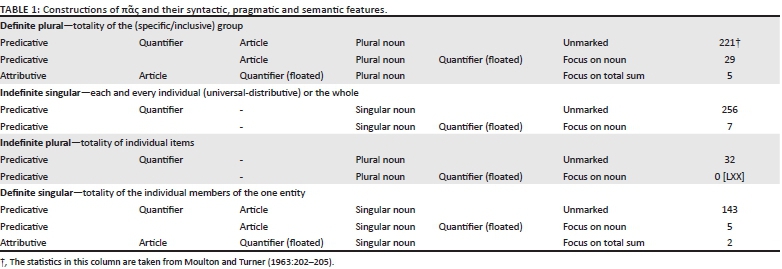
In linguistic terms, a quantifier is an item that appears with a noun to specify the number or amount of referents indicated by the noun. In English, various kinds of quantification are lexically differentiated-universal quantification (all), distributive quantification (each), and universal-distributive (every). In Greek, however, quantification is conveyed syntactically using primarily one lexical item, namely πᾶς. In this article, we examine the syntactic patterns of πᾶς as a quantifier from a linguistic point of view with attention to the determination of the noun (articular versus anarthrous), the number of the noun (singular versus plural) and the phrasal word order. We also examine the phenomenon of 'floating' quantification in which the quantifier moves to a new position in the noun phrase. Finally, we compare the patterns found in New Testament Greek with those of the quantifier •– in the Hebrew Bible in order to determine the extent and type of Semitic interference with respect to quantification in New Testament Greek grammar.CONTRIBUTION: The syntactic patterns of πᾶς as a quantifier are identified and the semantic import of each pattern is described. The relationship of πᾶς to the quantifier •– in the Hebrew Bible shows evidence of Semitic interference in New Testament Greek grammar
New Testament Greek syntax; quantification; quantifier; universal quantification; distributive quantification; floating quantification; Hebraisms