Dionisiese spore in Kusa se metafisika
Abstract
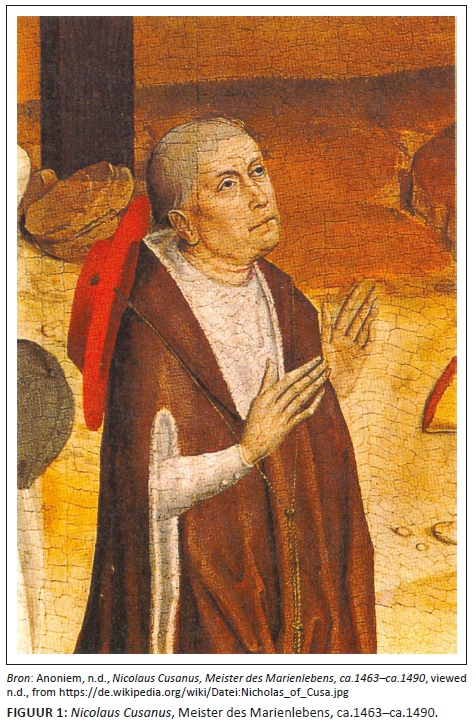
This article investigates the palimpsest reception of Pseudo-Dionysius (ca. 500) in the metaphysics of Nicholas of Cusa (1401-1464). The article covers Cusa's political theory and metaphysics, which are intertwined. Reading Cusa against the backdrop of an analysis of Pseudo-Dionysius' metaphysics in a preceding article, the author, in a synthetic conclusion, isolates seven Dionysic 'trails' (S1 to S7) in Cusa's metaphysics: the interpretation of transcendence as bound to immanence; the affirmation of God's transcendence in the world (or a metaphysics of 'creation as teophany'); the radical transcendence and simultaneous radical immanence of God (that is, God as 'Beingness'); fundamental restrictions of language and the analogical 'Naming' of God; creation as a system of dialectical symbols about God; the analogical participation of the subject in creation; and unification (reditus, the 'flowing of things back to God'). The Dionysic trails in Cusa's metaphysics are described as a noteworthy, if not important, palimpsest in the corpus of late Medieval philosophy and is indicative of what the author puts forward as 'discursive memory', which is presented as a modern-critical concept.
 Thumbnail