Consciring subjects: Q methodology described
Abstract
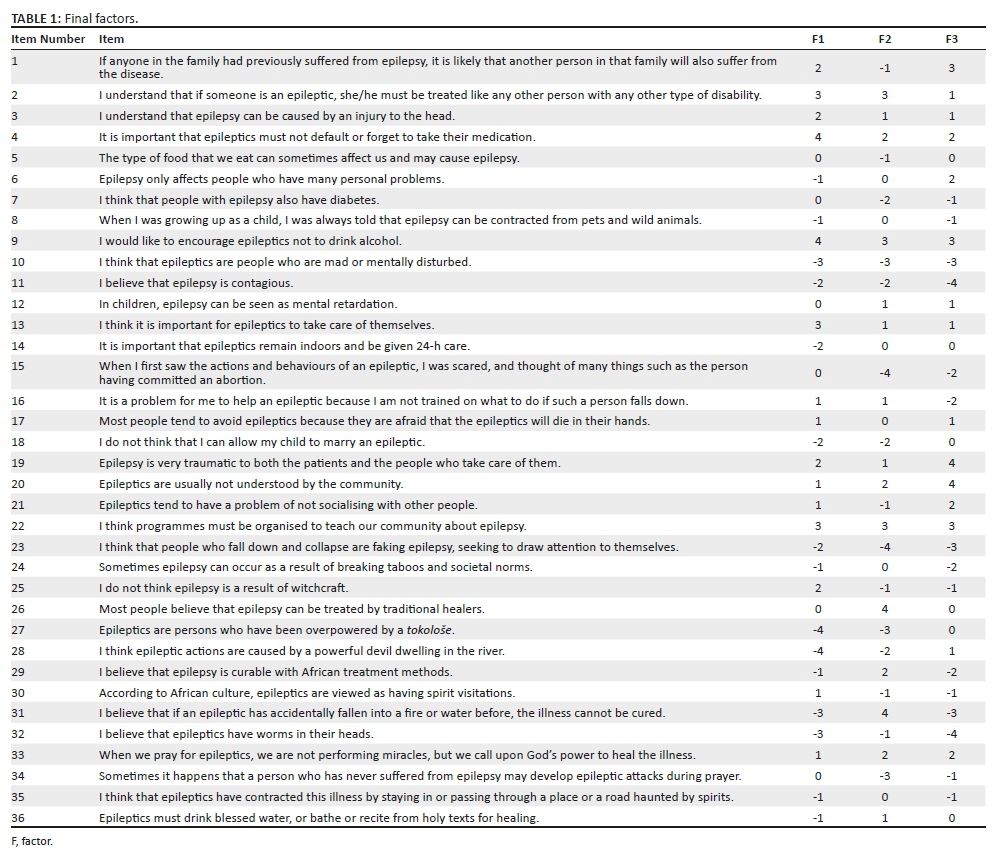
BACKGROUND: Despite the availability of Q methodology as a qualitative research alternative that seemingly circumvents the limits of standard qualitative methods across various fields, a recent review of qualitative research literature in leading health-related South African journals indicated that Q methodology is hardly a method of choice in South Africa. AIM: This article demonstrates the application of Q methodology, a qualitative research option, in psychological research. The methodology is suitably designed to investigate and clarify diverse subjective experiences, attitudes, opinions and/or beliefs held by a group of people on a given topic. METHODOLOGY: A study on the subjective understandings and perceptions of epilepsy is used to illustrate how Q methodology works. In this particular study, a diverse group of participants, comprising students, traditional healers, doctors, nurses, pastors, high school teachers, laypeople domiciled in rural and urban areas, and speakers of two of the dominant African dialects in the area, was used. RESULTS: Analysis produced three distinctive factors that are appositely named the scientific, the moderated traditionalist and the community-oriented stances. Each factor, constituted on the basis of close resemblance and statistical association between the rank orderings, represents an identifiable understanding of epilepsy by an exclusive grouping of participants. CONCLUSION: Concluding remarks about Q methodology are provided.
concourse; epilepsy; factor array; P-set; Q-sample; Q-sorting
 Thumbnail