Association of mode of entry to a nursing programme and student success: A two-year retrospective multi-cohort study
Abstract
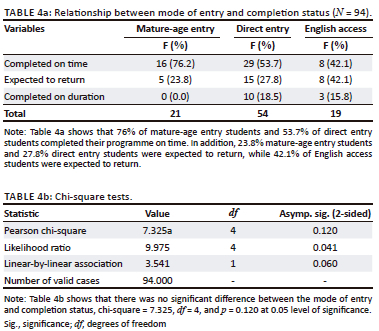
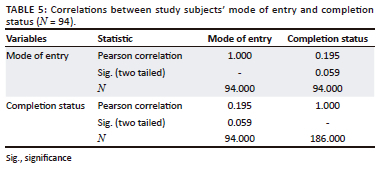
BACKGROUND: The issue of the mode of entry to nursing programmes and its effect on student success is a key concern among researchers globally. Identifying the mode of entry, which has the potential to improve academic success, decrease the failure rate and lead to the successful completion of a degree, is crucial to increase the nursing workforce AIM: The objectives of this study were to assess the association of mode of entry to a nursing programme on student success among undergraduate students SETTING: The study was conducted at a public nursing education institution (NEIs) in the northeast of Namibia METHOD: A retrospective multi-cohort study was conducted to assess the association of mode of entry on student success. Academic outcomes were analysed, observing two cohorts of nursing students RESULTS: Results show that 76.2% (f = 16) of mature-age entry students and 53.7% (f = 29) of direct entry students completed their programme on time. However, 42.1% (f = 8) of access students were expected to return. Female students 56.8% (f = 25) and male students 56.0% (f = 28) completed on time. There was no significant relationship between the mode of entry and completion status with p > 0.05, respectively CONCLUSION: A higher percentage of mature-age entry students was found to complete their studies on time than direct entry and English access entry students CONTRIBUTION: These findings could be used in the revision of student recruitment strategies to select nursing students who are more likely to achieve the best academic outcomes
mature-age entry; nursing programme; student success; mode of entry; undergraduate