Home-based care for umbilical cords of neonates by family caregivers in Mpumalanga province, South Africa
Abstract
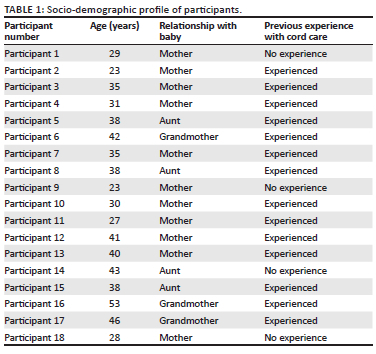
BACKGROUND: Multiple substances have been applied to neonates' umbilical cords and have yielded detrimental results on neonates' health status AIM: The study aimed to explore and describe home-based care for umbilical cords of neonates by family caregivers SETTING: The study was conducted at Waterval community, a village under Dr J.S Moroka local municipality in Nkangala district in the Mpumalanga province METHODS: A qualitative exploratory, descriptive research study design was used to explore home-based care for neonates' umbilical cords. The target population was family caregivers who had been caring for the umbilical cords of neonates at home. Non-probability and purposive sampling were done, and individual in-depth interviews were used for data collection. The sample size of 18 participants was determined by data saturation. Thematic analysis was utilised to analyse the data RESULTS: The following main themes emerged during data analysis: substances applied on the umbilical cord, beliefs associated with umbilical cord care, the effectiveness of health education provided on discharge from the community health centre and the healing process CONCLUSION: The findings of the study revealed that various harmful substances were applied to the umbilical cords of neonates, and these practices were influenced by cultural beliefs CONTRIBUTION: The findings of the study brought to light that indeed, the application of substances that have not been recommended by the South African guidelines on neonates' umbilical cord does lead to delayed umbilical cord separation and healing and has the potential to cause neonatal infections
family caregivers; neonatal home-based care; neonatal care; umbilical cord care; neonates