Peer-mentees' challenges in an undergraduate peer-group clinical mentoring programme in a nursing education institution
Abstract
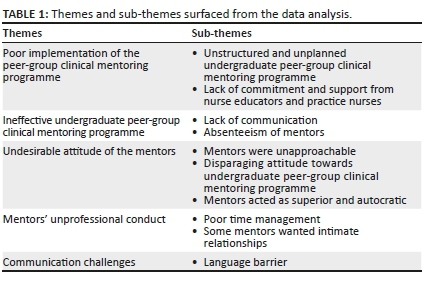
BACKGROUND: Clinical competency and professional growth amongst nursing students is the cornerstone of a nursing education programme. The demanding and complex training of nursing students requires various clinical teaching and learning strategies such as peer-group clinical mentoring.AIM: The objective of this research was to explore and describe the challenges that peer-mentees experience in an undergraduate peer-group clinical mentoring programme in one-specific nursing education institution in the North West Province.SETTING: The study was conducted at a nursing education institution in North West Province.METHODS: A qualitative, retrospective case study research design was used. Two separate World Café sessions following a semi-structured schedule based on Gibbs Reflective Cycle were conducted with 51 peer-mentees who were mentored in clinical practice. Four levels of qualitative thematic data analyses were employed to analyse the data.RESULTS: Five themes emerged from the findings of the study, namely, poor implementation of the peer-group clinical mentoring programme, ineffective undergraduate peer-group clinical mentoring programme, undesirable attitudes of the mentors, mentors unprofessional conduct as well as communication challenges. Ten sub-themes emerged from the findings. Literature control was done to support the findings.CONCLUSION: The findings showed that undergraduate nursing students faced a diversity of challenges in the effective learning and teaching of peer-mentees in a clinical context. Limitations and recommendations of the study were given. Recommendations were given for nursing practice, education and research
Reinforcement; Undergraduate peer-group clinical mentoring programme; Clinical mentoring; Undergraduate nursing student; Clinical learning and teaching