Experiences of nurse educators regarding teaching and learning during the COVID-19 pandemic
Abstract
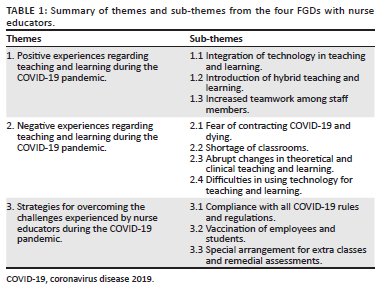
BACKGROUND: The abrupt start of the coronavirus disease 2019 (COVID-19) pandemic impacted educational systems globally, including nursing education institutions (NEIs). Teaching and learning in academic institutions were disturbed because of strict legislation measures, like lockdowns, that were implemented to curb the spread of COVID-19. These measures affected the quality of teaching and academic attainment AIM: This study aimed to explore and describe the experiences of nurse educators regarding teaching and learning during the COVID-19 pandemic at a NEI in the North West province (NWP). The study was conducted at a selected NEI, which comprises two campuses that are 178.1 km apart METHOD: A qualitative descriptive phenomenology approach was used. The nurse educators were purposively sampled, and 25 nurse educators participated in this study. Four focus group discussions (FGDs) were held to collect data through face-to-face semi-structured interviews. The data analysis followed Colaizzi's seven-stage process RESULTS: Three themes emerged from data analysis: positive experiences and negative experiences regarding teaching and learning during the COVID-19 pandemic, and strategies for overcoming the challenges experienced by nurse educators during the COVID-19 pandemic CONCLUSION: The study findings revealed that nurse educators experienced positive and negative challenges regarding teaching and learning during the COVID-19 pandemic. Furthermore, there is a need for NEIs to employ teaching and learning innovations, including the use of technology, to be able to divert to online teaching and learning during future pandemics where face-to-face teaching is halted CONTRIBUTION: The study findings may provide valuable insights for policymakers in higher education institutions (HEIs) to develop policies that incorporate innovative teaching methods. These methods will be relevant for future pandemics that may disrupt traditional face-to-face teaching and learning. As an enhancement of existing teaching practices, innovative approaches have proven to be effective and contribute to more inclusive education. By adopting these methods, HEIs can better support the achievement of Sustainable Development Goal 4, which aims to ensure quality and equitable education for all
higher education institutions; COVID-19; experiences; nurse educator; nursing education institution