Is community-based electrocardiography education feasible in the early phase of an undergraduate medical curriculum?
Abstract
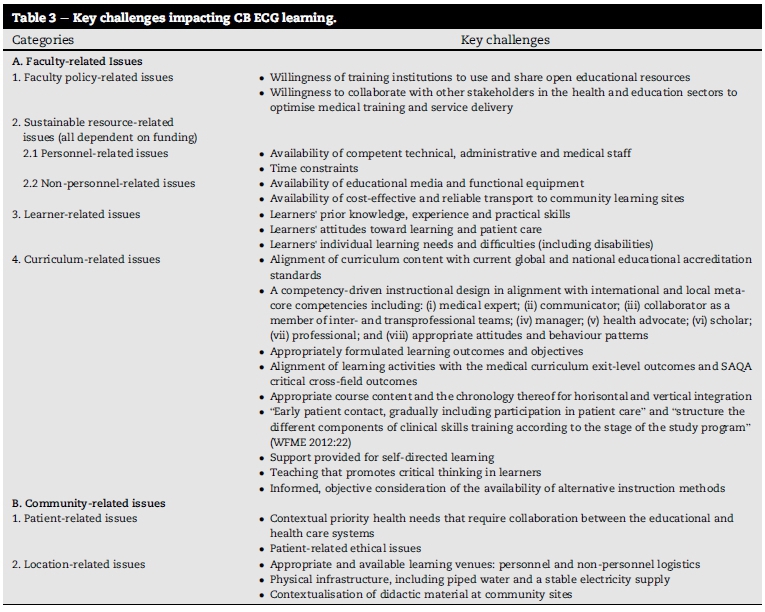
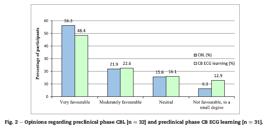
Accreditation authorities expect medical schools to increase their teaching standards and civic engagement, despite limited resources. The aim of this study was to investigate the feasibility of community-based (CB) electrocardiography (ECG) instruction in semesters 4 and/or 5 of the undergraduate MBChB programme at the University of the Free State in Bloemfontein, South Africa. A literature review and 34 structured interviews were employed, using a mixed-methods QUAN (+qual) research design. Regarding the preclin-ical phase, 18 interviewees strongly supported community-based learning (CBL) and 21 strongly supported task-based (TB) CBL. Responses were more conservative regarding the practicability of TB CBL. Twenty-two interviewees supported preclinical phase ECG-specific CBL. There was more support for implementing CB ECG in the clinical phase than in the preclinical phase. Challenges identified included finances, transport, personnel availability, clinic space, curriculum time constraints, student and driver absenteeism, and ethical aspects. Solutions for the preclinical phase included combining electrocardiography with other CBL tasks. Many interviewees supported preclinical phase TB CBL, although several factors determine its feasibility. Availability of human and other resources and curriculum time significantly impact CB ECG learning. Solutions necessitate additional location-specific research.
Electrocardiography; ECG; Training; Education; Medical curriculum; Undergraduate
 Thumbnail
 Thumbnail