Suppressed data: The controversy on Lynn Saffery's enquiry into African living conditions on the Northern Rhodesian Copperbelt, 1942-1945
Abstract
This article examines the controversy over Ambrose Lynn Saffery's enquiry into African living conditions on the Northern Rhodesian Copperbelt during the Second World War. The enquiry was held from August 1942 to January 1943 at the peak of the war, when the colonial government, mineworkers and mine management all faced the worst pressures of the war. The article contributes to scholarship on the impact of the wartime political economy on African living conditions in urban areas. Scholars analysed the surveys conducted on the urban African cost of living and demonstrate how they were shaped by the prevailing political economy. However, they largely overlook the debates that ensued during the enquiries and how they affected their conduct. The article uses archival evidence to demonstrate that Saffery's enquiry was shaped by the controversy between the Northern Rhodesia Chamber of Mines and the Labour Commissioner. While the former criticised the enquiry to protect the interests of the mining companies, the latter defended the study because it was organised by the Labour Department under his charge. The article reveals how the interests of different stakeholders influenced their perspectives on statistical enquiries. The controversy arose when the colonial government and the mining firms failed to accept and act upon the revelations of the survey. Instead, they suppressed the report to evade its political and economic implications.
Lynn Saffery; statistics; living conditions; cost of living; Copperbelt
Abstract
Hierdie artikel ondersoek die omstredenheid rondom Ambrose Lynn Saffery se ondersoek na die lewensomstandighede van swartes in die Noord-Rhodesiese Koperstreek gedurende die Tweede Wêreldoorlog. Hierdie ondersoek het van Augustus 1942 tot Januarie 1943 plaasgevind ten tyde van die felste oorlogvoering toe die koloniale regering, mynwerkers en mynbestuur met die ergste oorlogtydse druk gekonfronteer is. Dié artikel lewer 'n bydrae tot navorsing oor die impak van oorlogtydse politieke ekonomie op swart lewensomstandighede in stedelike gebiede. Navorsers het die opnames wat oor stedelike swart lewenskoste gedoen is, geanaliseer en aangetoon hoe dit deur die heersende politieke ekonomie gevorm is. Navorsers het egter grootliks die debatte wat tydens die ondersoeke aan die orde was en optredes beïnvloed het, geïgnoreer. Hierdie artikel maak van argivale bewysmateriaal gebruik om aan te dui dat Saffery se ondersoek deur die omstredenheid tussen die Noord-Rhodesiese Kamer van Mynwese en die Arbeidskommissaris beïnvloed is. Eersgenoemde het die ondersoek gekritiseer ten einde die belange van die mynmaatskappye te beskerm, terwyl laasgenoemde die ondersoek ondersteun het omdat dit deur die Departement van Arbeid, onder beheer van Saffery, gedoen is. Die artikel ontbloot hoe die belange van verskillende groeperinge hulle perspektiewe oor statistiese ondersoeke bepaal het. Die omstredenheid het ontstaan toe die koloniale regering en die mynmaatskappye geweier het om die bevindinge van die ondersoek te aanvaar en daarvolgens op te tree. In plaas daarvan het hulle die verslag ter syde gestel ten einde die politieke en ekonomiese gevolge van die bevindinge te vermy.
Lynn Saffery; statistiek; lewensomstandighede; lewenskoste; Koperstreek
Introduction
Political economy has been a major factor in statistical development in Africa since the colonial period. Various scholars have argued that political and economic conditions influenced the conduct of statistical enquiries and the nature and quality of data produced.1 Florian Kratke and Bruce Byiers argue that statistical development in colonial Africa was shaped by prevailing political currents and the perceived economic incentives of the data to the colonisers.2 The incentives and motivations for political elites, bureaucrats and other major actors shaped the production of statistics because they determined what and how to count.3 However, these scholars overlook the contests that emerged among different actors over the data. Sulaiman Bah and Pali Lehohla analyse the influence of political dynamics in the development of statistics in South Africa during Apartheid.4 They note that as racism coloured the country's policies, it inspired a racially stratified statistics system that collected much data on whites with little on Africans and other races.5 Consequently, African demographic statistics were scanty until the end of the apartheid period, after which they were expanded.
Gerardo Serra contends that the 1950s household budget surveys in Ghana were designed to suit the government's political agenda because they censored decisions on areas enumerated, subjects covered and the concepts and methods used.6 Hence, the surveys were not based purely on statistical decisions and this made their accuracy doubtful. Serra concludes that statistics were not necessarily a neutral reflection of reality as they were produced by social actors who had their own priorities.7 Similarly, Robert Ross argues that household budget studies held in Central Africa, including Northern Rhodesia, were political tools that colonial officials used to justify their hold on power by producing data which showed that they made the colonies prosper.8 Their surveys were biased towards areas of political and economic importance, such as the line-of-rail towns in Northern Rhodesia. Unlike scholars who do not recognise the competing forces that the state faced, Ross demonstrates that the Rhodes-Livingstone Institute researchers countered the work of government statistical offices and compiled data which showed that African living conditions were deteriorating.9 Consequently, controversies emerged over which datasets captured African living conditions correctly and sometimes, contentious reports were suppressed.
In the case of South Africa, Ross notes that household budget studies held during the Second World War at Kroonstad and Johannesburg produced crucial findings on the African cost of living. Yet, the reports on these findings were not published due to their low level of accuracy and for fear that they might fuel African agitation and be used as a political weapon against local authorities.10 This must also be viewed in terms of the wartime political economy. Addressing the issues raised in the reports required the direction of finances from the war effort, which the authorities were reluctant to accept. Hence, despite being circulated among officials, the reports were not published. However, Ross does not examine the controversies that erupted in reaction to these studies and the colonial officials' contribution to the suppression of the reports.
This article unravels a controversy that emerged during the Second World War between the mining companies and the Labour Commissioner, R.S. Hudson, over an enquiry undertaken under the auspices of the colonial government by the anthropologist Ambrose Lynn Saffery on African living conditions on the Northern Rhodesian Copperbelt from August 1942 to January 1943. The enquiry yielded data on African incomes and living costs.11 Although the Labour Commissioner and some labour officers praised Saffery's enquiry, the Northern Rhodesia Chamber of Mines (NRCM) sternly criticised it. The NRCM was formed earlier in 1941 by the four mining companies operating at Roan Antelope, Rhokana, Mufulira and Nchanga to coordinate their policies and represent their interests, especially regarding labour.12
The study analyses both sides of the controversy closely and argues that the commentators were influenced by the interests they represented and by the implications of the data. It contributes to the literature that views the cost-of-living studies as having been shaped by political and economic discourses of their time. The debates that emerged from the investigations illuminate the political economy of statistics. The article uses a variety of archival sources collected from the National Archives of Zambia (NAZ) in Lusaka, the Zambia Consolidated Copper Mines (ZCCM) Archives in Ndola, and the Historical Papers Research Archives (HPRA) at the University of the Witwatersrand in South Africa. The archives in Zambia were informative on Saffery's enquiry on the Copperbelt, while the HPRA provided data on his background and early research undertaken in South Africa.
The article begins by examining the nexus between the Second World War and cost of living research in Northern Rhodesia and provides a background on Saffery and his studies in South Africa.13 In some measure, these aspects shaped his enquiry on the Copperbelt and the emergence of the controversy. The discussion then turns to an analysis of the conduct of Saffery's enquiry, the debate it yielded, and the ramifications and implications of the enquiry.
The Second World War and cost of living research in Northern Rhodesia
Just as elsewhere in the British Empire, the Second World War (1939-1945) stirred the production of cost-of-living statistics in Northern Rhodesia. Before the war, the data on the cost of living in the country was scanty and confined to Europeans, showing only the prices of items in the line-of-rail towns. Colonial officials reported that data on Africans were unobtainable because the Africans were marginally integrated in the money economy, making it difficult to collect statistics on their living costs.14 However, the economist A.G. Robinson undertook a study of African households on the Copperbelt, which was published in 1933. This study only yielded 'estimate[s] of how the wages that had been earned in the Roan Antelope mine were actually spent.'15 After the 1935 strike by African mineworkers, the government felt the need to collect data on Africans and established the Rhodes-Livingstone Institute in 1937. This was followed by a study of African households by the anthropologist Godfrey Wilson at Broken Hill (Kabwe) in 1938-41. However, Wilson's study was limited in that it only included the Africans employed by the railway town's management board, the government, those in mission and domestic service, and their wages and budgets.16
During the war, the Northern Rhodesian government began collecting statistics on the cost of living. This was inspired by the rise in the cost of living that caused labour protests in urban areas. The war caused a drastic rise in commodity prices that arose as a result of shortages of essential goods and profiteering by some traders.17 This inflation of prices was also common elsewhere in the Empire. Westcott observes that in Tanganyika (Tan7ania), the prices of imported items doubled during the war.18 The commodity shortage itself emanated from the reduction in metropolitan exports to the colonies and the incidence of wartime shipping blockades by the Axis powers.19 With the wartime rise in the cost of living, the Labour Department, formed in 1939, began compiling data on commodity prices from African stores. With this in mind, the study of cost-of-living data was extended to urban Africans so that the findings could be used to assess the war's effects on their livelihood.20 The wartime challenges also sparked industrial action by mineworkers on the Copperbelt. On 17 March 1940, about 2 000 European miners at Mufulira and Nkana went on strike and a few days later, African mineworkers followed suit.21 Tembo notes that the strike was instigated by wartime economic exigencies such as labour shortages, price inflation, high living costs and static copper prices, all of which prompted mining companies to deny wage increases to their employees.22
In 1940, the Forster Commission investigated the Copperbelt strikes and recommended that an enquiry be undertaken 'into the extent to which the cost of living for Natives has increased owing to war conditions and that if the present bonus of 2/6 is found to be inadequate, it should be adjusted accordingly.'23 In May 1940, the mining companies on the Copperbelt introduced a war bonus or cost-of- living allowance, which was to be reviewed periodically on the basis of changes in prices of an agreed list of articles bought by Africans.24 The government requested other employers to follow suit and as a basis for assessing the rate of the allowance began compiling data on African living costs. By February 1941, the Labour Department, the Price Controller and the NRCM had come up with a list of essential articles for assessing the African cost of living.25 Based on the assumption that African employees received enough food rations, food items were excluded from the list, which was unfair because their families often had to engage in gardening, trade and beer sales to supplement their meagre rations.26Thus, in practice, there were often difficulties in arriving at fair prices to be used for calculating the rate of the cost-of-living allowance.27 It was in this context that the Northern Rhodesian government engaged Lynn Saffery to undertake an investigation of the wartime cost-of-living conditions of Africans on the Copperbelt.
Background and early research by Ambrose Lynn Saffery
Lynn Saffery was a South African anthropologist with vast experience in research on urban African livelihoods and a supporter of African trade unionism.28 He was born on 8 May 1910 at Humansdorp in present day Eastern Cape and attended St. Andrews College in Grahamstown where he matriculated in 1928.29 Saffery then pursued a Bachelor of History and Social Anthropology at the University of Cape Town and graduated in 1931. In 1933, he joined the South African Institute of Race Relations (SAIRR) in Johannesburg where he was appointed Assistant Secretary in 1934 and became Secretary from 1937 to 1943.30 While at the SAIRR, Saffery undertook research on labour problems, industrial legislation and African living conditions in urban areas of South Africa. He also held several enquiries into the cost of living of unskilled workers in various locations under the auspices of the South African Council of Educational and Social Research, the Smit Commission and the Wage Board.31 In 1939, he also made a study of the organisation of skilled workers in England and gained valuable experience for his contacts with African trade unions. His studies were prompted by the sharp rise in the cost of living in South Africa and elsewhere in the British Empire.32
Among Saffery's studies of the living conditions of Africans in South Africa was his enquiry at Kroonstad in May 1940. This was done in response to a request from the Kroonstad Location Advisory Board, which was bothered by African poverty and inadequate wages.33 Saffery computed the wages of male family members and related them to the cost in Kroonstad of a scientific minimum diet for a standard African family of five comprising a husband, wife and three children. To the cost of the diet, he added an estimate of the minimum spent on clothes, rent, school fees, medicine and sundries.34He found that the average weekly wage of Africans was 12s. 6d. while a standard family required a minimum of £1. 8s. 81/2d. to meet its weekly living costs.35 The deficit of the male wages over the cost of living was offset by economising on food, the income of wives and children from domestic work and by selling home-brewed beer.36 Ross notes that similar research in Durban and Johannesburg showed that African incomes were insufficient for a reasonable level of survival and, likewise, the deficit was offset by saving on food, earnings from juvenile labour, wives doing domestic work, brewing beer and occasionally, from renting out rooms in the family dwelling.37 In view of the deficit of wages over living costs, Saffery proposed a rise in African wages to a daily minimum of 3s. 6d. Although his findings featured in minimum wage debates in South Africa, his report was never published.38
Under the auspices of the South African Council for Education and Social Research, Saffery and Julian Rollnick conducted an enquiry into the wages and living conditions of unskilled African workers in Kimberley in 1941.39 The data were to be used for assessing the needs of unskilled workers and investigating ways of improving African living conditions in urban areas. After interviewing Africans about what they actually bought, the investigators compiled a list of the main items and evaluated the cost of each according to a reasonable minimum standard. The list of food items followed the minimum diet used by Saffery at Kroonstad but was based on the available foodstuffs at Kimberley.40 Food items were purchased and prices checked and the cost of fuel, transport and furniture were also included. The enquiry revealed that the weekly minimum expenditure of a standard family was £2. 1s. while the income of a family in Kimberley was only about 25s. out of which 18s. was from wages.41 The enquiry revealed that the wage income of unskilled workers was hopelessly inadequate, and had to be supplemented by the incomes of women and children. The investigators recommended that African wages be raised, social services be expanded, charitable care of the poor, sick and needy be increased and that Kimberley authorities should include African welfare in financial policies.42 Without doubt, it was due to this experience in investigating the living conditions of urban Africans, that Saffery was engaged to conduct the cost-of-living enquiry in Northern Rhodesia.
Saffery's cost-of-living enquiry on the Copperbelt
In August 1942, in response to the 1940 mineworkers' strikes, the Labour Department in what was then Northern Rhodesia, invited Saffery to undertake a six-month enquiry into the African cost of living and to advise the authorities on labour issues and industrial legislation.43 His first term of reference was 'to investigate the cost of living of Africans on the Copperbelt ... and to calculate a minimum standard of living based on international requirements and adjusted to suit local conditions.'44 Beginning in Rhokana (now Kitwe), the study was later extended to other urban areas on the line-of-rail, namely Ndola, Broken Hill, Lusaka and Livingstone. The second objective was to find out the extent and effects of stabilisation on the Copperbelt, while the third was to consider methods of providing collective bargaining to urban Africans and the suitability of the existing industrial legislation.45
Upon his arrival in Northern Rhodesia, Saffery spent a week in Lusaka and held discussions with the Labour Commissioner and other officials. He examined various official documents.46 He then relocated to Nkana on the Copperbelt where he was based and made brief visits to other centres, namely Mufulira, Roan Antelope, Nchanga and Ndola. He interviewed government officials, mine authorities, labour employers, missionaries and Africans on various aspects relating to the enquiry.47 He also examined official records and made house-to-house visits to African compounds to ascertain the living conditions of Africans. Only then did he compile a comprehensive report of his findings.
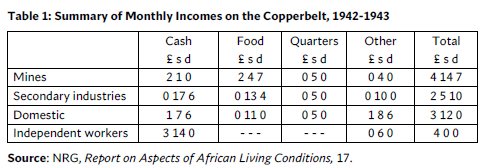
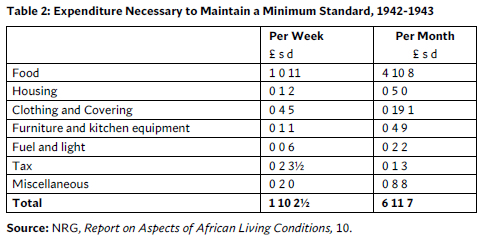
In his calculation of the cost of living of a 'typical' African family resident in the area, Saffery used a standard family of four; a husband, wife and two children, which was the average African family size in urban Northern Rhodesia.48 He compiled data on incomes and expenditures of this standard African family on the Copperbelt. The data is as shown in Table 1 and Table 2 below.
As can be seen from Table 1, Saffery estimated that African mineworkers had an average monthly income of £4. 14s. 7d., which included cash, food, living quarters and other sources, while their respective incomes from secondary industries, domestic service and independent work were £2. 5s. 10d., £3. 12s. and £4.49 On the other hand, he estimated that the monthly expenditure required for an African family to maintain a minimum living standard was £6. 11s. 7d. comprising £4. 10s. 8d for food, 5s. for housing, 19s. 1d. for clothing and covering, 4s. 9d. for furniture and equipment, 2s. 2d. for fuel and light, 1s. 3d. for tax and 8s. 8d. for other items.50
Comparison of data on the income and cost of living indicate a clear deficit. While the minimum living cost of a standard family was £6. 11s. 7d. per month, the maximum monthly income was £4. 14s. 7d., with the gap made up by various other means such as gardening, barter, beer sales and economy.51 This was similar to his findings at Kimberley and Kroonstad where women were engaged in domestic work to supplement the income of male wage earners.52 Likewise, Miriam Janisch's enquiry in Johannesburg found that the average monthly income of a family fell short of the expenditure/living costs and the deficit was made up by beer brewing or borrowing.53 With the revelations of the Copperbelt enquiry, Saffery concluded that the wartime inflation drastically increased the cost of living and impoverished most African urban dwellers.54 Despite being informative on the effects of the war on urban Africans, the enquiry opened up a heated controversy in Northern Rhodesia.
Criticism of Saffery's investigation by the Chamber of Mines
Saffery's enquiry attracted criticism from the NRCM, compound managers and some labour officers. The most incisive criticism was from the NRCM, which criticised the enquiry as having been 'based on inadequate data'. While some of the arguments of the NRCM were justifiable, others as this section demonstrates, were merely intended to defend the mining companies, whose interests it was intended to protect. Worth noting is that Saffery had a history of supporting African trade unions in South Africa and was seen as a threat to the mines and the colonial administration in Northern Rhodesia.55 The mines were thus against his presence on the Copperbelt for fear that he might influence mineworkers to engage in industrial unrest. In view these fears, the NRCM capitalised on the challenges that Saffery faced and the 'errors' he may have made. For instance, Saffery had lamented that 'six months was far too short a time in which to make really adequate investigations or detailed and profound study ...'56 In view of the inadequate time and data, the NRCM 'wondered' how Saffery had compiled such a lengthy report with many conclusions. It posited that an enquiry of such a wide scale should perhaps have been held by a commission of experts and not been limited to such a short period if they were to cover adequate ground and collect enough data.57 The NRCM also doubted Saffery's familiarity with statistical data despite his proven experience in cost-of-living research.
Another contention was raised on the concentration of the enquiry at Nkana. Saffery argued that it was only at Nkana that he found adequate data because the Compound Manager there, William J. Scrivener, had for many years collected, analysed and kept statistics on African labour, health, living and working conditions.58 For this reason, Saffery had relied heavily on data from Nkana to make generalised conclusions for the whole Copperbelt. Phyllis Deane cautions that it was perhaps unwise to rely on small samples when analysing African living conditions because there might be variations of level and content.59 In this regard, the NRCM criticised Saffery for not getting data from other Copperbelt centres, such as Mufulira, Roan Antelope, Nchanga and Ndola. It argued that compound managers in other centres also kept statistics on Africans' living and working conditions. It suggested that the data would have proved invaluable to the enquiry and a merger of various datasets would have yielded a more accurate basis for conclusions.60 The NRCM argued that Saffery's conclusions tended to be inaccurate because the situation at Nkana did not depict conditions in other centres. Saffery himself noted that some of his figures were arbitrary and that much of the report should not be treated as anything more than a preliminary indication of trends.61 The NRCM even argued that Saffery had drawn 'many baseless conclusions'.
The NRCM also criticised the 'minimum living standard' used in the enquiry, while Saffery indicated that the standard did no more than keep a person in reasonable health. In addition, the NRCM argued that the standard included many items not related to health (such as paying tax), and that it was designed specifically to keep a person in good health, comfort, entertainment, social life and luxury.62 The NRCM's argument was based on the fact that African conditions on the Copperbelt were similar to those on mines in other parts of the region and it viewed Saffery's argument as based on the conditions of European miners.63 Similarly, the NRCM argued that the 'standard' family was exaggerated because the average African family working on the mines comprised a man, wife and one and a half children; less than 16 per cent of married employees had two children.64 Hence, in the NRCM's view, the luxury items and overstated family inflated the living cost, which was worsened by the basing of the enquiry on 'abnormal' conditions. The NRCM disputed Saffery's data arguing that the enquiry should have been based on normal (standard) pre-war prices.65 For January 1943, the NRCM found items at prices lower than those Saffery used, citing: shirts at 6s. compared to 7s. 6d; a pair of shorts at 5s. compared to 6s. 6d; and a pair of trousers at 11s. 6d. compared to 30s.66 Overall, the NRCM argued that Saffery overstated the cost of living by more than double.
The NRCM also disputed Saffery's data on African wages. It claimed the facts were 'understated'. It collected, at each of the four mines, counter-data from male wage earners who admitted to having Saffery's 'average-sized family' and arrived at an average monthly cash earning of 43s. 5d. as compared with Saffery's 41s. It also refuted Saffery's claim that he had been 'liberal' in his assessment of the incomes being paid to workers when assessing the cost of a minimum living standard. The NRCM's view was that Saffery had understated the family income and inflated the living costs.67 The NRCM also dismissed his claim that there was a startling difference between the average income of the male wage earner and the minimum living cost of a standard family. Jane Parpart notes that the NRCM took advantage of the fact that most colonial officials were of the view that the mines as were exemplary employers who paid better wages than other employers and that employees rarely criticised the mine owners.68
The disparity in the figures produced by Saffery and the NRCM shows the nature of statistics drawn from processes that relied on the choices/decisions of the investigator. Jerven argues that decisions on 'who counts' and 'what counts' are usually subjective and highly controversial.69 That the NRCM collected statistics to counter those used by Saffery also casts doubt on the accuracy of its figures because it did so to protect the interests of the mines. As Parpart explains, the NRCM was a forum through which the mines devised uniform labour strategies and exerted influence on government policies.70 The mines rejected the data because it did not suit their agenda of minimising expenses and maximising profit.
The NRCM rejected Saffery's conclusions and recommendations as 'baseless'. It disagreed that the average African family was struggling to maintain a reasonable standard of living on the wages paid by the mining industry. It argued that Saffery had failed to prove that the wages of mineworkers were insufficient.71 It contended that the mines gave generous rations to their African employees and that there was never a need for them to buy expensive additional food for their families. They alleged that Saffery had not proved his claims about the deterioration of mineworkers' health and the high incidence of deficiency diseases and malnutrition in the mine compounds.72 Obviously, this was an attempt by the mines to minimise their responsibility for the health and wellbeing of their African employees. Walima Kalusa has demonstrated that the health of African mineworkers deteriorated during the war because the mines were reluctant to incur extra costs on them.73
The NRCM rejected Saffery's proposal to introduce a minimum wage, claiming it would be erroneous to do so based on abnormal conditions. Instead, it preferred giving subsidies and temporary allowances.74 Although it agreed that an advisory board should be appointed to verify Saffery's findings, it rejected his proposal for a full enquiry into the wages of unskilled workers.75 In addition, the NRCM criticised the proposal to introduce cash payment in lieu of rations. It argued that if African employees were given cash, they would simply spend it unwisely and buy food at retail prices. This would result in extra costs to employers.76 Furthermore, there was no guarantee that African workers would consume a balanced diet if given cash instead of rations and malnutrition would probably increase substantially. The mine owners said that they were concerned that a marked deterioration of the health of their workers would reduce productivity and cut their profits. Based on all these arguments, the NRCM advised the government to treat Saffery's report as 'preliminary' and to reject the recommendations. However, certain officials from the Labour Department, especially the Labour Commissioner, R.S. Hudson, defended aspects of Saffery's arguments, as shown below.
The Labour Commissioner's arguments in support of the enquiry
Some officials in the Labour Department, especially the Labour Commissioner, R.S. Hudson, defended the investigation partly because it was their department that organised the enquiry and had recruited Saffery.77 They argued that despite some errors Saffery had compiled useful data showing an understanding of African living conditions on the Copperbelt. They were aware that the wartime cost of living had risen and this was not reflected in the wages of workers. As Butler notes, 'basic wages remained low and working conditions deteriorated [during] the war.'78 To Saffery's supporters, the NRCM's criticism was just a ploy by the mines to conceal the inadequacy of the wages and the rations provided for the workers and to minimise their expenditure on the war bonus. Similarly, the Colonial Office noted in 1943 that the mines were just being sensitive to the financial implications and potential future costs.79
The Labour Commissioner responded to the NRCM's main criticisms describing them as 'entirely carping'. He argued that Saffery was very well qualified indeed to conduct the enquiry and that '...he was not engaged to make these investigations until [the Labour Commissioner himself had] made all possible enquiries regarding his capabilities in this direction'. Hudson went on to say that he had satisfied himself that Saffery was 'the best person we could obtain for the purpose'.80 While admitting that Saffery was not given enough time for a detailed study, he disagreed with the NRCM's claim that a six-month enquiry could not be used a basis for so lengthy a report as 'many far shorter investigations have resulted in far longer reports.'81
Hudson explained that he had instructed Saffery to make as full a report as he could, and furthermore gave Saffery 'directions on how to frame it and advised him to proceed as he thought best.'82 That Hudson gave Saffery such instructions illustrates that the enquiry was driven by forces beyond the investigator. In view of his instructions, Hudson admitted responsibility for some of the criticism that was raised.
Hudson also explained that because of the paucity of statistics on Africans, he had posted Saffery to Nkana, where it was possible to obtain the most data in the shortest time. He contended that other compound managers had far less data than Scrivener had.83 In Hudson's view, the data from Nkana had proved invaluable to the enquiry and particularly so in the limited time availed to him. Added to this, Saffery was correct to relate his findings on conditions at Nkana to other centres. While some of the criticism raised might be valid, Hudson mounted his defence because he headed the department that had organised the enquiry and had to protect his position and justify the expenditure on the survey.
The Labour Commissioner argued that since a correct diet is crucial to good health, the living standard used was not luxurious. He noted that the list of clothing followed what was agreed with the NRCM after enquiries on African mineworkers; and that the living standard could not ignore taxation because this was an ongoing liability 'whatever the earnings'.84 He added that Saffery's studies in South Africa had also included taxation because it was an unavoidable item of expenditure for adult male Africans.85 Adult male Africans were required to pay an annual tax of £1, which was about 5d. per week. Hudson also defended the basing of the living standard on wartime conditions as there were no data for the pre-war years and the investigator could only report on the prevailing conditions. He noted that because of the unavailability of data on African pre-war living conditions, it had been impossible to compute a cost-of-living index.86 Besides, many of the commodities that were available prior to the war had become unobtainable.
With regard to the size of the so-called 'standard' family, Hudson responded that the figure of four was a territorial one and included non-mineworkers. He advised Saffery to adopt that standard since it was derived after widespread enquiries had been made earlier in urban areas.87 He went on to note that if it was found necessary to fix minimum wages, adjustments could be made for any deviati ons. Hudson also refuted the NRCM's claim that mineworkers received high wages and excellent rations and posited that while the wages and rations were sufficient for a single labourer, they were inadequate to feed a family.88 The mining companies, in his view were mistaken in their claim that employees and their families were fed 'adequately'. Kalusa notes that during the war, the mines undercut rations to minimise the cost of feeding their workers.89 To Hudson, the NRCM's claim that Saffery had inflated food prices was unjustified. He noted that most of the prices quoted reflected the situation correctly and were confirmed by the Labour Department.90
Hudson also justified the use of the Rhokana (Nkana) ration scale to derive food requirements for calculating the cost of living. This was because it had the highest proportion of calories obtained from protective foods, as compared to the scales followed at the Nchanga, Mufulira and Roan Antelope mines.91 Therefore, the scale mentioned was healthier than the other three scales and was recommended by the Forster Commission and the Director of Medical Services for use in calculations of the Africans' cost of living.92 Kalusa explains that it had 'adequate protein in the form of animal flesh [and] sufficient fruit and vegetable needed in supporting required vitamins'.93 Hudson also defended the use of the Lusk standard to derive rations for women and children because this scale was accepted internationally and had hitherto been used in Jamaica.94 He remarked that to claim that most African women had at least five dresses did not necessarily mean their incomes were adequate. Rather, it was feasible to argue that their growing desire for modern goods prompted them to spend more than they could normally afford.95 By the 1940s, Africans had become increasingly desirous of European clothing and other goods that enhanced their status.
Furthermore, Hudson argued that criticism of data on the minimum living standard and cost was undue. In his view, the minimum living costs estimated by both Saffery and the NRCM fell short of the desirable minimum.96 He disagreed with assertions that Saffery's estimate of the average family income was mean and that the minimum living cost was generous. He contended that the average family was unable to maintain a reasonable living standard and that despite receiving rations, mine employees had to buy supplementary foodstuffs.97 He also noted that whether African employees required a wage rise to enable their families maintain a reasonable living standard would be decided after an enquiry by an advisory board. Yet, as was the case in other colonies, the government and other employers were loath to increase wages. In Sierra Leone, Sekgoma demonstrates that the heavy demands of the war accompanied by poor remuneration to employees had sparked a strike by workers in February 1942.98
In response to the NRCM's argument against cash in lieu of rations, Hudson concurred that it would bring extra costs to employers.99 Generally, for obvious reasons, employers were against cash payments. In Tanganyika, 'employers offered rations rather than cash increases, but these were often unpalatable and very unpopular among Africans.'100 By contrast, in South Africa, 'some increase in the wage rates occurred but this did not compensate for the increase in prices. Africans could only survive by eating too little and getting into debt.'101 As the next section illustrates, the above controversy, especially the NRCM's criticism, had serious implications that resulted in Saffery's report being proscribed.
Implications and suppression of Saffery's enquiry
The findings of Saffery's enquiry had serious political and economic implications that led to its suppression by mining authorities and the colonial administration. It should be noted that the data produced by the enquiry entailed that the working conditions of Africans, particularly their rations and wages, had to be improved significantly.102 Thus, accepting Saffery's findings and making them known to African workers and other stakeholders concerned about their welfare would significantly strengthen the Africans' case for better working conditions and wages, and had the danger of exacerbating labour militancy and industrial disharmony.
Another significant implication was that the mining companies and the colonial administration would have to spend significantly more resources to improve the working and living conditions of Africans. Yet, this was improbable because it contradicted wartime priorities at a time when resources were needed to finance Northern Rhodesia's contribution towards the Second World War. Alfred Tembo has shown the wartime importance of Northern Rhodesia's copper mining industry.103 Moreover, the colonial administration was alive to the fact that compelling mining firms to spend on improving African conditions to the extent implied by the findings, would stifle the mining sector, which was its main source of revenue, and jeopardise its relations with the mining companies. Research by Hyden Munene concurs, indicating that '...the colonial government and the mining companies worked closely together in supporting the war effort.'104 Aware of the implications of Saffery's findings, high-ranking colonial officials took a stance to protect the mining sector and suppressed Saffery's data.
Initially, the colonial administration attempted to keep Saffery away from the copper mining centres by assigning him to undertake research outside the region. In July 1943, it appointed Saffery as Labour Officer for research and labour advisory work and tasked him with undertaking other surveys.105
Between October 1943 and July 1944, Saffery was assigned to conduct enquiries in Broken Hill, Livingstone, Lusaka and Ndola where he studied the budgets of employees who received cash in lieu of rations.106 Parpart indicates that by sending Saffery to these towns, the government tried to keep him away from the copper mining centres to reduce the tension with the NRCM that was threatened by his presence.107 The extended enquiries incorporated procedures proposed by the 1944 conference of labour officers but some of them were applied 'under instructions' and not by choice. These included the Platt Scale (a medical nutritional scale authored by a British nutritionist Dr B.S. Platt) that was used to calculate minimum food requirements.108Some labour officers asserted that the scale had sufficient dietary groups but Saffery considered it to be 'inadequate in terms of balance and palatability' and applied it only under instruction because he preferred the Rhokana Scale.109 Kalusa notes that the government rejected the Rhokana Scale for fear that it might lead to labour stabilisation and urbanisation while the mining sector resented it for fear of increased expenditure.110
Similarly, Saffery estimated clothing and housing requirements based on the recommendations of labour officers. He lamented that the list of clothing requirements of the unskilled worker and his family suggested by labour officers was inadequate but he had to apply it as instructed at the conference.111 As for housing requirements, Saffery remarked that his use of 5s. as the monthly rent was criticised at the conference as being 'sub-economic'. It was therefore adjusted to a monthly rent of 13s. for married Africans as recommended by the conference.112 The incorporation of these procedures clearly demonstrates the influence of the colonial administration and mining firms. Saffery's second enquiry revealed similar trends as the first on the escalating cost of living, and once again it was opposed by colonial officials in Northern Rhodesia.
Predictably, the colonial administration settled for the view that Saffery's report was inaccurate and withheld it from circulation to avoid the cost implications of the findings. In February 1944, the Secretary for Native Affairs remarked that Saffery's report was inaccurate because 'doubt has been expressed as regards the accuracy of his findings by even the most liberal of the compound managers.'113 He went on to warn that Saffery's data should be used only with utmost care. Similarly, the Chief Secretary stressed that the report was challenged by the NRCM as inaccurate and misleading and cautioned those who intended to extract data from it.114 The NRCM's criticism became an excuse for colonial officials to reject the report. Amidst criticism from higher officials, the Labour Commissioner assumed the position that the report was a mere departmental document and did not reflect the opinions of his department and the central government.115
Because Saffery's report was assigned 'departmental status', it was not widely disseminated and was withheld from circulation. The Labour Department issued no copies to members of the public and circulated the report under strict confidential cover to a few government departments, the African Labour Advisory Board, and to the Colonial Office.116 It also denied requests for the report from outside the territory with the excuse that no spare copies were available. In 1945, when Saffery submitted reports of his studies, senior colonial officials simply responded that they would 'irritate employers'.117 As a result, neither report was ever published; both were sent to the Colonial Office under confidential cover. This was a 'victory' for the mining companies since, as Parpart observes, they managed to sidestep criticism and suppress the report and the findings and recommendations made were largely disregarded.118
That Saffery's report was suppressed illustrates the extent to which political and economic forces evident in the Second World War influenced the development of statistics. Kalusa notes that it reflects the lackadaisical attitude by the mines and the state at large towards the welfare of African labourers.119 Colonial authorities and the mines did whatever they could to avoid increasing their responsibility to African employees and this is evident in the report. Amidst ongoing criticism and refusal to change their stance, Saffery resigned his position in Northern Rhodesia and returned to South Africa in 1945.120 With the sustained complaints about the rise in commodity prices, the government appointed a special commission of enquiry into the cost of living in 1946. Predictably, it found that the rise in prices 'had created a serious situation in the territory because the effects were most pronounced among the lowly-paid wage earners whose incomes had remained stagnant.'121 The commission established that in the period in question (from 1939 to 1946), the African cost of living skyrocketed by about 90 percent. Indeed, the cost of living continued to climb steadily from its pre-war level throughout the 1940s and yet colonial officials continued to disregard Saffery's reports and refused to publish them.122
Conclusion
This article examines the controversy that emerged in Northern Rhodesia over the enquiry conducted by Lynn Saffery into African living conditions on the Copperbelt. It demonstrates that the views expressed by the commentators were influenced by their respective interests in the enquiry. On the one hand, the Chamber of Mines criticised the investigation in defence of the interests of the mines that sought to minimise costs and maintain profits by restricting their expenditure on African labour. The mines were also aware of Saffery's influence on African trade unions in South Africa and were thus against his presence on the Copperbelt. On the other hand, the Labour Commissioner defended the enquiry because he planned it, chose the investigator and was responsible for it to the central government. Therefore, he sought to justify the expenditure on the investigation and, to some extent, defend his department.
The article also demonstrates that the findings of the enquiry had serious political and economic implications that led to Saffery's enquiry and its findings being suppressed. The data produced by Saffery if circulated among representatives of African workers had the potential to agitate them and exacerbate industrial disharmony. Besides, it would require the mining companies and the colonial administration to spend significantly more on improving the working conditions of Africans at a time when wartime priorities did not allow increased expenditure. Therefore, high-ranking colonial officials expressed doubt on the accuracy of the enquiry on the pretext that it was criticised by the NRCM and they treated the report as inaccurate and misleading. Thus, Saffery's reports were not published and their circulation was restricted. In general, this article demonstrates that the production and circulation of statistics was shaped by political and economic discourses that emerged during their creation. It illustrates a case in which a statistical enquiry was not only criticised but also suppressed due to its political and economic connotations.
REFERENCES
- Bah, S.M. 'The Making and Unmaking of a National but Stratified Vital Statistics System in the Republic of South Africa and the New Making of a More Comprehensive Vital Statistics System'. Southern African Journal of Demography, 7, 1 (1999), 45-50.
- Butler, L.J. Copper Empire: Mining and the Colonial State in Northern Rhodesia, c. 1930-1964. New York: Palgrave Macmillan, 2007.
- Deane, P. Colonial Social Accounting, Economic and Social Studies. Cambridge: Cambridge University Press, 1953.
- Gluckman, M. Economy of the Central Barotse Plains. Manchester: Manchester University Press, 1968.
- Haines, R.J. 'The Politics of Philanthropy and Race Relations: The Joint Councils of South Africa, c. 1920-1955'. PhD thesis, University of London, 1991.
- Kalusa, Walima T. 'Aspects of African Health in the Mining Industry in Colonial Zambia: A Case Study of Roan Antelope Mine, 1926-1964'. MA Dissertation, University of Zambia, 1993.
- Kratke, F. and B. Byiers. 'The Political Economy of Official Statistics: Implications for the Data Revolution in Sub-Saharan Africa'. PARIS21 Discussion Paper No. 5, 2014.
- Lehohla, P. 'Statistics South Africa in Transition: Reflections on a Decade of Statistical Practice (1999-2004)'. African Statistical Journal, 1 (2005), 48-69.
- Munene, H. Copper King in Central Africa: Corporate Organisation, Labor Relations, and Profitability of Zambia's Rhokana Corporation. New York: Rowan & Littlefield, 2022.
- Parpart, J.L. Labour and Capital on the African Copperbelt. Philadelphia: Temple University Press, 1983.
- Perrings, C. Black Mineworkers in Central Africa. London: Heinemann, 1979.
- Ross, R. 'Politics of Household Budget Research in Central Africa'. Zambia Social Science Journal, 4, 1 (2013), 7-18.
- Ross, R. 'The Politics of African Household Budget Studies in South Africa'. History in Africa, 43 (2016), 205-228.
- Santebe, M. 'A History of the Production of Statistics in Zambia, 1939-2018'. PhD thesis, University of the Free State, 2021.
- Sekgoma, G.A. 'The Second World War and the Sierra Leone Economy: Labour, Employment and Utilisation, 1939-45', in Africa and the Second World War edited by D. Killingray and R. Rathbone, 232-257. New York: St. Martin's Press, 1986.
- Serra, G. 'Uneven Statistical Topography: The Political Economy of Household Budget Surveys in Late Colonial Ghana, 1951-1957', in Measuring African Development Past and Present, edited by M. Jerven (New York: Routledge, 2015), 9-27.
- Tembo, A. 'The Impact of the Second World War on Northern Rhodesia (Zambia), 1939-1953'. PhD thesis, University of the Free State, 2015.
- Westcott, N. 'The Impact of the Second World War on Tanganyika, 1939-49', in Africa and the Second World War, edited by D. Killingray and R. Rathbone, 143-159. New York: St. Martin's Press, 1986.
- Wilson, G. An Essay on the Economics of Detribalisation in Northern Rhodesia. (Lusaka: Rhodes-Livingstone Institute), 1941.
1 See, for example, F. Kratke and B. Byiers, 'The Political Economy of Official Statistics: Implications for the Data Revolution in Sub-Saharan Africa', PARIS21 Discussion Paper No. 5, 2014; G. Serra, 'Uneven Statistical Topography: The Political Economy of Household Budget Surveys in Late Colonial Ghana, 1951-1957', in Measuring African Development Past and Present, ed. M. Jerven (New York: Routledge, 2015), 9-27; and R. Ross, 'Politics of Household Budget Research in Central Africa', Zambia Social Science Journal, 4, 1 (2013), 7-18.
2 Kratke and Byiers, 'Political Economy of Official Statistics', 19.
3 Kratke and Byiers, 'Political Economy of Official Statistics', 19.
4 S.M. Bah, 'The Making and Unmaking of a National but Stratified Vital Statistics System in the Republic of South Africa and the New Making of a More Comprehensive Vital Statistics System', Southern African Journal of Demography, 7, 1 (1999), 45-50; and P. Lehohla, 'Statistics South Africa in Transition: Reflections on a Decade of Statistical Practice (1999-2004)', African Statistical Journal, 1 (2005), 48-69.
5 Bah, 'The Making and Unmaking', 45-50; and Lehohla, 'Statistics South Africa in Transition', 48-69.
6 Serra, 'Uneven Statistical Topography', 9-27.
7 Serra, 'Uneven Statistical Topography', 10.
8 Ross, 'Politics of Household Budget Research', 7-18.
9 Ross, 'Politics of Household Budget Research', 7.
10 R. Ross, 'The Politics of African Household Budget Studies in South Africa', History in Africa, 43 (2016), 217.
11 M. Santebe, 'A History of the Production of Statistics in Zambia, 1939-2018' (PhD thesis, University of the Free State, 2021), 40-42.
12 These were Roan Antelope Copper Mines, Rhokana Corporation, Mufulira Copper Mines and Nchanga Consolidated Copper Mines. See Northern Rhodesia Chamber of Mines Year Book, 1957, 1; and J.L. Parpart, Labour and Capital on the African Copperbelt (Philadelphia: Temple University Press, 1983), 99.
13 Data on Saffery's works in South Africa are available in the Historical Papers Research Archives (hereafter HPRA) William Cullen Library, University of the Witwatersrand.
14 Santebe, 'History of the Production of Statistics in Zambia', 33-34.
15 Ross, 'Politics of Household Budget Research in Central Africa', 8.
16 Ross, 'Politics of Household Budget Research in Central Africa', 8; and G. Wilson, An Essay on the Economics of Detribalisation in Northern Rhodesia (Lusaka: Rhodes-Livingstone Institute, 1941), 25-26, 41-46 and 59-61.
17 National Archives of Zambia (hereafter NAZ), MLSS 1/9/13 Minutes of the Conference of District Commissioners on the Copperbelt Province, 15-17 August 1941; and M. Gluckman, Economy of the Central Barotse Plains (Manchester: Manchester University Press, 1968), 105.
18 N. Westcott, 'The Impact of the Second World War on Tanganyika, 1939-49', in Africa and the Second World War, eds D. Killingray and R. Rathbone (New York: St. Martin's Press, 1986), 149.
19 A. Tembo, 'The Impact of the Second World War on Northern Rhodesia (Zambia), 1939-1953' (PhD thesis, University of the Free State, 2015), 134-136.
20 NAZ, MLSS 1/9/13, Minutes of the Conference of District Commissioners on the Copperbelt Province, 15-17 August 1941; and NAZ, MLSS 1/9/6 General Manager of Roan Antelope Copper Mines to the Chief Secretary, 4 January 1941.
21 Tembo, 'Impact of the Second World War on Northern Rhodesia', 189.
22 Tembo, 'Impact of the Second World War on Northern Rhodesia', 189; Parpart, Labour and Capital on the African Copperbelt, 75; and C. Perrings, Black Mineworkers in Central Africa (London: Heinemann, 1979), 217-224.
23 NAZ, MLSS 1/9/22, Labour Commissioner to Labour Officer, Ndola, 7 November 1940.
24 See Zambia Consolidated Copper Mines (hereafter ZCCM) Archives 2.13.3B, Anglo-American Corporation of South Africa: Early History of COLA, 1957; and NAZ, MLSS 1/9/12, Labour Commissioner to the Secretary of Lusaka Management Board, 9 May 1942.
25 The list included pairs of trousers and shorts, vests, socks, shoes, dishes, basins, mugs, cups, saucepans, sieves, spoons, knives, soap, blankets, blouses, print-cloth dresses, cotton, needles, matches, padlocks and candles. The data were gathered from the line-of-rail towns. See NAZ, MLSS 1/9/22, Labour Commissioner to Labour Officer for Ndola, 3 February 1941; and NAZ, MLSS 1/9/1, African Cost of Living Form, June 1942.
26 NAZ, MLSS 1/9/1, African Cost of Living Form, June 1942.
27 ZCCM, 2.13.3B, Anglo-American Corporation of South Africa: Early History of COLA, 1957.
28 R.J. Haines, 'The Politics of Philanthropy and Race Relations: The Joint Councils of South Africa, c. 1920-1955' (PhD thesis, University of London, 1991), 263-264.
29 HPRA, AD 1179/1, Memorandum on Lynn Saffery, 1946.
30 HPRA, AD 1179/1, Memorandum on Lynn Saffery, 1946.
31 HPRA, AD 1179/1, Testimonial in Favour of Lynn Saffery, 4 March 1943.
32 Ross, 'Politics of African Household Budget Studies in South Africa', 217.
33 Refer to HPRA, AD 1178, Report of the Enquiry into the Wages and Cost of Living of Natives at Kroonstad, 1940; and HPRA AD 1179/1 Testimonial in Favour of Lynn Saffery, 4 March 1943.
34 HPRA, AD 1179 4(d), Report of the Enquiry into the Wages and Cost of Living of Natives at Kroonstad, 1940.
35 HPRA, AD 1179 4(d), Report of the Enquiry into the Wages and Cost of Living of Natives at Kroonstad, 1940.
36 HPRA, AD 1179 4(d), Report of the Enquiry into the Wages and Cost of Living of Natives at Kroonstad, 1940.
37 Ross, 'Politics of African Household Budget Studies in South Africa', 212.
38 Ross, 'Politics of African Household Budget Studies', 217 and HPRA, AD 1178, Report of the Enquiry into the Wages and Cost of Living of Natives at Kroonstad, 1940.
39 HPRA, AD 1179 4(d), Report by Lynn Saffery and Julian Rollnick on Social and Economic Position of Workers at Kimberley, 1941.
40 HPRA, AD 1179 4(d), Report by Lynn Saffery and Julian Rollnick on Social and Economic Position of Workers at Kimberley, 1941.
41 HPRA, AD 1179 4(d), Report by Lynn Saffery and Julian Rollnick on the Social and Economic Position of Workers at Kimberley, 1941.
42 HPRA AD 1179 4(d) Report by Lynn Saffery and Julian Rollnick on the Social and Economic Position of Workers at Kimberley, 1941.
43 HPRA, AD 1179/1, Memorandum on Lynn Saffery, 1946 and HPRA, AD 843/RJ/R3 A Report on Aspects of African Living Conditions on the Copperbelt of Northern Rhodesia by Lynn Saffery, 1943, 1.
44 HPRA, AD 843/RJ/R3, Report on Some Aspects of African Living Conditions on the Copperbelt of Northern Rhodesia by Lynn Saffery, 1943, 1.
45 HPRA, AD 843/RJ/R3, Report on Some Aspects of African Living Conditions on the Copperbelt of Northern Rhodesia by Lynn Saffery, 1943, 1.
46 HPRA, AD 843/RJ/R3, Report on Some Aspects of African Living Conditions on the Copperbelt of Northern Rhodesia by Lynn Saffery, 1943, 1.
47 HPRA, AD 843/RJ/R3 A Report on Some Aspects of African Living Conditions on the Copperbelt of Northern Rhodesia by Lynn Saffery, 1943, 1.
48 HPRA, AD 843/RJ/R3 A Report on Some Aspects of African Living Conditions on the Copperbelt of Northern Rhodesia by Lynn Saffery, 1943, 2.
49 HPRA, AD 843/RJ/R3 A Report on Some Aspects of African Living Conditions on the Copperbelt of Northern Rhodesia by Lynn Saffery, 1943, 17.
50 NAZ, MLSS 1/9/6 Letter from Labour Commissioner to the Chief Secretary, 30 January 1943 and HPRA AD 843/RJ/R3 A Report on Some Aspects of African Living Conditions on the Copperbelt of Northern Rhodesia by Lynn Saffery, 1943, 17.
51 HPRA, AD 843/RJ/R3 A Report on Some Aspects of African Living Conditions on the Copperbelt of Northern Rhodesia by Lynn Saffery, 1943, 10 & 17 and NAZ MLSS 1/9/6 Labour Commissioner to the Chief Secretary, 30 January 1943.
52 HPRA, 1179 4(d) Report on the Enquiry into the Wages and Cost of Living of Natives at Kroonstad, 1940.
53 Ross, 'Politics of African Household Budget Research in South Africa', 215.
54 Ross, 'Politics of Household Budget Surveys in Central Africa', 9.
55 Haines, 'Politics of Philanthropy and Race Relations', 263-264; and HPRA, AD 1179/1 Memorandum on Lynn Saffery, 1946.
56 HPRA, AD, 843/RJ/R3, 'A Report on Some Aspects of African Living Conditions on the Copperbelt of Northern Rhodesia by Lynn Saffery', 1943, 1.
57 NAZ, SEC 1/1363, 'Comments of the Northern Rhodesia Chamber of Mines on the Report on Some Aspects of African Living Conditions on the Copperbelt of Northern Rhodesia, 28 February 1943'; Parpart, Labour and Capital on the African Copperbelt, 102.
58 HPRA, AD 843/RJ/R3, A Report on Some Aspects of African Living Conditions on the Copperbelt of Northern Rhodesia by Lynn Saffery, 1943, 2.
59 P. Deane, Colonial Social Accounting, Economic and Social Studies (Cambridge: Cambridge University Press, 1953), 24.
60 NAZ, SEC 1/1363, 'Comments of the Northern Rhodesia Chamber of Mines on the Report on Some Aspects of African Living Conditions on the Copperbelt of Northern Rhodesia', 28 February 1943.
61 HPRA, AD 843/RJ/R3 A Report on Some Aspects of African Living Conditions on the Copperbelt of Northern Rhodesia by Lynn Saffery, 1943, 2.
62 Parpart, Labour and Capital on the African Copperbelt, 102.
63 See ZCCM, 3.8.2E, 'European Cost of Living', August 1949, for a list of items used in calculating the European cost-of-living allowance. The list includes some items that were not on the Africans' list.
64 NAZ, SEC 1/1363, 'Comments of the Northern Rhodesia Chamber of Mines on the Report on Some Aspects of African Living Conditions on the Copperbelt of Northern Rhodesia', 28 February 1943.
65 NAZ, SEC 1/1363, 'Comments of the Northern Rhodesia Chamber of Mines on the Report on Some Aspects of African Living Conditions on the Copperbelt of Northern Rhodesia', 28 February 1943.
66 NAZ, SEC 1/1363, 'Comments of the Northern Rhodesia Chamber of Mines on Some Aspects of African Living Conditions on the Copperbelt of Northern Rhodesia', 28 February 1943.
67 NAZ, SEC 1/1363, 'Comments of the Northern Rhodesia Chamber of Mines on Report of African Living Conditions on the Copperbelt of Northern Rhodesia', 28 February 1943.
68 Parpart, Labour and Capital on the African Copperbelt, 38.
69 Cited by M. Jerven, ed., in Measuring African Development, 112 and 121.
70 Parpart, Labour and Capital on the African Copperbelt, 99.
71 NAZ, SEC 1/1363 Comments of the Northern Rhodesia Chamber of Mines on the Report on Some Aspects of African Living Conditions on the Copperbelt of Northern Rhodesia, 28 February 1943.
72 Parpart, Labour and Capital on the African Copperbelt, 102.
73 W.T. Kalusa, 'African Health in the Mining Industry in Colonial Zambia: A Case Study of Roan Antelope Mine, 1926-1964' (MA dissertation, University of Zambia, 1993), 69.
74 NAZ, SEC 1/1363, Comments, Northern Rhodesia Chamber of Mines on Report on African Living Conditions on the Copperbelt of Northern Rhodesia, 28 February 1943.
75 NAZ, SEC 1/1363, Comments of the Northern Rhodesia Chamber of Mines on the Report of Aspects of African Living Conditions on the Copperbelt, 28 February 1943.
76 NAZ, SEC 1/1363, Comments by Northern Rhodesia Chamber of Mines on Aspects of African Living Conditions on the Copperbelt of Northern Rhodesia, 28 February 1943.
77 NAZ, SEC 1/1363 Letter from Labour Commissioner to the Chief Secretary, 26/10/1943.
78 L.J. Butler, Copper Empire: Mining and the Colonial State in Northern Rhodesia, c. 1930-1964 (New York: Palgrave Macmillan, 2007), 70.
79 Butler, Copper Empire, 80.
80 NAZ, SEC 1/1363, Letter from Labour Commissioner to the Chief Secretary, 26 October 1943; Ross, 'Politics of Household Budget Research in Central Africa', 9.
81 NAZ, SEC 1/1363, Comments on Memorandum by Chamber of Mines on the Report dated 28 February 1943 by A.L. Saffery.
82 NAZ, SEC 1/1363 Letter, Labour Commissioner to Chief Secretary, 26 October 1943.
83 NAZ, SEC 1/1363 Comments on Memorandum by Chamber of Mines on Report dated 28 February 1943 by A.L. Saffery.
84 NAZ, SEC 1/1363, Comments on Memorandum by the Chamber of Mines on the Report dated 28 February 1943 by A.L. Saffery.
85 HPRA, AD 1179 4(d), Report of the Enquiry into the Wages and Cost of Living of Natives at Kroonstad, 1940.
86 NAZ, MLSS 1/9/22, Letter from Labour Commissioner to the Chief Secretary, dated 3 September 1943.
87 NAZ, SEC 1/1363, Comments on Memorandum by the Chamber of Mines on the Report, dated 28 February 1943 by A.L. Saffery.
88 NAZ SEC 1/1363, Comments on Memorandum by Chamber of Mines on Report dated 28 February 1943 by A.L. Saffery.
89 Kalusa, 'Aspects of African Health in the Mining Industry', 92.
90 NAZ, SEC 1/1363, Comments on Memorandum by the Chamber of Mines on the Report dated 28 February 1943 by A.L. Saffery.
91 See appendix to NAZ SEC 1/1363, Comments on Memorandum by the Chamber of Mines on the Report of 28 February 1943 by Saffery. The proportion of calories from protective foods in the Rhokana (Nkana) Scale was 39 percent, as compared to 29 percent in the Nchanga and Mufulira Scales and 26 percent in the Roan Scale.
92 NAZ, SEC 1/1363, Comments on Memorandum by Chamber of Mines on Report dated 28 February 1943 by Saffery.
93 Kalusa, 'Aspects of African Health in the Mining Industry', 93.
94 NAZ, SEC 1/1363, Comments on Memorandum by the Chamber of Mines on Report dated 28 February 1943 by Saffery.
95 NAZ, SEC 1/1363, Comments on Memorandum, by the Chamber of Mines on Report dated 28 February 1943 by Saffery.
96 NAZ, SEC 1/1363, Comments on Memorandum by the Chamber of Mines on Report dated 28 February 1943 by Saffery.
97 NAZ, SEC 1/1363, Comments on Memorandum by the Chamber of Mines on the Report 28 February 1943 by A.L. Saffery; NAZ, MLSS 1/9/12, Labour Commissioner to Secretary, Lusaka Management Board, 9 July 1942.
98 G.A. Sekgoma, 'The Second World War and the Sierra Leone Economy: Labour, Employment and Utilisation, 1939-45', in D. Killingray and R. Rathbone, eds, Africa and the Second World War (New York: St. Martin's Press, 1986), 240-242.
99 NAZ, SEC 1/1363, Comments on Memorandum by Chamber of Mines on Report dated 28 February 1943, by A.L. Saffery.
100 Westcott, 'Impact of the Second World War on Tanganyika', 149.
101 Ross, 'Politics of African Household Budget Studies in South Africa', 216.
102 Kalusa, 'Aspects of African Health in the Mining Industry', 93-94.
103 Tembo, 'Impact of the Second World War on Northern Rhodesia', 177-181.
104 H. Munene, Copper King in Central Africa: Corporate Organisation, Labor Relations, and Profitability of Zambia's Rhokana Corporation (New York: Rowan & Littlefield, 2022), 57.
105 HPRA, AD 1179/1, Memorandum on Lynn Saffery, 1946.
106 NAZ, SEC 1/1363, Letter from the Labour Commissioner to the Chief Secretary, 26 October 1943.
107 Parpart, Labour and Capital on the African Copperbelt, 102.
108 The food items mealie-meal, meat, vegetables, beans, nuts, fat, salt and sugar, were suggested by labour officers. See NAZ SEC 1/1363, Report on Wages and Cost of Living of Africans at Ndola, Livingstone, Broken Hill and Lusaka, 1944.
109 NAZ, SEC 1/1363, Report on Wages and Cost of Living of Africans at Ndola, Livingstone, Broken Hill and Lusaka, 1944.
110 Kalusa, 'Aspects of African Health in the Mining Industry', 93-94.
111 NAZ, SEC 1/1363, Report on Wages and Cost of Living of Africans at Ndola, Livingstone, Broken Hill and Lusaka, 1944.
112 NAZ, SEC 1/1363, Report on Wages and Cost of Living of Africans at Ndola, Livingstone, Broken Hill and Lusaka, 1944.
113 NAZ, SEC 1/1363, Secretary for Native Affairs to Chief Secretary, 17 February 1944.
114 NAZ, SEC 1/1363, Acting Chief Secretary, A.G.K. Johnston, to Assistant Director of the SAIRR, Johannesburg, 16 October 1946.
115 NAZ, SEC 1/1363, Letter from Labour Commissioner to the Chief Secretary, 26 October 1943.
116 NAZ, SEC 1/1363, Letter from the Secretary for Native Affairs to the Chief Secretary, 3 August 1945.
117 NAZ, SEC 1/1363, Letter from the Secretary for Native Affairs to the Chief Secretary, 3 August 1945; Parpart, Labour and Capital on the African Copperbelt, 102. A request for the report by Rheinallt Jones of the Anglo-American Corporation in Johannesburg was denied. NAZ, SEC 1/1363 Letter from the Secretary for Native Affairs to J.D. Rheinallt Jones, 30 December 1948. See also letter from Labour Commissioner to the Chief Secretary, 17 February 1949, and Letter from Director of African Education to the Chief Secretary, 23 March 1949.
118 Parpart, Labour and Capital on the African Copperbelt, 102.
119 Kalusa, 'Aspects of African Health in the Mining Industry', 93.
120 Kalusa, 'Aspects of African Health in the Mining Industry', 93 and HPRA, AD 1179/1 Memorandum on Lynn Saffery, 1946.
121 Tembo, 'Impact of the Second World War on Northern Rhodesia', 154 and Northern Rhodesia, Interim Report of the Enquiry into the Cost of Living (Lusaka: Government Printer, 1947), 6.
122 See ZCCM 3.8.2E, Statement on Living Costs, 17 January 1953; NAZ, MLSS 1/9/15 Labour Commissioner to Labour Officers, 23 October 1947; and NAZ SEC 1/1363 Minute No. Lab/D/13/1 by the Chief Secretary, 17 March 1949.