Kruger's lost voice: Nation and race in pre-World War 1 Afrikaans music records
On a theoretical level, popular music records serve as artefacts of the social and cultural networks in which their particular performers are embedded. Seen from this perspective, the appearance of the earliest Afrikaans gramophone records coincided with a crucial juncture in the formation of Afrikaner identity, as well as the development of the language itself. This article is a forensic investigation into the socio-political contexts in which the first Afrikaans gramophone records were produced. Its sources include updated discographic catalogues that have led to the discovery of listings of a number of recordings that pre-date the previously earliest known Africana and Afrikaans records. Most of the first Africana recordings were of the national anthems of the two Boer republics during and shortly after the Anglo-Boer War (1899-1902) and sung by Dutch singers. The first Afrikaans recordings by people beginning to define themselves as Afrikaners, date back to 1906, while local advertisements for Afrikaans records began to appear in 1910. This article will seek to explore the link between these recordings and claims for nationhood based on the linguistic identity of a key group of white Afrikaans speakers.
Afrikaans; Africana; gramophone records; identity; national anthems
Op 'n teoretiese vlak funksioneer populêre musiek albums as artefakte van die sosiale en kulturele netwerke waaraan die kunstenaars gekoppel is. Gesien van uit hierdie perspektief, val die eerste Afrikaanse gramofoon plate saam met 'n belangrike stadium in die ontwikkeling van Afrikaner identiteite, asook die ontwikkeling van Afrikaans as taal. Hierdie artikel is 'n forensiese ondersoek wat fokus op die sosio-politieke kontekste waarin die eerste Afrikaanse gramofoon plate gemaak is. Bronne sluit in opgedateerde diskografiese katalogusse wat gelei het tot die ontdekking van lyste van opnames wat ouer is as die vroegste bekendste Africana en Afrikaanse plate. Die meeste van die eerste Africana opnames was van die nasionale volksliedere van die twee Boere republieke tydens, en kort na, die Anglo-Boereoorlog (1899-1902) en is gesing deur Hollandse sangers. Die eerste Afrikaanse opnames deur mense wat begin het omhulself te definieer as Afrikaners dateer uit 1906, terwyl plaaslike advertensies vir Afrikaanse plate begin verskyn in 1910. Hierdie artikel beoog om die verhouding tussen hierdie opnames en eise tot nasieskap, gebaseer op die linguistiese identiteit van 'n sleutelgroep Afrikaners, te verken.
Afrikaans; Africana; gramofoon plate; identiteit; nasionale volksliedere
Kruger's lost voice: Nation and race in pre-World War 1 Afrikaans music records
Schalk D. van der Merwe
Lectures in History at Stellenbosch University and is currently completing his PhD on identity in Afrikaans popular music. He recently published "Radio Apartheid: Investigating a History of Compliance and Resistance in Afrikaans Popular Music, 1956-1979", South African Historical Journal, 66, 2, 2014, pp 349-370. He also plays bass in various rock groups
ABSTRACTOn a theoretical level, popular music records serve as artefacts of the social and cultural networks in which their particular performers are embedded. Seen from this perspective, the appearance of the earliest Afrikaans gramophone records coincided with a crucial juncture in the formation of Afrikaner identity, as well as the development of the language itself. This article is a forensic investigation into the socio-political contexts in which the first Afrikaans gramophone records were produced. Its sources include updated discographic catalogues that have led to the discovery of listings of a number of recordings that pre-date the previously earliest known Africana and Afrikaans records. Most of the first Africana recordings were of the national anthems of the two Boer republics during and shortly after the Anglo-Boer War (1899-1902) and sung by Dutch singers. The first Afrikaans recordings by people beginning to define themselves as Afrikaners, date back to 1906, while local advertisements for Afrikaans records began to appear in 1910. This article will seek to explore the link between these recordings and claims for nationhood based on the linguistic identity of a key group of white Afrikaans speakers.
Key words: Afrikaans; Africana; gramophone records; identity; national anthems.
OPSOMMINGOp 'n teoretiese vlak funksioneer populêre musiek albums as artefakte van die sosiale en kulturele netwerke waaraan die kunstenaars gekoppel is. Gesien van uit hierdie perspektief, val die eerste Afrikaanse gramofoon plate saam met 'n belangrike stadium in die ontwikkeling van Afrikaner identiteite, asook die ontwikkeling van Afrikaans as taal. Hierdie artikel is 'n forensiese ondersoek wat fokus op die sosio-politieke kontekste waarin die eerste Afrikaanse gramofoon plate gemaak is. Bronne sluit in opgedateerde diskografiese katalogusse wat gelei het tot die ontdekking van lyste van opnames wat ouer is as die vroegste bekendste Africana en Afrikaanse plate. Die meeste van die eerste Africana opnames was van die nasionale volksliedere van die twee Boere republieke tydens, en kort na, die Anglo-Boereoorlog (1899-1902) en is gesing deur Hollandse sangers. Die eerste Afrikaanse opnames deur mense wat begin het omhulself te definieer as Afrikaners dateer uit 1906, terwyl plaaslike advertensies vir Afrikaanse plate begin verskyn in 1910. Hierdie artikel beoog om die verhouding tussen hierdie opnames en eise tot nasieskap, gebaseer op die linguistiese identiteit van 'n sleutelgroep Afrikaners, te verken.
Sleutelwoorde: Afrikaans; Africana; gramofoon plate; identiteit; nasionale volksliedere.
A brief exploration of the linguistic and musical development of Afrikaans
The development of the Afrikaans language was a major source of pride and one of the cornerstones of white Afrikaner nationalist mythology from the 1930s onwards.12Sounding the Cape, provides a thoughtful exploration of the complexities of creolisation, hybridity and mettisage in the South African context.3 Common in the literature is the presence of racial oppression and power struggles that are more reflective of the colonial racial hierarchy than of a harmonious pluralistic society.4
A central theme was the historical racial dominance of Dutch colonists who imposed their language on imported slaves and indigenous local populations.5Statenbijbel in religious practices, limited the creole development of Afrikaans.67
Afrikaner identity was developed in a period when European civilisation was the model, and when everything African was stigmatised. In a context where Afrikaans was called a "Hotnot's language" or the bastardised language of "Asian and Mozambican maids" ... the supporters of the language reacted by emphasising the racial purity of the language. The racism which was made an element of the identity speaks of the way in which the African aspects of the identity were socially traumatised.8
The emerging white version of Afrikaans had to withstand the influence of the racial "other" to maintain its European cultural identity, whilst simultaneously resisting the challenges of British imperialism.9
The development of Afrikaans music was subject to similar social forces. Its diverse cultural heritage saw Afrikaans music sung in Afrikaans and played by musicians from across the racial spectrum.1011boeremusiek especially represented a complex interactional aggregate between the urban and the rural, race and class, much like the language itself.12TweedeTaalbeweging (Second Language Movement) shortly after the Anglo-Boer War, and was instrumental in the codification of Afrikaans and Afrikaner cultural (and political) identities. This placed the first Afrikaans records among a wider constellation of cultural artefacts aimed at "building a nation from words".13
Sources
No official archive exists of the earliest Afrikaans music recordings and written sources are very limited. The Suid-Afrikaanse Musiek Ensiklopedie (South African Music Encyclopaedia, hereafter SAME),14SAME's main sources is Roberto Bauer's The New Catalogue of Historical Records, 1898-1908/09.1516171819SAME (Thomas Denijs' and Betsy Schot's recordings of 1901). Unfortunately, such catalogues are not organised according to language or title, which forces the researcher to go through hundreds of thousands of matrix listings with potentially very low yields.2021SAME, a more complete picture has emerged on early Afrikaans records. These new discoveries provide a unique opportunity - and a larger sample size - to explore the relation between recorded Afrikaans music and emerging Afrikaner identities at a critical phase of the development of Afrikaner nationalism.
The first recordings of Afrikaans music
According to Eric Rosenthal, the well-known photographer Arthur Elliott recorded the voice of Paul Kruger onto a crude cylindrical device, which was subsequently lost, and with it probably the first sound recording of the Afrikaans language.22232425
... these records - the great majority - were made simply to give a little pleasure to their purchasers and to earn a few pence for the Company. However, even in the very earliest days, many records were made for more serious, even historical purposes.26
Of the tens of thousands of recordings made across the globe before 1905, only fifteen272829Marche Hérioque des Boers; 'Le Patriotisme des Boers; Boers, Je Vous Salue! and Hommage Aux Armeées Hérioiques des Republiques du Transvaal et d'Orange attest to this.30Buren-Marsch, a German composition by August Bernhard Ueberwasser between 1901 and 1904, an apparent homage to the citizens of the two Boer republics that contains a whole section on the Transvaal anthem.31
These pro-Boer sympathies reflected anti-British feelings on the continent at the time, which resulted in a number of recordings of Afrikaner national anthems, sung for the most part by Dutch singers. The first were recorded in Den Haag and Berlin in January 1900. In Den Haag, the Transvaalsch Volkslied was recorded by J.C. van den Berg, while E. Spieksma recorded Transvaal en Nederland and Volkslied van den Oranje Vrijstaat3233Boeren Nationale Hymne on 6 December 1900 in London.34Transvaalisch Volkslied in Berlin on 30 August 1901.35Het Transvaalsch Volkslied and Transvaalsch Vlaggenlied, while the Dutch baritone Thomas Denijs also recorded Het Transvaalsch Volkslied andTransvaalsche Vierkleur, in Amsterdam in the same month, although the exact day is unknown.3637
Another version of the anthem was recorded in Brussels by Jan Teirlynck on 12 September 1902.38Transvaalsche Volkslied was written in 1875 by Catharina van Rees (who was Dutch), on request by President Burgers,3940Vredelied over Transvaal on the same day, possibly in the same studio, that Teirlynck recorded the Transvaal anthem.41Wat zien we in Transvaal, was made in Brussels by Louis Verstraeten in either 1901 or 1902.42 The Dutch baritone, Arnold Spoel, recorded his own composition, Vereenigd Afrika, in Brussels in 1904.43Vereenigd Afrika "Aan de helden der Transvaal" 4445
Although these songs were all recorded by classically trained European (mostly Dutch) singers and not actually sung by Afrikaners, their direct relation to politics and the people of the Transvaal, offered support for Afrikaner independence. They also sub-textually highlighted tension between white Afrikaans speakers, precipitated by geographic and class differences:
In the early years of this century many "Afrikaners" maintained that Dutch and not Afrikaans was the language of the Afrikaner. In the Geref. Maandblad of Sept. 1905 a Prof. Marais said referring to Afrikaans: The kitchen language which is glorified in Pretoria ... is not the language of the cultured Afrikaner ... Therefore, to the Dutch-orientated Afrikaners Afrikaans had the image of being the language of the lower strata of society, of being a proletarian language or the language of a people fast becoming proletarianised in the cities. On the other hand the language was essential in the communication with and the mobilisation of the white Afrikaans-speaking working class.46
The link between early national anthems and the Afrikaner rural working class is strong. Jan Stephanus de Villiers composed many early Afrikaans psalms and hymns, as well as volksliedere like n leder Nasie (also known as Die Afrikaanse Volsklied) and Vlaggelied.4748Die Afrikaanse Patriot - the first Afrikaans newspaper, in Paarl, and appealed to Afrikaner nationhood and the acceptance of Afrikaans as a language.4950Transvaalse Vrijheidslied in 1881, which was more popular among Transvalers than the official anthem, Kent gij dat Volk, by Van Rees.51Volkslied van de Zuid-Afrikaansche Republiek, but is different from the Zuid-Afrikaansche Volsklied,52Transvaalsch Volkslied that is not Kent gij dat Volk, and which originated in the Eerste Taalbeweging.5354Di Vierkleur van die Transvaal (also known as the Transvaalse Volkslied) in 1881, which is not the same composition.55
In the absence of the actual recordings, it is impossible to establish definitely whether the early recordings of Transvaalsch Volkslied are indeed Van Rees' version, or one of the other anthems also known as the Transvaalsch Volkslied, or if some recorded the former, while the other recorded the latter, which would mean that they are in fact Afrikaans and not Dutch, and will have an even more direct link to early Afrikaner nationalist ideals. Despite the fact that there exists confusion over the titles of some of the anthems, the fact that many were penned by people closely connected with the first Taalgenootskap, adds real political significance.56
The earliest undisputed recordings by Afrikaans-speakers in Afrikaans date to 1906 and were made in London. On 9 July a J.F. Smith recorded Transvaal Dialogue; Transvaal Volkslied; The Vine: Transvaal Recitation; Boer Melodies; Transvaal Volks: Paraphrase. J.F. Smith was likely actually J.J. Smith - as initials were often noted down incorrectly either by studio engineers or later discographers who had to decipher handwritten documents. There is evidence that J.J. Smith's initials were occasionally changed to "J.D." on later record listings.57 Smith recorded several Afrikaans dialogues in the following years in London and was in correspondence with the Gramophone Record Company on copyright issues regarding Afrikaans recordings of English hymns.5859Die Huisgenoot in 1916. He also became the first ever professor in Afrikaans, at Stellenbosch University in 1919, where he happened to lecture a young Hendrik Verwoerd. Smith was also the first editor of the Woordeboek vir die AfrikaanseTaal (WAT).60
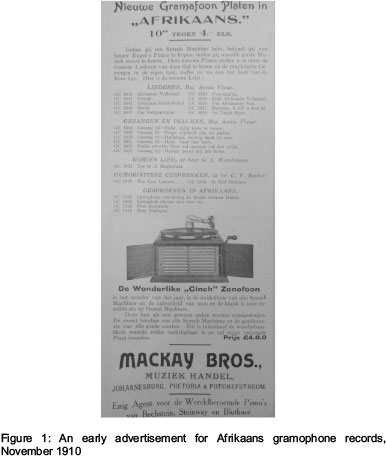
A few months after Smith's initial recordings, Paul Roos' Springbok rugby team (on tour to Britain in 1906) recorded Springbok Chorus and War Cry in London, released on the Gramophone Concert Record series.61Springboks Conversing in the Taal, Boer Recitation and Boer Dialogue.62 Recordings of spoken Afrikaans and references to the taal, became popular themes in later recordings, suggesting that Afrikaans was still something of a curiosity at the time. On Springbok Chorus and War Cry the rugby players sing My Matras en jou Kombers; Die Eenkant op die Anderkant af; Al Slaan my Ma my neer; and We are Marching to Pretoria.63Figure 1) - by the Mackay Brothers Company6465
It was for a collection of recordings done in London at the studios of the Gramophone Company between 1906 and 1910. The caption of the advertisement is revealing:
Indien gij een Spreek Machine hebt, behoeft gij niet langer Engelse Platen te kopen, indien gij waarlik goede Muziek wenst te horen. Deze nieuwe Platen stellen u in staat de fraaiste Liederen van dezetijdte horen en de prachtigste Gezangen in de eigen taal, welke zo aan het hart van de Boer ligt.66
The tension between English and Afrikaans underscored here is indicative of wider political tension between these groups six months into Union. The word "Boer" is also significant. The wording used in this advertisement (by an English company) is not coincidental. The influential linguist and Afrikaans language campaigner of the Second Language Movement, Gustav Preller, had the following to say about business opportunities aimed at the Afrikaners: "One of them is the practical businessman. If he wishes to reach the buying and commercial public, he tells the publishers of adverts, 'in Boer language, otherwise people won't understand'."67
Die Brandwag was launched in 1910 by the Afrikaanse Taalgenootskap (Afrikaans Language Society) as an important vehicle for language mobilisation in the wake of Union.68Die Brandwag and Huisgenoot re-packaged all manner of everyday things as "Afrikaans".69
Of the 23 songs and dialogues, six are hymns and psalms, two are Afrikaner national anthems,7071gezangen were Afrikaans versions of English hymns, and not original. The two English titled dialogues by Clarence Vivian Becker are labelled as "Afrikaans talking" and appear on the flipside of two Afrikaans dialogues recorded by J.J. Smith.72SAMEs earliest entry dates to 1910, which corresponds with Kelly's catalogue.7475
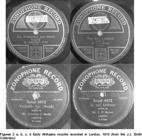
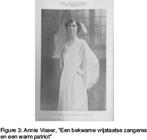
The Afrikaans soprano Annie Visser features prominently in these recordings, which might account for the choice of material. Visser was born on the farm Lokshoek in the Jagersfontein district of the Free State Republic in 1876, the daughter of Gert Petrus Visser, who chaired the Volksraad for 19 years. Before the Anglo-Boer War, she studied at the Royal Academy of Music in London, but moved to Amsterdam because she "could not be a guest in a country against which her brothers were fighting".76Zuid-Afrikaans Volkslied was made on the very same day of the formation of the Union of South Africa - 31 May 1910. The Union attracted international attention, which might have prompted the Gramophone Company to record such a commemoration.77
Visser was also a vocal supporter of Hertzog and his National Party.78Natal Mercury she stated that she aimed at "... making the Dutchman proud of his language by singing about it and in it ... the Dutch people need stirring up in this way."798081
Answering a public call for information on Visser's life, State President C.R. Swart himself responded with a letter in which he revealed a number of facts attesting to her close connection to the Afrikaner political elite of the early twentieth century. Visser apparently enjoyed a close relationship with the Hertzogs and often spent time at their home. She also sang at the inaugural congress of Hertzog's National Party in 1915, and was given the honour of choosing the colours of the new party (orange and white).82
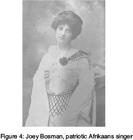
Another seemingly patriotic Afrikaans singer was Joey Bosman, who, like Visser, received classical vocal training in England, possibly during the Anglo-Boer War. According to a July 1903 article in De Goede Hoop, Bosman once, during her three year stay there, responded to anti-Boer comments by calmly pinning a ribbon of the Vierkleur (the flag of the defeated Transvaal republic) to her chest.83 Apart from this article, no other references to Bosman could be found nor any indication that she recorded any music, since she returned to South Africa well before the first Afrikaans recordings.
Since Bosman was her maiden name, she could well have made later recordings under a different surname. Two Joey's come to mind: a Joey Marais recorded Danie en Lenie/ Nader mijn God bij U in London in 1910,84Zuid-Afrika, in Cape Town in 1912.85Die Brandwag and Die Huisgenoot "fabricated a tremendous cult of personality around certain literary figures whom they depicted in personalised articles and full-page pictures."86
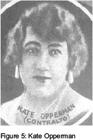
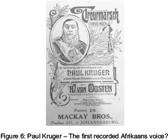
Kate Opperman recorded several songs including Het Volkslied van de Zuid-Afrikaanse Republiek, Het lied der Afrikaners and Volkslied van de Oranje-Vrystaat in London c. 1912-1913.8788Treurmarsch, a funeral march for Paul Kruger to the music of the Transvaalsche Volkslied by the British group The Black Diamonds8990
The SAME has a detailed list of several other pre-1912 recordings, including Ada Forrest's early recording of Hondt het Fort (which is actually misspelt, it should be Houdt het Fort), c. 1907.91"Die stor van Bethlehem" (again misspelt) in 1908. The majority of Forrest's recordings were in English and it is doubtful that she had any overt political leanings. Between 1909 and 1913, she performed regularly at the Promenade concerts held at Queen's Hall, although never in Afrikaans.92Hul sal dit tog nie Kry nie/ Overtuiging, Ou Tante Koos/ Grietjie, and Mamma, k wil n man hê/ Toe sê de Magistraat,9394"Taal singer", and performed recitals of exclusively Afrikaans folk songs at the prestigious Bechstein Hall in 1913. Notably, she donated half of her earnings to the suffragettes.95
The Peerless Orkes' Vat jou Goed en Trek Ferreira/ Tikkiedraai -Selections of Popular Afrikander Songs and Airs of 1909-1910 were also among the earliest Afrikaans music recordings.969798
Recordings in South Africa, 1912
The number of Afrikaans recordings increased exponentially from 1912, when the UK-based Gramophone Company sent a mobile recording unit, with recording engineer George Walter Dillnutt, to South Africa to make local recordings. These were probably the first in Africa, and were released under the subsidiary label Zonophone.100SAME lists at least 126 Afrikaans tracks that were released as albums.101102
Among the others were recordings of Afrikaans stories, notably by poet Melt J. Brink's own works, like Mijn Land, mijn Volk, en Taal, and Die Vrome meid, Deel 1/ Deel 2, as well as Afrikaan Talking.103 Brink was well-known local poet, as well as a prolific playwright, known for his humorous pieces.104N' Dronk Liedjie van n Mozambique en N Jolly Hotnot in Johannesburg in 1912.105106107weltanschauung at the time. Also noteworthy is that there are very few recordings of Afrikaner national anthems among these.
From 1 November 1912, Mackay Brothers also advertised these locally recorded Zonophone Double Discs at three shillings and sixpence per 10-inch record and five shillings per 12-inch.108109110111
On the other hand, the Carnegie Report showed that poor Afrikaners found access to gramophone players: "Immediately they start living in luxury; instead of saving, they buy a number of things they do not need, such as a gramophone or a piano."112113
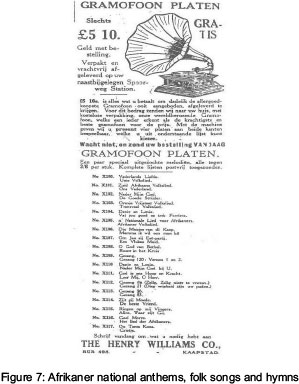
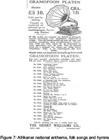
Figure 7 below, a 1916 advertisement for gramophone records (many of which were probably recorded in London before 1912) shows three main themes: nationalism, folk songs and spirituals. Various nationalist anthems were recorded, like Vaderlands Liefde, Unie Volkslied, Zuid-Afrikaanse Volkslied, Oranje-Vrijstaat Volkslied, Transvaal Volkslied, and Afrikaner Volkslied. Popular folk songs were Mamma ik wil Een Man hê, Ou Tante Koos, and Grietjie.114Treurmarsch), signifies his prominence as Afrikaner leader. Apart from nationalism, this much larger sample of recordings (including those of the following decades) contain codes of racial dominance, language aspirations, anti-imperialism and religion - all themes that were later invoked during the 1930s and the rise of a more "virulent"115
The development the South African recording industry was interrupted by the outbreak of the First World War in 1914, when it became too difficult to send the recordings back to England for pressing and then back again to South Africa as the finished product. It only resumed in 1924, when the Edison-Bell Company sent a recording studio to Cape Town, where 50 double-sided albums were recorded using new acoustic technology. Of these recordings, only eleven were in Afrikaans, and were mostly light operatic singers and church choirs.116117
By this time, of course, the Afrikaner political landscape had changed notably. Hertzog's National Party came to power in 1924 and Afrikaans was recognised as one of the two official languages of the Union in 1925. However, the language issue persisted in many ways while the issue of poor Afrikaners remained paramount. Whereas during the first two decades of the twentieth century, poor white-ism was regarded as the result of inherent weakness, attitudes changed after the Carnegie Commission's report. The social upheaval caused by the Great Depression in the early 1930s, exacerbated by the great drought of 1932-33, were especially hard felt by Afrikaners. Despite these conditions, this era saw a marked increase in the number of Afrikaans music recordings, including vastly popular boeremusiek albums, which underscored clear heterogeneous elements of class and political affinity that fall outside the direct scope of this article.
Conclusion
The complexity of Afrikaans music performance, as well as its diversity, is under-represented in early popular Afrikaans music records. This not only bears some testament to the racial politics intimately involved in the development of the Afrikaans language as well as popular Afrikaans music, but also of the contingent nature of these developments. What does appear to be a salient feature in early Afrikaans gramophone records is the close relationship between one emerging section of white Afrikaans speakers and their claims for nationhood in the early twentieth century._The trauma of the Anglo-Boer War and its immediate aftermath determined the socio-political context of these recordings of which the earliest were sung not by Afrikaners, but by sympathetic singers in continental Europe.
The recordings of various Afrikaner national anthems in London by patriotic Afrikaans singers around the time of Union, and the subsequent advertisements in Die Brandwag, coincided with a rapidly changing cultural landscape. Although few anthems were recorded in South Africa in 1912, the wider range of themes still reflected a growing Afrikaans cultural industry with strong links to Afrikaner nationalism, although the political content of these records should not be overstated. Advertisements for recorded Afrikaner anthems dated to 1916 do suggest some level of nostalgia to a politically independent past. Ultimately, one cannot claim that all pre-WW1 Afrikaans and Africana gramophone records represented an acute self-awareness of a developing linguistic identity and political self-determination, but they were nonetheless part of a growing number of cultural products at a particularly sensitive stage in the development of Afrikaner identities.
References
- 1. For example, see E.C. Pienaar, Die Triomf van Afrikaans: Historiese Oorsig van die Wording, Ontwikkeling, Skriftelike Gebruik en Geleidelike Erkenning van ons Taal, (Nasionale Pers, Kaapstad, 1943);
- M.S. du Buisson, Die Wonder van Afrikaans: Bydraes oor die Ontstaan en Groei van Afrikaans tot Volwaardige Wêreldtaal (Voortrekkerpers, Johannesburg, 1959).
- 2. P. Roberge, "The Formation of Afrikaans", Stellenbosch Papers in Linguistics, No. 27, 1993, p 48.
- 3. D. Constant-Martin, Sounding the Cape: Music, Identity and Politics in South Africa, (African Minds, Somerset West, 2013), pp 54-95.
- 4. Constant-Martin, Sounding the Cape, p 55.
- 6. F. Ponelis, "The Development of Afrikaans", in R. Dirven, M. Putz and S. Jager (eds), Duisberg Papers on Research in Language and Culture, 18 (Peter Lang, Frankfurt, 1993), p 69.
- 7. Stell, Luffin and Rakiep, "Religious and Secular Cape Malay Afrikaans Literary Varieties", p 289.
- 8. J. van Wyk, "Afrikaans Language, Literature and Identity", Theoria: A Journal of Social and Political Theory, 77, May 1991, p 85.
- 10. Constant-Martin, Sounding the Cape, pp 69-92.
- 11. J. Bouws, Solank daar Musiek is: Musiek en Musiekmakers in Suid-Afrika (1652-1982), (Tafelberg, Kaapstad, 1982).
- 12. W. Froneman, "Pleasure beyond the Call of Duty: Perspectives, Retrospectives and Speculations on Boeremusiek", D.Phil thesis, Stellenbosch University, 2012, pp 49-62.
- 14. J.P. Malan (ed.), Die Suid-Afrikaanse Musiek Ensiklopedie, Volume 1 (Oxford University Press, Cape Town, 1986), pp 350-385.
- 15. R. Bauer, The New Catalogue of Historical Records, 1898-1908/09 (Sidgwick & Jackson, Michigan, 1947).
- 16. Electronic communication with Alan Kelly, 29 October 2014.
- 17. The Alan Kelly Matrix Listings, available at http://www.normanfield.com/kelly.htm, accessed 19 June 2014. See also A. **Kelly, "Structure of the Gramophone Company and its Output, HMV and ZONOPHONE, 1898-1954", September 2000, p 3, available at The Truesound Online DiscographyProject,http://www.truesoundtransfers.de/disco.htm, accessed 18 July 2014.
- 18. Alan Kelly Catalogue, available at http://charm.rhul.ac.uk/index.html, accessed 5 October 2014.
- 19. Available at http://www.truesoundtransfers.de/disco.htm, accessed 18 July 2014.
- 20. For example, the author's search of almost 100 000 titles yielded just 15.
- 21. Available at http://www.flatinternational.org/templatevolume.php?volumeid=280, accessed 12 June 2014.
- 22. E. Rosenthal, Encyclopaedia of Southern Africa, Fourth edition (Frederick Warne, London, 1967), p 170.
- 23. Invented by Thomas Edison in 1877.
- 24. F.W. Gaisberg, Music on Record (Robert Hale, London, 1948).
- 25. Kelly, "Structure of the Gramophone Company and its Output", p 3.
- 26. Kelly, "Structure of the Gramophone Company and its Output", p 3.
- 27. This is as far as can be ascertained by consulting various matrix listings. It is possible that there might be more, since the listings are not complete.
- 28. J. Bouws, "Nederlandse Komponiste en die Afrikaanse Lied", Die Huisgenoot, 22 November 1946, p 25.
- See also Bouws, "Nederlandse Komponiste en die Afrikaanse Lied", p 25.
- 30. Trewhela, Song Safari, p 26.
- 32. Alan Kelly Catalogue, available at http://charm.rhul.ac.uk/index.html, accessed 5 October 2014.
- 33. Alan Kelly Catalogue, http://charm.rhul.ac.uk/index.html, accessed 5 October 2014.
- 34. Alan Kelly Catalogue, http://charm.rhul.ac.uk/index.html, accessed 5 October 2014.
- 35. Malan (ed.), Die Suid-Afrikaanse Musiek Ensiklopedie, Volume 1, p 405. See also Truesound Online Discography, available at http://www.truesoundtransfers.de/disco.htm, accessed 18 July 2014.
- 36. Alan Kelly Catalogue, http://charm.rhul.ac.uk/index.html, accessed 5 October 2014.
- 37. E. Blom (ed.), Grove's Dictionary of Music and Musicians, Volume 11 (Macmillan, London, 1954), p 665.
- 38. http://www.truesoundtransfers.de/disco.htm, accessed 18 July 2014.
- 39. Bouws, "Nederlandse Komponiste en die Afrikaanse Lied", p 25.
- 40. Malan (ed.), Die Suid-Afrikaanse Musiek Ensiklopedie, Volume 1, p 350.
- 41. http://www.truesoundtransfers.de/disco.htm, accessed 18 July 2014.
- 42. http://www.truesoundtransfers.de/disco.htm, accessed 18 July 2014.
- 43. Bauer, The New Catalogue of Historical Records, p 425.
- 45. Neerlandia, 25 (Dordrecht, Geuze & Co, 1921), available at http://www.dbnl.org/tekst/nee, accessed 16 July 2014.
- 46. Van Wyk, "Afrikaans Language, Literature and Identity", p 80.
- 47. Van Wyk, "Afrikaans Language, Literature and Identity", p 80.
- 48. Van Wyk, "Afrikaans Language, Literature and Identity", p 80.
- 49. De Afrikaanse Patriot, 1, 1, 15 January 1876, pp 1-1.
- 50. S.C.H. Rautenbach, "Die Kerksang as Agtergrond van die Poësie uit die EersteTydperk", Tydskrif vir Volkskunde en Volkstaal, 3, 1946, p 87.
- 51. Bouws, "Nederlandse Komponiste en die Afrikaanse Lied", p 106.
- 52. N.H. Theunissen,"Ons Volksliedjies", Die Brandwag, 7 October 1938, p 17.
- 53. Rautenbach, "Die Kerksang as Agtergrond van die Poësie uit die Eerste Tydperk", pp 85-87.
- 54. Rautenbach, "Die Kerksang as Agtergrond van die Poësie uit die Eerste Tydperk", pp 86-87. See also Theunissen, "Ons Volksliedjies", p 17.
- 55. http://www.vetseun.co.za/anarkans/nav/toonsetverwerkkomposeer.htm, accessed 6 August 2014.
- 56. For further discussion on the link between national anthems and political and military conflict, see Ludemann, "Buren-Marsch", p 58.
- 57. Alan Kelly Catalogue, http://charm.rhul.ac.uk/index.html, accessed 5 October 2014.
- 58. University of Stellenbosch (hereafter US) Documentation Centre, J.J. Smith Collection, PV 333.K.G. 14. The letter refers specifically to the gezange recorded by Annie Visser.
- 59. US Documentation Centre, J.J. Smith Collection, PV 333.K.F.1 (86), (88), (98).
- 63. A. Pakendorf, "Afrikaans Music History" at http://myfundi.co.za/e/Afrikaansmusic:History, accessed 28 August 2011. See also Malan (ed.), Die Suid-Afrikaanse Musiek Ensiklopedie, Volume 1, p 350.
- 64. This was the local distributor for HMV and Zonophone and one of the first companies to sell records in South Africa.
- 65. Die Brandwag, 15 November 1910, p ii.
- 66. If you have a gramophone player, you no longer have to buy English records if you want to listen to good music. These new records will enable you to listen to the finest songs and the most beautiful hymns of today in one's own language, so close to the heart of the Boer.
- 67. G, Preller, "Laa't Ons Toch Ernst Wezen", quoted in Hofmeyr, 'Building a Nation from Words", p 104.
- 68. Hofmeyr, "Building a Nation from Words", p 106.
- 69. Hofmeyr, "Building a Nation from Words", p 111.
- 70. Afrikaans Volkslied and Zuid Afrikaans Volkslied.
- 71. Die Brandwag, 15 November 1910.
- 72. US Documentation Centre, J.J. Smith Collection, PV 333.Pe.2 (7).
- 73. Trewhela, Song Safari, p 35.
- 74. Malan (ed.), Die Suid-Afrikaanse Musiek Ensiklopedie, Volume 1, p 357.
- 75. L. Laubscher and G. Nieman, The Carolin Papers: A Diary of the 1906/07 Springbok Tour, (Rugbyana Publishers, Pretoria, 1990).
- 76. F. Stegmann, "Baanbreker van die Afrikaanse Lied", Die Huisgenoot, 15 March 1963, p 61.
- 77. The South African Audio Archive, available at http://www.flatinternational.org/search.php, accessed 20 June 2014.
- 78. Malan (ed.), Die Suid-Afrikaanse Musiek Ensiklopedie, Volume 1, p 383.
- See also IzakGrové, "'Making the Dutchman proud of his language...': 'n Honderdjaar van die Afrikaansekunslied", TydskrifvirGeesteswetenskappe, 51, No. 4: December 2011, p. 667
- 80. F. Stegmann, "Annie Visser het Eerste in Londen Opgetree", Die Burger, 7 September 1961.
- 81. Stegmann, "Baanbreker van die Afrikaanse Lied", pp 9, 61.
- 83. De Goede Hoop, July 1903, p 146.
- 86. Hofmeyr, 'Building a Nation from Words", p 109.
- 87. Malan, (ed.), Die Suid-Afrikaanse Musiek Ensiklopedie, Volume 1, p 376.
- 88. Malan, (ed.), Die Suid-Afrikaanse Musiek Ensiklopedie, Volume 3 (Oxford University Press, Cape Town, 1986) pp 353-356.
- See also http://saoperasingers.homestead.com/Kate_Opperman.html, accessed 28 November 2014.
- 90. Die Brandwag,15 June 1912, p. iv.
- 92. www.Bbc.co.uk/proms/archive/performers/search/ada-forrest/1, accessed 20 Oct 2014
- 93. Song titles were often spelt differently in a different release. This was spelt Toe sê di magistraat. See also the variations of spelling of the Transvaal anthem mentioned earlier.
- 94. Malan (ed), Die Suid-Afrikaanse Musiek Ensiklopedie, Volume 1, p 374.
- 95. The British Journal of Nursing, 11 January 1913, p 36.
- 96. Malan (ed.), Die Suid-Afrikaanse Musiek Ensiklopedie, Volume 1, p 377. With regard to these early London recordings, the SAMEs discography provides detailed listings that need not be reproduced here.
- 97. For a detailed discussion on racial identities in the development of popular Afrikaans music, see Froneman, "Pleasure beyond the Call of Duty", pp 49-76.
- 98. Malan (ed.), Die Suid-Afrikaanse Musiek Ensiklopedie, Volume 1, p 354.
- See also http://www.flatinternational.org/template_volume.php?volume_id=280, accessed 12 June 2014.
- 104. US Document Centre, Melt J. Brink Collection, MS 9.
- 106. http://www.flatinternational.org/templatevolume.php?volume_id=280, accessed 12 June 2014.
- 107. http://www.flatinternational.org/templatevolume.php?volume_id=280, accessed 12 June 2014.
- 108. Die Brandwag, 1 November 1912, p xv. See also Trewhela, Song Safari, p 44.
- 109. Die Brandwag, 15 December 1912, p xiv and p xcvii.
- 110. Opskommel, 1992, Vol. 1, p 16. , available at http://www.boeremusiek.org/Afrikaans/Nuus/Opskommel/, accessed 17 September 2012
- 113. Albertyn, The Poor White Problem in South Africa: Part 5, p 42.