Beyond Employability: Reimagining Vocational Education for Ecological and Social Justice
Abstract
This study critically examined the predominance of employability discourses in technical and vocational education and training (TVET) in the Global South and explored how Paulo Freire's critical pedagogy can foster social and ecological justice. The study employs a critical narrative literature review informed by a systematic search strategy to examine how TVET policies and practices prioritise labour market outcomes, often at the expense of broader educational goals such as critical thinking, civic engagement, and sustainability. Through a thematic synthesis of the selected literature, the study addressed a theoretical and empirical gap concerning transformative approaches to vocational education. Findings indicate that integrating Indigenous knowledge systems and Ubuntu is vital for decolonising vocational education and enhancing students' agency. However, structural constraints, limited lecturer capacity, and a lack of systematic evaluation hinder the widespread adoption and effective implementation of these transformative approaches across TVET institutions. The study recommends the deliberate incorporation of justice-oriented perspectives into TVET curricula and targeted professional development for lecturers. Ultimately, the study concludes that by reorienting the sector toward ethical engagement and community empowerment, TVET can move beyond narrow economic outcomes to serve as a vehicle for social transformation and sustainable development in the Global South.
Technical and Vocational Education and Training (TVET); Employability; Critical Pedagogy; Social and Ecological Justice; Decolonial Pedagogy
Introduction
In the Global South, technical and vocational education and training (TVET) is considered a powerful means of combating youth unemployment, promoting economic growth, and aligning skills with labour market needs (Allais, 2020). Increasingly, governments and international policy documents have identified employability as the main end of vocational education (UNESCO, 2021). Therefore, curricula and training systems have been redesigned mainly to develop technical skills that are in line with the needs of industries. Nevertheless, this limited focus is regularly challenged for perpetuating neoliberal ideas, where education is simply seen as an instrument of market efficiency, thereby discounting aspects of social responsibility, critical awareness, or ecological consciousness (Majola & Geduld, 2025).
Although focusing on employability gets students ready for work technically, it still misses a lot of the social and holistic aspects of education, like community service and sustainability (Succi & Canovi, 2020). Students might become very good at using factory machines or at juggling complicated operations but, at the same time, be completely unaware of the social, ethical, or environmental side effects of their work. Such methods resemble Freire's (1970) critique of the banking model of education, where students are treated as passive recipients of knowledge, limiting critical thinking, dialogue, and active engagement in learning (Costa & Murphy, 2025). Additionally, it has been found that graduates very often lack the wider set of 21st-century skills, such as interpersonal skills, leadership, and ethical decision-making, which are crucial for enduring career growth in changing environments (Succi & Canovi, 2020).
TVET can be a place of transformative learning if programmes are designed for human development and social justice rather than only for economic purposes (McGrath & Powell, 2016). Critical pedagogy views reflection and action as inseparable components of praxis, enabling students to critically examine and challenge dominant social, political, and economic structures (Majola & Geduld, 2025). In the Global South, this change is through African traditional knowledge systems and local cultural values such as Ubuntu being used as ways of making vocational skills socially meaningful and culturally acceptable (Ndlovu-Gatsheni,2020). Some of the new projects being developed in the areas of sustainable agriculture and renewable energy show that it is possible for technical education to operate hand in hand with environmental protection, social change, and community development (Owusu-Agyeman & Aryeh-Adjei, 2024).
However, these encouraging practices in theory have not been enough to close the gap between the published work and institutional implementation. According to McGrath and Russon (2023), TVET policy and practice remain predominantly focused on skills development for employment, while social and ecological objectives receive comparatively less attention. Although critical pedagogy provides a useful theoretical lens for understanding transformative teaching and learning, there remains limited empirical evidence regarding how Freirean principles are enacted in TVET contexts, particularly in the Global South. Moreover, the use of participatory pedagogies is at times erratic, and may be compromised by limited lecturer capacity, inflexible courses, and absence of systematic studies on the long-term effects of the social aspects (Majola & Geduld, 2025).
This study examines the dominance of employability discourses within TVET and explores how critical pedagogy could contribute to advancing social and ecological justice in vocational education. It is guided by three research questions: (1) how current TVET curricula prioritise employability within policy and practice; (2) what examples exist of integrating community-oriented, socially responsive, and sustainability-focused approaches in TVET; and (3) how Freirean critical pedagogy can be used to reframe vocational education towards more transformative practice. To address these questions, the study employed a critical narrative literature review informed by a systematic search strategy. This approach synthesises academic literature, policy documents, and selected case studies to identify and interpret recurring patterns across TVET contexts.
The Dominance of Employability in TVET
TVET is generally regarded as an effective strategy to tackle workplace issues amongst young people, to support economic development and to make the workforce more ready (Allais & Wedekind, 2020). Notably, employability is still the major objective of vocational education in both Global North and South contexts as curricula are progressively developed to match labour market requirements (UNESCO, 2025). In this study, employability refers to the development of knowledge, skills, and attributes that enable graduates to obtain, maintain, and adapt to employment within changing labour markets. Governments and international organisations constantly put emphasis on producing graduates who are ready for work, which is reflective of a human capital approach to TVET sector. It is true that with this focus, students would be provided with the technical abilities that are most in-demand by industry. However, at the same time, this would exclude critical reflection, social involvement, and student agency to a great extent (Powell & McGrath, 2019). Although graduates in South Africa usually conform to the technical standards, they frequently lack the general competencies and soft skills that are vital for their employability in the long term. The literature therefore suggests that the central challenge is not abandoning employability but balancing it with wider educational and societal objectives (Tahirsylaj & Sundberg, 2025).
Expanding TVET Goals Through Social Justice and Sustainability
Several studies have suggested that vocational education should open up to wider social, ecological, and ethical objectives to support sustainable futures and holistic development beyond labour market outcomes narrowly defined (McGrath & Ramsarup, 2024). Within this study, social justice refers to promoting equity, inclusion, and meaningful participation in education, while ecological justice emphasises environmentally responsible and sustainable vocational practices. Examples worldwide show how vocational education can be a means to achieve social justice, community involvement, and ecological consciousness. In South Africa, although sustainability education mainly focuses on environmental and economic objectives, social sustainability such as equity and human rights is still very little integrated in the curriculum (Lotz-Sisitka et al., 2015). In India, vocational education has embraced entrepreneurial learning pathways that enable students to not only solve socioeconomic problems at the local level but also to develop community enterprises (UNESCO, 2020). TVET in the Global North continues to be a major area of change in how environmental and social considerations are being combined with skills development (McGrath & Ramsarup, 2024); again, vocational education is a means to train young people to gain employment. On the other hand, it provides an excellent opportunity to foster the responsible and socially aware citizens of tomorrow. These developments suggest that employability and social responsibility can be complementary, rather than competing, educational objectives.
Critical Pedagogy and Transformative Learning in TVET
Freire's (1970) critical pedagogy can help reimagine TVET as a means not only to train people in technical skills but also to empower them for social change. At the heart of this approach lies conscientisation, which encourages students to analyse the social, political, and economic conditions shaping their lives and to act upon them. Critical pedagogy in this study is understood as an educational approach that promotes dialogue, critical reflection, participation, and social transformation through learning. Students are encouraged to reflect on the ethical, social, and environmental consequences of their work (McGrath & Ramsarup, 2024). Research shows that participatory and reflective approaches can strengthen vocational education. In Brazil, Freire's influence has encouraged educational practices based on dialogue, cooperation, and learner empowerment (Freire, 1970). Maluleke et al. (2022) argue that all theories in career decision-making have value, but no single theory is sufficient to explain all contexts and individual circumstances in TVET education. Northern hemisphere cases also reveal that reflective learning, along with the fusion of theory and practice, is crucial for transformation (Organisation for Economic Co-operation and Development [OECD], 2020). Nevertheless, scholars acknowledge that applying critical pedagogy within formal TVET systems could present practical and institutional challenges, highlighting the need for context-sensitive implementation.
Curriculum Relevance and Policy AlignmentCurriculum development and policy frameworks are very important tools that define how TVET results are achieved. In South Africa, study programmes are mainly guided by top-down, industry-aligned policies. The influence of these policies is that they significantly curtail the ability of lecturers to promote critical, socially responsible, or transformative learning (Lotz-Sisitka et al. 2015). Globally, many TVET systems are still operating within the bounds of limited and rigid performance indicators and strictly defined learning outcomes that focus almost solely on job placement. Countries like Germany, Australia, and South Korea represent different ways of integrating vocational education with workplace training. These countries provide alternative models for enhancing the relevance of vocational programmes (OECD, 2020). Nonetheless, in sub-Saharan Africa, the situation of TVET continues to be weakened by structural and economic factors. The lack of adequately paid technical jobs, along with the rapid growth of low-quality education, essentially supports a narrow, employability-focused approach (Allais, 2020). The literature suggests that effective TVET policy should seek to balance labour market responsiveness with broader social and educational responsibilities.
Integration of Soft Skills and 21st-Century Competencies
Vocational education and professional learning communities adopting soft skills strategies, such as communication, problem-solving, leadership, and adaptability, are finding great potential in students' employability and long-term career development. TVET graduates who possess a combination of technical skills and broad competencies are more capable of coping with complex and changing situations at work, and of actively participating in social and environmental issues. Countries like Finland, Germany, Singapore, and Switzerland provide examples of upper-secondary vocational education that integrates technical skills with broader competencies, offering career flexibility and lifelong learning opportunities (OECD, 2024). In the Global South, soft skills development through participatory and experiential pedagogical approaches is used to open students' potential for meaningful engagement in social and community initiatives (Tafese & Kopp, 2025). Student agency, understood as learners' capacity to actively shape their educational experiences and future opportunities, is increasingly recognised as an important component of these broader competencies. This integration of technical and social capabilities reflects a growing international perspective on TVET (Wheelahan & Moodie, 2016).
Lecturer Capacity and Industry Linkages
A primary limitation in TVET systems is the lack of industry exposure for lecturers, which can hinder them from employing up-to-date and creative methods of teaching. Data indicate that professional development programmes, lecturers' work-based learning, and tighter industry linkages are essential for improving teaching quality and student results (OECD, 2023). Furthermore, most lecturers do not have the pedagogical tools to incorporate 21st-century skills, like critical thinking and collaboration, into their regular teaching routines. Participating in work-based learning, which essentially involves lecturer industry immersion, is an excellent method of upgrading their competencies and making technical training more aligned with the real world. Further, it helps students become more critically aware (Mesuwini & Mokoena, 2023). Strengthening lecturer capacity is therefore essential for balancing technical training with the broader social and ecological goals increasingly associated with contemporary TVET.
Gaps in TVET Research
Despite the steady expansion of academic scholarship, four significant gaps remain unaddressed. Firstly, critics claim that research and policy in TVET largely continue to focus on economic outcomes that are in line with human capital approaches, whereas the wider social and ethical aspects tend to be given less prominence (Allais, 2020). Secondly, while critical pedagogy provides a strong theoretical lens, empirical studies on its application in vocational education remain limited and largely context-specific, particularly in terms of evaluating transformative learning outcomes (Majola & Geduld, 2025). Thirdly, TVET policy transfer is largely characterised by lending and borrowing from the Global North to the Global South, with limited reciprocal exchange, which constrains understanding of how innovations can be effectively adapted across contexts (Barabasch et al., 2021). Fourth, there is little systematic evaluation of the long-term effects of socially oriented TVET programmes on communities; existing research mostly emphasises short-term outcomes. Addressing these gaps is essential for reimagining TVET as a holistic framework that balances technical skill with social responsibility and ecological stewardship. This study seeks to contribute to these debates by synthesising existing evidence on how employability objectives could be balanced with social, ecological, and transformative educational goals within TVET.
Theoretical Framework: Critical Pedagogy
This research is based on Paulo Freire's (1970) idea of critical pedagogy, which views education as a means for students to change their understanding of society and to participate actively in the transformation of their communities. Freire presented this idea in his book, Pedagogy of the Oppressed, where he pointed out that conventional education systems generally perpetuate social disparities by considering students as passive receivers of knowledge, excluding them as active students in the education process. In such cases, education is regarded more as an instrument for the continuation of power dynamics, and less as a means for empowerment. By viewing education not just as skills training but as a pathway to freedom for human beings, critical pedagogy directly opposes the narrow perspective of TVET as merely an economic tool. Critical pedagogy thus focuses on dialogue, reflection, practice, and participatory learning as necessary elements of effective education, thereby making students partners in the creation of knowledge. In this study, critical pedagogy is used not simply to describe educational ideals but as an analytical framework for examining whether TVET teaching practices, curricula, and learning environments promote passive skills reproduction or foster critical reflection, student participation, and socially responsible forms of vocational learning.
A key idea in Freire's theory is conscientisation, or the development of critical consciousness. Conscientisation means that students become aware of the social, political, and economic forces that influence their lives and, as a result, they are able to question the prevailing ideologies and challenge the structures that oppress them. In this way, students are not only learning technical skills or becoming vocationally competent; they are also developing an understanding of the larger impact of their actions and being motivated to engage in democratic and socially just behaviours. In this study, conscientisation is used to assess whether vocational teaching practices develop students' awareness of social, environmental, and ethical dimensions of their work, beyond technical competence. Within this study, conscientisation provides an analytical lens for examining whether TVET curricula and pedagogical practices encourage students to engage with issues such as social inequality, environmental sustainability, and community development alongside technical training. Rather than assuming that critical consciousness naturally emerges in vocational education, the study investigates the extent to which such outcomes are actively supported through teaching and learning practices. Although Freire developed this concept in adult literacy education, its application to TVET requires careful consideration because vocational education operates within institutional, labour market, and qualification structures that can both enable and constrain critical educational practices (Allais, 2020; McGrath & Powell, 2016).
Freire (1970) opposed education where lectures are like depositing knowledge into students who only memorise and reproduce it without any critical thinking. He critiques this approach as the banking model of education, where knowledge is transmitted from lecturer to student, reinforcing hierarchical relationships and limiting students' critical thinking, autonomy, and active participation in learning. He proposed a dialogical method where both students and lecturers produce knowledge together through discussion, reflection, and collaborative problem-solving. Such a shift thus reveals the need for more practice-oriented and skills-responsive teaching methodologies in vocational education that meet the needs of the workplace (Mesuwini & Bomani, 2021). In this study, the concepts of the banking model and dialogical education are used analytically to examine whether TVET workshop practices are predominantly lecturer-centred and procedural, or whether they create opportunities for collaborative learning, critical questioning, and shared problem-solving.
Praxis, another important component of Freirean (1970) pedagogy, is the integration of reflection and action as a continuous cycle. Education from this perspective, should not only deepen students' knowledge of the world but also prepare them to change it. Vocational education can provide a channel for practice through community-based learning projects, sustainability initiatives, and participatory interventions that provide technical training with direct link to social and environmental problems. Praxis prevents technical proficiency from being separated from morals; for example, an electrical engineering student pursuing a praxis approach would not only carry out the circuit installation but also ponder whether it is socially just and environmentally sustainable. Students in renewable energy programmes can combine acquiring technical skills with their involvement in the provision of energy to marginalised communities. Moreover, students in agriculture and environmental management programmes can enhance their ecological knowledge along with their technical skills, thereby promoting a comprehensive method of skills development that meets the requirements of social and environmental justice. In this study, praxis serves as an analytical category for exploring how vocational learning connects theoretical knowledge, practical skills, and social responsibility, particularly in relation to employability and community development outcomes.
Critical pedagogy emphasises democratic participation in education. It argues that students should be able to have a real say in shaping the content, methods, and goals of their education, and this challenges the traditional lecturer-led, hierarchical methods. In vocational education, for example, this might mean students working with lecturers to design learning projects, students leading each other by organising workshops according to different themes or even having student representatives participate in school decision-making. Within the context of this study, democratic participation provides a framework for analysing the extent to which TVET learning environments encourage student agency and active engagement rather than compliance with predetermined vocational routines.
The principles of democratic participation may also be strengthened through Ubuntu and Indigenous knowledge systems, particularly within the South African context. Ubuntu emphasises values such as collective responsibility, mutual respect, cooperation, and community well-being, while Indigenous knowledge systems recognise locally generated forms of knowledge and problem-solving. Rather than treating these concepts as abstract ideals, this study views them as complementary perspectives that can support collaborative learning, community engagement, and socially responsive vocational education. Their inclusion acknowledges that critical pedagogy within South African TVET should be sensitive to local cultural and historical contexts rather than relying exclusively on imported theoretical traditions. In practice, these principles could be implemented through collaborative workshop projects, community-based learning activities, locally relevant problem-solving tasks, and participatory approaches to vocational teaching and learning.
The application of Freirean pedagogy to TVET is not without challenges. Freire's work emerged from adult literacy education in Brazil, whereas contemporary TVET operates within formal qualification systems, state regulations, and labour market accountability structures. Critical scholars have argued that these institutional realities may limit the implementation of fully participatory and transformative educational practices (Allais, 2020; McGrath & Powell, 2016). Recognising these tensions strengthens the theoretical framework by acknowledging that critical pedagogy in TVET involves negotiating institutional constraints rather than assuming an uncomplicated transfer of Freire's ideas to vocational education.
Furthermore, this study conceptualises social and ecological justice as interconnected rather than separate concerns. Social justice seeks to promote equity, inclusion, and democratic participation, while ecological justice extends these concerns to the sustainable and responsible use of environmental resources. Within vocational education, these objectives often overlap because technical occupations increasingly require graduates to address environmental sustainability alongside community and economic needs. This perspective allows the study to examine how TVET can contribute to socially responsible and environmentally sustainable forms of development through teaching and learning practices. Within this framework, socially and ecologically just TVET could include vocational programmes that integrate sustainable production practices, community engagement, ethical decision-making, and environmental stewardship alongside technical competence.
This study draws on Freire's pedagogy, which views education as a process of human transformation through critical awareness and engagement. It points out that for students to master both the technical and the social aspects of an education they have to be conscientised, engaged in dialogue reflecting acting, and participating democratically. This theoretical framework, when applied to vocational education, indicates a path for TVET not only as a way to get a job but also as a democratic, socially responsible, and environmentally conscious setting. Importantly, these concepts are employed as analytical tools for interpreting the study rather than simply as philosophical principles. They guide the examination of how vocational education balances employability objectives with broader commitments to social responsibility, democratic participation, and environmental sustainability. Collectively, these Freirean concepts provide an interpretive framework for understanding how TVET can support both livelihood opportunities and broader social transformation. By following the tenets of Freire's pedagogy this paper on employability skills development is set in an ethical, societal, and environmental context that illustrates that vocational education can empower students to be creators of positive societal change.
Methodology
Research Design and Justification
This study employs a critical narrative literature review informed by a structured search strategy to examine the influence of employability discourses on TVET and the role of critical pedagogy in advancing social and ecological justice. The review involved a structured process of identifying, selecting, and synthesising scholarly literature, policy documents, and relevant case studies. Academic databases including Google Scholar, Scopus, ERIC, and Web of Science were used to identify relevant sources. The search was guided by keywords such as "TVET and employability," "critical pedagogy and vocational education," and "skills development and sustainability." Studies published between 2010 and 2025 were included.
Inclusion criteria focused on peer-reviewed journal articles, scholarly books, and relevant policy documents addressing TVET, employability, pedagogy, sustainability, and decolonial perspectives. Exclusion criteria included non-academic sources (except key policy reports), duplicate studies, and literature not directly related to vocational education contexts. The review does not aim to achieve the statistical comprehensiveness of a systematic review but instead provides an interpretive synthesis of key debates and perspectives. The analysis was guided by the research questions and followed a thematic synthesis approach. Data were coded and grouped into emerging themes through iterative comparison and conceptual interpretation. This approach is appropriate for examining TVET in the Global South, where educational systems are shaped by complex socio-economic and historical conditions. It enables integration of theoretical, policy, and empirical literature from diverse contexts while maintaining sensitivity to contextual variation (McGrath & Russon, 2023).
Data Sources and Contextual Considerations
Data for this research were carefully selected from peer-reviewed journal articles, academic books, policy documents of government and institutions, as well as published case studies. Choosing sources was done based on their relevance, trustworthiness, and how each source specifically sheds light on the intersection of TVET employability, social justice, and ecological sustainability. Priority was given to recent and influential scholarship, with sources included according to their relevance to the research questions and theoretical framework. While the focus was on Global South contexts (e.g. South Africa, Ghana, Brazil, and India), literature from globally recognised countries (e.g. United Kingdom, Germany, Finland, Australia, and Canada) was also included to provide the necessary theoretical depth and comparative benchmarks. Policy documents were key in interpreting the official strategic priorities of TVET institutions. These sources enabled the study to assess whether institutional frameworks give more importance to market-driven employability at the expense of wider educational objectives such as civic responsibility and environmental stewardship. Significantly, the paper continued to be contextually based by purposefully considering socioeconomic factors, local cultural aspects, and historical injustices, making sure that the research stays practically relevant to the real-life conditions of the Global South. Case studies further illustrated innovative practices including renewable energy projects and gender-responsive training initiatives. This study employs a critical narrative literature review informed by a systematic search strategy to examine employability discourses in TVET and the role of critical pedagogy. Guided by the research questions, the literature was thematically analysed to identify recurring patterns and contrasting perspectives across policy, theory, and practice. These patterns were coded and synthesised into themes through iterative comparison to ensure analytical coherence.
Data Analysis
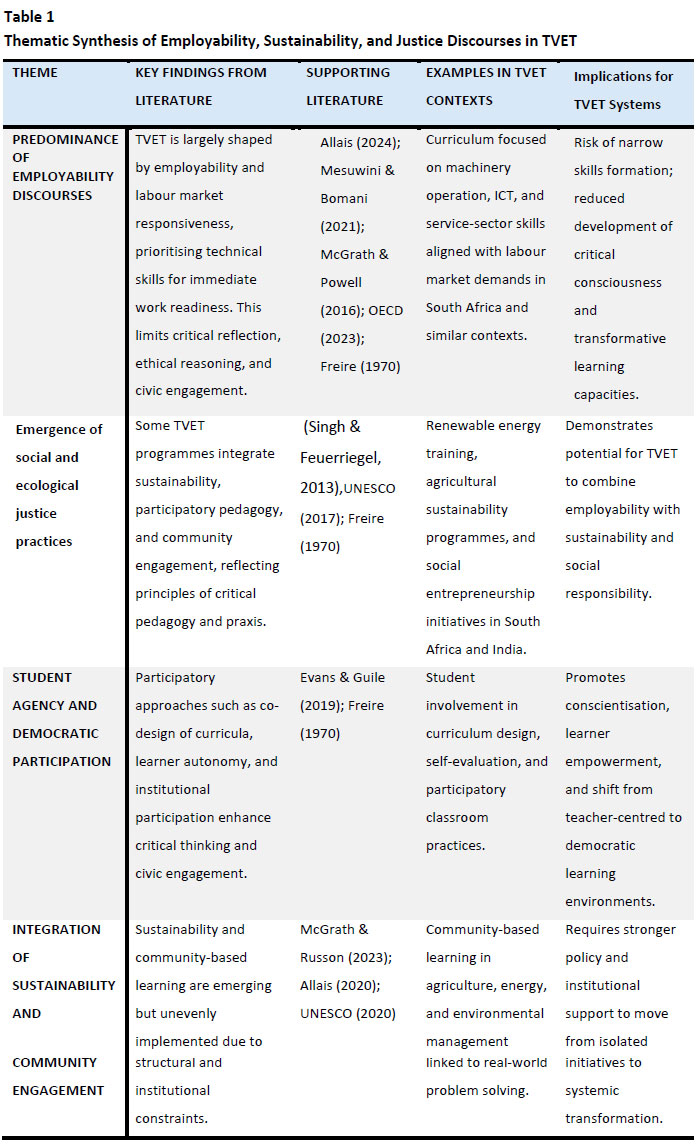
The collected literature and records were critically assessed by thematic content analysis, a qualitative research method to identify, code, and categorise repeated patterns in different sources (Braun & Clarke, 2006). The research concentrated on few major thematic areas like the predominance of employability agenda, the impact of neoliberal ideology on TVET, the inclusion of sustainability, and the application of critical pedagogy. The themes were derived through an iterative reading of the literature, and informed by the study's theoretical framework, allowing both deductive and inductive interpretation of the evidence. Utilising a thematic approach, it was possible to establish an advanced link between theory, policy, and practice, which helped to identify important points of agreement and disagreements in various TVET systems. For instance, although many policy documents emphasise technical skills for labour market participation, case studies revealed examples of institutions integrating community engagement, sustainability, and gender-responsive practices into vocational programmes. The analysis also considered literature that questioned the practical application of critical pedagogy in TVET and acknowledged institutional, policy, and labour market constraints that might limit its implementation. This comparative approach helped identify both the opportunities and limitations of employability-oriented reforms and highlighted important theoretical and empirical gaps. Contrasting perspectives were synthesised to minimise confirmation bias and strengthen the credibility of the findings. Rather than reproducing individual studies, the analysis involved coding literature to identify recurring patterns, tensions, and emerging directions, which were then synthesised into integrated themes within TVET scholarship. Additionally, the iterative nature of the analysis enabled the study to identify areas in theory and practice that constrain the transformative potential of vocational education (see Table 1).
Ethical Considerations
As a conceptual study based exclusively on published literature and secondary sources, this research did not involve human participants, primary data collection, or the use of personal information. Therefore, formal ethical clearance was not required. Nevertheless, the study adhered to established principles of research integrity by ensuring accurate citation and acknowledgement of all sources, thereby avoiding plagiarism and respecting intellectual property rights. Only credible and relevant scholarly and policy sources were included to promote the transparency, reliability, and trustworthiness of the analysis and its conclusions.
Strengths and Limitations
A critical narrative literature review provides a broad comparative understanding of TVET policies and practices across different contexts while allowing for theoretical interpretation of complex educational issues. It also helps identify emerging trends and innovative practices that may not be evident in individual empirical studies. However, one limitation of this approach is its reliance on existing literature, which may reflect publication and contextual biases. Furthermore, the absence of primary data limits the ability to capture local institutional experiences directly. Although contrasting perspectives were deliberately included, the interpretive nature of the review means that conclusions should be understood within the scope of the literature examined. Nevertheless, the careful selection of authoritative and diverse sources strengthens the credibility and trustworthiness of the findings.
Results
Predominance of Employability Discourses
The analysis of the reviewed literature identified employability as the dominant organising discourse shaping TVET across different contexts. This theme emerged through deductive analysis of recurring patterns in the literature, particularly those emphasising labour market responsiveness and skills-for-employment outcomes. Collectively, curricula, institutional policies, and pedagogical practices have been predominantly designed to equip students with technical skills aligned with immediate labour market demands, reflecting an employability-centred model of TVET development. This pattern is also evident in South African TVET contexts, where vocational programmes emphasise machinery operation, information and communication technology, and service-sector competencies aligned with workforce demands (Mesuwini & Bomani, 2021). The synthesis indicates that this employability-driven orientation is reinforced by broader neoliberal policy frameworks that position technical competence and employability outcomes as primary indicators of programme success.
A recurring analytical pattern across the literature is that while employability-focused models strengthen technical competence, they simultaneously limit opportunities for ethical reasoning, civic engagement, and critical reflection. The literature collectively suggests that students are often prepared for technical performance without sufficient engagement with the social, environmental, and ethical implications of their vocational practices, thereby limiting opportunities for critical engagement beyond workplace readiness. This tendency reflects Freire's (1970) critique of the banking model of education, where knowledge transmission occurs with limited dialogue and reflection. Overall, the analysis suggests that an exclusive focus on employability may constrain the development of critical consciousness and reduce the potential of TVET to function as a space for social transformation.
Emergence of Social and Ecological Justice Practices
The analysis of the reviewed literature identified an emerging but less dominant theme of social and ecological justice within TVET systems. This theme was derived deductively from the data set, particularly from studies that emphasised sustainability, participatory pedagogy, and community engagement as counterpoints to employability-focused models. Across the literature, certain TVET institutions are reported to integrate participatory teaching approaches and sustainability-oriented curricula, suggesting that technical education can incorporate social responsibility and ethical engagement alongside skills development. In South African contexts, renewable energy and agricultural training programmes illustrate how sustainability and community participation can be integrated into vocational learning (Singh & Feuerriegel, 2013).
Similarly, community-based adult education programmes in Latin America demonstrate an integrated approach that links technical skills with broader social and environmental improvement objectives (Freire, 1970). The literature further indicates that in other contexts, such as India, vocational programmes incorporating social entrepreneurship enable students to apply technical knowledge to local socioeconomic challenges (UNESCO, 2017).
Collectively, these initiatives reflect core principles of critical pedagogy, particularly the integration of reflection and action (praxis) as central to learning (Freire, 1970), demonstrating that vocational education can simultaneously support employability, social responsibility, and environmental sustainability. Overall, the synthesis suggests that where such practices are implemented, they contribute to the development of students' civic responsibility and environmental awareness by linking technical training to broader social consequences.
Students' Agency and Democratic Participation
The analysis of the reviewed literature identified student agency and democratic participation as a key enabling theme for advancing socially and ecologically responsive TVET. This theme emerged deductively from recurring patterns in studies that emphasised participatory learning, learner autonomy, and institutional inclusion in decision-making processes. Across the reviewed literature, participatory practices such as co-design of curricula, student self-evaluation, and involvement in institutional decision-making are consistently highlighted as mechanisms that strengthen learner engagement and ownership (Evans & Guile, 2019). The synthesis suggests that such participatory approaches enhance students' sense of ownership while also strengthening their capacity to critically engage with complex social issues and function as active citizens. The literature collectively indicates that these practices represent a shift away from historically hierarchical and instructor-centred educational models towards more participatory and inclusive forms of vocational education. These developments align with Freire's (1970) concept of conscientisation, where learners develop critical awareness of the social, political, and ecological conditions shaping their lives and are enabled to act upon them. The analysis indicates that when students are positioned as partners rather than passive recipients, vocational learning environments become more democratic spaces that support both technical development and civic maturity.
The literature further suggests that incorporating local and Indigenous knowledge systems strengthens the cultural relevance of vocational education and enhances students' contextual awareness and social connectedness. Collectively, the synthesis indicates that strengthening student agency positions vocational education as a more transformative space that extends beyond narrow job training towards broader social, educational, and democratic development, while maintaining the acquisition of vocational competencies required for employment.
Integration of Sustainability and Community Engagement
The analysis of the reviewed literature identified sustainability and community engagement as an emerging but unevenly developed theme within TVET systems. This theme was derived deductively from recurring patterns in studies that emphasised green skills development, experiential learning, and community-based vocational education. Across the literature, there is a growing emphasis on integrating sustainability and green skills into vocational education, particularly in sectors such as energy, agriculture, and environmental management (McGrath & Russon, 2023). The synthesis suggests that community-based learning initiatives function as a bridge between classroom-based technical knowledge and real-world sustainability challenges, enabling students to apply vocational skills in ways that benefit both local communities and the environment. Across the reviewed studies, community engagement is consistently associated with providing students with experiential learning opportunities that enable the application of technical skills to socially and environmentally responsible practices. The literature collectively indicates that such initiatives foster critical thinking, problem-solving abilities, and civic responsibility, reflecting Freire's (1970) concept of praxis as the integration of reflection and action.
However, the analysis also reveals that the implementation of sustainability and community engagement initiatives is constrained by structural challenges including limited funding, rigid curriculum structures, and inadequate institutional support for community-based learning. Consequently, the synthesis suggests that without stronger institutional and policy support, such initiatives are likely to remain isolated practices rather than becoming embedded features of TVET systems, thereby limiting their potential to contribute to systemic educational transformation (Allais, 2020).
Challenges and Persistent Gaps
Despite the emergence of promising initiatives, significant challenges remain in fully integrating social and ecological justice within vocational education systems. Technical skills and a limited concept of employability still dominate curricula and institutional goals, mirroring the deeply rooted neoliberal policy priorities. Virtually no thorough evaluation has been done of the social and environmental impacts of vocational education programmes. This limits institutions' ability to evaluate programme effectiveness and to scale successful initiatives beyond pilot implementation phases (McGrath & Russon, 2023). Furthermore, the evidence indicates that many lecturers lack the pedagogical preparation required to implement participatory, dialogic, and critically reflective teaching approaches, which constrains the transformative potential of the sector.
Like the majority of students, lecturers are also often shaped by the traditional banking model way of instruction and may require ongoing professional development if they are to move towards more dialogic and community-oriented teaching (Freire, 1970). Moreover, structural inequalities, historical legacies, and socioeconomic disparities in the Global South add to the challenge of implementing these models. However, promising examples show that with intentional policy backing, a thorough curriculum overhaul, and focused lecturer skill development, significant changes can be made. Findings show that although employability is still recognised as the main goal, vocational training has the capacity to inspire social responsibility and empower students-a potential which is revealed whenever principles of critical pedagogy are put into practice (UNESCO-UNEVOC, 2024). The findings reveal a persistent tension within TVET systems between employability-driven priorities and broader social and ecological justice objectives. While employability remains the dominant organising principle shaping vocational curricula and institutional practices, emerging examples of participatory pedagogy, sustainability-focused learning, community engagement, and student agency demonstrate the potential for more socially responsive forms of vocational education. The findings suggest that the challenge is not to replace employability with social and ecological justice but rather, to integrate these objectives in ways that prepare students for both meaningful employment and responsible participation in society.
Conclusion
The analysis conducted in this study demonstrates that employability remains the dominant organising logic in TVET systems across contexts; however, the findings of the review show that this dominance is increasingly being challenged, albeit unevenly, by emerging practices grounded in critical pedagogy, sustainability, and social justice. The synthesis of the reviewed literature indicates that while labour market responsiveness continues to shape curricula and institutional priorities, alternative approaches that integrate community engagement, democratic participation, and environmental responsibility are gradually emerging within vocational education. Programmes such as community involvement, sustainability initiatives, and collaborative teaching enable students to ponder the wider consequences of their activities and use their learning in real-life situations.
In relation to the first research question, the findings indicate that TVET curricula continue to prioritise employability objectives, often at the expense of broader social and ecological educational goals. What this study adds to existing debates is the identification of a clear pattern across the literature; where such initiatives are present, they consistently function as mechanisms that bridge technical training with social and ecological awareness, thereby extending the purpose of TVET beyond employability alone. In response to the second research question, the analysis identified community engagement initiatives, sustainability projects, participatory teaching practices, and the incorporation of local and Indigenous knowledge as the most consistent examples of community-oriented values across the literature, although their implementation remains uneven. The empowerment of students and their democratic involvement in decision-making processes make education more meaningful by allowing the inclusion of local and Indigenous knowledge. The analysis further highlights student agency as a critical but underdeveloped condition for transforming TVET, with evidence showing that participatory practices remain fragmented rather than systematically embedded across contexts.
Addressing the third research question, the findings suggest that Freirean critical pedagogy provides a useful framework for rethinking vocational practice by promoting dialogue, praxis, critical reflection, and student participation, although these possibilities are often constrained by institutional and policy realities. Therefore, the study concludes that while the literature strongly supports the transformative potential of TVET, the actual realisation of this potential remains inconsistent and dependent on institutional conditions rather than policy rhetoric alone. On the other hand, the pace of advancing change is slow because funding is limited, curricula are rigid, lecturer training is insufficient, and the evaluation of social and ecological outcomes remains weak.
A key contribution of this study is the synthesis of structural constraints across multiple contexts, which shows that these barriers are not isolated but recurrent system-wide limitations that consistently inhibit the implementation of critical and sustainability-oriented TVET reforms. Unlike general reform prescriptions in the literature (e.g. McGrath & Powell, 2016; McGrath & Ramsarup, 2024), this study specifies that such reforms must be understood as interdependent system changes where curriculum design, institutional capacity, and assessment practices must be aligned simultaneously for meaningful transformation to occur. The study therefore contributes to existing scholarship by demonstrating that the future development of TVET depends not on abandoning employability objectives, but on balancing them with social, ecological, and democratic educational purposes through integrated institutional and pedagogical reforms. The study contributes an analytical argument that TVET transformation is not simply a shift in educational purpose, but a contested and uneven process shaped by tensions between employability imperatives and emerging social-ecological justice agendas.
References
Literature Review
- Allais, S. (2020). Skills for industrialisation in sub-Saharan African countries: Why is systemic reform of technical and vocational systems so persistently unsuccessful? Journal of Vocational Education & Training, 72(3), 475-493. https://doi.org/10.1080/13636820.2020.1782455
- Allais, S. (2024). How the global VET toolkit weakened local colleges in South Africa. Journal of Vocational Education & Training, 77(1), 81-100. https://doi.org/10.1080/13636820.2024.2411509
- Allais, S., & Wedekind, V. (2020). Targets, TVET and transformation. In A. Wulff (Ed.), Grading goal four: Tensions, threats, and opportunities in the Sustainable Development Goal on quality education (pp. 322-338). Brill. https://doi.org/10.1163/9789004430365_014
- Barabasch, A., Bohlinger, S., & Wolf, S. (Eds.). (2021). International handbook of education for the changing world of work: Bridging academic and vocational learning. Springer.
- Costa, C., & Murphy, M. (2025). Critical education, generative artificial intelligence and the tyranny of freedom: A critique of modern technocracy. Technology, Pedagogy and Education. https://doi.org/10.1080/1475939X.2025.2547728
- Evans, K., & Guile, D. (2019). Knowledge, work and learning in the curriculum. In J. Buchanan, D. Finegold, K. Mayhew, & C. Warhurst (Eds.), The Oxford handbook of skills and training (pp. 309-325). Oxford University Press.
- Freire, P. (1970). Pedagogy of the oppressed (M. B. Ramos, Trans.). Herder & Herder
- Majola, E., & Geduld, D. (2025). The challenges of implementing a humanising pedagogy in technical vocational education and training colleges in South Africa. Education as Change, 29(1), 1-24. https://doi.org/10.25159/1947-9417/18342
- McGrath, S., & Ramsarup, P. (2024). Towards vocational education and training and skills development for sustainable futures. Journal of Vocational Education & Training. https://doi.org/10.1080/13636820.2024.2317574
- Mesuwini, J., & Bomani, M. (2021). Employer perspectives on sustainable employability skills for TVET engineering graduates in KwaZulu-Natal, South Africa. Journal of Critical Reviews, 8(2), 2079-2089. https://hdl.handle.net/10321/3762
- Mesuwini, J., & Mokoena, S. P. (2023). TVET lecturer work-integrated learning: Opportunities and challenges. International Journal of Learning, Teaching and Educational Research, 22(8), 415-440. https://doi.org/10.26803/ijlter.22.8.22
- Ndlovu-Gatsheni, S. J. (2020). Decolonization, development and knowledge in Africa. Routledge.
- Organisation for Economic Co-operation and Development. (2020). Education at a glance 2020: OECD indicators. OECD Publishing. https://doi.org/10.1787/69096873
- Organisation for Economic Co-operation and Development. (2023). OECD skills outlook 2023: Skills for a resilient green and digital transition. OECD Publishing. https://doi.org/10.1787/27452f29-en
- Organisation for Economic Co-operation and Development. (2024). Education at a glance 2024: OECD indicators. OECD Publishing. https://www.oecd.org/education/education-at-a-glance
- Owusu-Agyeman, Y., & Aryeh-Adjei, A. A. (2024). The development of green skills for the informal sector of Ghana: Towards sustainable futures. Journal of Vocational Education and Training, 76(2), 406-429. https://doi.org/10.1080/13636820.2023.2238270
- Powell, L., & McGrath, S. (2019). Skills for human development: Transforming vocational education and training. Routledge.
- Singh, A., & Feuerriegel, K. (2013). Greening TVET for sustainable development. Department of Higher Education and Training & Deutsche Gesellschaft für Internationale Zusammenarbeit. https://www.dhet.gov.za/Presentations/NSC%20draft%20paper%20DHET_Singh%20GIZ_Feuerriegel.pdf
- Succi, C., & Canovi, M. (2020). Soft skills to enhance graduate employability: Comparing students and employers' perceptions. Studies in Higher Education, 45(9), 1834-1847. https://doi.org/10.1080/03075079.2019.1585420