Integration of African Indigenous Knowledge Systems in TVET for Epistemic Justice and Sustainable Development
Abstract
Efforts to decolonise higher education have been primarily focused on universities, while technical and vocational education and training (TVET) has been overlooked. Consequently, Eurocentric ways of knowing continue to dominate and shape curricula, influencing operations in this sector. This conceptual article, situated within a decolonial framework, examines how the integration of African Indigenous knowledge systems into curricula, pedagogy, and assessment can promote epistemic justice in the Global South TVET sector, thereby supporting sustainable development. This study employs a qualitative conceptual and literature-based approach on a critical review of existing literature. This article argues that the integration of African Indigenous knowledge systems in TVET is essential because it will help eradicate epistemic injustices, amalgamate both local Indigenous knowledge and global knowledge systems, and foster skills development to address societal problems and promote sustainable development. This article concludes by proposing curriculum and policy reforms to legitimise Indigenous ways of knowing in vocational education in the Global South for sustainable development.
Epistemic Justice; Global South; Indigenous Knowledge Systems; Integration; Sustainable Development; TVET
Introduction
A decade ago, university students in South Africa undertook the challenge of addressing persistent issues within post-colonial and apartheid-era institutions. They argued that the academic framework in universities remains predominantly Eurocentric (Heleta & Dilraj, 2024). This activism ignited nationwide student protests, most notably the student-led #RhodesMustFall and #FeesMustFall movements. Students advocated for a decolonised curriculum to combat the neglect of African Indigenous knowledge in post-apartheid universities (Le Grange, 2019). The debates surrounding the decolonisation of higher education curricula have gained significant traction, especially in many universities in the Global South, such as those in South Africa. Scholars have emphasised that many institutions in the Global South maintain a curriculum rooted in Eurocentric perspectives, necessitating a rethinking of knowledge that transcends Northern frameworks (Heleta, 2016).
However, while these discussions flourish, the technical and vocational education and training (TVET) sector in South Africa remains marginalised within decolonial debates (Majola et al., 2026). This neglect is problematic because TVET plays a crucial role in equipping students with practical skills essential for the workforce (McGrath & Yamada, 2023). Despite its importance, the knowledge and competencies imparted in the TVET sector often reflect a colonial legacy, characterised by imported occupational standards, monolingual English instruction, and bureaucratic pedagogies that prioritise compliance over critical inquiry (Majola et al., 2026). These practices do not only undermine the relevance of vocational education but also perpetuate Eurocentric epistemologies in higher education institutions (HEIs; Mbembe, 2016). There exists an urgent need to incorporate Indigenous knowledge to enhance community development, livelihoods, and production systems (Mseleku, 2024). Instead of articulating a linear narrative regarding the inclusion of African Indigenous knowledge within TVET, this article contends that integrating such knowledge into TVET curricula is essential for dismantling the colonial logic entrenched in these institutions (Sibanda & Ofir, 2021; Towani, 2026).
The colonial history has drastically affected Indigenous cultures, striving to replace traditional knowledge systems with Western paradigms, thus limiting Africa's capacity to address its challenges and develop context-specific technologies (Naamwintome & Millar, 2015). In the face of pressing economic challenges, South Africa is in dire need of solutions that promote sustainable economic stability and individual resilience (Bayrakçeken, 2024). Therefore, the TVET sector must provide knowledge and skills conducive to sustainable livelihoods by incorporating local Indigenous knowledge. Such knowledge serves as a catalyst for societal transformation in areas like land use, food production, community management, health practices, and educational methodologies (Naamwintome & Millar, 2015). The integration of Indigenous knowledge systems (IKS) into the curriculum has faced significant resistance due to lingering colonial perceptions (Cindi, 2021). Therefore, this article argues that integration of Indigenous knowledge into TVET pedagogy, curriculum, and assessment is essential for addressing epistemic injustice, enhancing the relevance of vocational education, and fostering sustainable development for local communities and the livelihoods of students.
Drawing on Walter Mignolo's (2011) framework of decoloniality and epistemic injustice (Fricker, 2017), this article examines the manifestations of coloniality in TVET curricula, particularly how they sideline local Indigenous knowledge in fields such as agriculture, construction, health, and environmental management, thereby perpetuating perceptions of IKS as inferior (Seehawer, 2018). This article contributes to the literature by extending decolonisation debates beyond universities by foregrounding TVET as a critical site of epistemic transformation. It proposes a conceptual framework for integrating Indigenous knowledge into TVET curricula, pedagogy, and assessment and links this integration to epistemic justice and sustainable development. The article seeks to:
• Analyse how epistemic injustice manifests in TVET sector.
• Examine the role of IKS in transforming pedagogy, assessment, and curriculum.
• Propose strategies for integrating IKS to support sustainable development.
The Decolonisation of Higher Education
The decolonisation of higher education gained momentum during the 2015 and 2016 nationwide student-led protests under the banners of #RhodesMustFall and #FeesMustFall. During these protests, students asked for fee-free decolonised higher education. Students challenged the neoliberalisation and commodification of higher education and called for the dismantling of the Eurocentric epistemic hegemony (Heleta & Dilraj, 2024). Their activism has forced universities to rethink higher education curricula and they began to engage in debates on decolonisation to respond to student demands. Decolonisation of higher education implies an end to reliance on imposed knowledge, theories, and interpretations, and theorising based on one's own past and present experiences and interpretations of the world (Heleta & Dilraj, 2024). However, since 2016, some universities have made progress with decolonisation while some are still lagging behind (Mashilo & Govender, 2023). Therefore, to date, meaningful epistemic transformation is yet to be seen.
Historically, many institutions of higher education in the Global South were established within European frameworks to serve the interests of Whites and privilege their knowledge. It is not surprising to see how many of our post-colonial and apartheid universities continue to struggle with decolonisation. This has led to what Le Grange et al. (2020, p. 26) call university efforts at "decolonial washing," explaining that the decolonial transformation at universities resembles greenwashing-the provision of false impressions by corporations that are polluting the environment but using marketing strategies to portray themselves as caring for the nature and environment. Consequently, even local Indigenous knowledge is not given space, it is strategically delegitimised and regarded as not scientifically proven, which does not only marginalise rich local Indigenous knowledge, but paves the way for Eurocentric knowledge to continue to dominate the higher education sector.
Efforts to decolonise higher education sector have largely been concentrated on universities, with limited focus on TVET sectors. This creates a significant gap, given the role of TVET in terms of equipping students with practical skills to enable themselves to compete and enter workforce (McGrath & Yamada, 2023). The continued neglect of the TVET sector in decolonisation debates exposes students only to Western ways of knowing and training. Decolonisation of knowledge in TVET sector does not mean doing away with existing knowledge, training, and skills; it is about creating an inclusive space where multiple ways of knowledge exist. This perspective echoes Mbembe's (2016) assertion that decolonisation goes beyond mere rejection of Western knowledge, advocating instead for a more inclusive and pluralistic view of knowledge production.
Furthermore, for meaningful decolonisation to occur, there should be a transformation of pedagogical practices. Despite all the rhetoric, HEIs continue to be the "sites of the reproduction of coloniality through their endorsement, legitimation, and valorisation of particular forms of knowledge, pedagogy, and practice" (Motala et al., 2021. p. 1004). TVET pedagogy often reproduces colonial power relations under the guise of neutrality. A decolonial pedagogy must instead centre dialogue, relationality, and co-intentional learning (Shor & Freire, 1987). It implies re-centring African epistemologies, values, languages, and cosmologies in educational knowledge systems. It seeks to shift vocational education from being a delivery mechanism for Western industrial norms towards a locally grounded, communally accountable pedagogy (Majola et al., 2026). Without these systemic changes in pedagogy, attempts to decolonise pedagogy in the TVET sector risk becoming symbolic rather than genuine. Extending decolonial discourse in the TVET sector is a meaningful step towards transformation. Inclusion of local Indigenous knowledge in TVET is a step towards epistemic injustice in TVET and enhancing local skills development. By situating the TVET sector within the decolonial discourse, this article contributes to a better understanding of transformation of the TVET sector in the Global South, and calls for a more inclusive and locally relevant TVET education that will empower students to resolve their societal challenges.
TVET in the Global South
In Global South countries such as South Africa, the TVET sector is considered one of the most important tools to equip students with knowledge, skills, and employment opportunities for their personal advancement and development of their societies. However, despite its strategic importance, the sector continues to be framed by technocratic discourses of labour-market responsiveness and skills delivery (Allais & Marock, 2024). This framing has little to do with decolonisation of TVET nor does it challenge whose knowledge counts and whose doesn't; it trains or prepares students for the labour force, which extends epistemic injustice in the sector. The role of TVET in economic and human development forms the foundation for the growth of the TVET college sector (Ngcwangu, 2019). Rasool and Mahembe (2014) further emphasise that TVET plays an important role within a democratic state by ensuring that the competencies acquired by trainees are deployed to enhance national social and economic goals.
Debates on TVET in the Global South emphasise its economic and skills-development role, but should also address broader social and national priorities (Rasool & Mahembe, 2014). TVET must also tackle poverty, inequality, sustainable livelihoods, youth development, and innovation (Selane & Odeku, 2024). However, its responsiveness to societal needs remains limited, partly due to its focus as an alternative access pathway. Thus, TVET needs to be reconceptualised not only as labour-force preparation but also as a space for critical thinking and knowledge creation.
TVET colleges are a key tool for providing the human capital that industry requires because they produce the skills needed for development, employability, and preparing graduates to contribute more directly to the South African government's developmental agenda (Tikly, 2013). However, like universities, TVET colleges have faced funding challenges in supporting the increasing number of students entering the system. It is crucial for government and the private sector to allocate more funds in the sector to meet the skills demands of the economy and society at large, and to ensure that concrete and sustainable partnerships and collaborations with sectoral organisations and business groups are established (Selane & Odeku, 2024).
TVET in the Global South remains largely grounded in Eurocentric epistemologies (Majola & Madimabe-Mofokeng, 2025), creating a need for Africanised curricula through participatory curriculum design involving students, lecturers, and communities as co-creators of knowledge (Majola et al., 2026). This also requires lecturer training to challenge Eurocentrism and integrate Indigenous knowledge. Overall, mismatches between TVET goals, graduate outcomes, and dominant Western knowledge systems persist, highlighting the need to produce graduates who can address societal challenges using both global standards and local knowledge systems.
Indigenous Knowledge Systems
Naudé (2017) argues that historically, local Indigenous knowledge has been overshadowed by academic globalisation and Eurocentric knowledge systems. The voices of historically marginalised local Indigenous groups have been silenced at the expense of Western dominant knowledge. Indigenous knowledge is often neglected in knowledge-production environments and is generally described using terms such as "primitive," "backward," "savage," "rural," and "unscientific" (Ezeanya-Esiobu, 2019). The rich and unique knowledge produced by Indigenous peoples is often lost and systematically rendered invisible by those who have the power to shape the pedagogical frameworks of higher education institutions.
The marginalisation of Indigenous knowledge is closely linked to the enduring legacy of colonialism, which positioned it as inferior to a hegemonic epistemological model that produces and legitimises a true monoculture of knowledge (De Sousa Santos, 2015). Such exclusion reflects systematic epistemic injustice that continues to be practised by many HEIs to privilege dominant Western knowledge. The universalisation of Western knowledge in the Global South must be challenged; however, this doesn't mean that it should be removed from the curriculum. Locally derived knowledge must also be recognised as a form of knowledge within the higher education sector. Nyamnjoh (2016) asserts that those who are advocating for inclusion of Indigenous knowledge as part of curriculum and curriculum reform are often subjected to disciplinary mechanisms or social marginalisation by those who hold power, which shows the power dynamics and hegemony that exist in HEIs. This aligns with Mbembe (2016) that decolonisation demands a deeper structural and epistemic transformation of knowledge systems. Structural pushbacks that continue to hinder the inclusion of Indigenous knowledge must be challenged.
The lack of institutional policies supporting the inclusion and formalisation of Indigenous knowledge in Global South HEIs constitutes epistemic injustice. Efforts to formalise and include local Indigenous knowledge in TVET require HEIs to embrace and protect those advocating for structural change rather than punishing them. In this article, the inclusion of Indigenous knowledge in TVET is conceptualised as a critical resource for transforming the TVET sector and integrating alternative pathways to Eurocentric knowledge.
Gaps in the Literature
Despite growing debates on decolonising higher education, limited attention has been given to integrating Indigenous knowledge in TVET. Most research has focused on universities, leaving a gap in theorising TVET decolonisation. Although studies highlight Indigenous knowledge inclusion in universities (Mbembe, 2016; Vorster & Quinn, 2017), little work addresses its integration in TVET curricula, pedagogy, and assessment. While decolonial scholars provide strong frameworks on epistemic injustice (De Sousa Santos, 2015; Fricker, 2017; Kidd et al., 2017), its manifestation in TVET remains underexplored. This article contributes by extending decolonisation debates beyond universities, and proposing a framework for transforming TVET in the Global South.
Theoretical Framework
Decolonial Theory
This study is guided by decolonial theory and epistemic justice. The concept of decolonial delinking was first introduced by Aníbal Quijano in his influential essay Coloniality, Modernity and Rationality, originally published in 1989 and reprinted in 1992 (as cited by Mignolo, 2007, 2011). Decolonial theory critiques the ongoing influence of coloniality within knowledge systems, institutions, and societal structures, advocating for epistemic justice; it emphasises the need to move away from Eurocentric knowledge systems and to prioritise local epistemologies (Mignolo, 2011). The theory is relevant to this study because it explains how Eurocentric knowledge systems continue to dominate TVET curricula, assessment, and pedagogy and thereby marginalising African Indigenous knowledge. Decolonial theory also argues that institutions such as schools, colleges, universities, and churches in the Global South continue to reproduce coloniality (Ndlovu-Gatsheni, 2013). Using a decolonial perspective, this article advocates integrating Indigenous knowledge into TVET curricula to help decolonise higher education, amplify non-Western voices, and address Western-dominated epistemic injustice (Harvey & Russell-Mundine, 2019).
Epistemic Justice
Epistemic injustice refers to unfair treatment in relation to knowledge, understanding, and participation in communication (Kidd et al., 2017; Mitova, 2020). Epistemic justice, building on Fricker (2017), focuses on fair knowledge practices across fields such as education and healthcare (Cummings et al., 2023). It highlights whose knowledge is valued, its origins, and who benefits from it (Apple, 2018). De Sousa Santos (2015) extends this through the concept of epistemicide, the erasure of alternative knowledge systems, linked to abyssal thinking. De Santo (2026) argues that such exclusion is often masked as inclusion. In the Global South, institutions continue to reproduce coloniality (Ndlovu-Gatsheni, 2013), while the exclusion of Indigenous knowledge in TVET reinforces Western dominance and limits the relevance of vocational education (Heleta, 2016). An epistemic justice lens enables critique of these hierarchies by arguing that integrating Indigenous knowledge is not just curriculum reform but a step towards equitable knowledge production, addressing historical injustices, and supporting more sustainable TVET systems and societies.
Research Methodology
Research design
This study adopted a qualitative conceptual research design grounded in a critical and interpretive review of existing literature. Conceptual research serves as a cornerstone of scientific inquiry, providing the theoretical foundation upon which empirical studies build. It shapes our understanding of complex phenomena, guides the development of new theories, and informs empirical work across contexts (Heinonen & Gruen, 2024). The approach is relevant for this study because it critically examines existing knowledge, identifies conceptual gaps, and proposes a framework for integrating IKS in the TVET sector.
Data Collection
This study draws on secondary data obtained from a range of scholarly and policy-oriented sources including the following:
• Peer-reviewed journal articles.
• Published books and chapters.
• UNESCO sustainable development goals policy.
The literature was sourced from reputable academic databases including Scopus, Google Scholar, Web of Science, and ERICR. These databases were selected because they provide a wide range of peer-reviewed journals in education, Indigenous knowledge, curriculum studies, and TVET. Literature published between 2015 and 2026 was prioritised to reflect contemporary debates on decolonisation, IKS, and Global South TVET. This period is important because it encompasses the nationwide South African student protests calling for the decolonisation of higher education. The combination of earlier and more recent sources therefore ensures that the study is historically grounded while remaining responsive to contemporary debates.
The selection of these secondary sources of data was guided by purposive sampling, which involves selecting information-rich sources relevant to the focus of the research (Patton, 1999). The sources were selected based on their relevance to the study's key themes, namely, decolonisation of education, epistemic justice, sustainable development, IKS, TVET in the Global South, and sustainable development. The foundational frameworks of Mignolo (2011), Fricker (2017) and De Sousa Santos (2015) were given priority, based on their relevance to this study.
Data Analysis
This study employed qualitative conceptual and thematic data analysis to identify, analyse, and report themes emerging from existing scholarly literature. Through a decolonial lens, the analysis examined patterns of epistemic marginalisation, the exclusion of local Indigenous knowledge, and their impacts on the sustainable development of societies in the Global South. Insights developed from this analysis contribute to the understanding of Indigenous knowledge, epistemic justice, and sustainable development within the TVET sector.
Ethical Consideration
This study relied on publicly published available peer-reviewed journal articles, books, and chapters and did not involve any human participants. Therefore, this study did not require ethical clearance. Attention was given to respecting Indigenous knowledge, recognising that such knowledge is embedded within specific cultural, historical, and community contexts. The study sought to avoid misrepresentation of Indigenous knowledge and perspectives.
Trustworthiness
Trustworthiness is crucial in qualitative research because it informs and reassures the reader about the significance of the study (Bloomberg & Volpe, 2019). In this study, trustworthiness was ensured through theoretical triangulation, reflexivity, and the use of credible sources of information. The study utilised theoretical triangulation by drawing on theoretical perspectives of decolonial theory and epistemic justice. The use of multiple theories enabled a balanced and more comprehensive analysis of the integration of IKS into TVET, thereby reducing a risk of theoretical bias and strengthening the depth of interpretation. Reflexivity was applied throughout the study to critically examine the underlying assumptions, particularly those associated with dominant Eurocentric knowledge systems in higher education. The researcher remained aware of how personal perspectives and existing knowledge frameworks could influence the interpretation of data. The study relied on peer-reviewed journal articles, academic books, and policy documents, ensuring the credibility and reliability of data.
Limitations
This study does not use primary data, limiting its ability to provide context-specific insights. However, its strength lies in its theoretical and conceptual foundation, which can guide future empirical research on integrating Indigenous knowledge in TVET.
Discussion
Persistence Eurocentrism and Epistemic Injustice in TVET
The persistence of Eurocentrism and epistemic injustice within the TVET sector goes beyond mere marginalisation and exclusion of local knowledge systems; it reveals a structural silencing of non-Western epistemologies driven by colonial power dynamics. Many countries in the Global South still perceive their TVET systems as Eurocentric (Majola et al., 2026), perpetuating epistemic injustices that detrimentally affect local Indigenous knowledge. This exemplifies the concept of coloniality of knowledge, as described by decolonial scholars (Mignolo & Walsh, 2018; Ndlovu-Gatsheni, 2018). Despite the end of apartheid and colonialism, Western epistemologies continue to dominate the higher education landscape (Mbembe, 2016; Ndlovu-Gatsheni, 2018). Efforts aimed at decolonisation encounter significant backlash and institutional resistance, as noted by Kwoba et al. (2018). Thus, the post-colonial higher education sector has largely failed to liberate ways of knowing, a phenomenon Le Grange et al. (2020) term decolonial washing, where institutions falsely project a commitment to decolonisation while still privileging Western knowledge.
The pervasive influence of Eurocentrism and epistemic injustice is evident in module outlines, prescribed readings, and assessment tasks within the TVET sector (Majola et al., 2026). This Eurocentric epistemological framing creates gaps between local realities and vocational learning (Majola et al., 2026), and undermines the sustainability of Indigenous practices that communities have relied on for generations. In sectors like agriculture, Indigenous knowledge continues to be excluded from TVET curricula (Ezeanya-Esiobu, 2019). Given the challenges of climate change and rising food prices in South Africa, integrating Indigenous agricultural practices into curricula could better equip students with sustainable farming methods for their communities. Therefore, the misconception that IKS are inferior must be actively confronted. From a decolonial perspective, the exclusion of local Indigenous knowledge within the TVET sector constitutes not only epistemic injustice but also hermeneutical injustice, whereby educational institutions prioritise dominant cultural narratives while sidelining or erasing the contributions of marginalised communities (Omodan, 2023). Consequently, TVET graduates may lack the necessary contextual competencies to address the specific societal issues they encounter.
The supremacy of colonial languages as mediums of instruction further contributes to epistemic injustice. Conversely, elevating African languages as legitimate languages of theory and critique would promote linguistic Africanisation (Majola et al., 2026). This approach is not merely a translation for convenience; it recognises African languages as valid epistemic instruments that empower students to articulate their realities in their own terms. Epistemic injustice is a systemic issue embedded in various educational structures, including lecturer training, curriculum design, and accreditation standards. Vorster and Quinn (2017) argue that many academics have been trained within Western paradigms, making it challenging, especially for Black academics, to confront colonial forms of knowledge, while Mbembe (2016) highlights the particular burden this places on Black academics and students. Vocational education programmes have been designed to serve the working poor rather than the intellectual elite, thereby positioning TVET as both socially peripheral and epistemically subordinate (Majola et al., 2026). Furthermore, Majola et al. (2026) argue that coloniality persists in the TVET sector through imported occupational standards, monolingual English instruction, and bureaucratic pedagogies that prioritise compliance over critical inquiry. This evidence indicates an education system meticulously crafted to extend and perpetuate colonial legacies through both education and training.
Integration of Indigenous Knowledge Into TVET
The integration of IKS into TVET is not merely an inclusion of marginalised knowledge but an act of restoring epistemic justice in this sector. Africans utilise IKS as a management tool to address daily and development-related challenges through innovative concepts and applications to enhance their living and quality of life (Pophiwa & Saidi, 2022). Consequently, colonialism connected Africa to the Euro-West and led to the adoption of practices introduced by imperialism among Africans, resulting in the alienation of Indigenous knowledge from student's daily realities. The TVET, sector guided and shaped by the Western paradigm, continues to disrespect the socioeconomic and cultural conditions of a significant majority of learners in Africa (Carm, 2014). This leads to what Ndlovu-Gatsheni (2021) terms epistemic dislocation-when students inhabit a curriculum that denies their social and linguistic worlds.
This article argues that a key justification for integrating Indigenous knowledge into TVET is to teach a way of life that sustains both the individual and the community by integrating human individuality with communal needs. As societies evolve and adapt to modernity, it is important to recognise that Indigenous knowledges have the potential to shape the future beyond the current Western fundamentalist worldview, which falsely presents itself as the only perspective capable of universality (Ndlovu, 2014). To support the latter statement, Indigenous knowledge is not static; it constantly changes to meet new circumstances and challenges.
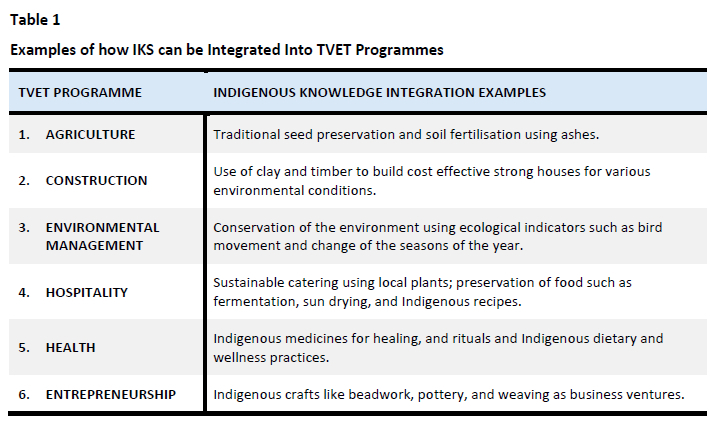
From an epistemic justice perspective, the inclusion of Indigenous knowledge is an urgent corrective measure to recognise knowledge that has been devalued and excluded from the formal education sector for a long time. Fricker (2017) conceptualises epistemic injustice as a wrong done to someone in their capacity as a knower, a condition that arises when local Indigenous knowledge is dismissed and excluded from formal education. Therefore, integrating local Indigenous knowledge into the TVET sector constitutes an act epistemic justice, challenging existing dominant forms of knowledge that have led to the marginalisation of Indigenous knowledge in the higher education sector (see Table 1).
The integration of Indigenous knowledge into TVET should not be merely symbolic; it should be based on practical domains where its applicability and value have been demonstrated within communities. For instance, in agriculture, the Vhavenda, like many Indigenous communities, incorporate Indigenous knowledge into their agricultural practices to promote sustainable environmental management (Edgar et al., 2022). For generations, they have developed sustainable agricultural practices such as terracing, crop rotation, polyculture, and water management to increase crop yields and minimise environmental impacts in their communities (Kugara & Mokgoatšana, 2022). Another example would be the Dikgale community in the Capricorn District of Limpopo Province, South Africa, which practises Indigenous farming techniques such as planting on different soil types, fertilising the soil, selecting and storing seeds, and maintaining crops (Rankoana, 2017). Therefore, integrating these practices into TVET agricultural programmes can assist students to solve their societal environmental challenges and create economic opportunities while promoting sustainable livelihoods.
Challenges of Integrating IKS into TVET
This article argues that integrating IKS into TVET requires careful consideration of several challenges. TVET curriculum developers must avoid romanticising IKS by recognising that all knowledge systems are subject to rigorous epistemological appraisal (Lebakeng, 2010). Meaningful integration of Indigenous knowledge requires the active participation, recognition, and compensation of Indigenous knowledge holders who contribute to educational programmes (Battiste, 2016). Furthermore, assessments should be designed in such a way that they acknowledge the experiential and community-based forms of knowledge while at the same time maintaining credibility, rigour, and quality assurance standards associated with formal qualifications (Wheelahan & Curtin, 2010). To avoid tokenistic approaches, Indigenous knowledge must move beyond superficial or symbolic inclusion and be meaningfully embedded within curriculum design, teaching, and learning practices (Le Grange, 2016).
Implications of Failure to Decolonise TVET
This article argues that if the decolonisation of TVET fails, historically marginalised people will continue to experience epistemic injustice in TVET sector. The process of decolonising higher education is critical in addressing the enduring impacts of epistemic injustice and psychological alienation experienced by communities in the Global South, particularly those historically marginalised. As it stands, Eurocentric knowledge systems continue to dominate university curricula, perpetuating a cycle that privileges information and practices from the Global North while sidelining valuable local knowledge (Zembylas, 2018). HEIs are at the forefront of this issue. Rather than implementing meaningful programmes and policies that tackle the structural problems hindering decolonisation and transformation, many institutions merely pay lip service to the idea of change. This reluctance to shift away from a Eurocentric paradigm leads to ongoing epistemic violence, which not only undermines Indigenous voices but also denies them the opportunity to express their knowledge and experiences. When HEIs dictate what constitutes valid knowledge and who has the right to speak (Foucault, 1980), they engage in a form of victimisation against those who challenge the status quo. This act of exclusion ultimately violates the fundamental right to education and freedom of expression. Students, especially those from historically marginalised groups, often feel like outsiders when they enrol in HEIs, mainly because the academic model is foreign to them (Agherdien et al., 2022). If decolonisation fails, students will continue to experience this form of exclusion in this sector.
Moreover, the marginalisation of local Indigenous knowledge within higher education curricula (Heleta & Chasi, 2023) can sever the ties that historically disadvantaged individuals have with their cultural heritage and communities. This disconnection may hinder their ability to address the societal challenges unique to their own contexts. The #FeesMustFall movement highlighted these concerns as students voiced their frustrations about an academic model that felt foreign and disconnected from their realities (Vorster & Quinn, 2017). They underscored the importance of acknowledging the geography of knowledge, advocating for an educational framework that resonates with their lived experiences. The urgent need for decolonisation within higher education is not simply a matter of academic reform; it is a crucial step towards justice and empowerment for communities historically excluded from the narrative of knowledge creation and dissemination.
Indigenous Knowledge and Sustainable Development
The integration of Indigenous knowledge into TVET has a potential impact that could lead to the sustainable development of the societies from which the students come. In the dynamic landscape of sustainable development, the use of Indigenous knowledge fosters resilient livelihoods, especially in regions rich with cultural diversity (Dasgupta et al., 2023). Indigenous knowledge offers a unique lens through which communities can solve environmental challenges, preserve biodiversity, and manage natural resources (Grey et al., 2020). Sustainable livelihood is a development concept that comprises people, their capabilities, and their means of living, including food, income, and assets (Chambers & Conway, 1992). Continued marginalisation of Indigenous knowledge in TVET sector limits students' ability to contribute to sustainable development in their communities. A key contribution of Indigenous knowledge is to local economic development of societies. However, Indigenous knowledge is facing economic marginalisation (Buric, 2023). Indigenous knowledge can contribute to economic growth, self-employment, job creation, and entrepreneurship to alleviate poverty (McGrath & Yamada, 2023). In a context characterised by high unemployment, skills shortage, and lack of entrepreneurship, the integration of Indigenous knowledge for local economic development is essential for improving inclusive and sustainable economic growth.
However, some positive strides have been made in Global South countries such as South Africa towards integrating Indigenous knowledge for sustainable livelihoods. For example, in the health sector, the Traditional Health Practitioners Act (Republic of South Africa, 2008) was enacted to regulate and formalise the practice of traditional medicine, which relies heavily on Indigenous knowledge. The Act legitimised the role of traditional healers and has increased the use of Indigenous knowledge in health care, and promoted its integration into the formal health care system (Street, 2016). This reduces reliance on Western medicine and contributes to the sustainable use of local Indigenous medicines, thereby promoting sustainable livelihoods for local communities.
For the integration of local Indigenous local knowledge to succeed in TVET, adequate funding, resources, and support (Antonelli, 2023) are required, and lecturers must be trained on how to interact with Indigenous communities when seeking information. Many Indigenous practices and techniques remain undocumented or inaccessible to wider audiences, hindering their potential contribution to sustainable livelihoods (Ndlovu, 2014). The availability of policies and adequate funding will not only contribute to the inclusion of local Indigenous knowledge but also improve students' access to relevant, context-based knowledge. More importantly, the integration of Indigenous knowledge into TVET aligns with global development priorities, particularly Sustainable Development Goal (SDG) 4, which aims to ensure inclusive and equitable quality education and promote lifelong learning opportunities for all; SDG 10, which seeks to reduce inequality within and among countries; and SDG 8, which promotes sustained, inclusive, and sustainable economic growth (UNESCO, 2021). However, continued alienation of local Indigenous knowledge in TVET undermines these objectives by producing graduates who are disconnected from local contexts and unable to contribute to sustainable development.
Transformation of Curriculum, Pedagogy, and Assessment in TVET
The integration of Indigenous knowledge into TVET requires the transformation of curriculum, pedagogy, and assessment. This section of the article discusses why transformation of curriculum, pedagogy, and curriculum is essential in TVET.
CurriculumEurocentric knowledge has for many years been the mostly recognised and preferred source of knowledge in HEIs, and this has rendered Indigenous knowledge worthless. The current state of TVET curricula illustrates epistemic dislocation (Ndlovu-Gatsheni, 2021)-when students must inhabit a curriculum that denies their social and linguistic worlds. Epistemic justice in this context is about integrating local Indigenous for contextual relevance, and incorporating historically marginalised knowledge as part of curricula in TVET.
Pedagogy
Almost all of academia's attention has been on Western research paradigms and methods of knowledge production (Held, 2019). Decolonising pedagogy involves moving beyond teacher-centred approaches and incorporating the African students' thoughts as a step towards liberating the higher education sector in Africa (Zembylas, 2018). Given that Indigenous knowledge is learned through oral practices and storytelling (Sium & Ritskes, 2013), incorporating these methods can improve students' deeper engagement with what is taught, and bridge the gap between what counts as legitimate knowledge and local Indigenous knowledge in TVET sector.
Assessment
Assessment remains a site of power in higher education, where remnants of coloniality persist. The power embedded in assessment practices makes assessment an important site for decolonisation (Godsell et al., 2024). Decolonised assessment in TVET should not be seen as a rejection of standards but as a reconfiguration of how competence is evidenced and validated. By integrating community-based assessment with robust moderation systems, clearly defined rubrics, and alignment to national qualification frameworks, assessment can remain credible, comparable, and fair while also being contextually relevant and socially responsive. The current TVET assessments, such as tests and examinations, are rooted in Western epistemology. Therefore, these methods of assessment limit students' ability to engage with practical and contextual dimensions of Indigenous knowledge. And, they risk reinforcing epistemic injustice by marginalising other forms of knowledge that do not conform to dominant assessment standards. Community-engaged assessment methods could also be used to provide students with an opportunity to integrate knowledge from their communities in their assessments.
Pedagogical Approaches for Integration
Radical integration of Indigenous knowledge requires more than curriculum reform; it challenges traditional classroom practices, which exhibit many drawbacks, including a singular teaching approach, disconnection from real-world applications, insufficient emphasis on perceptual skills development, and disregard for students' active knowledge acquisition (Jinghang, 2024). For it to be successful, it requires an experiential, context-based, and communal teaching approach.
Experiential Learning
Experiential learning is key to supporting students in applying theory to new scenarios, developing higher-order thinking and decision-making skills for life-long learning and employment (Pole & McGee, 2026). Experiential learning is closely aligned with the nature of Indigenous knowledge because it is practice-based, transmitted orally, and passed down through generations within communities (Chatterjee et al., 2022). Therefore, this approach is well-suited for integrating Indigenous knowledge into TVET because it reinforces the practical application of knowledge in real-world contexts.
Community-Based Learning
Community-based learning is a teaching practice that incorporates student volunteerism, experiential learning, and curriculum for academic credit (Mooney & Edwards, 2001). It incorporates problem-based service learning, direct service learning, and community-based research (Mooney & Evans, 2001; Dallimore et al., 2010). This approach allows students to engage directly with Indigenous knowledge holders, and allows students to acquire practical skills while simultaneously acknowledging and respecting Indigenous knowledge. This approach also makes it possible to pursue more ambitious goals, with the preservation of culture and the empowerment of Indigenous peoples as key focuses in promoting an intercultural curriculum (da Silva et al., 2024).
Co-Teaching With Knowledge Holders
Indigenous communities are often made invisible and excluded from knowledge systems historically accumulated by society (da Silva et al., 2024). TVET institutions must open up pathways for Indigenous knowledge holders to contribute to this sector. There is a need for construction "from the knowledge of the people and with the people," which allows for a more critical reading that "exceeds the borders of letters and constitutes itself in historical and social relations" (Maciel, 2011, p. 328). Co-teaching doesn't only enrich learning experiences but also contributes to epistemic justice by validating Indigenous knowledge within the higher education sector (Ndlovu et al., 2021). For this approach to be successful, it requires institutional flexibility and policies to support and accommodate Indigenous knowledge in TVET.
Recommendations
The findings of this conceptual paper highlight an urgent need to transform the TVET sector in the Global South. In order to successfully integrate Indigenous knowledge into TVET and promote epistemic justice, this conceptual paper makes the following recommendations.
Curriculum Reform and Integration of Indigenous KnowledgeThis article is not opposed to the presence of Eurocentric knowledge in TVET; rather, it suggests that TVET curriculum developers and lecturers develop curricula that recognise and create space for local Indigenous knowledge to form part of the TVET curriculum. Such curricula should reflect the socioeconomic, cultural, and Indigenous practices of the students in the sector. Indigenous knowledge should not be treated as a supplementary component but should be embedded across all subjects, teaching methodologies, and assessment practices to ensure meaningful learning and relevance.
Policy and Institutional Support
The Department of Higher Education and Training and TVET curriculum developers should revise the existing accreditation system, qualification frameworks, and quality assurance to ensure the integration of local Indigenous knowledge. TVET institutions should also implement mandatory policies requiring lecturers to integrate Indigenous knowledge into their teaching, and include it as a criterion in their performance agreements. Resources, lecturer training, and funding must be part of these policies.
Conclusion
This article has examined the integration of Indigenous knowledge in the Global South TVET sector in order to advance epistemic justice and sustainable development. This study is situated within a decolonial framework. It article argues that epistemic injustice continues to persist in TVET sector, where Indigenous knowledge continues to be sidelined and remains inadequately formalised. This distances students from their socioeconomic realities, cultural practices, and Indigenous knowledge. This article further argues that meaningful transformation of TVET requires the transformation of pedagogy, assessment, and curriculum. The integration of Indigenous knowledge in the Global South has potential implications for fields such as the economic and health sectors, enabling local societies to benefit in a sustainable manner. Failure to decolonise the TVET sector will perpetuate epistemic injustice and further marginalise rich Indigenous knowledge that is intended to benefit students and societies from which they come. While this study is conceptual in nature, it further provides a foundation for future empirical research on the integration of Indigenous knowledge in TVET sector. This article contributes to decolonial discourse by highlighting issues of epistemic injustice in an under-researched sector and emphasising the importance of decolonising the TVET sector. Advancing the integration of Indigenous knowledge in the TVET sector is essential for rethinking and reimagining TVET beyond the influence of the West and for fostering sustainable development in the Global South.
References
Literature review
- Agherdien, N., Pillay, R., Dube, N., & Masinga, P. (2022). What does decolonising education mean to us? Educator reflections. Scholarship of Teaching and Learning in the South, 6(1), 55-78.
- Allais, S., & Marock, C. (2024). What problem should skills solve? International Higher Education, 117, 26-27. https://doi.org/10.6017/ihe.2024.117.19275
- Antonelli, A. (2023). Indigenous knowledge is key to sustainable food systems. Nature, 613(7943), 239-242. https://doi.org/10.1038/d41586-023-00095-8
- Apple, M. W. (2018). Critical curriculum studies and the concrete problems of curriculum policy and practice. Journal of Curriculum Studies, 50(6), 685-690. https://doi.org/10.1080/00220272.2018.1537373
- Battiste, M. (2016). Research ethics for protecting Indigenous knowledge and heritage: Institutional and researcher responsibilities. In N. K. Denzin & M. D. Giardina (Eds.), Ethical futures in qualitative research (pp. 111-132). Routledge.
- Bayrakçeken, A. (2024). Economic security in times of crisis: A legal framework for sustainable financial resilience. Mayo Communication Journal, 1(2), 65-74. https://researchcorridor.org/index.php/mcj/article/view/158
- Bloomberg, L. D., & Volpe, M. (2019). Completing your qualitative dissertation: A road map from beginning to end (4th ed.). SAGE.
- Buric, S. (2023). Achieving reconciliation: An analysis on policies affecting the Indigenous peoples of Canada [Master's paper, University of Windsor]. University of Windsor Scholarship at UWindsor. https://scholar.uwindsor.ca/major-papers/
- Chambers, R., & Conway, G. (1992). Sustainable rural livelihoods: Practical concepts for the 21st century (IDS Discussion Paper No. 296). Institute of Development Studies. https://opendocs.ids.ac.uk/articles/report/Sustainable_rural_livelihoods_practical_concepts_for_the_21st_century/26473510
- Chatterjee, U., Kashyap, A., Everard, M., Panda, G. K., & Mahata, D. (Eds.). (2022). Indigenous people and nature: Insights for social, ecological, and technological sustainability. Elsevier.
- Cindi, L. (2021). Incorporating African Indigenous knowledge systems into the basic education curriculum: Experiences from two schools in the Gauteng and KwaZulu-Natal provinces, South Africa [Unpublished master's dissertation]. University of the Free State.
- Cummings, S., Dhewa, C., Kemboi, G., & Young, S. (2023). Doing epistemic justice in sustainable development: Applying the philosophical concept of epistemic injustice to the real world. Sustainable Development, 31(3), 1965-1977. https://doi.org/10.1002/sd.2490
- da Silva, P., Pereira, J., & Amorim, R. (2024). Decolonial approaches to vocational education in Brazil. Latin American Journal of Education, 12(2), 99-118.
- de Sousa Santos, B. (2015). Epistemologies of the South: Justice against epistemicide. Routledge.
- Ezeanya-Esiobu, C. (2019). Indigenous knowledge and education in Africa. Springer.
- Foucault, M. (1980). Power/knowledge: Selected interviews and other writings, 1972-1977. Pantheon Books.
- Fricker, M. (2017). Evolving concepts of epistemic injustice. In I. J. Kidd, J. Medina, & G. Pohlhaus Jr. (Eds.), The Routledge handbook of epistemic injustice (pp. 53-60). Routledge.
- Grey, M. S., Masunungure, C., & Manyani, A. (2020). Integrating local Indigenous knowledge to enhance risk reduction and adaptation strategies to drought and climate variability: The plight of smallholder farmers in Chirumhanzu district, Zimbabwe. Jàmbá: Journal of Disaster Risk Studies, 12(1), 1-10. https://doi.org/10.4102/jamba.v12i1.924
- Harvey, A., & Russell-Mundine, G. (2019). Decolonising the curriculum: Using graduate qualities to embed Indigenous knowledges at the academic cultural interface. Teaching in Higher Education, 24(6), 789-808. https://doi.org/10.1080/13562517.2018.1508131
- Heinonen, K., & Gruen, T. (2024). Elevating conceptual research: Insights, approaches, and support. AMS Review, 14(1), 1-6. https://doi.org/10.1007/s13162-024-00283-9
- Held, M. B. E. (2019). Decolonizing research paradigms in the context of settler colonialism: An unsettling, mutual, and collaborative effort. International Journal of Qualitative Methods, 18, 1-16. https://doi.org/10.1177/1609406918821574
- Heleta, S. (2016). Decolonisation of higher education: Dismantling epistemic violence and Eurocentrism in South Africa. Transformation in Higher Education, 1(1), 1-8. https://doi.org/10.4102/the.v1i1.9
- Heleta, S., & Chasi, S. (2023). Rethinking and redefining internationalisation of higher education in South Africa using a decolonial lens. Journal of Higher Education Policy and Management, 45(3), 261-275. https://doi.org/10.1080/1360080X.2022.2158113
- Heleta, S., & Dilraj, I. (2024). Decolonisation is not even a footnote: On the dominant ideologies and smokescreens in South African higher education. Transformation in Higher Education, 9, Article 416. https://doi.org/10.4102/the.v9i0.416
- Kidd, I. J., Medina, J., & Pohlhaus, G. (2017). Introduction. In I. J. Kidd, J. Medina, & G. Pohlhaus (Eds.), The Routledge handbook of epistemic injustice (pp. 1-9). Routledge.
- Kugara, S. L., & Mokgoatšana, S. (2022). Challenges presented by digitisation of VhaVenda oral tradition: An African Indigenous knowledge systems perspective. HTS Teologiese Studies/Theological Studies, 78(3), Article 7428. https://doi.org/10.4102/hts.v78i3.7428
- Kwoba, B., Chantiluke, R., & Nkopo, A. (Eds.). (2018). Rhodes must fall: The struggle to decolonise the racist heart of empire. Bloomsbury.
- Lebakeng, T. J. (2010). Discourse on Indigenous knowledge systems, sustainable socio-economic development and the challenge of the academy in Africa. CODESRIA Bulletin, 1-2, 24-29. https://doi.org/10.57054/cb01-022010501
- Le Grange, L. (2019). The curriculum case for decolonisation. In J. Jansen (Ed.), Decolonisation in universities: The politics of knowledge (pp. 29-48). Wits University Press.
- Majola, E., Geduld, D., & Sathorar, H. (2026). Decolonising from below: Africanisation, student voice, and epistemic justice in South African technical and vocational education and training. Inkanyiso: Journal of Humanities and Social Sciences, 18(1), a327. https://doi.org/10.4102/ink.v18i1.327
- Majola, E., & Madimabe-Mofokeng, M. (2025). Exploring traces of humanising pedagogy in South African TVET colleges: A transformative approach. International Journal of Educational Development in Africa, 10. https://doi.org/10.25159/2312-3540/19130
- Mashilo, P. P., & Govender, L. (2023). African identity and curriculum transformation at universities in South Africa. African Journal of Teacher Education, 12(2), 119-143. https://doi.org/10.21083/ajote.v12i2.7515
- Mbembe, A. (2016). Decolonizing the university: New directions. Arts and Humanities in Higher Education, 15(1), 29-45. https://doi.org/10.1177/1474022215618513
- McGrath, S., & Yamada, S. (2023). Skills for development and vocational education and training: Current and emergent trends. International Journal of Educational Development, 102, 102853. https://doi.org/10.1016/j.ijedudev.2023.102853
- Mignolo, W. D. (2007). Delinking: The rhetoric of modernity, the logic of coloniality and the grammar of de-coloniality. Cultural Studies, 21(2/3), 449-514. https://doi.org/10.1080/09502380601162647
- Mignolo, W. D. (2011). Geopolitics of sensing and knowing: On (de)coloniality, border thinking and epistemic disobedience. Postcolonial Studies, 14(3), 273-283. https://doi.org/10.1080/13688790.2011.613105
- Mignolo, W. D., & Walsh, C. E. (2018). On decoloniality: Concepts, analytics, praxis. Duke University Press.
- Mitova, V. (2020). Explanatory injustice and epistemic agency. Ethical Theory and Moral Practice, 23(5), 707-722. https://doi.org/10.1007/s10677-020-10094-z
- Mooney, G., & Edwards, R. (2001). Community, welfare, and decolonisation. Routledge.
- Mooney, G., & Evans, M. (2001). Globalisation and social policy. Palgrave.
- Motala, S., Sayed, Y., & de Kock, T. (2021). Epistemic decolonisation in reconstituting higher education pedagogy in South Africa: The student perspective. Teaching in Higher Education, 26(7/8), 1002-1018. https://doi.org/10.1080/13562517.2021.1940929
- Mseleku, Z. (2024). Transitioning from higher education to the labour market: The role of graduate internship on youth graduate employability. Cogent Education, 11(1), Article 2428069. https://doi.org/10.1080/2331186X.2024.2428069
- Naudé, P. (2017). Decolonising knowledge: In what sense is an "African" ethic possible? Inaugural lecture, Stellenbosch University.
- Ndlovu, M. (2014). Why Indigenous knowledges in the 21st century? A decolonial turn. Yesterday & Today, 11, 84-98. https://hdl.handle.net/10394/10919
- Ndlovu, C., James, A., & Govender, N. (2021). Can IK and Western science be complementary in an IK-SCIE agricultural curriculum? Theorising for an appropriate agricultural curriculum. In K. G. Fomunyam & S. B. Khoza (Eds.), Curriculum theory, curriculum theorising and the theoriser: The African theorising perspective (pp. 103-120). Sense Publishers.
- Ndlovu-Gatsheni, S. J. (2013). Coloniality of power in postcolonial Africa: Myths of decolonization. African Books Collective.
- Ndlovu-Gatsheni, S. J. (2018). Epistemic freedom in Africa: Deprovincialization and decolonization. Routledge.
- Ngcwangu, S. (2019). Skills development and TVET policies in South Africa: The human capabilities approach. In S. McGrath, M. Mulder, J. Papier, & R. Suart (Eds.), Handbook of vocational education and training: Developments in the changing world of work (pp. 1-14). Springer.
- Nyamnjoh, F. B. (2016). #RhodesMustFall: Nibbling at resilient colonialism in South Africa. Langaa RPCIG.
- Omodan, B. I. (2023). Unveiling epistemic injustice in education: A critical analysis of alternative approaches. Social Sciences & Humanities Open, 8(1), Article 100699. https://doi.org/10.1016/j.ssaho.2023.100699
- Patton, M. Q. (1999). Enhancing the quality and credibility of qualitative analysis. Health Services Research, 34(5 Pt 2), 1189-1208. https://pmc.ncbi.nlm.nih.gov/articles/PMC1089059/
- Pole, K., & McGee, M. (2026). Experiential learning. In S. Wang, Z. Zhou, & S. Marginson (Eds.), Teaching and learning in higher education (pp. 51-63). Springer Nature.
- Rankoana, S. A. (2017). The use of Indigenous knowledge in subsistence farming: Implications for sustainable agricultural production in Dikgale community in Limpopo Province, South Africa. In M. L. Larramendy & S. Soloneski (Eds.), Toward a sustainable agriculture (pp. 63-85). IntechOpen.
- Rasool, H., & Mahembe, E. (2014). FET colleges' purpose in the developmental state: Imperatives for South Africa. Study on programmes identified and prioritised by the FET Colleges Technical Task Team and its work streams. Human Resource Development Council of South Africa. https://www.saben.ac.za/wp-content/uploads/2017/06/FET-colleges-purpose-in-the-developmental-state-Imperatives-for-SA.pdf
- Republic of South Africa. (2008). Traditional Health Practitioners Act, 2007 (Act No. 22 of 2007). https://www.gov.za/documents/traditional-health-practitioners-act
- Seehawer, M. (2018). South African science teachers' strategies for integrating Indigenous and Western knowledges in their classes: Practical lessons in decolonisation. Educational Research for Social Change, 7(Special Issue), 91-110. https://doi.org/10.17159/2221-4070/2018/v7i0a7
- Selane, C., & Odeku, K. O. (2024). An analysis of how TVET is playing a significant role in fostering students' skills and competencies in South Africa. Journal of Educational and Social Research, 14(3), 293-305. https://doi.org/10.36941/jesr-2024-0073
- Shor, I., & Freire, P. (1987). What is the dialogical method of teaching? Journal of Education, 169(3), 11-31. https://doi.org/10.1177/002205748716900303
- Sibanda, A., & Ofir, Z. (2021). Evaluation in an uncertain world: A view from the Global South. In R. D. van den Berg, C. Magro, & M.-H. Adrien (Eds.), Transformational evaluation for the global crises of our times (pp. 37-61). IDEAS.
- Sium, A., & Ritskes, E. (2013). Speaking truth to power: Indigenous storytelling as an act of living resistance. Decolonization: Indigeneity, Education & Society, 2(1), 1-10. https://jps.library.utoronto.ca/index.php/des/article/view/18638
- Street, R. A. (2016). Unpacking the new proposed regulations for South African traditional health practitioners. South African Medical Journal, 106(4), 325-326. https://doi.org/10.7196/SAMJ.2016.v106i4.10623
- Tikly, L. (2013). Reconceptualizing TVET and development: A human capability and social justice approach. In M. Pilz (Ed.), Revisiting global trends in TVET: Reflections on theory and practice (pp. 1-39). Springer.
- Towani, J. Y. (2026). A decolonial exploration of the National Certificate Vocational (NCV) curriculum: A case of two TVET colleges in KZN [Doctoral dissertation, University of KwaZulu-Natal]. University of KwaZulu-Natal ResearchSpace. https://hdl.handle.net/10413/24479
- UNESCO. (2021). The United Nations world water development report 2021: Valuing water. https://unesdoc.unesco.org/ark:/48223/pf0000375724
- Vorster, J. A., & Quinn, L. (2017). The "decolonial turn": What does it mean for academic staff development? Education as Change, 21(1), 31-49. https://doi.org/10.17159/1947-9417/2017/1092
- Wheelahan, L., & Curtin, E. (2010). The quality of teaching in VET: Overview. LH Martin Institute for Higher Education Leadership and Management, Melbourne Graduate School of Education. https://austcolled.com.au/announcement/study-quality-teaching-vet
- Zembylas, M. (2018). Decolonial possibilities in South African higher education: Reconfiguring humanising pedagogies as/with decolonising pedagogies. South African Journal of Education, 38(4), 1-11. https://doi.org/10.15700/saje.v38n4a1699