
 Against Deficit Naming: Towards an African-Centred Rehumanisation of TVET Learners
Abstract
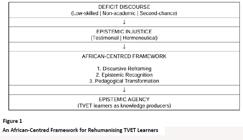
This conceptual paper examines how technical and vocational education and training (TVET) learners in South Africa are discursively constructed through deficit-oriented naming practices that reproduce epistemic and pedagogical inequalities. While existing scholarship has largely focused on access, employability, and system reform, limited attention has been paid to the role of language in shaping teaching and learning. Drawing on labelling theory, critical discourse analysis and Fricker's concept of epistemic injustice, the paper argues that labels such as "low-skilled," "non-academic," and "second-chance learners" position vocational students as intellectually subordinate within the post-school education system. These naming practices contribute to testimonial injustice by undermining learners' credibility as knowers, and to hermeneutical injustice by rendering vocational knowledge less visible within dominant academic frameworks. The paper further demonstrates how such deficit discourses inform pedagogical practices, including lecturer expectations, curriculum design, and student participation. In response, it proposes an African-centred framework grounded in Ubuntu and the humanising pedagogy of Paulo Freire, which repositions TVET learners as epistemic agents. The paper contributes to critical higher education scholarship by centring language as a key site of epistemic struggle and pedagogical transformation in the Global South.
African-Centred Education; Critical Pedagogy; Deficit Discourse; Epistemic Injustice; Higher Education Transformation; TVET Ubuntu; Vocational Knowledge
 Thumbnail
