
 Against Deficit Naming: Towards an African-Centred Rehumanisation of TVET Learners
Abstract
This conceptual paper examines how technical and vocational education and training (TVET) learners in South Africa are discursively constructed through deficit-oriented naming practices that reproduce epistemic and pedagogical inequalities. While existing scholarship has largely focused on access, employability, and system reform, limited attention has been paid to the role of language in shaping teaching and learning. Drawing on labelling theory, critical discourse analysis and Fricker's concept of epistemic injustice, the paper argues that labels such as "low-skilled," "non-academic," and "second-chance learners" position vocational students as intellectually subordinate within the post-school education system. These naming practices contribute to testimonial injustice by undermining learners' credibility as knowers, and to hermeneutical injustice by rendering vocational knowledge less visible within dominant academic frameworks. The paper further demonstrates how such deficit discourses inform pedagogical practices, including lecturer expectations, curriculum design, and student participation. In response, it proposes an African-centred framework grounded in Ubuntu and the humanising pedagogy of Paulo Freire, which repositions TVET learners as epistemic agents. The paper contributes to critical higher education scholarship by centring language as a key site of epistemic struggle and pedagogical transformation in the Global South.
African-Centred Education; Critical Pedagogy; Deficit Discourse; Epistemic Injustice; Higher Education Transformation; TVET Ubuntu; Vocational Knowledge
Introduction
Technical and vocational education and training (TVET) occupies a complex and often contradictory position within South Africa's post-school education system. On the one hand, policy frameworks consistently position TVET as central to economic development, skills formation, and social redress (Department of Higher Education and Training [DHET], 2013; National Planning Commission, 2012). On the other hand, the sector remains symbolically and institutionally marginal within the broader higher education landscape, where it is frequently constructed as inferior to university education (Allais, 2017; Powell & McGrath, 2013). Although this marginalisation is commonly explained in relation to structural inequality, funding limitations, and institutional capacity, I argue that insufficient attention has been paid to the role of language in reproducing these hierarchies, particularly within pedagogical contexts.
This paper proceeds from the premise that the naming of students within educational discourse is never neutral. In TVET contexts, learners are frequently described through deficit-oriented labels such as "low-skilled," "non-academic," and "second-chance learners" (Moodie et al., 2019; Wheelahan, 2015). These labels circulate across policy discourse, institutional practice, and classroom interaction, shaping assumptions about who TVET students are and what they are capable of becoming. Drawing on Howard S. Becker's (1963) labelling theory and Norman Fairclough's (2023) work in critical discourse analysis, I argue that such naming practices are not merely descriptive but constitutive. They shape forms of student subjectivity, position learners within hierarchies of knowledge, and influence how pedagogy is enacted within vocational education spaces.
Despite a growing body of scholarship on TVET in South Africa and the Global South, much of the literature has focused on issues of access, employability, curriculum responsiveness, and system efficiency (Magadza & Mampane, 2024; McGrath & Powell, 2016). Comparatively less attention has been given to the discursive construction of TVET learners and the implications this has for epistemic recognition and pedagogical practice. This represents a significant gap within critical higher education scholarship, where questions of language, power, and knowledge remain central. In response, I centre deficit naming as a key mechanism through which epistemic marginalisation is reproduced within educational contexts.
To develop this argument, I draw further on Fricker's (2007) theorisation of epistemic injustice. This enables an analysis of how naming practices shape both social identity and epistemic status. I conceptualise TVET as a contested pedagogical and discursive space in which language functions as a technology of power (Fairclough, 2023), shaping not only how students are perceived but also how knowledge is valued, transmitted, and legitimised. Through this lens, I argue that deficit naming produces testimonial injustice by undermining students' credibility as knowers, while hermeneutical injustice renders vocational forms of knowledge less visible within dominant academic frameworks (Fricker, 2007).
The implications of this argument extend beyond discourse analysis to the everyday practices of teaching and learning. When vocational learners are framed through deficit terminology, lecturer expectations, curriculum design, assessment practices, and student participation may all be affected. Language therefore becomes embedded within pedagogical processes, shaping whose knowledge is recognised and whose is marginalised within the classroom. Addressing deficit naming is consequently not only a representational concern but also a pedagogical imperative closely linked to broader projects of higher education transformation.
In response, I propose an African-centred framework for rehumanising TVET learners, drawing on the ethical and epistemic principles of Ubuntu (Letseka, 2012) alongside the humanising pedagogy of Paulo Freire (1970/2007). This framework seeks to reposition vocational students as epistemic agents who participate actively in knowledge-making rather than as passive recipients of skills training. By rethinking how learners are named and recognised, it becomes possible to challenge entrenched hierarchies between academic and vocational knowledge and to imagine more inclusive and socially just approaches to pedagogy.
The paper proceeds as follows. I first outline the conceptual approach informing the study before situating the marginalisation of TVET within its historical and structural context. I then examine deficit discourse and the politics of naming within educational settings, followed by an analysis of epistemic injustice and the academic-vocational hierarchy. I conclude by proposing an African-centred approach to rehumanising vocational learners and reflecting on its implications for teaching and learning in South African higher education.
Conceptual Approach
In this conceptual paper, I adopt a theoretical synthesis approach to examine deficit naming practices within South African TVET contexts and to develop an African-centred framework for rehumanisation. My aim is not to generate empirical data, but to bring existing theoretical perspectives into critical dialogue to offer a new way of understanding how language shapes epistemic inequality within higher education. I draw on critical discourse analysis (Van Dijk, 2015) to explore how language constructs and sustains epistemic hierarchies in educational contexts. This framework enables me to examine how labels used to describe TVET learners are not neutral descriptors, but carry implicit assumptions about intellectual ability and educational value. I also draw on labelling theory (Goffman, 1963) to show how such labels shape the ways learners are perceived, positioned, and treated within teaching and learning environments.
To deepen this analysis, I use the concept of epistemic injustice (Fricker, 2017) as my primary analytical lens. This enables me to examine how deficit naming undermines TVET learners in their capacity as knowers. I focus specifically on testimonial injustice, in which learners' credibility is unfairly diminished, and hermeneutical injustice, in which vocational forms of knowledge are insufficiently recognised or understood within dominant academic frameworks.
My process of theoretical synthesis unfolded through four iterative stages. First, I reviewed key scholarship on the marginalisation of TVET to identify gaps relating to language and discourse. Second, I examined how naming practices operate across policy, pedagogy, and scholarship, paying particular attention to recurring deficit-oriented terminology. Third, I engaged African-centred perspectives, especially Ubuntu, alongside humanising pedagogical traditions to explore alternative ways of conceptualising learners and knowledge. Finally, I brought these strands into conversation through a process of critical reflection to develop an integrated framework for rehumanising TVET learners.
This theoretical synthesis was guided by an interpretive and critical reading strategy rather than by a systematic review methodology. The aim was not to produce an exhaustive survey of TVET scholarship, but to identify recurring discursive patterns and conceptual tensions relating to the positioning of vocational learners within higher education. Literature was selected according to its relevance to three interconnected concerns: deficit discourse in education, epistemic marginalisation, and African-centred pedagogical thought. By bringing these bodies of scholarship into dialogue, I sought to develop a conceptual framework capable of explaining how naming practices mediate relationships between discourse, pedagogy, and epistemic recognition within South African TVET contexts. The framework should therefore be understood as an analytical and pedagogical tool rather than an empirically validated model. Throughout this process, I remain attentive to the implications for teaching practice, informed by my position as an academic literacy practitioner within a university of technology. This orientation enables me to prioritise conceptual depth while maintaining relevance to higher education practice, particularly in relation to pedagogy, student identity, and epistemic access.
Historical and Structural Marginalisation of TVET
To understand the contemporary positioning of TVET learners, it is necessary to situate the sector within its broader historical and structural context. Importantly, the marginalisation of vocational education is not incidental, nor simply the result of institutional inefficiency. Rather, it is historically produced through layered educational regimes that have systematically privileged particular forms of knowledge while devaluing others (Daniels, 2018). These regimes continue to shape how vocational education is organised, perceived, and enacted within teaching and learning environments.
A central feature of modern education systems is the enduring distinction between intellectual and manual labour. This distinction is not merely functional; it is epistemic. As Popkewitz (1997) argues, Western traditions of thought have long associated intellectual activity with higher-order reasoning, while manual work has been framed as routine or technical. This philosophical hierarchy became institutionalised through the separation of academic and vocational pathways, with universities positioned as sites of theoretical knowledge production and vocational institutions constructed as spaces for applied skills development (Wheelahan & Moodie, 2025; Young & Muller, 2014). Importantly, this separation did not simply differentiate forms of learning; it established a hierarchy of knowledge in which abstract, codified knowledge was accorded greater legitimacy.
In the South African context, this hierarchy was intensified under colonial and apartheid regimes. Education systems were deliberately structured to reproduce racialised divisions of labour, directing different population groups into differentiated educational pathways (Badat, 2009). Academic education was largely reserved for privileged groups and associated with intellectual authority and professional advancement. By contrast, vocational education was designed to prepare the majority of the population for manual labour within an industrial economy. As a result, vocational learning became historically associated not only with labour, but with subordination. This legacy continues to shape contemporary perceptions of TVET, where the sector is often implicitly positioned as an alternative for those excluded from university pathways.
While post-apartheid reforms have sought to redress these inequalities, the symbolic hierarchy between academic and vocational education has proven remarkably resilient. Universities continue to occupy the apex of the educational prestige hierarchy, while TVET colleges are frequently perceived as institutions of last resort (Allais, 2017; Powell & McGrath, 2013). I argue that this perception is not sustained by structural conditions alone, but also through deeply embedded epistemic assumptions about what counts as legitimate knowledge. These assumptions continue to influence how curricula are designed, how teaching is approached, and how students are positioned within learning environments.
At the policy level, the democratic state has consistently affirmed the importance of TVET. The White Paper for Post-School Education and Training positions the sector as central to economic development and social inclusion (DHET, 2013), while the National Development Plan 2030 identifies it as a key mechanism for addressing unemployment (National Planning Commission, 2012). However, these policy frameworks tend to frame vocational education primarily in terms of labour market responsiveness and skills supply. While such framing recognises the economic value of TVET, it also risks narrowing its educational purpose by positioning it predominantly as a site of training rather than as a space of knowledge production.
From a critical perspective, this economic orientation reflects broader global shifts associated with neoliberal education policy (McGrath & Powell, 2016). Within this paradigm, the value of education is increasingly measured in terms of employability and economic productivity. For TVET, this has significant pedagogical implications. When vocational education is framed primarily as a mechanism for producing employable graduates, teaching and learning practices may become oriented towards competency and performance, rather than towards critical engagement, knowledge construction, and intellectual development. In this way, broader policy discourses shape not only institutional priorities but also the epistemic conditions under which learning takes place.
The institutional separation between universities and TVET colleges further reinforces these hierarchies. Universities are typically associated with research, theory, and knowledge creation, while vocational institutions are associated with the application of existing knowledge (Naziz, 2019). Such distinctions obscure the intellectual complexity inherent in vocational practice. Technical problem-solving, diagnostic reasoning, and craft expertise involve sophisticated forms of cognition that are rarely recognised within dominant academic frameworks. As a result, vocational learners may be positioned as competent practitioners but not as legitimate knowers.
I therefore argue that the marginalisation of TVET is not only structural but epistemic. It is embedded in the ways knowledge is classified, valued, and transmitted within education systems. These classifications shape how learners are positioned before they even enter the classroom, influencing expectations about their intellectual capacity and educational potential. In teaching and learning contexts, this can translate into lowered expectations, constrained curricula, and limited opportunities for epistemic participation.
Understanding these historical and structural dynamics is essential for analysing how deficit discourses emerge and persist within the TVET sector. Such discourses are not isolated linguistic phenomena; they are rooted in longstanding systems of meaning that define what counts as valuable knowledge and who is recognised as a legitimate knower. In the following section, I examine how these dynamics are reproduced through deficit-oriented naming practices and the politics of discourse within contemporary educational contexts.
Deficit Discourse and the Politics of Naming
Having situated the marginalisation of TVET within its historical and structural context, I now turn to the role of language in sustaining these inequalities. I argue that the positioning of vocational learners is shaped not only through institutional arrangements, but also through deficit-oriented discourses that influence how such learners are understood within educational settings. Naming, in this sense, functions as a social and pedagogical practice through which educational hierarchies are reproduced.
Language does not merely reflect social reality; it actively constructs it. Drawing on Norman Fairclough's (2023) critical discourse analysis, discourse can be understood as a site where power, knowledge, and social relations intersect. Within education systems, naming practices operate as classificatory mechanisms that assign meaning to students' identities, abilities, and potential. Through repeated circulation across policy discourse, institutional practices and classroom interaction, particular labels become normalised and begin to shape how learners are perceived and engaged within pedagogical contexts.
In TVET contexts, deficit-oriented labels such as "low-skilled," "non-academic," and "second-chance learners" circulate widely (Moodie et al., 2019; Wheelahan, 2015). Although these terms may appear descriptive, they carry implicit assumptions about intellectual ability and educational worth. They position vocational learners within a lower tier of the educational hierarchy and frame vocational participation as compensatory rather than intellectually legitimate. Such labels are embedded within broader discursive formations that privilege academic knowledge while devaluing vocational forms of knowing.
To explain how these labels acquire social and pedagogical force, I draw on Howard S. Becker's (1963) labelling theory, which demonstrates how social categories can become internalised and institutionalised over time. Labels do not simply describe individuals; they shape expectations, interactions, and opportunities. Within educational contexts, deficit labels may influence how lecturers interpret students' abilities, design curricula, and structure assessment practices. Naming therefore becomes embedded within pedagogy itself, shaping not only how students are perceived but also how they are taught.
Within the South African post-school system, the persistent framing of TVET as a second-chance pathway illustrates this dynamic clearly. Although often intended to convey opportunity, the term implicitly constructs vocational learners as students who have failed to meet the standards associated with university admission. This framing positions TVET as remedial and reinforces deficit assumptions within pedagogical practice. Lecturers may consciously or unconsciously lower expectations, simplify content or prioritise basic competency over critical engagement. In this way, deficit discourse can shape both the quality and character of learning experiences within vocational education.
Challenging deficit discourse therefore requires the development of alternative naming practices that affirm vocational learners' epistemic agency and intellectual contribution. Rather than referring to TVET students as "low-skilled" learners, educational discourse might position them as "work-integrated learners," "technical knowledge practitioners," or "industry-ready students." Similarly, replacing the term "second-chance learners" with concepts such as "career-development students" or "community-based innovators" reframes vocational education as a legitimate and intellectually valuable pathway rather than a remedial alternative to university education. Although such shifts may appear symbolic, they have the potential to influence pedagogical expectations, institutional culture, and students' sense of belonging.
The academic-vocational binary further reinforces these discursive constructions. Academic knowledge is commonly associated with abstraction, theory, and intellectual authority, while vocational knowledge is framed as practical, technical, and applied (Wheelahan, 2015; Young & Muller, 2014). Although both forms of knowledge require complex cognitive engagement, only the former is consistently recognised as intellectually legitimate. This hierarchy is reproduced through language that positions vocational learners as skilled but not knowledgeable, competent but not intellectual. Such distinctions shape the conditions under which knowledge is recognised and valued within educational spaces.
From a critical perspective, deficit discourse reflects broader relations of power that determine whose knowledge counts. As Fairclough (2023) argues, discourse is both socially shaped and socially shaping. Once deficit labels become embedded within institutional practice and everyday interaction, they begin to normalise particular assumptions about intelligence, capability, and educational worth. Repeated exposure to such discourse may contribute to diminished confidence, weakened senses of belonging, and constrained participation in knowledge-making processes, especially when these assumptions become embedded within broader pedagogical structures.
Deficit discourse also obscures the intellectual richness of vocational learning. Technical and craft-based practices involve sophisticated forms of reasoning, including problem-solving, improvisation, and the integration of theory and practice. However, when vocational knowledge is reduced primarily to "skill," its cognitive and epistemic dimensions become less visible within dominant academic frameworks (Adams & Bell, 2016). This reinforces the perception that vocational learners engage primarily in application rather than understanding, thereby sustaining epistemic hierarchies within education systems.
Interrogating deficit discourse is therefore not simply a linguistic exercise; it is also a pedagogical and epistemic intervention. Examining how naming practices shape educational processes makes it possible to expose the mechanisms through which inequality is reproduced. Addressing deficit naming requires more than a change in terminology. It demands a reconsideration of the assumptions underpinning pedagogical practice, curriculum design, and student participation. In the next section, I extend this argument through Fricker's (2007) concept of epistemic injustice. This theoretical lens provides a more precise account of how deficit discourse undermines vocational learners not only socially, but also in their capacity as knowers within the educational landscape.
Epistemic Injustice and the Marginalisation of Vocational Knowledge
While deficit discourse shapes how TVET learners are perceived, its effects extend beyond representation to the level of knowledge itself. For me, the marginalisation of vocational learners is not only social but epistemic. To examine this dimension, I draw on Miranda Fricker's (2007, 2017) concept of epistemic injustice, which provides a framework for understanding how individuals or groups may be wronged specifically in their capacity as knowers. Fricker identifies two primary forms of epistemic injustice: testimonial injustice and hermeneutical injustice. Both are central to understanding how vocational learners are positioned within contemporary education systems. Importantly, these forms of injustice are not abstract philosophical concerns; they are enacted within everyday pedagogical practices, shaping whose knowledge is recognised, whose voices are heard, and whose contributions are legitimised within teaching and learning environments.
Testimonial injustice occurs when a speaker's credibility is unfairly diminished due to prejudice associated with their social identity. In educational contexts, credibility is often implicitly linked to institutional location, disciplinary affiliation, and perceived intellectual status. University-based knowledge is typically accorded authority, while vocational knowledge is frequently treated as secondary or derivative (Wheelahan, 2015). As a result, vocational learners may be positioned as recipients of knowledge rather than as contributors to it. Their insights, experiences, and forms of reasoning may be overlooked or undervalued, not because they lack substance, but because they are not recognised as legitimate within dominant epistemic frameworks.
Within TVET classrooms, testimonial injustice can manifest in subtle but pervasive ways. In some educational contexts, lecturers may place greater emphasis on abstract and theoretical forms of explanation than on experiential or practice-based knowledge, particularly within institutional cultures that privilege academic forms of reasoning. Students' contributions may be evaluated in relation to academic norms that do not fully capture the complexity of vocational reasoning. In such contexts, learners may come to internalise the perception that their knowledge is of lesser value. This has important pedagogical implications, as it can limit student participation, reduce confidence, and constrain opportunities for meaningful engagement in knowledge construction.
Hermeneutical injustice provides a second lens for understanding the marginalisation of vocational knowledge. This form of injustice arises when there are gaps in the collective interpretive resources available to make sense of particular experiences or forms of knowing (Fricker, 2007). In other words, individuals may possess valuable knowledge but lack the conceptual language through which that knowledge can be recognised and articulated within dominant systems of meaning.
In the context of TVET, hermeneutical injustice is evident in the privileging of abstract, codified knowledge over embodied, experiential, and practice-based forms of knowing. Vocational learning often involves tacit knowledge developed through engagement with tools, materials, and real-world problem-solving. Forms of expertise such as technical intuition, craft judgement, and situated decision-making are central to vocational practice, yet they are not easily translated into the language of formal academic discourse. As a result, these forms of knowledge may remain invisible or undervalued within educational settings that prioritise theoretical articulation.
Scholars of vocational education have long argued that this imbalance reflects deeper epistemic hierarchies embedded within modern education systems (Wheelahan, 2015; Young & Muller, 2014). Academic knowledge is often structured in ways that emphasise generalisability, abstraction, and formalisation, while vocational knowledge is situated, context-dependent, and practice-oriented. Although both forms of knowledge involve complex cognitive processes, only the former is consistently recognised as epistemically authoritative. This creates conditions in which vocational learners may struggle to have their knowledge acknowledged, not because it lacks rigour, but because it does not conform to dominant epistemic norms.
In the South African context, these dynamics are further shaped by historical inequalities. Colonial and apartheid education systems systematically privileged Eurocentric forms of knowledge while marginalising Indigenous and community-based epistemologies (Badat, 2009). Vocational education, which often draws on practical and locally embedded forms of knowing, is therefore positioned at the intersection of multiple forms of epistemic marginalisation. This historical layering intensifies the challenges faced by vocational learners in achieving epistemic recognition within the post-school system.
From a pedagogical perspective, the consequences of epistemic injustice are significant. When vocational learners are not recognised as legitimate knowers, teaching and learning practices may inadvertently reproduce exclusion. Curricula may prioritise theoretical knowledge at the expense of practice-based understanding. Assessment practices may fail to capture the depth of vocational reasoning. Classroom interactions may limit opportunities for students to contribute their own knowledge and experiences. In this way, epistemic injustice becomes embedded within the very processes through which education is delivered.
Addressing these injustices requires more than recognising the existence of different forms of knowledge; it requires a reconfiguration of the epistemic frameworks that underpin teaching and learning. Vocational knowledge must be understood not as a lesser form of knowledge, but as a different mode of knowing that integrates theory, practice, and context. Recognising this complexity opens up possibilities for more inclusive pedagogical approaches that value diverse forms of expertise and create space for vocational learners to participate as epistemic agents.
In the next section, I extend this analysis by examining how the academic-vocational binary operates as a broader epistemic hierarchy. By unpacking this binary, I show how the separation between academic and vocational learning continues to structure the conditions under which epistemic injustice is produced and sustained within education systems.
The Academic-Vocational Binary as an Epistemic Hierarchy
Building on the discussion of epistemic injustice, I now examine the academic-vocational distinction as a broader epistemic hierarchy structuring contemporary education systems. I argue that this binary does not merely differentiate institutional pathways; rather, it organises and ranks forms of knowledge, privileging certain ways of knowing while marginalising others. In doing so, it creates the conditions under which vocational learners are positioned as peripheral to intellectual life within educational contexts.
The distinction between academic and vocational learning has long shaped the organisation of modern education systems. Universities are typically associated with theoretical knowledge, disciplinary inquiry, and research, while vocational institutions are linked to practical training and occupational preparation (Wheelahan, 2015; Young & Muller, 2014). Although this differentiation may appear functional, it is underpinned by normative assumptions about the nature and value of knowledge. Academic knowledge is frequently framed as abstract, generalisable, and intellectually rigorous, whereas vocational knowledge is characterised as applied, technical, and context-specific.
These distinctions are not neutral; they carry considerable epistemic and symbolic weight. Within dominant educational discourses, abstraction and generalisability are often treated as markers of intellectual superiority. Consequently, academic knowledge becomes positioned as authoritative, while vocational knowledge is rendered secondary or derivative. This form of epistemic ordering shapes not only institutional hierarchies but also pedagogical expectations and learner identities.
It is important, however, not to reduce TVET scholarship to a singular deficit narrative. Some scholars argue that vocational education's close relationship with labour market responsiveness, employability, and occupational competence provides important opportunities for economic participation and social mobility, particularly in contexts marked by unemployment and inequality (McGrath & Powell, 2016).
From this perspective, competency-based approaches and skills-oriented curricula are not inherently reductive; rather, they may offer meaningful forms of empowerment for students navigating precarious economic conditions. The concern raised in this paper is therefore not vocational education's economic function in itself, but the tendency for employability discourse to overshadow the intellectual, epistemic, and transformative dimensions of vocational learning.
From an epistemological perspective, this hierarchy obscures the complexity inherent in vocational forms of knowing. Vocational practice involves far more than the application of pre-existing knowledge; it requires the integration of theory, experience, and contextual judgement through sophisticated forms of cognitive engagement. Processes such as diagnostic reasoning, adaptive problem-solving, and embodied judgement are central to technical and craft-based work. Yet because these forms of reasoning are often situated and tacit, they remain less visible within educational frameworks that privilege explicit and codified knowledge. This invisibility contributes to the marginalisation of vocational expertise within higher education.
The academic-vocational binary also shapes how learners are positioned within educational spaces. University students are commonly recognised as emerging scholars or knowledge producers, while vocational learners are more frequently constructed as future workers or trainees (Norodien-Fataar, 2024). Such distinctions influence expectations about intellectual participation and capability. Vocational learners may be expected to demonstrate competence, but not necessarily to question, theorise, or contribute to knowledge-making processes. In this way, the binary reinforces a separation between thinking and doing that constrains opportunities for epistemic engagement within TVET classrooms.
In the South African context, this hierarchy is further intensified by historical and social conditions. As discussed earlier, colonial and apartheid education systems entrenched divisions between intellectual and manual labour, associating academic pathways with privilege and vocational pathways with subordination (Badat, 2009). Although post-apartheid reforms have sought to expand access and improve the status of TVET, the symbolic hierarchy between university and vocational education persists. This persistence is evident not only in institutional arrangements but also in everyday pedagogical practices and discursive constructions of learners.
At the level of pedagogy, the academic-vocational binary shapes curriculum design, assessment practices, and classroom interaction. Vocational curricula may prioritise procedural competence over conceptual understanding, thereby reinforcing the perception that vocational learning is primarily instrumental. Assessment practices may focus heavily on performance outcomes without adequately recognising the reasoning processes underpinning skilled practice. Classroom interaction may also limit opportunities for learners to articulate, reflect on, and theorise their knowledge, constraining their participation as epistemic agents. In these ways, the binary is reproduced not only structurally but also through the micro-practices of education.
Importantly, the persistence of this hierarchy is not inevitable. Scholars have argued that vocational education involves forms of powerful knowledge that enable individuals to understand, navigate, and transform their social and material environments (Wheelahan, 2015; Young & Muller, 2014). Recognising vocational knowledge as intellectually rich challenges the assumption that theory and practice exist as separate domains. Instead, it opens possibilities for understanding knowledge as relational and integrated, encompassing both abstract reasoning and situated expertise.
Addressing the academic-vocational binary therefore requires more than institutional reform; it demands a reconsideration of the epistemic assumptions underpinning education systems. This includes recognising that different forms of knowledge can coexist without being hierarchically ordered and that vocational learners can engage in both practical and conceptual inquiry. Such a shift carries important implications for pedagogy because it calls for educational approaches that value multiple ways of knowing and create space for diverse forms of epistemic participation.
In the following section, I build on this critique by proposing an African-centred framework for rehumanising TVET learners. This framework seeks to challenge deficit naming and epistemic hierarchies by reimagining vocational learners as active participants in knowledge-making within more inclusive and socially just educational environments.
Towards an African-Centred Rehumanisation of TVET Learners
Having examined the historical, discursive, and epistemic conditions that shape the marginalisation of TVET learners, I now turn to the question of how these dynamics might be disrupted. I argue that addressing deficit naming and epistemic injustice requires more than critique; it demands a reconfiguration of the epistemic and pedagogical foundations upon which vocational education is built. In this section, I propose an African-centred framework for rehumanising vocational learners-one that repositions them as legitimate knowers and active participants in knowledge production.
Central to this framework is the recognition that education systems are not epistemologically neutral. Dominant models of schooling and higher education have been shaped largely by Eurocentric traditions that privilege abstraction, individualism, and disciplinary specialisation (Ndlovu-Gatsheni, 2018). While these traditions have generated important forms of knowledge, they have also marginalised alternative epistemologies that centre relationality, experience, and community-based learning. Within the context of TVET, this has contributed to the devaluation of vocational knowledge and the positioning of learners as deficient rather than capable.
An African-centred approach begins by challenging these epistemic hierarchies and recognising the plurality of knowledge systems. The philosophy of Ubuntu provides a critical foundation for this reorientation. As articulated by Letseka (2012), Ubuntu is often understood as an ethic of relationality grounded in the principle that a person becomes a person through others. However, beyond its ethical dimension, Ubuntu can also be read as an epistemological framework that understands knowledge as socially produced, collectively validated, and embedded within lived experience. From this perspective, knowing is not an individual possession but a relational process that emerges through participation in community life.
Reframing vocational education through Ubuntu shifts how learners are positioned within teaching and learning environments. Rather than being viewed as recipients of knowledge or as individuals in need of remediation, TVET learners can be understood as participants in collective knowledge-making processes. Their experiences, practices and forms of reasoning become valuable epistemic resources rather than deficits to be corrected. This shift challenges the individualising and deficit-oriented assumptions that underpin much of contemporary educational discourse.
In addition to Ubuntu, the humanising pedagogy of Paulo Freire (1970/2007) offers important insights for rethinking vocational education. Freire critiques banking models of education that treat learners as passive recipients of knowledge and instead, advocates for dialogical approaches in which learners and educators co-construct knowledge. Applying this perspective to TVET suggests that teaching and learning should move beyond narrow notions of skills transmission towards more critical, participatory, and reflective practices. Vocational learners should be engaged not only in doing, but also in questioning, interpreting, and theorising their practice.
An African-centred rehumanisation of TVET learners also requires a fundamental shift in how vocational knowledge is conceptualised. As argued in previous sections, dominant frameworks tend to separate theory from practice, positioning vocational learning as primarily instrumental. However, vocational practice involves the integration of conceptual understanding, experiential knowledge, and contextual judgement. Recognising this integration challenges the assumption that vocational learning lacks intellectual depth. Instead, it centres the complexity of vocational knowledge as a form of situated intelligence that is both practical and theoretical.
This epistemic reorientation has direct implications for teaching and learning. Curriculum design within TVET programmes should move beyond narrow competency-based models to incorporate opportunities for critical reflection, conceptual engagement, and knowledge integration. Assessment practices should be expanded to recognise not only performance outcomes but also the reasoning processes, problem-solving strategies and contextual judgements that underpin skilled practice. Classroom pedagogies should create space for dialogue, collaboration, and the recognition of students' lived experiences as legitimate sources of knowledge.
Language plays a central role in enabling this transformation. As argued throughout this paper, naming practices shape how learners are perceived and how they perceive themselves. An African-centred approach therefore calls for the deliberate re-naming of vocational learners in ways that affirm their epistemic agency. Rather than describing TVET students as "low-skilled" or "second-chance learners," educational discourse should recognise them as knowledge practitioners, technical thinkers, or community-based knowledge contributors. Such shifts are not merely symbolic; they can influence pedagogical expectations, institutional practices, and student engagement within learning environments.
Importantly, rehumanising vocational learners does not require rejecting academic knowledge or dismantling existing institutional structures. Rather, it involves reconfiguring the relationship between different forms of knowledge so that they are not hierarchically ordered. Universities and TVET institutions can be understood as complementary sites of knowledge production, each contributing distinct but equally valuable forms of understanding. This perspective aligns with broader decolonial efforts to create more inclusive epistemic landscapes within higher education.
Ultimately, an African-centred rehumanisation of TVET learners is both an epistemic and pedagogical project. It seeks to challenge deficit discourses, disrupt entrenched hierarchies, and create conditions in which vocational learners are recognised as capable, knowledgeable, and intellectually engaged participants in education. By affirming the dignity and epistemic agency of vocational students, it becomes possible to reposition TVET as a transformative space for teaching and learning within South Africa and the Global South.
While this framework is developed primarily in relation to South African TVET and broader postcolonial Global South contexts shaped by colonial and apartheid educational legacies, aspects of the argument may resonate more broadly within other vocational education systems where learners are discursively marginalised. Nevertheless, the framework should not be understood as universally applicable across all TVET contexts without consideration of local historical, political, and institutional conditions. Its primary contribution lies in offering an African-centred conceptual lens through which the relationship between discourse, epistemic recognition, and pedagogy may be critically examined.
An African-Centred Framework for Rehumanising TVET Learners
This paper proposes an African-centred framework for rehumanising TVET learners in response to the discursive and epistemic marginalisation produced through deficit-oriented naming practices. Drawing on labelling theory, critical discourse analysis, and Fricker's concept of epistemic injustice, I conceptualise rehumanisation as both a discursive and pedagogical intervention aimed at repositioning vocational learners as legitimate knowers within educational contexts.
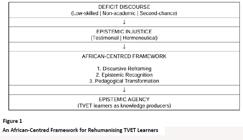
At its core, the framework is grounded in the ethical and epistemological principles of Ubuntu alongside the humanising pedagogy of Paulo Freire. Ubuntu offers a relational understanding of knowledge in which meaning is socially produced and collectively validated, while Freirean pedagogy centres dialogue, critical consciousness, and the co-construction of understanding. Together, these perspectives challenge individualised and deficit-oriented constructions of learners by recognising vocational students as active participants in collective processes of meaning-making and inquiry. The framework operates across three interconnected dimensions:
• Discursive reframing: Challenging deficit-oriented naming practices by replacing reductive labels with affirming conceptualisations of learners as epistemic agents.
• Epistemic recognition: Recognising vocational knowledge as a legitimate and intellectually complex form of knowing that integrates theory, practice, and contextual judgement.
• Pedagogical transformation: Reconfiguring teaching, learning and assessment practices to support meaningful student participation in knowledge-making processes.
In practice, these dimensions may be enacted through a range of institutional and pedagogical interventions. Discursive reframing may involve revising institutional language within policy documents, classroom communication, and student support structures to avoid deficit-oriented terminology. Epistemic recognition may include incorporating experiential, community-based, and practice-oriented forms of knowledge into curriculum and assessment practices. Pedagogical transformation may involve dialogical teaching approaches, reflective learning activities, and collaborative problem-solving pedagogies that position vocational learners as contributors to learning rather than passive recipients of training. Collectively, these interventions demonstrate how the framework could operate across multiple levels of educational practice.
These dimensions work together to disrupt both testimonial and hermeneutical injustice. By affirming learners' credibility as knowers, the framework responds to testimonial injustice, while the recognition of vocational forms of knowledge expands the interpretive resources available within educational contexts, thereby mitigating hermeneutical injustice. Figure 1 illustrates the relationship between deficit discourse, epistemic injustice, and the rehumanisation of TVET learners.
This framework makes three key contributions to critical higher education scholarship. Firstly, it integrates labelling theory, critical discourse analysis and epistemic injustice into a unified framework that explains how language operates as a mechanism of epistemic marginalisation within TVET. Secondly, it advances an African-centred epistemological perspective by positioning Ubuntu not only as an ethical principle but as a framework for understanding knowledge as relational, situated, and collectively produced. Thirdly, it translates critique into practice by offering a structured approach for transforming teaching and learning, enabling vocational learners to participate as epistemic agents rather than passive recipients of training. Through making explicit the relationship between discourse, knowledge, and pedagogy, the framework provides a conceptual tool for rethinking vocational education beyond deficit-oriented paradigms.
Conclusion
This paper has argued that the marginalisation of TVET learners is shaped not only by structural and economic conditions, but also by discursive and epistemic processes that influence how vocational learners and their knowledge are recognised within higher education. Through an analysis of deficit-oriented naming practices, it has demonstrated how language functions as a mechanism of power that shapes learner identities, pedagogical expectations, and the recognition of knowledge within teaching and learning environments. Drawing on labelling theory, critical discourse analysis, and Miranda Fricker's concept of epistemic injustice, the paper has shown that deficit discourse undermines vocational learners in their capacity as knowers. Through testimonial injustice, learners' credibility is diminished, while hermeneutical injustice renders their forms of knowledge less visible within dominant academic frameworks. These dynamics are further reinforced by the academic-vocational binary, which privileges abstract, theoretical knowledge and marginalises practice-based ways of knowing. In response, the paper advanced an African-centred framework grounded in Ubuntu and the humanising pedagogy of Paulo Freire. This framework repositions vocational learners as epistemic agents and provides a basis for rethinking teaching and learning practices in more inclusive and socially just ways.
The implications are both pedagogical and institutional. Rehumanising vocational learners requires a critical interrogation of the language used in educational contexts, alongside a reconfiguration of curriculum, assessment, and classroom practice to recognise the intellectual complexity of vocational knowledge. At a broader level, it calls for a shift in how TVET is conceptualised within the post-school system, from a compensatory pathway to a legitimate site of knowledge production.
This paper contributes to critical higher education scholarship by centring language as a central site of epistemic struggle and by linking discursive practices to pedagogical outcomes. It further opens avenues for empirical research into how deficit discourse is experienced and contested within classroom contexts, and how African-centred pedagogical approaches could transform vocational education. Ultimately, repositioning vocational learners as epistemic agents requires more than a shift in terminology alone. It demands a fundamental rethinking of how knowledge, learning, and human capability are understood within higher education. By challenging deficit discourse and affirming the epistemic contributions of vocational learners, it becomes possible to move towards a more just and inclusive educational landscape in which diverse forms of knowledge are recognised, valued, and sustained.
Adams, M., & Bell, L. A. (Eds.). (2016). Teaching for diversity and social justice (3rd ed.). Routledge. https://doi.org/10.4324/9781315775852
References
- Allais, S. (2017). Labour market outcomes of national qualifications frameworks in six countries. Journal of Education and Work, 30(5), 457-470. https://doi.org/10.1080/13639080.2016.1243232
- Badat, S. (2009). Theorising institutional change: Post-1994 South African higher education. Studies in Higher Education, 34(4), 455-467. https://doi.org/10.1080/03075070902772026
- Becker, H. S. (1963). Outsiders: Studies in the sociology of deviance. Free Press.
- Department of Higher Education and Training. (2013). White paper for post-school education and training: Building an expanded, effective and integrated post-school system. https://www.dhet.gov.za/WhitePaperPostSchoolEducationandTraining2013.pdf
- Fairclough, N. (2023). Critical discourse analysis. In M. Handford & J. P. Gee (Eds.), The Routledge handbook of discourse analysis (2nd ed., pp. 9-21). Routledge. https://doi.org/10.4324/9781003035244
- Freire, P. (2007). Pedagogy of the oppressed (M. B. Ramos, Trans.). Continuum. (Original work published 1970)
- Fricker, M. (2007). Epistemic injustice: Power and the ethics of knowing. Oxford University Press.
- Fricker, M. (2017). Evolving concepts of epistemic injustice. In I. J. Kidd, J. Medina, & G. Pohlhaus (Eds.), The Routledge handbook to epistemic injustice (pp. 53-60). Routledge. https://doi.org/10.4324/9781315212043
- Goffman, E. (1963). Stigma: Notes on the management of spoiled identity. Prentice-Hall.
- Letseka, M. (2012). In defence of Ubuntu. Studies in Philosophy and Education, 31(1), 47-60. https://doi.org/10.1007/s11217-011-9267-2
- Magadza, I., & Mampane, J. (2024). The role of TVET colleges in addressing the needs of NEET youth in a South African province. Community College Journal of Research and Practice, 1-17. https://doi.org/10.1080/10668926.2024.2436398
- Moodie, G., Wheelahan, L., & Lavigne, E. (2019). Technical and vocational education and training as a framework for social justice. Education International.
- National Planning Commission. (2012). National Development Plan 2030: Our future-make it work. https://www.gov.za/documents/other/national-development-plan-2030-our-future-make-it-work-15-aug-2012
- Ndlovu-Gatsheni, S. J. (2018). Epistemic freedom in Africa: Deprovincialisation and decolonization. Routledge.
- Powell, L., & McGrath, S. (2013). Why students enrol in TVET [Paper presentation]. Journal of Vocational Education and Training (JVET) Conference, Oxford, United Kingdom.
- Van Dijk, T. A. (2015). Critical discourse analysis. In D. Tannen, H. E. Hamilton, & D. Schiffrin (Eds.), The handbook of discourse analysis (pp. 466-485). Wiley. https://doi.org/10.1002/9781118584194.ch22
- Wheelahan, L., & Moodie, G. (2025). What do vocational colleges do? Journal of Vocational Education & Training, 77(1), 36-57. https://doi.org/10.1080/13636820.2024.2427778

