Re-Politicising TVET Lecturer Training in South Africa: Towards a Freirean and Humanising Praxis for Epistemic Justice
Abstract
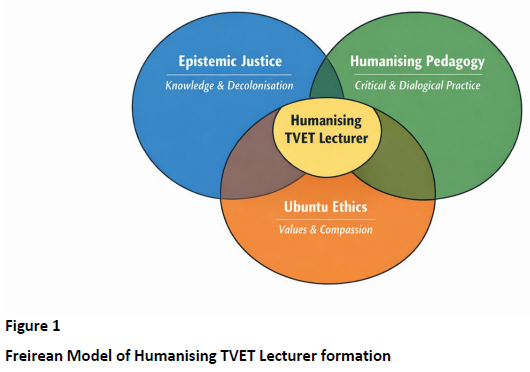
This conceptual paper reimagines technical and vocational education and training (TVET) lecturer formation in South Africa as a site of epistemic, pedagogical, and ethical struggle. While South African TVET policy discourses emphasise professionalisation, standardisation, and employability, such frameworks often reproduce technicist and depoliticised understandings of lecturer education. Drawing on Freire's pedagogy of humanisation, Ubuntu ethics, and epistemic justice, the paper argues that TVET lecturer training must move beyond narrow competence models towards a praxis of conscientisation, relational care, and epistemic decolonisation. Through conceptual analysis and critical literature synthesis, the paper conceptualises the TVET lecturer as a transformative intellectual: a dialogical agent capable of resisting neoliberal rationalities, cultivating student voice, and affirming historically marginalised knowledges. It advances a model of humanising lecturer formation that integrates three interrelated dimensions: epistemic justice, humanising pedagogy, and Ubuntu ethics. By theorising lecturer education through a South African Freirean-Ubuntu lens, the paper contributes to debates on vocational education, lecturer professionalisation, and epistemic justice, while offering a conceptual foundation for future empirical research and policy reform.
Conceptual Paper; TVET Lecturer Formation; Freirean Pedagogy; Humanising Praxis; Epistemic Justice; Decolonial Education; South Africa
 Thumbnail