Re-Politicising TVET Lecturer Training in South Africa: Towards a Freirean and Humanising Praxis for Epistemic Justice
Abstract
This conceptual paper reimagines technical and vocational education and training (TVET) lecturer formation in South Africa as a site of epistemic, pedagogical, and ethical struggle. While South African TVET policy discourses emphasise professionalisation, standardisation, and employability, such frameworks often reproduce technicist and depoliticised understandings of lecturer education. Drawing on Freire's pedagogy of humanisation, Ubuntu ethics, and epistemic justice, the paper argues that TVET lecturer training must move beyond narrow competence models towards a praxis of conscientisation, relational care, and epistemic decolonisation. Through conceptual analysis and critical literature synthesis, the paper conceptualises the TVET lecturer as a transformative intellectual: a dialogical agent capable of resisting neoliberal rationalities, cultivating student voice, and affirming historically marginalised knowledges. It advances a model of humanising lecturer formation that integrates three interrelated dimensions: epistemic justice, humanising pedagogy, and Ubuntu ethics. By theorising lecturer education through a South African Freirean-Ubuntu lens, the paper contributes to debates on vocational education, lecturer professionalisation, and epistemic justice, while offering a conceptual foundation for future empirical research and policy reform.
Conceptual Paper; TVET Lecturer Formation; Freirean Pedagogy; Humanising Praxis; Epistemic Justice; Decolonial Education; South Africa
Introduction: Situating TVET Lecturer Education in South Africa's Post-1994 Landscape
Technical and vocational education and training (TVET) remains one of the most contested terrains in South Africa's post-apartheid education system. Although policy positions TVET as central to addressing skills shortages, unemployment, and economic development, the sector continues to be treated as secondary to schooling and university education (Majola, 2025; Scheepers & Gebhardt, 2021). Within this hierarchy, the professional formation of TVET lecturers has received limited theoretical attention and institutional investment (Buthelezi, 2018). This marginalisation is rooted in the colonial and apartheid history of vocational education, where TVET was narrowly imagined as a mechanism for producing semi-skilled labour rather than as a site of critical knowledge, democratic participation, and human development.
Post-1994 policy reforms have sought to reposition TVET within an expanded and integrated post-school education and training system. The White Paper for Post-School Education and Training (Department of Higher Education and Training [DHET], 2013a) and the Policy on Professional Qualifications for Lecturers in Technical and Vocational Education and Training (DHET, 2013b) both aim to professionalise the sector, improve quality, and strengthen lecturer preparation. These are important policy commitments. However, they are often shaped by a technicist logic that equates transformation with standardisation, measurable competence, accountability, and labour-market responsiveness. As a result, lecturer education risks being reduced to procedural training rather than being understood as a critical, ethical, and intellectual process.
This paper argues that TVET lecturer formation in South Africa must be re-politicised. By re-politicisation, we refer to the need to reconnect lecturer education with questions of power, knowledge, justice, agency, and human dignity. TVET lecturers are not neutral transmitters of technical content. They are pedagogical, cultural, and epistemic mediators who work at the intersection of students' lived experiences, vocational knowledge, institutional policy, and social inequality. Their formation should therefore move beyond technical competence alone to include critical consciousness, dialogical pedagogy, ethical relationality, and epistemic justice.
This argument is grounded in three interrelated theoretical resources: Freirean humanisation, Ubuntu ethics, and epistemic justice. Freire's critical pedagogy provides a language for understanding education as conscientisation, dialogue, and praxis rather than passive transmission (Freire, 1970, 1998). Ubuntu contributes an African ethical framework that foregrounds relationality, care, interdependence, and collective human flourishing (Bhengu, 2006). Epistemic justice, following Fricker (2007), draws attention to whose knowledge is recognised, whose voices are silenced, and how educational systems reproduce hierarchies of credibility and belonging. Together, these frameworks make it possible to reconceptualise the TVET lecturer as a transformative intellectual rather than a technician of skills delivery.
This article is conceptual rather than empirical. It develops a Freirean-Ubuntu framework for humanising TVET lecturer formation in South Africa through critical engagement with policy, lecturer education scholarship, critical pedagogy, Ubuntu philosophy, and epistemic justice literature. The article proceeds as follows. First, it analyses the policy landscape and its limits, with particular attention to the technicist assumptions shaping lecturer professionalisation. Second, it develops the theoretical framework by bringing Freirean humanisation, Ubuntu ethics, and epistemic justice into dialogue. Third, it reconceptualises the TVET lecturer as a humanising and transformative intellectual. Fourth, it proposes a three-dimensional model of lecturer formation centred on epistemic justice, humanising pedagogy, and Ubuntu ethics. The final section outlines implications for curriculum design, mentorship, policy reform, and future research. In doing so, the paper positions TVET lecturer education as a critical site of epistemic renewal and democratic transformation. It contributes to debates on vocational education in South Africa by challenging depoliticised approaches to lecturer training and arguing for a model of formation grounded in justice, dialogue, care, and human freedom.
Methodological Approach: Conceptual Analysis and Critical Literature Synthesis
This article is conceptual in nature and does not report primary empirical data. It employs conceptual analysis and critical literature synthesis to reframe TVET lecturer formation in South Africa as an ethical-political and epistemic project. Conceptual analysis is appropriate for this article because the aim is not to measure an empirical phenomenon, but to clarify, connect, and extend key theoretical constructs-namely, Freirean humanisation, Ubuntu ethics, epistemic justice, and TVET lecturer formation.
The literature was selected purposively rather than systematically, with emphasis on scholarship that speaks directly to four interrelated areas: South African TVET policy and lecturer education, Freirean critical pedagogy and conscientisation, Ubuntu and humanising pedagogy, and epistemic justice and decolonial education. Key policy documents, particularly the White Paper (DHET, 2013a) and the Policy on Professional Qualifications (DHET, 2013b), were read alongside critical scholarship on vocational education, teacher identity, professionalisation, and decolonial pedagogy.
The analysis proceeded through three conceptual moves. First, the paper identifies the limits of technicist and compliance-driven approaches to TVET lecturer formation. Second, it brings Freirean pedagogy, Ubuntu philosophy, and epistemic justice into dialogue as complementary theoretical resources. Third, it develops a conceptual model of humanising lecturer formation built around epistemic justice, humanising pedagogy, and Ubuntu ethics. The purpose of this synthesis is to generate a theoretically grounded framework that can inform future empirical research, policy reform, and lecturer education practice in South Africa.
Ethical Considerations
This article is a conceptual paper based on published literature, policy documents, and theoretical analysis. It does not involve human participants, interviews, surveys, institutional fieldwork, or the collection of primary data. Formal ethical clearance was therefore not required. Nevertheless, ethical scholarly practice was observed through accurate citation, careful representation of sources, and transparent acknowledgement of the theoretical traditions and policy documents on which the argument is based.
Literature Review: The Policy Landscape and Its Limits
The White Paper and the Professional Qualifications Policy
In the post-1994 era, South Africa's government has invested considerable effort in reforming the post-school education and training system to respond to both historical inequities and contemporary economic imperatives (Majola, 2025). Two cornerstone policy documents guide this reform agenda: the White Paper for Post-School Education and Training: Building an Expanded, Effective and Integrated Post-School System (DHET, 2013a) and the Policy on Professional Qualifications for Lecturers in Technical and Vocational Education and Training (DHET, 2013b). Collectively, these frameworks seek to expand access, enhance coherence across post-school institutions, and professionalise the lecturer workforce in TVET colleges.
The White Paper (DHET, 2013a) presents a vision of an integrated post-school system that is responsive to social and economic needs. It positions TVET colleges as pivotal in producing the skills necessary for industrial growth and competitiveness, while also promoting inclusive access to education for historically disadvantaged groups. Similarly, the Policy on Professional Qualifications (DHET, 2013b) aims to create clear qualification pathways and professional standards for TVET lecturers, thereby improving the quality and status of the sector. These intentions are commendable, particularly given the fragmented and inconsistent nature of lecturer preparation programmes inherited from the apartheid era (Adendorff, 2020a).
However, while these policies promise transformation, their underlying logic reflects the persistent influence of instrumentalist and neoliberal discourses. The language of "competence," "standards," and "employability" dominates, revealing an implicit assumption that educational value is determined by measurable productivity rather than by human or epistemic development (Wedekind, 2016). In privileging efficiency and output, the policy environment risks replicating the very technicist paradigms that critical scholars have long problematised (Doh Nubia et al., 2024; Moll, 2023; Motala et al., 2023; Vally & Motala, 2022). What is absent in these frameworks is an engagement with education as a moral, relational, and political project-one concerned not only with what lecturers can do, but with who they are, how they think, and the kinds of societies their pedagogies help to build.
Moreover, these frameworks tend to marginalise local knowledges and reflective praxis, privileging globalised standards and imported competency models over indigenous epistemologies and context-specific teaching practices (Maluleke et al., 2024; Vimbelo & Bayaga, 2023). Heleta (2016) argues that this reliance on Eurocentric knowledge systems perpetuates epistemic violence by disregarding African intellectual traditions and the lived realities of educators and learners. Consequently, while policy discourse invokes notions of transformation, it often reproduces colonial hierarchies of knowledge that position the TVET lecturer as a passive implementer rather than an active knowledge producer (Mesuwini et al., 2021; Papier, 2011; Vimbelo & Bayaga, 2023). The challenge, therefore, is not merely to refine policy but to reconceptualise the epistemological assumptions on which it rests to move from an instrumentalist to a humanising understanding of lecturer formation.
The Technicist Turn in Vocational Education
The technicist orientation of South Africa's vocational policy landscape is neither isolated nor accidental; it is part of a broader global shift in vocational education that privileges performance management, standardisation, and measurable outcomes (Vally & Motala, 2014). Hodkinson (1998) was among the first to critique this trend, warning that the growing emphasis on quality assurance and output control risks reducing teaching to a mechanistic process devoid of creativity or moral purpose. When teachers are assessed primarily by the extent to which they meet competency-based standards, their professional identities become fragmented and depersonalised. This dynamic is particularly acute in the TVET sector, where lecturers are often required to meet industrial and bureaucratic expectations simultaneously, with little room for reflexive or dialogical engagement (Papier, 2022; Van der Bijl, 2021).
Hyslop-Margison and Dale (2010) extend this critique by demonstrating how vocational education reform has been co-opted by neoliberal ideology, turning education into a tool for labour market adjustment rather than human development. Within such a paradigm, pedagogical practice is subordinated to the logic of employability, and the lecturer's role is reduced to that of a skills trainer. This instrumental framing erases the political and ethical dimensions of teaching and undermines the potential for education to function as a site of resistance and emancipation (Doh Nubia et al., 2024; Maluleke et al., 2024). For TVET lecturers in South Africa, this results in what might be termed an epistemic dislocation; they are positioned as custodians of knowledge systems that neither originate from nor fully serve their social contexts.
Adendorff (2020b) observes that while professionalisation initiatives seek to legitimise the TVET lecturer as an educational professional, the dominance of performance-based accountability frameworks constrains opportunities for critical inquiry and pedagogical innovation. Instead of empowering lecturers to interrogate the social purposes of vocational education, current training models tend to reinforce conformity to externally defined norms. The result is a paradox; policies intended to elevate the professional status of TVET lecturers may, in practice, curtail their intellectual autonomy and silence their voices in shaping curriculum and practice.
To counter this trajectory, there is an urgent need for a counter-hegemonic framework of lecturer education grounded in critical pedagogy and humanising praxis. Such a framework would view teaching not as a neutral technical activity but as a transformative social practice aimed at consciousness-raising and emancipation. By drawing on Freire's (1970, 1998) notion of conscientisation, and integrating the relational ethics of Ubuntu (Bhengu, 2006), TVET lecturer training can move beyond compliance-based professionalism toward a model that affirms the lecturer's role as a critical, reflective, and ethical actor within the wider struggle for social justice. This reorientation would restore to vocational education its rightful place as a domain of human freedom, rather than one of bureaucratic regulation.
Theoretical Framework
The conceptual grounding of this paper is informed by three interrelated traditions: Freirean humanisation, Ubuntu philosophy, and the discourse of epistemic justice. Together, these frameworks illuminate the moral, political, and epistemological dimensions of TVET lecturer education (Vimbelo & Bayaga, 2023). They provide a basis for challenging the instrumentalist assumptions embedded in current policy and practice, and for reimagining lecturer formation as a deeply ethical and transformative process. Each framework, while distinct, converges on the principle that education must serve human flourishing and social emancipation rather than economic reproduction.
Freirean Humanisation and Conscientisation
At the heart of Paulo Freire's pedagogy lies a profound belief in the human capacity for transformation through critical reflection and action. Freire (1970) conceptualised education as a practice of freedom-a dialogical process in which learners and educators co-construct knowledge to understand and transform their world. In Pedagogy of the Oppressed, he rejects the banking model of education, where teachers deposit information into passive students, arguing instead for a problem-posing pedagogy that recognises learners as subjects of their own learning. This approach transforms education from a neutral technical act into a political and ethical endeavour grounded in humanisation.
Freire (1998) later expanded on this idea in Pedagogy of Freedom, emphasising that authentic teaching requires courage, humility, and a commitment to justice. Education, in his view, is an act of love that demands both critical reflection (conscientisation) and political engagement. Freire and Shor (1987) further articulated that dialogue is the cornerstone of liberatory pedagogy; it is through dialogue that educators and learners collectively unveil the structures of oppression and imagine alternative futures. Dale and Hyslop-Margison (2011) have extended Freire's insights to vocational education, arguing that teacher education should prepare educators not simply to reproduce labour-market demands but to act as transformative intellectuals who challenge inequitable social orders.
Applying Freire's framework to the South African TVET context repositions the lecturer as a critical and transformative intellectual rather than a deliverer of pre-packaged curricula. In contrast to the technicist and bureaucratic orientation of current policy frameworks, a Freirean conception of lecturer formation insists on the development of critical consciousness, ethical responsibility, and dialogical engagement. TVET lecturers are thus envisioned as agents of social transformation who mediate between students' lived experiences and broader structures of power. Through conscientisation, lecturers can reclaim their professional agency, transforming the classroom into a space of collective inquiry and resistance to dehumanising educational practices. Freirean pedagogy, therefore, provides both the theoretical foundation and moral compass for a humanising model of lecturer education.
Ubuntu as an African Humanist Framework
While Freire provides a global language of liberation, the African philosophical tradition of Ubuntu offers a locally grounded and culturally resonant ethic of humanisation. Ubuntu, often expressed as "I am because we are," embodies a relational ontology that locates human identity and flourishing within the community rather than the individual. Bhengu (2006) describes Ubuntu as the ethical essence of democracy, emphasising compassion, interdependence, and mutual recognition as the foundations of human dignity. In educational contexts, Ubuntu shifts the focus from individual achievement toward collective well-being and moral responsibility.
Within vocational education, Ubuntu pedagogy has emerged as a powerful counterpoint to the neoliberal individualism that dominates contemporary discourse (Vimbelo & Bayaga, 2024; Ngubane & Makua, 2021). It calls for pedagogical relationships that are nurturing, dialogical, and community-centred. As Ngubane and Makua argue, Ubuntu-inspired pedagogy transforms teaching into a moral encounter rooted in empathy and respect, fostering learning environments where students are valued as whole human beings. In the context of TVET lecturer education, Ubuntu offers an ethical framework for rethinking professionalism not as adherence to standards but as a commitment to social solidarity and moral accountability.
By integrating Ubuntu with Freirean pedagogy, a distinctly Southern model of humanisation emerges-one that recognises both the structural and relational dimensions of transformation. Ubuntu complements Freire's focus on conscientisation by embedding it within the African ethic of communal care. Whereas Freire emphasises dialogue and critical reflection as vehicles for liberation, Ubuntu situates these processes within a relational understanding of humanity. Together, they form the normative foundation for an Africanised lecturer formation that resists technicism and reclaims education as a site of ethical co-creation and collective transformation.
Epistemic Justice and Decolonial Knowing
If Freire and Ubuntu provide the ethical and pedagogical grounding for a humanising TVET framework, the notion of epistemic justice (Fricker, 2007) provides its epistemological core. Fricker's theory highlights how power operates through knowledge-determining who is recognised as a knower and whose experiences are considered credible. She distinguishes between testimonial injustice (where certain voices are disbelieved or discredited) and hermeneutical injustice (where marginalised groups lack the conceptual resources to make sense of their experiences). In the South African context, Heleta (2016) extends this critique to higher and vocational education, arguing that colonial epistemologies continue to structure curricula, research, and assessment in ways that silence African perspectives. This systemic epistemic violence reproduces dependency and erases the intellectual agency of both lecturers and students.
Within TVET, epistemic injustice manifests through the dominance of Western, industrial, and managerial models of competence that devalue Indigenous and experiential forms of knowing. Curricula tend to privilege technical expertise over cultural knowledge, and policy discourses often fail to recognise the epistemic richness of working-class and community-based practices. This epistemic marginalisation limits the transformative potential of vocational learning, reducing it to a form of disciplinary training rather than knowledge democracy (Balwanz & Hlatshwayo, 2016).
Calls for Africanisation and decolonial pedagogy seek to redress this imbalance. Biccard and Meeran (2024) argue that Africanising the curriculum requires more than symbolic inclusion; it demands rethinking the epistemological foundations of education itself. Similarly, Khoza and Ngqula (2025) highlight the importance of centring the voices and experiences of the working class in shaping inclusive and contextually relevant curricula. For TVET lecturer formation, this means equipping educators to interrogate whose knowledge counts, in what language it is taught, and to what social ends it serves. By embedding epistemic justice within the design of lecturer education, we can begin to dismantle the hierarchies that separate technical from intellectual work, or vocational from academic knowledge. This shift repositions TVET lecturers as epistemic agents-co-creators of knowledge who engage critically with local realities while contributing to global discourses on education and work. Epistemic justice thus complements Freirean humanisation and Ubuntu ethics by asserting that transformation in TVET must be both pedagogical and epistemological; it must restore dignity not only to human relationships but also to the ways of knowing that have been historically devalued.
The three theoretical pillars outlined above Freirean humanisation, Ubuntu ethics, and epistemic justice form the intellectual scaffolding for a new conception of TVET lecturer formation. Together, they enable a shift from technicism and compliance toward a praxis of freedom, solidarity, and epistemic renewal. The next section builds upon this framework to conceptualise what it means to become a humanising TVET lecturer in postcolonial South Africa and how such an identity can be nurtured through transformative professional formation.
Conceptualising the Humanising TVET Lecturer
Reframing Lecturer Identity
The re-humanisation of TVET education necessarily begins with re-conceptualising the identity of the lecturer. In conventional understandings, lecturer identity is constructed primarily through institutional expectations of technical competence, curriculum delivery, and administrative compliance. Such an identity is largely externally defined, leaving little room for reflexivity or moral agency. However, as teacher-identity scholars have shown, identity is neither static nor merely professional; it is an ongoing process of interpretation and negotiation shaped by social, cultural, and institutional contexts (Beijaard et al., 2004; Gee, 2000; Kelchtermans, 1993).
Gee (2000) distinguishes between institutional, discourse, and affinity identities frameworks that highlight how educators' self-conceptions emerge within broader structures of power and meaning. Köpsén (2014), in turn, emphasises that vocational teachers construct identity through their prior occupational experience, pedagogical learning, and participation in professional communities. These insights remind us that identity formation is dialogical: lecturers continually interpret who they are in relation to their learners, colleagues, and institutional discourses.
In the South African context, this identity work is intensified by structural inequities and policy contradictions. Yassim et al. (2019) demonstrate that TVET lecturers often experience tension between their industrial backgrounds and educational roles, while Grijpstra and Papier (2015) highlight the fragile sense of agency produced by bureaucratic accountability systems. Wedekind et al. (2024) similarly show that the current policy focus on measurable quality constrains the moral and pedagogical dimensions of professional identity.
Building on these insights, this paper proposes that TVET lecturer identity must be reconstituted as dialogical, critical, and justice-oriented. A humanising conception of identity recognises lecturers as reflective moral agents who co-create meaning with students rather than merely transmit externally sanctioned knowledge. It embraces reflexivity (the capacity to interrogate one's assumptions), dialogue (the commitment to mutual learning), and praxis (the integration of reflection and action for social change). Through this reorientation, lecturer identity becomes not an administrative category but an ethical stance grounded in solidarity and transformation (Maluleke et al., 2024; Vimbelo & Bayaga, 2023).
Three Dimensions of Humanising Lecturer Formation
Re-imagining lecturer formation through a humanising lens requires identifying the core dimensions that nurture such an identity. Drawing on the theoretical foundations developed earlier, three interrelated dimensions are proposed: epistemic decolonisation, pedagogical transformation, and ethical relationality. Together, these constitute the scaffolding for a Freirean-Ubuntu approach to lecturer education.
Epistemic Decolonisation
Epistemic decolonisation concerns reclaiming local and Indigenous knowledges while challenging the Eurocentric assumptions embedded in existing curricula and assessment systems. As Heleta (2016) argues, post-apartheid reforms have not adequately confronted the epistemic legacies of colonialism; Western epistemologies still dominate what counts as legitimate knowledge. For TVET lecturer education, this means that the conceptual and pedagogical frameworks guiding professional learning often remain disconnected from African realities. Adendorff (2020b) warns that the over-reliance on imported competency models erodes lecturers' ability to draw from community-based and experiential knowledge traditions. A decolonised approach invites lecturers to engage critically with the social purposes of vocational education: "Whose knowledge is taught?" "In whose language?" "Toward what end?" By positioning lecturers as epistemic agents, epistemic decolonisation transforms the TVET classroom into a site of cognitive justice and cultural affirmation.
Pedagogical Transformation
Pedagogical transformation entails re-imagining teaching as a dialogical and participatory practice rather than a unidirectional transfer of skills. Freire (1970) envisioned education as a process of problem-posing, where teachers and students jointly interrogate reality and act upon it. This approach contrasts sharply with the behaviourist pedagogies that dominate vocational training. Within South Africa's TVET sector, Wedekind et al. (2024) advocate pedagogical reform that foregrounds inquiry, reflection, and contextual learning rather than rote technical instruction. In a humanising model of lecturer formation, pedagogical transformation would be cultivated through professional programmes that value critical dialogue, collaborative learning, and praxis. Lecturers would learn to situate technical competencies within broader social, ethical, and environmental concerns, fostering student agency and voice. Such pedagogy acknowledges that vocational learning is not only about doing but about understanding being in the world.
Ethical Relationality
The third dimension, ethical relationality, draws directly from Ubuntu and the moral imperatives of care, compassion, and interconnectedness (Bhengu, 2006). Maluleke et al. (2024) show how humanising vocational pedagogy can transform educational spaces by embedding values of empathy and solidarity. Ethical relationality redefines professionalism in moral rather than managerial terms. It requires that lecturers cultivate trustful relationships with students, recognising their inherent worth and potential. This dimension also involves building collegial networks among lecturers, bridging the isolation often experienced within fragmented institutional cultures. Ethical relationality thus functions as both an ethical stance and a pedagogical method; it shapes how lecturers teach, how they learn from one another, and how they contribute to the collective flourishing of their institutions and communities (Buthelezi, 2018). Together, these three dimensions constitute a coherent vision of humanising lecturer formation. They move beyond policy compliance and technical training toward a holistic model that integrates knowledge, pedagogy, and ethics in the service of justice and transformation.
The TVET Lecturer as Transformative Intellectual
The integration of these dimensions culminates in a re-imagining of the TVET lecturer as a transformative intellectual. Rather than viewing lecturers as mere conveyors of industry-aligned competencies, this perspective recognises them as public intellectuals engaged in shaping the moral and epistemic contours of society. Freire's notion of conscientisation provides the philosophical anchor for this role; lecturers must help students read their world critically and act to change it. This means engaging with curricula not as static prescriptions but as living documents open to reinterpretation, dialogue, and contextual relevance.
Russon and Wedekind (2024) conceptualise lecturers as mediators within complex ecosystems that include employers, communities, policy actors, and students. Their agency is shaped by these intersecting pressures, yet they also possess the capacity to reshape these systems through reflective and ethical action. Kidega et al. (2023), Zhang et al. (2024) and Shi (2012) similarly highlight how vocational educators in African contexts navigate identity construction amidst competing expectations of economic utility and cultural belonging. Within such ecosystems, the lecturer's role as a transformative intellectual becomes both challenging and indispensable; they must balance institutional accountability with moral responsibility and critical inquiry.
By embracing this intellectual role, lecturers transcend the narrow confines of technical professionalism and enter the broader terrain of social pedagogy. They become agents of conscientisation, curriculum co-creators, and catalysts for epistemic renewal. This conception aligns with Freire's (1998) assertion that education is never neutral it either domesticates or liberates. A humanising TVET lecturer consciously chooses the latter, aligning their practice with the ethical imperatives of justice, solidarity, and hope.
The next section builds upon this reconceptualisation by translating these philosophical and identity-based insights into a Freirean model of lecturer formation a three-dimensional conceptual framework integrating epistemic decolonisation, pedagogical transformation, and ethical relationality as the pillars of a humanising vocational education.
The Conceptual Model
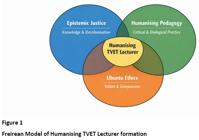
The model may be represented visually as three overlapping spheres (as depicted by Figure 1, below), each corresponding to a foundational domain of humanising lecturer education: (1) Epistemic justice (knowledge)-concerned with what and whose knowledge is legitimised, (2) humanising pedagogy (practice)-concerned with how teaching and learning occur, and (3) Ubuntu ethics (values)-concerned with why and for whom education takes place. At the intersection of these domains lies the humanising TVET lecturer: a transformative intellectual who integrates critical knowledge, dialogical pedagogy, and ethical relationality into an emancipatory professional praxis.
Epistemic Justice: Reclaiming Knowledge
The first sphere, epistemic justice, foregrounds the lecturer as an epistemic agent who contests the hierarchies of knowledge entrenched in colonial and neoliberal systems. Drawing from Fricker (2007) and Heleta (2016), it challenges testimonial and hermeneutical injustices that devalue African and working-class knowledges. For lecturer formation, this means cultivating the capacity to critically interrogate curricula and to co-create content that reflects diverse epistemologies. Through epistemic justice, lecturers learn to view knowledge as dialogically constructed and contextually situated, rather than universal and detached (Papier, 2012; Papier & McGrath, 2020). In practice, this involves integrating local histories, Indigenous technologies, and linguistic diversity into vocational curricula. It also requires creating spaces within professional development where lecturers analyse how power and ideology shape what counts as legitimate expertise.
Humanising Pedagogy: Transforming Practice
The second sphere, humanising pedagogy, translates critical awareness into dialogical teaching practice. Freire (1970, 1998) insists that authentic learning arises through the co-investigation of reality; teachers and students engage in reciprocal dialogue that unites reflection and action. In the TVET context, this pedagogy disrupts the traditional hierarchy between lecturer and learner, repositioning both as co-learners engaged in collective inquiry. Humanising pedagogy thus entails moving from transmission to transformation: from the delivery of standardised content to the facilitation of critical understanding. Professional learning programmes for lecturers should model this approach by embedding participatory workshops, problem-posing seminars, and community-based projects (Vimbelo & Bayaga, 2023, 2024). Such pedagogical transformation nurtures professional reflexivity and reconnects technical instruction with ethical and civic purpose.
Ubuntu Ethics: Embedding Values
The third sphere, Ubuntu ethics, anchors lecturer formation in an African moral philosophy that prioritises compassion, respect, and interdependence (Bhengu, 2006; Maluleke et al., 2024). Ubuntu shifts the focus of education from individual achievement toward collective well-being. When integrated into lecturer preparation, it encourages educators to view teaching as a relational act of care rather than a contractual obligation. Ubuntu ethics challenges the competitive ethos of neoliberal education by fostering solidarity among lecturers and between lecturers and students (Majola & Geduld, 2025). It also reframes professional conduct through moral accountability: to teach ethically is to affirm the humanity of others. Embedding Ubuntu in lecturer training can therefore cultivate a culture of belonging in TVET colleges, reinforcing social cohesion while deepening pedagogical empathy.
Integration: A Southern Decolonial Praxis
These three spheres converge at what this paper conceptualises as a Southern decolonial praxis for TVET lecturer formation. This integrative space embodies the synthesis of critical knowledge, dialogical practice, and ethical values. It represents a distinctly Global South response to the depoliticising tendencies of neoliberal reform a praxis that recognises education as both epistemological and moral labour. In this model, epistemic justice provides the cognitive foundation, humanising pedagogy offers the methodological pathway, and Ubuntu ethics sustains the moral orientation. Their integration generates a holistic framework through which lecturers can reclaim professional agency, reconstruct vocational knowledge, and participate in the broader project of decolonising post-school education.
Consequences for Curriculum Design, Mentorship, and Policy Reform
The Freirean model carries significant consequences for the design and governance of TVET lecturer education.
Curriculum DesignCurricula for lecturer development should move beyond competency matrices to include modules on critical pedagogy, African epistemologies, and community engagement. This requires revisiting the DHET (2013b) qualification policy to incorporate reflective practice and contextual research as core components. Programmes might, for example, pair technical specialisations with courses on social justice, ethics, and the philosophy of education thus balancing vocational expertise with moral and intellectual depth.
Mentorship and Professional Learning
Humanising lecturer formation depends on mentorship structures that model the very values they seek to instil. Mentors should act not as assessors but as critical friends, guiding new lecturers through collaborative reflection, peer dialogue, and situated learning within their college communities. Such mentorship can counteract the isolation and compliance culture noted by Grijpstra and Papier (2015), fostering instead a network of collegial solidarity rooted in Ubuntu.
Policy Reform
At the policy level, adopting a Freirean model would mean re-framing quality assurance from an outcomes-based logic to a values-based and context-responsive approach. DHET and institutional leaders could support this by incentivising reflective inquiry, participatory action research, and cross-college communities of practice. Policies must recognise lecturers not merely as implementers of curriculum but as co-designers of knowledge systems. Embedding humanising and decolonial principles in national frameworks would align South African TVET with global movements for epistemic democracy and social justice.
Toward Transformative Professionalism
This model envisions transformative professionalism: a conception of lecturer formation that unites knowledge, practice, and ethics in the pursuit of human emancipation. It affirms that to teach vocationally is also to teach politically and morally to cultivate not only skills but also dignity, agency, and hope. By centring epistemic justice, humanising pedagogy, and Ubuntu ethics, the Freirean model provides a decolonial blueprint for re-imagining the future of TVET lecturer education in South Africa and across the Global South.
Implications and Future Directions
The Freirean model of TVET lecturer formation proposed in this paper both aligns with and extends the transformative aspirations of South Africa's White Paper for Post-School Education and Training (DHET, 2013a). The White Paper calls for an expanded, integrated, and socially responsive post-school system. However, in practice, its implementation has often been guided by a technicist logic that equates transformation with managerial efficiency and measurable performance. The conceptual framework advanced here reclaims the humanising and emancipatory intent of the White Paper while challenging its reduction to a bureaucratic exercise. It provides a philosophical and pedagogical foundation for rethinking lecturer formation as a moral and epistemic project one that prioritises dignity, dialogue, and justice over compliance and control.
Policy Implications
At the policy level, this model underscores the need for humanising praxis to be integrated into DHET frameworks that guide lecturer professionalisation and curriculum design. Current policies, such as the Policy on Professional Qualifications for Lecturers in Technical and Vocational Education and Training (DHET, 2013b), could be revised to incorporate modules on critical pedagogy, Ubuntu ethics, and reflective practice as essential components of lecturer education. In doing so, the policy environment would begin to recognise lecturers not merely as technical functionaries but as transformative intellectuals engaged in the ethical and epistemic renewal of the TVET system. Furthermore, professional development standards could be broadened to include competencies related to ethical relationality, cultural responsiveness, and community engagement. Embedding these dimensions would operationalise the humanising and decolonial principles that the White Paper (DHET, 2013a) articulates but does not yet fully enact. Such alignment would allow policy to move beyond the rhetoric of transformation toward a genuinely relational and context-sensitive praxis.
Institutional and Practice Implications
Institutionally, the model calls for a reorganisation of lecturer education programmes around dialogical, participatory, and reflective pedagogies. Colleges and universities responsible for lecturer training should redesign their curricula to include spaces for collaborative inquiry and praxis-based learning. Lecturers-in-training should be encouraged to engage in community-based projects, critical reflection journals, and peer-dialogue seminars that mirror the Freirean notion of education as co-creation. Mentorship programmes, as previously discussed, should be reframed as communities of practice rather than hierarchical evaluation systems. Experienced lecturers can serve as co-learners and facilitators who guide novice educators in navigating the complex intersection of pedagogy, ethics, and institutional constraints. In practice, this approach nurtures a professional culture grounded in Ubuntu values of compassion and solidarity rather than competition and compliance. Institutions could also cultivate centres for humanising vocational pedagogy to promote ongoing professional learning, action research, and dialogue between policymakers, practitioners, and communities. Such spaces would embody the relational and transformative spirit central to the Freirean model, transforming colleges into living laboratories of ethical and epistemic renewal.
Research Implications
Finally, this conceptual framework opens rich avenues for future research. Empirical studies are needed to explore how humanising lecturer formation unfolds across diverse contexts of the Global South, where historical inequalities, neoliberal reforms, and cultural pluralism intersect. Comparative studies such as those initiated by Kidega et al. (2023), Zhang et al. (2024) and Shi (2012) could investigate how vocational educators in African, Asian, and Latin American contexts navigate similar tensions between market demands and emancipatory pedagogies. Further research might also employ participatory and narrative methodologies to document lecturers' lived experiences of transformation and resistance within policy-driven environments. Such work would deepen understanding of how Freirean, Ubuntu, and decolonial principles can be operationalised in the everyday practices of vocational educators. By extending this conceptual inquiry into empirical terrain, scholars can build a body of Southern pedagogical theory that redefines what it means to teach and learn vocationally in contexts of inequality.
Conclusion
This paper has argued for the re-politicisation of TVET lecturer training through a conceptual framework grounded in Freirean humanisation, Ubuntu ethics, and epistemic justice. Against the backdrop of neoliberal and technicist policy orientations, the paper advances a counter-hegemonic vision of lecturer formation as a deeply moral, dialogical, and emancipatory process. In doing so, it positions the TVET lecturer not as a technician of skills, but as a transformative intellectual an agent of conscientisation who mediates between knowledge, community, and justice.
By integrating epistemic justice (knowledge), humanising pedagogy (practice), and Ubuntu ethics (values), the proposed Freirean model constitutes a distinctly Southern decolonial praxis for vocational education. It reframes lecturer training as an endeavour that not only prepares competent professionals but also cultivates socially conscious educators capable of challenging structural inequalities and epistemic hierarchies. In this sense, humanising lecturer formation becomes a vital strategy for restoring dignity to vocational learning and for reasserting TVET as a space of democratic participation and epistemic freedom.
Ultimately, this conceptual paper offers a theoretical foundation for future empirical and policy-oriented research on TVET lecturer development in South Africa and across the Global South. It contributes to a growing body of scholarship that refuses to separate technical education from moral and political purpose, insisting instead that all education is inherently ethical and transformative. To re-politicise TVET lecturer education is, therefore, to affirm the possibility of a postcolonial future in which vocational learning serves not only labour markets but humanity itself.
Adendorff, H. (2020a). Advanced diploma: Technical and Vocational Teaching Module: Being a TVET lecturer. Department of Higher Education and Training. www.dhet.gov.za
Adendorff, H. (2020b). Advanced diploma: Technical and Vocational Teaching Module: From interpreting curriculum to lesson planning. Department of Higher Education and Training. www.dhet.gov.za
References
- Balwanz, D., & Hlatshwayo, M. (2016). Re-imagining post-schooling in Sedibeng: Community-based research and critical dialogue for social change. Education as Change, 19(2), 133-150. https://doi.org/10.1080/16823206.2015.1085615
- Beijaard, D., Meijer, P. C., & Verloop, N. (2004). Reconsidering research on teachers' professional identity. Teaching and Teacher Education, 20(2), 107-128. https://doi.org/10.1016/j.tate.2003.07.001
- Bhengu, M. J. (2006). Ubuntu: The essence of democracy. Novalis Press.
- Buthelezi, Z. (2018). Lecturer experiences of TVET College challenges in the post-apartheid era: A case of unintended consequences of educational reform in South Africa. Journal of Vocational Education & Training, 70(3), 364-383. https://doi.org/10.1080/13636820.2018.1437062
- Dale, J., & Hyslop-Margison, E. J. (2011). Paulo Freire: Teaching for freedom and transformation. Springer.
- Department of Higher Education and Training. (2013a). White Paper for post-school education and training: Building an expanded, effective and integrated post-school system. https://www.dhet.gov.za/SiteAssets/Latest%20News/White%20paper%20for%20post-school%20education%20and%20training.pdf
- Department of Higher Education and Training. (2013b). Policy on Professional Qualifications for Lecturers in Technical and Vocational Education and Training. https://www.gov.za/documents/notices/higher-education-act-and-national-qualifications-framework-act-policy
- Doh Nubia, W., Maluleke, L., Dlamini, N. (2024). Teacher education for the technical and vocational education and training sector: A misconceived or misplaced priority. In L. Ramrathan, S, Maistry, & S. Blignaut (Eds.). Critical reflections on teacher education in South Africa. Palgrave Macmillan. https://doi.org/10.1007/978-3-031-58090-1_9
- Freire, P. (1970). Pedagogy of the oppressed. Continuum.
- Freire, P. (1998). Pedagogy of freedom: Ethics, democracy, and civic courage. Rowman & Littlefield.
- Freire, P., & Shor, I. (1987). A pedagogy for liberation: Dialogues on transforming education. Bergin & Garvey.
- Fricker, M. (2007). Epistemic injustice: Power and the ethics of knowing. Oxford University Press.
- Gee, J. P. (2000). Identity as an analytic lens for research in education. Review of Research in Education, 25, 99-125. https://doi.org/10.2307/1167322
- Hyslop-Margison, E. J., & Dale, J. (2010). Teacher education and the ideology of schooling: A critical analysis of vocational education reform. Springer.
- Khoza, L. P., & Ngqula, Z. N. (2025). Education and the working class: Is there hope for an inclusive approach? Africa Education Review, 1-10. https://doi.org/10.1080/18146627.2025.2479507
- Maluleke, L., Moeng, M., & Pepeta, N. (2024). Humanising vocational pedagogy: The influence of a university-based educator professional programme. In R. Dlamini, I. Moll, & V. Naiker (Eds.), Technical and vocational teaching in South Africa: Practice, pedagogy and digitalisation (pp. 199-216). Springer.
- Mesuwini, J., Thaba-Nkadimene, K. L., & Kgomotlokoa, L. (2021). Nature of TVET lecturer learning during work integrated learning: A South African perspective. Journal of Technical Education and Training, 13(4), 106-117. https://doi.org/10.30880/jtet.2021.13.04.009
- Moll, I. (2023). A critique of andragogy in the South African TVET context. Journal of Vocational, Adult and Continuing Education and Training, 6(1), 145-163. https://doi.org/10.14426/jovacet.v6i1.318
- Motala, E., Senekal, I., & Vally, S. (2023). A commentary on student struggles, violence and organisational weakness. Education as Change, 27. https://doi.org/10.25159/1947-9417/13712
- Ngubane, N., & Makua, M. (2021). Ubuntu pedagogy: Transforming educational practices in South Africa through an African philosophy: from theory to practice. Inkanyiso, 13(1), 12. https://doi.org/10.4102/ink.v13i1.9
- Papier, J. (2011). Vocational teacher identity: Spanning the divide between the academy and the workplace. Southern African Review of Education with Education with Production, 17(1), 101-119. https://hdl.handle.net/10520/EJC99005
- Papier, J. (2022). A foundation for practitioner-based research in TVET: The new postgraduate diploma. In S. Loo (Ed.). Teacher educators in vocational and further education. springer briefs in education. Springer. https://doi.org/10.1007/978-3-030-90502-6_4
- Papier, J., & McGrath, S. (2020). Growing the TVET knowledge base in the South: South African postgraduate output, 2008-2018. Journal of Vocational, Adult and Continuing Education and Training, 3(1), 126-142. https://doi.org/10.14426/jovacet.v3i1.129
- Russon, J. A., & Wedekind, V. (2023). Vocational teachers as mediators in complex ecosystems. In S. McGrath, G. Openjuru, H. Lotz-Sisitka, S. Allais, J. Zeelen, V. Wedekind, P. Ramsarup, D. Monk, L. Metelerkamp, J. Russon, B. Kyaligonja, G. Robbins, S. Adrupio, D. Ocan, & K. Nyeko (Eds.), Transitioning vocational education and training in Africa (pp. 97-117). Bristol University Press.
- Scheepers, J., & Gebhardt, J. (2021). Inside TVET: Challenges and needs for TVET in South Africa-Cape-VET Vol. 1. In C. Nagele, N. Kersh, & B. E. Stalder (Eds.), Trends in vocational education and training research (pp. 252-260). Vocational Education and Training Network (VETNET). https://doi.org/10.5281/zenodo.5205502
- Shi, W. (2012). Development of TVET in China: Issues and Challenges. In: Pilz, M. (eds) The Future of Vocational Education and Training in a Changing World. VS Verlag für Sozialwissenschaften, Wiesbaden. https://doi.org/10.1007/978-3-531-18757-0_6
- Vally, S., & Motala, E. (2014). Education and inequality in South Africa. In M. Cross & A. Ndofirepi (Eds.), Democracy and education: An education 2030 vision (pp. 103-117). HSRC Press.
- Vally, S., & Motala, E. (2022). The making of post-apartheid state policies for workers, adult and community education and training: Abandoned possibilities. Education as Change, 26. https://doi.org/10.25159/1947-9417/11366
- Vimbelo, S. W., & Bayaga, A. (2023). Humanising pedagogy in mathematics education at South African technical and vocational education and training (TVET) colleges: Influence on TVET teaching and learning. International Journal of Learning, Teaching and Educational Research. https://doi.org/10.26803/ijlter.22.9.34
- Vimbelo, S., & Bayaga, A. (2024). Transforming mathematics education in TVET colleges through humanising pedagogy. IETE Journal of Education, 65(2), 139-154. https://doi.org/10.1080/09747338.2024.2324808
- Wedekind, V. (2016). Technical and vocational education and training (TVET) reform in South Africa: Implications for college lecturers. SAQA Bulletin, 15(1), 1-29. https://www.saqa.org.za/wp-content/uploads/2023/02/SAQA-Bulletin-15.pdf
- Wedekind, V., Russon, J. A., Liu, Z., Zungu, Z., & Li, M. (2024). What is a "quality TVET lecturer"? Problematising the concept of quality in vocational education. Journal of Vocational, Adult and Continuing Education and Training, 7(2), 120-141. https://doi.org/10.14426/jovacet.v7i2.421
- Yassim, K, Rudman, N & Maluleke, L. (2019). Enabling vocational lecturer capacities toward sustainable human development: Toward radical revisioning. In S. McGrath, M. Mulder, J. Papier, & R. Suart (Eds.), Handbook of vocational education and training: Developments in the changing world of work (291-308). Springer. https://doi.org/10.1007/978-3-319-94532-3_6