Determinants of Translanguaging Pedagogy Acceptance and Uptake in Multilingual University Classroom Discourses
Abstract
In this paper, I explore the determinants of university students' acceptance and use of translanguaging in multilingual classrooms in Johannesburg, South Africa. Students in this context have largely been socialised into normative monolingual pedagogies that favour English. However, recent research has seen a paradigm shift, which highlights the limitations and inadequacies of these approaches in multilingual classes, where the language of instruction is not the mother tongue of most students. Research has also highlighted the benefits of translanguaging in such settings, benefits that transcends academia. While studies on translanguaging are gaining traction, there is a paucity of research that reflects on the determinants of translanguaging acceptance and uptake. Grounded in the Theory of Planned Behaviour, the study used a qualitative interpretive approach. Two focus group interviews consisting of seven and eight participants respectively, were conducted. Findings reveal that several factors determine translanguaging acceptance and uptake, and these include prior experience in translanguaging, aligning home languages to languages of the classroom, student-parent/guardian attitudes towards Indigenous languages, and intellectualisation of Indigenous languages and resource development, among others. The study emphasises that the efficacy and effectiveness of translanguaging in learning and teaching alone is insufficient for its successful implementation in this domain. It is hoped that these results contribute towards ensuring that measures are put in place to harness, and fully realise, the benefits offered by translanguaging in multilingual classrooms discourses.
translanguaging; multilingualism; monolingualism; determinants; classroom discourse
Introduction
Issues of multilingualism and multilinguality are a reality in Africa in general, and in the linguistically and culturally diverse nation of South Africa, the country under study. Communities are multilingual and multicultural and diverse languages have been in peaceful co-existence before the genesis of institutionalised language planning and language policies. Colonialism and globalisation also added linguistic species to an already superdiverse ecology. Through language contact, people have learned to navigate through languages in their ecologies for communication purposes. In such linguistic and culturally diverse communities, the use of more than one language is therefore common and considered the norm in most domains of language use.
Although the use of more than one language is usually the norm in everyday communication, particularly by Indigenous communities, the education domain remains an area of plurilinguistic exclusion. Contrary to the provisions of both the South African Constitution and the South African Language in Education Policy that promotes linguistic diversity in the education domain through additive bilingualism (Department of Education, 1997), the South African classroom context is characterised by monolingual pedagogy ideology and practice, with English and, to a lesser extent, Afrikaans playing monopoly as languages of learning, teaching, and assessment for all content subjects. Learners, students, educators, lecturers, and parents alike have been socialised into normative models of language practices that lean towards monolingual practices. These monolingual practices tend to favour languages of wider communication, with most formerly colonised polities inheriting colonial language-in-education policies. Botswana, Zambia, Zimbabwe, Lesotho inherited English, Mozambique inherited Portuguese, and South Africa inherited English and Afrikaans as languages of teaching, learning, and assessment by default. Monolingual education practices look at linguistic diversity as a problem, as characterised through the lens of Ruiz's (1984) language orientation. Proponents of the monolingual bias believe in the superiority of some languages over others. For them, linguistic diversity in the classroom is therefore a problem that should be shunned. Although the South African Constitution and national education policies recognise the country's multilingual nature, English still remains the dominant language of learning and teaching (LoLT) in higher education institutions. This incongruence between policy and practice in some instances reflects the ideologies that people hold about languages. The lack of political will with regard to developing, modernising, and intellectualising Indigenous languages also reflects the same.
The 21st century has however seen a paradigm shift towards flexible language practices in the classroom after realising the negative impact of monolingual pedagogies in multilingual contexts, particularly in circumstances where the language of academics is not part of the local endoglossic linguistic ecology. In South Africa, English monolingual classroom language practices have created uneven scales with non-English first language learners starting school at a disadvantage (UNESCO, 2015). According to Trudell & Young (2016), monolingual education has also failed, in most cases, to meet the needs and demands of learners whose first language is not the LoLT. The South Africa Department of Education has acknowledged that the absence of the mother tongue in the classroom has resulted in the failures witnessed year after year. This has created some degree of social injustice and violation of human linguistic rights. The paradigm shift is therefore an attempt at correcting this anomaly and at the same time, offering local learners an opportunity to learn in languages they know best (UNESCO, 2015). Post 1994, South Africa's policies have advocated for the inclusion of Indigenous languages in education, though challenges remain in achieving parity among these languages. English, despite its dominance, is a second or third language for many students, presents barriers to academic success and participation (Makalela, 2016). The Department of Higher Education and Training (DHET, 2020) has emphasised the underutilisation of Indigenous languages in higher education and has called for strategies to strengthen these languages as languages of academic discourse.
The shift towards flexible language practice in the classroom has ushered in a wide array of possible and related alternatives, all pointing to the idea that classrooms that are linguistically heterogeneous should use whatever linguistic resources at their disposal for meaning making and the enhancement of teaching and learning. These pedagogical alternatives include, but are not limited to metrolingualism, flexible bilingualism (Creese & Blackledge, 2010), translanguagin-the focus of this study (García, 2009; Makalela, 2016) - and hybrid language practice. All these alternatives work on the premise that "teachers and learners should have the freedom to negotiate meaning through whichever linguistic resources are available to them, rather than stipulating which languages should be used at any given time" (Willans, 2013, p. 546). These plurilingual pedagogies therefore look at linguistic diversity as a resource (Ruiz, 1984), as opposed to monolingual pedagogies that frame linguistic diversity in the classroom as a problem.
Within the South African education space, translanguaging, which involves fluid language practices that draw on all available linguistic resources of bilingual and multilingual individuals, has been identified as a promising pedagogical approach, particularly in classrooms characterised by linguistic superdiversity. This language practice involves the use of different linguistic resources-whether it is switching between languages or drawing on elements of more than one language simultaneously-in both speaking and writing. In the university context, it represents an opportunity to dismantle barriers that often prevent students from fully engaging in academic work. There is substantial literature on translanguaging as a befitting alternative within the South African context (Makalela, 2016; Mbirimi-Hungwe, 2021; Yafele & Motlhaka, 2021). Most of these studies show how translanguaging as a pedagogic alternative can be incorporated into the South African classroom context as well as explain the importance of linguistic fluidity in the classroom context. Research has also highlighted the advantages that come with employing translanguaging pedagogies in linguistically superdiverse classroom contexts, advantages that transcend academia and correct social, economic, and even political injustices of the past.
However, in as much as findings from literature are novel and point to the advantages offered by translanguaging, there seems to be little or no evidence of translanguaging acceptance and uptake, particularly in South Africa. There is also a dearth of literature that explores factors and conditions that determine the acceptance and uptake of translanguaging, thus ensuring smooth and effective implementation of these novel ideas. I argue that these factors and conditions are crucial considering that they would usher pedagogic transformation into a context where monolingual pedagogy has been the norm for a long time. It is equally important to understand that acceptance of any preferred pedagogic alternative by the stakeholders it is intended to serve will go a long way in easing its implementation and thereby enabling the harnessing of the benefits it brings. I concur with Fullan (2007) who argued that building a shared vision is necessary for the successful development of educational concepts and change. Considering the above discussion, this study aims to explore determinants of acceptance and uptake of plurilinguistic classroom practices by university students with particular reference to translanguaging within the linguistically diverse context of Johannesburg, South Africa where the default language of teaching, learning, and assessment is English. The study therefore responds to the following research question: "What are the determinants of translanguaging acceptance and uptake in university classroom discourses from students' perspective?" The main objective is thus to identify factors that would lead to the successful implementation of translanguaging at university level.
Studies on translanguaging within the context of education have recently gained traction in South Africa. The concept of translanguaging was first introduced by Cen Williams in 1994, based on his studies in bilingual schools in Wales where learners would read and listen in one language then speak and write in another, thereby integrating and not separating bi- or multiple languages. Translanguaging-informed scholarship has thus endeavoured to shift the monolingual bias deeply rooted in language education and advocate for linguistic justice for bi/multilinguals (Sembiante & Tian, 2023). Although Williams (1994) originally coined the Welsh term trawsieithu, Baker (2003) later translated it into English as translanguaging. Researchers have looked at translanguaging from different perspectives. Research is replete with studies that establish the effectiveness of translanguaging as a resource in helping multilingual students to comprehend academic texts:
Classroom translanguaging offers cognitive, socio-cognitive and affective benefits to students. It frees students from monolingual chains of violence and violations, chains that strip children/learners of their home and community languages inclusive of the cultural vestiges that they employ every day for discussion and communicative purposes . . . children/learners get methodically disrobed and deprived of their integrity, independence, freedom, and voice. (Yafele & Motlhaka, 2021, p. 2120)
These authors also alluded to the usefulness of learners' cultural repertoires as resources in teaching and learning. Translanguaging thus brings Indigenous knowledge systems into the classroom to help with meaning making and comprehension. The importance of Indigenous knowledge systems embedded in local languages was also acknowledged by Nyamupangedengu and Khupe (2024). Translanguagers, according to Garcia (2009, p. 47), are capable of "convey[ing] not only linguistic knowledge, but also combined cultural knowledge that comes to bear upon language use."
Australian researchers have documented the significance of recognising doctoral education as a multilingual space where doctoral students' multilingual repertoire should be legitimatised as a source of knowledge production (Liu et al., 2025). Research has shown that the power and usefulness of translanguaging goes beyond undergraduate teaching to postgraduate research. Supervisors have realised that languages are not only linguistic entities but that they provide access to wells of knowledge; "from this perception, translanguaging has the potential to be an effective concept for interpreting and scrutinising supervision episodes involving multilingual doctoral students and their supervisors" (Liu et al., 2025, p. 3). Translanguaging thus offers advantages that go beyond languages as modes for enhancing communication to opportunities for harnessing knowledge beyond monolingual pedagogies. According to Rabbidge (2019), vague language policies in educational settings can impact teachers, who may prioritise one language over another based on their personal beliefs or socio-historical influences. The author links the success of classroom translanguaging with the quality of the language policy an institution might develop, and how it could unintentionally hinder the development of translanguaging spaces. Some language policies may favour certain languages and create a view that other languages are not as superior as the ones being used in the institution, therefore teachers may develop beliefs based on such language policies and end up prioritising some languages and leaving out others-which may negatively impact on the languages that are denied access in the classroom.
Previous researches have also shown challenges in implementing translanguaging in multilingual classrooms. Ticheloven et al. (2021) addressed the challenging task of establishing meaningful translanguaging in multilingual classrooms, which they contended necessitates negotiation between different stakeholders. Their study aimed to identify concrete challenges regarding translanguaging from the perspective of scholars, teachers, and students. These participants agreed in some instances, but showed lack of consensus in various other issues. Ticheloven et al.'s (2021) results showed that challenges emerged at and within different levels-at the classroom level (undesired effects of translanguaging such as linguistic isolation and discomfort, teachers failing to keep up with discussions) and at the individual level (attitudes and affective challenges). This implies that implementing translanguaging in the classroom and taking everybody on board is not an easy albeit necessary task. Stakeholders thus have to be intentional about conditions for the acceptance, uptake, and comfort in translanguaging for both students and lecturers.
Theoretical Framework
The study is grounded in the Theory of Planned Behaviour (TPB), a psychological theory developed by Icek Ajzen (1991) to explain how people's attitudes, social pressures, and perceived control influence their intentions and behaviours. TPB is an extension of the Theory of Reasoned Action ( which focused only on attitudes and subjective norms) by adding a third factor: perceived behavioural control. The TPB works on the premise that human behaviour is guided by three key factors that shape a person's intention to perform a behaviour, and this intention is the main determinant of whether the behaviour will occur. Intention, according to TPB is determined by three factors. The first factor is attitude towards behaviour. This talks to one's evaluation of performing the behaviour. The evaluation is focused on whether the behaviour will have positive or negative impact. Attitude towards a particular behaviour is therefore influenced by beliefs about the outcome of the behaviour. The second determinant is subjective norms. These norms are influenced by perceived social pressure from others. Lastly, is perceived behavioural control. With this factor, intention is determined by one's belief in their ability to perform the behaviour, taking into account challenges they may face and the availability of resources. This TPB was preferred because issues of language use are determined by choices that people make, choices that may be influenced by beliefs, attitudes, and ideologies among other things. The theory offers a way of exploring what influences students to make particular language choices and how students' attitudes, social expectations, and perceived control shape their language practices. Understanding these influences provides guidance towards ensuring that necessary plans are put in place to enable translanguaging in educational settings.
Methodology
This study adopted the qualitative phenomenological design to explore factors that determine translanguaging acceptance and uptake in university classrooms from the students' lens. The essence of the qualitative phenomenological design lies in the assumption that there is no single reality and that reality is understood from the perspectives of those who live it (Teherani et al., 2015). In the entire qualitative research process, the researchers keep a focus on learning the meaning that the participants hold about the problem or issue, not the meaning that the researchers bring to the research, or that writers express in the literature (Creswell & Creswell, 2018). Through this design, students were given voice to express their subjective realities, experiences, interpretations, and perceptions on the determinants of translanguaging acceptance and uptake in university classrooms. Students were thus placed at the centre of this research. Understanding students' views on the matter was deemed crucial in the successful implementation of translanguaging in the classrooms because students are not only interested parties in the whole matrix, they are part of the end users and intended beneficiaries of translanguaging.
Population, Sampling, and Data Gathering The research site for this study was a metropolitan university in Johannesburg, South Africa. Johannesburg is an educational hub that is home to students from diverse linguistic and cultural backgrounds, making it a fertile site for translanguaging studies. The population for the study was drawn from the university's student population, in particular, those in the School of Languages studying towards undergraduate and honours degrees. The rationale for this population group was driven by the fact that translanguaging is a topic in their Sociolinguistics and Multilingualism in Training and Education modules so the research topic was not new to the students. It was also based on the fact that the School had already initiated translanguaging practices in their tutorial sessions. From this population, a purposive sampling technique was employed to select participants for the study. The selection criteria used were that participants should be students registered in the School of Languages, in their second or third year of study or studying towards an honours degree, and that students should be competent in two or more languages. Invitation to participate in the study was posted on Blackboard, the learning management system used by the University as well as the department's physical notice boards. Those who showed interest approached the researcher who explained the study process to the prospective participants. Those who chose to participate were then given consent forms, which they signed prior to participating.
Focus group interviews were adopted for the study. Focus group discussions are a vital method in qualitative research because they provide rich, in-depth insights into participants' attitudes, perceptions, and experiences. By bringing together a diverse group of individuals to discuss a specific topic, researchers can observe the dynamics of group interaction, uncover shared beliefs, and explore the reasons behind certain opinions, choices, or behaviours. Fifteen students volunteered to participate so the researcher conducted two focus group interviews with seven and eight participants, respectively. The sample was divided into two groups based on the availability of participants and also, to ensure that everybody was given enough time to discuss the issue at hand in detail. The two groups consisted of participants from diverse linguistic backgrounds, thus ensuring a range of perspectives on language practices in education. This interactive setting stimulated participants to express ideas that I believe might not have been revealed in individual interviews, thus allowing me to capture a broader range of perspectives. Furthermore, the dialogue among participants highlighted areas of consensus or divergence within the group. This provided opportunities for enhanced depth and validity of the research findings.
An interview schedule was used to guide the discussion (see Appendix 1). Questions for discussion were primarily asked in English. The follow-up discussion was also primarily in English although participants were given the option to engage in other languages in their linguistic repertoires. Data from the discussions were analysed using Braun and Clarke's (2022) thematic analysis. I read through the data several times to familiarise myself with them before manually generating initial codes and searching for themes. Identified themes were then reviewed and named and lastly, a report was produced.
Ethical Considerations
Ethical considerations were followed in this study. Approval to carry out the study was obtained from the university. Participants were neither forced nor coerced into taking part; they volunteered and willingly signed informed consent forms. Although there was no unforeseen harm expected, the university's student psychological services unit was informed so that they would be on standby. Anonymity in the write up was ensured through the use of pseudonyms. The interviews took place in a seminar room used by students for seminars, workshops, and tutorials. Apart from ethical considerations, issues of trustworthiness were also taken into consideration. Member checking was used as one way of ensuring study's trustworthiness. I shared preliminary findings with participants to ensure accuracy.
Limitations
Although the study relied on in-depth discussions, it focused on one school within a single university faculty. Perspectives from other schools and faculties of the university may have been missed. Due to this, results may not be generalised. A broader and more inclusive study that includes other stakeholders like lecturers, scholars, and administrators might be required.
Findings
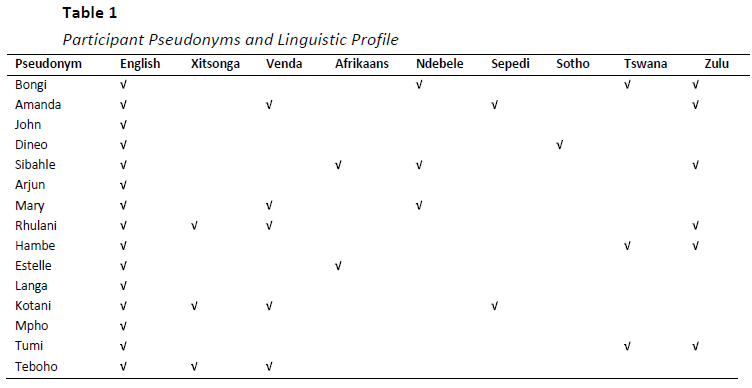
The study aimed to identify factors that determine the acceptance and uptake of translanguaging pedagogies in university classrooms. Data were collected, through focus group interviews, from a student population of a university in Johannesburg. Table 1 below presents the study's participant linguistic profile.
Findings from the discussions were analysed using thematic analysis. The data were analysed through the theoretical lens of TPB. The following themes speak to what students see as determinants of translanguaging acceptance and uptake: 1) prior experience in translanguaging, 2) aligning home languages to languages of the classroom, 3) debunking the perceived nexus between English and academic currency, 4) student-parent/guardian attitudes towards Indigenous languages, 5) language policy implementation in higher education institutions, 6) intellectualisation of Indigenous languages and resource development, and 7) synchronising the LoLT and language of assessment.
Prior Experience in Translanguaging
Participants reported varying levels of prior experience with translanguaging. Some students reported that they had been exposed to fluid multilingual practices in their communities and found this exposure useful in navigating multilingual classroom interactions, while others expressed discomfort due to a lack of prior experience with such pedagogies. What became clear from the discussion was the contrasting experiences in language use between students living in townships and who went to high schools in townships, and those from affluent suburbs who went to private schools. According to Bongi: "Translanguaging is the in thing, that's what we do ekasi every day maam, at home, in the street and in the classroom, even the teachers do the same."
For students who identify with Bongi, their experience with translanguaging in day-to-day interactions provides a smooth transition to classroom translanguaging. Amanda further indicated that they enjoy tutorials from the African languages modules because "that's how we communicate all the time." Note that the African Languages Department of this institution encourages the use of African languages during tutorial sessions.
On the other hand, students like John found it uncomfortable to include any other language in the classroom except for English because they have never experienced it in their homes nor in primary or high school. Participants who identified with John's view are monolingual English speakers (of White, Black, and Indian races). Dineo, Mary, and Tumi do practice translanguaging in their social interactions but were discouraged from using indigenous languages, particularly in high school and had been engaged in monolingual English interactions in their first and second years of study in University. Due to this experience, they found translanguaging to be "abnormal" in university classroom spaces.
Aligning Home Languages to Languages of the Classroom
The focus group interviews brought to the fore the mismatch between the Indigenous languages (ILs) used at home, and those in the classroom, namely, the standard languages. The students indicated that in as much as they wanted to use their languages in the classrooms, they had come to the realisation that there is incongruence between the ILs and the standard languages. Rhulani, a Venda mother tongue speaker indicated that they were allowed to use English and Venda in high school but the problem according to this participant was that "the Tshivenda that the teachers want is not the same as the one we use at home." The discussion around this incongruence further indicated that such differences can impact engagement the implication being that learning in the standard languages requires extra effort. There was a general consensus among participants that it might actually be easier for non-mother tongue speakers of ILs to learn and use ILs because they do not have to unlearn anything at this level.
Debunking the Perceived Nexus Between English and Academic Currency
A prevalent issue that also came out from the discussion was the association of English and academic currency, sometimes referred to as the academic lingua. While participants believed that English is crucial for academic and professional success, they lamented the marginalisation and linguistic repression of ILs, which they believed are also carriers of wealthy of information. However, despite the knowledge embodied in these languages, some students hold the perception that ILs cannot be used for academic discourse, reinforcing a hierarchical view of languages, which places English in its own league in relation to ILs. There are students who believe that certain knowledge cannot be disseminated or taught in African languages. The following excerpts reflect some students' perception of their languages with regards to their use in academia:
Many of the subject matter being presented to us cannot be translated into these languages properly, if at all. It is because the subject was not made with these languages in mind, only English and many European languages. (Rhulani)
We all know ukhuti [that] our African languages are limited. Imagine doing Engineering in isiHlubi guys akukhonakali [it is impossible]. (Sibahle)
Although the perceptions may not hold true, and may not be linguistically justified, the responses are validated by institutions' over-reliance on English and, to some extent, Afrikaans monolingual pedagogies despite prevailing multilingual policies in higher education. Kaschula and Maseko (2014, p. 26) indicated that 23 South African universities have adopted a language policy that favours the promotion of African ILs, however, "only a handful have implementation plans and actively promote African languages in their teaching acts." The non-existence or scarcity of these teaching acts as well as teaching and learning resources in ILs in institutions of higher education help perpetuate the myth that African languages are not fit for academia and in turn, this continues to valorise Western epistemologies. ILs continue to be viewed through an intellectual deficit lens, seen as inferior or unsuitable for academic discourse. This erroneous assumption further leads to students coming from these looked-down-on linguistic backgrounds lacking confidence in using their languages in the classrooms.
Student-Parent/Guardian Attitudes Towards ILs
The linguistic profile of the participants indicated that a majority of them spoke two or more languages. These languages are however valued and looked at differently by different participants. A key issue that came out of this is students' attitudes toward the languages within their linguistic repertoires.
These attitudes often reflect a compartmentalised view of language, where different languages are associated with specific functions or domains-a phenomenon associated with linguistic functional division of labour. Students tend to exhibit positive attitudes toward dominant languages, such as English, which is perceived as prestigious and instrumental in accessing educational and employment opportunities. When asked which languages they would consider translanguaging in, positivity was not directed towards English alone, dominant endoglossic languages isiZulu, isiXhosa, and SeSotho were also found to be languages of preference, the motivation being their hegemonic tendencies towards other endoglossic languages as well as their level of development.
Some participants indicated that while they would not have any problems with some endoglossic languages like isiZulu, SeSotho, and isiXhosa in the classroom, there were some languages that they believed could not be used in the classrooms. Asked which ones and why, participants believed that some linguistic codes could not be considered as languages, and pointed out Setokwa, isiBhaca, isiHlubi. Participants also indicated that some languages were too minor to be used in the classrooms. Ndebele, SiSwati, Xitsonga were mentioned despite them comprising part of the country's 12 official languages. What is noteworthy is that mother tongue speakers of languages like Xitsonga indicated that even though they were willing to take up translanguaging in classroom interactions, they would not feel comfortable doing it in their own languages because of the perceptions that other language speakers have about their languages, "maybe if the government develops our language like they did for isiZulu, or maybe one day when others see us like part of them," said frustrated Xitsonga first language speaker, Kotani. Interestingly, this was supported by both dominant and non-dominant language speakers, alike. Thus, there was a consensus on the view of some languages as minor, inadequate, and lacking in academic utility. These attitudes directly influence students' willingness or intention to engage in classroom translanguaging practices in these languages. So although participants showed some willingness to translanguage, acceptance and uptake is not open to all ILs. Attitude towards languages determines take up. According to Mabaso (2018), the VaTsonga people were, at some stage, looked down upon as an ethnic group and this negative attitude created such an inferiority complex within some of the VaTsonga that it can still be felt. Apart from student attitudes, society also mirrors these language attitudes, contributing to the broader linguistic hierarchy observed in educational settings. According to Hambe, her grandmother who is working hard to provide for her university education expects her to speak fluent English:
She [the grandmother] sends me to school to learn more English. She does not expect me to be taught in my home language. I don't tell about the struggles that I go through because of this English.
Another student, Teboho lamented the pressure that communities back home put upon them to speak in English, and show other community members how much they have achieved. These societal perceptions contribute to the linguistic choices students make in classrooms, choices that further entrench the dominance of English and shape translanguaging behaviour. Asked how they would respond to such challenges, the participants indicated that they would choose English.
Language Policy Implementation in Higher Education Institutions
The language in education policy of South Africa (Department of Education, 1997) and the Language Policy for Higher Education (DHET, 2002) are clear on the issue of accommodating official ILs in the education space. Most higher education institutions even have their own local multilingual policies drawn from the national policy. Asked whether they knew their institution's language policy, most students indicated that they did not know, and that they just assumed that it was English because they were using English only, particularly for lectures and assessments. Some students were not happy that their languages were left out: "fhedzi why hu si Venda?" queried Teboho. However, there was a consensus on the need for institutions to start implementing their language policies in earnest. Participants in this study felt that if institutions enforced implementation of their multilingual language policies, then students and lecturers alike would be left with no alternative but to employ multilingual pedagogies
Intellectualisation of ILs and Resource Development
Apart from issues of language attitudes and ideologies, students also highlighted issues of lexical deficiency and the underdevelopment of ILs. They indicated that sometimes the will to accommodate ILs in the classroom is there, but their current status hinders their effective use and renders them unfit for the classroom:
Half the time I am forced to continue struggling with English because of lack of certain terms in my language. After all, we do not have textbooks to refer to like we do for English. (Hambe)
This participant alludes to the idea that ILs are not only found wanting in terms of lexical equivalence but there is also a scarcity of learning resources in those languages. From the discussion on preferred languages for classroom translanguaging discussed above, participants leaned towards isiZulu, SeSotho, and isiXhosa "because of their level of development," according to Bongi. This perception that, unlike English, ILs are not adequately developed to cope with modern terminologies of various fields of knowledge is not new (Khumalo, 2017; Khumalo & Nkomo, 2022). The need to modernise and intellectualise ILs emerged strongly; "an intellectualised language is one that can be used for educating a person in any field of knowledge from preschool to university and beyond" (Sibayan, 1991, p. 229). These processes are also the basis for the development of teaching and learning resources in ILs. Whilst intellectualisation of ILs and development of teaching and learning resources in ILs have been identified in this study as determinants of classroom translanguaging uptake, Siziba (2024) advised that the use of African languages should not wait for intellectualisation to be accomplished first, but that both processes should take place simultaneously. According to Bamgbose (2011, pp. 3-4):
Experience has shown that while expanding vocabulary by creating terminology, competing terms emerge through the actual use of a language by different stakeholders, such as teachers, writers, and media practitioner.
Synchronising LoLT and Language of Assessment
The group also discussed the non-alignment of LoLT and language of assessment with reference to ILs. Rhulani questioned the value of translanguaging in teaching and learning but not assessments:
But, how does it help to discuss stuff in our vernacular and still be required to write assignments, tests, exams in English? Even when we did presentations, about our own cultures like in one of my module, they still want English. This is why some of us still fail even when I know the stuff.
For this student, translanguaging is only helpful when it is also used for assessments. While some students concurred with Rhulani, others indicated that they preferred writing assessments in English.
Discussion
Findings from this study have brought to the fore a number of issues. Based on TPB, the findings illustrate how attitudes, subjective norms, and perceived behavioural control shape the acceptance and uptake of translanguaging in higher education institutions. From this discussion, it is clear that prior experience with translanguaging plays a crucial role in shaping attitudes towards translanguaging uptake in the classroom. Those with prior experience tended to perceive translanguaging positively, indicating confidence and willingness to use it. Those who lacked prior experience indicated discomfort and a negative attitude towards classroom translanguaging. This suggests that perceived behavioural control is a key determinant of uptake. Findings further indicate that attitudes towards uptake are also influenced by subjective norms or social pressures. Participants from ekasi [townships] experienced strong enabling norms from both their communities and high school classrooms, thus reinforcing translanguaging acceptance and uptake at university level. It is therefore crucial that classroom translanguaging practices are implemented and supported from the lower levels of education. In this way, students would find it normal to translanguage at every level of their education.
Findings from this study revealed that students would be comfortable with classroom translanguaging in their actual home languages. The mismatch between home languages and standard languages has also been mentioned by Makoni et al. (2007), who argued that standard languages are social constructs unrelated to learners' mother tongues or the languages that students use at home-they are, in effect, mother tongues in search of speakers. Cook (2009) in their study of language use in Tlhabane and Phokeng in the North West Province of South Africa concurred with Makoni et al. (2007). The findings of the latter study revealed that most school children's home language in their study was not standard Setswana but street Setswana. In other words, standard languages cannot be the basis of classroom language practices because their effect may be similar to using English, which is a second or third language for most students. The effect of the mismatch is exacerbated by the fact that ILs have intra-language variations, particularly where vocabulary is concerned. These variations, in most cases, mark regional or geographical realisations of the same language. Again, standard languages ignore such dimensions of intra-language variation (Weber & Horner, 2017), thereby denying students the opportunity to make use of the resources they have in their linguistic repertoires for meaning making. Allowing languages and their inter-and intra-variations is therefore considered a determinant for translanguaging. Ruiz's (1984) resource and rights dimensions are aptly captured in translanguaging and work not only toward academic success but also, as conduits for social justice against standard language ideologies and monolingual pedagogies, which according to Cooper, (2010, p. 238) "do not improve but rather debilitate language and deprive humans of the resources that enable them to make meanings flexibly in response to ever-changing conditions". Aligning home languages and languages of the classroom was therefore found to strengthen positive attitudes towards acceptance and uptake.
The findings also highlight the complex interplay between student and society attitudes, language ideologies, and societal perceptions in shaping translanguaging practices within university classrooms. Subjective norms, particularly students' and society's attitudes towards ILs were found to have significant influence on translanguaging uptake. Dragojevic (2017) argued that our attitudes towards language may have multitudinous behavioural consequences, particularly negative attitudes perpetuating discrimination, problematic social interactions, and biases against not only minority languages, but endoglossic languages in general. Positive societal perceptions on classroom translanguaging encourages greater confidence in engaging ILs in classroom discourses. In the same manner, the extent to which higher education institutions implement multilingual policies gives students perceived control, normalises translanguaging, and fosters institutional legitimacy. Language planning agencies, such as government departments and language boards or academies, together with higher education institutions are therefore pivotal policy instruments in bridging gaps between policy (intention) and implementation (performance) (Beukes, 2009).
There is a need to also inculcate a sense of pride in students in ILs, awareness in parents on the usefulness of mother tongue languages in education, demystify Anglo-normative language ideologies that solely valorise English, and the assumption that people will and should be skilled in English, and that they are defective if they are not (Mckkiney & Norton, 2008). Unless and until attitudes toward ILs change, ILs will continue to be viewed through a deficit lens-seen as inferior or unsuitable for academic discourse. Anglo-normativity, a colonial legacy, reflects negatively on non-English fluent speakers and their languages because it paints a picture of intellectual deficiency. This erroneous assumption further leads to students from these looked-down-on linguistic backgrounds lacking confidence in using their languages in the classrooms.
Findings also point to the intellectualisation of ILs and the development of resources as determinants of translanguaging acceptance and uptake. ILs attract negative attitudes due to inadequate development. Without adequate development and resources, students may perceive limited control over their ability to use ILs in higher education. On the other hand, development enhances perceived behavioural control. Associated with the issue of ILs valorisation is the need to align the LoLT with the language of assessment. Institutions and lecturers alike are therefore encouraged to rethink assessment methods and create spaces in the assessment policies where translanguaging is accommodated, spaces that are more inclusive. This alignment would challenge the myth that English holds exclusive academic value, thereby debunking the nexus between English and academic currency. From a TPB perspective, such shifts in belief systems are crucial in shaping intentions to engage with translanguaging.
Overall, findings from this study have highlighted the influence that ideologies and beliefs have on people's perceptions, attitudes, and ultimately, their behaviour (Corbett & Wilson, 2002). Vandeyar (2020) further argued that beliefs, unlike knowledge, tend to be resistant to change. This then calls for concerted efforts from all stakeholders to decolonise this mentality that favours Anglo-normativity. Students need to be made aware of the usefulness of ILs and mother tongues in education from an early age, maybe through practice that normalises classroom translanguaging. Unless this mindset is transformed, classroom translanguaging will remain a good alternative on paper, but not in practice, for most universities despite the literature being replete with studies that attest to its efficacy.
Conclusion
While translanguaging has been shown to offer significant pedagogical advantages, and is found to be a transformative pedagogy, its successful uptake in university classrooms depends on various social, attitudinal, ideological, educational, and policy factors. Among other things, the study highlights the following as determinants for translanguaging acceptance and uptake in university classrooms: prior experience with translanguaging, positive attitudes towards ILs, inclusive policy implementation in higher education institutions, as well as intellectualisation of ILs and resource development. Taken together, the findings underscore the importance of addressing these attitudinal, ideological, and policy barriers in efforts to implement and promote translanguaging as a pedagogical strategy. Encouraging the use of all languages within students' repertoires requires not only institutional support but also a broader cultural shift in how languages are valued and understood. If universities are to serve as inclusive spaces for knowledge production, they must actively work to dismantle the linguistic hierarchies that continue to marginalise non-dominant languages and the students who speak them. However, it is worth noting that there was no complete consensus on all determinants given that there were also divergences on some factors. One thing though remained constant-the need to create a conducive environment for acceptance and uptake of translanguaging pedagogies in university classrooms.
References
Literature Review
- Ajzen, I. (1991). The Theory of Planned Behavior. Organizational Behavior and Human Decision Processes, 50, 179-211. https://doi.org/10.1016/0749-5978(91)90020-T
- Baker, C. (2003). Biliteracy and transliteracy in Wales: Language planning and the Welsh National Curriculum. In N. Hornberger (Ed.), Continua of biliteracy (pp. 71-90). Multilingual Matters.
- Bamgbose, A. (2011). African languages today: The challenge of and prospects for empowerment under globalisation. In E. G. Bokamba, R. K. Shosted, & B. T. Ayalew (Eds.), Selected proceedings of the 40th Annual Conference on African linguistics: African languages and linguistics today (pp. 1-14). Cascadilla Proceedings Project. http://www.lingref.com/cpp/acal/40/paper2561.pdf
- Cook, S. E. (2009). Street Setswana vs. school Setswana: Language policies and the forging of identities in South African classrooms. The Languages of Africa and the Diaspora: Educating for Language Awareness, 12, 96. https://doi.org/10.21832/9781847691354-009
- Cooper, M. M. (2010). Sustainable writing. In B. Horner, M.-Z. Lu, & P. K. Matsuda (Eds.), Cross-Language relations in composition (pp. 236-244). Southern Illinois University Press.
- Corbett, D., & Wilson, B. (2002). What urban students say about good teaching. Educational Leadership, 60(1), 18-22. https://eric.ed.gov/?id=EJ653547
- Creese, A., & Blackledge, A. (2010). Translanguaging in the bilingual classroom: A pedagogy for learning and teaching. The Modern Language Journal, 94(1), 103-115. https://doi.org/10.1111/j.1540-4781.2009.00986.x
- Creswell, J. W., & Creswell, J. D. (2018). Research design: qualitative, quantitative, and mixed methods approaches (5th ed.). SAGE.
- Department of Education. (1997). Language in Education Policy. https://www.education.gov.za/Portals/0/Documents/Policies/GET/LanguageEducationPolicy1997.pdf?utm_source=chatgpt.com
- Department of Higher Education and Training. (2002). Language policy for higher education. https://www.dhet.gov.za/Management%20Support/Language%20Policy%20for%20Higher%20Education.pdf
- Department of Higher Education and Training. (2020). Language policy framework for public higher education institutions (Government Gazette No. 43860, Notice 1160 of 2020). https://www.gov.za/sites/default/files/gcis_document/202011/43860gon1160.pdf
- Dragojevic, M. (2017). Language attitudes. Oxford Research Encyclopedia of Communication. https://doi.org/10.1093/acrefore/9780190228613.013.437
- Fullan, M. G. (2001). The new meaning of educational change. Teachers College Press.
- García, O. (2009). Education, multilingualism and translanguaging in the 21st century. Social Justice Through Multilingual Education, 140-158. https://doi.org/10.21832/9781847691910-011
- Khumalo, L. (2017). Intellectualisation through terminology development. Lexikos, 27, 252 - 264. http://doi.org/10.5788/27-1-1402
- Khumalo, L., & Nkomo, D. (2022). The intellectualisation of African languages through terminology and lexicography: Methodological reflections with special reference to lexicographic products of the University of Kwazulu-Natal. Lexikos, 32(2), 133-157. https://doi.org/10.5788/32-2-1700
- Liu, W., Han, J., Singh, M., & Wright, D. (2025). A translanguaging approach to doctoral supervision: Leveraging students' multilingualism as intellectual resources. International Journal of Applied Linguistics, 1-13. https://doi.org/10.1111/ijal.12748
- Mabaso, X. E. (2018). Xitsonga in South Africa. In T. Kamusella, F. Ndhlovu, F. (Eds.), The Social and Political History of Southern Africa's Languages (pp. 311-330). Palgrave Macmillan.
- Mckkiney, C., & Norton, B. (2008). Identity in language and literacy education. In B. Spolsky & F. M. Hult (Eds.), The handbook of educational linguistics (pp. 192-205). Blackwell.
- Rabbidge, M. (2019). Translanguaging in EFL contexts: A call for change. Routledge.
- Siziba, L. (2024). Towards the intellectualisation of Indigenous African languages through university language policies in South Africa. Forum for Linguistic Studies, 6(3), 198-212. https://doi.org/10.30564/fls.v6i3.6543
- Teherani, A., Martmianakis, T., Stenfors-Hayes, T., Wadhwa, A., & Varpio, L. (2015). Choosing a qualitative research approach. Journal of Graduate Medical Education, 7(4), 669-670. https://doi.org/10.4300/JGME-D-15-00414.1
- Ticheloven, A., Blom, E., Leseman, P., & McMonagle, S. (2021). Translanguaging challenges in multilingual classrooms: Scholar, teacher and student perspectives. International Journal of Multilingualism, 18(3), 491-514. http://doi.org/10.1080/14790718.2019.1686002
- Trudell, B., & C. Young. (2016). Good answers to tough questions in mother tongue-based multilingual education. SIL International.
- UNESCO. (2015). Rethinking education towards a global common good. https://doi.org/10.54675/MDZL5552
- Weber, J.-J., & Horner, K. (2017). Introducing multilingualism: A social approach. Routledge.
- Williams, C. (1994). An evaluation of teaching and learning methods in the context of bilingual secondary education. [Unpublished doctoral thesis]. Bangor University.
- Yafele, S., & Molthaka, H. (2021). Breaking the monolingual chains: Translanguaging for academic-literacy access and success. Journal of Critical Reviews, 8(2), 2119-2131. https://hdl.handle.net/10210/488857
Appendix 1
Interview Schedule for Group Discussions
The following were part of the questions that guided the discussion:
1. Given that you have learned about the importance of translanguaging in teaching and learning, and since the School of Languages also encourages it, kindly share your experiences with translanguaging.
2. Given your experiences, would you support and engage in translanguaging in your lectures? Why; why not?
3. For those who have no experience in translanguaging, now that you know what it is and its advantages, would you feel comfortable in classroom translanguaging? (Note that there are some modules without tutorials.)
4. Is there anything that you think should be done to enable you to engage in translanguaging comfortably and effectively in your lectures?
5. Which languages would you consider for translanguaging? What factors guide your choices?
6. What is your university language policy? What languages are included?