School Community Partnerships for Promoting Sustainable Learning Practices in Rural Primary Schools
Abstract
This article examines how sustainable learning can be enhanced among vulnerable learners in primary schools. The article is framed by Bronfenbrenner's ecological systems theory and contemporary resilience scholarship. It adopts an interpretive qualitative design within a doctoral research project focused on school-community partnerships that support resilience and sustainable learning practices in rural primary schools in KwaZulu-Natal, South Africa. Data were generated through focus group discussions, reflective journals, and interviews with educators. They were analysed thematically to illuminate how learners and teachers co-construct adaptive strategies in challenging socioeconomic conditions. Findings reveal that sustainable learning and resilience in learners are not fixed personal attributes but a relational and contextual process fostered through caring pedagogies, life skills education, and supportive school-community partnerships. Learners' psychosocial competence, self-awareness, emotional regulation, empathy, and problem-solving emerged as central to both well-being and academic engagement. When teachers integrated culturally relevant life-skills activities and strengths-based feedback, learners displayed enhanced self-efficacy, adaptability, and hope. Conversely, deficit-oriented practices and rigid academic expectations undermined resilience. The paper concludes that enhancing sustainable learning requires transforming schools into ecosystems of care and sustainability, linking social-emotional learning with equity, digital access, and ecological awareness. Policy recommendations include embedding resilience education within the national curriculum, equipping teachers with trauma-informed practice, and aligning the Screening, Identification, Assessment and Support framework with cross-sectoral well-being initiatives. By conceptualising resilience as a foundation for sustainable learning, this study contributes to global debates on inclusive education, social justice, and the ethics of care in post-apartheid South Africa.
resilience; sustainable learning; psychosocial competence; vulnerable learners; South Africa; life-skills education; inclusive pedagogy; participatory action research
Introduction
Educational resilience has emerged as a central theme in discussions about quality and equity in South African schooling. Persistent socioeconomic inequalities, compounded by the legacies of apartheid, continue to shape learners' access to quality education (Spaull & Jansen, 2019). Children from impoverished communities, rural schools, and under-resourced urban areas often face multiple intersecting vulnerabilities: poverty, food insecurity, trauma, and limited psychosocial support. These conditions make sustainable learning difficult to achieve unless schools intentionally become spaces of care, connection, and resilience-building (Theron, 2021).
In response to these challenges, the Building Resilience for Sustainable Learning project (Mbambo-Mkhwanazi & Hlalele, 2023) sought to understand how educators can empower vulnerable learners to overcome adversity through psychosocially responsive pedagogical practices. Grounded in the belief that resilience is not merely an innate trait but a dynamic, context-dependent process (Ungar, 2019), the project explored how supportive relationships and learner agency could be cultivated within schools. The study was situated in the broader discourse of education for sustainable development (ESD), aligning with UNESCO's Sustainable Development Goal 4 (SDG 4), which advocates for inclusive, equitable, and quality education that promotes lifelong learning opportunities for all.
Resilience, in this framework, is viewed as the capacity of individuals and systems to adapt positively to significant adversity (Masten, 2021). For vulnerable learners, this means more than academic perseverance; it involves emotional regulation, self-efficacy, and a sense of belonging within the school environment (Theron & Donald, 2023). Schools thus serve as critical sites for building psychosocial competence, where teachers act as both educators and emotional anchors. As Donald et al. (2022) argued, sustainable learning occurs when learners' emotional, social, and cognitive needs are holistically addressed.
While existing studies have acknowledged the role of social support and teacher-learner relationships in fostering resilience (Mampane, 2020; Theron, 2021), fewer have examined how educators conceptualise and operationalise resilience within their pedagogical and relational practices. This study, therefore, bridges that gap by examining the lived experiences of teachers and learners within vulnerable schooling contexts. By analysing narratives emerging from the Building Resilience for Sustainable Learning initiative, it seeks to illuminate how schools can become resilience-enabling environments where learners are not merely surviving adversity but developing the skills and dispositions necessary for sustainable learning and lifelong growth.
At a conceptual level, the paper situates resilience within a social-ecological systems framework (Bronfenbrenner, 1994; Ungar, 2019), recognising that learner outcomes are shaped by interactions between individuals, families, schools, and communities. It also draws on the ethics of care framework (Noddings, 2012), which emphasises relational interdependence and empathy as foundations for human development. Integrating these frameworks allows for a multidimensional understanding of resilience that foregrounds relationships, context, and social justice.
Furthermore, the paper engages with recent scholarship (2020-2025) that expands the concept of resilience beyond individual adaptation to include transformative resilience, the capacity of schools and systems to change in ways that reduce vulnerability and promote equity (Johnson & Winthrop, 2022; Theron & Liebenberg, 2023). This shift reflects a significant evolution in resilience research, from focusing on "beating the odds" to "changing the odds" (Ungar, 2019). It aligns with South Africa's post-2015 educational agenda, which calls for inclusive, caring, and socially responsive schools (Department of Basic Education [DBE], 2019).
This study thus contributes to three interrelated discourses:
1. Educational resilience as a dynamic, relational process.
2. Sustainable learning as a goal that integrates emotional and academic well-being.
3. Inclusive education as a vehicle for equity and social transformation.
By exploring these themes through an empirical case, the paper argues that fostering resilience in vulnerable learners requires a systemic, culturally responsive approach grounded in care, collaboration, and contextual sensitivity. The following sections detail the theoretical foundations, methodology, and findings that support this claim.
Theoretical Framework
The Building Resilience for Sustainable Learning project was conceptually grounded in a social-ecological framework of resilience (Bronfenbrenner, 1994; Ungar, 2019) and informed by the ethics of care (Noddings, 2012) and the principles of ESD (UNESCO, 2020). Together, these frameworks provided a multidimensional lens for understanding how resilience is cultivated among vulnerable learners within the complex social realities of South African schooling. Rather than viewing resilience as an individual trait or static outcome, the project conceptualised it as a dynamic, relational, and context-sensitive process that evolves through interactions between learners, educators, families, and broader community systems (Theron, 2021).
The Social-Ecological Perspective on Resilience
Bronfenbrenner's (1994) ecological systems theory provides a foundational understanding of how human development is shaped by nested environmental systems: the microsystem (immediate environments such as family and school), mesosystem (interactions between these settings), exosystem (broader social structures), and macrosystem (cultural and policy contexts). Within this model, resilience is not viewed as an attribute residing solely within the child but as an emergent property of reciprocal interactions between the individual and their environment (Ungar, 2019).
In South African schools, where learners often face socioeconomic hardships, this ecological framing highlights the importance of supportive microsystems such as teacher-learner relationships and peer support networks (Theron & Donald, 2023). These immediate contexts can buffer the effects of adversity and promote adaptive functioning. At the mesosystemic level, collaboration between schools, families, and community organisations enhances the collective capacity to support learners' emotional and academic needs (Mampane, 2020). Policies and institutional practices at the exosystem and macrosystem levels, such as inclusive education policies and district-level psychosocial services, also play critical roles in enabling or constraining resilience-building processes (DBE, 2019).
Ungar's (2021) social-ecological model extends Bronfenbrenner's ideas by emphasising navigation and negotiation. According to Ungar, resilient individuals are those who can navigate to resources that sustain their well-being, and negotiate for these resources to be provided in culturally and contextually meaningful ways. Within vulnerable school contexts, resilience thus depends not only on learners' individual coping capacities but also on the availability, accessibility, and meaningfulness of external support systems. This distinction is vital for sustainable learning because it shifts the responsibility for resilience from individuals to systems, requiring schools to become resource-rich ecosystems of support.
The Ethics of Care as a Relational Pedagogy
Complementing the social-ecological approach, Noddings' (2012) ethics of care provides a moral and relational foundation for resilience-building in educational spaces. Care theory posits that relationships are at the heart of ethical and educational practice. It asserts that genuine human connection, empathy, and attentiveness are prerequisites for meaningful learning and well-being (Gilligan, 2014). In contexts of vulnerability, where learners may experience neglect, trauma, or exclusion, caring pedagogies serve as protective factors that foster emotional safety and a sense of belonging (Theron, 2021).
In the Building Resilience for Sustainable Learning project, teachers who demonstrated responsive care through consistent encouragement, patience, and relational attunement were observed to enhance learners' confidence and engagement. This finding aligns with contemporary research that emphasises the importance of caring teacher-learner relationships in predicting resilience and positive academic trajectories, particularly among marginalised learners (Botha & van Niekerk, 2022; Ngcobo & Muthukrishna, 2023).
Recent studies have further refined the concept of care to include critical and transformative care, where educators consciously challenge inequities and structural barriers that affect learners' well-being (Beyers, 2022). This approach aligns with Freire's (1970) notion of praxis, which involves reflection and action directed at transforming oppressive realities. Within South African schools, transformative care implies not only attending to learners' emotional needs but also addressing systemic injustices such as poverty, stigma, and under-resourcing that undermine sustainable learning.
Education for Sustainable Development (ESD) and Psychosocial Competence
Resilience and care must be understood within the broader educational vision of sustainability. The UNESCO (2020) framework for ESD calls for learning that equips individuals with the knowledge, skills, values, and attitudes necessary to contribute to a more just and sustainable future. ESD is inherently holistic, integrating cognitive, socioemotional, and behavioural learning dimensions. In this sense, it converges with the psychosocial orientation of resilience theory, which similarly emphasises adaptive capacities, empathy, collaboration, and problem-solving (Mhlongo & Walton, 2021).
In the context of vulnerable learners, sustainable learning is achieved when educational processes build psychosocial competence-the capacity to manage emotional, social, and cognitive challenges in adaptive ways (World Health Organization, 2021). As Mbambo-Mkhwanazi and Hlalele (2023) demonstrated, resilience-building practices such as reflective journaling, peer mentoring, and emotional literacy activities can strengthen these competencies, enabling learners to persist and thrive in the face of adversity.
Rieckmann (2018) further argued that sustainable education requires key competencies including critical thinking, systemic thinking, and collaboration-all of which were nurtured through the community-linked projects in this study. The integration of ESD with resilience and care frameworks highlights the reciprocal relationship between individual empowerment and systemic transformation. While resilience allows learners to adapt within existing conditions, sustainability demands that educational systems themselves become more just, inclusive, and nurturing (Theron & Liebenberg, 2023). Thus, ESD serves as the macro-level driver that ensures resilience is not limited to coping with adversity but extends to reimagining and restructuring learning environments for long-term equity and well-being.
Synthesising the Framework
Taken together, the social-ecological, care, and ESD frameworks form a coherent theoretical triad that underpins this study. The social-ecological perspective situates resilience within multi-layered systems of support; the ethics of care foregrounds the relational and moral dimensions of educational practice, and ESD provides the aspirational vision of sustainability that aligns micro-level resilience processes with macro-level educational transformation.
This integrated framework acknowledges that resilience among vulnerable learners is relationally co-constructed, emerging through interactions between caring educators, supportive peers, engaged families, and enabling institutional systems. It also recognises that sustainable learning requires transformative resilience, where schools evolve into inclusive, empathetic, and resourceful ecosystems capable of supporting all learners.
In summary, this theoretical synthesis positions resilience as a systemic and transformative process that bridges psychosocial well-being and educational sustainability. The following section outlines the methodological approach employed to explore how these theoretical principles manifested in the lived realities of teachers and learners participating in the Building Resilience for Sustainable Learning project.
Methodology
Research Paradigm and Design
This study was situated within the Critical Emancipatory Research (CER) paradigm (Boog, 2003; Nkoane, 2021), complemented by a Participatory Action Research (PAR) design. The choice of CER was informed by its commitment to transformation, participation, and social justice principles that align with the aims of building resilience and promoting sustainable learning among vulnerable learners. CER acknowledges that knowledge is socially constructed and shaped by power relations (Kemmis et al., 2014). Therefore, research participants were not positioned as passive subjects but as co-researchers whose lived experiences and contextual knowledge informed both the process and the outcomes of the study.
The PAR design was employed as a practical methodology within this emancipatory framework. It enabled the collaborative development of locally grounded solutions through cycles of reflection, action, and evaluation (Kindon et al., 2007). PAR's participatory nature was particularly suitable for a project concerned with sustainable learning because it fostered ownership, agency, and community engagement-key conditions for long-term resilience (Bergold & Thomas, 2019). Through this approach, the research became not only a process of inquiry but also a process of empowerment for participants.
Research Context and Participants
The study was conducted in the uMkhanyakude district of KwaZulu-Natal, South Africa, a deep rural region characterised by high levels of poverty, limited educational resources, and social vulnerability. According to district data, unemployment in the area exceeds 90 per cent, and approximately 70 per cent of households rely on social grants. The participating community faced multiple intersecting challenges: inadequate infrastructure (limited electricity, poor road networks, no clinics within 20 km), a shortage of psychosocial support services (no educational psychologists within the district), and high rates of child-headed households due to HIV/AIDS-related deaths.
Despite these constraints, schools in the area demonstrated strong communal networks and a commitment to learner well-being. Three primary schools participated in the study, each with multi-grade classrooms (Grades R-7), feeding schemes operating daily, and active school governing bodies. The schools serve approximately 450 learners collectively, with an average learner-to-teacher ratio of 35:1. A total of 12 participants were purposively selected as core co-researchers. This group comprised:
The inclusion of diverse voices was intentional, reflecting the study's social-ecological orientation and ensuring that resilience was examined through multiple lenses (Ungar, 2019). Participants were selected based on their ongoing involvement with youth support initiatives and their willingness to engage collaboratively in reflective research processes. Written informed consent was obtained from all adult participants and from parents/guardians of learner participants.
Participatory Action Research Implementation
The PAR process was implemented over eight months (March-October 2023) and comprised three complete cycles. Each cycle followed the PAR spiral of planning, action, observation, and reflection (Kemmis et al., 2014).
Cycle 1: Problem Identification and Relationship Building (Weeks 1-8)
• Planning: Initial meetings with school principals to introduce the project; community mapping exercise.
• Action: Formation of the co-researcher team; participatory workshop on resilience concepts; establishment of ground rules and ethical protocols.
• Observation: Documentation of community assets and challenges; identification of priority areas.
• Reflection: Collective analysis of initial findings; consensus on focus areas for intervention. During this cycle, co-researchers decided that interventions should address three priority areas: emotional support for learners, economic empowerment linking to learning, and strengthening community networks. The researcher facilitated but did not direct these decisions.
Cycle 2: Co-design and Pilot Interventions (Weeks 9-20)
• Planning: Sub-committees formed around each priority area; intervention strategies co-designed.
• Action: Pilot implementation of: (a) peer mentoring programme (15 learner pairs); (b) school vegetable garden linked to entrepreneurship curriculum; (c) community resource mapping workshop.
• Observation: Regular documentation through photographs, meeting minutes, and observation notes.
• Reflection: Mid-cycle review meeting where participants evaluated pilot interventions and made adjustments.
Cycle 3: Reflection, Consolidation, and Evaluation (Weeks 21-32)
• Planning: Co-design of evaluation framework; preparation for sustainability planning.
• Action: Full implementation of refined interventions; community showcase event.
• Observation: Systematic data collection through focus group discussions (FGDs) and written reflections.
• Reflection: Final participatory analysis workshop where co-researchers interpreted findings collectively and developed sustainability recommendations.
Throughout all cycles, the researcher's role shifted from facilitator in Cycle 1 to co-learner and resource person in Cycles 2 and 3. Decision-making was democratic, with each co-researcher having equal voice in prioritising actions and interpreting outcomes.
Data Generation Methods
Data were generated through FGDs and free writing reflections (FWRs). These methods were selected for their alignment with PAR principles of dialogue, participation, and voice.
Focus Group Discussions
The FGDs provided a platform for dialogic engagement, allowing participants to share experiences, debate ideas, and co-construct understandings of vulnerability and resilience within their school and community contexts (Wilkinson, 2015).
FGD Composition and Scheduling
• Youth group: Four learners (Nokuthula, Sabelo, Zinhle, Mandla). Met three times (once per cycle) for 60-90 minutes per session. Sessions held in the school library after hours, with refreshments provided.
• Adult stakeholder group: Eight participants (four teachers + four community stakeholders). Met three times (once per cycle) for 90-120 minutes per session. Sessions held in the community hall on Saturday mornings.
Total: Six FGD sessions across both groups.
FGD Facilitation Process
• Sessions were co-facilitated by the researcher and one co-researcher (rotating).
• Each session began with a check-in and review of previous discussions.
• Discussions were conducted in isiZulu (participants' home language) to ensure authentic expression.
• Sessions were audio-recorded with consent and transcribed verbatim, then translated to English by a professional translator and verified by the researcher.
Guiding Questions
For Cycle 1 (Problem identification):
• What does resilience look like in our community? Can you share examples of learners who have overcome challenges?
• What are the biggest challenges that make it difficult for learners to succeed in school?
• How do we currently support each other when facing difficulties?
For Cycle 2 (Action reflection):
• What has changed since we started our interventions? What is working well?
• What challenges have we encountered in implementing our plans?
• What should we adjust moving forward?
For Cycle 3 (Evaluation):
• Looking back over the past months, what have we learned about building resilience?
• What changes have we seen in learners, teachers, or the community?
• What should continue after this project ends?
Free Writing Reflections
The FWRs complemented FGDs by enabling participants to articulate personal insights in an unstructured and introspective manner. This method was particularly valuable for learners, who could express their thoughts creatively without the constraints of formal interviews.
Prompt Provided
At the end of Cycle 1, participants were given the following prompt (in isiZulu and English):
Over the next few weeks, as we work together on this project, please write down your thoughts, feelings, and observations. You can write about anything related to resilience, learning, and our work together. Some things you might consider:
• A moment when you felt supported or supported someone else.
• A challenge you faced and how you handled it.
• Something you learned about yourself or others.
• Your hopes for learners in our community.
• Any ideas you have for making our school more supportive.
Write freely-there are no right or wrong answers. You can write in isiZulu or English. If you prefer, you can draw or use a combination of words and pictures. Your reflections will help us understand resilience from your perspective.
Coordination Process
• Each participant received a dedicated notebook and pen at the end of Cycle 1.
• Participants were invited to write as often as they wished, with no minimum requirement.
• Notebooks were collected at the start of Cycle 3 (after approximately four months).
• Participants who preferred typing could submit digital reflections via email or WhatsApp.
• Confidentiality was assured. Only the researcher read the reflections, and identifying information was removed during analysis.
• At the final workshop, participants could choose to share excerpts from their reflections with the group.
All 12 participants submitted written reflections, with entries ranging from three to 15 pages. Learner reflections included drawings, poems, and personal stories. Adult reflections tended to be more analytical, documenting observations of change processes.
Data Analysis
The data were analysed using thematic analysis (TA), following Braun and Clarke's (2019) 6-phase approach: familiarisation, coding, theme development, review, definition, and reporting. The research team collectively engaged in collaborative coding, a process consistent with participatory and emancipatory principles.
Analysis Process
1. Familiarisation: All transcripts and reflections were read multiple times by the researcher and two co-researcher volunteers who participated in the analysis workshop.
2. Initial coding: In a 2-day participatory workshop, co-researchers identified meaningful segments of text and assigned preliminary codes. Coding was done on large paper sheets with colour-coded sticky notes.
3. Theme development: Codes were grouped into potential themes through discussion and consensus. Co-researchers debated the relationships between codes until agreement was reached.
4. Theme review: Themes were checked against the entire dataset. Disconfirming evidence was actively sought and discussed.
5. Theme definition: Each theme was named and defined collaboratively, with co-researchers contributing to the wording.
6. Reporting: The researcher drafted the findings section, which was then reviewed by co-researchers for accuracy and resonance with their experiences.
The use of TA allowed for flexibility in engaging with both inductive and deductive insights. Inductively, the analysis surfaced themes grounded in participants' lived experiences. Deductively, these themes were interpreted through the lens of the theoretical framework, ensuring conceptual coherence.
Trustworthiness and Rigour
Trustworthiness was enhanced through multiple strategies aligned with Lincoln and Guba's (1985) criteria:
• Credibility: Prolonged engagement (eight months in field); triangulation (multiple data sources, multiple participant groups); member checking (participants reviewed findings); peer debriefing with doctoral supervisor.
• Transferability: Thick description of context, participants, and processes to enable readers to assess applicability to their settings.
• Dependability: Systematic documentation of all research decisions through reflective field notes; audit trail maintained.
• Confirmability: Reflexive journaling by researcher to bracket assumptions; findings grounded in participant voices rather than researcher preconceptions.
By integrating participatory, reflective, and rigorous methods, the study upheld both the ethical and epistemological integrity required for research that seeks to empower rather than extract.
Findings and Discussion
The analysis of the FGDs and FWRs revealed how vulnerable learners, educators, and community members collaboratively cultivated resilience as a foundation for sustainable learning in rural KwaZulu-Natal. Three overarching and interrelated themes emerged, each presented below with empirical evidence followed by theoretical interpretation.
Theme 1: Creating Youth-Centric and Caring Learning Ecologies
Empirical Findings
Participants across all groups emphasised the importance of safe, inclusive, and caring learning environments as the foundation of both resilience and sustainable learning. Teachers described how nurturing relationships and empathetic engagement transformed classroom spaces into "zones of support" rather than "zones of deficit."
Teacher Perspectives
Thandi, a Foundation Phase teacher with 15 years' experience, explained:
I realised that before I can teach a child anything, I must first make them feel safe. Many of my learners come to school hungry, some have not slept well because they share a small room with many people. If I shout at them for not doing homework, I am adding to their burden. Instead, I started greeting each child at the door every morning, asking how they are. Some days, a child just needs to be seen. When they know you care, they will try harder in class.
Nomusa, an Intermediate Phase teacher, reflected on how she adapted her pedagogy:
There was a learner who always slept in class. At first, I was frustrated. But then I spoke to her grandmother and discovered she walks eight kilometres to school every day, leaving home at 4 am because she must first fetch water. After that, I stopped punishing her and started letting her rest for 15 minutes when she arrives. Then I give her extra attention during breaks. Her work improved because she felt understood, not judged.
Learner Perspectives
Learners consistently identified caring teachers as the primary reason they continued attending school despite hardships.
Nokuthula (age 13, Grade 6) wrote in her reflection:
When my teacher listens to me and helps me without shouting, it really changes how I feel about learning. At home, things are not easy, and sometimes I come to school feeling worried and tired. However, when my teacher is patient and takes time to understand what I am going through, it makes me feel supported and safe. It gives me the confidence to try again, even when I have made mistakes or when the work feels difficult. Knowing that my teacher cares and does not get upset with me easily, it makes school like a place where I stay, start over, and keep pushing forward, no matter what challenge I am facing, even outside of school.
Sabelo (age 14, Grade 7) shared in an FGD:
Last year, my mother was very sick and I had to take care of my younger siblings. I missed many days of school. When I came back, I expected the teacher to be angry. But Teacher Bongani just said, "I'm glad you're back. Let's see how we can catch up." He gave me extra worksheets and let me work with a friend. That made me want to prove that I could still pass. If he had shouted at me, I think I would have just given up.
Community Stakeholder Perspectives
Nomvula, the social worker, observed:
What I see in these schools is that teachers are doing more than teaching. They are acting as social workers, counsellors, and sometimes parents. This is not in their job description, but they do it because they see the need. When teachers create that caring environment, children open up. I have had teachers refer children to me who were experiencing abuse, something the child never told anyone before. That only happens when there is trust.
Theoretical Interpretation
These empirical findings align directly with Noddings' (2012) assertion that care in education transcends academic instruction; it involves attentiveness, empathy, and responsiveness that affirm learners' dignity. In vulnerable contexts, such affective care mitigates the psychosocial effects of poverty, stigma, and trauma, enabling learners to persist in schooling (Botha & van Niekerk, 2022; Ngcobo & Muthukrishna, 2023).
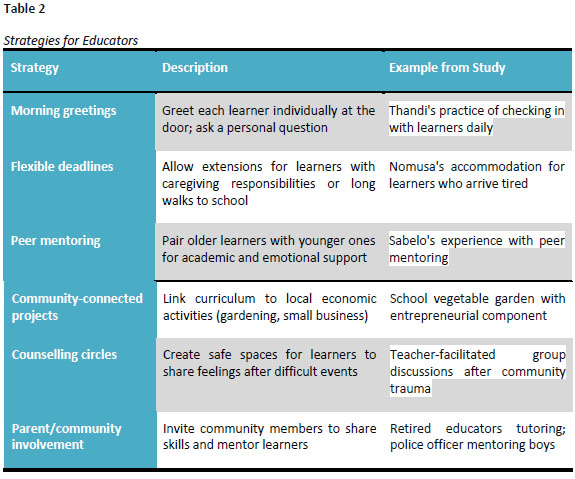
The teachers who participated in the study perceived caring pedagogy as a transformative act, not merely a moral obligation, but also as a strategy for promoting equity and inclusion. They implemented small but meaningful practices: flexible deadlines for learners with caregiving responsibilities, counselling circles after traumatic events, and inclusive classroom discussions. These practices exemplify what Beyers (2022) termed transformative care, where authentic care involves challenging structural inequalities and fostering learner agency.
From a social-ecological perspective (Bronfenbrenner, 1994; Ungar, 2019), these caring relationships operate at the microsystem level, serving as proximal processes that directly influence learner development. The emergence of youth-centric social ecologies, informal learning hubs, and peer mentorship circles reinforced caring relationships beyond the classroom. These hubs, often situated in school halls or community centres, became spaces for homework clubs, emotional support, and life skills training. In these ecologies, care was distributed rather than individualised; it flowed through networks of teachers, peers, and community stakeholders.
This finding resonates with the collective resilience model proposed by Theron (2021), which posits that resilience in resource-constrained contexts is sustained when care and support are shared across interconnected systems. It also mirrors the UNESCO (2020) call for schools to serve as community anchors for sustainable development, integrating educational, emotional, and social resources in a single ecosystem. In short, creating youth-centric and caring ecologies transforms schools into sustainable ecosystems of learning" (Mhlongo & Walton, 2021). Such environments foster emotional safety, belonging, and mutual accountability, the psychosocial preconditions for sustained educational engagement and well-being.
Theme 2: Expanding Local Economic and Educational Opportunities
Empirical Findings
A second theme related to the importance of linking learning with livelihood and local opportunity. Participants argued that sustainable learning cannot exist in isolation from the economic realities of learners' communities.
Teacher Perspectives
Sipho, a teacher and coordinator of the school garden project, explained:
We realised that many learners were disengaged because they didn't see the point of education. Their parents are unemployed, older siblings are unemployed after finishing school. They think, "Why should I study if there are no jobs?" So, we had to show them that education can help them create opportunities, not just wait for jobs.
Bongani added:
The vegetable garden started as a way to supplement the feeding scheme. But then we thought, "Why not teach the children how to run it as a small business?" Now our Grade 7 learners manage the garden. They keep records, calculate profits, and sell vegetables to the community. They are learning mathematics, entrepreneurship, and responsibility-all while contributing to the school.
Learner Perspectives
Zinhle (age 13, Grade 7) wrote in her reflection:
When we as learners begin to understand that what we learn at school can actually help us survive and build better lives right here in our own village, our whole attitude towards education changes. We stop thinking that education is something that only matters in big towns or cities, or that its benefits are meant for people who live far away from urban areas. Instead, we start to realise that what we learn can help us improve our own community, support our families, and create opportunities without having to leave home. This makes learning feel more relevant and meaningful because it connects directly to the challenges and possibilities we encounter every day in the village.
Mandla (age 14, Grade 7) shared in an FGD:
I used to think I would have to go to Johannesburg to find work. But now, through our garden project, I see that I can grow things and sell them here. I'm learning how to calculate profit, how to save money, how to work in a team. Even if I don't go to university, these skills will help me. It makes me want to stay in school because I'm learning things I can actually use.
Community Stakeholder Perspectives
Siphiwe, the youth leader, observed:
What excites me is that the children are now teaching their parents. One parent came to me and said her daughter taught her how to budget using the profits from selling eggs. Another parent said her son showed her how to keep simple records for their spaza shop. The learning is going both ways.
Gladys, the nurse, noted the health implications:
The garden has improved nutrition. Children are eating vegetables at school, and some have started home gardens. When children are better nourished, they concentrate better and get sick less. This connects directly to their ability to learn.
Theoretical Interpretation
This pragmatic form of situated learning aligns with the ESD paradigm, which advocates for integrating local relevance, environmental stewardship, and social entrepreneurship into education (UNESCO, 2020). Such approaches enable learners to view their schooling as part of a broader continuum of sustainable livelihoods, rather than a narrow path to urban employment (Glover & Kusterer, 2016; Mahaye, 2024).
Moreover, exposure to local economic activities enhanced learners' self-perceived competence and sense of agency, both of which are central to the social-ecological understanding of resilience. By engaging in agricultural projects and micro-enterprise initiatives, learners developed tangible skills while fostering a mindset of adaptive innovation. These activities functioned as experiential learning platforms that strengthened problem-solving, collaboration, and self-efficacy-core components of resilience (Ungar, 2021).
This finding aligns with the argument by Mukonza and Nkuna (2022) that resilience-building in African education should be coupled with localised sustainability practices, enabling learners to respond creatively to environmental and economic disruptions. Similarly, Rieckmann (2018) emphasised that sustainable education requires competencies such as critical thinking, responsibility, and collaboration, all of which were nurtured in these community-linked projects.
From an ecological systems perspective, these initiatives strengthened the mesosystem by creating meaningful connections between school learning and community life (Bronfenbrenner, 1994). Learners experienced continuity between what they learned in school and what mattered in their daily lives, enhancing the relevance and retention of both academic and practical skills.
In essence, expanding local educational and economic opportunities transforms vulnerability into potential. It redefines learning as an act of place-based empowerment, anchoring education within community development and ensuring that resilience contributes not just to individual survival but to collective sustainability.
Theme 3: Building Healthy Networks and Relational Capital for Sustainability
Empirical Findings
The third central theme underscored the role of social networks and relational capital in sustaining resilience among vulnerable learners. Across all participant groups, relationships were consistently identified as both a protective resource and a catalyst for learning.
Learner Perspectives
Learners described how supportive friendships and peer study groups helped them manage academic and emotional pressures.
Zinhle wrote in her reflection:
My friends and I have created our own rule to help each other stay strong. Whenever one of us feels overwhelmed or feels like giving up-whether it is with schoolwork, problems at home, or just feeling tired-the rest of us step in to remind her why she started in the first place. We discuss her goals, dreams, and the progress she has already achieved. In this way, we encourage one another and ensure that no one is left to struggle alone. This support system we have built helps us keep going, even on the days when things feel too heavy. It is our way of lifting each other and making sure we all stay focused and motivated in our schoolwork.
Sabelo shared in an FGD:
Before this project, I kept my problems to myself. I thought asking for help meant I was weak. But when we started the peer mentoring programme, I was paired with an older learner who had been through similar things. He showed me that it's okay to talk. Now I have three friends I can go to when I'm struggling. We help each other with homework, but we also just listen.
Teacher Perspectives
Thandi observed changes in classroom dynamics:
I've noticed that learners are now more willing to help each other. Before, they competed. Now they collaborate. When one learner finishes their work, they automatically go to help someone who is struggling. This was not something we taught explicitly-it emerged from the culture we built.
Nomusa noted the role of technology in expanding networks:
Some of our learners now have access to smartphones through a community initiative. They created a WhatsApp group for homework help. Even when schools are closed, they are still learning and supporting each other. This is something we never had before.
Community Stakeholder Perspectives
Jabulani, the police officer, described the impact on youth at risk:
I work with young boys who are vulnerable to gang involvement. Through this project, we connected some of them with positive role models in the community-men who have stable jobs, who are involved in their churches, who can show them a different path. When boys see that there are adults who care about them, who will show up for them consistently, it changes how they see themselves and their future.
Nomvula, the social worker, emphasised the importance of intergenerational ties:
What makes this community special is that older people still play a role in raising children. Even if parents are absent, there is a grandmother, a neighbour, a church member who steps in. In this project, we formalised some of that through the mentorship programme. But the foundation was already there-this community has always practised collective child-rearing. We just strengthened what already existed.
Siphiwe, the youth leader, added:
The networks we built through this project are not just for now. Teachers now have each other's numbers; they know who to call when a child needs help. The social worker knows the teachers personally, so referrals happen faster. The nurse comes to the school regularly now, not just when called. We have created systems that will continue after the project ends.
Theoretical Interpretation
Such accounts illustrate the peer-based dimension of resilience, where social belonging serves as a buffer against stress and promotes persistence (Theron & Liebenberg, 2023). Teachers and community participants echoed this, noting that mentorship and intergenerational ties between youth and adults created a web of accountability that extended beyond the classroom.
The study found that technological connectivity also expanded these networks. With improved internet access through local initiatives, learners began engaging in online study forums, career mentorship groups, and virtual peer exchanges. This digital engagement enhanced learners' exposure to diverse perspectives and resources, aligning with Twum-Antwi et al.'s (2020) assertion that access to social and informational networks strengthens adaptive capacities in youth.
However, participants also cautioned that digital inclusion must be equitable and supported by digital literacy training. Without this, technology risks reinforcing existing inequalities. This aligns with recent research by Mlambo and Mhlongo (2023), who argued that digital resilience, the capacity to use technology safely and productively, is increasingly integral to educational sustainability in South Africa's rural areas.
Relational capital extended beyond peers and technology. Teachers, parents, and local leaders collaboratively built intersectoral support networks that addressed learners' holistic needs, encompassing mental health, nutrition, safety, and mentorship. This collaboration embodied the social-ecological theory's mesosystemic interaction (Bronfenbrenner, 1994), illustrating how connections between schools, families, and communities enhance the resilience of both individuals and systems.
These networks were not merely reactive safety nets but proactive systems of care and opportunity. For example, retired educators volunteered to provide extra tutoring sessions; local nurses offered health talks; police officers mentored young boys vulnerable to gang involvement. Such community-based initiatives resonate with international findings that resilience is co-constructed through cross-sectoral partnerships (Ungar, 2021; World Health Organization, 2021).
In this sense, relational capital functioned as the infrastructure of sustainable learning, a network of shared care, accountability, and hope. The strength of these connections determined the community's capacity to withstand adversity and adaptively respond to emerging challenges such as climate stress, technological disruption, and social change (McGuire et al., 2020; Theron, 2021).
Interpreting the Findings: Toward Transformative Resilience
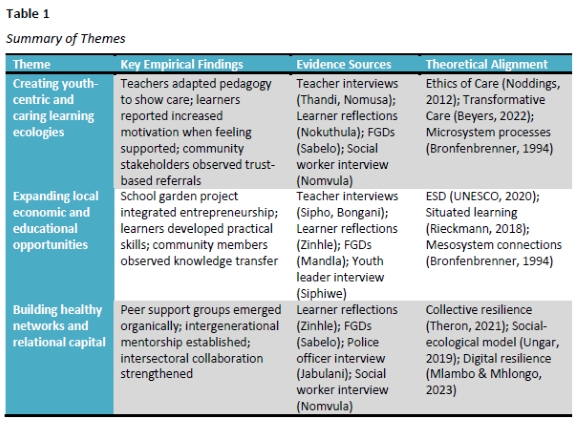
Synthesising the above themes (see summary in Table 1) reveals a model of transformative resilience that goes beyond coping with adversity to reshaping the social and educational structures that produce it. Within this model, sustainable learning for vulnerable learners emerges from the interaction of three interdependent systems:
• Relational systems (care and connection).
• Structural systems (economic and educational opportunity).
• Ecological systems (community and environmental sustainability).
This integrated model extends the traditional notion of resilience, which focuses on individual persistence, to a systemic and collective process of adaptation and transformation (Theron & Donald, 2023; Ungar, 2021). The findings affirm that resilience-building initiatives must simultaneously address psychosocial, pedagogical, and socioeconomic dimensions.
Furthermore, the study confirms the synergy between resilience and ESD. When learning environments embed values of collaboration, equity, and ecological consciousness, they cultivate not only competent learners but active sustainability citizens (UNESCO, 2020). In this regard, resilience functions as both a means and an outcome of sustainable education-a dynamic process that strengthens learners' capacity to thrive while contributing to the resilience of their communities.
Importantly, the participatory nature of this research enabled these findings to emerge from the community's own understandings and priorities. The PAR process itself contributed to building the relational capital described in Theme 3, as co-researchers developed trust and collaborative relationships through their work together. This methodological insight reinforces the substantive finding that resilience is not delivered to communities but co-constructed with them.
Ultimately, the Building Resilience for Sustainable Learning project illustrates that vulnerability is not destiny. Through caring ecologies, contextually grounded learning opportunities, and strong relational networks, rural schools can become sites of transformation-not merely spaces of survival, but ecosystems of sustainable growth.
Conclusion and Implications
This study has examined how resilience can be intentionally cultivated to promote sustainable learning among vulnerable learners in South African schools. Drawing on the case study of the Building Resilience for Sustainable Learning project in rural KwaZulu-Natal, the findings reaffirm that resilience is not merely an individual trait but a dynamic and relational process embedded within social, cultural, and institutional systems. By foregrounding the experiences of learners, educators, and community members, this research highlights the crucial role of contextually grounded, caring, and participatory educational ecologies in fostering the psychosocial competence and academic engagement of vulnerable learners.
At its core, the study demonstrates that resilience and sustainability are mutually reinforcing. Schools that nurture relational care, provide meaningful learning linked to local opportunity, and facilitate cross-sectoral collaboration build both the capacity to adapt and the capacity to endure. Resilience, in this sense, is transformative; it equips learners and communities not only to survive adversity but also to co-create new pathways of possibility. The findings thus expand existing understandings of resilience by situating it within the socio-ecological and ethical frameworks of care, equity, and sustainability (Theron & Donald, 2023; UNESCO, 2020; Ungar, 2021).
Educational Implications
The implications for educational practice are multifaceted. First, the findings call for a paradigm shift from deficit-focused to strength-based pedagogies. Rather than pathologising vulnerability, educators should identify and build upon learners' existing competencies, cultural assets, and community knowledge. Integrating life skills education, social and emotional learning, and ESD into the curriculum can help learners cultivate adaptive capacities such as self-regulation, collaboration, and problem-solving (Naudé & Meier, 2021; UNESCO, 2020).
Second, teacher education programmes should include explicit training in trauma-informed and caring pedagogies, preparing educators to respond empathetically to the psychosocial realities of learners in under-resourced contexts (Beyers, 2022; Mampane, 2020). Teachers who understand the relational dimensions of learning are better positioned to create inclusive classrooms where learners feel safe, valued, and capable of growth. As this study revealed, consistent yet straightforward acts of care, such as listening, validating emotions, and maintaining flexible expectations, significantly enhance learners' motivation and resilience.
Third, schools should institutionalise peer-support and mentorship programmes, capitalising on the power of relational networks to sustain learner engagement. Structured peer tutoring, student leadership initiatives, and intergenerational mentoring can provide psychosocial scaffolding that extends learning beyond the classroom (Theron & Liebenberg, 2023). These networks, both face-to-face and digital, serve as vital social capital that reinforces a sense of belonging and resilience, particularly for learners navigating poverty, disability, or family instability.
Policy Implications
At policy level, the findings highlight the need for integrated, multi-sectoral approaches to supporting vulnerable learners. Education policy must align with social development, health, and community-based initiatives to address the structural roots of vulnerability such as food insecurity, gender inequality, and mental health stigma. The DBE's (2014) Policy on Screening, Identification, Assessment, and Support provides a foundation for such collaboration; however, implementation requires sustained capacity-building, resource allocation, and community engagement.
Policies should also prioritise contextual flexibility; rural and township schools must have autonomy to design locally relevant interventions that draw on Indigenous knowledge systems, community partnerships, and environmental sustainability practices (Mukonza & Nkuna, 2022). National and provincial education frameworks should therefore recognise resilience-building not as an "add-on" programme but as a core educational outcome linked to learner well-being, academic achievement, and long-term social sustainability.
Furthermore, in the wake of technological disruption and climate uncertainty, educational policy should promote digital and ecological resilience. Access to affordable internet, digital literacy, and green learning environments must be considered essential components of equitable education (Mahaye, 2024; Mlambo & Mhlongo, 2023). These investments ensure that learners not only survive systemic shocks but also acquire the skills to thrive in a rapidly changing world.
Research Implications
From a research perspective, this study underscores the value of participatory and context-sensitive methodologies. The combination of focus group dialogues and reflective writing enabled authentic expressions of voice, emotion, and agency-dimensions that are often absent in quantitative studies of resilience. Future research should continue to prioritise learner-centred and community-engaged approaches, exploring how resilience is locally conceptualised and enacted within diverse South African contexts.
There is also a need for longitudinal studies examining how school-based resilience initiatives influence learners' life trajectories, employability, and community participation over time. Additionally, comparative studies across provinces and between rural and urban schools could reveal how socioeconomic and cultural factors shape resilience processes differently. Ultimately, interdisciplinary research that integrates psychology, education, and sustainability science would deepen our understanding of how psychosocial competence interacts with ecological and systemic resilience.
Practical Applications for Educators
Based on the findings, educators can implement concrete strategies in their classrooms and schools as summarised in Table 2.
Policy Implementation Recommendations
For policymakers at district, provincial, and national levels, the following actionable steps are recommended:
• Integrate resilience indicators into school monitoring frameworks alongside academic performance metrics.
• Allocate dedicated funding for school-based psychosocial support including counsellors, social workers, and nurse visits.
• Mandate trauma-informed practice training in all teacher professional development programmes.
• Establish intersectoral referral protocols between DBE, Department of Social Development, and Department of Health.
• Support school-community partnership models through small grants and recognition programmes.
• Invest in digital infrastructure for rural schools including devices, connectivity, and digital literacy training.
• Review curriculum to explicitly include resilience competencies (self-awareness, emotional regulation, problem-solving) across subjects.
Concluding Reflections
In conclusion, this study affirms that building resilience for sustainable learning is not a peripheral concern but a central educational imperative in South Africa's journey toward equity and social justice. Vulnerable learners, far from being passive recipients of aid, are active agents of change when supported through caring, connected, and opportunity-rich learning ecologies. By embedding resilience within the broader pursuit of sustainability, educators and policymakers can transform schools into living ecosystems of hope, where learners not only recover from adversity but also cultivate the skills, values, and relationships necessary to shape a more just and sustainable society.
As the Building Resilience for Sustainable Learning project demonstrates, sustainable education begins with the conviction that every learner, regardless of circumstance, possesses the capacity to thrive. The task of the education system, therefore, is to nurture that capacity patiently, contextually, and collectively until resilience becomes not an exception, but the norm of learning in South Africa's schools.
References
Literature Review
- Bergold, J., & Thomas, S. (2019). Participatory research methods: A methodological approach in motion. Forum: Qualitative Social Research, 13(1). https://doi.org/10.17169/fqs-13.L1801
- Beyers, C. (2022). Transformative care and education: Reimagining pedagogy for social justice in South Africa. Routledge.
- Botha, A., & van Niekerk, A. (2022). The role of caring relationships in fostering resilience in South African classrooms. South African Journal of Education, 42(2), 1-10. https://doi.org/10.15700/saje.v42n2a2045
- Braun, V., & Clarke, V. (2019). Reflecting on reflexive thematic analysis. Qualitative Research in Sport, Exercise and Health, 11(4), 589-597. https://doi.org/10.1080/2159676X.2019.1628806
- Bronfenbrenner, U. (1994). Ecological models of human development. In T. Husen & T. N. Postlethwaite (Eds.), International encyclopedia of education (2nd ed., pp. 1643-1647). Pergamon Press.
- Department of Basic Education. (2014). Policy on screening, identification, assessment and support (SIAS). https://wcedeportal.co.za/eresource/214311
- Department of Basic Education. (2019). Report on the implementation of education for sustainable development in South African schools. https://www.education.gov.za/
- Donald, D., Lazarus, S., & Moolla, N. (2022). Educational psychology in social context: Ecosystemic applications in Southern Africa (7th ed.). Oxford University Press.
- Freire, P. (1970). Pedagogy of the oppressed. Continuum.
- Gilligan, C. (2014). Moral injury and the ethics of care: Reframing the conversation about differences. Journal of Social Philosophy, 45(1), 89-106. https://doi.org/10.1111/josp.12057
- Glover, D., & Kusterer, K. (2016). Small farmers, big business: Contract farming and rural development. Palgrave Macmillan.
- Johnson, V., & Winthrop, R. (2022). Transforming education for holistic student development: Learning from education systems. Brookings Institution.
- Kemmis, S., McTaggart, R., & Nixon, R. (2014). The action research planner: Doing critical participatory action research. Springer.
- Kindon, S., Pain, R., & Kesby, M. (Eds.). (2007). Participatory action research approaches and methods: Connecting people, participation and place. Routledge.
- Lincoln, Y. S., & Guba, E. G. (1985). Naturalistic inquiry. SAGE.
- Masten, A. S. (2021). Resilience in development: Progress and transformation. In D. Cicchetti (Ed.), Developmental psychopathology (3rd ed., pp. 271-333). Wiley.
- Mlambo, P., & Mhlongo, M. (2023). Digital resilience and equity in post-pandemic schooling. South African Journal of Childhood Education, 13(1), 78-94. https://doi.org/10.4102/sajce.v13i1.1253
- Noddings, N. (2012). The ethics of care: Personal, political, and global. University of California Press.
- Rieckmann, M. (2018). Learning to transform the world: Key competencies in education for sustainable development. In A. Leicht, J. Heiss, & W. J. Byun (Eds.), Issues and trends in education for sustainable development (pp. 39-59). UNESCO.
- Spaull, N., & Jansen, J. (Eds.). (2019). South African schooling: The enigma of inequality. Springer.
- Theron, L. C., & Donald, D. (2023). Resilience and education in South Africa: Systemic perspectives. HSRC Press.
- Theron, L. C., & Liebenberg, L. (2023). The relational ecology of resilience in youth. Journal of Adolescent Research, 38(4), 391-410. https://doi.org/10.1177/07435584211040242
- Twum-Antwi, A., Jefferies, P., & Ungar, M. (2020). Promoting child and youth resilience through social networks. Child Indicators Research, 13(5), 1743-1763. https://doi.org/10.1007/s12187-020-09717-7
- UNESCO. (2020). Education for sustainable development: A roadmap. https://unesdoc.unesco.org/ark:/48223/pf0000374802