Teachers as Street-Level Bureaucrats: A Qualitative Study of Leadership Impacts on Academisation in Lagos TVET Institutions
Abstract
Technical and vocational education and training (TVET) systems across the Global South are increasingly pressured to adopt academic-style curricula, standardised assessments, and certification frameworks, a process known as academisation. However, little is known about how frontline TVET teachers navigate these pressures in resource-constrained settings. This qualitative case study investigates how 13 TVET teachers in Lagos, Nigeria, respond to leadership directives that prioritise theory, paperwork, and examination coverage over practical, hands-on training. Framed by Lipsky's theory of street-level bureaucracy, the study draws on semi-structured interviews across three public technical colleges. This study found that teachers routinely face conflicting directives and exercise discretionary power through a continuum of strategies: rhetorical balance, quiet non-compliance, material improvisation, personal financial sacrifice, unpaid overtime, and subversion of timetables. Leadership pressures around certification systematically exclude struggling students, compelling teachers to provide uncompensated remedial support and engage in quiet accommodations such as lenient marking or oral assessments. It can be concluded that TVET teachers in Lagos are classic street-level bureaucrats whose discretionary practices are symptoms of systemic abandonment rather than professional agency. Repoliticising TVET teaching requires recognising teacher discretion as a resource for system improvement, addressing material constraints, and centring frontline voices in policy design.
TVET Leadership; Academisation; Teacher Agency; Street-Level Bureaucracy; Lagos; Nigeria
Introduction
Across diverse international contexts, technical and vocational education and training (TVET) systems are undergoing profound transformation as policymakers seek to elevate the status and academic standing of vocational qualifications. This process, variously termed academisation, tertiarisation, or academic drift, refers to the progressive integration of vocational education into higher education frameworks (Bartholomew et al., 2025b; Gonon et al., 2025). It is characterised by the adoption of academic curricula, research expectations, and university-aligned governance structures (Kaiser, 2025). While proponents argue that academisation enhances the prestige and portability of vocational qualifications, critics contend that it systematically devalues the practical, work-based knowledge that has historically constituted TVET's distinctive contribution to skills development (Misselke, 2022; Winch & Burgess, 2024). Within this contested terrain, TVET teachers occupy a uniquely precarious position; they are simultaneously expected to implement top-down policy reforms and to exercise professional discretion in responding to students' diverse learning needs (Okolie et al., 2021). Yet, despite growing attention to the structural dimensions of academisation, the lived experiences of TVET teachers, particularly how they navigate, resist, or accommodate these policy pressure, remain critically underexamined (Okolie et al., 2021).
This silence is especially pronounced in the Global South, where TVET systems are often shaped by imported policy frameworks that bear limited relation to local labour markets, cultural contexts, and institutional capacities (Lepholisa & Yu, 2025; Majola et al., 2026). In Nigeria, the recent push to integrate Lagos State TVET colleges into broader higher education architectures exemplifies this tension (Ojo, 2014; Shefiu et al., 2023). Drawing on international models such as competency-based education and national qualifications frameworks (Jinadu & Bello, 2025; Oviawe & Anetekhai, 2020), Nigerian policymakers have sought to modernise vocational provision by emphasising standardised curricula, measurable learning outcomes, and enhanced academic credentials (Bartholomew et al., 2025a; Oladipupo et al., 2024). However, these reforms collide with the material realities of Lagos's informal economy, where many graduates seek work, and with the pedagogical practices of TVET teachers who possess deep vocational expertise but limited formal academic qualifications (Chee Sern et al., 2018). This disjuncture between policy aspiration and on-the-ground implementation raises some critical questions:
• How do teachers respond to leadership directives that prioritise academic-style certification and theory coverage over students' practical learning needs?
• What strategies do teachers use to preserve practical, hands-on training when systemic constraints and academisation pressures (standardised curricula, written examinations, credentialing requirements) limit their resources and autonomy?
• How do leadership pressures around examination pass rates and certification outcomes affect teachers' capacity to support academically struggling and linguistically disadvantaged students?
By centring teachers as active agents in policy implementation rather than passive recipients of reform, this study challenges dominant narratives that frame TVET teachers as obstacles to modernisation. Instead, it argues that teachers' discretionary practices constitute a form of street-level resistance, a necessary adaptation to policies that, however well-intentioned, fail to account for the complexities of vocational pedagogy in resource-constrained, culturally diverse, and economically precarious contexts. In doing so, the study contributes to emerging scholarship on the politics of TVET reform in the Global South, offering three theoretical extensions to street-level bureaucracy theory and an empirically grounded typology of teacher discretionary practices.
The Global Academisation Debate in TVET
Academisation which is also termed "tertiarisation" or "academic drift," refers to the progressive integration of vocational education into higher education frameworks (Gonon et al., 2025). This process manifests through three mechanisms: (1) curriculum standardisation that emphasises theoretical knowledge over practical skills, (2) assessment reforms that prioritise written examinations over competency demonstrations; and (3) governance structures that mimic university models (Winch & Burgess, 2024). In European contexts, research has documented how formerly distinct vocational pathways have been absorbed into higher education systems, often with the effect of displacing craft knowledge in favour of abstract, propositional knowledge (Gonon et al., 2025; Nylund & Virolainen, 2019).
Mechanisms of Academisation: From Policy to Practice
Academisation is not a monolithic event but a set of policy instruments that reshape teachers' work. Three mechanisms are particularly relevant to the Lagos context. First, the introduction of national qualifications frameworks (e.g. Nigerian Skills Qualification Framework [NSQF]; National Board for Technical Education [NBTE], 2020) shifts attention from process (learning by doing) to outcomes (measurable, documentable competencies). This requires teachers to spend time on paperwork, portfolio assessment, and external moderation-activities that are academic in nature. Second, standardised written examinations (e.g. National Business and Technical Examinations Board [NABTEB]) privilege literacy and theoretical knowledge over practical demonstration. When pass rates become the primary accountability metric, teachers are incentivised to cover the syllabus rather than ensure skill mastery. Third, quality assurance frameworks that mimic university inspection models prioritise documented evidence (lesson plans, logbooks, assessment records) over observation of teaching practice. These three mechanisms collectively constitute the academisation pressure that teachers experience. The present study examines how these mechanisms play out in Lagos TVET institutions.
Policy Borrowing and Neoliberal Conditionality
Nigeria's adoption of the NSQF and competency-based curricula reflects broader patterns of policy borrowing from the United Kingdom and Australia (Jinadu & Bello, 2025). The NSQF was explicitly modelled on the UK's Qualifications and Credit Framework and Australia's Australian Qualifications Framework. This borrowing occurred under structural adjustment conditions; international financial institutions, including the World Bank and UNESCO, have conditioned educational funding on the adoption of competency-based, outcomes-framed curricula (Allais & Marock, 2024). As Majola et al. (2026) argue, such policy lending often ignores local labour market realities, an informal economy where approximately 80% of workers are employed and where certificates matter less than demonstrated skill.
The Nigerian Policy Landscapes
The case under study is defined by three interlocking policy instruments. First, the NSQF, adopted in 2015 and revised in 2020, establishes eight levels of vocational qualifications aligned with the national education system (NBTE, 2020). The NSQF requires TVET institutions to document learning outcomes, maintain assessment portfolios, and submit to external moderation-all of which increase bureaucratic workload for teachers without corresponding increases in resources.
Second, the NABTEB conducts standardised written and practical examinations for TVET students. While NABTEB includes practical components, teachers consistently reported that leadership pressures focused almost exclusively on written examination pass rates, which are publicly reported and tied to institutional funding (Osagie, 2026). Third, the Lagos State TVET Quality Assurance Framework mandates regular inspection visits, during which inspectors review lesson plans, assessment records, and syllabus coverage. These three instruments (NSQF, NABTEB, and the Quality Assurance Framework) constitute the formal policy environment. Together, they shift institutional attention toward measurable outputs (certificates, pass rates, completed logbooks) and away from process outcomes (student skill acquisition, pedagogical quality). Understanding this architecture is essential for grasping why teachers experience academisation pressures even in the absence of formal university alignment.
Teacher Discretion Under Pressure
Lipsky (1980, 2010) theorised that frontline workers, known as street-level bureaucrats, develop coping mechanisms when policy demands exceed available resources. Teachers, police officers, and social workers routinely exercise discretion to align policy with client realities. In TVET contexts, research from South Africa (Majola et al., 2024), Europe (Gonon et al., 2025), and China (Bailey et al., 2024) confirms that teachers exercise discretion through improvisation, selective compliance, and unpaid labour. However, the extent to which such discretion is possible depends critically on leadership practices-a dimension Lipsky left underspecified. This study therefore investigates not only whether Lagos TVET teachers exercise discretion but under what leadership conditions such discretion becomes feasible, visible, or transgressive, and how these discretionary acts simultaneously resist and reveal the mechanisms of academisation.
Theoretical Framework
Building on the street-level bureaucracy framework (Lipsky, 1980, 2010), this study makes three theoretical extensions. First, it examines how institutional leadership-including principals, department heads, and quality assurance officers-conditions the scope of frontline discretion (Abdullahi & Abubakar, 2024; Adewale, 2022). Second, it draws on Bernstein's (1996) pedagogic code theory to analyse how weakened boundaries (classification) between academic and vocational knowledge shape teachers' capacity for context-responsive practice (Guthrie et al., 2009; Nylund & Virolainen, 2019). Third, it incorporates Schmid and Garrels' (2022) concept of structural oppression, the systemic de-professionalisation of TVET teachers through neoliberal reforms, to argue that teachers' discretionary practices are not merely individual coping strategies but collective responses to institutional powerlessness.
Finally, the study draws on Freire's (1970) critique of banking pedagogy-the model in which students are treated as empty vessels to be filled with abstract, examinable content. While Freire wrote primarily about adult literacy, his framework applies directly to TVET contexts where practical, dialogical, problem-posing instruction is systematically subordinated to rote learning and examination preparation (Majola & Majola, 2025). Banking pedagogy in TVET reproduces, rather than reduces, educational inequality by privileging students who are already literate and confident.
In addition to these theoretical extensions, this study offers an empirical contribution: a descriptive typology of discretionary practices in TVET, comprising strategic accommodation (surface compliance with hidden resistance), material improvisation (substituting missing tools), temporal subversion (reallocating teaching time), and assessment adaptation (modifying evaluation methods). These categories are empirically grounded but provisional; they require validation in other contexts. By applying this framework to Lagos, the study contributes to comparative understandings of how TVET teachers worldwide navigate the contradictory demands of academisation. By centring teachers as active agents in policy implementation rather than passive recipients of reform, this study challenges dominant narratives that frame TVET teachers as obstacles to modernisation.
Methodology
Research Design and Theoretical Orientation
This study adopts a qualitative case study design, informed by Lipsky's (1980, 2010) theory of street-level bureaucracy and Bernstein's (1996) pedagogic code theory. The design is rooted in an interpretive paradigm, which prioritises understanding how TVET teachers in Lagos make sense of, respond to, and occasionally resist academisation policies in their daily practice. Rather than testing causal hypotheses, the research seeks to capture the situated, relational, and context-dependent nature of policy implementation-recognising that teachers' discretionary decisions are shaped by the interplay of structural constraints, institutional cultures, and professional values (Majola et al., 2026; Schmidt, 2020).
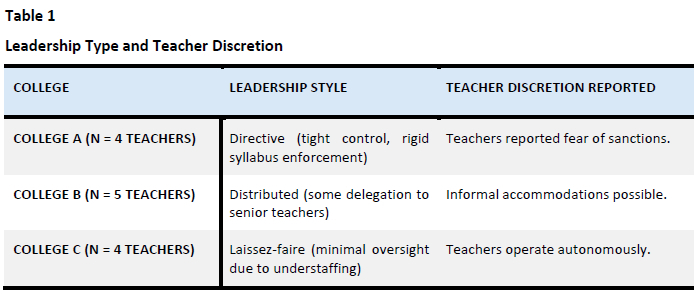
A case study approach was selected for its capacity to illuminate the complexity of real-world institutional settings. As Pilz and Li (2020) argue, comparative and context-sensitive case designs enable researchers to examine how policy reforms are mediated by local histories, resource configurations, and power relations. The case in this study is defined as the implementation of academisation policies across three public technical colleges in Lagos State, with particular analytical attention to the micro-interactions between teachers and their institutional leaders. This bounded system allowed for in-depth exploration of how different leadership styles (directive, distributed, or laissez-faire, see Table 1) influence teachers' capacity to exercise professional discretion in response to standardised curricula, competency-based assessment, and academic credentialing requirements (Hordern, 2020).
Trustworthiness and Rigour
To ensure methodological rigour, the study adopted established qualitative quality criteria. Credibility was enhanced through prolonged engagement, member checking, and triangulation across data sources. Interview data were triangulated with documentary analysis (college handbooks, quality assurance manuals) to understand formal expectations, and with observational field notes (used solely for contextual thick description, not as primary evidence). No observational data are presented as findings; they enriched interpretation only. Dependability was supported through a transparent audit trail documenting coding decisions and theme development. Confirmability was strengthened through reflexive journaling and peer debriefing with an experienced TVET practitioner. Transferability was addressed through thick description of the research context, allowing readers to assess applicability to similar settings.
Research Participants and Setting
This study was conducted in three public technical colleges located in different administrative zones of Lagos State. These colleges were purposively selected to capture variation in institutional history, leadership tenure, and student demographics. Each college offers NABTEB programmes as well as trade-based certifications in fields such as electrical installation, welding, plumbing, hospitality, and information technology. Across the three sites, approximately 120 TVET teachers are employed, of whom 13 participated in this study.
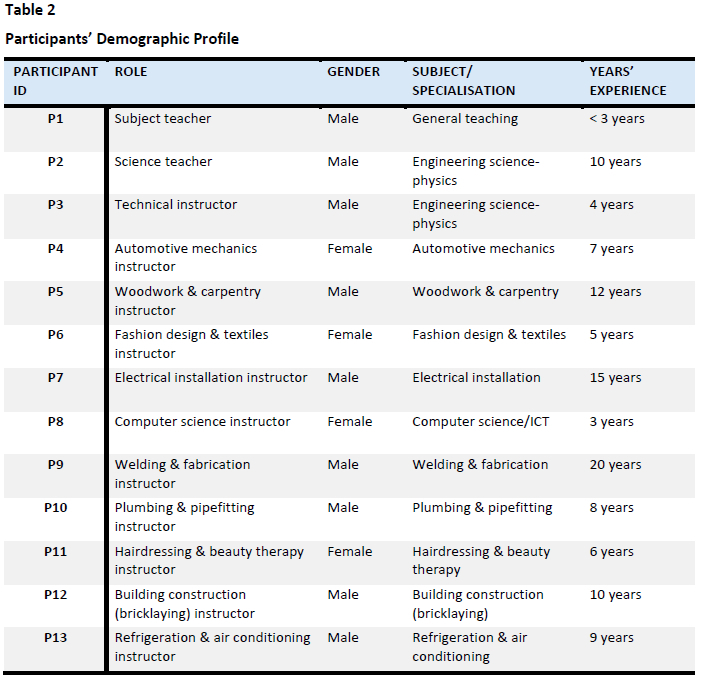
Inclusion criteria required that teachers had at least two years of experience in the Lagos TVET sector and had been exposed to at least one major curriculum or assessment reform associated with academisation (e.g. introduction of national qualifications framework levels, competency-based curricula, or external moderation requirements). The final sample as shown in Table 2 comprised 13 teachers (nine men, four women), consistent with the participant identifiers (P1-P13) used throughout the findings. Participants' teaching experience ranged from four to 22 years, and their qualifications included trade certificates, National Diplomas, and, in a few cases, bachelor's degrees in technical education. This heterogeneity enabled the study to explore not only frontline discretion but also how teachers who occupy hybrid roles navigate between compliance and advocacy.
Data Generation Methods
Data generation unfolded over a three-month period (January-March 2026) and employed three complementary methods: semi-structured individual interviews, documentary analysis of institutional policies, and informal observational notes from college visits. Semi-structured interviews were conducted with each of the 13 teachers, lasting between 60 and 90 minutes. Interviews were guided by an open-ended protocol that explored: (1) teachers' understanding of recent policy changes (curriculum standardisation, assessment reforms, quality assurance requirements), (2) their daily experiences of implementing these policies, (3) instances where they exercised discretion to adapt, resist, or modify policy directives, (4) their perceptions of leadership support or constraint, and (5) the emotional and professional costs of navigating competing demands. Interviews were conducted in a mixture of English and Pidgin English, depending on participant preference, and were audio-recorded with informed consent.
Documentary analysis supplemented the interview data. The following documents were collected and analysed:
• National Policy on Education (Federal Republic of Nigeria, 2013 edition, relevant sections on TVET).
• Operational manual NSQF (NBTE, 2024)
• NABTEB Syllabus and Examination Guidelines for each trade represented in the sample.
• Lagos State Ministry of Education Quality Assurance Manual (2022).
This documentary analysis served two purposes: to trace the origins and rationales of academisation reforms in Nigeria, and to identify gaps between policy rhetoric (e.g. "TVET shall emphasise practical skills") and on-the-ground implementation (e.g. inspection checklists that contain no practical observation items).
Observational notes were compiled during visits to each college. The study did not conduct systematic classroom observation due to access constraints. Instead, the researcher recorded brief field notes on the physical environment, staffroom interactions, and informal conversations with teachers before or after interviews. These notes were used solely for contextual thick description and were not systematically coded or analysed as primary data. Interviews were transcribed verbatim. Transcripts were returned to participants for member checking to clarify meanings or withdraw any statement they felt uncomfortable with.
Researcher Positionality and Reflexivity
As a Nigerian researcher with prior experience in educational policy analysis but no direct employment history within Lagos TVET colleges, first author occupied a position of what (Pilz & Li, 2020) term the insider-outsider third space. First author is familiar with the broader socio-political context of Nigerian education-the chronic underfunding, the prestige hierarchy favouring university education over vocational training, and the everyday realities of urban poverty in Lagos. However, he was not a TVET teacher or administrator and thus lacked direct experiential knowledge of the micropolitics of college life. This positioning offered both advantages and challenges. On one hand, teachers were willing to speak candidly about institutional failures and leadership shortcomings, perhaps because they did not perceive him as a threat to their employment. On the other hand, there was risk of misunderstanding the tacit knowledge, unwritten rules, and embodied practices that constitute vocational pedagogy (Bailey et al., 2024).
To mitigate this, we adopted a stance of reflexive humility. Before each interview, we disclosed his outsider status explicitly, inviting teachers to correct our assumptions and to treat us as a learner. During analysis, we engaged in peer debriefing with a colleague who has worked as a TVET administrator in Lagos, testing our interpretations against the practical knowledge. We also maintained a reflexive journal throughout data collection and analysis, documenting moments of surprise, discomfort, or emerging bias. For example, an early entry noted our tendency to assume that teachers would uniformly resist academisation; subsequent interviews revealed more important positions, with some teachers valuing the status and recognition that academic credentials conferred. These reflexive notes were systematically incorporated into the analytic process.
Data Analysis
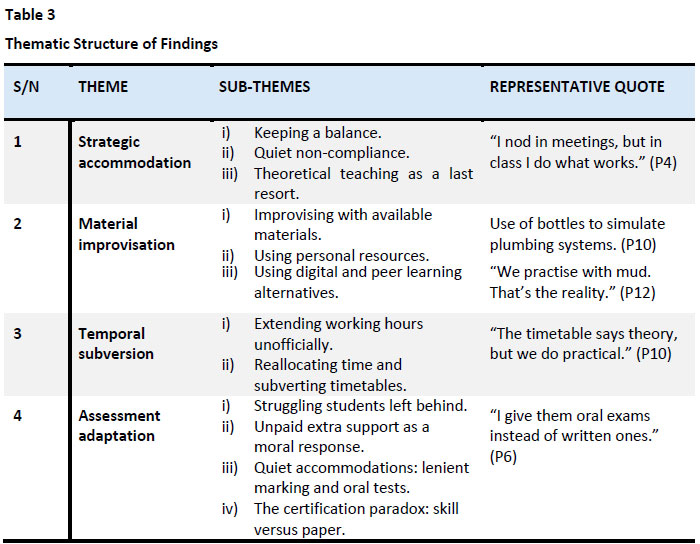
Data were analysed through a hybrid process of inductive thematic analysis and theory-driven coding, using NVivo 14 software. The analysis proceeded in five phases. First, interview transcripts and field notes were read repeatedly to achieve familiarisation. Second, open coding was conducted to identify emergent patterns, concerns, and tensions in teachers' accounts. These initial codes were then organised into candidate themes using constant comparison across participants and colleges. Third, themes were refined, renamed, and validated through a feedback session with four participating teachers who were invited to comment on a preliminary findings' summary. Their feedback led to the renaming of one theme to "strategic accommodation." Fourth, four major themes were identified: (1) strategic accommodation, (2) material improvisation, (3) temporal subversion, and (4) assessment adaptation. Fifth, a second round of coding was conducted to ensure all data were captured within these themes.
Ethical Considerations
Gatekeeper permission was secured from the Lagos State Ministry of Education and from the principals of each participating college. Given the sensitivity of discussing leadership practices and institutional shortcomings, special attention was paid to confidentiality and non-retaliation. All participants provided written informed consent after receiving a detailed information sheet. The information sheet explicitly stated that participation was voluntary, that refusal would carry no consequences, and that teachers could withdraw at any point without providing a reason. Alpha-numeric labelling was used to replace the participants' names (P1, P2 . . . P13). Additionally, interview recordings and transcripts are stored on a password-protected server, accessible only to the research team. Data will be destroyed five years after project completion.
Findings
This section presents the findings from interviews with 13 TVET teachers across three technical colleges in Lagos, Nigeria. Rather than organising the findings by research question, we present the four themes that emerged from inductive thematic analysis (see Table 3 for the thematic structure). These themes (strategic accommodation, material improvisation, temporal subversion, and assessment adaptation) capture the daily realities of street-level bureaucrats navigating resource scarcity, conflicting leadership mandates, and the pressures of certification. Each theme along with sub-themes is illustrated with representative quotes and together, they answer the study's three research questions.
Theme 1: Strategic Accommodation
Teachers in this study routinely faced directives from school leadership that prioritised theory, paperwork, and examination coverage over hands-on practical training. Their responses ranged from quiet negotiation to outright disregard of mandates, reflecting the discretionary power characteristic of street-level bureaucrats.
Keeping a Balance
Many teachers described their response to conflicting directives using the metaphor of balance. This framing allowed them to maintain professional self-respect while subtly resisting managerial impositions. One participant explained:
I simply keep a balance between management instructions and the right objectives needed to meet for students to be better. (P1, male subject teacher)
Similarly, another teacher stated:
It's always about keeping a balance, keeping that balance is important, obeying management instructions and preserving the quality of one's personality and profession is the balance. (P3, male technical instructor)
However, this language of balance often concealed more active forms of resistance. Teachers spoke of nodding in meetings while doing the opposite in their classrooms. A female automotive instructor captured this duality:
I nod in meetings, but in class I do what works. For example, they wanted us to use only English manuals. My students don't understand English well, so I translate into Pidgin and Yoruba during practical. (P4)
Quiet Non-Compliance and Outright Disregard
When directives were perceived as directly harmful to student learning, several teachers reported ignoring them entirely. One participant described a mandate to spend 80% of class time on theory in preparation for exams:
They said we must spend 80% of time on theory for exams. I ignored that. I spent 70% on practical. If I followed their rule, my students would leave without any skill. (P4)
Another teacher, working in electrical installation, recounted how he circumvented a ban on practicals during the rainy season:
They said "no practicals in the rainy season" because the workshop roof leaks. I moved practicals to the corridor. I didn't ask permission. (P7)
In some cases, teachers substituted missing materials with whatever was available, turning constraint into improvisation. A physics teacher explained:
In this case, we have to improvise. For example, we needed a 3.0V battery for practical and it was not provided, we have to get two 1.5V tiger head batteries. (P2)
Theoretical Teaching as a Last Resort
Not all teachers could resist. Some described circumstances where they had no choice but to abandon practical work entirely. A male science teacher admitted:
Yes. Lesson must continue and I have to teach theoretically. (P2)
This admission reveals the limits of teacher discretion: when resources are entirely absent and leadership is unyielding, the only option is to simulate practice through theory - a hollow substitute that teachers themselves recognise as inadequate.
Theme 2: Material Improvisation
Faced with chronic shortages of tools, consumables, and functional equipment, teachers developed a repertoire of creative strategies to keep practical training alive. These strategies ranged from personal financial sacrifice to pedagogical improvisation, and from extended working hours to the use of digital alternatives.
Improvising With Available Materials
The most common strategy was improvisation-substituting missing or broken equipment with everyday items. A plumbing instructor described how he simulates water flow:
I use bottles and hoses to simulate water flow. It's not real, but it's better than nothing. I also draw diagrams on the floor. (P10)
A bricklaying teacher, lacking cement and blocks, resorted to mud:
No cement. No blocks. We practise with mud. That's the reality. Students learn to lay mud blocks, not real ones. That's not useful on a real site. (P12)
Despite the obvious limitations, these improvisations represented teachers' determination to provide some form of hands-on experience. A computer science instructor turned to students' personal devices:
I let students use their phones. Many have smartphones. We code using online compilers. Management doesn't like phones in class, but I tell them it's educational. (P8)
These practices exemplify material improvisation, where teachers actively reconstruct the learning environment to compensate for systemic resource deficits.
Using Personal Resources
Many teachers subsidised the system from their own pockets. An electrical instructor stated simply:
I bring my own tools from home. (P7)
A welding teacher added:
I bring scrap metal from home. I also let students practise in pairs to share electrodes. That's not ideal, but it's something. (P9)
In more extreme cases, teachers purchased consumables directly from local markets, sometimes without reimbursement:
I buy cement from the local store and get reimbursed later. Sometimes they refuse to pay. (P12)
These acts of personal sacrifice were common but rarely acknowledged by management. One participant observed that teachers are:
Mechanics, electricians, and counsellors all in one. We buy tools with our own money. (P4)
Using Digital and Peer-Learning Alternatives
Where physical resources were entirely absent, teachers turned to digital tools. A hairdressing instructor explained:
I use YouTube videos to show techniques. I also invite former students who now own salons to speak. Management doesn't like visitors, but I invite them anyway. (P11)
Peer learning also featured prominently. Students who had access to smartphones or had previous informal training were often enlisted to demonstrate skills to their classmates. This horizontal knowledge sharing compensated, in part, for the lack of qualified instructors and functional equipment.
Theme 3: Temporal Subversion
Several teachers reported staying after official hours or coming in on weekends to provide additional practical sessions for struggling students. This unpaid labour was framed as a moral obligation rather than a professional requirement:
I sometimes stay after hours with weak students. No one pays me for that. (P5)
I come on Sundays for the weakest ones. No one pays me. (P11)
A refrigeration instructor described how he kept the workshop open secretly:
I closed the door and told students not to make noise. That's how we survive. (P13)
Reallocating Time and Subverting Timetables
Another strategy was the quiet reallocation of theory periods to practical work. Teachers manipulated official timetables to create space for hands-on learning:
The timetable says theory, but we do practical. (P10)
This form of everyday resistance required minimal confrontation but maximal discretion. Teachers became adept at hiding their practical sessions from supervisory visits, often moving classes to corridors, outdoor spaces, or empty rooms.
Theme 4: Assessment Adaptation
Leadership in Lagos TVET institutions was consistently described as prioritising examination pass rates and certification outcomes over the learning needs of individual students, particularly those who were academically weak or linguistically disadvantaged. This created a persistent tension for teachers who felt a professional and ethical obligation to support struggling learners.
Struggling Students Left Behind
The most frequent complaint was that the pace of instruction-driven by exam syllabi and leadership demands to cover content-systematically excluded weaker students. A female automotive instructor explained:
Struggling students need extra time and more practical exposure. But leadership rushes us to finish the syllabus for exams. So weak students are left behind. That is not justice. (P4)
A science teacher confirmed this observation:
Students don't get the much knowledge required for their certification. (P2)
The problem was compounded by the fact that many students entered TVET with low English proficiency. Teachers noted that exam-oriented teaching assumed a level of literacy that many learners simply did not possess:
The only challenge is their lingual incompetence, it's difficult for them to understand English language such that it's affecting their interest. (P3)
When students cannot understand instructions, rushing through the syllabus only deepens their alienation. Yet leadership pressures left teachers with little room to slow down or provide remedial support within official hours.
Unpaid Extra Support as a Moral Response
In response to this systemic neglect, many teachers took it upon themselves to provide additional support outside of formal teaching time. This labour was entirely uncompensated and often unrecognised:
I sometimes stay after hours with weak students. No one pays me for that. (P5)
Struggling students need more time on live circuits. But exams mean we rush. I stay back on Saturdays for free. No one thanks me. (P7)
A hairdressing teacher described an even more intensive commitment:
Struggling students need one-on-one attention. But exams force group teaching. I sometimes come on Sundays for the weakest ones. No one pays me. But I do it. (P11)
These testimonies reveal a profound sense of professional conscience that persists despite institutional indifference. Teachers framed their extra support not as a choice but as a necessity, a quiet rebellion against a system that measures success only by pass rates.
Quiet Accommodations
Some teachers developed strategies to help struggling students progress without formally failing them. These accommodations were justified as pragmatic responses to impossible conditions:
I sometimes mark them leniently to keep them moving. That's my quiet compromise. (P10)
I give them oral exams instead of written ones. That's my quiet rebellion. (P6)
A refrigeration teacher adopted a similar approach:
I give them oral practical tests instead of written ones. That's my workaround. (P13)
These practices allowed teachers to maintain a veneer of compliance with examination requirements while assessing students in ways that were more accessible and less punitive. However, they also raised ethical questions about the validity of certification, questions that teachers themselves acknowledged but felt powerless to resolve.
The Certification Paradox
Teachers universally agreed that practical skill was more valuable for students' futures than a certificate, yet leadership consistently prioritised the latter. A welding instructor stated bluntly:
Skill. A welder with a good skill is hired immediately on sites. A certificate alone is useless. Leadership says skill, but they don't fund it. (P9)
A computer science teacher echoed this:
Skill. Tech companies don't ask for your NSQF certificate. They ask, "can you build this?" Leadership doesn't understand the industry. (P8)
However, teachers also recognised that leadership's focus on certification was driven by external accountability mechanisms. A female automotive instructor explained:
Leadership cares about exam pass rates because of government inspection. (P4)
This created a double bind for teachers; they knew that their students needed practical competence to survive in Lagos's informal economy, but they were evaluated, and their institutions were funded, based on examination statistics. Struggling students, caught in the middle of this contradiction, were the ones who suffered most.
Discussion of Findings
The findings of this study reveal that TVET teachers in Lagos operate as classic street-level bureaucrats whose daily practices are shaped by a complex interplay of leadership directives, resource constraints, and certification pressures. Rather than merely coping with systemic deficits, teachers exercise discretionary power through four empirically grounded strategies: strategic accommodation, material improvisation, temporal subversion, and assessment adaptation.
How Policy-Practice Discrepancies Constitute Academisation
A central concern raised by this study is whether the documented struggles consisting of exam pressure, theory coverage mandates, and resource scarcity, actually constitute academisation or merely reflect generic challenges of under-resourced TVET. The findings demonstrate that these discrepancies are not simply symptoms of poverty; rather, they are active mechanisms of academic drift. Three such mechanisms emerge from the data.
First, the displacement of practical by theoretical knowledge. When leadership mandates that 80% of class time be spent on theory, when the timetable says theory and practical must be hidden, the curriculum has shifted from vocational to academic logics. This is not merely a resource problem; it is a fundamental redefinition of what counts as legitimate knowledge. Bernstein's (1996) concept of classification is instructive here; the boundary between academic (theoretical, propositional) knowledge and vocational (practical, craft) knowledge has been weakened, allowing academic knowledge to colonise the vocational curriculum.
Second, and relatedly, the substitution of competency demonstration by written examination. While NABTEB includes practical components, teachers consistently reported that leadership pressure focused overwhelmingly on written examination pass rates. When written exams become the primary accountability metric, the very logic of vocational education is displaced by academic assessment technologies. In response, teachers' assessment adaptations (oral tests, lenient marking) represent attempts to reintroduce competency-based judgement within an academically framed system.
Third, the replacement of process accountability by output credentialism. The NSQF and Quality Assurance Framework shift attention from how students learn (process) to what they can document (outcomes). Teachers reported that inspectors focus on completed checklists and logbooks, not on teaching quality. This is classic academic accountability; measurable outputs stand in for unmeasurable processes. The certification paradox involving earning a certificate without skill is the logical consequence, revealing how credentialism has displaced genuine skill development. Together, these three mechanisms demonstrate that what teachers experience as daily chaos is, in fact, the operational reality of academisation.
The first research question asked how teachers respond to leadership directives that conflict with students' practical learning needs. This study found that teachers employ a continuum of responses, ranging from rhetorical balance to quiet non-compliance and, in extreme cases, outright disregard of mandates. The language of balance, that is, a balance between management instructions and the right objectives, functions as a public script that conceals more active resistance. This finding aligns with Lipsky's (1980, 2010) theory of street-level bureaucracy, which posits that frontline workers develop coping mechanisms to manage the gap between policy demands and client realities. In this study, teachers nodded in meetings, translated English manuals into local languages, and quietly reallocated theory periods to practical work classic examples of discretion as a survival mechanism.
However, the findings also reveal more overt forms of resistance. Some teachers ignored mandates to spend 80% of class time on theory, instead devoting the majority of time to practical training. Others moved practical sessions to corridors after bans on rainy-season workshops. These acts are not merely coping; they are deliberate subversions of authority, justified by a professional ethic that places student learning above institutional compliance. This finding corresponds with Majola et al. (2026), who describe refusal as a principled resistance to policies that devalue context-responsive pedagogy in South African TVET.
Nevertheless, the study also exposed the limits of discretion. When resources were entirely absent, no cement, no gas, no functional computers, some teachers conceded to theoretical teaching as a last resort. This finding resonates with Allais (2012) and Gamble (2022), who argue that in such moments the system reproduces exactly what it claims to overcome, a vocational education that is neither vocational nor educational. Thus, discretion in the Lagos context is often a symptom of institutional abandonment rather than professional agency. This finding is in line with Schmidt (2020), who argues that neoliberal reforms de-professionalise TVET teachers by shifting the costs of system failure onto frontline workers. As teachers in this study stated (paraphrased), they become mechanics, electricians, and counsellors all in one, buying tools with their own money, a clear indication of structural oppression.
The second research question asked what strategies teachers use to preserve practical training despite systemic constraints. This study identified a rich repertoire of everyday resistance, improvisation with mud, bottles, and phones; personal expenditure on tools and consumables; unpaid overtime; and surreptitious timetable manipulation. These strategies align with De Certeau's (1984) concept of tactics, the creative, opportunistic actions of the powerless within spaces controlled by the powerful. A plumbing teacher simulating water flow with bottles and hoses exemplifies tactical pedagogy. This finding is consistent with Lotz-Sisitka and McGrath (2023), who observe that vocational educators in resource-constrained settings have always relied on such making do, but when making do becomes permanent, it signals systemic neglect.
The personal financial sacrifice documented in this study is particularly concerning. Teachers reported buying electrodes, cement, sewing machines, and basic tools from their own pockets, often without reimbursement. This phenomenon is not unique to Lagos; research from South Africa (Majola et al., 2024; Wedekind et al., 2024) and Europe (Gonon et al., 2025) has noted similar patterns. However, the scale and frequency reported here suggest that teachers have become de facto funders of public TVET. This finding resonates with Allais and Marock (2024), who argue that when teachers subsidise the system, it allows policymakers to avoid addressing fundamental resource shortages. It also corresponds with the economic challenges identified by Adebayo and Ghavifekr (2025) in Nigerian higher education, where academic leaders reported using personal income to support departmental programmes due to inadequate institutional funding.
Subversion of timetables involving teaching practicals during theory periods, was another common tactic. This finding aligns with the temporal subversion observed in other Global South TVET contexts (Majola & Majola, 2025). Teachers reported that they closed workshop doors, hid practical sessions from supervisors, and reallocated official teaching time. This is a direct challenge to managerial authority, and the fact that teachers persist despite risk indicates the depth of their commitment to hands-on learning. It also suggests that formal institutional structures have lost legitimacy in the eyes of front-line staff, a finding that echoes critiques of technicist drift in VET (Hodkinson, 1998).
The third research question examined how leadership pressures around exams and certification affect teachers' ability to support struggling students. The findings are unambiguous; exam-driven pacing systematically excludes weak learners, teachers provide unpaid remedial support, and many resort to quiet accommodations such as lenient marking or oral tests. This dynamic is a classic illustration of what Lipsky (1980) called the resource-constrained coping of street-level bureaucrats. Struggling students, often those with poor English proficiency, are deprioritised because they require more time, which the exam syllabus does not allow. This finding aligns with Bernstein's (1996) concept of classification; when the boundary between exam content and student life worlds is strong, teachers cannot easily bring struggling learners' experiences into the curriculum. The result is what Freire (1970) called the banking model where students are treated as empty vessels to be filled with abstract, examinable content, regardless of their readiness or relevance.
This finding corresponds with the work of Porres (2018), who observes that when the system refuses to provide genuine learning opportunities, teachers are forced into pedagogical triage, deciding who gets what crumbs of attention. In Lagos, teachers' responses are deeply ambivalent. On one hand, they provide unpaid extra support-staying after hours, coming on weekends, out of professional conscience. This resonates with the concept of moral economy in teaching, where ethical obligations override contractual responsibilities (Hoyle, 1974). On the other hand, teachers engage in what might be called benevolent cheating: lenient marking, oral tests in place of written exams, and passing students who have not mastered required skills. This finding is consistent with Okolie et al. (2021), who documented similar quiet accommodations among Nigerian TVET teachers. These practices are ethically fraught-they protect struggling students from failure but also devalue certification. Yet teachers see them as necessary evils in an impossible system.
The certification paradox, the tension between skill and paper, emerged as a central theme. Teachers universally agreed that practical skill is more valuable for students' futures than a certificate, yet leadership consistently prioritised the latter. This finding aligns with critiques of credentialism in VET (Powell & McGrath, 2019). In Lagos, as in South Africa, the pressure to produce certificates has intensified under performance-based funding and accountability regimes (Allais & Marock, 2024). Teachers are caught between two logics: the logic of the market (which demands demonstrable skill) and the logic of the bureaucracy (which demands measurable outputs). The casualties are struggling students, who are passed along without learning, and teachers themselves, who bear the moral weight of this contradiction.
Taken together, these findings paint a picture of a profession in crisis. Teachers in Lagos TVET institutions are not simply under-resourced; they are actively required to perform impossible roles including social worker, rule-breaker, and moral guardian, without institutional support. Their daily practices of discretion, improvisation, and quiet accommodation are not signs of professional agency but symptoms of systemic abandonment. It is a system that has embraced academic logics of measurement, standardisation, and credentialism at the expense of vocational logics of demonstrated competence, practical mastery, and contextual responsiveness.
This analysis resonates with the call for repoliticisation advanced by Majola et al. (2026) and Majola (2026) in the South African context. Just as those authors argued that Freirean pedagogy offers an alternative to both technicist training and elitist academisation, this study suggests that repoliticising TVET teaching in Lagos would require a fundamental shift in how teacher discretion is understood and supported. Rather than leaving teachers to cope alone, policymakers should recognise street-level discretion as a resource for system improvement. Teachers' adaptations are not problems to be eliminated but sources of practical knowledge about what works and what does not (Lipsky, 2010; Majola et al., 2024). This finding corresponds with the principles of good governance identified by Adebayo and Ghavifekr (2025), who argued that academic leaders must listen to subordinates, engage in dialogue, and provide adequate resources to achieve sustainable change.
However, repoliticisation cannot stop at recognition. It requires material change: adequate tools, consumables, and infrastructure; manageable class sizes; and leadership that prioritises learning over examination statistics. It also requires pedagogical transformation-moving away from the banking model (Freire, 1970) towards dialogical, hands-on, context-relevant instruction. This finding aligns with the recommendations of Wedekind et al. (2024), who argue that quality TVET requires not only competent lecturers but also adequate resources and supportive leadership. In the Lagos context, teachers pleaded for practical resources-water, pipes, space-and for an end to using students as free labour. These are not radical demands; they are the basic promises of vocational education.
Finally, repoliticisation means listening to teachers as policy actors, not just policy implementers. This study demonstrates that teachers have clear, practical proposals grounded in daily struggle. To ignore them is to perpetuate a system that pretends to train but actually excludes-a system that has traded vocational integrity for academic mimicry. As Freire (1970) insisted, the oppressed must be subjects of their own liberation. In the context of TVET, this means centring the voices of those who teach and those who learn. Only then can vocational education fulfil its promise of social justice and economic transformation.
Policy Implications
The findings point to three actionable recommendations for Lagos State TVET policymakers and college principals. First, the government should establish a discretionary fund for workshop consumables. Teachers currently spend personal income on electrodes, cement, and sewing machine oil. A modest revolving fund, managed by a teacher committee would reduce personal financial sacrifice. This is not a solution to chronic underfunding but a stopgap that signals recognition of teachers' material contributions. Second, a revision of examination pacing guidelines to include mandatory practical weeks before external exams. Currently, syllabus coverage pressures exclude struggling students. A policy requiring two weeks of hands-on revision before NABTEB examinations would create protected time for remedial practical work. This could be implemented without legislative change via principal discretion. Third, government should create confidential reporting channels for teachers to disclose policy-practice conflicts without fear of retaliation. Several participants expressed fear of managerial punishment. An anonymous feedback system such as a third-party phone line or locked box would allow leadership to learn about quiet accommodations without forcing teachers to expose themselves. Pilot this in one college before scaling.
Conclusion
TVET teachers in Lagos are classic street-level bureaucrats, forced to navigate conflicting mandates with minimal resources. Their responses sustain instruction under constrained conditions, yet they also reveal systemic inefficiencies that demand structural intervention. Repoliticising TVET teaching requires acknowledging this invisible labour, addressing the material deprivation that makes it necessary, and restoring the dignity of both teachers and students. The path forward is to build a vocational education system that is not merely disciplined but also just, adequately resourced, and genuinely educational. One where teachers are not abandoned street-level functionaries but co-authors of a transformed, humanising pedagogy. Achieving this will require policymakers to recognise teacher discretion as a resource for improvement, not a problem to be eliminated, and to centre frontline voices in policy design.
Finally, several limitations must be acknowledged. The study draws on 13 teachers from three colleges, so findings are not statistically generalisable. No student perspectives or institutional leadership accounts were collected for triangulation. The absence of systematic classroom observation means the analysis relies on self-reported practices, leaving social desirability bias possible. The study also captured only a single three-month window. Future research should address these gaps through multi-perspectival, longitudinal, and observational designs.
References
Literature Review
- Abdullahi, M., & Abubakar, M. (2024). Exploring the cooperation between management and school teachers in the implementation of technical and vocational education policy in Nigeria. Journal of Science, Technology and Innovation Policy, 10(2), 30-37. https://doi.org/10.11113/jostip.v10n2.146
- Adebayo, S. A., & Ghavifekr, S. (2025). Challenges of leading change in higher education institutions: Evidence from Nigeria. Educational Management Administration & Leadership, 0(0), 1-22. https://doi.org/10.1177/17411432251334704
- Adewale, S. (2022). School administrators' and teachers' perceptions on policy change implementation strategies adoption in technical colleges in South-West Nigeria. E-Kafkas Eğitim Araştırmaları Dergisi, 9(2), 735-750. https://doi.org/10.30900/kafkasegt.996019
- Allais, S. (2012). Will skills save us? Rethinking the relationships between vocational education, skills development policies, and social policy in South Africa. International Journal of Educational Development, 32(5), 632-642. https://doi.org/10.1016/j.ijedudev.2012.01.001
- Allais, S., & Marock, C. (2024). What problem should skills solve? International Higher Education, 117, 26-27. https://doi.org/10.36197/IHE.2024.117.12
- Bailey, W., Lavender, K., Youde, A., Jiao, J., Bailey, W., Lavender, K., Youde, A., & Experiences, J. J. (2024). Experiences from great vocational education policy change in China: A teacher perspective. International Journal of Training Research, 22(1), 87-104. https://doi.org/10.1080/14480220.2024.2332350
- Bartholomew J. O., Olateji, M., Matthew Ijiga, O., Okoli, I., & Frempong, D. (2025a). Future-proofing skills in the Global South: Strategic directions for transforming technical and vocational education and training (TVET). International Journal of Advanced Multidisciplinary Research and Studies, 5(2), 2478-2492. https://doi.org/10.62225/2583049x.2025.5.2.4730
- Bartholomew J. O., Olateji, M., Okoli, I., Frempong, D., & Matthew Ijiga, O. (2025b). Policy, power, and performance: The role of government in shaping successful TVET outcomes-a cross-national study. International Journal of Advanced Multidisciplinary Research and Studies, 5(2), 2507-2521. https://doi.org/10.62225/2583049x.2025.5.2.4732
- Bernstein, B. (1996). Pedagogy, symbolic control and identity: Theory, research, critique. Taylor and Francis.
- De Certeau, M. (1984). The practice of everyday life (S. Rendall, Trans.). University of California Press.
- Federal Republic of Nigeria. (2013). National policy on education. NERDC. https://educatetolead.wordpress.com/wp-content/uploads/2016/02/national-education-policy-2013.pdf
- Freire, P. (1970). Pedagogy of the oppressed. Continuum.
- Gamble, J. (2022). "Occupation" labour markets and qualification futures. Journal of Vocational Education & Training, 74(2), 311-332. https://doi.org/10.1080/13636820.2020.1760336
- Guthrie, H., Harris, R., Simons, M., & Karmel, T. (2009). Teaching for technical and vocational education and training (TVET). In L. J. Saha, & A. G. Dworkin (Eds.), International handbook of research on teachers and teaching (pp. 851-863). Springer. https://doi.org/10.1007/978-0-387-73317-3_55
- Hordern, J. (2020) A framework for the comparative study of institutional-employer partnerships in vocational education and training. In M. Pilz & J. Li (Eds.), Comparative vocational education research (pp. 43-56). Springer.
- Hoyle, E. (1974). Professionality, professionalism and control in teaching. In V. Houghton, R. McHugh, & C. Morgan (Eds.), Management in education: The management of organisations and individuals (pp. 314-320). Ward Lock Educational & Open University Press.
- Kaiser, F. (2025). Academic drift of technical VET teacher education in Germany, Sweden, and other Nordic countries. Nordic Journal of Vocational Education and Training, 5(1), 148-179. https://doi.org/10.3384/njvet.2242-458X.24v15i1
- Lagos state government quality assurance. (2022). Annual report. https://oeqalagos.com/wp-content/uploads/2024/08/OEQA-2022-ANNUAL-REPORT.pdf
- Lepholisa, N. R., & Yu, R. (2025). Salient effects of lingering colonial pasts in Africa's technical and vocational education and training systems: A review of former French and British colonies. Vocation, Technology and Education, 2(2). https://doi.org/10.54844/vte.2025.0959
- Lipsky, M. (1980). Street-level bureaucracy: Dilemmas of the individual in public service. Russell Sage Foundation.
- Lipsky, M. (2010). Street-level bureaucracy: Dilemmas of the individual in public service. Russell Sage Foundation.
- Lotz-Sisitka, H., & McGrath, S. (2023). Introducing VET Africa 4.0. In S. McGrath, G. L. Openjuru, H. Lotz-Sisitka, S. Allais, J. Zeelen, V. Wedekind, P. Ramsarup, D. Monk, L. Metelerkamp, J.-A. Russon, G. Kyaligonja, P. Robbins, P. Adrupio, M. Ocan, C. Nyeko, M. Adoye, T. Molebatsi, M. Tshabalala, & D. Muhangi (Eds.), Transitioning vocational education and training in Africa: A social skills ecosystem perspective (pp. 1-21). Bristol University Press. https://doi.org/10.56687/9781529224658-005
- Majola, E., Geduld, D., & Sathorar, H. (2026). Between compliance and consciousness: Africanising curriculum and professional identity in South African vocational education. Interdisciplinary Journal of Education Research, 8(1), 1-18. https://doi.org/10.38140/ijer-2026.vol8.1.13
- Misselke, L. (2022). What will T levels change? The portrayal of technical and vocational education in England: tensions in policy, and a conundrum for lecturers. Journal of Vocational Education and Training, 74(4), 708-708. https://doi.org/10.1080/13636820.2022.2118948
- National Board for Technical Education. (2024). Operational manual Nigerian Skills Qualification Framework (NSQF). https://web.nbte.gov.ng/sites/default/files/2024-03/MANUAL-new-compressed.pdf
- Nylund, M., & Virolainen, M. (2019). Balancing "flexibility" and "employability": The changing role of general studies in the Finnish and Swedish VET curricula of the 1990s and 2010s. European Educational Research Journal, 18(3), 314-334. https://doi.org/10.1177/1474904119830508
- Okolie, U. C., Ogwu, E. N., Osuji, C. U., Ogba, F. N., Igwe, P. A., & Obih, S. O. (2021). A critical perspective on TVET teachers' pedagogical practices: Insights into the guiding pedagogical principles in practice. Journal of Vocational Education and Training, 75(3), 439-458. https://doi.org/10.1080/13636820.2021.1894221
- Osagie, O. (2026, February 9). NABTEB vows stronger exam system as 60% secure five credits. The Nation. https://thenationonlineng.net/nabteb-vows-stronger-exam-system-as-60-secure-five-credits/
- Pilz, M., & Li, J. (Eds). (2020). Comparative vocational education research enduring challenges and new ways. Springer. https://doi.org/10.1007/978-3-658-29924-8
- Porres, G. T. (2018). Beyond qualification: The issue of emancipation in the pedagogy of VET. KU Leuven.
- Powell, L., & McGrath, S. (2019). (2019). Capability or employability: Orientating VET toward "real work". In S. McGrath, M. Mulder, J. Papier, & R. Suart (Eds.), Handbook of vocational education and training: Developments in the changing world of work (pp. 126-148). Springer.
- Schmidt, T. (2020). Reformed and reduced: Vocational education and structural oppression. Power and Education, 12(3), 276-291. https://doi.org/10.1177/1757743820967027
- Shefiu, O., Adegbenro, D. R., Oyenike, O. R., & Adetunji, A. B. (2023). Effectiveness of technical vocational education and training (TVET) on self-employed youths for sustainable skills empowerment in a knowledge-based economy in Lagos State, Nigeria. International Journal of Innovative Research and Development, 12(5), 108-113. https://doi.org/10.24940/ijird/2023/v12/i5/MAY23007
- Wedekind, V., Russon, J.-A., Liu, Z., Zungu, Z., & Li, M. (2024). What is a "quality TVET lecturer"? Problematising the concept of quality in vocational education. Journal of Vocational, Adult and Continuing Education and Training, 7(2), 22. https://doi.org/10.14426/jovacet.v7i2.421