An Insightful Look Into Mathematics Teachers' Navigation of Indigenisation as a Pedagogic Approach: A Contribution Toward Decolonisation1
Abstract
The teaching of mathematics amidst the rising influence of globalisation in South Africa's basic education has come at the expense of the possibility of integrating local and Indigenous knowledge systems (LIKS) in the classroom. The scholarship of indigenisation reveals that mathematics teachers are confronted with pedagogical impediments that hinder a decolonised view informed by LIKS. Not much is currently understood about how mathematics teachers navigate these impediments during curriculum implementation, especially in rural areas. The Southern Theory underpinned the study because it advocates for the democratisation of marginalised Indigenous knowledges. This paper seeks to provide pedagogical insights into mathematics teachers' experiences during the integration of LIKS in their classrooms. A qualitative research approach was employed within an interpretivist paradigm. The study relied on an exploratory research methodology wherein nine participants were purposively sampled from the rural areas of the Eastern Cape Province, South Africa. Data were generated through focus group discussions. The findings identified fundamental dimensions that hinder the implementation of LIKS although the participants appeared to have had sufficient pedagogical insights required for such integration. In conclusion, for an effective decolonisation of mathematics education, the implementation of the curriculum needs to be flexible to allow for the possibility of LIKS.
curriculum implementation; decolonisation; indigenisation; mathematics teachers; rural areas
Introduction
The South African government, through its policy of Indigenous Knowledge Systems (IKS) (Department of Science and Technology, 2008), has expressed its desire to recognise, promote, develop, and protect the country's rich IKS. This position appears to be at odds with other policy imperatives, which have insidiously embraced a homogenous culture through globalisation, in so doing, posing a challenge to South Africa's aspirations for IKS education. This anomaly has materialised in the teaching of mathematics in South Africa's classrooms, especially in rural areas where teachers are often conflicted with issues of language, appropriate examples, and how it could be used to incorporate learners' real-life experiences. In this article, we understand IKS, including in mathematics, as knowledge, skills, and practices that originated in distant generations of Indigenous peoples, and traditional methods that stemmed from a process of experimental learning (Mlotshwa & Tsakeni, 2024). Meanwhile, indigenisation is a transformative practice of knowledge creation that involves integrating local and Indigenous knowledge systems (LIKS) into the daily life encounters of learning and teaching to enrich individuals' thoughts and emotions regarding their cultural ways of being (Dlakavu et al., 2022; Madimabe et al., 2022). Indigenisation, therefore, positions Indigenous ways of being as a fundamental element of the learning process, fostering a closer link between LIKS, cultural legacy, and personal identity. Indigenisation can be viewed in several ways as a process that encourages a culturally responsive curriculum through the needs, knowledge, and traditions of local communities (Webb & Mashford-Pringle, 2022). Indigenisation can also be described as a phenomenon that encompasses the incorporation of Indigenous people's knowledge, heritage, culture, and traditional ways of knowing, to the extent that they become a fundamental part of the identity of the educational institutions (Adams, 2025; Madlela, 2024). These two views are essential for the teaching of mathematics because they encompass how teacher could navigate the curriculum expectations in their teaching.
Recognising the growing international commitment to achieving Sustainable Development Goal 4 (quality education that promotes inclusive and equitable education for all), the South African Department of Basic Education (DBE, 2011) has taken a deliberate decision to position cultural diversity as a central foundation of its educational policy approach. This policy has also been used to advocate for the teaching of Indigenous mathematics at a TVET college (Madimabe et al., 2022). The Curriculum Assessment Policy Statement (CAPS) for mathematics acknowledges the benefits of integrating LIKS into mathematics concepts for the promotion of educational methods that align with learners' socio-cultural backgrounds (DBE, 2011). Based on this, the dominance of Western epistemology in South Africa's mathematics curricula needs to be examined from the perspectives of teachers to articulate Indigenous knowledges that align with the experiences of learners, especially those in the rural areas (Chahine & de Beer, 2021; Jojo, 2023).
There is a global advocacy for the application and the integration of LIKS into the education curriculum; however, the teaching of secondary school mathematics continues to remain largely abstract and decontextualised for most South African learners, thereby failing to reflect their rich cultural and historical context (Chahine & de Beer, 2021; Garcia-Olp et al., 2022). The absence of LIKS in mathematics teaching results in epistemological dissonance, particularly for learners from rural and socioeconomically disadvantaged backgrounds (Ngololo & Kanandjebo, 2024). Learners often struggle to reconcile their prior knowledge gained at home, which is grounded in Indigenous and community-based practices, with the school curriculum knowledge and concepts, which limits conceptual understanding and meaningful classroom engagements (Josua et al., 2022). The effectiveness of classroom teaching is inherently shaped by environment-specific factors associated with LIKS, which eventually contribute to a better understanding of mathematical concepts (Mandikonza, 2019). The importance of supporting teachers to enhance their understanding of the cultural and Indigenous knowledge of the communities they teach has been well explored (Aikenhead, 1996; D'Ambrosio, 2001; Maxwell, 2013; Nkopodi & Mosimege, 2009; Ogunniyi, 2004). For these scholars, mathematics teachers need to appropriately use LIKS and not rely only on theoretical knowledge of mathematics but also on the pedagogical enhancement of concept acquisition.
Several features have been identified as affecting teachers' abilities to plan inclusively while indigenising their classroom practices, including teachers' biographies, unwillingness to change, and unpreparedness for indigenisation (Boice et al., 2021; Jacobs, 2015; Mudaly, 2018). For example, Jacobs (2015) identified that the most common and important influences on teachers' ability to indigenise classroom practices are age, highest educational qualification, and experience in teaching the respective subjects. Additionally, Mudaly (2018), Seehawer (2018), and Govender and Mudzamiri (2022) highlighted that the challenge emanates from mathematics teachers' misinterpretation and disengagement with the principles contained in the CAPS document because it lacks clarity on content-related IKS. Thus, these authors have shed light on the personal and contextual constraints that affect teachers' ability to innovate and implement teaching practices that are culturally inclusive. These findings demonstrate an immediate requirement for customised teacher training, detailed educational standards, and institutional backing to enable mathematics teachers to deliver Indigenous teaching approaches (Kadonsi et al., 2023). The implementation of Indigenous teaching approaches requires instructional materials that enable a merge of traditional mathematical teaching methods and learners' LIKS (Photo & McKnight, 2024).
Over the past two decades, research has highlighted the importance of indigenising mathematics pedagogy as a means to create inclusive learning environments, particularly in South Africa (Muttaqiin et al., 2021). Daniel et al. (2022) explained the essential nature of IKS incorporation into mathematics learning through Indigenous instruction. Similarly, Ilyas et al. (2021) emphasised that LIKS enables learners to access their multicultural understanding and past experiences, thereby creating more purposeful learning environments. More specifically, Photo and McKnight (2024) argued that not only does indigenising the mathematics pedagogies make learning more relevant and meaningful, but it also bridges the persistent gap between traditional Western mathematics education and learners' everyday experiences. However, due to limited systematic support and professional development opportunities, mathematics teachers face profound challenges in navigating the quest for indigenisation (Beatty & Clyne, 2024; Maqoqa & Mvenene, 2023).
The importance of a relationship between the government's policies, models of the curriculum, and integration of Indigenous knowledge in learning is gaining traction, partly due to the emergence of the decolonisation discourse. For instance, the study of Makumane and Ngcobo (2021) revealed that the Lesotho curriculum reviews are intended to deal with the socio-economic development of the country in terms of education, indicating that certain key aspects remain underserved in their model of education, which has the potential to affect the curriculum evolution. Thus, the challenges surrounding the integration of IKS into curricula of education in South Africa may be impacted by the absence or the slow pace of government commitment and study material, such as textbooks and assessment criteria, which lack the inclusion of contextualised content that embraces cultural diversity (Madlela, 2024).
This exploratory study seeks to provide an understanding of how mathematics teachers navigate the indigenisation process within their pedagogical practices. This is done through exploring secondary school mathematics teachers' perceptions and pedagogical insights regarding the integration of IKS for the indigenisation of mathematics pedagogy as an approach. In addition, the study intends to shed light on the support needed by secondary school mathematics teachers to catalyse the integration of IKS for the indigenisation of the mathematics pedagogy. Due to the study's exploratory nature and contextual limitations, this research does not seek to generalise findings across all secondary schools located in the rural areas of South Africa. Instead, it offers an in-depth, situated analysis of how the integration of LIKS for the indigenisation of mathematics pedagogy interacts with the realities of the secondary schools located in the rural areas of the Eastern Cape.
The paper is organised into seven sections. Following this introduction, the next two sections present the problem statement, and the theoretical framework, focusing on the key principles of the Southern Theory and its relevance to the indigenisation of the mathematics classroom instruction for a meaningful and culturally responsive pedagogy. The methodology of this study then follows, detailing the usage of focus group discussions as the data collection instrument. The findings then highlight key themes relating to the indigenisation of the mathematics pedagogy, followed by a discussion of the challenges and support needed by secondary school mathematics teachers for a successful integration of IKS. The paper concludes with a summary of key insights, theoretical contributions, and practical recommendations, along with suggestions for future research.
Problem Statement
The South African Department of Basic Education, through the 2024 National Senior Certificate Examination Report, highlighted mathematics as an important gateway subject at the secondary level. Although achieving a new record in the matric pass rate at 87.3% for the class of 2024, an alarming trend is emerging of a significant decrease in enrolment for mathematics. The annual data show that from 2023 to 2024, mathematics enrolment declined by 12,338, going from 268,100 learners to 255,762 learners. The decline in mathematics enrolment has indicated systemic problems that particularly affect learners, especially those from rural areas because they are the most affected and under-resourced contexts. One of the key structural challenges contributing to this decline is the uneven distribution of mathematics teachers across South African provinces, which often depends on school size rather than educational need. The Minister of Basic Education, Ms. Gwarube, in Mzekandaba (2025) stated that 464 public schools, many of which are in rural areas, do not offer mathematics because of a lack of resources or a lack of learner demand. The KwaZulu-Natal Province has most of these schools (135), followed by the Eastern Cape (84), Limpopo (78), Western Cape (61), Northwest and Gauteng (31), the Northern Cape Province (19), Free State (14), and Mpumalanga Province (11). By using school size as a basis for teacher allocation, the DBE inadvertently marginalises rural learners, many of whom are already disadvantaged by poor infrastructure, socio-economic hardship, and limited subject choices. This strategy limits learner access to vital career pathways in industry, engineering, medicine, and information and communications technology, and undermines the country's commitment to making mathematics a high-priority subject.
In an effort to address this problem, the DBE has scheduled various national projects such as the STEM Focus Schools Programme, the Mathematics, Science, and Technology Conditional Grant, partnership protocols with neighbouring countries, as well as continuing training of the teachers (Mzekandaba, 2025). Thus far, these efforts have not resulted in authentic actions, particularly in settings where inequalities are greatest. Much as DBE is responsive to the pertinence of mother tongue-based bilingual education (which is being phased in gradually by grade for improving instructional support and providing adequate class time), there is hardly any ongoing pragmatic effort being made to operationalise the integration of LIKS into the secondary school mathematics education (Jojo, 2023). Such disconnection between what is taught formally in mathematics curricula and the background knowledge of Indigenous learners limits the relevance of mathematics teaching and magnifies other issues of disengagement and diminished enrolment (Kadonsi et al., 2023). Several studies have been conducted on the teaching of mathematics, most of which have been focused on the use of technology, overcrowded classrooms, support for teachers, and the need for more mathematics teachers in South Africa (Graham, 2023; Graham et al., 2021; Saal et al., 2025). Not much is known about how teachers navigate the indigenisation as a pedagogic approach in rural areas of the Eastern Cape province of South Africa. In this paper, we intend to provide an insightful look into mathematics teachers' experiences on how they navigate their understanding of indigenisation as a pedagogic approach.
Theoretical Framework
The paper draws on the Southern Theory, which fundamentally opposes the hegemonic position of Northern Theory within the discourse of postcolonial curriculum revisions (Chimbi & Jita, 2022). It incorporates previously overlooked IKS together with anti-imperialist resistance movements (Chakrabarti, 2023). Southern Theory opposes the claims of dominant Northern theorists that theory production is limited to the metropolis (Connell, 2014). The theory intends to provide a framework to reconfigure the basis of a fresh philosophical perspective, which would deconstruct Western traditional educational structures to make way for Indigenous theoretical frameworks to lead educational transformation in schools (Chimbi & Jita, 2022). The Southern Theory characterises an innovative interdisciplinary field encompassing academic theories, knowledge, and artistic expressions in the Southern Hemisphere (Swartz et al., 2024). Of particular focus is the perceived disjunction between predominant methodologies of knowledge generated from the Northern Hemisphere and the lived realities of individuals in the Southern Hemisphere, most of whom still experience a colonised curriculum (Dwyer & Buckle, 2022). Scholars such as Abebe et al. (2022) and Chaka (2022) have gravitated toward scholarship of the Southern Theory to confront the limitations of conventional educational research frameworks in order to probe educational issues affecting marginalised communities' voices. In doing so, the theory provides a framework through which the Western knowledge paradigm can be challenged while simultaneously being inclusive of Indigenous ways of being and doing, thereby contributing to a broader decolonisation agenda (Mukherjee, 2019; Santos, 2018). The Southern Theory is one of the avenues that could assist in understanding how teachers could navigate the process of indigenising their mathematics curriculum.
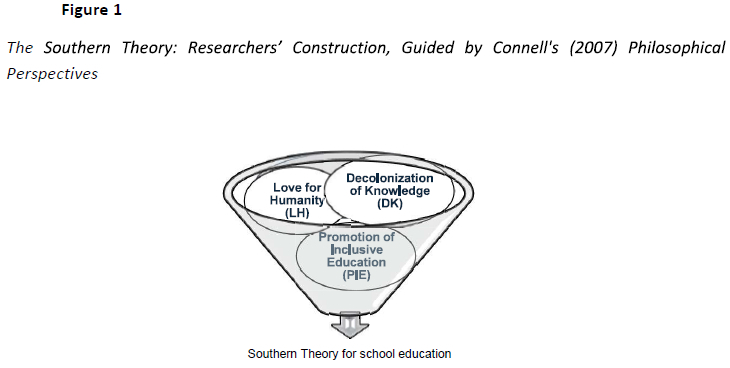
Three tenets underpin the Southern Theory: the decolonisation of knowledge (DK), the love for humanity (LH), and the promotion of inclusive education (PIE) as can be seen in Figure 1. The DK advocates for active engagement of stakeholders in the decolonisation of education by critically examining and challenging colonial legacies, biases, and power structures regarding academic content, methodologies, perceptions, and prejudices (Chakrabarti, 2023; Connell, 2014).
The Inclusion of Southern Perspectives in Social Science, Teaching, and Education
Due to the underpinning advocacy of the DK, teachers and scholars can encourage and envisage the indigenisation of the mathematics curriculum, especially in rural areas where the language of teaching and learning is mainly through local and Indigenous languages. The tenet of LH has positioned itself as a potential driving force for teachers' pedagogical development, embraced by the concept of love and inclusivity. The concept of LH in mathematics education has recently gained prominence amongst scholars such as Scott (2022) and Moreno-Pino et al. (2022). This prominence is attributed to a growing consensus that education should be intricately intertwined with humane values. This perspective underscores the crucial role of such values in shaping collective perceptions of mathematics and its pedagogy. Thus, LH in mathematics education requires collaboration, positive perceptions, context sensitivity, and humanistic professional pedagogical approaches. PIE has benefited from several studies in the advancement of inclusive mathematics education (Acharya, 2020; Malapane, 2022; Su & Yang, 2023). Aspects of inclusivity in mathematics that have promoted indigenisation include curriculum design, alignment with learners' real-world experiences, mathematical modelling, incorporation of Indigenous knowledge, and education for sustainable development.
These three tenets (DK, LH, and PIE) have all provided a unique but essential dimension to the indigenisation of mathematics because they offer valuable perspectives on promoting inclusivity, relevance, cultural sensitivity, and responsiveness for teachers to navigate the process of indigenisation in their respective classrooms.
Research Methodology
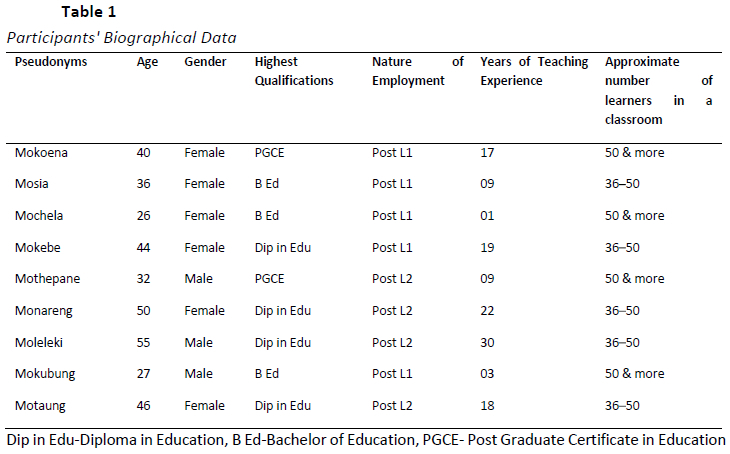
A qualitative research method was used to gain an insightful look into mathematics teachers' navigation of indigenisation in their classrooms. In this qualitative inquiry, we focused on understanding the different realities of teacher experience of our participants by making sense of their experiences during the integration of LIKS in mathematics pedagogy (Hatch, 2023). Our approach was framed within an interpretivist paradigm because it allowed us to "view the world through the perceptions and experiences of the participants" (Sathorar & Blignaut, 2021, p. 9). This implies that knowledge of teachers' navigation of the indigenisation process exists as a social construct (Makokotlela & Gumbo, 2025). Nine participants were purposively selected for the study, consisting of Sesotho-speaking Grade 8 mathematics teachers from rural public, Quintile secondary schools in the Alfred Nzo District, in the Eastern Cape Province of South Africa. Table 1 indicates the biographical data of each purposively selected participant. The study relied on focus group discussions for data generation (Akyildiz, & Ahmed, 2021). We used focus group discussions because they helped us delve into the intricate nuances of the indigenisation of mathematics by our participants. Participation was voluntary, and participants were made aware of their right to withdraw at any time.
Thematic analysis was used to make sense of the generated data. Thematic analysis is best known for its ability to classify, evaluate, and interpret patterns of meaning into a broader terrain of qualitative data (Braun & Clarke, 2019). We analysed the experiences of our participants by first coding the generated data, categorising it, and interpreting it for meaning. This systematic and rigorous approach to data analysis was deliberately adopted to ensure the trustworthiness and validity of the study's findings. Ethics approval to conduct the research was sought and granted by the Nelson Mandela University Research Ethics Committee-Human and the Provincial Department of Basic Education.
Findings of the Study
To understand teachers' pedagogical insights into how they navigate the integration of LIKS during the teaching of mathematics, the following themes emerged from the data:
1) Teachers' understanding of the integration of LIKS into the secondary school mathematics curriculum,
2) Teachers' acumen on the indigenisation of the mathematics pedagogy,
3) Positioning Indigenous games in the Grade 8 mathematics classroom, and
4) Perceived challenges in navigating indigenisation.
Teachers' Understanding of the Link Between LIKS and Technology in the Mathematics Curriculum
Participants' understanding of the link between the mathematics taught in their classroom and
the usage of technology when teaching mathematics demonstrated a sense of comprehension needed to implement an indigenised-oriented curriculum. One participant said:
I can say, my understanding of the link between LIKS and mathematics, is like linking learners' understanding in the classroom to their cultures. Maybe like Sesotho games such as Kgathi would really help in terms of the counting, Sine and Cosine graphs because when you jump there you can count how many times, and the swinging of the rope representing the period, and shape of the trigonometry graphs. (Mokebe)
The participant appears to be linking her cultural understanding with how she navigates the teaching of mathematics in her classroom. Although she still relies on English to articulate mathematical language, the link between the two concepts (LIKS and Western articulation of mathematical concepts) has been constructed in the participant's classroom. Another participant said:
My understanding is that when we teach maths, we should make examples that learners can understand, maybe by also adding technology to further show the examples, and then these examples can be about any form of cultures, backgrounds, and things around all of us. (Moleleki)
These participants' experiences invalidate the belief that LIKS and technological tools work solely in isolation from formal mathematics classroom instruction because the two resources can work together to provide culturally appropriate pedagogical approaches that enhance the secondary school mathematics conceptual understanding. Nwokocha and Legg-Jack (2024) echoed this view by stating that there are multiple ways of integrating LIKS and technology to enhance the mathematics classroom practice. Meanwhile, a participant stated that they have not attempted to implement any of these linkages because of certain problems prevailing in the school:
Colleagues, I believe all these are recommended by the department for us to do in our classroom. I, for one, have not done any linking of LIKS or technology. I teach mathematics, the way I have been teaching it, and my learners understand, but I think making learning more fun and entertaining can play a vital role in making the learners understand and grasp the concepts easier. (Monareng)
Some participants expanded on the application of the link between LIKS, technological tools, and mathematics classroom instruction through the usage of the Sesotho cultural games, for example:
Yes, it is teaching maths concepts and making examples that are visible, practical, maybe like the Sesotho games, like my peer have stated, as for technology, maybe showing like shapes, teaching probability, and others using technology. (Mochela)
Sharing a similar view was Mothepane:
Honestly, it is important that we priorities the development of learners' understanding of mathematics, especially at the introduction level, Grade 8. I agree with the examples mentioned by previous speakers, we can use cultural games, as we know, challenges we experience, especially on the side of technology.
It is evident that there is a relationship between LIKS and technology, which could be used for better concept learning of mathematics and learner involvement. Participants seemed to be embracing the educational value of combining digital tools with cultural examples to help learners understand abstract mathematical ideas through contextual learning. Some participants reported that their classrooms lack implementation of these connections because they face difficulties with inadequate technology access, along with traditional teaching methods and insufficient training. This theme illustrates that linking LIKS, Grade 8 mathematics concepts, and technology received positive feedback from participants (Daniel et al., 2022).
Teachers' Acumen in the Indigenisation of the Mathematics Pedagogy
To ensure that the research fully captures the participants' understanding and viewpoint of the indigenisation of mathematics, the discussion also explored views on whether the indigenisation of mathematics has the potential to bring about change in learner performance. Participants responded affirmatively, both through non-verbal gestures such as the thumbs-up, clapping of hands, and nodding of heads features on online interviews. Participants understood the indigenisation of mathematics as "teaching mathematics concepts and making examples that are visible, practical, maybe like the Sesotho games, like my peer has stated" (Mochela). Similarly, Mokebe added, "is like linking learners' understanding in the classroom mathematics to their cultures." Motaung expressed her view of the indigenisation of the mathematics concepts, stating it "is an approach that allows our learners to tap into their life experiences while learning." The view of another participant was:
My understanding is that when we teach maths, we should make examples that they can understand, examples can be about any form of cultures, backgrounds, and things around all of us. (Moleleki)
Some participants acknowledged that the implementation of the indigenisation quest is not an individual responsibility but for teachers as a collective. This view was shared by Mosia:
I believe that if we can work as a collective to include our unique cultural practices, such as dance, games, and important rules attached, artefacts, and all others, can help our learners to grasp the challenging mathematics concept easily in class.
Sharing a similar view were:
Of course, because when you look at our cultures and heritage, as South Africans, we are an arithmetic nation. And by that, I mean that we are a nation that loves seeing our diverse identities all that we do, so LIKS can have a positive impact on learner performance. (Monareng)
In general, as teachers teaching in the rural areas of EC, we need to change the formal traditional ways of teaching whereby it is just the teacher who is disseminating the concepts to the learners but use other ways like indigenising our teaching to include all forms of knowledge. (Mothepane) Mokoena's remarked:
As South Africans, we embody different forms of IKS, thus we need to collaborate and be guided professionally, through professional development programmes and trainings, so that as teachers we are on the same wavelength.
Thus the indigenisation of mathematics classroom instruction is very much needed and a vital aspect within the South African rural contexts. Participants indicated that because there are different forms of knowledge that can be used to change the status quo of mathematics education, professional support for rural teachers should form an essential component of teachers' guidance. In addition, participants' acumen towards the indigenisation of mathematics highlighted the importance of the different ways in which the indigenisation process can be implemented, such as appropriating cultural games to mathematical concepts (Moleleki), dances and important rules attached (Mosia), and association of different cultural artefacts with mathematical principles (Mochela), which are available in the local communities through the teaching of mathematics. This indicates that the participants had sufficient understanding of the indigenisation of the mathematics pedagogies processes. Based on this understanding, some participants provided a descriptive translation of mathematical concepts into the learners' Indigenous language for better understanding.
Positioning Indigenous Games in the Grade 8 Mathematics Classroom Practice
The positioning of Indigenous games is a potential way to integrate LIKS into mathematics pedagogy. LIKS can be understood as different forms of knowledge, skills, and practices that originated in distant generations of Indigenous peoples, and traditional methods that stemmed from a process of experimental learning. This analysis tapped into the participants' understanding of the forms of cultural games that could be employed when teaching Grade 8 mathematics. Some participants' responses on how they use games in their pedagogy were as follows:
For me, I would suggest the playing of Indigenous games. As I know that these games (activities) have a lot of benefits, such as learners' ability to focus and obey the game rules and keep to them. Like when playing diketo [jackstones], their hands and eyes must work together to prevent losing the stone, and these experiences are also needed in the comprehension of mathematics concepts. (Mokebe)
The participants also explained how technology supports enhanced pedagogical practices and increased student involvement. Digital tools provide a pathway to introduce native games using visual materials, which extends learning beyond school hours. This is how participants shared their experience:
Yes, I have also heard that learners can learn multiple functions from playing Indigenous games such as kgathi [skipping rope]. Through this game, learners can identify geometric shapes with the aim of interpreting, converting, and integrating them into mathematics word problems. (Moleleki)
To save time, at times learners can be shown images of such games through technology and then be tasked to go and play at home in their own time. In that way, learners will be learning while having fun, which is an element needed in maths. (Mochela)
Learning patterns, shapes, and their properties, including other mathematical geometry taught in the classroom through concrete pictorial visuals and practical strategies such as difaha [beadwork], streets, and house patterns, can improve learners' visualisation skills and assist learners relate the classroom taught knowledge to their everyday lives. (Mokubung)
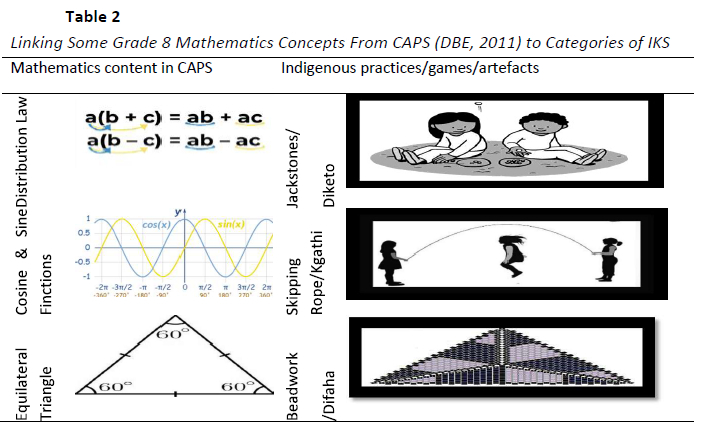
The incorporation of LIKS into the teaching of Grade 8 mathematics concepts, as stipulated in CAPS (DBE, 2011), can provide beneficial approaches for educational development through traditional knowledge integration. Through Mokebe, learners experience the opportunity to play traditional games like jackstones, which simultaneously develop the learner's concentration skills while teaching numbers, counting, mathematical rules, and coordination skills that align with nuances of mathematical comprehension. Additionally, Moleleki reported that skipping rope can enable learners to identify geometric forms as well as use them for mathematical problem solving. Furthermore, Mochela stated that these activities do not necessarily have to be played; showing images of educational games via technology can allow learners to learn independently and enjoy their educational experience in their own time. Mokubung described concrete pictorial visuals and practical strategies, including beadwork and patterns from streets and houses, which can help learners develop their visualisation skills while creating real-world connections. The collected intelligence demonstrates that IKS in the form of cultural games has the potential to generate meaningful learning experiences that are both engaging and aligned with learners' surroundings (Table 2).
The above represents a visual conceptualisation of Grade 8 mathematics content in relation to LIKS, captured through the aid of technology. The participants were able to identify this link during their teaching, and used games as sources of illustration for a better acquisition of mathematical concepts, as noted in CAPS. This framework revealed that IKS is not marginal but profoundly mathematical, providing alternate roads to intuiting the concepts of number systems in the form of algebraic expression, trigonometry, and geometric reasoning. The inclusion of such examples in the teaching process would contribute to reaffirming the African cultural identity of learners and be a step towards changing curriculum implementation to be more humanising and relevant to learners. However, effective implementation of such links is contingent upon a wider policy review to include textbook design, teacher training, and measurement requirements, which should establish an enabling environment to allow teachers to deeply institute IKS pedagogy into their practice without viewing it as a supplement or add-on of their practice.
Perceived Challenges in Navigating Indigenisation
From participants' discursive reflections on the potential difficulties that mathematics teachers often encounter when implementing innovative strategies in the teaching of mathematics (Madlela, 2024; Meeran, 2024), strategies such as LIKS and the teaching of mathematics were identified. Participants reported having difficulties finding culturally appropriate resources, organising packed classrooms, and finding the time to make meaningful content adaptations. For example, Mochela stated that:
For me, my main challenge is time, overcrowding, and identifying appropriate resources and materials that would be suitable for the Grade 8 curriculum and that link to our Indigenous learners' background. It is important that we use resources that are culturally appropriate to the school community's background. Standard curriculum materials like the textbooks do not represent learners' cultural backgrounds that links to how they engage in learning.
These difficulties are not only pedagogical but also structural and epistemological, highlighting the complexities involved in aligning curriculum delivery with learners' cultural contexts. This often requires teachers to think imaginatively and vis-à-vis the context. This becomes even more difficult where resources are not easily or readily available. This is how one participant shared her experience of the challenges:
Yes . . . I also see that the absence of teaching materials which match my reality as an urgent challenge, because most educational resources focus on Western mathematical concepts, making it challenging to engage native learners. So, finding or creating educational materials with traditional knowledge and perspectives demands additional time for development. (Moleleki)
The participants' reflections highlight the systematic barriers that prevent them from using culturally inclusive, contextualised, and participatory mathematics lessons. Another participant explained that:
The main challenge is the resources. Presently, our learners are often passive.... only one or two learners participate, ask questions, so to save time, I continue with the lesson. I find myself talking the entire period, emphasising the important points of the concepts without letting the learners discuss and participate in their learning process. (Mokebe)
Mokebes' reflections share that learners become passive when under time pressure, so they tend to rely on teacher-based instruction. Using Southern Theory lens, our analysis is that teachers find the PIE to be difficult and impractical based on their current operational limitations (Malapane, 2022). From the participants' perspective, learner-centred approaches are affected by systemic factors, including time constraints and classroom overcrowding (Nwokocha & Legg-Jack, 2024). Additionally, these reflections demonstrate an integration challenge between content knowledge and technological pedagogical knowledge. The teacher controls the subject material but does not have the essential tools or time, which prevents the activation of meaningful teaching methods that adapt to learners' different contexts. This is how a participant encapsulated her experiences of the challenge:
Our challenges are time, managing large classes because of infrastructure predicaments, and making it difficult to provide individual support. And for me personally, content-related trainings, for simpler ways of indigenising our teachings and the usage of technology, is needed. (Monareng)
Monareng's further utterances highlight the overlapping challenges mentioned by other participants, such as time constraints, overcrowded classrooms, and limited training in both content and technology integration, for example:
making it difficult to provide individual support . . . trainings for simpler ways of indigenising our teachings and the usage of technology are needed.
For Monareng, to successfully incorporate technology and LIKS into mathematics teaching, there is a deficiency in technological pedagogical knowledge and technological content knowledge. This reflection highlights the common epistemic and infrastructure marginalisation in Global South contexts as purported by the Southern Theory (Swartz et al., 2024). To counter the dominance of Western pedagogical norms and promote context-responsive teaching, it is necessary to build capacity locally, as indicated by the call for training in Indigenous and technological strategies (Garcia-Olp et al., 2022). This need for training was echoed by a participant when they explained that:
On the point of the need for training, I think all stakeholders involved should be capacitated on this process. Because this change process requires shared and communicated understanding from the learners' side, the teachers, and the parents, to avoid resistance and opposed adoption. Remember, this Western way of teaching has been done for decades, and I think trust for change must be achieved from all angles and the entire school community. (Mosia)
Mosia stressed that adequate training becomes essential for everybody who participates in the shift towards native teaching practices between teachers and learners:
This change process requires shared and communicated understanding . . . trust for change must be achieved from all angles and the entire school community.
From the participants' experiences, we understand how collaborative pedagogy brings educational change from classrooms into the educational ecosystem of the local school community as an aspect of indigenisation. Pedagogical changes that maintain success and longevity require every party involved to know and support the methodologies with sufficient confidence. It is evident that the participants are confronted with multiple obstacles that prohibit them from attempting to use creativity and innovation in their classroom instructions (Nwokocha and Legg-Jack, 2024). The main obstacles that secondary mathematics teachers face include insufficient time, overcrowded teaching spaces, limited resources, as well as insufficient content-related professional development training. The passiveness of learners poses difficulties to teachers because learners frequently avoid class interactions. In brief, the existing problems in secondary school mathematics education show a need for improved resource distribution, improved infrastructure for fewer learners per class, and dedicated training to link content, LIKS, and technology for enhanced mathematics teaching (Meeran, 2024).
In light of these challenges, research demonstrates that rural mathematics teachers turn to pragmatic and collaborative learning, resource-sharing, and school-based professional learning communities (Medequillo & Gallardo, 2024). They use community resources as well as creative repurposing of teaching (Algones et al., 2024; Yi et al., 2024). In combination, these strategies embody resilience, agency, and innovation of teachers-their capabilities to maintain a practice and establish adaptive spaces that meet the needs of learners with varying needs. It is thus important to fund and expand such initiatives in the reimagining of the mathematics pedagogy that is relevant and transformational to the context.
Discussion of the Findings
This study focused on how mathematics teachers navigate the indigenisation of the secondary school mathematics pedagogy so as to link it to the varied cultural elements of learners within their learning environments. Using Connells' Southern Theory as a lens, the study deduced that participants had positive perceptions towards the integration of LIKS for the indigenisation of the secondary school mathematics pedagogy as an appropriate approach. Furthermore, the participants' insightfulness of indigenisation was in accordance with the tenets of the theoretical framework underpinning this study. For example, some participants unpacked their understanding of indigenisation as linking learners' understanding in the classroom to their cultures (DK), making examples using forms of culture, such as Sesotho cultural games (PIE).
Drawing from the literature, these perspectives align with the PIE and DK, which are key tenets of the Southern Theory framework. Scholars such as Acharya (2020), Malapane (2022), and Su and Yang (2023) advocated for the promotion of inclusive and culturally responsive strategies, underscoring the importance of learning experiences in educational instruction. The participants' experiences offered valuable perspectives on promoting inclusivity, relevance, and cultural responsiveness in mathematics education, aligned with the objectives of the proposed study. These findings emphasise indigenisation as a vital approach through PIE in Southern Theory. Furthermore, these findings support and concur with the findings of Nxumalo and Mncube (2019), Mosimege (2020), Mabotja (2023), and Meeran (2024), affirming teachers' awareness of the need to incorporate cultural practices and indigenise the pedagogy.
Simultaneously, participants' responses, pertaining to their pedagogical insights into the indigenisation quest, revealed that participants are aware of the need to indigenise their teaching. However, participants reported challenges about pedagogy; at face value, these are endemic challenges that are current for most mathematics teachers working in schools located in the rural areas of the Eastern Cape Province. These challenges are issues understood to be the cause of the continued reliance on non-innovative, traditional ways of teaching. These issues ranged from classroom overcrowding and time allocation, non-prioritisation of teacher capacitation in schools located in rural settings, and the absence of guiding teaching resources that incorporate the integration of LIKS into diverse mathematics concepts.
With respect to the number of learners per class, participants indicated that five of the secondary school mathematics teachers handle classes with between 36-50 learners in a classroom. Furthermore, four teachers have classes with more than 50 learners each, whereas the South African national learner-teacher ratio policy is 33:1 (DBE, 2018). The findings from the discussions identified classroom overcrowding, shortage of LIKS-informed teaching resources, and the absence of professional development programmes that are grade- and concept-specific as the main obstacles for teaching localised and indigenised mathematics teaching methods. The participants' views highlighted these challenges as key to their not attempting to indigenise the mathematics pedagogy. Some schools do not have enough classrooms to split learners into smaller groups, making it difficult for teachers to plan for LIKS-linked lessons because of the assumption that innovative lessons are time-consuming. A view that is also epitomised in the works of Mpiti and Wambu (2023) and Maqoqa and Mvenene (2023), where overcrowding was viewed as a persistent problem mainly in the rural areas of the Eastern Cape and various areas of South Africa. Although in the current study, the main cause of overcrowding is attributed to a shortage of classrooms (infrastructure), Maqoqa and Mvenene (2023) argued that rurality is a context unattractive to many, thus, non-retention of qualified mathematics teachers results in overcrowded mathematics classes.
The study participants knowingly and unknowingly showed understanding of the practical benefits of LIKS integration in mathematics education, although the identified obstacles prohibit them from translating these benefits into classroom practice. Research participants concluded that teaching mathematics through cultural elements would enable learners to experience a meaningful and relevant understanding of the mathematics concepts taught. Thus, progress on the integration of LIKS and culturally responsive pedagogical strategies depends on the elimination of issues related to the availability of LIKS-informed resources, advancements in teacher competencies, and curriculum support formalities, like infrastructure.
Conclusion and Recommendations
This study explored secondary school mathematics teachers' perceptions and pedagogical insights regarding integrating LIKS into mathematics pedagogy. The findings identified fundamental dimensions that hinder the integration of LIKS into the secondary school mathematics classrooms. The findings showed that mathematics teachers have positive perceptions and possess sufficient pedagogical insights required to integrate LIKS, however, they were able to unpack potential ways in which some Grade 8 mathematics concepts from CAPS could be linked to LIKS. Similarly, teachers expressed several impediments that prohibited the indigenisation of mathematics pedagogy and recommended ways to support them. The study demonstrates that faced with the challenge of the integration of LIKS into curriculum delivery, teachers tend to engage in pragmatic adaptive strategies that favour coping with the highlighted demands of the classroom environment. These strategies permit them to cope with the expectations of curriculum delivery but reflexively reduce the range of more forward-thinking and inclusive pedagogical actions. It points to the necessity of reinforcing professional development and curriculum support systems in a manner that allows teachers to transition beyond coping strategies and toward any form that embraces and harnesses, as true, the power of Indigenous knowledge in mathematical learning.
It is recommended that mathematics teachers be provided with professional development programmes that are concept-specific and tailored toward the indigenisation of the pedagogy. Additionally, be provided with teaching resources such as grade-specific guidelines illustrating the practical implementations per concept per grade. Mathematics pedagogies that are culturally responsive and relevant to the learner's LIKS in the classroom can enable a transformative learning environment that supports a greater connection to indigenised learning among learners. In conclusion, for effective contribution towards the decolonisation of mathematics education, the South African curriculum needs to be flexible to allow for the possibility of LIKS. Accordingly, this study emphasises the prioritisation of professional development programmes that equip mathematics teachers with the knowledge and strategies necessary for the integration of LIKS into the classroom pedagogical practices.
References
- Abebe, T., Dar, A., & Lysa, I. M. (2022). Southern theories and decolonial childhood studies. Childhood, 29(3), 255-275. https://doi.org/10.1177/09075682221111690
- Acharya, A. (2020). Feature interview with Amitav Acharya. St. Antony's International Review, 16(1), 215222. https://www.ingentaconnect.com/contentone/stair/stair/2020/00000016/00000001/art00018
- Adams, C. (2025). Teachers' perceptions of indigenizing learning at a Canadian offshore school. International Journal of Curriculum and Instruction, 17(2), 501-520. https://ijci.net/index.php/IJCI/article/view/1560
- Aikenhead, G. S. (1996). Science education: Border crossing into the subculture of science. Studies in Science Education, 27(1), 1-52. https://doi.org/10.1080/03057269608560077
- Akyildiz, S. T., & Ahmed, K. H. (2021). An overview of qualitative research and focus group discussion. International Journal of Academic Research in Education, 7(1), 1-15.https://doi.org/10.17985/iiare.866762
- Algones, C. J., Calizo, E. V., & Bauyot, M. M. (2024). Experiences of teachers teaching in far-flung areas of division of Davao Del Norte: A phenomenological study. International Journal of Research and Innovation in Social Science. https://doi.org/10.47772/ijriss.2024.806212
- Beatty, R., & Clyne, C. (2024). Relationships and reciprocity in mathematics education. In A.-L. King, K. O'Reilly, & P. J. Lewis (Eds.), Unsettling education: Decolonizing and indigenizing the land (pp. 214237). Canadian Scholars & Women's Press.
- Chahine, I. C., & de Beer, J. (Eds.). (2021). Evidence-based inquiries in ethno-STEM research: Investigations in knowledge systems across disciplines and transcultural settings. Information Age.
- Chaka, C. (2022). Digital marginalization, data marginalization, and algorithmic exclusions: A critical Southern decolonial approach to datafication, algorithms, and digital citizenship from the Souths. Journal of e-Learning and Knowledge Society, 18(3), 83-95. https://doi.org/10.20368/1971-8829/1135678
- Chakrabarti, D. (2023). Urban theory of/from the Global South: a systematic review of issues, challenges, and pathways of decolonization. Frontiers in Sustainable Cities, 5, 1163534. https://doi.org/10.3389/frsc.2023.1163534
- Chimbi, G. T., & Jita, L. C. (2022). Ubuntu: The pursuit of an indigenous curriculum reform policy in post-colonial Lesotho, Zimbabwe and South Africa. Bulgarian Comparative Education Society.
- Connell, R. (2007). Southern theory: The global dynamics of knowledge in social science. Polity.
- D'Ambrosio, U. (2001). What is ethno-mathematics, and how can it help children in schools? Teaching Children Mathematics,7(6), 308-310. https://doi.org/10.5951/TCM.7.6.0308
- Daniel, R. A., Wilhelm, T. A., Scott, H., Goldman, G., & Hinzman, L. (2022, December 02). What is "Indigenous knowledge" and why does it matter? Integrating ancestral wisdom and approaches into federal decision-making. The White House. https://bidenwhitehouse.archives.gov/ostp/news-updates/2022/12/02/what-is-indigenous-knowledge-and-why-does-it-matter-integrating-ancestral-wisdom-and-approaches-into-federal-decision-making/
- Department of Basic Education. (2011). Curriculum and policy assessment statement Grades 7-9. https://www.education.gov.za/LinkClick.aspx?fileticket=uCNqOwfGbmc%3d&tabid=573&portalid=0&mid=1629&forcedownload=true
- Department of Basic Education. (2018). Education statistics in South Africa 2016. https://www.education.gov.za/Portals/0/Documents/Publications/Education%20Statistic%20SA%202016.pdf
- Department of Science and Technology. (2008). Innovation towards a knowledge-based economy: Ten-year plan for South Africa (2008-2018). http://www.esastap.org.za/download/sa_ten_year_innovation_plan
- Dlakavu, A., Mathebula, J., & Mkhize, S. (2022). Decolonising and indigenising evaluation practice in Africa: Roadmap for mainstreaming the Made in Africa Evaluation approach. African Evaluation Journal 10(1), a620. https://doi.org/10.4102/aej.v10i1.620
- Dwyer, S. C., & Buckle, J. L. (2022). Cultural insider-outsider: Reflecting on positionality in shared and differing identities. In P. Liamputtong (Ed.), Handbook of qualitative cross-cultural research methods: A social science perspective (pp. 8-99). Edward Elgar.
- Graham, M. A. (2023). Overcrowded classrooms and their association with South African learners' mathematics achievement. African Journal of Research in Mathematics, Science and Technology Education, 27(2), 169-179. https://hdl.handle.net/10520/ejc-saarmste_v27_n2_a169
- Graham, M. A., Stols, G. H., & Kapp, R. (2021). Integrating classroom technology: South African mathematics teachers. Computers in the Schools, 38(3), 189-213. https://doi.org/10.1080/07380569.2021.1953951
- Hatch, J. A. (2023). Doing qualitative research in education settings. SUNY Press.
- Jojo, Z. (2023). Enhancing mathematics teaching practice supervision in an open distance e-learning context: Challenges and successes with 4IR. Journal of Educational Studies, 2023(si2), 76-88. http://dx.doi.org/10.59915/jes.2023.special.2.5
- Mabotja, K. S. (2023). The affordances of ethnomathematical perspectives in pre-service Mathematics teacher education at selected universities in South Africa (Unpublished doctoral dissertation]. North-West University.
- Madimabe, M. P., Omodan, B. I., & Tsotetsi C. T. (2022). Incorporation of Indigenous knowledge in the mathematical geometry discipline at a TVET College. REDIMAT:Journal of Research in Mathematics Education,11(3),296-312. http://dx.doi.org/10.17583/redimat.7890
- Makokotlela, M. V., & M. T. Gumbo. (2025). Decolonisation of the curriculum through the integration of Indigenous knowledge in higher education. South African Journal of Higher Education, 39(1), 23754. https://doi.org/10.20853/39-1-6004
- Makumane, M. A., & Ngcobo, S. (2021). The representation of curricular spider-web model in the Lesotho curriculum and assessment policy framework. The Journal for Transdisciplinary Research in Southern Africa, 17(9). https://doi.org/10.4102/TD.V17I1.796
- Malapane, K. (2022). Classifying non-redundancy in the HERA array [Master's thesis, University of the Western Cape]. https://hdl.handle.net/10566/16606
- Mandikonza, C. (2019). Integrating indigenous knowledge practices as context and concepts for the learning of curriculum science: A methodological exploration. Southern African Journal of Environmental Education, 35. http://dx.doi.org/10.4314/sajee.v35i1.13
- Maxwell, J. A. (2013). Qualitative research design: An interactive approach. SAGE.
- Medequillo, A., & D. Gallardo, R. (2024). Multigrade teachers in rural areas: Thoughts to ponder. International Journal of Innovative Science and Research Technology (IJISRT). https://doi.org/10.38124/ijisrt/ijisrt24jun026
- Meeran, S. (2024). Decolonising mathematics education: Teachers' initial experiences of using ethnomathematical games in the intermediate phase. Interdisciplinary Journal of Sociality Studies, 4(s1), 1-14. https://doi.org/10.38140/ijss-2024.vol4.s1.03
- Mlotshwa, N., & Tsakeni, M. (2024). Challenges experienced by teachers when integrating Indigenous knowledge systems in natural sciences practical work. African Journal of Research in Mathematics, Science and Technology Education, 28(2), 300-313. https://doi.org/10.1080/18117295.2024.2414160
- Mosimege, M. (2020). The use of Indigenous games in the teaching and learning of mathematics. Revemop, 2, 1-16. https://doi.org/10.33532/revemop.e202009
- Mpiti, P. T., & Wambu, Z. Y. (2023). An investigation into the determinants of underperformance in mathematics among Grade 12 learners in a high school in the Eastern Cape. In D. Ortega-Sánchez (Ed.), Education annual volume 2023 (pp. 1 -16). IntechOpen.
- Mudaly, V. (2018). Decolonising the mind: Mathematics teachers explore possibilities for indigenising the school curriculum, Mathematics and Computer Science Cluster, School of Education, University of KwaZulu-Natal, Durban, South Africa. Journal of Education, 74, 68-83. http://dx.doi.org/10.17159/2520-9868/i74a05
- Mukherjee, M. (2019). Southern theory and postcolonial comparative education. Oxford Research Encyclopedia of Education. https://doi.org/10.1093/acrefore/9780190264093.013.466
- Mzekandaba, S. (2025, May 05). Hundreds of SA public schools don't offer maths. IT Web. https://www.itweb.co.za/article/hundreds-of-sa-public-schools-dont-offer-maths/P3gQ2MGAnDPvnRD1
- Ngololo, E., & Kanandjebo, L. N. (2024). Indigenous knowledge content & mathematics curriculum: Some evidence from a Namibian perspective. Jumuga Journal of Education Oral Studies and Human Sciences (JJEOSHS), 7(2),1-15. https://doi.org/10.35544/jjeoshs.v7i2.93
- Nkopodi, N., & Mosimege, M. (2009). Incorporating the Indigenous game of morabaraba in the learning of mathematics. South African Journal of Education, 29, 377-392. https://doi.org/10.15700/saie.v29n3a273
- Nwokocha, C. G., & Legg-Jack, D. (2024). Reimagining STEM education in South Africa: Leveraging Indigenous knowledge systems through the m-know model for curriculum enhancement. International Journal of Social Science Research and Review, 7(2), 173-189. https://doi.org/10.47814/iissrr.v7i2.1951
-
Nxumalo, S., & Mcube, D. W. (2019). Using indigenous games and knowledge to decolonise the school curriculum: Ubuntu perspectives. Perspectives in Education, 36, 103-118. 10.18820/2519593X/pie.v36i2.9
» https://doi.org/10.18820/2519593X/pie.v36i2.9 - Ogunniyi, M. B. (2004). The challenge of preparing and equipping science teachers in higher education to integrate scientific and indigenous knowledge systems for learners: The practice of higher education. South African Journal of Higher Education, 18(3), 289-304. https://hdl.handle.net/10520/EJC37088
- Photo, P., & McKnight, M. (2024). Investigating Indigenous knowledge awareness among South African science teachers for developing a guideline. Curriculum Perspectives, 44, 61-71. https://doi.org/10.1007/s41297-023-00224-9
- Saal, P. E., Mdlulwa, N., & Hannan, S. (2025). Unlocking the power of play: Exploring key influences of digital game-based learning adoption among South African mathematics teachers. Computers in the Schools, 42(1), 51-72. https://doi.org/10.1080/07380569.2024.2405518
- Santos, B. D. S. (2018). The end of the cognitive empire: The coming of age of epistemologies of the South. Duke University Press.
- Seehawer, M. (2018). South African science teachers' strategies for integrating Indigenous and Western knowledges in their classes: Practical lessons in decolonisation Educational Research for Social Change, 7(1), 91-110. https://doi.org/10.17159/2221-4070/2018/v7i0a7
- Su, R., & Yang, H. (2023). Exploratory study on the curriculum construction of preschool education major in applied private universities based on OBE concept. The Educational Review, USA, 7(9), 1270-1274.http://dx.doi.org/10.26855/er.2023.09.005