What We Want: Student Voices in Shaping a New African University
Abstract
Students' voices have often been heard in protests against unfair treatment and ignored needs by university administration and lecturers. Student unions have represented students in decision making but have in some instances been labelled "political agents for opposition parties." The long-standing cry by students stems from their need to be involved in matters concerning them, their needs, and expectations from universities at which they are enrolled. Thus, students' active participation in decision making is an important element in reshaping African universities. Failure to pay attention to student voices defeats the purpose of 21st-century participatory and inclusive higher education. This paper explores the participatory involvement of students in creating a new African university. Using Dunne & Zanstra's (2011) Students as Change Agents Model as a theoretical framework, the researcher explores the role of students in higher education governance in the transition to a new African university. Employing a mixed method approach, data were collected through online questionnaires with both closed and open-ended questions. Findings show that more than 60 per cent of students feel unheard and uninvolved in university governance. Overall, students are willing and ready to use dialogue and take part in the transformation of higher education but can only do so through equal representation in higher education governance structures. Conclusively, it is important that higher education governance utilises inclusive and participatory approaches for ownership of goals, co-creation of knowledge, as well as decision-making processes. Accountability is key in governance, and should include the voices of students for the avoidance of conflict and violence.
participatory involvement; students' voices; decision making; African university; re-shaping
Introduction
At the turn of the 21st century, dialogue around shifting curricula from teacher-centred approaches to learner-centred approaches took the world stage. Many important shifts in curriculum and pedagogy were introduced into the classroom allowing for participatory involvement of students in the teaching and learning process. Teachers ceased to be knowledge sources but became facilitators of learning, new approaches, and interactive tools as technology advancements were integrated into education (Sikhakhane et al., 2020). This allowed for students' voices to be heard in classrooms across the world. However, in higher education, whilst students have a participatory role in the learning process through individualised research and participation in lecture dialogue, there remain gaps in how far they can be involved in governance issues. From my observations, the voices of students have often been heard in protests against unfair treatment and ignored needs by university administration and lecturers.
The involvement of students in decision making has been represented by student unions, who are at times mislabelled political agents for opposition parties (Mugume & Luescher, 2017). It is my submission that the long-standing cry by students stems from their need to be involved in governance matters concerning them. Thus, student involvement and participation in decision making is an important element in reshaping African universities. Prescribing the needs of, and ignoring the voices of, African students has led to continued strife between university administrators and students, thus leading to contentious relationships that do not support development. Ignoring student voices defeats the purpose of 21st-century participatory and inclusive higher education. Against this backdrop, rethinking governance in the context of an African university becomes of paramount importance.
Research Questions
This paper focuses on whether students' voices are heard in higher education, and what expectations students have in terms of their involvement in governance issues. The guiding questions for this research are:
• To what extent do students in higher education perceive that their voices are heard in institutional decision-making processes?
• What expectations do students have regarding their involvement in governance issues within higher education institutions?
Literature Review: Governance and Students' Voices in Higher Education
Governance as defined by Rahaman (2024) is multifaceted and captures the ways in which power is utilised to manage and control resources and systems in a country or institution. It includes the capacity for designing, formulating and implementing policies, and discharging functions (Rahim, 2019). In higher education, governance refers to the ways through which higher education institutions are organised and managed (Wolhuter & Langa, 2021). Student representation refers to
the formal structures and processes of elected or appointed student representatives speaking or acting on behalf of the collective student body in higher education governance within a higher education institution or a higher education system. (Klemenčič et al., 2015, p. vii)
The confluence of higher education governance and student representation in higher education governance implies the participatory inclusion of students' representatives in the process of designing, formulating and implementing policies, and executing functions. Allowing students to have a say in issues affecting them develops a sense of ownership of the higher education institutions they are affiliated to.
An interesting observation in the debate on students' governance in higher education in Africa was made by Altbach (2018, p. xi) who pointed out that:
Universities would not exist without students. Students are at the heart of the academic enterprise. It is worth remembering that some of the earliest universities, in medieval Italy, were established and managed by students. In the 21st century, in the era of massification, students are often seen as burdens, customers, or sources of income, but seldom as the key rationale for the university.
The failure to acknowledge the importance of students' voices has led to vandalism and anarchism being not only "conventional, but so intensely socialised" (Rapatsa, 2017, p. 13). What is missing is the acknowledgement that decisions that have a direct effect on students are being made in their absence (Davids & Waghid, 2020). Thus, decisions that are relevant to students must involve them in order for them to be acceptable and meaningful. The importance of student voices can therefore not be ignored in dialogue concerning students.
Students' Protests in African Universities
Demonstrations and protests have been used by students since the 1960s to gain mileage and attention to student grievances in various higher education institutions (Hungwe & Divala, 2020). In Africa, most of these protests turn violent because students feel that they are being ignored by the system at both institutional and government levels. This is an indication that student protests are linked to the social, economic, and political landscape of the countries in which they take place-thus leading to the politicisation of student protests (Ruwoko, 2020). The politicisation of student representation does nothing to improve the relationship between student bodies in Africa and higher education administrators. The responses of government are almost predictable as those who involve themselves in the protests are often arrested, brutalised, locked up and, at times, murdered (Mlambo, 2013). The student representation councils (SRCs) that are meant to represent students have been demonised as political agents, hence every protest that students engage in is quickly viewed from a political standpoint. Hungwe and Divala (2020, pp. 149-150) stated that "conceptually, student protests are organised, collective actions in which students coalesce to express grievances or reservations against the unfavourable conditions within the university or the nation." Concisely, student protests are "incidents of student revolt or unrest, which constitute a serious challenge or threat to the established order or to sanctioned authority or norms" (Nkinyangi, 1991, p. 158). While students are well within their rights to protest, the series of students' arrests and protests point to erosion of progressive rights (Ruwoko, 2020).
Students' involvement in national politics does not make the situation any better but further aggravates and supports the widely held notion that students are political agents for opposition parties. While there is a thin divide between academic life and socio-economic and political life, the expectations on students to separate the two becomes unreasonable. Ruwoko (2020) quoted Takudzwa Ngadziore, the 11th Zimbabwe National Students Union president commenting on the issue of students' protests who stated that they were:
Facing unjustified arrests for claiming their space in the freedom arena, shockingly holding placards in Zimbabwe which speaks to the rotten life we wake up to makes you a terrorist in the eyes of the state.
He argued that protests are done as protection of student voices, and political and economic issues that affect students' lives. There are numerous reports of students being abducted and tortured because they are considered a dangerous entity and a potent symbol of black aspiration for young people and their families across Zimbabwe (Ruwoko, 2020). Students' reactions to instances where they feel ignored can be non-violent-marching, singing, picketing, class boycotting, and disruption of lectures (Fomunyam, 2017). Violent forms of protest are destructive in nature and can be in the form of burning, looting, and in Nigeria in some instances, university management has been abducted, kidnapped, and tortured to coerce administration into responding to student grievances (Aghedo, 2015; Okey, 2017).
Student protests attempt to influence institutional governance to look into student issues. The process of addressing students' issues needs to take into consideration responsibility, respect, and accountability between parties. Violent protests cannot be condoned when there are other reasonable and peaceful ways of addressing grievances. It is important that "university students and management transcend the trappings of historicity and ideology" (Hungwe & Divala, 2020, p. 158) in which violent revolutions are used to react to unresolved grievances in order to usher in a new African university in which the voices of students are heard without violence.
There is a common thread that ties university students' reasons for protesting. This implies that university students across Africa face similar challenges and react in similar ways, possibly because their voices are either not heard or taken for granted. The reasons for protests in higher education institutions in Africa include the quest for freedom of expression, a call for the end of corruption, which has dire effects on future prospects of university graduates, better living conditions, free or affordable education, a stop to fees hikes, the need for quality accommodation and food at campus, inadequate or non-existent funding, and transportation to and from campus (Holdt, 2014; Hungwe & Divala, 2020; Okey, 2017; Ruwoko, 2020).
There are however specific incidents in South Africa that sparked huge protests, which shook higher education across Africa. In 2015, at University of Cape Town, Stellenbosch University, and Cape Peninsula University of Technology, students protested against slow transformation processes, language policy, and other academic policies that are made without students' involvement, race relations, access, and funding opportunities (Mashayamombe & Nomvete, 2021). In the same period of 2015-2016, university students organised a protest dubbed "Burn to be Heard," which caused the destruction of campus property costing over eight million rand (Daniel, 2018.). Such instances of violence have devastating effects on higher education administration as well as students' access to quality and affordable education (Duncan, 2016).
The frequency of students' protests at African universities calls for a new form of thinking regarding decision making in higher education. For the African university to be viewed as a site for democratic leadership and academic finesse, there is a need to move away from violent student activism. It is shocking and disappointing that:
In nearly all African universities, there is recurrence of violent student protests, which result in massive property destruction, injury and loss of human life. Owing to the over-valuation of credentialism, which is possibly hindered by access issues such as the ever-increasing tuition fees, poor university management, political intolerance and the economic malaise. The African university is typically a volatile site of insurrection, unrest, and running battles between police and student protesters. (Hungwe & Divala, 2020, p. 154)
Failure by university management to respond to and dialogue with students pushes them to resort to violence after which they are termed rogue, rebels, and uncultured. There is therefore a need for "systematic and regular interactions for dialogue between university management and student union organisations" (Hungwe & Divala, 2020, p. 160). Lack of regular dialogue and deliberations creates mistrust and plants seeds of violence. This clearly indicates a gaping hole in the processes of decision making (Davids, 2014). For transformation to occur there has to exist mutual understanding and mutual dialogue undergirded by transparency and accountability. The university belongs to students, administrators, and the broader community. Decision making has to be inclusive of all the parties involved through fair representation. Therefore, the new African university has to be premised on the imperatives of consultation, discussion, and debate on areas of mutual concern to all stakeholders involved.
Hungwe and Divala (2020) have raised questions around the handling of student representation in drafting institutional budgets and policies, financial transparency, and in high management structures such as senate. Therefore, when students resort to violence or protest, should there not be interrogation of the deep-seated structures that systematically exclude students in matters concerning them? It is thus critical to open our minds to question whether the decision-making processes being used in higher education are effective or need re-thinking and re-designing. Unpacking these issues is central to clarifying assumptions about important issues such as the financial standing of the institutions. Students generally believe that universities have huge financial resources to address the various challenges of accommodation, funding, and food among others. Despondency and violence are created by these assumptions in the absence of mutual dialogue, transparency, and accountability by university management. While Hungwe and Divala (2020) raised important questions for university administration, one central question that the new African university should be asking is: "What do students want?"
Theoretical Framework
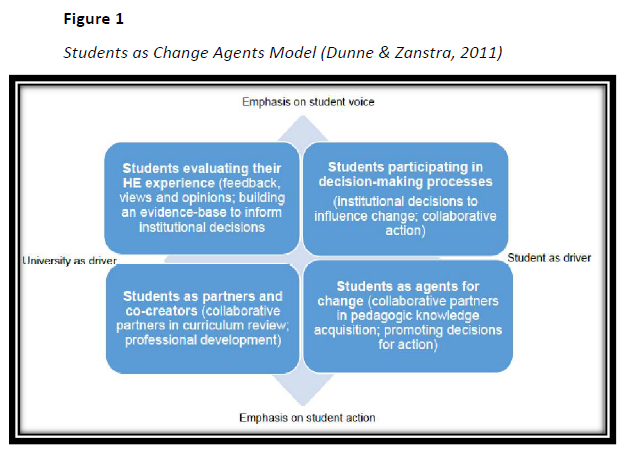
This paper is grounded in Dunne and Zanstra's (2011) Students as Change Agents Model, which draws from the understanding that involvement of students in various processes at higher education institutions has evolved over time, with students being "included in a variety of ways, ranging from feedback on learning experiences to involving students in curriculum design, and including student representation in decision-making processes" (Strydom & Loots, 2020, p. 20). There is also need to explore students' experiences and make them known in order to foster accountability and transparency. Student voices are often heard through established roles and processes that include student unions, representatives, associations, forums, survey respondents, and co-researchers (Strydom & Loots, 2020). Dunne and Zanstra (2011) proposed a model for student involvement in both the change and decisionmaking processes in higher education (see Figure 1).
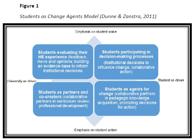
This model conceptualises students' inclusion in higher education decision making. Dunne and Zanstra (2011) argued that the missing element in higher education institutions' effort to engage and include students is the actual process of allowing students to bring about change. The model differentiates the four forms of student involvement in institutional policy and practice. Students in their roles as evaluators, participants, partners, and agents of change can be both voices and drivers of policy and practice in university decision making. Thus, it is important to position students in their roles to improve quality in higher education institutions. In the model, there are four key roles that students should be allowed to undertake if any real change is to occur in higher education institutions. In their model, Dunne and Zanstra suggested that through surveys, higher education institutions can measure students' experiences and engagement thus providing feedback on the quality of education that is being imparted by the university.
This is meant to help improve universities and improve learning. These authors argued that merely listening to students' voices is not enough but should be supported by "giving students an opportunity to generate their own ideas and solutions that bring about changes" (Dunne & Zanstra, 2011, p. 25). By doing this, students do not become consumers of what universities offer but become co-creators and co-owners of university goals and outcomes. They further argued that treating students as mere consumers is what infuriates students, and leads to public shows of disgruntlement in the form of violent protests. Students' evaluations of what university experiences they are getting become the key to unlocking better universities in which the voices of students matter.
Inclusion of students through their active involvement in committees and departments as well as other governance structures is important in developing good leadership among students. The SRC is one of the structures that students can get involved in, but it is not clear how far their involvement goes. Opening up space for students' involvement in higher education governance provides opportunities for contributing to quality through democratic human engagement (Waghid, 2019). Positioning students as participants in decision-making processes "shows institutional commitment to greater student involvement in changes to teaching, learning, and institutional development" (Strydom & Loots, 2020, p. 26).
Dunne and Zanstra (2011) were of the belief that involvement of students in institutional developments, teaching and learning spaces, reviewing pedagogical strategy and practices, as well as through research makes them co-creators and experts, which is critical for the advancement of higher education outcomes. Involving students in higher education governance research shows a causal link between students' involvements in curriculum design and enhanced teaching and learning (Brooman et al., 2015). Nel (2017) asserted that collaborative student relationships contribute immensely to knowledge creation and meaningful learning experiences through participatory dialogic pedagogy and fosters liberated students (Mudehwe-Gonhovi et al., 2018). This implies that inclusive governance provides opportunities for students to freely share their ideas and create for themselves higher education institutions that align and support student growth and visibility in issues that affect them. When students become partners in higher education governance, it increases their potential to become positive change agents who use more constructive strategies for development, as opposed to violence.
As key stakeholders in higher education institutions, students are expected to support and advance institutional goals and outcomes. One of the most important roles they can be assigned is to become actively engaged in influencing change and taking up leadership roles (Seale, 2016). Student activism is one of the most common examples of how students can be involved in transforming institutions. Student voices have often been associated with protests against high tuition fees, student debt, accommodation, funding, various forms of marginalisation, socio-economic inequalities that affect issues of access, and perceived oppressive higher education systems (Nielsen, 2019; Stuurman, 2018). It is pertinent that as higher education enters into current modes of governance, the place of student voices be positioned to address a broad range of issues that affect teaching and learning outcomes as well as the positive development of the institutions the students are affiliated to. This paper seeks to determine if students perceive these roles as being acknowledged by their universities and if their involvement is considered important. Furthermore, it outlines students' expectations of their involvement in university governance.
I argue, in this paper, that to ensure meaningful and effective student representation and involvement in higher education governance, there must be collective student voice presence within higher education decision-making processes. For full student representation, democratic procedures, student-created communication channels, and formal structures need to be availed to ensure representatives convey collective student interests in higher education decision-making bodies (Klemenčič, 2014). There is no arguing that students are key stakeholders in higher education and therefore deserve a serious level of input and influence (Tyrrell & Varnham, 2015) in the formulation of higher education policy and educational quality assurance. This could help to develop graduates who possess leadership and democratic skills, critical thinking, and responsible citizenship thus eradicating the culture of violent protests to be heard. This research collects diverse student views and perspectives to create an enabling environment for students to become more involved and attached to their institutions, leading to increased development and less destruction.
Methodology
In order to gather student voices in the process of transitioning to a new African university, the researcher employed a mixed methods approach utilising online questionnaires with closed questions for the quantitative data and open-ended questions for the generation of qualitative data. The target participants were university students who were identified through purposive snowball sampling. This is a hybrid method in which the researcher identifies participants based on specific characteristics, then the identified participants refer suitable candidates to become part of the study (Ting et al., 2025). The researcher identified known university students and shared the online questionnaire link, which they then shared with other students they knew. This was done because universities were closed due to the COVID-19 pandemic and were using online models of learning. The researcher also wanted to gain access to as many university students as possible in a short space of time. The closed questions data collected were analysed using Excel, and charts were generated to represent the findings.
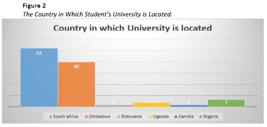
Thematic analysis was also incorporated for analysing qualitative data gathered from open-ended questions. This method was selected because it is suitable for qualitative research where the researcher wants to systematically organise and analyse data sets. The researcher searches for themes that reflect the narratives prominent in a data set (Dawadi, 2020). Data were organised around key themes that emerged from the participants' responses. A total of 107 responses were recorded for this study from participants learning at various universities in Africa, with the highest numbers coming from South Africa (54) and Zimbabwe (40), respectively. To protect the identities of the students, no email addresses were collected on the online form.
Students' Voices in Higher Education Institutions: Analysis, Findings, and Discussion
In this section, I discuss the findings of the study that sought to interrogate students' perceived levels of inclusion in their universities' governance systems, and what their expectations were. The aim was to come up with a collaborative approach that serves both the university and the students through reduced violence and protests, which have become the norm for students in higher education. Findings from the 107 questionnaire responses indicate that the voices of students need to be heard to avoid instances where they have to resort to violence. While violence is used as justification for gaining visibility and forcing higher education leadership and government to take note of student grievances, it is a costly mechanism that affects access and quality of education, among other things.
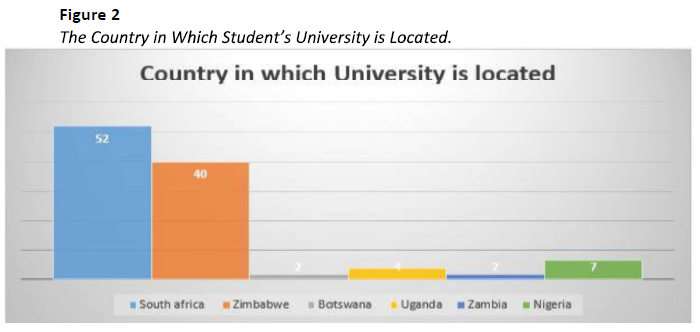
The respondents were from different universities in different African countries including South Africa (52), Zimbabwe (40), Botswana (2), Uganda (4), Zambia (2) and Nigeria (7), as shown in Figure 2. This data collected was useful in understanding the different contexts in which university students find themselves and how their thoughts and views can be consolidated in the process of transitioning to a new African university.
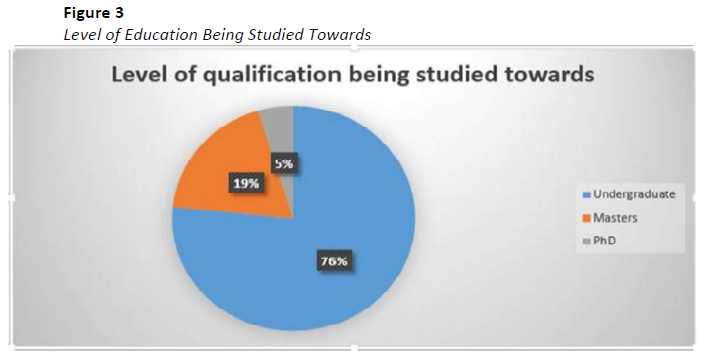
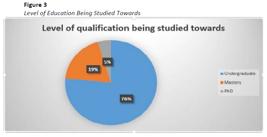
Data collected also shows that the respondents were enrolled in different academic programmes ranging from undergraduate, master's to doctoral (see Figure 3). Most (76%) were studying towards an undergraduate qualification, with 19% studying towards a master's qualification and 5% enrolled as doctoral students (PhD).
Asked how much they felt their voices were being heard by university administration, most students said they did not feel that their voices were being heard. Most (60%) of the students felt that their concerns were not acknowledged while a mere 10% felt that their issues were being acknowledged, and 30% were indifferent. The results reflect a general neglect of students' voices and needs. When the majority of students feel that they are not considered important, and that their issues are taken for granted, they may begin to resent the very systems meant to help them in advancing their academic and personal development (Nielsen, 2019). When students feel ignored, they retaliate by engaging in violent disruptions of both academic and administrative activities (Fomunyam, 2017). Democratising students' governance through practical engagement and involvement is central to retaining the dignity of the higher education space (Dunne & Zustra, 2011). The importance of students' engagement and involvement in higher education governance cannot be ignored. Engaging students to become change agents through participatory involvement in higher education governance would go a long way in influencing democratic responses to student and administrative concerns. Regular dialogue is key to reducing violent protests by students.
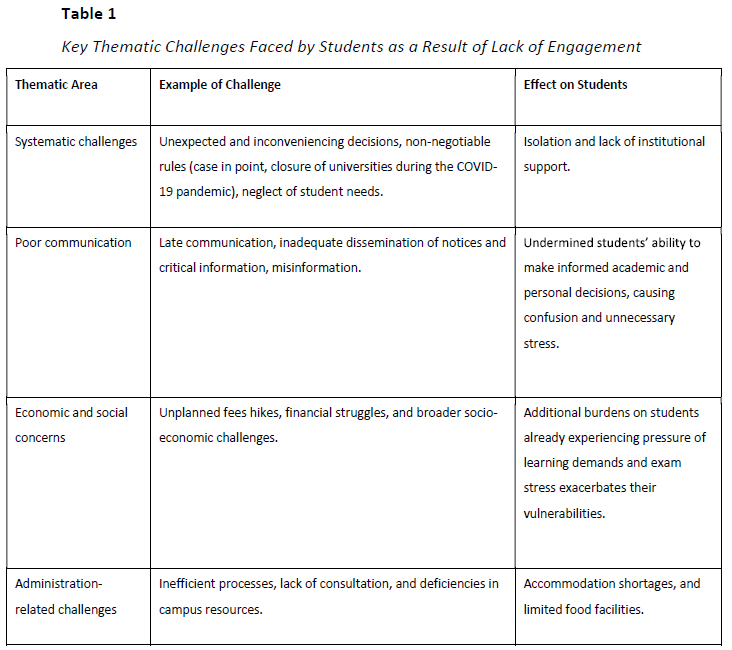
Another question related to what challenges students encountered as a result of lack of engagement. Key issues that emerged from students' responses were organised into four major themes as shown in Table 1.
The themes presented in Table 1 reflect an environment that neglects to sufficiently integrate student well-being and participation into institutional decision-making processes. To support this, Student 33 pointed out that the lack of acknowledgement of students' grievances deprives students of quality learning experiences. Students, at times do not receive proper lectures and have nowhere to complain or, if they do, they are often ignored. This tends to give lecturers too much power and allows them to bully and abuse students. Student 33 wrote:
Some administrative staff members also ill-treat students as they feel they have the upper hand and students are not important. We are viewed as insignificant elements in the university structure, yet without us, there would be no universities.
This confirms Altbach's (2018, p. xi) assertion that "universities would not exist without students. Students are at the heart of the academic enterprise." When students are trivialised in the university structures, they do not feel the importance of upholding and preserving the values, goals, outcomes, and property of the universities they belong to. It is important that students be involved in university governance as suggested by Dunne and Zanstra (2011) in their Students as Change Agents Model.
A large proportion (60%) of undergraduate students pointed out that one of the biggest challenges facing students as a result of lack of engagement and involvement is unfair practices by lecturers and ill-treatment by university administrators. Most (80%) of the undergraduate students who complained of ill-treatment by lecturers and administrators were from South African and Zimbabwean universities. As stressed by Student 7:
At times we have solutions to issues that may be troubling administrators, for instance, online registration, but we are not given a chance to assist since those in charge of the process tend to be foul mouthed and do not take time to listen to some suggestions we make. In the end, some people fail to register on time or register at all leading to loss of higher education opportunities for our colleagues.
Thus, viewing students as partners in university governance becomes a transformative factor for the African university. Giving students an opportunity to evaluate their university experiences and engaging them to become co-creators of solutions allows for the provision of quality feedback, which is central to the provision of quality learning experiences. It also helps in the upholding of university values and achievement of goals.
Students were also asked which key areas they considered critical and required most engagement by university administrators, and they identified the following: academic experiences; students' welfare, and work-life balance for students who work for fees, accommodation and funding opportunities; administrative issues (particularly the relationship between administrative staff and students); and programme structures and learning models. The concerns raised by students are some of the issues that have often caused violent protests across African universities. It is this "overplayed and broken record" by students that is causing many instances of destructive protests. Thus, it is my argument that the new African university must seriously consider these concerns by engaging students as evaluators, partners, participants, and change agents to develop a new relationship that makes students an important element in higher education governance.
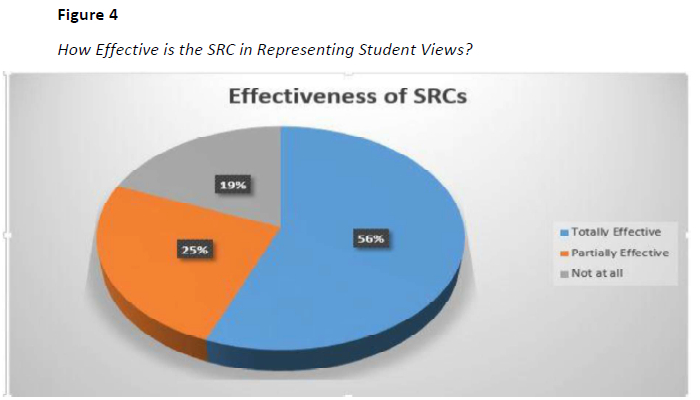
In the questionnaire, students were asked to comment on the effectiveness of SRCs in representing student views. The responses are shown in Figure 4.
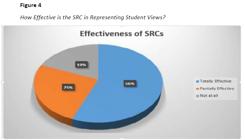
The results from data collected shows that 56% of the students believed that the SRC is an effective body, but only if given space to articulate the concerns and ideas of students. A quarter (25%) of the respondents stated that the SRC was partially effective and 19% did not see the effectiveness of the SRC, with some labelling them "useless." Student 48 explained why they feel that the SRC is effective, stating:
If the SRC can influence students to go on a protest against administrative decisions or non-decision, then imagine the power they have if they are allowed to sit on higher education governance bodies.
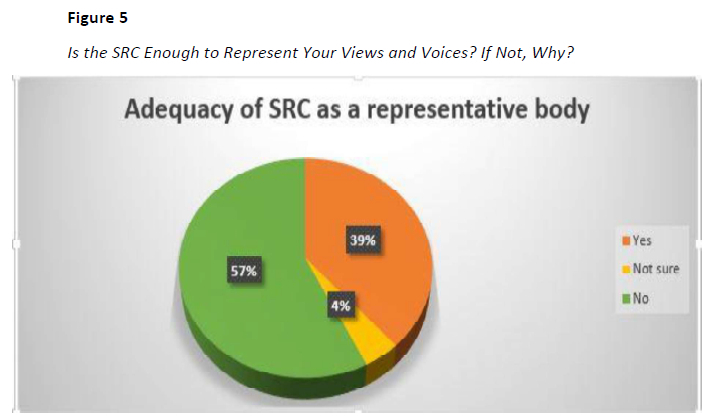
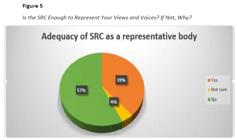
From the data collected, 57% of the respondents in universities across Africa do not believe that the SRC is enough to represent their views due to lack of full representation at departmental level (see Figure 5). This means that students feel that the SRC is not fully representative of the total students' body because some departments do not have representatives in the Council. Others described the SRC as useless since because does not engage with all students. One reason was that the SRC could
Do best if they concerned themselves with all students' concerns, especially on student finance. A non-politically aligned SRC in the new African university would be ideal. Politics is a true spoiler. (Student 102)
The above comment by Student 102 shows that students are being used by political parties or are using their positions in student leadership to settle political scores, thus turning students' concerns into political dialogue, a move that does not help students' activism.
The author strongly believes that if universities do not capture students through participatory involvement and dialogue, they will continue to be taken advantage of for political mileage by various political parties who have other agendas outside of education and skills impartation. Many (39%) of the respondents believed that the SRC is adequate as a representative body while 4% did not view them as adequate.
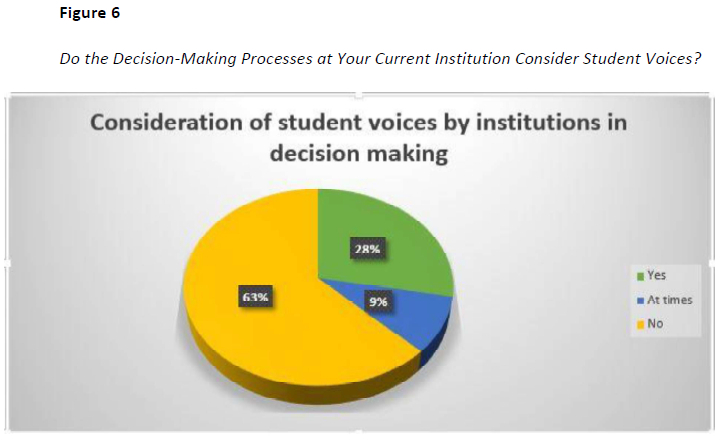
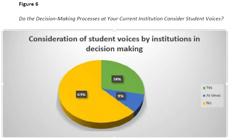
Data collected showed that 63% of respondents feel that their institutions do not consider student voices in decision-making, 28% feel that their voices are heard and only 9% feel that universities consider student voices sometimes (Figure 6). Most students therefore generally feel ignored and unacknowledged when they lodge complaints or have ideas to share.
One of the greatest challenges for higher education in Africa is "how to facilitate the creation of spaces in which the student voice is not merely demonstrated as being present, but in which that presence also has power, authenticity and validity" (Hall, 2017, p. 183). Thus, the question on what African universities can do better to ensure that student voices are heard and can be useful in influencing decision making on issues that involve them was posed to the student respondents.
In response to this, students advocated for a university system and culture that empowers and involves students in decision-making processes that potentially affect students. They further called upon university leadership not to pay lip-service to promises and policies because this has an effect on students' future outcomes. To improve the process of decision making in universities, it is important, according to the respondents, that more students participate in decision-making boards and create platforms for students to freely and safely voice their concerns and opinions as well as share ideas with higher education governing bodies. While SRCs are a central element in the relationship between administration and the student body, 80% of the students who responded to the questionnaire strongly felt that there is a need for better student representation through increased number of representatives and introduction of representation at departmental level. Student 69 commented: "Some departments have no representation in the SRC therefore making it difficult for their concerns to be heard." Most student revolts have been marred by insinuations of politics and affiliation of students to political parties such that some students believe that it is the politicisation of student concerns, which breaks the communication line. Thus, to improve communication, students suggested that students who are apolitical must lead SRCs, and should be allowed to sit on decision-making boards. The implication is that open-minded dialogue and democracy are key in participatory and inclusive student engagement, as suggested in Dunne and Zanstra's (2011) model of student involvement.
Key to student involvement and engagement in higher education governance is the element of students as participants, which allows the voices of students to be heard in various ways. Students were asked what would be the best way for student involvement in decision making and they suggested various strategies for gathering students' voices. These included:
• Surveys, questionnaires, and dialogue.
• Educating students on their rights to build interest in decision making.
• Participatory workshops and forums between students and administrators.
• Engagement at all levels to ensure efficient information dissemination within all spheres of university.
• Elected student leadership must engage students and not make decisions that are politically motivated.
• Using the voting system.
• Fair representation of students across departments.
These responses indicate a willingness by students to be involved and engaged in governance issues through dialogue and participatory engagement (Luescher et al., 2016).
Technology has become central to education and the emergence of the COVID-19 pandemic made it more apparent that the new African university has to make it a priority. The researcher asked students how the new African university should involve students in ensuring effective and efficient utilisation of ICTs. Students indicated that the recent COVID-19 pandemic exposed the inequalities between students with some failing to access technology due to economic challenges. In light of this challenge, student respondents suggested that in the new African university, public-private partnerships should be developed to assist students in acquiring the required gadgets and technology support, such as affordable data and efficient campus wi-fi, to enable full participation by students. Others suggested blended learning, which considers both online and one-on-one learning models. With electricity continually being cut off, 90% of students suggested that the government and relevant stakeholders consider solar energy as the main source of power in academic institutions to reduce power loss that affects technology use. The importance of lecturers getting training in technology use and integration was raised because most students felt that the quality of lectures delivered during online learning was largely affected by the inability to use technology by some lecturers. Providing techno spaces that are user friendly would also make the university more inclusive. As opined by Dunne and Zanstra (2011), giving students an opportunity to generate their own ideas makes them co-creators and co-owners of universities, and brings about positive change that is key in achieving set outcomes. The suggestions by students show that engaging students as evaluators of university experiences can potentially improve quality.
In a follow up question, the researcher asked respondents what they envisioned in the new African university. They said they envision a university in which student voices are heard and supported by providing affordable and equal access to education, creating an environment that nurtures inclusivity and diversity as well as creates and promotes balance between education and socio-economic conditions of students. They further pointed to a university that prioritises better quality and learning standards; better cohesion, cooperation, and communication between administration and students; provision of more funding for students from low-income families; and a listening leadership that takes serious consideration of students concerns. The new African university, according to the majority of students who participated in this study, should be able to hire and produce, not only educated or certified academics, but highly intellectual individuals.
The most common response among the students related to the availability of efficient online systems and platforms. Student 23 stressed the importance of "a university with proper IT infrastructure and flexible learning models with student engagements being at the forefront." The implication of this desire by students indicates how technology has become a key component for teaching and learning in higher education. The COVID-19 pandemic exposed the technology gaps and effect of the digital divide on students, and the level of technological preparedness within higher education institutions. Many (70%) of the respondents identified lack of access to technology as one of the factors that disturbed online learning hence, they envision the new African university to have adequate access to technology that is affordable to all students regardless of socio-economic background. It would be highly interesting to further engage students and SRCs across Africa in designing and proposing higher education models for the new African university in terms of academic aspects (programme structures and learning models), students' welfare, funding, and administrative issues relevant to students' life at university.
Changing the Trajectory Towards a New African University
To ensure the shaping of a new African university that is robust and provides meaningful contribution to society, it is important to consider setting up SRCs that are representative of each of the faculties in the institution by the students' body. The selected SRC representatives should engage all students to ensure full representation of concerns. University administration must give thought to the involvement of students, through said council, in decisions that directly affect students. Both students and university administration must avoid physical confrontation and students' protests through inclusive and participatory involvement. This should emanate from university administrators being transparent, especially with the financial position of the institution so that students do not base their conclusion on assumptions.
To the politician, the continued clashes between students and administrators is a sign of a revolution and political interest by students, yet the researcher believes that these are cries for attention-for a voice in issues affecting the daily conditions of university students. It is a pointer to the inadequacies of the higher education decision-making system that is authoritarian in nature, exclusory in decision making, and generally dictatorial both in structure and processes (Mashayamombe & Nomvete, 2021). The perception by students is that when institutional management ignores their petitions and statements, they can only be forced by confrontational physical violence to address their grievances. The envisaged new African university needs to move away from student violence as a mechanism for attaining set goals and coercing university management to listen to student needs and concerns. The new African university must speak and practise inclusivity in all its spheres. It must seek to understand genuine student concerns through participatory student involvement and dialogue.
Assumptions of what students want should not be used to make decisions; rather, consultative and inclusive stakeholder connections must be employed to garner thoughts and ideas around key issues that end up affecting students in higher education. It is critical to develop systems that allow for dialogue and transparency so there are not assumptions with regards to the needs of students in higher education (Davids & Waghid, 2020; Fomunyam, 2017). Students in higher education are key to development at global level, therefore universities must accord them the opportunity to exercise the skills that the global community will require post graduation. The four important roles that students need to play as part of student-inclusive governance in higher education should focus on students as evaluators of the curriculum, students as participants in planning and executing functions that advance university goals, students as partners, and students as change agents as reflected in the model by Dunne and Zanstra (2011). Prescribing the needs, and ignoring the voices, of African students has led to continued strife between university administrators and students thus leading to contemptuous relationships that do not support development (Holdt, 2012).
Giving students a voice and a role in university governance is key in shaping a generation that co-creates and co-owns university objectives and goals. In this way, they will be willing to protect university legacies and fight against rampant and unnecessary destruction of university property and the future of higher education (Daniel, 2018). The new African university has to forge ahead together with students rather than viewing students as mere consumers of what universities offer.
Conclusion
The recurring violence in university student protests-marked by torched buildings, burnt cars, and even loss of life-reveals a profound disconnect between students and university administrators. This pattern underscores the marginalisation of students in higher education governance, where their concerns often go unheard until expressed through extreme actions. A truly transformative African university must decolonise traditional higher education governance processes and systems by fostering inclusive dialogue, prioritising student voices, and embedding them at the core of decision-making processes. The future of higher education in Africa depends on institutions that recognise students not as outsiders, but as essential stakeholders in shaping a system that serves them.
References
- Aghedo, I. (2015). Values and violence: Explaining the criminalization of higher education students in Nigeria. Journal of Black Studies, 46(2), 172-198. https://doi.org/10.1177/0021934714562959
- Altbach, P. G. (2018). Student politics in America: A historical analysis. Routledge.
- Daniel, L. (2018, August 08). Counting the costs of Fees Must Fall protests: Damages totalling R800 million. The South African. https://www.thesouthafrican.com/news/fees-must-fall-protests-damages-r800-million/
- Davids, N. (2014). Gratitude as an enactment of democratic citizenship education. South African Journal of Higher Education, 28(5), 1513-1524. https://doi.org/10.20853/28-5-416
- Davids, N., & Waghid, Y. (Eds.). (2020). University education, controversy and democratic citizenship. Springer.
- Duncan, J. (2016, September 30). "Burn to be heard": #FeesMustFall in South Africa has turned violent. https://africanarguments.org/2016/09/burn-to-be-heard-why-feesmustfall-in-south-africa-has-turned-violent/
- Dunne, E., & Zanstra, R. (2011). Students as change agents: New ways of engaging with learning and teaching in higher education. Escalate. https://dera.ioe.ac.uk/id/eprint/14767
- Fomunyam, K. G. (2017). Student protests and the culture of violence at African universities: An inherited ideological trait. Yesterday and Today, 17, 38-55. https://doi.org/10.17159/2223-0386/2017/n17a3
- Holdt, K. V. (2012). The violence of order, order of violence: Between Fanon and Bourdieu. Current Sociology, 61(2), 112-131. https://doi.org/10.1007/978-3-030-56985-3_9
- Hungwe, J. P., & Divala, J. J. (2020). "Burn to be heard": The (in)dispensability of "revolutionary" violence in student protests and responsible citizenship in African public universities. In N. Davids& Y. Waghid (Eds.), University education, controversy and democratic citizenship (pp. 147-166). Palgrave Macmillan.
- Klemenčič, M. (2014). Student power in a global perspective and contemporary trends in student organising. Studies in Higher Education, 39(3), 396-411. https://doi.org/10.1080/03075079.2014.896177.
- Luescher, T. M., Klemečič, M., & Jowi, J. O. (Eds.). (2016). Student politics in Africa: Representation and activism. African Minds.
- Mashayamombe, J., & Nomvete, S. (2021). Leadership and politics of belonging in a 2015 FeesMustFall Movement: A case of uprising. Politikon, 48(1), 41-56. https://doi.org/10.1080/02589346.2021.1877454.
- Mlambo, A. S. (2013). Student activism in a time of crisis-Zimbabwe 2000-2010: A tentative exploration. Journal of Contemporary History, 38(1), 184-204. https://repository.up.ac.za/bitstreams/9352b574-fe22-4453-b790-655f6ff7fa8d/download
- Mudehwe-Gonhovi, F. R., Galloway, G., & Moyo, G. (2018). Dialogic pedagogical innovation: Creating liberating learning practices for first-year university students. South African Journal of Higher Education, 32(5),140-157. https://doi.org/10.20853/32-5-2111
- Mugume, T., & Luescher, T. M. (2017). Student representation and the relationship between student leaders and political parties: The case of Makerere University. South African Journal of Higher Education, 31(3), 154-171. http://dx.doi.org/10.20853/31-3-639
- Nkinyangi, J. A. A. (1991). Student protests in sub-Saharan Africa. Higher Education, 22(2), 157-173. https://doi.org/10.1007/BF00137474
- Rahaman, F. (2024). Governance: Meaning, types and characteristics. The Social Science Review: A Multidisciplinary Journal, 2(6), 84-87. https://doi.org/10.70096/tssr.240206014
- Rahim, A. (2019). Governance and good governance: A conceptual perspective. Journal of Public Administration and Governance, 9(3), 133-142, https://dx.doi.org/10.5296/jpag.v9i3.15417
- Rapatsa, M. (2017). Student activists or student anarchists? South Africa's contemporary student protests reviewed. European Review of Applied Sociology, 10(15), 13-20. https://doi.org/10.1515/eras-2017-0005
- Ruwoko, E. (2020, September 01). Series of student arrests "points to erosion of progressive rights." University World News. https://www.universityworldnews.com/post.php?story=20200901064928971
- Seale, J. (2016). How can we confidently judge the extent to which student voice in higher education has been genuinely amplified? A proposal for a new evaluation framework. Research Papers in Education, 31(2),212-233. https://doi.org/10.1080/02671522.2015.1027726
- Sikhakhane, M., Govender, S., & Maphalala, M. C. (2020). Investigating pedagogical paradigm shift in the 21st century teaching and learning in South African secondary schools. International Journal of Education and Practice, 8(4), 705-719. http://dx.doi.org/10.18488/iournal.61.2020.84.705.719
- Strydom, F., & Loots, S. (2020). The student voice as contributor to quality education through institutional design. South African Journal of Higher Education, 34(5), 20-34. https://doi.org/10.20853/34-5-4263
- Stuurman, S. (2018). Student activism in a time of crisis in South Africa: The quest for "black power." South African Journal of Education, 38(4), 1-8. https://doi.org/10.15700/saje.v38n4a1704
- Ting, H., Memon, M. A., Thurasamy, R., & Cheah, J. (2025). Snowball sampling: A review and guidelines for survey research. Asian Journal of Business Research, 15(1), 1-15. https://10.14707/ajbr.250186
- Tyrrell, J., & Varnham, S. (2015). The student voice in university decision making. Higher Education and the Law, 30-40. http://hdl.handle.net/10453/47797
- Waghid, Y. (2019.) Quality, dissonance and rhythm within higher education. South African Journal of Higher Education, 33(3), 1-7. https://doi.org/10.20853/33-3-3569
- Wolhuter, C., & Langa, P. (2021). Management and governance in higher education: South African universities under siege. Acta Paedagogica Vilnensia, 46, 105-118. https://dx.doi.org/10.5296/jpag.v9i3.15417