From Employability to Emancipation: Reconceptualising TVET Through Ecological, Gender, and Social Justice Lenses
Abstract
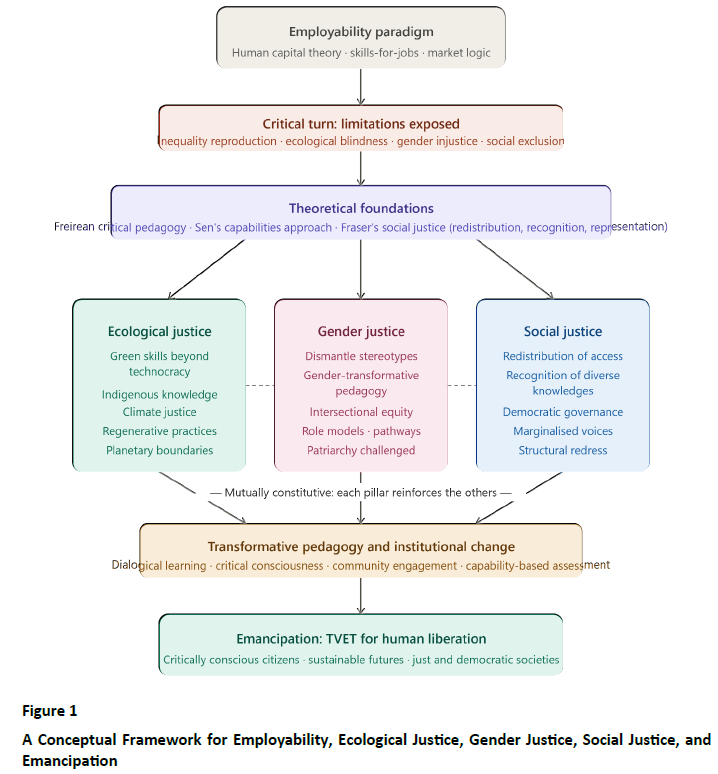
The transformative potential of technical and vocational education and training (TVET) as a tool for socioeconomic development is well documented, yet it remains underutilised. This reimagination draws on critical theories such as Freirean pedagogy, capabilities approach, and feminist political ecology to re-space TVET from instrumentality. In terms of ecology, TVET can generate green skills that transcend the narrow green economy's technocratic solutions and provide a critical awareness about unsustainable modes of production, climate justice, and regenerative practices. Gender justice is the dismantling of centralised stereotypes that segregate trades where women are underrepresented within trades aligned with science, technology, engineering, and maths, men in caregiving professions, and promoting gender-transformative pedagogical approaches. This is inclusive of recruitment, role models, and curriculum to tackle intersectional inequalities and support students to challenge patriarchal norms and provide equal opportunities to participate in future sustainable jobs. The social justice lens highlights particular attention to include marginalised communities and resist them being excluded based on their class, race, ethnicity, disability, or geography. Transformed TVET goes beyond employability to cultivate ecologically sensitive, gender-equitable, and socially just future ways of being. This redirection requires political, institutional, and pedagogical renewal to become TVET for all as a genuinely democratic and liberating force.
Ecological Justice; Employability; Gender Justice; Social Justice; Transformative Education
 Thumbnail