From Employability to Emancipation: Reconceptualising TVET Through Ecological, Gender, and Social Justice Lenses
Abstract
The transformative potential of technical and vocational education and training (TVET) as a tool for socioeconomic development is well documented, yet it remains underutilised. This reimagination draws on critical theories such as Freirean pedagogy, capabilities approach, and feminist political ecology to re-space TVET from instrumentality. In terms of ecology, TVET can generate green skills that transcend the narrow green economy's technocratic solutions and provide a critical awareness about unsustainable modes of production, climate justice, and regenerative practices. Gender justice is the dismantling of centralised stereotypes that segregate trades where women are underrepresented within trades aligned with science, technology, engineering, and maths, men in caregiving professions, and promoting gender-transformative pedagogical approaches. This is inclusive of recruitment, role models, and curriculum to tackle intersectional inequalities and support students to challenge patriarchal norms and provide equal opportunities to participate in future sustainable jobs. The social justice lens highlights particular attention to include marginalised communities and resist them being excluded based on their class, race, ethnicity, disability, or geography. Transformed TVET goes beyond employability to cultivate ecologically sensitive, gender-equitable, and socially just future ways of being. This redirection requires political, institutional, and pedagogical renewal to become TVET for all as a genuinely democratic and liberating force.
Ecological Justice; Employability; Gender Justice; Social Justice; Transformative Education
Introduction
Technical and vocational education and training (TVET) is touted as a practical response to skills shortages, youth unemployment, and economic competition in both developed and developing nations. Influenced by human capital theory, dominant policy discourses conceptualise TVET primarily in terms of employability, focusing on the development of job-related skills that can increase productivity and facilitate easy re-insertion in the labour market (McGrath & Powell, 2016). While this strategy has produced measurable results in terms of employment outcomes in certain contexts, it is becoming increasingly clear that it has significant weaknesses. Narrow, employability-focused models are also known to reproduce existing inequalities, serve short-term rather than long-term needs of the labour market, and are increasingly challenged to respond adequately to intersecting crises of ecological destruction, gender injustice, and social exclusion.
This paper makes the case that a re-visioning of TVET is long overdue: from an employability paradigm to one of emancipation and liberatory human development. Through an ecological, gender, and social justice lens, it advances TVET to provide transformative education that enables not only skilled workers but also critically conscious, agentic citizens who can shape sustainable, just, and democratic societies. This follows the general trend in the literature to call for TVET to move beyond its neoliberal instrumentalism and to focus on holistic human development.
The limitations of the current employability-centric model are well-documented. Human capital approaches, which underpin much TVET policy, tend to reduce education to its economic utility, often resulting in curricula that are narrowly skills-based and responsive primarily to immediate industry needs. Empirical studies show mixed or limited impacts on long-term employment quality, particularly for marginalised groups, and highlight risks of reproducing class, gender, and regional hierarchies (Generalao et al., 2025). In many Global South contexts, TVET graduates, especially women and those from disadvantaged backgrounds, face persistent barriers to decent work, while programmes frequently overlook environmental sustainability and social cohesion.
A capabilities approach, inspired by Sen and Nussbaum, offers a compelling alternative foundation. Leon Tikly (2013) advocates reconceptualising TVET through a human capabilities and social justice framework, arguing that TVET should enable individuals and communities to develop the freedoms and functionings they have reason to value. This includes economic participation but extends to democratic citizenship, environmental stewardship, and personal well-being. Similarly, Wheelahan and Moodie (2016) propose a social justice framework for TVET that emphasises productive capabilities, inclusion, and the role of vocational education in building tolerant, sustainable societies.
The mainstreaming of the ecological paradigm within TVET is a pressing necessity at this moment (Vitalocca et al., 2026). The climate crisis calls for greening TVET where students are provided with competencies for sustainable livelihoods, circular economies, and climate resilience (UNESCO, 2026). Conventional methods have overlooked or worsened environmental destruction in the form of antiquated industrial practices. To ecologise TVET is to embed sustainability in curricula, foster green skills and a culture of planetary care, and shift greening out of the margins and from the sidelines of systemic transformation.
Gender justice is also a crucial frontier. TVET has a long history of gendering its curricula and delivery, with women being absent from elite technical areas and segregated into the care and low-pay sectors. Patriarchal values, traditional beliefs, and systemic discrimination impede women from participating and succeeding. Studies illustrate that TVET can either reinforce and, in turn, de-skill patriarchy, or it can be a site for patriarchy to be challenged through specific, transformative engagements (Wignall, 2023). A gender-transformative TVET would have to consider issues of access, persistence, pedagogy, and pathways into leadership as well as interrogate or disrupt wider power relations such as those of race, class, and ability.
Social justice paradigms further expand the lens. Intersectional forms of marginalisation based on class, race, disability, migration status, and location must be challenged in TVET. In a social justice TVET orientation, TVET is viewed as a right and not a second-rate option, and equity of access, acknowledgement of diverse knowledges, and redress are put in the forefront. With this, including critical consciousness, agency, and collective action at the core of individual students, where they can confront oppressive structures, if not simply adjust to them (Avis, 2023).
This rethinking is not simply cumulative but paradigmatic. It calls for a re-conceptualisation of the very purpose, the administration, the curriculum, the pedagogy, and the assessment of TVET. Beyond making compliant workers for existing labour markets, liberating TVET seeks to develop emancipated persons who can reconfigure those markets and societies around justice and sustainability. Such a vision speaks to global agendas such as the Sustainable Development Goals (specifically SDGs 4, 5, 8, and 13) but requires stronger measures going beyond rhetorical commitments. By detaching vocational education from limited employability imperatives, this reimagining elevates TVET as a critical tool for human liberation and planetary well-being for the 21st century.
The Employability Paradigm and Its Shortcomings
The dominant discourse in TVET policy and practice over the past three decades has been shaped by the employability paradigm. Rooted in human capital theory (Becker, 1964; Schultz, 1961), this paradigm conceptualises TVET primarily as an investment in individual skills that enhances productivity, labour market participation, and economic growth. Governments, international organisations such as the World Bank, Organisation for Economic Co-operation and Development, and International Labour Organization (ILO), and many national TVET strategies have prioritised aligning curricula with industry demands, promoting competency-based training, and measuring success through graduate employment rates and short-term earnings (McGrath & Powell, 2016). Although this perspective seems practical in the context of high youth unemployment and incessant technological change, many critical studies demonstrate its theoretical, empirical, and ethical inadequacies.
Ngcwangu (2019) maintains that the employability paradigm reduces education to a narrow instrumental function. TVET students are positioned as human resources whose value is determined by their immediate utility to the labour market. As a result, curricula are becoming more focused on technical expertise and employability skills (communication, teamwork, adaptability) and are less focused on the wider goals of education, including critical thinking, ethical reasoning, civic engagement, and creative problem-solving (Wheelahan & Moodie, 2016). Consequently, TVET is often perceived and experienced as a second-tier educational pathway, reinforcing social stratification rather than challenging it. Working-class, rural, and minority students are overrepresented in vocational tracks that provide few opportunities for further education or social advancement.
Empirical facts also invalidate the assumptions of the paradigm. Although certain studies report favourable short-term employment outcomes, especially for students who completed secondary education, a more comprehensive view suggests mixed and even non-existent effects on job quality, income stability, and career progression in the long run (Murshed, 2025). The need to rethink TVET and its connection to decent work is stressed by the fact that countless graduates now find themselves in unstable, poorly paid, or unregulated jobs. To complicate matters, there are systemic mismatches between what training providers offer and what the labour market requires, growing bigger with the speed of digitalisation and automation. Report after report on employers complaining about graduates who do not have the advanced technical skills or the flexibility and general, broad-based skills needed for ever-changing economic climates.
These failings of the paradigm are made more obvious when viewed through the prism of equity. Gender inequities are still stark. Women are often steered toward traditionally feminised fields such as hospitality, beauty therapy, or caregiving, which command lower status and remuneration, while facing cultural, institutional, and practical barriers in male-dominated trades like engineering, construction, and renewable energy technologies (Wignall, 2023). Similarly, students from low-income, Indigenous, or disabled backgrounds encounter structural exclusion. TVET systems frequently reproduce rather than mitigate intersecting inequalities based on class, race, geography, and disability.
Another key constraint of the paradigm is its inability to acknowledge the role of nature in shaping human existence. By overemphasising the short-term competition in the economy, TVET that is labour market oriented has, overall, reinforced unsustainable industrial paradigms. Programmes for training have generally failed to cover environmental issues, climate change adaptation, or circular economy and biodiversity conservation. This omission is even more shocking at a time of escalating climate crisis, when TVET could and should have a central role in green transitions for workers. Rather, the hegemonic model has the potential to lock societies in high-carbon trajectories, and underestimate the transformative competencies to enable just ecological transitions (Langthaler, 2021).
In theory, the employability paradigm is based on an erroneous view of human development. It presupposes that building individual skills necessarily leads to societal good and that market signals are a sufficient guide for educational demand. Capability theorists (e.g. Tikly, 2013) argue for a wider ideal, not unwarranted by Sen's (1999) theoretical lens. TVET should focus on expanding the real freedoms people need to pursue lives they have reason to value, including economic security as well as social, political, and ecological agency. This narrows the focus to employability and overlooks other functions and the potential of TVET to contribute to social cohesion, democratic engagement, and sustainable development. Moreover, the governance of the paradigm is also questionable. A high degree of industry collaboration and reliance on performance statistics related to employment outcomes can cause curricula to be dominated by business interests, and hence endanger academic integrity and neglect broader societal goals of education. In many places, this means implementing such courses within underfunded public TVET institutions, amid low societal esteem for vocational routes and professional development geared towards conformity rather than creativity (Avis, 2023).
These shortcomings are not merely technical failures but reflect deeper ideological assumptions about the purpose of education in a neoliberal era. By framing students primarily as future workers rather than as citizens, innovators, and stewards of the planet, the employability paradigm constrains TVET's emancipatory potential. A reconceptualisation is therefore not an optional enhancement but an ethical and practical necessity. The following section discusses an alternative framework that integrates ecological sustainability, gender justice, and broader social justice principles to reposition TVET as a vehicle for human emancipation and societal transformation.
Methodology and Theoretical Framework
This paper adopts a critical-constructive conceptual research design, drawing on systematic literature engagement, theoretical synthesis, and comparative case analysis to develop and advance an emancipatory framework for TVET. Conceptual research of this kind occupies a legitimate and important position within educational scholarship, particularly when the goal is paradigm critique and normative reorientation rather than the generation of new primary empirical data (Jabareen, 2009; Leshem & Trafford, 2007). The paper's contribution is theoretical and analytical; it synthesises existing knowledge across disciplinary boundaries, identifies gaps and contradictions in the dominant paradigm, and constructs a new analytical architecture that reframes existing debates and opens new directions for empirical inquiry.
Systematic searches were conducted across four primary academic databases: ERIC (Education Resources Information Centre), Scopus, Web of Science, and Google Scholar. Search terms were developed iteratively, corresponding to the paper's core thematic dimensions. The primary literature search focused on publications reflecting the period during which the current employability paradigm became dominant in global TVET policy, and during which critical responses to it developed most substantially. Foundational theoretical texts, including Freire (1970), Becker (1964), Schultz (1961), and Sen (1999), were included regardless of publication date, given their centrality to the theoretical framework. Key policy documents from UNESCO, ILO, and national governments were included from their publication dates, where relevant to the argument.
Case Selection: South Africa and Brazil
The choice of South Africa and Brazil as cases was deliberate, and as such, the comparisons made are expected to shed light on the contradictions and possibilities of emancipatory TVET reform within Global South contexts. The rationale for case selection is informed by Flyvbjerg's (2006) argument for purposive case selection in qualitative comparative research and by Yin's (2014) considerations for case study design.
Case Analysis Method
The analysis of the South African and Brazilian cases followed Bereday's (1964) four-stage comparative education methodology, adapted for the paper's specific analytical purposes.
• Stage 1: Description. Each case was described along six systematic dimensions: historical and structural context, policy architecture and governance, ecological justice integration, gender justice provisions, social justice orientation, and pedagogical culture and institutional readiness, drawing on the empirical and policy literature identified through the search process described above. Descriptions were constructed to be as empirically grounded as possible, distinguishing between what the literature documents as established practice and what policy documents articulate as aspiration.
• Stage 2: Interpretation. Using the paper's theoretical framework, system descriptive results for each case were interpreted to determine how each system's features reflected, contradicted, or partially exemplified the principles of the emancipatory TVET model. This interpretative stage was explicitly theoretical rather than empirical, employing the theoretical frameworks of critical pedagogy, capabilities theory, and social justice to empirical narratives instead of allowing these narratives to speak for themselves.
• Step 3: Contrasting. The narratives from the two case studies were then compared to identify convergences, divergences, and complementarities. This juxtaposition was structured by the six comparative dimensions established in the description stage, enabling systematic rather than impressionistic comparison. Structured comparison matrices were developed at this stage to make the juxtaposition analytically transparent.
• Stage 4: Comparison. Comparative conclusions were drawn from the juxtaposition, identifying patterns that hold across both cases, differences that illuminate context-specific factors, and complementarities that suggest directions for South-South learning. Comparative conclusions were assessed for their generalisability beyond the two cases and for their implications for the emancipatory TVET framework's theoretical claims.
Theoretical Framework Selection and Application
The selection of Freire's (1970) critical pedagogy, Sen's (1999) capabilities approach, and Fraser's (2008) social justice theory as the paper's theoretical foundations was not arbitrary, but reflects a deliberate analytical choice grounded in three criteria: theoretical complementarity, established application to education and TVET contexts, and normative adequacy for addressing the three justice dimensions central to the paper's argument. Tikly (2013) has applied the capabilities approach to TVET with relevance to African contexts. McGrath and Powell (2016) have elaborated both capabilities theory and social justice paradigms in their critique of TVET and development. Lotz-Sisitka et al. (2016, 2022) have integrated Freirean pedagogy and environmental and sustainability education in Southern African TVET contexts.
The three models were evaluated for whether they were suitable to address the three justice concerns at the heart of this paper. Critical pedagogy offers the means to teach ecological consciousness, gender norms deconstruction, and critical social analysis. The capabilities approach furnishes a normative basis for ecological justice by expanding human development theory to consider ecological functioning. Fraser's (2008) tripartite model enables the analysis to capture distinctions between redistribution, recognition, and representation in terms of gender and social justice.
Development of the Conceptual Framework
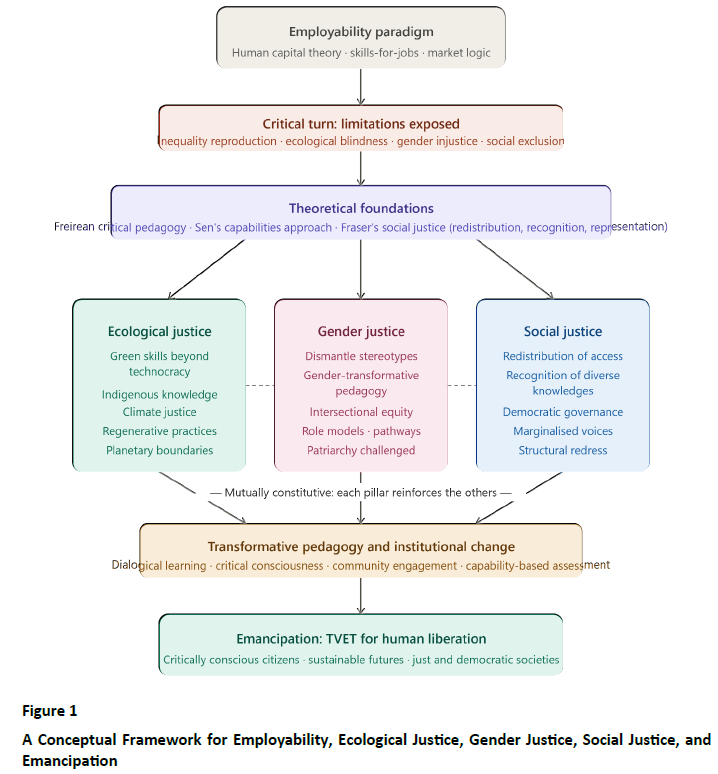
The paper's overarching analytical strategy is guided by Jabareen's (2009) approach to constructing a conceptual framework that consists of four phases: mapping and categorising selected literature, identifying and naming concepts, deconstructing and categorising concepts, and weaving concepts into a framework. This methodology is particularly suited to papers that synthesise across theoretical traditions to produce new analytical architectures rather than testing existing theories against empirical data. The deconstructed concepts were integrated into the emancipatory TVET framework through a process of identifying structural relationships among them (see Figure 1). At the top sits the employability paradigm, the current dominant model rooted in human capital theory, which feeds downward into a critique band identifying the structural failures that make reconceptualisation necessary: inequality reproduction, ecological blindness, gender injustice, and social exclusion.
Such critiques emerge within the three theoretical traditions which inform the emancipatory project, and these include: Freire's (1970) critical pedagogy, Sen's (1999) capabilities approach, and Fraser's (2008) three-dimensional social justice framework. The three pillars of ecological justice, gender justice, and social justice are depicted as parallel but connected laterally and are to be understood by the broken connectors between them. This visual choice reflects a core argument of the paper; these are not separate agendas but mutually constitutive dimensions. Ecological justice without gender equity risks reproducing green jobs in the same male-dominated patterns. Gender justice without social redistribution reaches only the least marginalised women. Social justice without ecological grounding prepares communities for a world that no longer exists.
All three pillars converge into the transformative pedagogy band, which represents the site of practical implementation of dialogical learning, critical consciousness, community engagement, and capability-based assessment. This layer is where theoretical commitments meet institutional reality. The framework culminates in emancipation; the production not merely of skilled workers but of critically conscious, agentic citizens capable of shaping sustainable, just, and democratic societies, the paper's central normative aspiration.
Alternative Viewpoints on the Employability Agenda and Human Capital Approaches
The TVET framework of this paper, underpinned by an emancipatory framework, is to be viewed within the sustained and formidable challenges from competing theoretical stances. Human capital revisionists such as Kraak (2008) and Hanushek and Woessmann (2015) posit that the failures of the employability paradigm are a result of the weakness of its application and not of the weakness of its theoretical framework, that a more complex human capital perspective should take account of equity and quality concerns without needing to discard the core of its framework. The pragmatic defence of employability, developed in South African contexts by Allais (2012), maintains that in societies where youth unemployment among those aged 15-34 years exceeded 46.5% in 2023, more expansive educational visions cannot take the place of the urgent moral priority of connecting young people to decent work, and that the order of reform must be determined by institutional capacity rather than theoretical ambition.
Political economists influenced by Hall and Soskice (2001) offer an even more fundamental critique, contending that TVET systems are functionally embedded in national political economies, and that the logics of these political economies cannot be changed through curriculum and pedagogy reform. And Allais (2014) empirically shows how South Africa's qualifications framework, explicitly designed for social justice, led to bureaucratic inflation and the proliferation of credentials without the structural mobility it promised, implying that the reconceptualisation of education in the absence of labour market transformation risks reproducing the very inequalities it purports to work against. Collectively, these concerns require that the emancipatory framework become clearer about what educational reform can realistically do within the constraints of the political economy of deep inequality and its notion of TVET's transformative potential be related to specific enabling institutional and governance conditions rather than only as an ideal (McGrath & Powell, 2016).
The strongest critique is certainly from post-development, decolonial scholarship, which argues that the emancipatory horizon, for all the salience of its progressive aspirations, reproduces the logic of modernity in its very epistemological roots. Sen's (1999) capabilities approach, Fraser's (2008) social justice philosophy and-although it is a stretch to include this as being among progressive Western liberal intellectual traditions-Freirean critical pedagogy also bear colonial epistemological legacies that privilege individualist, rationalist, Eurocentric notions of human agency and flourishing as being culturally universal (Grosfoguel, 2007; Mignolo, 2011).
Ndlovu-Gatsheni (2013) furthers this critique by asserting that African institutions of learning are still grounded in an epistemology of ignorance that systematically marginalises Indigenous forms of knowledge, and that to liberate Indigenous knowledge is to challenge how knowledge is viewed and valued because to necessitate Indigenous knowledge within a curriculum system that is still essentially Western in its logic and isomorphic in its claims cannot be the way for authentic decolonisation. Thus, the treatment of Ancestral knowledge through a framework such as Ubuntu philosophy and traditional ecological knowledge must move from the peripheral space of add-on accommodation to the centre of the theoretical project, portraying Western-based frameworks as merely one option to be considered among many within a true pluriversal knowing (Ndlovu-Gatsheni, 2013). Recognising these limitations does not negate the emancipatory framework, but rather clarifies it; the strongest stance is that the capabilities approach, Fraser's (2008) tripartite model, and Freirean praxis can be taken as transitional tools, while one is seeking, in sincere collaboration with Southern intellectual traditions, a more decolonised theoretical architecture that is commensurate with the epistemological complexity of TVET reform in post-colonial nation-states (Lotz-Sisitka et al., 2022).
Transforming TVET: Justice-Oriented Perspectives
The paper's most fundamental scholarly contribution is its construction of a three-dimensional emancipatory framework that integrates ecological justice, gender justice, and social justice as simultaneously operative, mutually constitutive lenses for reconceptualising TVET. While each of these dimensions has been applied to TVET separately in the existing literature, their systematic integration into a single, coherent analytical framework is particularly valuable. Wignall (2023) has examined gender-transformative approaches to vocational education with particular attention to patriarchal structures. What has been largely absent from the literature, and what this paper directly addresses, is a framework that treats these three dimensions not as separate reform agendas to be pursued in sequence or in parallel, but as analytically inseparable aspects of a single emancipatory project.
An overarching contribution is the paper's reframing of TVET's social status and institutional identity. The existing literature on TVET stigma and status has largely framed the problem as one of public perception to be addressed through marketing, quality improvement, and better articulation with higher education pathways. The paper advances a more fundamental argument; TVET's second-tier status is not primarily a perception problem but a structural consequence of its positioning within educational systems that reflect and reproduce class hierarchies, racial stratifications, and gendered divisions of labour. The normative implication that TVET should be reconstituted not as a better pathway into existing hierarchies but as a genuinely democratic institution committed to challenging those hierarchies represents a significant advance on the existing status debate.
Empirical Evidence on Ecological Justice in TVET
South Africa
Lotz-Sisitka and colleagues' (2016) extensive programme of research at Rhodes University's Environmental Learning Research Centre provides the most systematic empirical evidence on ecological learning in South African TVET. Their longitudinal study of the Fundisa for Change teacher and TVET educator development programme found that educators who participated in sustained professional development integrating critical environmental pedagogy with technical content significantly changed their teaching practices, moving from transmissive to dialogical approaches and reporting increased student engagement with local environmental issues. Critically, the study found that these pedagogical changes were most durable when supported by institutional structures, including curriculum team collaboration, college leadership endorsement, and community partnership frameworks, rather than when dependent on individual educator initiative alone.
Pesanayi's (2019) doctoral research on agricultural TVET in the Eastern Cape of South Africa provided empirical evidence of what place-based, ecologically grounded TVET looks like in practice. Working with smallholder farming communities and TVET agricultural programmes, Pesanayi documented how curriculum approaches that connected technical agricultural training to local water catchment management, indigenous seed conservation, and community food sovereignty produced graduates with stronger ecological agency and more contextually embedded technical skills than conventional agricultural TVET curricula. His work provides rare empirical evidence for the kind of Indigenous knowledge integration and community-embedded ecological TVET that the paper advocates theoretically.
Brazil
Caetano et al.'s (2021) study on the incorporation of environmental education in Brazilian vocational courses revealed that courses specifically based on popular education frameworks, using Freirean methodologies of thematic investigation to recognise local environmental issues as points of departure for curriculum development, were more effective in terms of ecological agency and community environmental participation than those that presented environmental content as an isolated curriculum module.
The Deutsche Gesellschaft für Internationale Zusammenarbeit (GIZ, 2021) evaluation of green skills programmes implemented through Serviço Nacional de Aprendizagem Industrial (SENAI) across multiple Brazilian states provided mixed empirical evidence. On the positive side, SENAI's renewable energy technician programmes in the Northeast, a major wind and solar resource site, had particularly strong results in employment and technical competence. But the evaluation noted that aspects of ecological citizenship (graduates' perspectives on energy justice, community ownership models, and the energy transition in Brazil and its distributive consequences) were weakly developed; that is, most programmes had a limited focus on installation and maintenance skills. This is a basis for affirming the theoretical integration of Freirean pedagogy with ecological justice in the paper.
Empirical Evidence on Gender Justice in TVET
Proven successful practices according to UNESCO-UNEVOC (2024) are transformational gender pedagogy that links critical thinking on gender norms with technical training such as role model programmes with successful women in trades, community engagement campaigns to confront parental and societal beliefs, and pathways for flexible learning that allow care responsibility, robust monitoring, and accountability systems with explicit gender targets.
South Africa
Matenda's (2020) study on women in engineering TVET programmes in Gauteng offered rich qualitative insights into the multiplicity of barriers encountered by Black African women in technical TVET. In narrative interviews with female students from three colleges, Matenda traced how sexual harassment by male students and teachers, the nonexistence of female role models in technical departments, and the incongruity of inflexible college schedules with students' caregiving commitments converged to drive dropout rates in women's engineering programmes that were far greater than any official figure because many women who left did so informally and not through formal deregistration. A study by three South African researchers (Friderichs et al., 2024) revealed that female technical graduates may be discriminated against by employers, and women often face hostile work environments in male-dominated sectors. That means lower pay, fewer chances for promotion, and more people dropping out of technical careers.
Brazil
Yannoulas' (2013) study on women and vocational education in Brazil synthesised findings from research programmes across multiple states, documenting persistent occupational segregation in SENAI and SENAC programmes and identifying the mechanisms through which this segregation was reproduced: curriculum materials depicting technical occupations as male-dominated, assessment practices that disadvantaged women's collaborative and contextual problem-solving approaches, and industry placement processes in which employer preferences for male candidates in technical roles were accommodated rather than challenged by TVET institutions. The evaluation of ILO-supported gender-inclusive green jobs programmes in the Brazilian renewable energy sector found that programmes that actively recruited women through community networks, provided mentorship from women already working in the sector, and engaged employers in advance on anti-discrimination commitments produced female participation rates of between 35% and 42% in renewable energy technician training-significantly above the sector average-and that 68% of female graduates from these programmes were still employed in the sector three years after completion (ILO, 2023).
Empirical Evidence on Social Justice in TVET
South Africa
Rogan and Reynolds' (2016) nationally representative quantitative research on outcomes for TVET graduates in South Africa, based on a sample of over 3,000 graduates followed up for three years, indicated that female technical graduates faced far poorer labour market outcomes than male graduates with the same qualifications, lower starting salaries, slower progression, higher levels of qualification-employment mismatch, and higher levels of exit from technical careers within two years of graduating. Baatjes' (2018) participatory action research with women in artisan training programmes in the Western Cape found that peer learning groups specifically designed to develop women's technical confidence and professional identity, which the authors termed communities of feminist practice, produced measurable improvements in programme completion rates and post-qualification employment outcomes compared to control groups receiving standard TVET provision. Critically, their evidence suggested that these improvements were sustained over a two-year follow-up period, addressing the common criticism that gender-transformative interventions produce short-term attitudinal change without durable structural impact.
Emerging Transformative Practices: A South Africa-Brazil Comparison
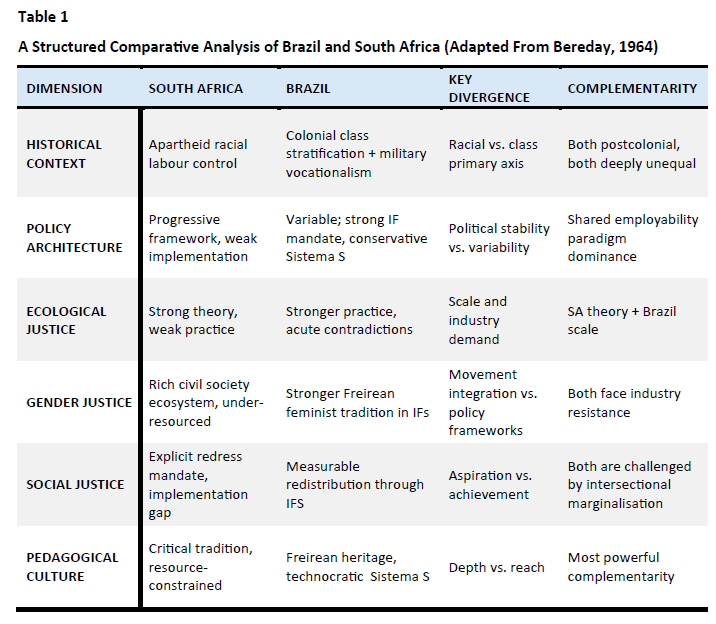
To further develop the analysis, this part includes a comparison with the TVET systems of South Africa and Brazil. The two are large, upper-middle-income countries with high inequality, colonial/ postcolonial histories, racialised populations, and a young workforce. They provide interesting examples of the tensions and potential for reorienting TVET past employability to ecological, gender and social justice (see Table 1)1
Persistent Challenges
South Africa's White Paper (Department of Higher Education and Training [DHET], 2013) and Brazil's (2008) Federal Institute mandate represent genuine political commitments to equity and social justice, yet both coexist with the persistent reproduction of the very inequalities they are designed to address. The comparison reveals that ecological, gender, and social justice dimensions of TVET reform face structurally similar implementation barriers in both contexts, even where the surface features of those barriers differ. In both countries, progressive TVET reform initiatives tend to be donor-dependent, geographically concentrated, and vulnerable to political and fiscal turbulence. Structural inequalities rooted in apartheid have become so entrenched that South Africa is struggling to escape them. TVET colleges are plagued by insufficient funding, obsolete facilities, high dropout rates, and weak linkages with universities. Gender segregation is still rife, and women are an integral minority in many technical trades. Ecological integration, such as it is, is glacial despite the country's Just Energy Transition commitments (DHET, 2023).
Brazil's system of TVET is more institutionalised and dominated by strong non-state organisations, such as SENAI (industrial) and SENAC (commercial/services). Although Brazil has seen greater coverage and stronger links with industry, ongoing challenges include disparities between regions (North/Northeast and South/Southeast), racial inequities (Afro-Brazilians and Indigenous peoples are notably absent from quality programmes), and gender biases, notably in engineering and green technology (Villalobos Barría & Klasen, 2016). Policy rhetoric in the two countries has been dominated by the employability paradigm, which has tended to promote narrow and short-term skills training that neither addresses structural unemployment nor equips students for socially just green transitions.
Emerging Transformative Practices
Brazil demonstrates several strengths in scale and innovation. SENAI has developed extensive green skills programmes in renewable energy, biofuels, and sustainable manufacturing, supported by strong industry partnerships. Gender initiatives include targeted recruitment and support for women in non-traditional trades. With improved funding arrangements and national coordination, the system is now able to support a broader range of social experimentation (GIZ, 2021; SENAI, 2013).
South Africa is innovative in its community practice and critical pedagogy. Several TVET colleges are piloting place-based curricula that address local ecological concerns and incorporate Indigenous knowledge and social justice (Lotz-Sisitka et al., 2022). Synergies at the grassroots level with NGOs and sector education and training authorities (SETAS) have resulted in promising gender transformative and green work; admittedly, these are fragmented and less scaled than in Brazil. While the South African system has greater potential to be critical, contextually responsive, and socially activist, influenced by its history of social movements, Brazil's system is stronger in technical quality and responsiveness to industry needs.
Tensions and Contradictions
Both countries reveal similar tensions. In Brazil, the strong industry influence through SENAI risks prioritising corporate needs over broader social and ecological justice goals. Positive employment outcomes are often skewed toward male and more privileged students (Villalobos Barría & Klasen, 2016). In South Africa, progressive policies frequently clash with resource gaps due to funding shortages and governance challenges (UNESCO-UNEVOC, 2024). A comparative analysis by de Villiers and de Villiers (2023) suggests that the size and industry linkage capabilities of Brazil may be a useful lesson for South Africa, and that South Africa's stressing of critical consciousness and engagement with social movements might provide some enlightenment to Brazil's more technocratic methods.
Green transitions remain challenging in both scenarios. Brazil has a head start in green skills for bioeconomy and renewables, but is accused of environmental racism in the Amazon. Although green job creation in South Africa's energy transformation may provide opportunities to democratise the labour market, without proper intervention, it may simply perpetuate previous forms of exclusion. At the heart of the shared contradictions is a gap between aspirations in policy (SDGs, green economy strategies, commitments to gender equality) and realities on the ground shaped by neoliberalism and politics of turbulence. This highlights the significance of context. Emancipatory TVET, therefore, must be situationally sensitive to localised histories of inequity and draw on cross-regional Global South experiences.
Pedagogy for Social Change
An ecological, gender, and social-justice-based reformulation of TVET is therefore more than curriculum reform; it is a radical reorientation of pedagogy. Traditional vocational pedagogy, often rooted in behaviourist and competency-based models, tends to treat students as passive recipients of technical skills designed to meet immediate industry demands. This approach reinforces the limitations of the employability paradigm by prioritising compliance, standardisation, and narrow workplace readiness over critical agency and transformative action. In contrast, a pedagogy of social transformation has TVET operating as an arena for liberation, conscientisation, and capacity enhancement.
Theoretical Foundations
The roots of this pedagogy are taken from three interwoven traditions. First, the critical pedagogy of Paulo Freire (1970) that criticises the banking concept of education, which treats students as bank accounts to be credited with knowledge, and advocates a problem-posing, dialogical method that fosters critical consciousness. Applying this mindset to TVET means going beyond teaching techniques of working to working for educating students to question the social, economic, and environmental conditions under which they live, find oppressive structures and, collectively, transform these. From this perspective, vocational education becomes a site for praxis, a coming together of reflection and action where, in addition to acquiring employable skills, students challenge dominant narratives of development, gendered logics, and ecological harm (Majola, 2025). In TVET, this entails teaching far more than isolated technical skills (such as welding or coding) but rather enabling students to critically examine the social, economic, and ecological conditions that shape their jobs and communities.
Second, Sen's (1999) capabilities approach articulates a vision of what should be. The purpose of a pedagogy is not just to prepare students to have certain capabilities, but to enable them to have these capabilities of functioning in a real sense. This means building capacity to obtain decent work, but also the capabilities of environmental stewardship, gender equity advocacy, democratic participation, and personal flourishing. Tikly (2013, p. 20) articulates this insight in relation to TVET, when he contends that vocational education should enable functionings "that individuals and communities have reason to value."
Thirdly, Fraser's (2008) tri-dimensional concept of social justice provides a feasible means for analysis. Transformative pedagogy must deal with redistribution (equalising access to good-quality learning materials and experiences), recognition (validating the value of diverse identities, cultural knowledges, and vocational pathways), and representation (ensuring students in general and particularly from marginalised groups have the opportunity to co-create curricula and to participate in institutional decision-making).
Features of Emancipatory TVET Pedagogy
The following key takeaways from Xaba's (2023) study suggest the interconnected features that should characterise a pedagogy for social change in TVET:
• Dialogical and participatory learning: Classrooms and workshops turn into sites of co-creation. Facilitators and participants get involved in generative themes derived from our lived experiences like unemployment among youth, gender-based violence in workplaces, or climate effects on local livelihoods. Group projects, community mapping, and reflective circles promote collective problem-solving.
• Fusion of technical and critical capacities: By giving students a strong foundation in technical skills as well as educating them to think critically about ecological systems, gender, and society. A course on solar installation, for instance, would have a technical component but also feature discussions on energy justice, models of community ownership, and the gender-related issues of energy sourcing.
• Intersectional and place-based education: Pedagogy should enhance how gender, race, class, and place intersect. That could mean examining how apartheid spatial planning shapes and constrains opportunities for TVET and green jobs in South Africa. In Brazil, it might distil the connection between agribusiness, deforestation, and Indigenous rights in agricultural TVET programmes.
• Experiential and community-engaged learning: Strong partnerships with local communities, cooperatives, NGOs, and social enterprises enable authentic work-integrated learning. Students might design sustainable farming systems with smallholder farmers or develop gender-sensitive renewable energy solutions for informal settlements.
• Reflective and transformative assessment: Assessment moves beyond standardised competency tests to include critical reflection journals, peer reviews, community feedback sessions, and portfolios that document both technical mastery and social impact.
Teacher Education and Institutional Support
The success of this pedagogy hinges on TVET lecturers. Current teacher training in many contexts remains technicist and insufficient for facilitating critical dialogue or addressing complex justice issues. Professional development programmes must therefore prioritise training in critical facilitation and conflict transformation-deepening lecturers' own ecological and gender consciousness, action research methodologies that enable educators to inquire into their own practice. Institutions must also create enabling conditions, such as smaller class sizes for dialogue, safe and inclusive learning environments, and reward systems that value transformative teaching alongside technical expertise. (Allais et al., 2019).
Implementing a pedagogy for social change faces significant obstacles, including resource constraints, resistance from industry partners focused on narrow skills, and policy environments that prioritise measurable employment outcomes. However, the South African and Brazilian cases demonstrate that hybrid models are possible. Brazilian SENAI programmes have successfully combined strong technical training with inclusion initiatives, while some South African colleges are pioneering community-engaged critical approaches. Transformative pedagogy for social change turns TVET from a tool of social reproduction into an instrument of social emancipation. It enables students to not only access the world of work, but also to transform it in the direction of greater ecological sustainability, gender equity, and social justice (Xaba, 2023).
Discussion on Resource Constraints, Policy Barriers, and Institutional Readiness for Change
Resource Constraints
Chronic Underfunding
The foundational problem is fiscal. South African TVET colleges have historically received significantly less public funding per student than universities, despite serving a student population that is, on average, more socioeconomically vulnerable and therefore more expensive to support adequately. The DHET's (2025) own reports acknowledge persistent backlogs in infrastructure maintenance, laboratory equipment, and digital connectivity across the college sector. Many campuses operate with outdated workshop machinery that cannot simulate contemporary industry conditions, let alone the green technologies that an ecologically just curriculum would require. When budgets are stretched simply to keep facilities functional, investing in curriculum transformation, lecturer development, and community engagement programmes becomes structurally very difficult (Development Bank of Southern Africa [DBSA], 2023).
The fiscal strain has been drastically exacerbated by the general deterioration in South Africa's macroeconomics. Load shedding, now partially ameliorated but still structurally unresolved, has disrupted college operations, damaged equipment, and increased operating costs. The post-COVID fiscal consolidation has constrained the National Student Financial Aid Scheme (NSFAS), which is the primary mechanism through which low-income students' access TVET. NSFAS disbursement failures, well-documented through parliamentary oversight reports, have caused students to drop out, not because of academic failure but because they cannot afford transport, food, or accommodation (DHET, 2025). Transformative pedagogy is simply inaccessible to a hungry, transport-deprived student.
Infrastructure Inequity
Resource constraints are not uniformly distributed. There is a sharp spatial gradient in college quality that maps almost perfectly onto apartheid geography. Colleges in Gauteng and the Western Cape tend to be better resourced, better connected to industry, and better staffed than those in Limpopo, the Eastern Cape, or the Northern Cape (DBSA, 2023). Rural and township campuses, precisely those serving the most marginalised students that the emancipatory framework most urgently targets, are disproportionately under-equipped. A gender-transformative curriculum, for instance, requires safe sanitation facilities, secure transportation, and childcare infrastructure. Many campuses lack all three, making the structural exclusion of women with care responsibilities not a cultural problem but a material one with a material solution that remains unfunded.
Digital Divide
The economy, as well as pedagogical practice, is becoming increasingly digitised, adding a further resource dimension. Emancipatory TVET, such as critical inquiry, participatory learning, and engaging with a variety of knowledge sources, requires an infrastructure of reliable internet connection and the availability of devices. Nevertheless, digital infrastructure in the South African TVET college system is still very uneven. Students who lack smartphones, data, or stable electricity at home are effectively excluded from blended and online learning modalities. Makhene (2023) views this as not merely an inconvenience but a structural barrier that reproduces the very exclusions the framework seeks to dismantle, and it demands not incremental improvement but a nationally coordinated infrastructure investment programme of a scale that current budgets do not contemplate.
Policy Barriers
The Employability Paradigm Embedded in Policy Architecture
Perhaps the most significant policy barrier is that the dominant employability paradigm is not merely an intellectual disposition but is structurally embedded in the instruments through which TVET is governed and evaluated. The primary performance metrics by which colleges are assessed (throughput rates, certification completion, and graduate employment figures), create powerful institutional incentives to prioritise narrow, measurable, short-term outputs over the broader capability development that emancipatory TVET demands (Majola et al., 2025). Lecturers and college managers who might personally be sympathetic to transformative approaches face accountability pressures that push relentlessly in the opposite direction. Systemic change requires changing these incentive structures, not merely changing minds.
The National Qualifications Framework and the SETA system, while important achievements in post-apartheid education architecture, have created their own rigidities (World Bank, 2023). The SETA funding model ties skills development levies to relatively short-term, employer-defined training priorities. This creates a structural bias toward industry needs as currently constituted rather than toward the socially and ecologically transformed economy that a justice-oriented TVET seeks to help create. Funding flows tend to follow existing economic structures, making it difficult to invest significantly in green skills for sectors that do not yet exist at scale, or in critical consciousness development that produces no immediately measurable industry output (Allais & Marock, 2024).
Coordination Failures Across Government Departments
Emancipatory TVET, by its nature, sits at the intersection of education, labour, environment, agriculture, energy, and social development policy. South Africa's departmental silos make coherent cross-sectoral coordination extraordinarily difficult. The Just Energy Transition Partnership, for instance, has significant implications for TVET curriculum in renewable energy, energy efficiency, and related trades. Yet the planning and funding of TVET's contribution to this transition has not been adequately integrated into the DHET's (2025) operational priorities. The biodiversity and climate change adaptation programmes of the Department of Forestry, Fisheries and the Environment (2020) have also not been consistently linked to (agricultural and environmental) TVET curricula. These are the missed coordination moments, which means transformative possibilities at those policy intersections are not taken up as a matter of course.
The Recognition of Prior Learning Problem
South Africa's Recognition of Prior Learning (RPL) policy is formally progressive; it acknowledges that marginalised communities have accumulated valuable knowledge and skills outside formal education systems. In practice, however, RPL implementation in TVET remains inconsistent, bureaucratically cumbersome, and structurally biased toward literate, formally documented knowledge (Majola et al., 2024). For Indigenous communities, rural smallholder farmers, or informal economy workers whose expertise is embodied and contextual rather than certificated, RPL as currently implemented offers little genuine recognition. This matters enormously for the Fraser (2008)-inspired recognition dimension of the framework: a TVET system that cannot practically acknowledge the value of Indigenous ecological knowledge or community-based skills cannot claim to be epistemically just, whatever its policy documents say.
Industry Influence and Its Limits
South Africa's TVET system is designed to be responsive to industry, and industry partnership is genuinely important for ensuring that graduates can access employment. But the current model of industry influence is asymmetric in ways that obstruct transformative change (Allais & Ngcwangu, 2025). Large corporate interests in mining, construction, and manufacturing have disproportionate influence over SETA priorities and curriculum direction. Smaller social enterprises, cooperatives, community-based organisations, and the informal economy, which are more likely to provide the kinds of decent, contextually embedded work that an emancipatory TVET would prepare graduates for, have far less structural voice. The result is a system calibrated toward the needs of existing large employers rather than toward the transformation of work itself.
Institutional Readiness for Change
Lecturer Capacity and Professional Identity
The most direct human resource constraint on institutional readiness is the current state of TVET lecturer preparation. Many South African TVET lecturers are industry practitioners who have been recruited for their technical expertise rather than their pedagogical capacity. This is not in itself a problem; industry experience is genuinely valuable, but it means that the professional development infrastructure needed to equip lecturers for critical, dialogical, gender-transformative, and ecologically conscious teaching is largely absent (Maluleke et al., 2024). Existing in-service training tends to focus on qualification upgrading and technical updating rather than on the philosophical reorientation and facilitation skills that emancipatory pedagogy demands.
Beyond skills, there is a professional identity question. Many TVET lecturers identify primarily as tradespeople or technical experts rather than as educators with a broader social mandate. Asking them to facilitate discussions about patriarchy, ecological justice, or colonial knowledge hierarchies can feel alien to their professional self-understanding and outside what they consider their legitimate role. Transforming institutional readiness, therefore, requires not only training programmes but a sustained, supported process of professional identity development, a form of conscientisation among educators themselves that mirrors what Freire envisions for students.
Organisational Culture and Resistance to Change
South African TVET colleges, like many large educational institutions, have developed organisational cultures shaped by decades of compliance-oriented management, hierarchical governance, and risk aversion (Allais & Ngcwangu, 2025). The post-apartheid transformation of the college sector involved significant amalgamations of previously racially segregated institutions, and the cultural and interpersonal legacies of those mergers have not been fully resolved in many places. In such cases, transformative change efforts, especially those involving the reorganisation of power relations, challenging the content of established curricula, or bringing community members into decision-making processes, may encounter strong opposition from the institution.
It is not always ideological. It is often just the fatigue of college staff under incredible resource strain, trying to care for massive student populations with very minimal support structures, while also complying with bureaucratic reporting requirements that are very complex (Allais & Ngcwangu, 2025). To expect already stretched lecturers and administrators to also take on the adoption of pedagogical change and social justice agendas without the necessary support, resources and workload adjustments is to invite a response of go through the motions rather than any real engagement.
Governance and Democratic Participation
South African TVET college governance structures formally include student representative councils and community stakeholders, but the depth of meaningful participation varies enormously in practice. Student governance at many colleges is constrained by short terms of office, limited institutional knowledge, inadequate administrative support, and political dynamics that do not always align with the interests of the most marginalised students. Representation of the community can also be tokenistic if community members do not have the information, time, and infrastructure needed to take an informed part in nuanced decisions about curriculum and policy (Majola, 2026).
The Stigma Problem
Lastly, and perhaps most significantly, the ability of institutions to transform TVET is limited by a longstanding negative perception of vocational education in South Africa. TVET is considered by students, parents, employers, and society in general as a "second-best" option for those who failed academically (Mahlangu & Mtshali, 2024). This attitude reflects the colonial and apartheid education system's marginalisation of manual, technical, and vocational knowledge, and it persists despite official policy statements seeking to recast TVET as a route of high value. This stigma influences patterns of recruitment, the motivation of students, the attitudes of employers, and the way college staff see themselves-in ways that stultify even the best-conceived programmes.
Limitations and Future Research
This paper is guided by conceptual considerations and makes use of secondary data and illustrative cases. Future empirical studies should assess the effects of justice-based TVET programmes employing mixed-methods designs combining life-history interviews with structured surveys, which would capture both the quantitative breadth and the qualitative texture of capability development. Crucially, such studies need to disaggregate data by gender, race, class, disability, and geography from the outset, rather than treating these as afterthoughts in analysis. Longitudinal professional development studies tracking how TVET lecturers' own ecological consciousness, gender awareness, and critical facilitation skills evolve, and how those changes ripple into student outcomes, would address a crucial implementation gap the paper identifies but does not resolve.
The framework invokes intersectionality but does not operationalise it. This calls for participatory action research methodologies where affected communities co-design the research questions, co-collect data, and co-interpret findings, ensuring that the voices most marginalised in current TVET systems are not merely studied but are epistemically central to the inquiry. If TVET curricula are to embed ecological literacy and gender-transformative content as core rather than peripheral elements, the field needs rigorous studies examining how such redesigns are received, implemented, and contested. Curriculum ethnographies, sustained observation, and interview studies inside colleges undergoing reform would illuminate the gap between policy intent and classroom reality.
The South Africa-Brazil comparison is intellectually productive but geographically narrow. The framework would be significantly strengthened by extending comparisons to other contexts: India's ITI system and its caste dynamics, Indonesia's TVET expansion amid rapid ecological degradation, sub-Saharan African contexts where informal economy integration is unavoidable, and small island developing states where climate vulnerability is existential. Horizontal South-South learning partnerships, rather than North-South knowledge transfer models, should anchor this comparative agenda methodologically and politically.
The paper repeatedly notes the gap between progressive policy rhetoric and implementation. Political economy analyses examining who resists justice-oriented reform and why, tracing the interests of industry bodies, government ministries, and international development organisations, would help explain why the distance between aspiration and practice is so persistent. Green skills research currently tends to measure narrow technical competencies, such as whether a graduate can install solar panels, rather than the deeper ecological agency the framework envisions. Developing and validating psychometric tools that measure ecological consciousness, systems-thinking capacity, and commitment to climate justice in TVET populations would fill a significant methodological void.
Conclusions and Implications
Redefining Educational Purpose Through the Capabilities Lens
The most foundational theoretical implication is the displacement of employment rates as the primary measure of TVET success by a capabilities-based conception of human flourishing. A capabilities lens demands that we ask not only whether graduates find jobs but whether they find decent jobs, whether they have a voice in their workplaces and communities, whether they are equipped to navigate ecological transitions, and whether they experience themselves as agents capable of shaping their circumstances rather than merely adapting to them.
Extending Freirean (1970) Praxis into Vocational Contexts
A second theoretical contribution is the systematic application of Freirean critical pedagogy to a domain of vocational and technical education where it has historically been underutilised. The emancipatory framework insists that praxis, the dialectical unity of critical reflection and transformative action, is as essential in a welding workshop or an agricultural training centre as it is in any other educational setting. Students learning solar installation should also be learning to interrogate energy justice. Students learning agroecology should also be developing the analytical tools to understand land dispossession.
Operationalising Fraser's (2008) Justice Dimensions in Educational Policy
The theoretical contribution here is the demonstration that justice in education is irreducibly three-dimensional: addressing material access without challenging cultural stigma produces formally inclusive but experientially hostile institutions; challenging cultural stigma without redistributing resources produces recognition without opportunity; and pursuing both without democratising governance produces paternalistic institutions that serve marginalised communities without being accountable to them. All three dimensions must be pursued simultaneously for genuine transformation to occur.
Intersectionality as Analytical Necessity
The framework also makes a theoretical contribution in its insistence on intersectional analysis. The experiences of Black African rural women with disabilities in South African TVET, or of undocumented young people in Brazilian vocational programmes, cannot be adequately understood by examining gender, race, class, disability, or geography separately. These axes of marginalisation compound and interact in ways that produce distinctive forms of disadvantage that single-axis analyses systematically miss. Theoretically, this means that emancipatory TVET must be built on an intersectional foundation from the outset, not as an afterthought or a supplementary lens, but as a constitutive analytical commitment that shapes how data are collected, how programmes are designed, and how success is measured.
Ecological Justice as a Capability
The most theoretically novel contribution is the integration of ecological justice into the capabilities framework. Sen's (1999) original formulation of the capabilities approach was relatively silent on environmental sustainability and planetary boundaries. The emancipatory TVET framework extends this tradition by arguing that ecological functioning, the capacity to live within the Earth's ecosystems, to understand and respond to climate change, to participate in just transitions, must be understood as a fundamental human capability, not an add-on to the core capabilities of economic participation and democratic citizenship. This extension has significant implications for how TVET curricula are designed, for what counts as green skills, and for the relationship between vocational education and the broader project of ecological civilisation transitions.
Curriculum Transformation as a Systemic ProjectThe practical implication for curriculum is not that ecological literacy, gender justice content, and social justice modules should be added to existing programmes as supplementary units. That additive approach has been tried and found wanting it produces peripheral content that is easily marginalised under time pressure and treated by students and lecturers alike as tangential to the "real" business of skills training. The emancipatory framework demands instead that these dimensions be integrated into the core of every vocational programme, shaping how technical content is framed, contextualised, and assessed. A construction curriculum that embeds green building principles, labour rights, and community impact considerations from the outset is fundamentally different from one that covers these topics in a standalone module.
Pedagogy as the Site of Transformation
The practical implication is a significant investment in TVET lecturer development, not as a one-off training event but as an ongoing, institutionally supported process of professional growth that takes the complexity of teaching for social change seriously. In South Africa specifically, where many TVET lecturers are industry practitioners who entered teaching primarily because of their technical expertise, this means building professional development pathways that honour and build on that expertise while expanding it in directions that the current system does not support or reward.
Institutional Culture as the Enabling Condition
The practical implication is that transformative TVET requires institutional culture change as a parallel and equally important project. This means creating conditions in which lecturers feel safe to experiment with new pedagogical approaches, in which student voice is genuinely incorporated into institutional decision-making, in which community partnerships are resourced and sustained rather than episodic and donor-dependent, and in which the success of transformative practice is recognised and rewarded rather than evaluated solely against narrow employment metrics.
Governance Reform as Democratic Practice
In practice, this involves establishing and properly supporting mechanisms through which marginalised communities can genuinely participate in decisions about what TVET focuses on, how it is provided, and how its success is evaluated. In South Africa, this entails a reconsideration of the SETA governance structure to accommodate a more balanced representation of community and social movement interests as well as industry. In Brazil, it means dismantling the relatively technocratic governance bodies of SENAI and SENAC to include the voices of the Afro-Brazilian, Indigenous, and working-class communities they claim to serve.
Policy and Funding Architecture
The current reliance on employer-led definitions of skills requirements through SETAs, and on measuring college performance primarily in terms of employment and pass rates creates structural incentives that are fundamentally misaligned with empowering goals. In practice, it means lobbying for ring-fenced funding for green curriculum development (and other gender-transformative programming) as well as for a capability- and equity-disaggregated set of indicators of TVET success. And lobbying for stronger cross-government coordination-among education, labour, environment, and social development-to allow TVET to coherently participate in just transitions, gender equality strategies, and social inclusion agendas that currently are departmental silos.
The South-South Learning Imperative
South Africa's emphasis on critical consciousness, social movement engagement, and community-responsive pedagogy offers something to Brazil's more technically accomplished but institutionally technocratic system. Brazil's scale, institutional infrastructure, and industry partnership capacity offer something to South Africa's chronically under-resourced and fragmented college sector. The practical implication is the development of sustained, well-resourced South-South exchange programmes, research partnerships, and policy learning networks that enable TVET systems in the Global South to learn from one another's strengths and failures rather than primarily from Northern models that were developed in fundamentally different political, economic, and ecological contexts.
References
Literature Identification
- Allais, S. (2012). Will skills save us? Rethinking the relationships between vocational education, skills development policies, and social policy in South Africa. International Journal of Educational Development, 32(5), 632-642. https://doi.org/10.1016/j.ijedudev.2012.01.001
- Allais, S. (2014). Selling out education: National qualifications frameworks and the neglect of knowledge. Sense Publishers.
- Allais, S., & Ngcwangu, S. (2025). "I wanna die a slow death when I'm busy with that annual training report. ": Why employer engagement for skills planning in South Africa goes wrong. International Journal of Educational Development, 113, 103217. https://doi.org/10.1016/j.ijedudev.2025.103217
- Allais, S., Papier, J., & Sayed, Y. (2019). Technical and vocational education and training: A framework for social justice. Education International. https://www.ei-ie.org
- Avis, J. (2023). In pursuit of equity: Vocational education and training and social justice. Journal of Vocational Education & Training. https://doi.org/10.1080/13596748.2023.2221119
- Baatjes, I. (Ed.). (2018). Learning for living: Towards a new vision for post-school learning in South Africa. HSRC Press. http://hdl.handle.net/20.500.11910/12244
- Becker, G. S. (1964). Human capital: A theoretical and empirical analysis, with special reference to education. University of Chicago Press.
- Bereday, G. Z. F. (1964). Comparative method in education. Holt, Rinehart & Winston.
- Brazil. (2008). Lei nº 11.892, de 29 de dezembro de 2008: Institui a Rede Federal de Educação Profissional, Científica e Tecnológica, cria os Institutos Federais de Educação, Ciência e Tecnologia, e dá outras providências [Law No. 11,892 of 29 December 2008: Establishes the Federal Network of Professional, Scientific and Technological Education, creates the Federal Institutes of Education, Science and Technology, and provides for other related matters]. https://www.jusbrasil.com.br/legislacao/92587/lei-11892-08
- Caetano, R. C., Martínez, S. A., & Silva, M. N. W. (2021). Overview of popular education in Brazil and the social movements: Freirean inspiration and contributions to the practice of critical environmental education. Revista de Educação Popular, 20(1). https://doi.org/10.14393/REP-2021-61600
- Department of Forestry, Fisheries and the Environment. (2020). National climate change adaptation strategy. https://www.dffe.gov.za/sites/default/files/docs/strategy.framework/ccaq/nationalclimatechange_adaptationstrategy2020.pdf
- Department of Higher Education and Training. (2013). White Paper for post-school education and training: Building an expanded, effective and integrated post-school system. https://www.dhet.gov.za/SiteAssets/Latest%20News/White%20paper%20for%20post-school%20education%20and%20training.pdf
- Department of Higher Education and Training. (2023). National plan for post-school education and training 2021-2030. https://www.dhet.gov.za/SiteAssets/NPPSET/DHET%20NPPSET%20_%20Web%20version%2018092023.pdf
- Department of Higher Education and Training. (2025). Revised strategic plan 2025-2030. https://www.dhet.gov.za/Strategic%20Plans/Strategic%20Plans/DHET%20TABLED%20REVISED%202025-2030%20STRATEGIC%20PLAN.pdf
- Deutsche Gesellschaft für Internationale Zusammenarbeit. (2021). TVET for green economic development and employment in Brazil. https://www.giz.de/en/projects/tvet-green-economic-development-and-employment-brazil
- Development Bank of Southern Africa. (2023). Going beyond the infrastructure funding gap: A South African perspective on TVET. https://www.dbsa.org/sites/default/files/media/documents/2023-08/Beyond%20the%20Gap%20-%20Technical%20and%20Vocational%20Education%20and%20Training%20-%202023.pdf
- Fraser, N. (2008). Scales of justice: Reimagining political space in a globalizing world. Columbia University Press.
- Freire, P. (1970). Pedagogy of the oppressed (M. B. Ramos, Trans.). Continuum
- Generalao, I. N. A., Balaoro, J. M., Lorenzo, P. J. M., & Rivera, J. P. R. (2025). Examining the effects of Technical Vocational Education and Training on employment outcomes in the Philippines. Philippine Institute for Development Studies.
- Hall, P. A., & Soskice, D. (Eds.). (2001). Varieties of capitalism: The institutional foundations of comparative advantage. Oxford University Press.
- Hanushek, E. A., & Woessmann, L. (2015). The knowledge capital of nations: Education and the economics of growth. MIT Press.
- International Labour Organization. (2023). Green jobs, an opportunity for women in Latin America: Climate change, gender and just transition. EUROCLIMA+ Programme. https://www.ilo.org/sites/default/files/wcmsp5/groups/public/@americas/@ro-lima/documents/publication/wcms_888590.pdf
- Langthaler, M. (2021). Skills for green and just transitions: Reflecting on the role of VET. Just Transition Alliance. https://justtransitionforall.com/
- Leshem, S., & Trafford, V. (2007). Overlooking the conceptual framework. Innovations in Education and Teaching International, 44(1), 93-105. https://doi.org/10.1080/14703290601081407
- Lotz-Sisitka, H., Belay, M., Mphepo, G., Chakraborty, R., Hebbar, M., Bhumika, T., Chikunda, C., Macgregor, S., Pesanayi, T., Sisitka, L., Shumba, O., & Taylor, A. (2022). Co-designing green skills and just transitions: Comparative perspectives. Rhodes University Environmental Learning Research Centre.
- Majola, E., Geduld, D., & Rangana, N. (2025). Critical pedagogy in context: Problematising the application of Paulo Freire's framework in TVET education in South Africa. International Journal of Training Research. https://doi.org/10.1080/14480220.2025.2531215
- Maluleke, M., Moeng, M., & Pepeta, B. (2024). The challenges of implementing a humanising pedagogy in TVET colleges in South Africa. Education as Change. https://unisapressjournals.co.za/index.php/EAC/article/view/18342
- Matenda, S. (2020). Experiences of women students in engineering studies at a TVET college in South Africa. Journal of Vocational, Adult and Continuing Education and Training, 3(1), 17-36. https://doi.org/10.14426/jovacet.v3i1.128
- McGrath, S., & Powell, L. (2016). Skills for sustainable development: Transforming vocational education and training. International Journal of Educational Development, 50, 12 -19. https://doi.org/10.1016/j.ijedudev.2016.05.006
- Mignolo, W. D. (2011). The darker side of Western modernity: Global futures, decolonial options. Duke University Press.
- Murshed, R. (2025). Is TVET more likely to lead to employment than general education? International Journal of Educational Development. https://doi.org/10.1016/j.ijedudev.2025.102XXX
- Ndlovu-Gatsheni, S. J. (2013). Empire, global coloniality and African subjectivity. Berghahn Books.
- Ngcwangu, S. (2019). Skills development and TVET policies in South Africa: The human capabilities approach. In S. McGrath, M. Mulder, J. Papier, & R. Suart (Eds.), Handbook of vocational education and training: Developments in the changing world of work (pp. 259-272). Springer. https://doi.org/10.1007/978-3-319-94532-3_4
- Pesanayi, V. T. (2019). Boundary-crossing learning in agricultural learning systems: Formative interventions for water and seed provision in southern Africa [Unpublished doctoral dissertation]. Rhodes University.
- Sen, A. (1999). Development as freedom. Oxford University Press.
- Serviço Nacional de Aprendizagem Industrial. (2013). SENAI actions for sustainable development. SENAI-DN.
- Tikly, L. (2013). Reconceptualising TVET and development: A human capability and social justice approach. In K. Ananiadou (Ed.), Revisiting global trends in TVET: Reflections on theory and practice (pp. 1-39). UNESCO-UNEVOC International Centre for Technical and Vocational Education and Training.
- UNESCO. (2026, February 3). Greening TVET: The essential skills that protect Nepal's future. https://www.unesco.org/en/articles/greening-tvet-essential-skills-protect-nepals-future
- UNESCO-UNEVOC. (2024). Empowering Africa's future through TVET: Research synthesis 2021-2024. UNESCO-UNEVOC International Centre for Technical and Vocational Education and Training.
- Villalobos Barría, C., & Klasen, S. (2016). The impact of SENAI's vocational training program on employment, wages, and mobility in Brazil: Lessons for Sub Saharan Africa? The Quarterly Review of Economics and Finance, 62, 74-96. https://doi.org/10.1016/j.qref.2016.07.010
- Wheelahan, L., & Moodie, G. (2016). Global trends in TVET: A framework for social justice. Education International. https://download.ei-ie.org/Docs/WebDepot/GlobalTrendsinTVET.pdf
- Wignall, R. (2023). Up-skilling women or de-skilling patriarchy? How TVET can challenge gender inequality. International Journal of Educational Development. https://doi.org/10.1016/j.ijedudev.2023.102XXX
- World Bank. (2023). Skills development in South Africa: Identifying issues for further analysis. https://documents1.worldbank.org/curated/en/099063023125520718/pdf/P1719940b8f0620c709b680a921a7bb4a20.pdf
- Xaba, J. (2023). Examining the role of vocational education and training within Black Economic Empowerment: The case of a steel-producing company in pre- and post-apartheid South Africa. Nordic Journal of African Studies, 32(4), 402-423. https://doi.org/10.53228/njas.v32i4.1002