What NGOs Reveal About Vocational Education's Possibilities
Abstract
Technical and vocational education and training (TVET) policy in South Africa is undergoing reform with increased emphasises on standardising curricula, benchmarking institutions, and tightening requirements for lecturer qualifications. These reforms, however, do not address the needs of marginalised youth and they limit innovative teaching. This article draws on qualitative research across three case studies of NGOs who operate adult and community education programmes on the Cape Flats in the Western Cape. The theoretical approach draws on an integrated framework that combines Freire's critical pedagogy, social capital theory, and Sen's capability approach. This analysis examines the NGO programmes as alternative models that reveal what vocational education achieves when freed from compliance structures. Across the three independent organisations, 926 coded excerpts revealed three findings: belonging functions as the foundational condition that should be established before any other development is possible, structural consciousness is embedded in the curriculum and continues across staff changes, and practitioner wisdom constitutes Indigenous theorising that produces frameworks that parallel academic theory through praxis. Educators who create programmes in response to the community context create different pedagogical possibilities. This study reveals how these programmes prioritise dialogical learning and local knowledge systems in ways that academicised TVET, as currently configured, tends not to accommodate. The study provides concrete examples of what humanising vocational education looks like in practice. The findings challenge the assumptions that academisation represents progress. The question shifts for decolonial TVET scholarship from how to build alternative approaches to why existing approaches are not being learned from.
Adult and Community Education; Critical Pedagogy; Decolonial Pedagogy; Vocational Education; Youth Unemployment
Introduction
The South African technical and vocational education and training (TVET) policy has been undergoing sustained reform, including lecturer professionalisation, curriculum alignment, and institutional benchmarking, all of which are actively pursued (Vally & Motala, 2022). Although the reform agenda is coherent and substantive, an important question is not specifically asked. That question is about whose circumstances vocational education is designed to address. That question is of great importance on the Cape Flats, where youth unemployment is not merely a skills deficit. It is the consequence of the structural inheritance of apartheid's spatial engineering that deliberately impoverished specific communities (Bridger, 2021; MacMaster, 2007). Young people from marginalised communities arrive at any vocational programme carrying that history with them. The labour market that they attempt to enter generally operates through mechanisms that standard policy frameworks rarely name.
This article makes a specific claim. Practitioners of three Cape Flats community organisations that provide adult and community education (ACE) have actualised what humanising vocational education can become. It has been developed as an operationalised reality, evidenced empirically, practised unofficially by those who enact it, and existing beyond regulatory systems. This article explores what this means for transformation and where TVET scholarship should look. The aim of this article is to examine what ACE programmes presented by three Cape Flats nongovernmental organisations (NGOs) reveal about the possibilities of vocational education when it operates outside formal compliance structures. The article addresses one question. "What do these programmes reveal about how ACE responds to the multidimensional nature of youth unemployment in a severely marginalised context?"
Three main conclusions follow from the collected data. The first is about belonging, where the data highlight how a relational pedagogy centred on belonging challenges the individualistic underpinnings of mainstream TVET. Belonging operates as the hierarchically prior condition through which development in other areas becomes possible (Nussbaum, 2011). The second conclusion is about structural consciousness. All three organisations integrate dialogical pedagogy and critical structural analysis, which their practitioners developed themselves and practise without academic influences. The third conclusion concerns knowledge itself. The frameworks that the facilitators produce through their practice constitute what Ndlovu-Gatsheni (2018) terms indigenous theorising: theoretical knowledge produced outside academia that merits scholarly engagement and recognition.
Together, these arguments dispute what the reform agenda holds to be true at its very core. Transformation will not come through the reform of existing institutions. It comes through learning from those at the margins who have already built what the reform agenda aspires to build (Vally & Motala, 2022). What NGOs reveal about vocational education's possibilities is not a vision of what could be built. It is evidence of what has already been built, by whom, and under what conditions. This article covers the theoretical foundations, the research approach, the surrounding circumstances, the findings, the discussion, and then the conclusion.
Theoretical Framework
This analysis is anchored in three theoretical frameworks selected for what they make visible in the Cape Flats context rather than for their theoretical comprehensiveness. Freire's (1970) critical pedagogy provides the epistemological foundation for this analysis. He criticises the banking model of education as the deposit of predetermined knowledge into passive recipients, leaving the structural conditions of learners' lives unaddressed. The NGOs studied reject the banking model. In fact, problem-posing pedagogy here starts with what learners already know and have experienced and then carries it into the learning space. It is also here that the facilitator becomes a co-investigator rather than a source of knowledge, thereby collapsing the hierarchical distance.
Freire's conscientisation, the development of critical structural awareness, becomes both the process and the goal. Consciousness is mapped by Freire (1973) along a continuum from naïve to critical. The transitional space between the two is an empirical pattern documented across all three case studies, in which structural and explanatory frames coexist, though uneasily, within the same participant narratives. Majola et al. (2025) extend the critical pedagogy framework to current South African TVET contexts, demonstrating that dialogical processes remain generative when institutional space allows them to operate. The social capital theory extends what critical pedagogy cannot see on its own. Critical pedagogy addresses consciousness; however, it does not address the relational infrastructure through which employment becomes accessible.
The social capital theory describes the relational network through which access to employment is understood. Bonding capital is the trust and solidarity generated within close networks and repeated interactions, which Coleman (1988) distinguishes from bridging connections. These are connections that carry information and resources across different social boundaries (Putnam, 2000). Woolcock and Narayan (2000) add the dimension of linking capital as the most consequential for marginalised communities. These are vertical connections to institutions, systems, and authority that most Cape Flats residents notably lack. Their prediction that communities with strong bonding capital will often lack bridging and linking is confirmed at programme entry across all three organisations. Lin (2000) conceptualises network poverty as the intersection of material deprivation and social isolation, which is typical of what participants carry in. Skills development without attention to network architecture would address only one dimension of a multidimensional structural problem. A third dimension is added by the capability approach, which both preceding frameworks leave unaddressed. The social capital theory identifies the network conditions of exclusion; however, it does not describe what prolonged exclusion does to individuals' sense of what is possible.
Sen (1999) developed the capability approach, which was then extended by Robeyns (2005) and Nussbaum (2011). It addresses what structural exclusion does to people over time and what education can realistically restore. Sen (1999) makes an essential foundational distinction between capability and functioning. A person could develop true capability through a programme and yet still be hindered from translating that capability into employment by material, social, or environmental factors that the programme did not change. They include factors such as transport costs, social networks, employer discrimination, gang territorial control, and age-based eligibility thresholds. The gap between capacity and opportunity is where the data of this research are most honest, and emphasise its analytical value. Without the concept of conversion factors, the gap between programme outcomes and employment may appear to be individual failure. However, with it, the gap can be accurately characterised as a structural mechanism. Across the dataset, practical reason, defined as the capability to form and pursue life plans with true self-direction, is identified as the primary individual-level outcome that structural exclusion erodes, and that effective ACE partially restores.
Sen's theory of adaptive preferences explains how deprivation leads people to downgrade their aspirations. This study adds to that theory by mapping the process through which it occurs. The selection of the three frameworks was not arbitrary. Critical pedagogy addresses epistemology and classroom politics. It cannot account for the relational infrastructure through which employment becomes accessible or remains inaccessible. It also does not theorise how ongoing exclusion affects the aspiration over time. The social capital theory addresses the relational conditions under which access to employment occurs. It does not theorise what ongoing exclusion does to personhood and agency. The capability approach addresses what people can do and what they can become. However, it cannot account for the collective political dimensions of the denial of capabilities. It also does not name the relational mechanism through which deprivation operates.
The three frameworks operate together by each explaining situations which the others cannot. Each framework explains one part of what unemployed youth on the Cape Flats face. The capability approach names the gap between training and work. When youth complete a programme yet remain unemployed, the approach locates the failure in that gap rather than in the person. Social capital theory explains why that gap is wider for some than for others. Those with bridging and linking ties hear about openings, secure introductions, and reach opportunities. Those with only bonding ties within an excluded community do not. Here the gap is relational, not personal. Critical pedagogy explains how youth make sense of being stuck. Without a structural reading, exclusion is felt as personal failure. Critical pedagogy explains how that happens and how it can change. Together, the three frameworks trace one predicament from its structural roots, through the relationships that spread it unevenly, to its effect on what youth believe is possible. De Lannoy et al. (2020) document that youth unemployment in severely marginalised South African contexts is multidimensional in exactly this way, shaped by structural, relational, and individual factors at the same time. Walker (2019) makes the same case in education, proposing epistemic capability as a foundational freedom that requires both the political conditions Freire (1973) theorises and the substantive freedoms Sen (1999) identifies. Ndlovu-Gatsheni's (2018) account of epistemic freedom provides the overarching commitment within which the three operate.
The Research Design
The study is situated within a critical constructivist paradigm, where knowledge is understood as socially produced, contextually embedded, and shaped by power relations (Korstjens & Moser, 2018; Lincoln & Guba, 1985). The chosen paradigm enables the analysis to name structural conditions without reducing participants to victims of their context. It further allows practitioner knowledge to be documented. A qualitative case study design allows for analytical rather than statistical generalisation. Findings confirmed across multiple source types within cases and confirmed across cases meet the analytical generalisation that Yin (2018) established. The findings presented here meet that criterion.
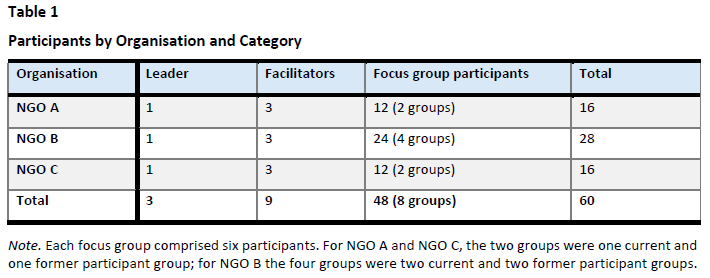
The three organisations are all community-based NGOs that run ACE programmes on the Cape Flats in the Western Cape. They have been coded NGO A, NGO B, and NGO C to maintain organisational anonymity. NGOs were selected using purposive sampling based on three criteria (Patton, 2015). Firstly, they had all been operating continuously in extremely marginalised communities with a primary focus on youth unemployment. Secondly, they had been established long enough to have a pool of retrospective participants. Thirdly, they run sufficiently different programmes so that cross-case findings could not be attributed to a single programme model alone. NGO A runs a faith-based holistic ACE programme. NGO B implements early childhood development learnerships and youth employment service internships. NGO C offers computer literacy, life skills, and entrepreneurship in a mobile library-based model. There are differences in programme infrastructure and contextual environment, and each dataset is completely independent of the others. The study involved 60 participants across the three organisations, and various organisational documents. Participant categories and numbers are shown in Table 1.
These sources were supplemented by organisational documents, including training manuals, annual reports, newsletters, and funding documents.
The data come from several types of sources within each case. Triangulation was achieved by combining interviews with organisational leaders and facilitators, participant feedback (current and former), and available documentation. A finding that is confirmed only by organisational leadership, for instance, is less credible than one confirmed by multiple independent sources, such as facilitators, participants, and programme documents. NGO A provides 333 coded excerpts from five source types. NGO B provides 333 excerpts from six source types. NGO C provides 260 excerpts from seven source types. The dataset contained 926 coded excerpts.
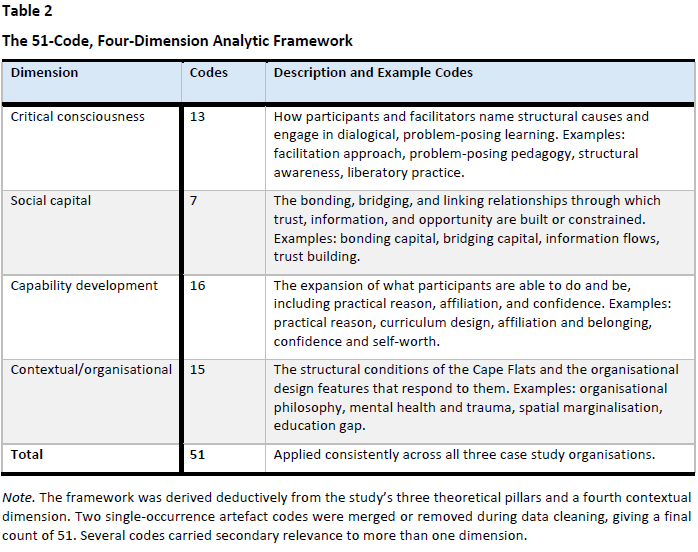
The analysis followed Braun and Clarke's (2022) reflexive thematic analysis across phases 3-5. A 51-code, four-dimensional analytic framework was applied consistently across cases. This framework was derived from the three theoretical pillars. The deductive approach meant that themes per case were generated through a structured coding process. The framework consisted of 51 codes across four analytic dimensions. They originated deductively from the study's three theoretical foundations together with a fourth contextual and organisational dimension. The critical consciousness dimension (13 codes) captured how participants and facilitators named structural causes of unemployment and engaged in dialogical learning. The social capital dimension (7 codes) captured the relationships through which trust, information, and access to opportunity were built or constrained. The capability development dimension (16 codes) captured the expansion of what participants were able to do and be. The contextual and organisational dimension (15 codes) captured the structural conditions of the Cape Flats and the design features through which programmes responded to them. The framework was applied consistently across all three cases, with the full set of codes presented in Table 2.
Inductive attention was also maintained for patterns extending beyond the framework's original dimensions. Where findings confirm theoretical positions, those positions are named. Where evidence extends existing understanding, the extension is argued from the data. Where the data support claims that the reviewed literature has not addressed, those claims are identified as original contributions. Both cross-case frequency and within-case triangulation depth informed analytical weight. Low-frequency patterns across multiple cases may carry less weight than a frequency confirmed across all source types within a single case. The basis for each claim's analytical status is stated throughout the findings.
Ethical clearance for the study was obtained from the University of South Africa. Informed consent was obtained from all participants, who were reminded that they could withdraw at any time. The three organisations were given generic names, and individual participants are referred to by role and organisation only. Some participants disclosed sensitive experiences, including psychological distress, suicidal ideation, and exposure to violence. These disclosures required particular care. A social worker was available throughout the fieldwork to support any participant affected, and participants were informed of this support before each session. Where such material is reported in this article, identifying details have been removed and quotations are attributed only by role and organisation, so that no individual can be identified. Attention was given throughout to protecting participants' anonymity, safety, and dignity.
The researcher's positionality should be noted because she is an NGO practitioner working in a similar Cape Flats context. This positions her as an insider close to the phenomenon under investigation. The researcher had access to insider knowledge within the specific context but was also at risk of bias as an NGO practitioner. The researcher's insider position was managed through reflexive journalling throughout data collection and analysis phases. Weekly meetings with the second author, who works outside the field context, provided an external check on emerging interpretations. Triangulation across three independent organisations and multiple source types further ensured that no single perspective shaped the findings.
The Cape Flats as a Structural Condition
Youth unemployment on the Cape Flats is a structurally inherited context (Matli & Ngoepe, 2021). When designing programmes this becomes a significant consideration for how programmes are designed, outcomes are evaluated, and which policy responses would be sufficient. Starting an analysis of what these three organisations achieve without considering this structural account could lead to misreading the evidence. Impoverishment is the consequence of the apartheid spatial order that was deliberately engineered through mechanisms such as the Group Areas Act. MacMaster (2007) documents how communities were stripped of generations of social and economic capital through forced removal. They were then confined spatially and left systematically under-resourced. These conditions have persisted beyond the democratic transition. It resulted in Cape Flats schools that disproportionately allocate budgets to security infrastructure, reducing what is available for learning (Christian & Stambach, 2024).
Participants interviewed in this study carry these specific structural barriers into the programmes they attend. There were three barriers consistently documented across the data. They are experience Catch-22, gang territorial control, and age-based disqualification. Experience Catch-22 is evident across all three organisations, described by participants in strikingly consistent language and without prompting. Employment requires prior experience, yet experience can only be gained through employment. No amount of personal effort resolves this paradox. It is a structural mechanism that produces exclusion independently of individual capacity or motivation.
Gang territorial control as a barrier to formal employment is not evident in the reviewed TVET literature, and its absence is analytically significant. In Manenberg, for instance, the gangs levy protection fees on residents who leave their specific area for formal work. The economics become unattainable when wages, transport costs, and the protection fee leave insufficient funds for household costs. Choosing not to seek employment could indicate rational calculations rather than a sign of low motivation. Policy that recognises this mechanism could design around it. It could, for instance, include transport or employment options to make employment viable despite protection fees.
The South African National Youth Policy defines youth as those aged between 14 and 35 years (Department of Women, Youth and People with Disabilities, 2020). This age threshold is applied to learnerships, government programmes, and employer recruitment. Because life trajectories, such as interrupted schooling, early parenthood, and extended unemployment, carry youth past the upper limit they are unable to access the meaningful opportunities the threshold was intended to unlock. The human cost of this barrier is illustrated by one participant (NGO C, Former Participant Focus Group, Participant 2), who rejected the threshold as a definition of her possibilities:
My life won't stop at 35. I'm still living.
For Sen (1999), conversion factors-the personal, social, and environmental conditions of a person's life-determine whether a developed capability becomes an actual functioning. De Lannoy et al. (2020) add to the argument that ongoing exposure to these conditions over time produces progressive identity erosion. In other words, prolonged exclusion from employment opportunities shifts from an economic state to an internalised identity. It is this erosion of identity that the programmes in Section 5 are designed to interrupt. The design of standardised TVET is for participants who need skills and qualifications (Gjelstad, 2025). Participants need at least three things that precede skills and qualifications. First, they need their circumstances named and acknowledged honestly. Second, they need a programme environment that operates as a counterweight to the conditions they navigate daily. Third, before anything else, they need to belong somewhere.
Findings
Belonging Before Content: Relational Pedagogy as Foundational Architecture
Consider what participants carry into the NGO programmes when they arrive. For instance, schools that were underfunded by design or having been rejected by the labour market for many years, not being able to acquire credentials because of a lack of opportunities. Some arrive having not eaten. Some come from communities where leaving for work means paying gang protection fees on their income. The question that is raised by the data is not why the programmes work, but what must be established before anything else in them can work.
The answer, confirmed across 107 coded excerpts across all three organisations, is belonging. Here, belonging is not a pastoral aspiration or the feature of good facilitation style. It is an intentionally designed architectural condition embedded in the curriculum and sustained by institutional culture. It is operationalised with specific structural mechanisms before any vocational content begins. This finding converged across all three cases and independent source types. The finding moves beyond any theoretical literature the researcher reviewed or was aware of. At NGO A, the first curriculum principle is belonging. It is mentioned in the training manual before any skills content:
Belonging is the feeling of security and support when there is a sense of acceptance, inclusion, and identity.
Three facilitators were interviewed independently, and articulated the same causal sequence in their own words. Facilitator 3 is precise in description:
As soon as participants start realising they are seen and heard, and they matter, it almost opens up something on the inside, like they are more receptive to the content that you want to teach.
The logic is hierarchical and not parallel. Participants become receptive to learning once they feel they belong, and learning happens once they are receptive. For this reason, these programmes establish belonging before any content begins. NGO A Facilitator 1 describes the programme environment as somewhere participants can:
Just leave everything at home or at the gate.
NGO A, Former Participant Focus Group, Participant 1 confirms the results of this design:
It is my second family . . . they never get tired.
The language is significant because it is the register of unconditional presence rather than an evaluation of a programme. At NGO B, belonging is architectural as an institutional practice. The NGO B organisational leader describes it as running:
From the receptionist to the CEO.
A current participant (NGO B, Current Participant Focus Group, Participant 1) expressed this without prompting:
You can see even when you go through the reception, you never find someone who is sad. Like everyone is warm.
A former participant (NGO B, Former Participant Focus Group, Participant 2) identified the mechanism:
It feeds from the top.
When participants enter the programme, they are formally assigned to a mentor and given a direct number. The commitment to the participant is stated by NGO B Facilitator 2:
Even in the middle of the night and in a crisis.
The relational availability to participants is calibrated to the structural conditions of participants' lives as a deliberate programme design decision. At NGO C, the design rationale is the most explicitly stated by Facilitator 2, who described her intention:
Because of what is happening in the outside world, they come with all of that in our space, so it is my duty to let them feel this is the space I belong to. Here I can feel free; they go home, and there's nothing there.
The closing phrase was structurally significant because it indicates that for many participants, the programme site is where the only conditions for belonging are available to them. One participant (NGO C, Current Participant Focus Group, Participant 4) described returning to the programme after a year at home with a newborn and returning to shared purpose:
But now I'm excited to see the people.
The choice of words mattered here because the excitement by the participant signalled restoration of a relational need. For Coleman (1988), bonding capital is trust and mutual support that is generated through repeated interaction within a group. The data across the three organisations confirm Coleman's mechanism but adds that belonging in these programmes is established institutionally before group interactions begin. Communities that are shaped by extreme trauma and social fragmentation will not produce belonging through peer interaction alone. Belonging needs to be part of the programme design. Morgan et al. (2020) attribute bonding capital in youth programmes to structured peer engagement. The three cases confirm the mechanism but qualify it. In contexts of severe marginalisation, peer interaction alone does not produce belonging so the institution must engineer it.
Nussbaum (2011) presents 10 central human capabilities in a horizontal arrangement, where each is of equal importance. She further describes affiliation capability as living with and towards others and experiencing the social bases of self-respect. The data from this study directly challenge the horizontal logic. Belonging is not one capability among 10 equals in this context. Belonging is the condition through which all the other capabilities become reachable. This is a significant revision of how the capability approach should be applied in severely marginalised educational contexts. Ubuntu pedagogy makes the same argument from a different epistemological tradition, where personhood is constituted relationally, and education that fails to consider this disregards the person (Ngubane & Makua, 2021). De Lannoy et al. (2020) document how prolonged unemployment erodes identity over time. The evidence from this cross-case study shows the reverse, demonstrating how designed institutional belonging interrupts identity erosion and is the necessary precondition for further development.
Compliance frameworks do not have a belonging module because belonging is not content. Yet, belonging is what makes content reachable. It is the relational condition that determines whether a participant can engage with what a programme offers. What NGOs reveal about the possibilities of vocational education starts here. A programme that establishes relational safety before content begins does not compromise the content, but it creates the conditions on which those outcomes depend. Belonging-centred design is the precondition for vocational education and for achieving its purposes.
Structural Consciousness Embedded in Practice
The findings indicated that all three organisations rejected banking education, which is not in itself new given that critical pedagogy scholarship has long called for this. What makes the finding significant is how the organisations reject banking education through their own named practices, which they developed independently without drawing on Freire. The practices are institutional based and not dependent on any individual facilitator. This finding extends the literature.
The largest theme cluster in the dataset is dialogical practice at NGO B. This pattern was confirmed across all five source types at NGO A, while at NGO C the most consequential finding was that structural analysis was embedded in the written curriculum. This clearly indicated that conscientisation is organisationally held. Because it does not dependent on any individual facilitator's orientation, it is transferable across staff changes. At NGO A, the rejection of the banking model is evident in the opening sessions, where, for instance, classroom rules were co-constructed by participants before any content was delivered. NGO A Facilitator 3 stated it directly:
We do not impose the rules. We know what kind of rules we want as an organisation . . . but we ask them to discuss which rules they would like to adopt. The common denominator of the rules that were mentioned is what the class rules will be.
Before any subject content is introduced, participants become agents of their own learning environment. Circle time is a regular practice for shared problem identification and collective problem-solving. This makes dialogue a primary mode of being in the classroom space. NGO A Facilitator 1 demonstrated a practice that Freire's (1970) co-investigator model anticipated theoretically. She disclosed her own history of unemployment as a deliberate pedagogical decision:
As a facilitator, you have to make yourself vulnerable also . . . I was also unemployed; I was also a youth.
This practice collapses the hierarchical distance between the facilitator and the participant in a specific, reproducible way. Furthermore, the reviewed literature does not identify facilitator self-disclosure of personal unemployment as a reproducible technique in ACE programmes specifically serving youth in marginalised communities. At NGO A, it is a named, consistently practised, and evidenced across independent facilitator and participant accounts. At NGO B, the banking education critique emerged through practice. NGO B Facilitator 2 drew on her own experience at a TVET college to express what formal education without relational investment produces:
You come to class, we teach you next, then you go home. There's no extra. Seeing to the well-being and the mental well-being of a person.
The organisational director of NGO B concluded the same diagnosis through sustained observation of graduate outcomes:
We almost like training young people to tick boxes when it comes to the education system. And we need to be way better at that.
The same critique is demonstrated in the design of the room itself. NGO B's teaching space is U-shaped, so that participants face one another rather than the facilitator at the front. Lateral engagement then becomes the default. Colour-coded seating at NGO does further work by breaking up the social groupings participants arrive with before any content begins. The effect is measurable because participants that work in these groups produced higher-quality output than they did alone. These were deliberate design choices at NGO B. Their effects appear across independent sources, positioning knowledge as distributed across the group rather than held at the front of the room. NGO B Facilitator 3 names the epistemology behind the design:
There is always someone in the room who knows the answer, and there is always someone who doesn't.
That principle was arrived at through practice, not theory. Structural consciousness at NGO C operated at a curriculum level rather than within individual facilitators. Participants were placed within a social stratification hierarchy as expressed in the training manual. The manual drew comparisons between contemporary housing dispossession and the forced removals under the Group Areas Act. It also presented national household indebtedness data as the economic context within which participants sought employment. The NGO C Facilitator 2 demonstrated the analysis on a curriculum level by naming the structural scale directly:
We are not capable of making a difference in South Africa now.
And then immediately asked:
But what can we do as this group?
Here, the participant was not left without agency, while the structural reality remained unchanged. This movement demonstrated what Freire (1973) calls the transition from naïve to critical consciousness. The structural understanding is held together with a commitment to act within it.
A standardised TVET curriculum is less able to foster structural consciousness, which depends on a dialogical problem-posing orientation. It should enable participants to name structural failure as structural rather than personal. The three organisations examined in this study did both consistently because structural analysis was embedded in the curriculum and not dependent on individual facilitators. The evidence of this study documents that this orientation can be institutionalised so that structural consciousness becomes a consistent programme outcome. This is what conscientising vocational education can look like in practice.
Practitioner Wisdom as Indigenous Theorising
The most unexpected finding concerns what facilitators knew, and what they had constructed over years of facilitation practice in proximity to the structural conditions their participants navigated. The facilitators across all three organisations built frameworks for relational safety, understanding aspiration, structural positioning, and the development process. These frameworks paralleled academic theoretical positions without being derived from them. Following Ndlovu-Gatsheni's (2018) account of epistemic freedom, this study names this indigenous theorising. What this means in this context is that facilitators develop their own explanatory frameworks by reflecting on years of practice. This is not the same as practical skill. Skill is the ability to perform a task well where indigenous theorising is the ability to explain why it works. They articulated the principles behind their practice in ways that parallel established theory. This type of knowledge warrants serious scholarly engagement. Three distinct forms are documented.
Facilitator-Generated Pedagogical Technique
On the first day of every programme, Facilitator 1 at NGO C introduced a structured framework:
You had a plan? And you are now executing the first plan. But your Plan B should already be in place. You cannot wait till the end of the course. You already need to think about your next plan.
This agency framework was designed for the specific conditions of the Cape Flats labour market, where repeated rejection was the norm. The facilitator derived this framework over years of watching participants live through structural rejection, where Sen's (1999) practical reason capability does not reach this operationalisation. NGO C Facilitator 1 observed when and how participants changed and developed a theory of the development process. She described growth as nonlinear, unpredictable, and often as invisible until the end of a course:
It's like a flower that starts blooming and opens up.
Habiyaremye et al. (2022) critiqued output-based programme evaluation on the same grounds and found that only a quarter of South African programme graduates rated the skills they acquired as useful for finding employment.
Lived Experience as Pedagogical Authority
Facilitator 2 at NGO disclosed the foundational approach of her facilitation technique directly:
I was in a rush to kill myself when I started at this organisation. But because of their support, encouragement, do this, do that.
This became the explanatory basis for the pedagogical decisions she made. For instance, normalising psychological distress, ensuring relational safety at the beginning of every session, and positioning self-esteem before job-readiness content. She derived these pedagogical decisions from having lived what her participants were living. Freire (1970) names this as the praxis. The same epistemological basis was evident at NGO A, where a facilitator disclosed her personal unemployment history before the content began, as documented above.
The Director as Practitioner-Researcher
The organisational leader at NGO C developed a programme theory:
I made an analysis. And I came out of that analysis, and I wrote a paper on it.
Out of that position paper, NGO C was established. Its programme architecture followed from sustained enquiry into why unemployment persists and what education could and could not do about it. The reflective practitioner model of Schön (1983) names this kind of sustained inquiry a theoretical concept, while the director enacted it, which produced the entire functioning programme.
What would this mean for how TVET scholarship positions practitioners? The tendency is for ACE scholarship to position theory in universities, while practice occurs in organisations, with knowledge flowing in one direction. Practitioners without credentials operate in circumstances in which their knowledge is discounted by virtue of their social position (Walker, 2019). The appropriate response from scholarship is to engage with what practitioners at the Cape Flats already knew. It meant evaluation frameworks that revealed practitioner-generated knowledge and scholarship that treated community-based organisations as sites for developing theories. Practitioner wisdom was the most challenging implication for vocational education's potential as a knowledge base for transforming vocational education because the knowledge base already existed. It was generated through praxis, held by practitioners, and was present in communities. Scholarship was needed to engage with what was already there.
Discussion
The three findings, namely belonging, structural consciousness, and practitioner wisdom, converged on the conditions that made these programmes effective. However, these were the same conditions that compliance-based approaches worked against. The main difference across the three organisations was the mechanisms used to deliver each function. The findings name what a programme must do. For instance, structural consciousness must be embedded in the curriculum. Belonging must be established, and practitioner knowledge must be recognised. They sit in tension with the standardisation logic that compliance frameworks tend to require.
Academisation tends to detach vocational education from its social roots (Gjelstad, 2025). In post-colonial settings this process is intensified, where colonial educational models continue to set the terms (Ndlovu-Gatsheni, 2018). The data show this through specific programme decisions. NGO A began with belonging rather than vocational content. NGO B arranged classrooms so participants faced one another, encouraging lateral engagement. NGO C built social stratification analysis into the curriculum before any skills content. These organisations could make such design choices because they were not bound by compliance requirements.
The theoretical framework established above adds implications for how vocational education understands youth unemployment in marginalised communities. Lin (2000) names network poverty as an intersection of material deprivation and social isolation. On the other hand, Woolcock and Narayan (2000) claim that marginalised communities possess strong bonding capital but lack bridging and linking networks to move towards employment. Therefore, skills development without networking architecture addresses one dimension of a structural problem. Social capital is a design requirement that compliance frameworks do not include because they measure qualification attainment rather than relational infrastructure.
The findings point to a significant implication-structural conditions that produce youth unemployment at the Cape Flats cannot be resolved by programme participation alone. After participants complete their programmes the prior structural difficulties they faced, such as age-based disqualification, experience Catch-22, gang economic control, and mental health deterioration remain unsolved. It is therefore imperative that structural honesty be included as programme design. Should frameworks like TVET claim qualification as sufficient for employment, responsibility for unemployment will be inadvertently transferred onto the individual rather than onto structural and systemic failure. This has implications for programme design and for how policy frames its own accountability.
Majola et al. (2025) demonstrate that within South African TVET colleges, dialogical participant-led processes can enable participants to challenge the narrow economic logic that technicist vocational education produces. Zinn and Rodgers (2012) advocate humanising pedagogies to facilitate genuine transformation. This study provides empirical evidence that these pedagogies already exist and function in community organisations operating under severe resource constraints outside compliance frameworks. Instead of better programmes, formal systems need a different purpose where belonging, structural consciousness, and practitioner knowledge are placed at the centre rather than at the margins of what counts as vocational education.
The three organisations collectively demonstrate a coherent model of vocational education. Their architecture differs from compliance-based approaches with four design principles. First, belonging should be established before vocational content begins. Second, the political economy of participants' circumstances must be embedded in the curriculum to institutionalise structural consciousness. Third, social capital should be built across bonding, bridging, and linking through programme design because these do not emerge organically in communities shaped by network poverty. Fourth, facilitators and practitioners should be positioned as producers of knowledge, with their frameworks documented and built from. These design principles are already implemented and operationalised across the three organisations.
Two limitations need to be acknowledged. The first limitation is that the study draws on three cases within one region. The findings make claims about what is possible and what is required in the context of severe marginalisation. However, the findings are not statistically representative. The second limitation is NGO A's faith-based architecture, which raises questions about its replicability in secular contexts. The outcome of NGO A's work is not uniquely religious. The programme delivers daily grounding, unconditional belonging, and affirmation of worth as functions, not as mechanisms tied to faith. NGO A's faith basis is not what produces its outcomes. The other two organisations deliver the same functions by secular means. What varies across the three is the mechanism, while the function it serves stays constant. This is why the findings transfer. They name the functions that matter, not the mechanisms through which each organisation happens to deliver them, and that distinction lets the findings hold beyond a faith-based setting without claiming universality.
The NGO sector generally works outside formal funding and accreditation structures that give the three organisations freedom to design responsive programmes. They are left exposed when donor funding is unreliable and provision of programmes can become difficult to sustain when funding ends. Set against the scale of youth unemployment on the Cape Flats, their reach is modest. The skills participants gain do not always carry across into formal qualification pathways because the work of the NGOs are not formally recognised within the post-school system. These constraints mean that NGO programmes cannot substitute real reform of the formal sector. What is demonstrated by these organisations is what good design looks like in practice, although they do not operate at national scale.
Conclusion
Within the South African context, TVET policy is treated as progressing whenever standardisation is applied, as though tighter curricula and benchmarked institutions were themselves the measure of improvement. The 926 coded excerpts gathered in this study from three independent NGOs challenge that assumption. These organisations work outside compliance structures, and they produce outcomes that standard frameworks were never designed to measure. What the data show is what already exists in practice. Belonging is built into the pedagogical architecture before any vocational content begins. Structural consciousness, generated by practitioners rather than borrowed from academic theory, and durable across staff changes because it lives in the curriculum and the organisational design itself, emerges as a documented outcome. This knowledge is indigenous, coherent, grounded in its context. It carries weight regardless of credentials.
Merely incorporating these insights into compliance frameworks will not be an adequate response. Applied to belonging-centred, consciousness-raising, practitioner-led education, such frameworks will erase precisely what makes it effective. What is required is a genuine epistemic reorientation towards what already works, where it works, among the practitioners who already know how to do it. Vally and Motala (2022) describe post-apartheid ACE policy as a history of abandoned possibilities. The possibilities documented here are active, functioning, and empirically evidenced. They have not been abandoned.
This research shifts the conversation about vocational education transformation. Current scholarship positions change in the context of institutional restructuring and policy reform. The evidence presented here repositions it towards the change already occurring in community organisations at the Cape Flats. This shifts what decolonial TVET scholarship can claim from a future aspiration contingent on system reform to a present reality. Ndlovu-Gatsheni (2018) framed epistemological decolonisation as the recovery of knowledge that colonial institutions made invisible. The knowledge documented in this study is already present, active, and consequential. The question is whether scholarship and policy are prepared to learn from it.
Braun, V., & Clarke, V. (2022). Thematic analysis: A practical guide. SAGE.
References
- Bridger, E. (2021). Survival in the "dumping grounds": A social history of apartheid relocation by Laura Evans [Book review]. Journal of Agrarian Change, 22(2), 443-446. https://doi.org/10.1111/joac.12411.
- Christian, D., & Stambach, A. E. (2024). Inequalities in the Cape Flats: Principals' perspectives on children's schooling. South African Journal of Childhood Education, 14(1), a1527. https://doi.org/10.4102/sajce.v14i1.1527.
- Coleman, J. S. (1988). Social capital in the creation of human capital. American Journal of Sociology, 94(Supplement), S95-S120. https://doi.org/10.1086/228943.
- De Lannoy, A., Graham, L., Patel, L., & Leibbrandt, M. (2020). Why is youth unemployment so intractable in South Africa? A synthesis of evidence at the micro-level. Journal of Applied Youth Studies, 3(2), 115-131. https://doi.org/10.1007/s43151-020-00012-6.
- Department of Women, Youth and People with Disabilities. (2020). National Youth Policy 2020-2030. Government of South Africa. https://www.gov.za/sites/default/files/gcis_document/202103/nationalyouthpolicy.pdf.
- Freire, P. (1970). Pedagogy of the oppressed. Herder & Herder.
- Freire, P. (1973). Education for critical consciousness. Continuum.
- Gjelstad, L. (2025). Countering academisation of VET through local collaboration: A situational analysis from Western Norway. Nordic Journal of Vocational Education and Training, 15(1), 204-225. https://doi.org/10.3384/njvet.2242-458X.25151204.
- Habiyaremye, A., Habanabakize, T., & Nwosu, C. (2022). Bridging the labour market skills gap to tackle youth unemployment in South Africa. The Economic and Labour Relations Review, 33(4), 786-805. https://doi.org/10.1177/10353046221138400.
- Korstjens, I., & Moser, A. (2018). Series: Practical guidance to qualitative research. Part 4: Trustworthiness and publishing. European Journal of General Practice, 24(1), 120-124. https://doi.org/10.1080/13814788.2017.1375092
- Lin, N. (2000). Inequality in social capital. Contemporary Sociology, 29(6), 785-795. https://doi.org/10.2307/2654086.
- Lincoln, Y. S., & Guba, E. G. (1985). Naturalistic inquiry. SAGE.
- Morgan, H., Parker, A., & Marturano, N. (2020). Community-based intervention and marginalised youth: Inclusion, social mobility and life-course transition. Journal of Education and Work, 33(5-6), 327-342. https://doi.org/10.1080/13639080.2020.1767765.
- Ndlovu-Gatsheni, S. (2018). The dynamics of epistemological decolonisation in the 21st century: Towards epistemic freedom. The Strategic Review for Southern Africa, 40(1), 72-95. https://doi.org/10.35293/srsa.v40i1.268.
- Ngubane, N., & Makua, M. (2021). Ubuntu pedagogy: Transforming educational practices in South Africa through an African philosophy: From theory to practice. Inkanyiso: Journal of Humanities and Social Sciences, 13(1), 1-12. https://www.ajol.info/index.php/ijhss/article/view/212332.
- Nussbaum, M. C. (2011). Creating capabilities: The human development approach. Harvard University Press.
- Patton, M. Q. (2015). Qualitative research and evaluation methods: Integrating theory and practice (4th ed.). SAGE.
- Putnam, R. D. (2000). Bowling alone: The collapse and revival of American community. Simon & Schuster.
- Robeyns, I. (2005). The capability approach: A theoretical survey. Journal of Human Development, 6(1), 93-117. https://doi.org/10.1080/146498805200034266.
- Schön, D. A. (1983). The reflective practitioner: How professionals think in action. Basic Books.
- Sen, A. (1999). Development as freedom. Oxford University Press.
- Vally, S., & Motala, E. (2022). The making of post-apartheid state policies for workers, adult and community education and training: Abandoned possibilities. Education as Change, 26(1). https://doi.org/10.25159/1947-9417/11366.
- Walker, M. (2019). Defending the need for a foundational epistemic capability in education. Journal of Human Development and Capabilities, 20(2), 218-232. https://doi.org/10.1080/19452829.2018.1536695.
- Woolcock, M., & Narayan, D. (2000). Social capital: Implications for development theory, research, and policy. The World Bank Research Observer, 15(2), 225-249. https://doi.org/10.1093/wbro/15.2.225.
- Yin, R. K. (2018). Case study research and applications: Design and methods (6th ed.). SAGE.