Whose Knowledge Counts? African Languages, Translanguaging, and the Reproduction of Epistemic Justice in South African TVET
Abstract
This theoretical paper argues that the determination of whose knowledge counts in South African TVET curricula is decided through language. This is because the dominance of English and the institutional absence of African languages reproduce epistemic injustice that marginalise students' ways of knowing, explaining, and demonstrating vocational competence. The problem investigated is that TVET colleges largely teach, assess, and certify vocational knowledge in English, while most students make meaning in their everyday lives and communities through African languages. This structural mismatch weakens epistemic access to specialised vocational concepts and narrows classroom participation. Moreover, it positions African language reasoning as unofficial, informal, or inferior, with direct consequences for identity affirmation, belonging, and success in learning and assessment. The aim of the study is to advocates for the inclusion of African languages and translanguaging as legitimate instruments for teaching and learning in TVET. The paper adopts a theoretical essay design and synthesises scholarship on epistemic justice, multilingual education, and translanguaging. Furthermore, the paper argues firstly, that the inadequate mediation of the English-dominant curriculum is a gatekeeping process. Secondly, that translanguaging can and should be considered an epistemic practice and importantly, the institutional inclusion of African languages can redistribute epistemic power. This paper finds that epistemic hierarchies persist when translanguaging is tolerated only as informal classroom talk while teaching and learning reward monolingual English performances. It thus recommends piloting African language-mediated teaching in selected programmes, developing vocational terminology and multilingual learning materials. Furthermore, the paper suggests that there is a need to capacitate lecturers in multilingual pedagogy and to revise assessment tasks and criteria to recognise multilingual evidence of learning without lowering standards. It concludes that integrating African languages is a curriculum justice intervention that reshapes what counts as knowledge in TVET
African Languages; Translanguaging; Epistemic Justice; TVET Curricula; Epistemic Hierarchies
Introduction
There is no such thing as a neutral language in education. It organises entry to the curriculum, shapes participation in classroom conversation, and influences whose knowledge becomes legitimate. This is of particular concern in a multilingual country such as South Africa, where institutionalised practices grant English the status of both academic and vocational power despite the social reality of linguistic diversity. Technical and vocational education and training (TVET) colleges are at the centre of this contradiction. Powell et al. (2024b) argue that they are accepting students from linguistically diverse communities, most of whom think, reason, and solve problems in their day-to-day lives with the help of African languages as their mother tongues. Nevertheless, the curriculum is taught, tested, and certified in English (Madileng, 2022). It is more than just a communication problem. It is an epistemic recognition question: "What are the modes of knowing, explaining, and demonstrating competence that will count in vocational education?"
Interestingly, the Language Policy Framework for Public Higher Education Institutions issued by the Department of Higher Education and Training (DHET, 2020) seeks to promote the role of historically marginalised languages by enhancing their use in teaching, research, learning, and communication. However, Kerfoot (2024) cautions that the TVET sector is under-reported in discussions of language policy in relation to teaching and learning. Consequently, as du Plooy et al. (2025) indicate, consistent findings show that English as the language of instruction affects student learning and progress in the sector. A study commissioned by DHET found that the TVET college industry has not taken the matter seriously, even though it has adverse impacts on academic achievement, especially among learners who are second-language English speakers (Powell et al., 2024b).
To augment the debate on language policy, Papier and Mawoyo (2024) place the introduction of African languages and translanguaging as argument for why they should be viewed as legitimate tools for teaching and learning. Their main argument is that the omission of African languages in TVET is not apolitical. Institutional formation is the reason why English has been preferred as the language of competence recognised and, in the process, has limited the conditions in which students can be knowers. At this point, translanguaging is important because it reinterprets multilingual repertoires as sources of learning rather than disruptions of the academic order. In this paper, translanguaging is not viewed as a random combination of languages but as an epistemic practice through which students derive meaning from technical concepts, construct meaning, solve problems, and demonstrate skill in particular situations.
The essence of this argument is the very nature of TVET colleges. In contrast with other educational environments, where knowledge is assessed through lengthy academic writing, TVET also appreciates demonstrations, procedures, applied judgment, workplace problem-solving, and communication in practice. As long as there are language structures available for such practices, the dominance of one language in the formal curriculum directly influences who can be made to sound knowledgeable. Thus, this paper does not view language as a cosmetic addition to vocational education but as part of the plumbing of access, dignity, and success.
The paper has been split into nine sections. It starts with an introduction that describes South African policy and the sector. It subsequently builds a conceptual and theoretical context of epistemic justice, translanguaging, and Ubuntu translanguaging. This is followed by a literature review that discusses African languages, the transformation of higher education, and multilingual realities in TVET. The design is then outlined as the methodological orientation of a theoretical paper. The argument builds on main points about gatekeeping, translanguaging as an epistemic practice, and the institutional reproduction of epistemic hierarchies. The paper concludes by outlining implications, recommendations, and a concluding statement regarding curriculum justice in South African TVET.
South African Policy and Sectoral Context
Language in education in South Africa is an issue that cannot be viewed outside the context of the history of colonialism, apartheid, and the stratification of knowledge through the assistance of language. The African languages had long been marginalised in the sphere of formal power, and English, at different times and in different places, had gained power within institutions, as had Afrikaans. In the democratic period, multilingualism became a policy and constitutional aspiration. The fact that English remains the default language of academic legitimacy means policy promises do not always translate into reformed educational practice. The outcome is a cycle in which African languages are recognised as symbols, but they are not yet developed as languages of learning, teaching, and assessment.
An interesting intervention in post-school education is the Language Policy Framework of Public Higher Education Institutions (DHET, 2020), which acknowledges the deplorable conditions of South African native languages and explicitly promotes their use in teaching, learning, research, and communication across institutions of higher learning and the general population. The framework is important because it shifts language from peripheral assistance to a recognition that it is central to access, inclusion, redress, and change. Nonetheless, it has a narrow institutional focus. It fails to extend this recognition and implementation to TVET colleges, even they serve multilingual student populations and play a pivotal role in the national skills development agenda.
This silence is significant because TVET is not a peripheral educational subsector. It is one of the primary places where the issues of equity, employability, youth inclusion, and economic participation are discussed. Surveys of student demand, student support, and curriculum delivery in TVET have repeatedly demonstrated that the sector supports students with complex educational backgrounds and skewed distributions of access to academic English (Nkambule & Ngubane, 2023; Powell et al., 2024a; Williams et al., 2024). When language policy is unclear or implicit, institutions are more likely to follow the path of least resistance by maintaining English as the default. This default is rarely neutral for students; it is incorporated into the hard work of learning specialised concepts, comprehending assessment tasks, and demonstrating competence in a formal institutional context.
The conflict between policy promise and institutional silence also tells us more about change in post-school education. African languages may be identified with national identity and social inclusion, yet they remain underdeveloped as languages of power, professional practice, and quality assurance. This unequal distribution is apparent across most higher education sites. However, it is particularly acute in TVET because as vocational education is more dependent on explanation, visual modelling, and active engagement. Students who do not have full access to the language of the curriculum may feel marginalised before being given a fair chance to demonstrate what they know.
This latter argument, according to TVET, is linguistically under-theorised and can be supported by more recent sources, which note the sector as being under-researched in sociolinguistics and pedagogy. Anthonie (2024) argues that South African TVET is a heteroglossic environment, implying that multilingual contact is an everyday experience in the sector. However, the institutional structuring of teaching and assessment remains skewed towards monolingual norms. On the same note, the study of the isiXhosa-speaking hospitality students by Truter (2026) suggests that the linguistic resources of students ought to be taken seriously in an interventionist approach to learning support. In accordance with such studies, one can assume that multilingualism is practised in colleges, but has not yet been realised in the creation of formal curriculum or language policy.
The above policy gap is further highlighted by the findings of a study commissioned by DHET on the performance of students, which show that English as the language of instruction is a negative predictor of academic performance in TVET and that the sector is not doing enough to change the situation (Powell et al., 2024b). The question is not, however, whether language is important in TVET, but whether it is of great importance; and the institutional response has been quite feeble. That weakness can be read as part of a larger set of more broadly construed epistemic issues: the conditions of knowledge authorisation are biased in favour of English, even when African languages are central to the meaning-making of students.
Conceptual and Theoretical Framing
The paper is organised into three interrelated concepts: epistemic justice, translanguaging, and Ubuntu translanguaging. Epistemic justice is the overarching normative viewpoint. It makes us wonder who is a legitimate knower, whose input is appreciated and whose is not, and how institutional practices can generate systematic disenfranchisement in the circulation of knowledge. Epistemic injustices in multilingual education occur when students' interpretive resources are not acknowledged as valid. When their modes of expression are not considered a source of competence, or when one language is adopted as the only legitimate means of acquiring academic power. Kerfoot (2024) establishes this relationship by demonstrating that learning through a multilingual curriculum is not only a pedagogical issue but also a question of justice. The case of language policy, entry to the curriculum is determined by entry to sense, and the structure of entry to sense is determined by language; this is an epistemic question.
Another view of multilingual communication and learning is translanguaging. Instead of considering named languages as discrete, bounded systems that must be separated in education, translanguaging emphasises how multilingual speakers dynamically summon their entire linguistic repertoires to make sense, accomplish communicative purposes, and engage in social worlds. This can be applicable in education, where learners are given free rein to use all available semiotic and linguistic means to study concepts, develop explanations, and engage in bargaining activities. Translanguaging thus rejects deficit conceptions of multilingualism and treats fluid language use as a source of knowledge rather than an indicator of disorganisation. It also challenges the ideology that epistemic legitimacy is constantly tied to a single dominant language.
Translanguaging has to be decolonial in the Global South. Makalela (2016) builds upon Ubuntu translanguaging as a different conceptualisation of the more complex multilingual experience, claiming that the process of meaning-making is to be interpreted relationally, rather than within fixed language boundaries. Makalela (2019) builds on this argument by demonstrating that the interdependence of the universals of linguistic resources is revealed in the Ubuntu translanguaging of classroom talk. Makalela and da Silva (2023) position Ubuntu translanguaging as the decolonisation of multilingualism in the Global South, grounded in the ethics of interrelatedness and the understanding that no language is complete without the others in social and pedagogical spaces. This framing is particularly applicable in South Africa, where multilingualism is a normative practice while the educational structures remain influenced by colonial linguistic hierarchies.
Ubuntu translanguaging is relevant to this paper because it goes beyond a limited understanding of African languages as mere scaffolding for English. Rather, the paper argues that African languages are the stuff of meaning-making. They are not intermediate vehicles for legitimate knowledge, but are themselves legitimate vehicles in which knowledge can be understood, explained, and exemplified. This is an essential point of difference to TVET. Where vocational competence involves in judgment, problem-solving, explanation, and application, the languages through which that competence is developed and demonstrated cannot be regarded as secondary or informal.
Another concept that is needed here is curriculum mediation. There is no such thing as curriculum in abstraction; it is mediated by language, examples, assessment, the lecturer's explanations, workplace simulations, and student interaction. It is the mediation of curriculum as language that therefore constitutes what is taught and how intelligible it is. In a scenario where the mediation language is too far removed from learners' sense-making materials, weakened epistemic access is experienced. On the other hand, in cases where familiar repertoires can be used in mediation, familiarity with the repertoires can be increased, and greater involvement can be included. This paper, therefore, does not consider African languages as markers of identity per se, but as pedagogical and epistemic tools that can make the curriculum more accessible and equitable.
The last theoretical step of the paper is to relate translanguaging to recognition. Recognition in this context, means more than allowing students to speak in whichever language they choose. It involves institutional recognition that African languages can carry a variety of specialised knowledge, can be used in the curriculum, and can be used to ensure a justifiable demonstration of competence. In the absence of that acknowledgment, multilingualism will be accepted but not appreciated. The difference between tolerated multilingualism and recognised multilingualism pervades the paper and underpins the argument that TVET still reproduces epistemic hierarchies despite the reality of multilingualities on the ground.
Emerging literature on multilingual education in South Africa and the Global South has questioned monolingual pedagogies. Makalela and White (2021) propose that a decolonial approach is needed in the context of translanguaging and superdiversity in the Global South because mainstream educational frameworks falsely depict the multilingual reality. Makoni and Pennycook (2023) urge consideration of the multilingualisms of the Global South in ways that defy the confines of Western thought. Multilingualism is not a phenomenon that can be left out in such discussions; it is the natural condition of social and educational existence. That view is significant for TVET, where multilingual interaction is not incidental but an integral part of the student community, workplace culture, and classroom communication.
The debates regarding African languages, especially in South Africa, have been moving towards intellectualisation and epistemic inclusion rather than symbolic recognition. Ndimande-Hlongwa et al. (2024) suggest that the intellectualisation of African languages in higher education is key to decolonisation and change. Their place is important to TVET in that it serves as a reminder that language inclusion is not achieved through rare instances of translation or the rhetoric of celebration. It must be closely tended, and the development of disciplinary vocabulary, the expansion of domains of use, and the institutional recognition of African languages as media of serious knowledge should be prioritised. Similarly, Nkadimeng and Makalela (2023) reimagine the epistemologies of quality assessment practices, and argue that African languages must be conceptualised within the frameworks of quality, assessment, and legitimacy rather than culture or access.
Kerfoot (2024) proposes an intervention that is particularly relevant because it links the concept of multilingual learning through translanguaging to language and epistemic justice across the curriculum. This connection helps the present paper transcend an instrumental argument-that multilingual pedagogy leads to increased understanding. Though the problem of better understanding is important, the much larger problem is that the marginalisation of students' repertoires to non-curricular spaces is an equivalent marginalisation of students as full members of knowledge. At this point, translanguaging is less about a better teaching strategy and more about whether students' modes of thinking can penetrate the institutional world of recognition.
In the literature, however, the TVET sector is relatively underdeveloped. Anthonie (2024) identifies the heteroglossic realities of South African TVET and demonstrates that the area is sociolinguistically rich and under-researched. The relevance of this diagnosis is that it indicates a gap between the institutions' multilingual character and the curriculum's formal language needs. In her paper, Truter (2026) suggests that it is necessary to develop models of workplace learning support grounded in linguistic reality for isiXhosa-speaking hospitality students. Despite the paper by Majola and Madimabe-Mofokeng (2025) being humanising pedagogy-oriented, it nonetheless contributes to this discussion by indicating that TVET pedagogy must meet the needs of students as socialised and meaning-making beings, rather than as abstract information consumers. When the languages in which students create meaning of the world are peripheral to the institution, humanising pedagogy in multilingual colleges is difficult to sustain.
Other texts on TVET refer to related situations that reinforce the language problem. Nkambule and Ngubane (2023) focus on public mistrust and sustainability in the field, and Williams et al. (2024) identify barriers to curriculum supervision and implementation when lecturers critically reflect on the National Certificate (Vocational). This kind of work does not necessarily foreground language, but it demonstrates a sector already grappling with delivery, student support, and uneven levels of student preparedness. In this regard, relying on English as the sole path to curriculum success may only exacerbate, rather than reduce, inequality. The broader questions of support, belonging, confidence, and completion are entangled with language.
The fact that multilingualism in vocational and professional education cannot be viewed as conflicting with quality or competitiveness is also noted in the literature. Adewale (2023) suggests a bilingual approach to TVET in Africa as part of an overall strategy for global competitiveness. ResCue and van Pinxteren (2023) can be considered representative of the broader African higher education community and are thus relevant to the policy issue of Indigenous languages because they alert us to the risk of further turning Indigenous languages into mere symbolic constructs. These studies suggest that the recognition of African languages is not a rejection of modernisation. Quite the contrary, language-responsive systems are better positioned to expand participation, reduce misrecognition, and facilitate substantial engagement with specialised knowledge.
There is also the matter of African-language scholarship as a part of knowledge justice and not just of linguistic inclusion. Diving into the case of teaching and learning African languages in Kenya and South Africa, Khohliso et al. (2024) disclose that African languages have not yet been equitably represented in institutions of higher learning. Their comparative approach is fruitful because it underscores that it is not a question of possibility but of institutional will, planning, and intellectual investment. Where African languages are treated with seriousness, there is room for expansion of the curriculum, and where they are marginalised, transformation is rhetorically valid and structurally invalid.
The large gap that emerges in the perspective of the literature is therefore apparent. Although the concepts of translanguaging, African-language intellectualisation, and epistemic justice in the literature on schooling and higher education have become increasingly sophisticated, the relationship between these debates and the South African TVET curriculum has not been adequately theorised. The literature available demonstrates that TVET is multilingual, that industry is under pressure to improve student performance, and that African languages are under-institutionalised. The only thing lacking is a concentrated argument that unites these strands and explains how the under-representation of African languages in TVET reproduces epistemic hierarchies. It is that gap that this paper is going to fill.
Methodological Orientation
The paper has been composed as a theoretical paper. It does not include primary empirical fieldwork, but builds a systematic conceptual argument through critical engagement with scholarly and policy literature. The theoretical design fits the purpose because the paper's key problem is not descriptive. The paper poses the question of how language defines whose knowledge is important in TVET, and what it would entail to acknowledge African languages as valid sources of teaching, learning, and assessment. These questions demand conceptual elucidation, synthesis across bodies of literature, and case studies of institutional arrangements rather than reporting on a specific field site.
The materials presented for discussion include scholarship on translanguaging, Ubuntu translanguaging, multilingual education, epistemic justice, the intellectualisation of African languages, and South African TVET. The significance of the policy documents, specifically the DHET (2020) Language Policy Framework for Public Higher Education Institutions is also clear because it shows the position of language in the broader post-school sector. The analysis is then carried out using thematic synthesis. It examines the continued use of the gatekeeping language of TVET, English. It views translanguaging as an epistemic rather than just a communicative practice. It describes how epistemic hierarchies are recreated through the under-recognition of African languages. Moreover, it theorises the possible practical implications of this analysis based on curriculum design, lecturer development, and assessment.
The rigor of this kind of inquiry is based on conceptual consistency, clarity of argument, and integrity in the literature utilised. The paper thus does not claim to provide empirical results unsupported by the studies and reports mentioned. At the same time, it helps with interpretation by bringing together strands of scholarship that are normally discussed in isolation. This aligns with the aim of theoretical work in educational research: to demystify assumptions, reveal inconsistencies, and propose more adequate ways of understanding policy and practice. It is not the measurement of a variable is central to the paper, but rather why it should be considered educationally restrictive and normatively unfair. This paper is a theoretical study; as such, no primary data were collected from participants. Instead, it draws on secondary data informed by the literature. However, Webster et al. (2014) emphasise the need to ensure the trustworthiness of such data. Accordingly, this study was conducted ethically and with the utmost integrity.
Discussion
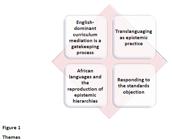
Four related themes are addressed in the discussion (see Figure 1). Their combination shows that the issue of African languages in TVET is not merely a question of classroom convenience, but also an institutional environment within which knowledge is recognised. The first theme is that English-dominant curriculum mediation is a gatekeeping process. The second is that translanguaging must be considered an epistemic practice. The third is that the institutionalisation of African languages in TVET is poor, thus reproducing epistemological hierarchies even in the presence of multilingualism in the sector. The fourth theme addresses the common counterargument that elevating the status of African languages would dilute standards, and argues that this counterargument rests on a limited conception of quality and competence.
English-Dominant Curriculum Mediation as Gatekeeping Process
TVET college English is not just a medium of instruction. It typically acts as a criterion of legitimacy. Students who are subjected to a hyper-English-centric environment of assessment activities, lecturer explanations, formal rubrics, and certification processes must not only master vocational materials but also demonstrate that they have mastered them in a language that might not be their most resourceful for making meaning. It can produce a language curriculum that blends intellectual capability with linguistic conformity. Even students who are knowledgeable about a technical process may appear less competent when they are unable to express that knowledge fluently in English, while students who are proficient in formal English may be judged more competent even when their conceptual understanding is uneven.
The problem is that there is no place for African languages in TVET. English is indeed a valued asset in the labour market and most professional settings. And institutional dominance is more likely to reduce the circumstances under which competence can be recognised. Powell et al. (2024a) show that English as the medium of instruction negatively affects the performance of TVET students, especially those who learn in a second language. This is a powerful reminder that language can create a barrier to epistemic access when it is taken to be transparent rather than regarded as socially stratified. Underachievement could be an indicator of limited exposure to the language of the curriculum and not a lack of knowledge or ability.
Symbolically, gatekeeping also takes place. Where a particular language is consistently associated with correctness, quality, formality, and certification, other languages become associated with incompleteness, informality, or deficiency. Students may have opportunities to speak African languages with their peers to explain concepts or use examples, however, until the formal curriculum acknowledges such practices, they will not be considered valid in education. The TVET curriculum does not merely teach content; it also establishes a hierarchy of languages and, by implication, a hierarchy of knowers. This is precisely why the paper posits the problem as being epistemic. The TVET language regime helps determine who is recognised as a legitimate knower and whose knowledge remains institutionally invisible.
There is also a time aspect to gatekeeping. Students entering TVET are often expected to master both the official language of assessment and pedagogy quickly and, simultaneously, to familiarise themselves with new disciplinary knowledge. The pressure of having to perform in English from the outset shorten the time available for this process. When this occurs, students may be tempted to memorise or remain quiet instead of learning. This seeming lack of engagement indicates a curriculum design that overemphasises short-term performance in the mainstream language at the expense of learning development.
Translanguaging as Epistemic Practice
This theme argues that translanguaging can be viewed as an epistemic practice. Most of the educational literature focuses on instrumental forms of translanguaging that ensure students learn the material more efficiently. Although this is true, there is a less visible aspect to this in vocational education. Students are not necessarily conscious of moving from one language to another; rather, they draw on and exchange their linguistic repertoires. This dynamic movement across linguistic resources enables technical knowledge, practical judgment, and situated problem-solving. For multilingual students, meaning-making is often repertoire-based rather than language-bound.
This understanding is critical in TVET because vocational competence is linked to practice. However, the student can make the most sense of the task when he or she applies known linguistic and cultural contexts to describe a service process, theorise about a fault, or discuss a market situation. The translanguaging process helps students to connect the specialised vocabulary with the lived examples, localised understanding, and familiar conceptual anchors. This procedure can enrich rather than dilute disciplinary learning. Both Kerfoot (2024) and Makalela (2019) suggest that multilingual meaning-making can make participation more inclusive and effective, and provide a stronger foundation for engagement with the curriculum.
Ubuntu translanguaging is based on this understanding by rejecting the idea that African languages are merely stepping stones to English. Rather, the languages are understood as interdependent in the construction of meaning. The pedagogical implication is that a student's linguistic repertoire should not be divided into legitimate and illegitimate components at the discretion of an institution. Rather, the curriculum should be constructed in such a way that the repertoires can be productively mobilised in the production of knowledge. In the case of TVET, this means acknowledging that competence can be shaped, assessed, and shared through multilingual channels. It is also the recognition that a student's epistemic agency is most effective when the curriculum does not force a distinction between knowledge and the linguistic means through which it is expressed, thereby making knowledge more thinkable.
The assertion that translanguaging is an epistemic practice is thus an insistence that language is part of the content of learning, not merely a wrapping around it. This is particularly critical in vocational education, where knowledge is context-specific and action-oriented. Students are required to interpret, judge, elucidate, and act. These are all acts that are both linguistic and practical. A multilingual pedagogical approach will not shut out standards but will extend them beyond monolingual success into meaningful performance of ability. It raises the question of whether the curriculum is aligned with what students can do and learn, rather than merely observing how a student's performance aligns with a dominant language norm.
African Languages and the Reproduction of Epistemic Hierarchies
This theme posits that African languages are poorly institutionalised in the TVET sector, thus reproducing epistemic hierarchies. These hierarchies are already in place, with one category of linguistic resources being considered the rightful bearer of legitimate knowledge, while the others are relegated to secondary status-particularly in the South African post-school sector. Here, multilingualism, change, and decolonisation are more aggressively discussed in public discourse, and higher education policy is more focused on strengthening Indigenous languages in universities. African languages in TVET, however, are not part of the formal mediation of the curriculum, the design of assessment, or the practice of certification. This means that the symbolic position of African languages has improved faster than their institutional position.
Ndimande-Hlongwa et al. (2024) state that the intellectualisation of African languages is primarily grounded in decolonisation, which also applies to TVET. Failure to cultivate and develop African languages in technical and vocational fields is an indication of serious knowledge gaps elsewhere. Nkadimeng and Makalela (2023) support this idea; they identify African languages as being aligned with quality assessment practices. Through their work, the notion that quality and African languages are opposites is dispelled. Indeed, the converse might be the case. When African languages are not included in assessment design, quality can suffer because the system fails to reflect what students actually know and can do.
Policy silence is not the only way in which the hierarchy is reproduced; it is also reproduced in daily practices. Although a teacher can enable learners to discuss assignments in an African language, the message about formality will not change when the official rubric merely indicates recognition of performance in English. Similarly, a college may be ceremonially bilingual or even multilingual, yet still issue all serious learning materials in one dominant language. When this occurs, tolerance-but not recognition-of translanguaging occurs. Multilingualism is a way of life for students, yet institutions fail to acknowledge it as a legitimate form of curriculum participation. Such an incongruence between survival and recognition is one of the most striking indicators of epistemic hierarchy. Its impacts are far-reaching. Students may lose confidence, engagement, or be labelled slow learners. Lecturers might continue to use ad hoc multilingual support without institutional support, professional development, or material resources. The college, in its entirety, might not realise the correlation between language, student achievement, and curriculum justice. In this regard, the non-recognition of African languages is not a one-time language problem. It is interwoven with the greater material of inequality in TVET. It also curbs future development in African languages because it deprives them of one of the largest institutional hubs for the creation and sharing of contemporary vocational and technical thought.
Responding to the Standards Objection
Among the most prevalent reasons to oppose more vigorous recognition of African languages in TVET is that it will lead to a lack of standards, disorientation, or inadequate workplace preparation for graduates. This objection is understandable; however, it is usually based on a thin, historically weighted conception of quality. It assumes that quality will be guaranteed if teaching and assessment are closely tied to English, and that the African languages can serve only as preliminaries or remedies in pedagogy. However, this stance conflates the language of assessment with the content of ability. A student who can deconstruct an issue, defend a process, and demonstrate judgment through multilingual paths may be more competent than one who can reproduce formal English without a strong command of concepts.
The standards objection can be challenged based on the literature reviewed in this paper. Nkadimeng and Makalela (2023) argue that African languages should be judged by standards of quality rather than by low expectations. Similar pedagogical arguments are advanced by Kerfoot (2024), who suggests that epistemic justice is not a gentler form of rigour but a necessity for gaining meaningful participation in knowledge. In TVET, quality can be measured by students' ability to perform, explain, and apply vocational knowledge clearly and confidently. When the assessment system fails to appropriately identify competence because it uses only English, even the monolingual model could be the source of poor quality.
Further, increased recognition of African languages does not imply the abandonment of English. A multilingual model will be able to retain English when it is necessary in a profession, and also recognise that proficiency and understanding can be developed in more than one language. This is especially so in South African workplaces and communities where multilingualism is prevalent. Training students to succeed in school in a monolingual way may not be as practical as educating them to become multilingual professionals. The protest against standards, though, has to be turned round; the real threat to standards is perhaps a culture of evaluation that conflates linguistic limitation with educational quality.
Implications for Curriculum, Pedagogy, and Assessment
If one concurs with this paper's argument, a multilingual turn in TVET sector would be pedagogically reasonable and normatively essential. The former implication concerns curriculum mediation. Colleges need to abandon informal linguistic accommodation and begin to plan how to teach multilingually. This does not mean abandoning English. Rather, it is about the realisation that concept explanation, examples, discussion, formative tasks, and workplace simulations can be strengthened when students are in a position to utilise African languages as part of disciplined sense-making. Curriculum mediation in this context permits a shift away from a monolingual frame towards engagement across repertoires.
The second implication concerns the development of lecturers. A shift towards multilingual pedagogy cannot be left to individual lecturers' goodwill. The institutions are required to invest in lecturers' capacity-building to make them aware of the translanguaging, epistemic access, and pedagogical significance of African languages in vocational education. This has to be a discipline-sensitive, practical aspect of development. It should include questions for classroom discussion, terminology, materials in multiple languages, and methods for organising the works, to give students a chance to represent their knowledge without reducing the levels. As soon as lecturers are ready to view students as multilingual epistemic agents rather than poor users of English, humanising pedagogy in TVET, as suggested by Majola and Madimabe-Mofokeng (2025), would become more possible.
The third implication concerns materials and terminology. One of the reasons why institutions are not keen to recognise African languages is the view that there is no technical vocabulary. However, the work of terminology is no reason to wait for recognition; it is only one of the tasks recognition must do. Colleges, universities, language practitioners, and professional bodies should collaborate on glossaries, multilingual concept guides, parallel materials, and African-language materials for selected programmes. This type of work aligns with the broader project of intellectualising African languages, extending their fields of deployment beyond the symbolic identity discourse.
The fourth implication concerns assessment. It is probably the most decisive area. Epistemic hierarchies will not be greatly affected as long as African languages are not recognised in formal assessment. Reform does not mean eliminating all English requirements. It involves redesigning some assessment tasks and standards so they are more likely to differentiate between conceptual competence and performance within a confined language. Oral descriptions, demonstrations, multilingual dictionaries, assisted written work, and stage assessment plans can all be used to help determine what students really know. The argument by Nkadimeng and Makalela (2023) on quality assessment is helpful in this case because it does not accept the false dichotomy between fairness and standards.
Consequently, the paper argues that TVET should be accorded special attention in policy. Higher education institutions (universities) have reached a milestone with the DHET' (2020) framework, but there is a significant disparity at the college level. The presence of a sector-specific language structure or implementation plan for TVET would be an assurance that African languages are not left out of the sector's educational future, and that their place in the sector's education is not an informal afterthought in the classroom. This would also bring language policy closer to the realities of student demographics, promises of access to the curriculum, and national change.
Recommendations
This paper draws recommendations from the analysis. To begin with, the teaching and learning of African languages in some high-enrolment programmes should be piloted by the DHET through TVET colleges. The outcomes to be observed in these pilots are not just language outcomes but also conceptual understanding, student confidence, and performance in the assessment. The pilot models could support a scaled implementation and facilitate the customisation of approaches to specific disciplinary and geographical settings.
Secondly, curricular materials need to be prepared to facilitate multilingualism in colleges, such as glossaries, concept sheets, bilingual or multilingual handouts, and lecturer support tools. These resources do not need to be utilised to replace the current English resources immediately. Instead, they could be structured processes of increasing the epistemic scope as disciplinary language is gradually built up in African languages. In this case, collaboration with universities, language units, and professional councils would be helpful.
Thirdly, the lecturers should get formal training in multilingual pedagogy, translanguaging, and assessment design. Such training should go beyond the calls and offer lecturers practical strategies for a multilingual professional classroom. These are the ways to motivate conceptual discourse, scaffold technical discourse across languages, and distinguish between linguistic surface difficulty and conceptual confusion.
Fourthly, policy should be explicit in recognising African languages in TVET as a source for teaching, learning, and assessment. Without being supported by policy, multilingual practice will remain unequal (based on individual initiative) and subject to dismissal as not serious. A language implementation framework unique to TVET would provide strategic guidance and help shift the accommodation discourse toward curriculum justice.
Lastly, future studies will also need to address language barriers and investigate the effectiveness of multilingual innovations in vocational courses, workshops, laboratories, and student support units. Empirical research on pilot programmes, redesign of assessment, and creation of terminology help move the debate from principle to practice. Furthermore, evidence is needed to ensure that multilingual reform in TVET is guided by proven practice rather than supposition.
Contribution of the Paper
The paper contributes to existing scholarship by taking a step beyond the deficit-oriented approach to studying language use in TVET education, and suggesting an integrated framework that emphasises African languages, translanguaging, and social justice as intertwined processes of language transformation in education. In so doing, it makes a conceptual contribution by advancing linguistic diversity as a resource for equitable access to knowledge, participation, and student success in multilingual TVET contexts. Moreover, the paper presents and develops the current discussion of multilingual education by specifically placing the concept of translanguaging in the context of TVET, a field which has not been extensively researched in the literature. This focus provides a socially just and contextually responsive way of rethinking teaching and learning that will better reflect the linguistic realities of learners of African origin.
Conclusion
This paper has argued that linguistics plays a determining role in whose knowledge counts in the South African TVET context. In situations where English remains the primary channel for curriculum mediation, assessment, and certification, African languages are relegated to the periphery and not considered viable tools of knowledge. Such a structure can reproduce epistemic hierarchies, providing institutional visibility to certain types of linguistic performance while obscuring others. The TVET colleges maintain a multilingual student body, which is not given the same attention in the formal curriculum.
The paper has demonstrated that language in vocational education is not merely about communication by bringing together scholarship on translanguaging, Ubuntu translanguaging, African-language intellectualisation, and TVET multilingual realities. It is also about accessibility, visibility, and fairness. Translanguaging is relevant because it shows that students do not always bring additional languages into the classroom merely as resources for meaning-making, through which concepts become intelligible and competence becomes possible. The importance of African languages does not lie solely in their status as cultural symbols. They can be career languages of reasoning, description, analysis, and synthesis.
The paper has policy implications and, as such, there is need for further research in these study areas. Longitudinal studies in the TVET sector are suggested to examine the gains made in recognising the significance of Indigenous languages in the discourse of public higher education (universities) with the limited recognition of the substantive role they play in TVET. Epistemic hierarchies will persist as long as the sector continues to rely on informal multilingual survival strategies as an alternative to official acknowledgment. However, the introduction of African languages into TVET cannot be regarded as a degradation or retreat into irrelevance in the global arena. It is more appropriately defined as a curriculum justice intervention that broadens the parameters of knowledge that can be dispensed, learned, and legitimately valued in a multilingual society.
African language recognition in TVET colleges, in this regard, is a demand for another concept of transformed quality of education, in which quality is not measured by monolingual conformity but by the capacity of institutions to provide meaningful understanding, involvement, and successful performance for the students they serve. This extends whose knowledge is recognised as legitimate. The solution cannot be confined to English. The African languages need to be addressed as an element of the knowledge regime, with vocational futures supported by a fairer TVET system in South Africa.
References
Literature Review
- Adewale, S. (2023). Repositioning technical and vocational education and training in Africa for global competitiveness: A bilingual model. Journal Bidang Pendidikan Dasar, 7(2), 149-160. https://doi.org/10.21067/jbpd.v7i2.8561
- Anthonie, A. N. (2024). A sociolinguistic appraisal of an under-researched (higher) education setting: The heteroglossic realities of the South African technical vocational education and training sector [Unpublished doctoral dissertation]. Stellenbosch University. https://scholar.sun.ac.za/server/api/core/bitstreams/0af9eb93-6e3a-4d78-b349-28288d7579c4/content
- Department of Higher Education and Training. (2020). Language policy framework for public higher education institutions. https://www.gov.za/sites/default/files/gcis_document/202011/43860gon1160.pdf
- Khohliso, X., Bwire, A. M., Ngugi, P., Miima, F. A., & Babusa, H. (2024). State of African languages teaching and learning in higher education in Kenya and South Africa. Journal of Languages and Language Teaching, 12(3), 1119-1136. https://doi.org/10.33394/jollt.v12i3.10787
- Madileng, M. M. (2022). An examination of the English curriculum in technical and vocational education and training colleges. Journal of Vocational, Adult and Continuing Education and Training, 5(1), 75-93. https://hdl.handle.net/10520/ejc-jovacet_v5_n1_a6
- Makalela, L. (2016). Ubuntu translanguaging: An alternative framework for complex multilingual encounters. Southern African Linguistics and Applied Language Studies, 34(3), 187-196. https://doi.org/10.2989/16073614.2016.1250350
- Makalela, L. (2019). Uncovering the universals of ubuntu translanguaging in classroom discourses. Classroom Discourse, 10(3/4), 237-251. https://doi.org/10.1080/19463014.2019.1631198
- Makalela, L., & da Silva, K. A., (2023). Translanguaging and language policy in the Global South: Introductory notes. Revista Brasileira de Linguística Aplicada, 23(1), 299-319. https://doi.org/10.1590/1984-6398202333203
- Makalela, L., & White, C. (2021). Translanguaging and superdiversity in the Global South: A decolonial perspective. International Journal of Bilingual Education and Bilingualism, 24(10), 1837-1850. https://doi.org/10.1080/13670050.2018.1543692
- Makoni, S., & Pennycook, A. (2023). Looking at multilingualisms from the Global South. In C. McKinney, P. Makoe, & V. Zavala, (Eds.), The Routledge handbook of multilingualism (2nd ed., pp. 17-30). Routledge.
- Majola, E., & Madimabe-Mofokeng, M. (2025). Exploring traces of humanising pedagogy in South African TVET colleges: A transformative approach. International Journal of Educational Development in Africa, 10, Art. 19130. https://doi.org/10.25159/2312-3540/19130
- Ndimande-Hlongwa, N., Ndebele, H., & Zibane, S. (2024). Intellectualisation of African languages in higher education institutions as a strategy for decolonisation and transformation. Alternation, 31(2A), 7-20. https://doi.org/10.29086/2519-5476/2024/v31n2a2
- Nkambule, B. I., & Ngubane, S. A. (2023). Eradicating a culture of public mistrust in TVET college education in South Africa: A manifesto for the sector's sustainability ahead of 4IR. Research in Social Sciences and Technology, 8(4), 301-329. https://doi.org/10.46303/ressat.2023.44
- Papier, J., & Mawoyo, M. (2024). What does "quality teaching and learning" mean in TVET contexts? Journal of Vocational, Adult and Continuing Education and Training, 7(2), 76-97. https://hdl.handle.net/10520/ejc-jovacet_v7_n2_a6
- Powell, L., Muronda, F., & Tini, S. (2024a). Factors affecting student performance at TVET colleges. Department of Higher Education and Training. https://www.dhet.gov.za/ResearchNew/TVET%20Research%20Programme/Factors%20Affecting%20Student%20Performance%20at%20TVET%20Colleges.pdf
- Powell, L., Muronda, F., & Tini, S. (2024b). Student demand for TVET colleges. Department of Higher Education and Training. https://www.dhet.gov.za/ResearchNew/TVET%20Research%20Programme/Student%20Demand%20for%20TVET%20Colleges.pdf
- ResCue, E., & van Pinxteren, B. (2023). The policy relevance of indigenous languages for higher education in Africa: A Ghanaian perspective. Policy Futures in Education, 21(8), 900-915. https://doi.org/10.1177/14782103221111953
- Truter, E. (2026). Participatory interventionist learning support for isiXhosa-speaking hospitality students at a technical and vocational education and training college [Unpublished doctoral dissertation]. Stellenbosch University. https://scholar.sun.ac.za/server/api/core/bitstreams/0af9eb93-6e3a-4d78-b349-28288d7579c4/content.
- Webster, S., Lewis, J., & Brown, A. (2014). Ethical considerations in qualitative research. In J. Ritchie, J. Lewis, C. M. Nicholls, & R. Ormston (Eds.), Qualitative research practice: A guide for social science students and researchers (2nd ed., pp. 77-110). SAGE.
- Williams, A. R., Prins, K., Nkambule, B. I., & Ngubane, S. A. (2024). Understanding barriers to optimal supervision and delivery of the National Certificate (Vocational) curriculum through TVET college lecturers' reflective evaluations. Research and Evaluation in Education, 10(1), 6. https://doi.org/10.21831/reid.v10i1.72274