Reconfiguration of Polytechnic Education in Zimbabwe: Towards a Holistic Framework Beyond Redistribution, Recognition, Representation, and Reconciliation1
Abstract
This study examines the peacebuilding roles of Zimbabwe's polytechnic colleges through the 4Rs framework (redistribution, recognition, representation, and reconciliation) using document analysis and semi-structured interviews. Findings show that despite stated and perceived peacebuilding contributions detailed in policy documents and echoed by participants (such as widened access, identity support, participatory structures, and skills for youth) positive peace remains elusive. The dominance of human capital theory (HCT) underpinning education constrains polytechnics to an economistic logic that privileges productivity over social justice, cultural plurality, and ecological sustainability-thereby limiting their capacity to address structural causes of the status quo. The study argues that a fifth R, reconfiguration, is necessary to transcend these limitations. Reconfiguration involves two steps. First, reconfigure the theoretical underpinning by integrating HCT with alternative approaches like the capability approach (to focus on expanding students' real freedoms and choices, not just employability), solidarity economy (to prioritise cooperation, reciprocity, and community wealth over competition), and buen vivir (to centre ecological sustainability and collective well-being alongside economic growth). Second, couple this retheorised foundation with intensified and expanded empirical work that pilots the implementation of these integrated foundations in practice. Through heritage-based, decolonial pedagogy, this dual reconfiguration prepares polytechnics to lead the country beyond economic instrumentalism to foster social transformation, democratic participation, and epistemic freedom. The study thus reclaims polytechnic education as a strategic site for piloting decolonised, people-, profit-, and-planet-centred development toward sustainable positive peace.
Polytechnic Education; Positive Peace; 4rs Framework; Reconfiguration; Capability Approach
Introduction
Polytechnic colleges in Zimbabwe are mandated to produce technical skills for industry, yet their peacebuilding potential remains under-valued and under-examined. Existing literature frames polytechnics largely through human capital theory (HCT), where education is treated as an investment in individual productivity for the labour market (Kariwo, 2009; Vally & Motala, 2014). This limited framing undervalues the socio-political roles polytechnics can play in contexts marked by structural inequality and protracted conflict.
This study addresses that gap by exploring both the stated roles in policy and the perceived roles in interviews of polytechnic colleges in advancing peacebuilding in Zimbabwe. It seeks to help understand how polytechnics contribute to, and are constrained from, fostering positive peace beyond narrow economic outcomes. The study deploys Daoust & Novelli's (2020) 4Rs framework (redistribution, recognition, representation, and reconciliation) as both theoretical lens and analytical tool. Findings from policy documents and interviews with seven senior staff members at three polytechnic colleges reveal contributions across the 4Rs, but also show that HCT's dominance constrains these institutions to an economistic logic that limits their capacity to address root causes of conflict. To move beyond this impasse, the article advances a fifth R, namely reconfiguration. First, this requires re-theorising polytechnic education by integrating HCT with the capability approach, solidarity economy, and buen vivir (good living) then, second, piloting these integrated principles through heritage-based, decolonial pedagogy.
The article proceeds as follows. First, it provides background and context on Zimbabwe's political economy and the historical positioning of polytechnics, with conceptual discussion of HCT and alternative frameworks. Second, it details the qualitative methodology. Third, it presents findings along the 4Rs plus reconfiguration. Fourth, it analyses and discusses how integrated theoretical foundations can enable polytechnics to become strategic sites for positive peace. The article then ends with a conclusion that includes implications for policy and practice.
Background and Context
This study was conducted against a background marred by crises and negative peace in the country. Since independence in 1980, Zimbabwe has experienced recurrent crises that entrench negative peace where there is absence of direct war, but persistence of structural violence. Hyperinflation peaked at 89.7 sextillion per cent in November 2008 (Hanke & Kwok, 2009), while unemployment averaged over 80 per cent from the late 1990s (Hurungo, 2010). Scarcity of essential goods, dollarisation in 2009, and post-election violence in 2018 (Chikwanha, 2020) illustrate how economic instability and political repression interact. In this context, positive peace requires more than absence of war and demands non-violence, social justice, and ecological sustainability (Devere, 2018).
In further retrospect, postcolonial to precolonial trajectories of violence are traceable. Before 1890, Zimbabwe experienced internal conflicts among Munhumutapa, Rozvi, and Ndebele polities (Cobbing, 1976; Pikirayi, 2001). Colonial occupation from 1890 intensified violence through land dispossession, the First Chimurenga in 1896, and the Second Chimurenga culminating in independence in 1980. Post-independence, Gukurahundi 1982-1987 (Ndlovu-Gatsheni, 2008) and state responses to protests show continuity of coercive politics. Polytechnics, established as technical schools from 1926, functioned under colonialism to reproduce white skill monopoly (Ncube et al., 2020). Post 1980, their inherited HCT orientation continued to privilege labour-market outcomes over social transformation.
Turning to the conceptual terrain, this study engages several contested concepts that shape how polytechnic education is understood and practised. HCT views education as investment in skills for economic growth, reducing learners to future workers (Brown et al., 2020). Critics argue this ignores freedoms, culture, and ecology (McGrath et al., 2020). The capability approach reframes development as expanding substantive freedoms to choose lives people value (Nussbaum, 2011; Sen, 1999). Solidarity economy emphasises plural economies where market, redistribution, and reciprocity coexist (Laville, 2010). Buen vivir centres collective well-being and ecological harmony over gross domestic product (GDP) growth (Acosta, 2013). Positive peace thus moves beyond negative peace by integrating justice, recognition, and sustainability (Shields, 2017). Reconfiguration, as proposed here, is constitutive rather than additive; it re-anchors polytechnic theory so these alternatives reshape institutional purpose, not just add content.
This literature review focuses on the role of polytechnic education in promoting positive peace and sustainability. It draws on literature from diverse contexts to distil insights relevant to Zimbabwe and the broader developing world. Ultimately, these contributions aim to promote the reconfiguration of a viable and positively peaceful Zimbabwe. Polytechnic institutions originated in early 19th-century Europe, with the French École polytechnique founded in 1806 as a model for applied scientific and technical training (Schubring, 2019). The concept spread to Britain in the 19th century, where polytechnics developed as institutions combining theory and practice to solve real-world problems across disciplines (Brosan, 1972). The UK polytechnic model was later exported to its colonies, including Southern Rhodesia (now Zimbabwe), as part of a vocational education system designed to supply skilled labour to industry (Ncube et al., 2020). Zimbabwe's polytechnic system was therefore influenced by the British education system, including the UK's former polytechnic model, although it has since evolved toward what national policy now terms a "heritage-based" model under Education 5.0 (Ministry of Higher & Tertiary Education, Innovation, Science and Technology Development [MHTEISTD], 2018c).
All three original technical colleges namely Harare, Bulawayo, and Mutare continue to operate under the name "polytechnic" in post-independence Zimbabwe, alongside newer institutions such as Kwekwe and Masvingo polytechnics (MHTEISTD, 2018c). The heritage-based model refers to Education 5.0, Zimbabwe's 2018 policy shift that mandates higher and tertiary education institutions to add innovation and industrialisation to the traditional teaching, research, and community service roles of Education 3.0 (MHTEISTD, 2018c). Under this model, polytechnics are expected to convert local heritage, resources, and indigenous knowledge into products, services, and enterprises that contribute to national development. Consistent with their global origins, Zimbabwe's polytechnics were created and remain mandated to provide students and industry with applied, technical, and vocational knowledge oriented toward practical problem-solving and innovation. This applied focus distinguishes them from universities that emphasise theoretical knowledge.
In Portugal, the role of polytechnic colleges extends beyond the economic dimension to include socio-cultural benefits (João et al., 2015). However, it is noted that higher education, including the polytechnics, is typically underrated as a peacebuilding priority (Milton & Barakat, 2016). Milton and Barakat further argue that higher education, including polytechnics, remains under-prioritised in peacebuilding policy, despite evidence from post-conflict contexts that technical and vocational education and training (TVET) can contribute to economic recovery and social cohesion. In Zimbabwe, policy documents emphasise GDP and industrialisation outcomes, but give less attention to socio-cultural and peacebuilding contributions (MHTEISTD, 2018c).
A comprehensive study by Legusov et al. (2022) encompassing case studies from diverse geographical contexts, including Canada, Chile, China, Taiwan, and the United States underscored the pivotal role of TVET institutions (herein polytechnics)) in fostering sustainability. This finding highlights the critical importance of TVET institutions in driving sustainable development and underscores the need for their active engagement in shaping sustainability agendas globally, and Zimbabwe is no exception. On the African continent, McGrath et al. (2020) conducted a literature review that criticised the predominantly Anglophone-biased HCT-based application of a borrowed Old Commonwealth polytechnic toolkit that is ill-suited for African realities. McGrath et al. (2020) proposed the critical capabilities approach to polytechnic education in Africa which, among other tenets and most importantly to this study, acknowledges the influence of the political economy and structural realities on TVET.
Empirical work in South Africa and Kenya demonstrates that TVET graduates exercise agency in creating informal enterprises and community projects when curricula move beyond narrow employability to capability development (Powell & McGrath, 2019). Thus, while African polytechnics have potential to support balanced development, this depends on decolonising curricula and expanding beyond HCT assumptions. Recent scholarship further supports this move toward transformation in TVET. Tikly et al. (2020) argue that African TVET must shift from borrowed Eurocentric models toward contextually responsive frameworks that engage political economy and structural inequality. In peacebuilding education, Novelli et al. (2019) demonstrate that education institutions can reproduce or challenge conflict dynamics depending on curriculum and governance choices, reinforcing the relevance of the 4Rs for post-conflict contexts.
Decolonial theorists such as Mignolo (2021) and Ndlovu-Gatsheni (2021) stress epistemic freedom and the need to centre indigenous knowledge systems within education reform, which aligns with Zimbabwe's heritage-based Education 5.0 rhetoric. Finally, SDG 4.7 and UNESCO (2022) highlight TVET's role in sustainable development through competencies for ecological stewardship and social justice. Together, this recent literature reinforces the case for reconfiguring polytechnic theory beyond HCT toward frameworks that integrate capability, solidarity, and ecological well-being.
Methodology
This study employed an interpretive research paradigm to explore the stated and perceived peacebuilding roles of Zimbabwe's polytechnic colleges. Interpretive logic was adopted because the research sought to understand meaning, context, and stakeholder perspectives rather than test hypotheses (Janks, 1997). Aligned with this paradigm, the study used two qualitative data collection methods, namely, document analysis of publicly accessible policy documents from the MHTEISTD, and semi-structured interviews with seven senior staff at three purposively selected polytechnic colleges. This research was conducted under the PEER Network project and received ethical approval from the University of Ulster Research Governance Filter Committee as a Category A study.
This methodology enabled a nuanced examination of the data to identify patterns, themes, and relationships that underlie the peacebuilding roles of polytechnic colleges in Zimbabwe. Descriptive, interpretive, and connective analyses (Janks, 1997) enabled beyond surface-level descriptions and uncovering of deeper meanings and connections within the data. The relationships between theory, practice, and context emerged as will be discussed in the results section.
Documents
In this study, document analysis entailed a process of review, examination, and interpretation of policy documents from the MHTEISTD in Zimbabwe. Drawing on Bowen (2009), this approach enabled the extraction of meaning and empirical knowledge from the documents. Document analysis was used alongside interviews to achieve methodological complementarity, thereby strengthening the rigour, credibility, and trustworthiness of the interpretive findings (Bowen, 2009). While only two data sources were used, juxtaposing policy statements with participant perspectives allowed for deeper contextual understandings. Notwithstanding some limitations inherent to document analysis, such as potential gaps in detail and selectivity bias, this methodology offers several advantages that were leveraged in this study. These include its efficiency and cost-effectiveness. Document analysis is a non-intrusive and non-reactive method allowing researchers to examine existing documents without influencing the phenomenon under study. The five policy documents that were sampled for analysis from the MHTEISTD are:
• Document 1: The Doctrine Policy Document (MHTEISTD, 2018c) maps out polytechnic education as important towards the achievement of vision 2030. This will be achieved through Education 5.0 (teaching, research, community service, innovation, and industrialisation) which emphasises innovation and technological development through innovation hubs and technology parks.
• Document 2: The Client's Charter declares that the MHTEISTD (2024) is establishing departments with specific missions to aid in the realisation of an industrialised Zimbabwean economy.
• Document 3: Zimbabwe Manpower Planning and Development Act (Zimbabwe, 2021) provides for the management of technical or vocational institutions, universities, teachers colleges and vocational training schemes.
• Document 4: The Strategic Plan 2019-2023 (MHTEISTD, 2019) is based on the direct link between the country's economic performance and its higher and tertiary education sector where cutting edge universal knowledge is applied locally and practically.
• Document 5: The Zimbabwe National Qualifications Framework (MHTEISTD, 2018b), integrates education and training into a unified structure of qualifications with minimum bodies of knowledge that make courses comparable.
These documents were analysed to distil the stated peacebuilding roles of polytechnic colleges in Zimbabwe in terms of redistribution, recognition, representation, reconciliation, and ultimately, reconfiguration.
Sampling and Participants
Purposive sampling was used to select three polytechnic colleges to ensure relevance to the research aim and variation in institutional context. Within each college, senior colleagues with institutional decision-making responsibility and direct knowledge of policy implementation were selected for interview. A total of seven interviews were conducted with one principal, one deputy principal, one regional examinations officer and four heads of department across the three colleges. Interviews continued until no new insights emerged, following Guest et al.'s (2006) guidance on data saturation for qualitative studies. To ensure anonymity, all participants were assigned pseudonyms as follows:
• Chengwe, regional examinations officer with a commerce background and passionate about entrepreneurship.
• Ganda, a polytechnic college principal with institutional knowledge and experience dating back to the 1980s.
• Shamba, a deputy principal who served in various capacities including public relations before becoming substantive in his current position.
• Batsirayi, a former head of Management Studies department.
• Zamani, head of mechanical engineering division with industry experience.
• Josphat, head of electrical engineering with telecommunications industry background.
• Shylet, head of division of civil engineering department.
Data were analysed using descriptive, interpretive, and connective analysis (Janks, 1997). Analysis of documents and interview transcripts generated five overarching themes aligned with the 4Rs framework plus reconfiguration, namely, (1) redistributing resources, opportunities, and hope, (2) recognition and identity support, (3) representation in decision-making, (4) reconciliation and social cohesion, and (5) reconfiguration of theoretical foundations and piloting empirical applications. These themes were developed from the data, with the 4Rs providing the analytical tool. Description of each theme is provided in the findings section to meet interpretive standards of contextual depth. In the following subsection, we focus on the 4Rs framework and introducing the fifth R.
The 4Rs Framework
This study employs the 4Rs framework where the Rs are redistribution, recognition, representation, and reconciliation (Novelli et al., 2017) as dimensions along which to explore the peacebuilding contributions of polytechnic colleges in Zimbabwe. In terms of that, redistribution focuses on addressing economic disparities including the distribution of educational supplies and opportunities thus relating to access and success issues at the polytechnic colleges. Recognition relates to addressing cultural disparities and injustices related to difference. Representation aims at addressing political disparities and divides in participation. Reconciliation addresses conflict legacies, historical memory, truth, justice, and seeks to restore trust and harmonious relations across the various divides. Figure 1 provides a diagrammatic presentation of the 4Rs framework.
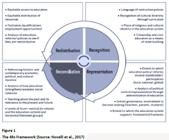
Theoretically, this project propounds a fifth R (reconfiguration), which will occupy two key integrating positions in the circular diagram above where there are arrows. Firstly, right at the epicentre, where reconfiguration will take the form of retheorising towards a more inclusive and sustainable theoretical underpinning. Secondly, as overarching and culmination of the 4Rs represented by the outer arrows where reconfiguration will entail polytechnics as centres where the enriched theoretical frameworks will be piloted. Reconfiguration occupies two positions: at the centre (re-theorising foundations by integrating HCT with capability, solidarity, and buen vivir) and as the outer ring (guiding empirical piloting of these integrated principles through heritage-based pedagogy and community projects). This demonstrates how reconfiguration is constitutive rather than additive, giving direction and culmination at theoretical and empirical levels to the 4Rs, that is, where theory meets practice. That way, the circular 4Rs framework captures the means and the fifth R becomes the end in a sustainable positive peacebuilding process. There is a quest for a thriving and deep reconfiguration (Chivasa, 2022) which drives and is driven by the 4Rs.
Empirically, through a combination of document analysis and elite interviews (Smith, 2006), the study contributes an analysis of stated policy aims and the perceptions, attitudes, and experiences of decision-makers (Janks, 1997). The study contributes towards understanding peacebuilding roles of polytechnic colleges through the 4Rs thus reconfiguring the polytechnic education and, by extension, the country into its post crisis, positively peaceful epoch. Attention will be paid to the limitations of the current efforts, and alternative possibilities will be explored.
Several limitations shape the interpretation of findings. First, data are drawn from policy documents and interviews with seven senior staff at three colleges; perspectives of students, lecturers, industry, and communities are not included, which may limit the range of perceived peacebuilding roles. Second, reliance on institutional documents introduces selectivity bias because policies present intended rather than enacted roles. Third, the study is context-specific to Zimbabwe's post-2000 political economy, reducing generalisability to other TVET systems. These limitations mean findings should be read as an interpretive account of stated and perceived roles rather than an evaluation of impact. Future research should expand participants and include classroom observation to strengthen claims about reconfiguration in practice.
Findings
Drawing on document analysis of five MHTEISTD policy documents and semi-structured interviews this section presents the findings on the peacebuilding roles of polytechnic education in Zimbabwe. Findings are organised around the 4Rs framework themes (redistribution, recognition, representation, and reconciliation) and the fifth R (reconfiguration). Reconfiguration is presented in two subsections; retheorising, and empirical piloting.
Redistributing Resources, Opportunities and Hope
The redistribution theme presents how the documents and participants described polytechnics' role in redistributing material and educational resources. The Zimbabwe Manpower Planning and Development Act 28:02, stipulates a provision for "bursaries, loans or advances" (Zimbabwe, 2021, p. 19). Polytechnic colleges are key sites for redistribution, where resources are made available to students from previously disadvantaged backgrounds. Furthermore, the Strategic Plan 2019-2023 (MHTEISTD, 2019, p. 6) states that "our education is relevant to the realities and resource endowments of the country." By providing education that leverages local resources, polytechnic colleges become hubs for redistributing resources and opportunities. The planned and ongoing construction of polytechnic colleges in previously disadvantaged locations, such as Plumtree and Binga, evidences the redistributive role placed on polytechnics.
As Chengwe noted, "We have what we call the ISOP [Integrated Skills Outreach Programme] where the college will go out to rural areas and try to impart skills to groups in communities particularly in building and welding, the basics." This initiative highlights the various ways that polytechnic colleges provide education and skills development, in addition to their formal programmes. It emerged that polytechnic colleges in Zimbabwe are drivers of opportunities and hope for social mobility, inclusion, and cohesion. As Ganda mentioned, the entry requirements are not very strict at polytechnic colleges, offering a chance even to those who would not qualify to study at universities.
It is important to note that redistribution comes with both challenges and opportunities. Disparity of esteem emerged strongly because polytechnics have historically received less attention and resources compared to universities. Zamani noted, "My view is that polytechnic colleges are not getting the attention that they deserve. Universities are getting more attention and support than the polytechnics." Shylet concurred, "Most people prioritise universities." By providing education and training to an inclusive enrolment of students from various backgrounds, polytechnic colleges contribute to redistribution.
These accounts show how provisions for bursaries and local resources in the documents align with participant descriptions of outreach and open access, while also showing differences between intended resource distribution and participant perceptions of disparity of esteem. This pattern illustrates redistribution in practice, yet it also exposes the limits of HCT. Bursaries and outreach expand access, but participants' reports of disparity of esteem show how economistic framing privileges university pathways. Integrating the capability approach would reframe this not only as access to training, but as expansion of students' real freedoms to choose valued livelihoods beyond narrow employability.
Polytechnics as Catalysts for Recognition and Peace
The theme on recognition presents how participants and policy documents described the role of polytechnics in recognising students' identities, cultural practices, and indigenous heritage. Rather than treating culture as peripheral, interviewees spoke about embedding Zimbabwean heritage in curriculum design and institutional practices. Documents similarly frame heritage-based education as a mandate for higher and tertiary institutions. The extracts below are presented as integrated narrative of participant perspectives and policy statements.
The 4Rs framework emphasises the importance of recognition as a crucial element in building and sustaining peace. The Strategic Plan 2019-2023 (MHTEISTD, 2019, p. 18) states that "there is high literacy level (96%) whilst the skills levels are low (38%)," thus underscoring the disparity between literacy and skills levels in Zimbabwe. By offering comprehensive programmes and courses, polytechnics recognise the potential for improvement in all individuals, regardless of their colour and creed. The recognition role of polytechnics also manifests through the colleges' contributions to personnel and talent pool development in ways that empower the beneficiaries. The Strategic Plan 2019-2023 further emphasises the importance of human resources as part of heritage, stating:
The nation relies upon its Heritage, that is, its flora, its fauna, its water, its minerals, and the quality of its human resources. (MHTEISTD, 2019, p. 4)
Polytechnics directly contribute to the quality of Zimbabwe's talent pool by providing innovative skills that cater to the needs of the economy, environment, and communities. This, in turn, brings recognition to the diverse student body and acknowledges their potential.
The Strategic Plan 2019-2023 further notes that "The ability to attract international students and participate in the world economy is critical" (MHTEISTD, 2019, p. 27). As Shamba mentioned, "Now the foreign students we have are from Equatorial Guinea, previously we had foreign students from Namibia." Through these international engagements, polytechnic colleges contribute to peace and stability in the region, fostering communication and cooperation between Zimbabwe and other countries. These findings show how the Strategic Plan's framing of heritage and skills gaps aligns with participant descriptions of diverse and international student enrolment, while differences emerge between policy emphasis on skills levels and participant emphasis on diversity of backgrounds. This pattern shows recognition through heritage-based curriculum and diverse enrolment, yet HCT's focus on measurable skills flattens culture to labour-market input. The capability approach and buen vivir would reframe recognition as affirming students' identities and ecological heritage as valued ends, not just workforce attributes.
Representing Voices, Interests, and Rights
The representation theme presents how participants and policy documents described mechanisms for including diverse stakeholder voices in decision-making at Zimbabwe's polytechnic colleges. Participants referred to formal structures such as advisory boards and industry committees, while policy documents outline consultation mandates for curriculum development. This subsection presents how participants and policy documents described mechanisms for including stakeholder voices in decision-making. Policy documents frame representation as part of access and inclusivity. The Doctrine Policy Document (MHTEISTD, 2018c) places emphasis on heritage-based education and highlights the importance of fair representation in determining access to training opportunities, including gender equality and inclusivity for women and marginalised groups.
Interview participants described consultation and advisory structures as the main ways representation occurs. Shylet noted that "The college always consults with stakeholders when they are taking important decisions." Batsirayi added that "Of course, we have structures. We also have a balanced college advisory council." Ganda, concurred, "Everybody is catered for. As such we include everyone in the decision-making process."
These accounts show that the documents' emphasis on fair representation aligns with participant descriptions of consultation, structures, and inclusive decision-making, while differences between policy emphasis on heritage-based access and participant emphasis on procedural consultation are noted. These consultation structures reflect representation procedurally, but HCT reduces participation to supplying industry with skilled labour. Solidarity economy would reframe representation as democratic co-governance where students, communities, and staff share decision power over what is produced and for whom.
Fostering Harmony: Reconciliation Through Polytechnics
The next theme is reconciliation. It presents how participants and policy documents described the role of polytechnic colleges in reconciling differences and building relationships across diverse student and community groups. Participants spoke about peacebuilding in terms of reducing conflict and fostering unity through skills training and shared institutional activities. Policy documents refer to national cohesion and social stability as intended outcomes of TVET. Evidence from interviews and the Strategic Plan 2019-2023 (MHTEISTD, 2019) shows that perspectives largely converge and differ where the Strategic Plan flags structural disharmony. It laments the disharmony between training outcomes and the socioeconomic environment, a key finding for this study; it states:
Our education system has traditionally not resulted in any direct creation of industries, due to a palpably ingrained disconnect between knowledge outcomes and the broader socioeconomic environment. (MHTEISTD, 2019, p. 10)
Interview participants described reconciliation through shared activities and diverse enrolment. Chengwe referred to the student body as "a mixed bag" including students "from various political affiliations" and from rural areas "who usually take longer to catch up." Josphat noted students "from abroad" including "Equatorial Guinea, Democratic Republic of Congo and from Mozambique" studying alongside local students "from all over the country." Community engagement was also described as a reconciliatory practice. Chengwe explained the ISOP where "the college will go out to rural areas and try to impart skills to groups in communities." Batsirayi and Ganda described student volunteering at hospitals and old people's homes as important gestures of reconciliation.
This study demonstrates that education alienation endures within polytechnic colleges despite heritage-based rhetoric and interventions across redistribution, recognition, representation, and reconciliation. Consequently, a deliberate recalibration and coordination of these peacebuilding pillars is required. Community service and mixed student cohorts demonstrate reconciliation in practice, yet HCT's economistic logic treats these as soft skills for productivity. Integrating buen vivir and social justice theory would reposition reconciliation as restoring relationships between people, heritage, and ecology as the core purpose of polytechnic education, not a by-product of employability.
Reconfiguration in Theory: Integrating Human Capital With Capability and Solidarity Theoretical Foundations
Despite the perceived and stated peacebuilding roles that polytechnic colleges play as outlined above, the institutions remain far from achieving their redemptive potential in real terms. To address these tensions and contradictions that constrain the realisation of emancipatory polytechnic education in both practice and conception, this study argues for prioritising an examination of the underlying conditions producing this paradox. Accordingly, the study advances reconfiguration as a fifth, integrative pillar. Without reconfiguring the current HCT underpinnings and its concomitant institutional relations, colonial pedagogies, and resource flows, polytechnic education will continue to reproduce alienation and disharmony between training outcomes and the socioeconomic environment rather than generate positive peace. Reconfiguration thus entails reclaiming polytechnic education as a site of social transformation, democratic participation, and epistemic freedom in Zimbabwe and by extension, Global South. It is therefore not additive but constitutive of positive peacebuilding of and through Zimbabwe's polytechnic education.
The current configuration of polytechnic education in Zimbabwe has not yielded the desired outcomes despite the peacebuilding roles they play. Many of their redistribution, recognition, representation, and reconciliation roles have not been translated into tangible positive peace outcomes for the country. This study proposes a fifth R, reconfiguration, to capture the desired outcomes of the peacebuilding process.
A critical challenge identified in the Strategic Plan 2019-2023 (MHTEISTD, 2019), is the disconnect between the information, knowledge, and skills outcomes of polytechnic education in Zimbabwe and the socioeconomic environment. This disjuncture hinders the efficacy of polytechnic education in peacebuilding. Reconfiguration of polytechnic education presents an opportunity to re-examine the underlying factors contributing to this paradox.
This study proposes a reconfiguration beyond the realm of the labour and commodity markets to a syncretical blend that also draws from alternative approaches. These include (1) the capability approach (Nussbaum, 2011; Sen, 1999) where development is viewed as freedom to choose from an array of capabilities, (2) solidarity economy (Laville, 2010) characterised by a plural economy-market, redistribution and reciprocity, (3) buen vivir (Acosta, 2013), which prioritises environmental sustainability and well-being, (4) social justice theory (Fraser, 2008; Rawls, 1971), where emphasis is placed on fairness and equality, and (5) the Human Development Index (United Nations Development Programme, 1990), which measures national development beyond economic growth.
Some examples demonstrating the effectiveness of these alternative approaches include Costa Rica's focus on environmental sustainability (buen vivir), Brazil's solidarity economy initiatives, and India's capability-based development programmes. In that regard, it would be a false dilemma if we agitate for the total removal of HCT and implementation of one of the alternatives. The theoretical approaches are complementary to each other rather than mutually exclusive. They allow for a balance to be achieved as people, planet, and profits all matter. It is therefore possible to build a reconfigured and prosperous polytechnic system in Zimbabwe based on a hybrid theoretical foundation. This supports both national opulence and individual human flourishing in a decolonised (Tuck & Yang, 2012) and environmentally sustainable manner, culminating in the long overdue positively peaceful epoch.
Reconfiguration in Action: Polytechnic Colleges Driving Growth, Development and Peace
While reconfiguring the theoretical foundations of polytechnic education in Zimbabwe is necessary, it is not sufficient on its own to achieve a holistic transformation. Practical reconfiguration initiatives, possibilities of which were profiled in policy documents and interview data, are equally vital. Central among these is the elevation of innovation and entrepreneurship to the core of polytechnic education. As Chengwe observed, "entrepreneurship is taught across the board to everyone." The cross-cutting integration of entrepreneurship modules equips students with competencies to establish and sustain survivalist enterprises. Indeed, "some students have successfully launched their own businesses," Chengwe further attested. Such initiatives resonate with the capability approach (Nussbaum, 2011; Sen, 1999), wherein development is understood as expanding individuals' substantive freedoms to choose from an array of valued capabilities, including the capability to create dignified livelihoods.
This practical reorientation aligns with national policy and requires expansion and centring. The Strategic Plan 2019-2023 (MHTEISTD, 2019) mandates the reconfiguration of higher and tertiary education in Zimbabwe, including polytechnics, from Education 3.0 (teaching, research, and community service), to heritage-based Education 5.0, which adds innovation and industrialisation. Crucially, it opens space to embed buen vivir (Acosta, 2013), which prioritises environmental sustainability and collective well-being over narrow growth metrics, and the Human Development Index (United Nations Development Programme, 1990), which reframes national progress beyond GDP to include health, education, and living standards.
Polytechnic colleges advance peacebuilding through direct civic engagement grounded in reciprocity and redistribution. These are key principles of the solidarity economy (Laville, 2010), characterised by a plural economy that integrates market, state redistribution, and community reciprocity. Batsirayi illustrated this possibility by describing voluntary service: "We have adopted a ward at a local hospital and the students volunteer to clean up and assist in looking after the patients. Our students also volunteer to work at companies during holiday." Similarly, Ganda noted that under the subject National and Strategic Studies:
Community engagement, they do it. . . . They have been to a local old people's home where the electrical engineering students have done electrical repairs and the clothing students have done their curtains, prepared their beds and so on.
Such discipline-based community engagement cultivates practical skills while fostering wider social reconfiguration, peace, and harmony. These are direct expressions of social justice theory (Fraser, 2008; Rawls, 1971), which foregrounds fairness, recognition, and equitable distribution of resources and opportunities.
Shamba's account highlights proactive measures, including the Government Entrepreneurship and Employment Programme (GEEP), which "provided financial support to student-led companies." This programme enables students to develop entrepreneurial capacity, generate income, and pursue self-sufficiency. It expands their capability sets in line with the capability approach while embedding solidarity economy practices through collective enterprise and reinvestment in communities.
By reconfiguring programmes and services around integrated theoretical frameworks, polytechnic colleges can assume a more consequential role in Zimbabwe's development and peacebuilding trajectories. Their real-life practical projects, spanning hospital adoption, old-age home repairs, student-led construction, and GEEP-funded enterprises, demonstrate high potential to pilot these alternative approaches. Through such projects, polytechnics operationalise a plural economy that values profit for sustainability, planet via ecological stewardship, and people through capability expansion and social justice.
Operationalisation of the integrated framework could proceed through two steps. First, curriculum redesign would embed capability approach modules on choice and agency, solidarity economy projects on cooperative enterprises, and buen vivir units on ecological stewardship alongside existing HCT employability training. Second, assessment would move beyond completion rates to measure capabilities using capability indices, community reciprocity through student-led project audits, and ecological impact via campus sustainability metrics. Thereafter, future research could use participatory action research with students and communities to pilot, monitor, and refine these interventions, generating evidence on how integrated theory translates into practice. This provides a pathway from conceptual reconfiguration to empirical implementation.
The fifth R, reconfiguration, propels reconciled communities forward by ensuring that heritage is decisively converted into decolonised products and services that build back better (Dube et al., 2021) towards positive peace. The entrepreneurship and community projects show pockets of reconfiguration already in practice, yet HCT frames them as isolated income-generating add-ons. Coupling HCT with capability, solidarity economy, and buen vivir would reframe them as intentional pilots that expand student freedoms, embed reciprocity, and centre ecological well-being, making reconfiguration the constitutive foundation rather than an optional extra.
Analysis and Discussion
This section separates description from analysis. Findings presented above describe what documents state and what participants perceived. Here, those descriptions are examined against theoretical debates on HCT, capability approach, solidarity economy, and buen vivir. The aim is not to repeat findings but to explain how empirical patterns relate to theoretical limitations and possibilities for reconfiguration. This structure ensures empirical detail precedes, and grounds, conceptual argumentation.
The findings demonstrate that polytechnic colleges in Zimbabwe advance peacebuilding through the 4Rs. Participants described polytechnic colleges as sites where bursaries, outreach programmes, and relatively open entry requirements expanded access for students from previously disadvantaged backgrounds. Documents such as the Zimbabwe Manpower Planning and Development Act (Zimbabwe, 2021) and Strategic Plan 2019-2023 (MHTEISTD, 2019) formalise resource allocations and local-resource relevance mandates. At the same time, interviewees reported disparity of esteem when polytechnics are compared to universities. Thus, while redistribution is evident in policy intent and participant accounts, the data do not permit claims about actual impact on structural inequality without further longitudinal or outcome data.
Polytechnics expand equitable access to education, recognise individual potential, enable inclusive decision-making, and foster social cohesion and reconciliation. They play a vital role in fostering reconciliation by bringing together students and staff from different backgrounds, redistributing heritage-based educational resources, recognising individual potential, and ensuring representation in decision-making processes. Yet positive peace remains elusive in Zimbabwe. This paradoxical outcome aligns with critiques that capitalism has "failed to meet even the most basic needs and aspirations of the citizenry" (Motala, 2023, p. 350). Zimbabwe's polytechnic education, anchored in HCT and thus aligned with capitalist logic, is not exempt; structural crises persist despite institutional peacebuilding efforts. These constraints may render polytechnic peacebuilding efforts structurally futile without deeper transformation. This is in line with McGrath et al. (2020) who recommended the capability approach for African vocational education and training in place of the Eurocentric HCT.
This study thus proposes the fifth R, reconfiguration which must begin with theoretical foundations, incorporating alternative frameworks like the capability approach, solidarity economy, buen vivir, social justice theory, and the Human Development Index. This shift enables the simultaneous realisation of non-violence, prosperity, social justice, and ecological sustainability, the composite elements of positive peace (Devere, 2018). Empirical evidence from this study including entrepreneurship training, community engagement, and industry internships, reveals polytechnics already hosting pockets of possibility that pilot alternatives to HCT. These applied projects constitute a critical peacebuilding function of polytechnic colleges in themselves, operationalising the triple bottom line of people, planet, and profit (Nikolaou et al., 2013; Nogueira, 2023). Thus, reconfiguration moves polytechnic education beyond HCT's restricted view of education as mere capital investment-an approach insufficient to advance the nation beyond negative peace (Murwira, 2022). By piloting integrated theoretical frameworks through practice, polytechnic colleges emerge as strategic sites for advancing positive peace and sustainable development in Zimbabwe.
Conclusion
The historical context of polytechnic colleges in Zimbabwe reveals that these institutions were initially established to serve the interests of colonial powers and imperialists, rooted in the HCT framework. This study examined the role of polytechnic colleges in Zimbabwe in advancing peacebuilding within a context marked by persistent structural violence and negative peace. Findings indicate that polytechnic colleges contribute through the 4Rs (redistribution, recognition, representation, and reconciliation) as outlined in the policy documents and evidenced in expanded access, inclusive governance, and community engagement practices discussed during interviews.
Yet these efforts remain constrained, and positive peace a mirage for polytechnic colleges and the country at large. This study argues for prioritising a re-examination of the underlying conditions producing this contradiction where the HCT paradigm remains the dominant theoretical underpinning of Zimbabwe's education system. HCT's economistic focus on individual productivity and growth obscures social and ecological dimensions critical to positive peace. It is paradoxical to expect that a theoretical framework that served the interests of colonialism would remain relevant in a democratic republic, unless major adjustments to it have been implemented. The continued reliance on HCT can be seen as a form of intellectual inertia, hindering the development of more contextually relevant, robust, and effective approaches to education and development.
To transcend these limits, the study proposes a fifth R, reconfiguration, integrating HCT with alternative theoretical frameworks, including the capability approach, solidarity economy, buen vivir, social justice theory, and the Human Development Index. Empirically, pockets of possibility exist at polytechnic colleges, such as group entrepreneurship, student-led enterprises, hospital-ward adoption, old-age home repairs, and GEEP-supported projects that already pilot these alternatives. They demonstrate polytechnics' high potential to operationalise the triple bottom line of people, planet, and profit through practice. Reconfiguration thus positions polytechnic colleges as strategic sites for piloting decolonised, heritage-based Education 5.0. By converting heritage into products and services that simultaneously advance non-violence, prosperity, social justice, and ecological sustainability, polytechnics can move Zimbabwe beyond HCT's insufficient conception of education as capital investment.
This study contributes to scholarship on TVET and peacebuilding in three ways. First, it empirically documents how Zimbabwe's polytechnics engage the 4Rs while constrained by HCT dominance, using both policy and senior staff perspectives. Second, it conceptually advances reconfiguration as a fifth R, showing how integrating capability, solidarity, and buen vivir with HCT can re-anchor polytechnic purpose toward positive peace. Third, it identifies existing pockets of possibility in entrepreneurship and community projects that can serve as pilot sites. Future research should test this integrated framework through longitudinal, participatory studies with students and industry, assess capability expansion and ecological outcomes, and compare findings across other African TVET systems. Such work can move reconfiguration from proposal to evidence-based practice.
References
Acosta, A. (2013). Buen vivir: Sumak Kawsay, an opportunity to imagine another world. Rosa Luxemburg Foundation.
Review of Literature
- Bowen, G. A. (2009). Document analysis as a qualitative research method. Qualitative Research Journal, 9, 27-40. https://doi.org/10.3316/QRJ0902027
- Brosan, G. S. (1972). The development of polytechnics in the United Kingdom. Paedagogica Europaea, 7, 41-60. https://www.jstor.org/stable/1502485
- Brown, P., Lauder, H., & Cheung, S. Y. (2020). The death of human capital? Its failed promise and how to renew it in an age of disruption. Oxford University Press.
- Chivasa, N. (2022). Reflections on peacebuilding constructs in Seke District, Zimbabwe. SAGE Open, 12, 21582440221077246. https://doi.org/10.1177/21582440221077246
- Cobbing, J. (1976). The Ndebele under the Khumalos, 1820-1896. The Journal of African History, 17, 259-283. https://doi.org/10.1017/S0021853700014478
- Daoust, G., & Novelli, M. (2020). Background study on political economy of education tools (PEER Working Paper 1). Political Economy of Education Research Network. https://peernetworkgcrf.org/resource/background-study-on-political-economy-of-education-tools/
- Devere, H. (2018). Exploring relationships for positive peace. In Factis Pax: Journal of Peace Education and Social Justice, 12(1), 59-79. https://openjournals.utoledo.edu/index.php/infactispax/article/view/1016
- Fraser, N. (2008). Scales of justice: Reimagining political space in a globalizing world. Columbia University Press.
- Guest, G., Bunce, A., & Johnson, L. (2006). How many interviews are enough? An experiment with data saturation and variability. Field Methods, 18, 59-82. https://doi.org/10.1177/1525822X05279903
- Hanke, S. H., & Kwok, A. K. F. (2009). On the measurement of Zimbabwe's hyperinflation. Cato Journal, 29, 353-364. https://doi.org/10.3386/w15050
- Hurungo, J. T. (2010). Trade policy review: Zimbabwe. Trade Law Centre. https://www.tralac.org/images/docs/4236/trade-policy-review-zimbabwe-hurungo-2010.pdf
- João, A., Luísa, C., Carvalho, R., Florbela, C., Jorge, C., Luís, F., Joana, F., Ferreira, M., Eugénio, L., Joaquim, M., Nicolau, A., Sara, N., Sandra, N., Pedro, O., Cristina, P., Sandra, P., & José, S. (2015). The impact of polytechnic institutes on the local economy. Tertiary Education and Management, 21, 81-98. https://doi.org/10.1080/13583883.2015.1023471
- Kariwo, M. T. (2009). The role of continuing education in Zimbabwe. In E. T. T. Jackson, D. Springer, & L. King (Eds.), Global perspectives on adult education (pp. 159-173). Palgrave Macmillan. https://doi.org/10.1057/9780230621057_10
- Laville, J. -L. (2010). The solidarity economy: An international movement. RCCS Annual Review, 2, 3-41. https://doi.org/10.4000/rccsar.202
- McGrath, S., Ramsarup, P., Zeelen, J., Wedekind, V., Allais, S., Lotz-Sisitka, H., Monk, D., Openjuru, G., & Russon, J. A. (2020). Vocational education and training for African development: A literature review. Journal of Vocational Education and Training, 72, 465-487. https://doi.org/10.1080/13636820.2019.1679969
- Mignolo, W. D. (2021). The politics of decolonial investigations. Duke University Press.
- Milton, S., & Barakat, S. (2016). Higher education as the catalyst of recovery in conflict-affected societies. Globalisation, Societies and Education, 14, 403-421. https://doi.org/10.1080/14767724.2015.1127749
- Ministry of Higher and Tertiary Education, Innovation, Science and Technology Development. (2018a). Zimbabwe 2018 national critical skills audit report. Government of Zimbabwe. https://www.zimche.ac.zw/wp-content/uploads/2019/04/2018-National-Skills-Audit-Report.pdf
- Ministry of Higher and Tertiary Education, Innovation, Science and Technology Development. (2018b). Zimbabwe National Qualifications Framework. Government of Zimbabwe. https://www.zimche.ac.zw/wp-content/uploads/2019/04/ZNQF.pdf
- Ministry of Higher and Tertiary Education, Science and Technology Development. (2018c). Doctrine: The modernisation & industrialisation of Zimbabwe through education, science and technology development. https://www.zimche.ac.zw/wp-content/uploads/2019/04/The-Doctrine.pdf
- Ministry of Higher and Tertiary Education, Innovation, Science and Technology Development. (2019). Strategic plan 2019-2023. Government of Zimbabwe. https://planipolis.iiep.unesco.org/sites/default/files/ressources/zimbabwe_strategic_plan_2019-2023_eng.pdf
- Ministry of Higher and Tertiary Education, Innovation, Science and Technology Development. (2024). The client's charter. Government of Zimbabwe. https://mhtestd.gov.zw/?wpdmpro=mhteistd-client-service-charter
- Murwira, A. (2022). Peacebuilding through indigenous knowledge systems: Lessons from civil society organisations in Zimbabwe. In S. M. Kang'ara & E. A. G. Kekula (Eds.), Civil society and peacebuilding in sub-Saharan Africa in the Anthropocene (pp. 191-203). Springer. https://doi.org/10.1007/978-3-031-07155-5_11
- Ncube, R., Mhlanga, G., Matamanda, A. R., Ndaayashata, P., & Chirisa, I. (2020). The political economy of education and knowledge under economic stress: Reflections on colonial and post-colonial Zimbabwe. Journal of Social Sciences, 65, 1-12. https://doi.org/10.31901/24566756.2020/65.1-3.2270
- Ndlovu-Gatsheni, S. J. (2008). Nation-building in Zimbabwe and the problem of Ndebele particularism. African Journal on Conflict Resolution, 8, 31-64. https://doi.org/10.4314/ajcr.v8i1.39401
- Ndlovu-Gatsheni, S. J. (2021). Decolonisation, development and knowledge in Africa: Turning the world systems theory research programme on its head. Routledge.
- Nikolaou, I. E., Evangelinos, K. I., & Allan, S. (2013). A reverse logistics social responsibility evaluation framework based on the triple bottom line approach. Journal of Cleaner Production, 56, 173-184. https://doi.org/10.1016/j.jclepro.2011.12.014
- Novelli, M., Daoust, G., Selby, J., & Valisno, R. (2019). Education and conflict: Researching the interface. Education and Conflict Review, 2(1), 6-16. https://www.ucl.ac.uk/ioe/departments-and-centres/centres/education-and-international-development/higher-education-conflict-resolution-and-peacebuilding/education-and-conflict-review
- Nussbaum, M. C. (2011). Creating capabilities: The human development approach. Harvard University Press.
- Pikirayi, I. (2001). The Zimbabwe culture: Origins and decline of southern Zambezian states. AltaMira Press.
- Powell, L., & McGrath, S. (2019). Skills for human development: Transforming vocational education and training. Routledge.
- Rawls, J. (1971). A theory of justice. Harvard University Press.
- Schubring, G. (2019). The myth of the polytechnic school. In É. Barbin, M. Menghini, & K. Volkert (Eds.), Descriptive geometry, the spread of a polytechnic art: The legacy of Gaspard Monge (pp. 3-14). Springer. https://doi.org/10.1007/978-3-319-94234-6_1
- Sen, A. (1999). Development as freedom. Oxford University Press.