Women TVET Students' Voices on Health, Personal, Social, and Financial Well-Being in Life Skills Education: A Capability Approach1
Abstract
Life skills education (LSE) is compulsory in South African technical and vocational education and training (TVET) but has largely failed to address students' complex needs or support their well-being. In this paper, we explore first-year TVET women students' experiences of well-being in a compulsory vocational life skills programme. Our study was guided by the research question: "What insights can be gained about personal, social, and financial well-being in LSE from the experiences of first-year women TVET students?" We chose to frame the study with the Capability Approach because it is an approach that is aligned to the intention of LSE to empower students to lead fulfilling lives. We applied an interpretivist phenomenological research methodology to guide the study through two distinct phases: Epoché, which foregrounded students' voices, and reduction, in which we critically analysed their voices through the literature and through a capability lens. Our study found that mature women students need life skills that align with their values and address their practical challenges, while also affirming their achievements and resilience. Based on these findings, we suggest reconceptualising the life skills curriculum in a way that is responsive to students' lives and enhances their capabilities for well-being. We argue that LSE potentially offers a curricular space in which students' voices can be heard, and from which a more student-centred re-envisioning of LSE might emerge.
Well-being; Life Skills Education; Technical Vocational Education and Training (TVET); Mature Women Students; Phenomenology; Capability Approach
Introduction: The Changing TVET Demographic
Technical and vocational education and training (TVET) in South Africa has undergone a demographic shift. According to the South African Department of Higher Education and Training (DHET, 2023), most vocational students (58 per cent) are in the 20 to 29-year age group, with nearly a quarter (24 per cent) falling into the 30 to 39-year age group, leaving only 18 per cent of the student population below 19 years of age. Consequently, most female students entering vocational classrooms are adult women with rich, complex life histories. Despite this demographic reality, the compulsory TVET life skills education (LSE) curriculum remains a legacy, adolescent-focused model. In the life skills classroom adult women students learn about nutrition, relationships, how to prevent unwanted pregnancies, and the dangers of drug abuse, while their personal experiences of poverty, gender-based violence, addiction, and family responsibilities are largely ignored.
Problem Statement
The central research problem addressed in this study is the disjuncture between how well-being is framed within the TVET LSE and the lived realities of first-year women students. TVET LSE has a particular focus on well-being, and students are expected to achieve curriculum outcomes related to "describing a balanced lifestyle, describing the effects of substance abuse on a person and society, and describing human sexuality within relationships" (DHET, 2020, p. 4). Well-being, as conceptualised in the outcomes of LSE, is disconnected from the realities faced by most first-year women TVET students. LSE's prescriptive emphasis on individual responsibility for issues like poverty, unplanned pregnancy, and trauma is not consistent with best practices and causes shame rather than empowerment. Furthermore, the curriculum's deficit-based, individualistic approach to health, relationships, and sexuality lacks the relational empathy and collective humanness (Ubuntu) characteristic of communal support networks navigating localised poverty and gender-based violence. Consequently, this framework fails to deliver the systemic, trauma-informed care required by this student cohort. Existing research in LSE has persistently overlooked student voices in evaluating or critiquing LSE. To address this gap, this study is guided by the core research question: "What insights can be gained about personal, social, and financial well-being in LSE from the experiences of first-year women TVET students?"
The aim of this study is to investigate the experiences and perspectives of first-year women students at a South African TVET college for the purpose of understanding how LSE could better contribute to students' well-being. To achieve this aim, the study fulfils three primary research objectives. The first objective is to document and analyse the socio-economic, personal, and educational realities that define the daily lives of first-year women TVET students. The second objective is to apply a capability lens to evaluate how the existing life skills curriculum either enables or constrains women students valued functionings and freedoms. The final objective is to identify the curricular and pedagogical implications necessary to transform LSE into an inclusive space that affirms student dignity and supports human flourishing.
Literature Review: Well-being in TVET LSE
The literature proposes four basic types of well-being in LSE. The first is well-being related to bodily, emotional, and psychological health (Velasco et al., 2021), including general health and hygiene, sexual health (Lou et al., 2008; Shefer & Macleod, 2015; Smith & Harrison, 2013) and recovery from trauma (Brown et al., 2015; Eastman, 2016; John & Cox, 2018). The second is personal well-being, which is related to concepts such as self-confidence and self-efficacy (Pillay, 2012), integrity (Shek et al., 2021), emotional intelligence (Kazemi et al., 2014), critical thinking (Rönnlund et al., 2019), and the self-worth that can be affirmed by including Indigenous, local knowledges and home languages in LSE (Lück & Magxaki, 2019; Manyau et al., 2018). Third is social well-being, often described as responsible citizenship (Kumar, 2020) or, in the South African context, Ubuntu (Lefa, 2015; Ngubane & Makua, 2021). Finally, there is financial well-being, comprising poverty reduction (Sheshadri et al., 2023) and human development (Kim, 2021).
The research literature on LSE in TVET reveals limited success in meeting the complex well-being needs of students in vocational education (Black & Yasukawa, 2013; Nasheeda et al., 2019). Many studies show that LSE has not adequately considered the needs, perspectives, or lived experiences of the students it aims to serve. This makes teaching and learning well-being in LSE particularly complex, because teaching well-being to students who are not in a state of well-being is a contradiction in terms (Cairns & Mallock, 2017).
A systematic review by Nasheeda et al. (2019) notes that many programmes reporting positive outcomes lack systematic implementation, evaluation, and monitoring, yielding only short-term results. Sustained, long-term benefits occur only when LSE explicitly targets student needs, such as combining psychological and counselling support for marginalised early school leavers (Eastman, 2016; Kim, 2021), focusing on livelihood-related transferable skills (Brown et al., 2015), or integrating women's empowerment with transformative learning (Sheshadri et al., 2023, p. 255). The literature also suggests that when successful interventions are underpinned by a disciplinary knowledge base, as seen in hygiene education or HIV prevention, there is evidence of skills development (Velasco et al., 2021). In contrast, poorly defined areas such as so-called soft skills (Brown et al., 2015) or development (Sheshadri, 2023) have limited evidence of efficacy. The research literature also shows that more successful programmes maintain a targeted focus such as embedding critical thinking to explore personal experiences and wider perspectives (Rönnlund et al., 2019, p. 302).
Fostering meaningful change among marginalised or traumatised women is a highly complex, and necessarily collaborative, endeavour (John & Cox, 2018; Nasheeda et al., 2019; Pillay, 2012). But when women's experiences, needs, and voices are heard, women students can be better equipped to achieve personal and economic freedom (Aploon-Zokufa & Needham, 2023). While there is some documented success in improving health outcomes, such as understanding contraception and HIV prevention (Barrett, 2007; Lou et al., 2008; Velasco et al., 2021), South African educators frequently undermine these benefits by adopting judgmental attitudes toward pregnant students and women's sexuality (Shefer & Macleod, 2015; Smith & Harrison, 2013). The literature shows that centring the curriculum and pedagogy on the actual needs of students emerges as the primary prerequisite for both developing students' knowledge of well-being, as well as improving their experience of well-being in education.
Theoretical Framework: LSE through a Capability Lens
The theoretical underpinning of this study is Amartya Sen's (1988) capability approach, as adapted by Martha Nussbaum (2000, 2011) for educational and development contexts. This framework is sensitive to gender inequalities and human development, prioritising what individuals can do and be: their freedoms and capabilities. Nussbaum (2011, pp. 33-34) identifies 10 central capabilities necessary for human flourishing: 1) life, 2) bodily health, 3) bodily integrity, 4) sense, imagination, and thought, 5) emotions, 6) practical reason, 7) affiliation, 8) other species, 9) play, and 10) control over one's environment. For the purposes of this study, these core capabilities are clustered across the four key concepts from the capability-informed literature to evaluate how LSE intersects with the life-worlds of women students: 1) authentic autonomy, 2) inflorescent dignity, 3) relational and emotional well-being, and 4) freedoms and unfreedoms.
Central to personal well-being within this framework is Nussbaum's (2003, p. 290) concept of the "examined life," which positions critical self-reflection as a prerequisite for human flourishing. By engaging critically with ideas, students develop the capacity to interrogate their own emotions, desires, and biases to make choices aligned with their core values (Nussbaum, 2016). In an educational setting, the examined life fosters "authentic autonomy" (Wood & Deprez, 2012, p. 473) and a "commitment to comprehensive autonomy" (Ferracioli & Terlazzo, 2014, p. 443), positioning students as active agents who decide how to engage in learning and whether to exercise their basic capabilities. Furthermore, capability theory emphasises that educational justice must respect the right to dignity, which arises from both internal self-respect and external institutional validation (Walker et al., 2022). Mollvik (2021, p. 336) frames this pedagogical demand as "inflorescent dignity," arguing that facilitators should focus on human potential to allow dignity to unfold dynamically throughout a student's life. Within an inclusive space, dignity is contingent upon participation, ensuring students feel respected as participating members of their institutional community (Walker et al., 2022).
Nussbaum (2003) believes that our emotions are actually judgments about the world and our place in it. While standard life skills curricula often value emotional intelligence (John & Cox, 2018), as a form of emotional control, a capability lens highlights the intelligence of one's emotions, and the role of compassion, empathy, and solidarity in human development (Nussbaum, 2016; Sacco, 2024). Therefore, lecturers should facilitate emotional well-being with pedagogical care (Cameron, 2024; Walker et al., 2022), thus avoiding wounding institutional practices that will compound students' disengagement and feelings of failure (Hegna, 2019).
Critics of the capability approach caution that its overemphasis on individual capabilities underestimates how institutional inequalities are reproduced (Wilson-Strydom & Walker, 2015). To counter this, recent capability scholarship extends the framework to encompass relational transformation (DeJaeghere, 2020) by integrating a relational ontology drawn from post-colonial and critical feminist perspectives to identify structural injustices. Including a relational lens can address problematic neoliberal vocational reforms that promote responsibilisation, a process that shifts systemic failures onto vulnerable individuals (McLeod, 2019). As Powell and McGrath (2019) argue, individualistic soft-skills agendas consistently underestimate how severe economic deprivation and unequal power dynamics constrain the translation of resources into capabilities and valued functionings. Therefore, this study merges the capability approach with a phenomenological focus on the student voice to critically evaluate LSE structures and safeguard the fragile educational pathways of women students.
Methodology: Interpretive Phenomenology
This study used a phenomenological research design, motivated by its aim to investigate the experiences and perspectives of first-year women students at a South African TVET college, for the purpose of understanding how LSE could better contribute to students' well-being. Interpretive phenomenology in particular strives to find out how research participants make sense of their life-worlds (Van Manen, 2023), in this case, focusing on the experiences of women students enrolled in a compulsory life skills programme.
Participant Selection
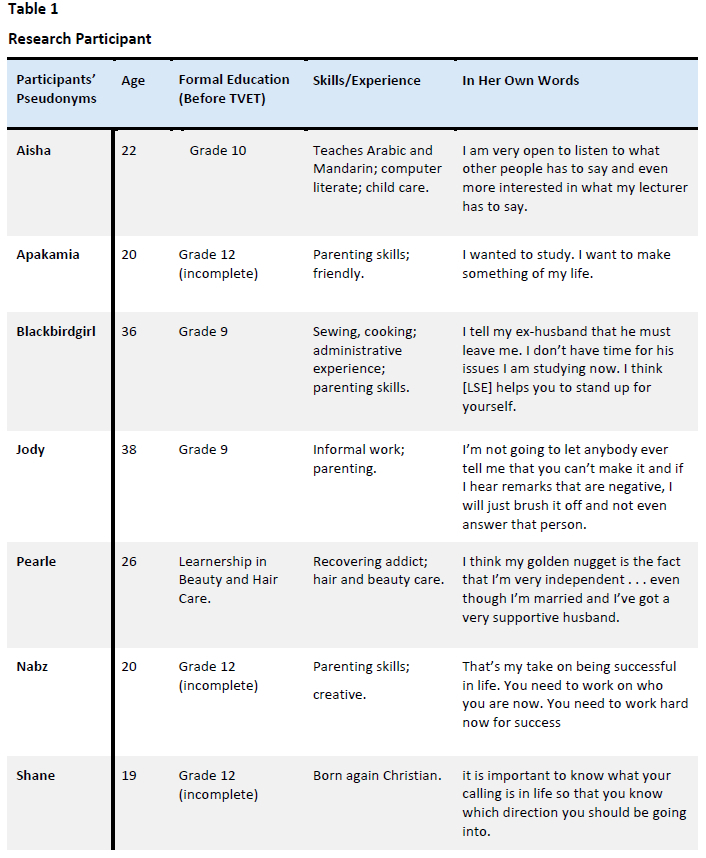
We focused on women students as the most vulnerable group in TVET (Sheshadri et al., 2023). Although TVET institutions are often assumed to be male-dominated, women actually constitute the majority of overall student enrolments, with men accounting for only 34.4% (38,171) of new intakes across South Africa's 50 public TVET colleges (DHET 2023, p. 10). However, because women remain proportionally underrepresented at 25.5% (17,965) within high-status, technical engineering programmes, the broader institutional framework continues to neglect women students' needs; prioritising their voices is therefore essential to counter this bias in the vocational literature. All first-year women students enrolled in childcare, health care, and business programmes at a South African TVET college were invited to participate in the research project. Seven students (see Table 1), who met the selection criteria, consented to engage in the year-long data collection process.
Data Collection
Data collection involved a series of individual interviews, supplemented by arts-based methods to elicit rich narratives including photo elicitations, river-of-life drawings, and journaling. Towards the end of the academic year, we facilitated a focus group meeting which brought all participants together to share their reflections and further insights.
Trustworthiness of the Data
Our strategies to ensure trustworthiness were as follows. First, we used a combination of data collection methods to corroborate findings: documents, journals, individual and focus group interviews, and visual data. Second, we applied interpretivist phenomenological methods (described below). Third, we conducted member checks throughout the process. Fourth, we obtained peer feedback on the data analysis to ensure that the data collection and analysis followed phenomenological methods, allowing for replication of the research within similar contexts and using similar methodologies.
Data Analysis
We analysed the students' data in two phases, following interpretivist phenomenological methods. In the initial pre-analysis phase, Epoché, we deliberately bracketed the data (Van Manen, 2023), that is, we attempted to put aside our assumptions about the students and about LSE. We continued to foreground participants' experiences in the first level of Reduction, an analysis of the collected data framed by concepts from the literature. In the second level of Reduction, we interpreted the data through the lens of capability theory, examining how students' experiences related to their capabilities, functionings, and to factors influencing their well-being. Both Epoché and the two levels of Reduction were integral to understanding students' lived experiences and generating insights towards a reconceptualisation of LSE.
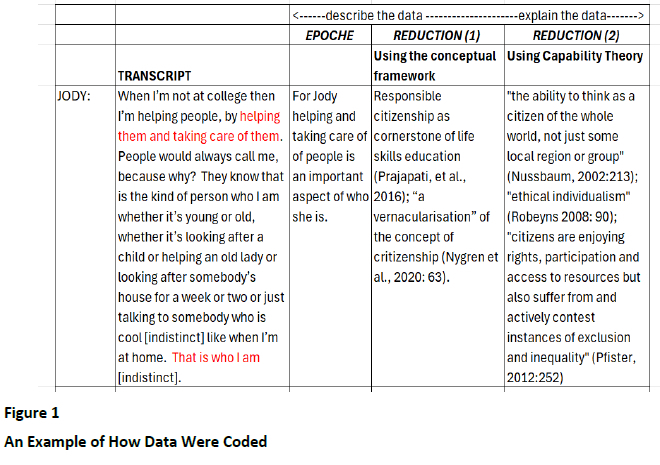
The structure for the data analysis of the interviews, adapted from Van Manen (2023) was as follows (see Figure 1):
• Transcribe interviews and field notes verbatim, and review them twice to mitigate researcher bias. Each student checked her interview transcript, which had been anonymised.
• Bracketing (Epoché): Re-examine verified verbatim interviews to identify coding of participants' experiences. The process required descriptive labelling in a Microsoft Excel spreadsheet.
• Reduction 1: The first-level analysis drew on concepts in well-being in LSE from the literature to code and categorise the student data,
• Reduction 2: The second-level analysis coded and categorised the data, drawing on the capability approach to well-being.
Ethical Considerations
Following the formal process of ethics clearance from the research ethics committee, and authorisation to conduct research at the TVET college, potential research participants were invited to the project. Informed consent was obtained from all participants by explaining the requirements of participation and informing participants of their rights in relation to the research project. It was made clear that a participant's decision to withdraw from the study would be respected. Participants decided how they would like to be contacted, and their preferred manner of communication. They also chose their own pseudonyms. Communication with the students always involved sincere enquiry about their and their family's well-being throughout the study. Anonymity and confidentiality were maintained, and member checks were conducted. A relationship of trust developed over time.
Reduction Level 1: What the Students Told Us About Their Well-Being
In this section, we analyse the student data, foregrounding their voices, while organising the data in categories of the four elements of well-being defined in the literature.
Bodily and Psychological Well-Being
Some students found the health information provided by LSE as potentially beneficial. Shane, for example, felt that the section on HIV was useful:
LSE teaches you about being healthy . . . like for example, HIV, how to actually get yourself sorted after you have got HIV, what is the treatment that you can go for and that tells you what you should do or how you should do it also, to protect yourself.
Pearle, who was navigating a 14-year-long dependency on tik (crystal methamphetamine), was not impressed with the section on the prevention of drug abuse. An LSE lecturer, unaware of Pearle's situation, required the class to view images of illicit substances online. Pearle recounted being triggered by the display, noting that it induced severe emotional distress and made her feel as though she did not "belong anywhere while also being homeless."
As the women students' narratives show, LSE's preventative approach, such as warnings about pregnancy, drug addiction, and sexual behaviour was too little, too late (Barrett, 2007). Moreover, the preventative approach failed to address the pervasive landscape of gender-based violence and trauma that the students encountered daily (Lou et al., 2008; Shefer & Macleod, 2015; Smith & Harrison, 2013). The consequences of the preventative approach exacerbated students' distress and feelings of shame, rather than supporting their recovery from trauma (Brown et al., 2015; Eastman, 2016; John & Cox, 2018; Kim, 2021).
Personal Well-Being
Shane highlighted how LSE occasionally fostered a sense of emotional competence and assertiveness, explaining that LSE:
Has actually taught me or has actually mould[ed] me into this person of actually being able to say no. . . . It helps me to discern on the things that I know or the things that are good for me and the things that are bad for me.
For other students, the processes of identity formation and affirmation were challenging. Aisha observed that LSE:
Forces you to face certain things within yourself that you've maybe been avoiding or that you don't like to think about.
For students like Apakamia, this exposure was alienating because she "did not like talking about [her] stuff," demonstrating that LSE's clinical approach to personal growth often produced vulnerability and shame rather than authentic self-efficacy (Eastman, 2016). Personal well-being thus emerged through the participants' attempts to build self-efficacy, critical awareness, and an authentic identity within an educational framework that frequently viewed them through a deficit lens.
Social Well-Being
Students understood their social well-being in terms of Ubuntu: a culturally rich perspective of giving to others and receiving support from others in return (Ngubane & Makua, 2021). Lefa (2015, p. 1) describes Ubuntu as "humanity [which] is ideally expressed in relationships with others." Jody exemplified this orientation: she actively sustained her community, "assisting individuals in [her] community" and routinely looked after "the community children and allowed them to play until their parents [came] home." Relational well-being was also forged inside the TVET institution when empathetic facilitators awarded students extrinsic dignity.
You get that lecturer that is very more supportive . . . and she advises you . . . because maybe she's a very understand[ing] person that I will say okay, she knows . . . why are people this age here and why, for what reason. . . . She will like just to give you advice and give you moral support. (Blackbirdgirl)
When empathy was absent, students disengaged from LSE. Nabz withdrew from class attendance after experiencing an unsupportive environment:
If you had that feeling you're going to feel it again in that class and I didn't want to feel this.
Financial Well-Being
The participants experienced severe economic deprivation, constantly negotiating the costs of their education and basic family survival. Jody described herself as "having to skarrel [scrounge] for bread and milk money, or to get to college"; she took on the informal work of returning grocery carts at a supermarket to secure her train fare. As she explained:
Sometimes I don't even get to college. When I am here then it's a little bit of the trolley money. . . . There's times when we just don't worry even eating . . . because why? There's other stuff that needs to be taken care of.
This extreme financial precarity was exacerbated by her home environment, where she was locked out of her home until her rent was paid.
Blackbirdgirl, who lived with her pensioner parents and children in the room of a municipal flat, wanted to escape menial work and generate an income for "the needs of the whole family." Nabz highlighted the burden of domestic labour, noting that she had no time for personal enjoyment. Her daily experience was defined by a long commute to college, working on assignments in brief 30-minute windows between childcare and domestic duties. For these women, the LSE's abstract lessons on basic time management and individual financial responsibility completely ignored the systemic constraints, such as delayed transportation allowances and unreliable bursary disbursements that dictated their daily access to education (Powell & McGrath, 2019).
Reduction Level 2: Students' Experiences Through a Capability Lens
In this section, we draw on the more complex and integrated concepts of the capability approach to reframe the initial research findings.
Authentic Autonomy
From a capability perspective, practising authentic autonomy is foundational to well-being because it requires that educational environments support an individual's freedom to make choices aligned with their core values (Ferracioli & Terlazzo, 2014; Wood & Deprez, 2012). Within this study, the women students exerted distinctive forms of agency to navigate severe life disruptions. Blackbirdgirl demonstrated her authentic agency by "standing up for [herself]" against an abusive ex-husband, while Shane identified a sense of purpose, noting it was "important to know what your calling is in life so that you know which direction you should be going into."
For other participants, agency manifested as critical self-reflection. Nabz understood agency as a continuous process of self-development, explaining:
You need to work on who you are now. You need to work hard now for success. . . . That's my take on being successful in life.
Similarly, Pearle protected her independence as a core capability, calling it her "golden nugget that makes me push through" on her journey to escape poverty, drug abuse, and violence.
While Tikly (2013) argues that vocational education must support the development of autonomy, and the official curriculum claims to enable students to "make informed and responsible decisions" (DHET 2020, p. 2), the data reveal that this autonomy was only partially supported. While all students were making choices, not everyone wanted to examine these in LSE. For example, Jody was comfortable discussing how she had reached decisions in her life, while Apakamia was not. Thus, it was only to a certain extent that students felt that LSE had assisted them with achieving authentic autonomy, as Shane explained.
So [LSE] has actually taught me or has actually mould[ed] me into this person of actually being able to say no . . . and also, to know that saying no, may not mean that you are weak but that you have a strong willpower and that you know that what you're doing is either wrong or right. It helps me to discern on the things that I know or the things that are good for me and the things that are bad for me.
Inflorescent Dignity
Achieving well-being within education is dependent on the realisation of human dignity, which encompasses both internal self-respect and the external validation granted by others (Walker et al., 2022). Aisha expressed a clear sense of intrinsic dignity through her religious attire, stating:
I like the way I am dressed. I feel comfortable with it . . . I am not doing this to please my parents.
Her self-respect was reinforced by a supportive home environment, allowing her dignity to develop, a process Mollvik (2021) terms "inflorescent dignity."
However, the institutional environment frequently acted as a negative conversion factor (Walker et al., 2022), undermining students' sense of self-worth through systemic exclusion. Several participants felt that they were not always given the respect they felt they deserved. The students had learned to stand up for themselves in the home environment, but they found challenges in the college environment that they had not expected:
I feel that due to me experiencing the same kind of treatment in some ways, due to our race, I would say, where we had witnessed that many students that come from the different race . . . for us it was kind of like just in some way . . . mind-boggling to have witnessed that some people are treated in a certain way. (Pearle)
Pearle felt that the college environment was racist; the opposite of an inclusive, supportive educational space that would ensure "safety from harm in the form of humiliation or unjust treatment" (Mollvik, 2021, p. 338). During their first year at college, there were numerous challenges to the students' dignity. Jody explained how she had to use her small travel grant to provide food for her family, which forced her to do informal work, relying on tips received from customers whose trolleys she returned to the supermarket:
Sometimes I don't even get to college. When I am here then it's a little bit of the trolley money.
For some participants, the life skills classroom was a safe space in what was perceived as an often-hostile college environment:
I say you actually learn from [LSE] where you get that lecturer that is very more supportive . . . and she advises you . . . and being more confident in your life and giving you advice because maybe she's a very understand[ing] person that I will say okay, she knows . . . why are people this age here and why, for what reason. . . . She will like just to give you advice and give you moral support and make you understand. (Blackbirdgirl)
Emotional and Relational Well-Being
The students' narratives show that emotional resilience can be developed in LSE. Jody, managing domestic abuse, achieved what she termed "emotional success" only after her life skills facilitator helped her identify and name her experiences as emotional bullying. This conceptual clarity allowed her to intentionally deploy positive self-talk and ignore negative remarks, directly improving her daily functionings. Jody's situation was very far from well-being. She operated in survival mode, constantly trying to find money to pay rent and get food. Yet, despite this, Jody still contributed to her community. When at home, she looked after "the community children and allowed them to play until their parents [came] home." Like many women who take on further studies, Jody sacrificed her own well-being and prioritised the well-being of others.
However, when deep-seated student traumas are ignored by the LSE curriculum or its facilitators, negative emotions can displace compassion and disrupt solidarity (Delors, 2013). Nussbaum (2003) notes that while negative emotions can impede academic progress, they can also be re-channelled through moral reflection to establish purpose. Pearle demonstrated this capacity:
It's something that you need to work on yourself where you have to give your everything . . . you're having purpose in life.
Despite facing acute hardships, including homelessness, the participants achieved the emotional resilience to sustain their educational aspirations.
Freedoms and Unfreedoms
The final level of capability reduction exposed structural unfreedoms that limited the students' capabilities through LSE's neoliberal focus on individual responsibilisation (McLeod, 2019; Strenio, 2020). LSE routinely framed wellness through prescriptive, individual preventative behaviours, yet its abstract warnings regarding sexual behaviour and substance abuse arrive too late for women who are already navigating the consequences of structural violence. The curriculum remained silent on counselling survivors of violence, despite South Africa's status as a country where intimate partner violence is a pervasive crisis (Govender, 2023). The extract below, from an online interview with Nabz, shows how challenging returning to studies is for mature female students:
I feel like when I'm at home, there isn't time. . . . I feel like sitting with my work for two hours is not enough . . . can you hear my daughter in the background? I'm surprised she hasn't disturbed me yet . . . I'm learning to cope now with it by staying at college an extra half an hour to an hour or leaving early in the morning to arrive at college. Just sometimes to even do my homework, finish off assignments because I really . . . do struggle.
Jody, the oldest female participant in the study, had to "work extra hard to keep the roof over the heads" of herself and her children. She enrolled at TVET because of a chance encounter with a stranger at the supermarket where she returned trolleys, who asked her "what she want[ed] to do with the rest of her life." After enrolment, Jody found she was left with limited options:
I can't even use my transport money to travel to college or buy toiletries for me. And [my mother] doesn't allow me in the house until that R is paid. . . . There are times when we just don't worry even eating . . . because why? There's other stuff that needs to be taken care of.
Jody's situation is very far from well-being. She operates in survival mode, constantly trying to find money to pay rent and get food. These structural constraints created severe conflict between competing capabilities, forcing women into restricted choices. Nabz was forced to choose between her fundamental right to education and her cultural responsibilities as a young mother, an external pressure that limited her choices and personal well-being. Similarly, Apakamia's functioning was restricted by the absence of single-parenting skills, or acknowledging the logistics of arranging childcare before her commute.
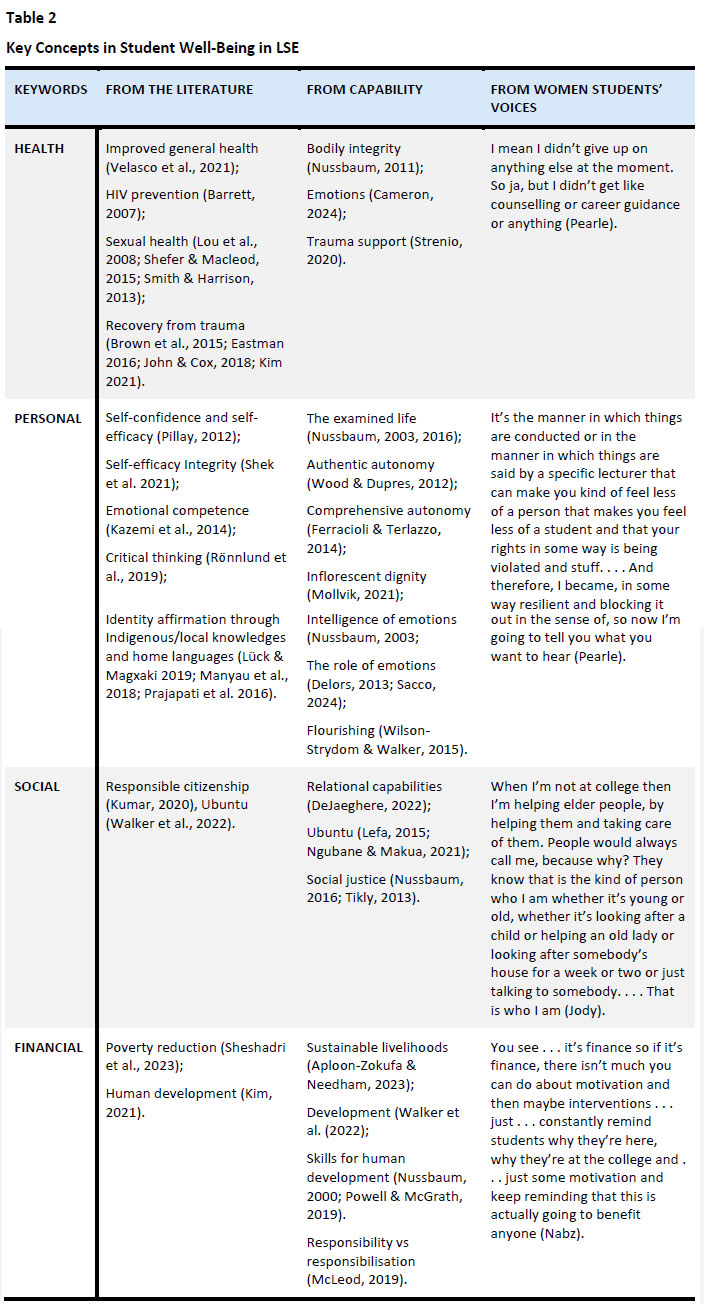
Ultimately, these structural unfreedoms manifest as severe financial distress rather than poor time-management skills. Shane and Pearle began their daily commute at five o'clock in the morning, while Apakamia faced a gruelling 120 km public transport journey costing R200 a day. Blackbirdgirl and Nabz described lives of domestic drudgery where schoolwork could only be done late at night after children and aging parents were fed and "sorted." Jody's survival mode forced her to forgo eating entirely when she could not afford both transit fare and her rent requirement. The LSE curriculum treats these structural, economic inequalities as individual obstacles to be overcome through personal motivation, or the development of time-management skills, and by doing so, shifts accountability onto the student, failing to address the systemic support necessary for genuine human flourishing. Table 2 synthesises similarities and differences across the literature, capability theory, and the empirical data, showing how the key concepts reveal themselves in students lived experiences.
Conclusion and Implications
The students' narratives, shaped by diverse experiences, societal expectations, and systemic constraints, provide insights into how an LSE curriculum could reconceptualise well-being. Given that this qualitative study focused on rich narrative accounts of seven participants, the insights generated are intended to signal the pedagogical and systemic implications for well-being in LSE, rather than definitive recommendations. The primary pedagogical implication of this research is the need to shift LSE away from its historical, adolescent focus toward an adult education pedagogy. Both the national student demographics provided by the DHET (2023) and the life experiences documented in this cohort show that TVET classrooms are occupied by adult learners. An adult-centred pedagogy would centre students' experiential knowledge by validating their parental, caregiving, and livelihood strategies as strengths rather than as personal deficits or learning obstacles. Furthermore, a contextually responsive LSE curriculum would integrate Indigenous knowledge and support mechanisms for trauma recovery, replacing responsibilisation with structural analyses of poverty and gender-based violence.
Students wanted to learn and progress in their studies. They wanted empathetic facilitators who could contribute to their growth, and they wanted a curriculum that spoke to their realities-parenting, overcoming drug addiction, addressing the trauma of violence-and they wanted the personal, social, and financial skills that they had developed acknowledged and shared. The findings demonstrate that while the students had a desire to progress academically and contribute meaningfully to their communities, LSE routinely overlooked their agency and resilience. Thus, the LSE curriculum should be negotiated with the students it intends to serve. This would involve a shift from decontextualised life skills towards a more flexible framework that could adapt to local needs, supporting students' holistic health, personal, social, and financial well-being through critical reflection, empathetic facilitation, and communal solidarity.
On a theoretical level, this study contributes to vocational scholarship by demonstrating the utility of the capability approach in evaluating curriculum responsiveness. By expanding on Nussbaum's capabilities framework and building specifically on relational capabilities (DeJaeghere 2020, 2022), the study argues that an individual's capacity to experience well-being cannot be separated from the institutional and social conversion factors that surround them. A relational approach to LSE, favouring social justice, student voice, and institutional validation, is more effective in empowering vulnerable student pathways than traditional, individual compliance or preventative models (Nasheeda et al., 2019; Sheshadri et al., 2023). Ultimately, this research highlights that when student voices are considered, LSE can be re-envisioned space for social justice and human flourishing.
Additionally, the research highlights the importance of a holistic approach to LSE that addresses not only cognitive skills but also intentional "humanness [like] caring, sharing respect, compassion" (Ngubane & Makua, 2021, p. 4) and associated social, emotional, and physical well-being. Throughout this study, the voices of TVET students were foregrounded. It is now incumbent to heed their call for a more relevant, equitable, and empowering LSE. Let their experiences guide our actions as we work to create learning environments where every student can thrive. In the same way that students appreciated being part of this research project, as Shane expressed in the quote below, students need to be more widely consulted about what they would value in LSE:
I just want to say thank you for giving me this platform to show or to speak about my perspective on things and how I feel about things, and I felt like I could speak my mind. So, thank you.
References
- Aploon-Zokufa, K., & Needham, S. (2023). Pathways of early childhood development practitioners into higher education: A capabilities approach. Journal of Vocational, Adult and Continuing Education and Training, 6(1), 127-144. https://hdl.handle.net/10520/ejc-jovacet_v6_n1_a8
- Barrett, H. R. (2007). Too little, too late: Responses to the HIV/AIDS epidemics in sub-Saharan Africa. Geography, 92(2), 87-96. https://doi.org/10.1080/00167487.2007.12094186
- Black, S., & Yasukawa, K. (2013). Beyond deficit models for integrating language, literacy and numeracy in Australian VET. Journal of Further and Higher Education, 37(4), 574-590. https://doi.org/10.1080/0309877X.2011.645469
- Brown, A. N., Rankin, K., Picon, M., & Cameron, D. B. (2015). The state of evidence on the impact of transferable skills programming on youth in low- and middle-income countries (3ie Scoping Paper 4). International Initiative for Impact Evaluation. https://doi.org/10.23846/SP0004
- Cairns, L., & Malloch, M. (2017). Competence, capability and graduate attributes. In M. Mulder (Ed.), Competence-based vocational and professional education: Bridging the worlds of work and education (pp. 103-124). Springer. https://doi.org/10.1007/978-3-319-41713-4_6
- Cameron, J. (2024). Incorporating an emotional dimension in the capability approach. In F. Comim, P. B. Anand, & S. Fennell (Eds.), Social choice, agency, inclusiveness and capabilities (pp. 202-221). Cambridge University Press. https://doi.org/10.1017/9781009232678
- DeJaeghere, J. (2022). Reframing life skills: From an individualistic to a relational transformative approach. In J. DeJaeghere & E. Murphy-Graham (Eds.), Life skills education for youth: Critical perspectives (pp. 73-90). Springer. https://doi.org/10.1007/978-3-030-85214-6_5
- Ferracioli, L., & Terlazzo, R. (2014). Educating for autonomy: Liberalism and autonomy in the capabilities approach. Ethical Theory and Moral Practice, 17(3), 443-455. https://doi.org/10.1007/s10677-013-9443-2
- Hegna, K. (2019). Learner identities in vocational education and training: From school to apprenticeship. Journal of Education and Work, 32(1), 52-65. https://doi.org/10.1080/13639080.2019.1593330
- John, V. M., & Cox, A. J. (2018). Fostering life-altering change amongst South African youth through non-formal education. Cogent Education, 5(1), Article 1457762. https://doi.org/10.1080/2331186X.2018.1457762
- Kazemi, R., Shabani, S. M. & Abolghasemi, A. (2014). The effectiveness of life skills training on self-esteem and communication of students with dyscalculia. Social and Behavioral Sciences, 114, 863-866. https://doi.org/10.1016/j.sbspro.2013.12.789
- Kim, J. (2021). An analysis of Uganda's vocational education: Assessing human capital and human development approaches. Issues in Educational Research, 31(2), 556-573. http://www.iier.org.au/iier31/kim.pdf
- Kumar, S. (2020). Prerequisite of life skills education for citizenship development. International Journal of Life Skills Education, 6(2), 35-45. https://educafl.ub.ac.id/index.php/educafl/article/view/143/135
- Lefa, B. (2015). The African philosophy of Ubuntu in South African education. Studies in Philosophy and Education, Indonesian Journal of Religious Volume 9, Number 1(2026): 1-13. https://doi.org/10.46362/ijr.v9i1.56
- Lou, C. H., Wang, X. J., Tu, X. W., & Gao, E. S. (2008). Impact of life skills training to improve cognition on risk of sexual behaviour and contraceptive use among vocational school students in Shanghai, China. Journal of Reproduction and Contraception, 19(4), 239-251. https://doi.org/10.1016/S1001-7844(08)60026-7
- Lück, J., & Magxaki, A. (2019). Language in a life orientation class: Complexities and contradictions. Journal of Vocational, Adult and Continuing Education and Training, 2(1), 93-111. https://hdl.handle.net/10520/EJC-1ba123d12a
- Manyau, T., Cronje, A., & Mokoena, M. A. (2018). Linking life orientation and indigenous knowledge education in South Africa: Lessons learnt from literature. Indilinga African Journal of Indigenous Knowledge Systems, 17(2), 202-218. https://hdl.handle.net/10520/EJC-13956e3aec
- McLeod, J. (2019). Reframing responsibility in an era of responsibilisation: Education, feminist ethics. In C. Halse, C. Hartung, & J. Wright (Eds.), Responsibility and responsibilisation in education (pp. 43-56). Routledge.
- Mollvik, L. (2021). Inflorescent dignity: A reconstructive interpretation of Martha Nussbaum's conception of dignity and its implications for education. Ethics and Education, 16(3), 336-354. https://doi.org/10.1080/17449642.2021.1927319
- Nasheeda, A., Abdullah, H. B., Krauss, S. E., & Ahmed, N. B. (2019). A narrative systematic review of life skills education: Effectiveness, research gaps and priorities. International Journal of Adolescence and Youth, 24(3), 362-379. https://doi.org/10.1080/02673843.2018.1479278
- Ngubane, N., & Makua, M. (2021). Ubuntu pedagogy-transforming educational practices in South Africa through an African philosophy: From theory to practice. Transformation in Higher Education, 6(1), 1-12. https://hdl.handle.net/10520/ejc-uz_inka-v13-n1-a2
- Nussbaum, M. C. (2000). Women and human development: The capabilities approach. Cambridge University Press. https://doi.org/10.1017/CBO9780511841286
- Nussbaum, M. C. (2003). Upheavals of thought: The intelligence of emotions. Cambridge University Press. https://doi.org/10.1017/CBO9780511840715
- Nussbaum, M. C. (2011). Creating capabilities: The human development approach. Harvard University Press.
- Nussbaum, M. C. (2016). Anger and forgiveness: Resentment, generosity, justice. Oxford University Press.
- Pillay, J. (2012). Keystone life orientation (LO) teachers: Implications for educational, social, and cultural contexts. South African Journal of Education, 32(2), 167-177. https://doi.org/10.15700/saje.v32n2a497
- Powell, L., & McGrath, S. (2019). Skills for human development: Transforming vocational education and training. Routledge.
- Sacco, G. (2024). The role of emotions in the capabilities approach: A critical analysis. Philosophy, 99(2), 223-245. https://doi.org/10.1017/S0031819123000402
- Shefer, T., & Macleod, C. (2015). Life Orientation sexuality education in South Africa: Gendered norms, justice and transformation. Perspectives in Education, 33(2), 1-10. https://hdl.handle.net/10520/EJC171670
- Shek, D. T., Lin, L., Ma, C. M., Yu, L., Leung, J. T., Wu, F. K., Leung, H., & Dou, D. (2021). Perceptions of adolescents, teachers and parents of life skills education and life skills in high school students in Hong Kong. Applied Research in Quality of Life, 16(5), 1847-1860. https://doi.org/10.1007/s11482-020-09848-9
- South African Department of Higher Education and Training. (2020). Subject guidelines: Life skills and computer literacy. https://www.dhet.gov.za
- South African Department of Higher Education and Training. (2023). Fact sheet on age for students in PSET institutions. https://www.dhet.gov.za
- Tikly, L. (2013). Reconceptualizing TVET and development: A human capability and social justice approach (UNESCO-UNEVOC Report). UNESCO-UNEVOC International Centre for Technical and Vocational Education and Training. https://www.tecnicoprofesional.mineduc.cl/wp-content/uploads/2016/08/Revisiting-Global-Trends-in-TVET.pdf
- Van Manen, M. (2023). Phenomenology of practice: Meaning-giving methods in phenomenological research and writing (2nd ed.). Routledge.
- Walker, M., McLean, M., & Mukwando, P. (2022). Low-income students, human development and higher education in South Africa: Opportunities, obstacles and outcomes. African Minds. https://www.africanminds.co.za/wp-content/uploads/2022/05/9781928502395_txt.pdf
- Wilson-Strydom, M., & Walker, M. (2015). A capabilities-friendly conceptualisation of flourishing in and through education. Journal of Moral Education, 44(3), 310-324. https://doi.org/10.1080/03057240.2015.1043878