Tutors' Experiences and Perceptions of Integrating Translanguaging Pedagogy Into University Tutorials
Abstract
This paper explores tutors' experiences and perceptions of integrating translanguaging pedagogy into a tutorial system at a South African university. South African universities grapple with creating language policy implementational spaces for epistemic access and, in response, University of the Free State has adopted translanguaging through its tutorial system to mediate epistemic access. However, no studies have yet been conducted to examine the experiences and perceptions of tutors who must often implement translanguaging pedagogy. Hence, this paper aims to fill this gap by exploring tutors' experiences and perceptions regarding integrating translanguaging pedagogy into the tutorial system in various disciplines. This qualitative study deployed focus group and semi-structured interviews to elicit the experiences of tutors facilitating multilingual classrooms. The study is framed within the ubuntu translanguaging framework. Data were analysed using thematic analysis. The findings show that tutors reported supportive, resistant, and contradictory perceptions on the integration of translanguaging pedagogy in the tutorial system.
translanguaging; pedagogy; tutorial system; different disciplines; South Africa; university
Introduction
Research on translanguaging within higher education has proliferated globally, establishing it as a critical lens for understanding multilingual practices, knowledge production, and identity construction. In the postcolonial South African terrain, however, the epistemic promise of translanguaging remains under-realised because pedagogical practices continue to be constrained by the dominance of inherited monolingual ideologies. University classrooms still struggle to integrate students' full linguistic repertoires as legitimate resources for sense-making and epistemic access, thereby reproducing exclusions in knowledge participation. While the Language Policy Framework for Higher Education (Department of Higher Education and Training, 2020) offers a national directive to institutionalise multilingualism across research, teaching, and learning, the persistent disjuncture between policy and practice highlights an urgent need to embed translanguaging as a systematic pedagogical resource within higher education.
In the area of teaching and learning, the tutorial space has been identified as a key site to pilot the implementation of the Language Policy Framework, particularly because issues of linguistic and epistemic praxis within this context remain under-researched. Tutorials, or supplemental instruction, are a long-established global practice designed to provide academic support for students who encounter learning challenges. Research consistently shows that the primary purpose of tutorials is to serve as an institutional strategy for enhancing student success and reducing high dropout rates in universities (Amor et al., 2021; Da Re et al., 2017; Munley et al., 2010).
In most cases, tutoring systems are shaped by university culture, institutional policies, available learning resources, and the broader context in which they operate (López-Gómez et al., 2020). However, these systems often reproduce Eurocentric models that are transferred into complex multilingual settings, such as South Africa, without sufficient adaptation. As a result, monolingual tutoring pedagogies become normalised, limiting students' opportunities to draw on their full linguistic repertoires. Challenging this tendency, Hurst and Mona (2017) argued that translanguaging within tutorials is essential because it fosters socially just pedagogies that recognise and value linguistic diversity. This position is reinforced by growing evidence on the cognitive, linguistic, and academic affordances of multilingual learning spaces (García & Wei, 2014; Heugh et al., 2022; Makalela & da Silva, 2025).
Research on tutoring in South Africa has highlighted the significant opportunities tutorials provide for student learning and success. Clarence (2016) showed that tutorials can enhance epistemic access for tutees, while Faroa (2017) demonstrated their role in improving student engagement in higher education. More broadly, tutoring studies consistently point to their effectiveness in supporting students' cognitive development, academic achievement, professional growth, and peer learning (Arco-Tirado et al., 2020; López-Gómez et al., 2020). Yet, despite these benefits, throughput and success rates across the South African higher education system remain worryingly low (Department of Higher Education and Training, 2024). This suggests that current tutoring practices, while valuable, are not sufficient to address systemic challenges.
This paper argues that without a reorientation of tutoring towards inclusive practices that take seriously the multilingual realities of students, issues of epistemic injustice and identity alienation will persist. In line with the Language Policy Framework for Higher Education (Department of Higher Education and Training, 2020), the University of the Free State's Language Policy (2023) commits to creating spaces for epistemic access by embedding translanguaging pedagogy within its tutorial system. Building on that policy shift, this paper explores the potential of translanguaging pedagogy-understood as the use of students' unitary linguistic repertoires to make meaning of their bi/multilingual worlds-as a strategy to transform tutorials into spaces of equity and inclusion. Specifically, the paper investigates an under-researched area: how university tutoring systems can integrate the use of more than one language simultaneously as languages of input and output in complex multilingual contexts.
Translanguaging pedagogy
While Cen Williams (1994) is often credited with coining the term "translanguaging" in relation to Welsh-English bilingual education, it is important to note that the practice itself predates his description. Williams' formulation captured a pedagogical technique whereby learners engaged in the receptive and productive use of two languages-such as reading in Welsh and writing in English (Baker, 2011; García & Wei, 2014). However, this framing risks obscuring the deeper historical and social realities of multilingualism. As Makalela (2016, 2018) underscored, translanguaging is not an innovation of the Welsh context but a long-standing social practice, particularly visible in the Global South, where speakers have always drawn fluidly on their unitary linguistic repertoires to make meaning, negotiate identities, and sustain epistemic continuity. In this sense, Williams' contribution lies in naming and formalising a practice that multilingual communities had been enacting for centuries.
In their introductory notes on translanguaging and language policy in the Global South, Makalela and da Silva (2023, p. 1) contended: "There seems no doubt in our view that translanguaging has taken a center stage as a viable strategy to transform learning and teaching practices that have historically followed the one-oneness ideology of the European Enlightenment." This "one-oneness" view-rooted in colonial modernity-has long sustained epistemic injustice by fragmenting linguistic repertoires into discrete, enumerable entities and by privileging European languages as the sole vehicles of knowledge. By contrast, translanguaging pedagogy advances a decolonial alternative that recognises the full linguistic repertoire of bi/multilingual speakers as a unitary semiotic resource for meaning-making, identity affirmation, and knowledge production (García, 2009; García & Wei, 2014; Makalela, 2015). In this way, translanguaging not only disrupts monolingual ideologies but also reclaims epistemic spaces historically denied to multilingual communities, positioning their practices as central to the transformation of education in the Global South.
Since its initial formulation, the meaning of translanguaging has been expanded and contextualised across diverse localities and scholarly traditions. García (2009, p. 45), for instance, defined it as the "multiple discursive practices in which bilinguals engage in order to make sense of their bilingual worlds." Building on this, translanguaging has been conceptualised in multiple ways: as pedagogy, as translingual practice, and as Ubuntu translanguaging pedagogy rooted in African epistemologies (Canagarajah, 2011; Creese & Blackledge, 2010; García, 2009; Makalela, 2015). Further variations include pedagogical translanguaging (Cenoz & Gorter, 2021) and translanguaging as theory and practice (Li, 2018). Each of these iterations reflects particular contextual emphases, demonstrating that translanguaging is not a fixed construct but a dynamic and evolving framework whose meanings shift according to sociolinguistic and epistemic conditions.
For this study, the focus is not on the initial version of translanguaging but on Ubuntu translanguaging, which offers a distinct African epistemological paradigm. As Makalela (2017, p. 14) explained, it seeks to "describe unbounded, fluid, mobile and versatile uses of languages in the 21st century." Unlike approaches that impose artificial boundaries between languages, Ubuntu translanguaging reflects the authentic praxis of speakers who draw seamlessly on their full repertoires in meaning-making. Grounded in the philosophy of Ubuntu, this transformative paradigm emphasises relationality, interdependence, and both vertical and horizontal flows of negotiated meaning (Makalela, 2026).
Central to this translanguaging framework is Ubuntu translanguaging pedagogy, which foregrounds cultural competence as a resource for navigating complex multilingual spaces. By disrupting linguistic hierarchies and addressing epistemic injustices, it generates inclusive spaces that afford students multiple pathways for knowing and becoming. In the context of this study-where student demographics are highly heterogeneous-Ubuntu translanguaging provides a relevant and robust theoretical grounding. More specifically, its application within the tutorial system makes it possible to reimagine tutorials as decolonial pedagogical sites: spaces where students' diverse repertoires are not only validated but are actively mobilised to enhance epistemic access and transform academic support into a socially just practice.
Tutorial Systems at Universities
Tutor Development and Preparedness
There is an agreement among scholars that tutors can be lecturers or undergraduate and postgraduate students. For this reason, it is necessary that tutors go through a capacitation or development path to be equipped with approaches meant to facilitate their tutorials. Elsewhere, research shows that tutors who are not trained may resort to pedagogical practices that have negative consequences for student engagement and success (Faroa et al., 2025; Motaung & Makombe, 2021; Sithole, 2024). Therefore, it is important that tutoring systems provide the necessary skills for tutors to effectively facilitate and enhance their tutorial practices. The training should consider tutors' personal qualities and capacity to integrate different attributes, which may include the ability to communicate in different African languages, and pedagogical approaches to managing language diversity when planning, organising, and implementing tutorial lessons.
Considering this, one aspect of the training should highlight the need for awareness of cultural competence given that tutoring systems cater for diverse students in terms of ethnicity, socioeconomic backgrounds, and languages. It is worth noting that tutoring offers a variety of skills that can be learned by tutors, including, amongst others, communication, problem solving, collaboration, classroom management, and development of self-esteem (Lin et al., 2025; Sithole, 2024). Tai and Zuo (2024) explored the use of translanguaging by an English second language tutor in online language tutorials at a university in Hong Kong. Their study found that the workshop for professional development of the tutor's capacity to implement translanguaging was important in his practice. The study also indicated that the ideology and willingness of the tutor enabled the creation of a translanguaging space in a virtual environment.
A recent study by Nsele et al. (2024) at University of KwaZulu-Natal revealed that post bilingual tutor training, tutors had more confidence to advocate for the usage of tutees' home languages; the tutors allowed tutees to use their home languages during tutorials to enable them to ask more questions and enhance classroom engagement. Despite that, the study revealed misunderstandings about the purpose of tutorials and the role of lecturers, which had negative implications for policy advocacy in the teaching and learning space. The study concluded that there is a need for workshops for both tutors and lecturers. Although tutors had been attending such workshops, greater lecturer stakeholder buy-in was required given that bilingual tutorials have the potential to co-construct knowledge spaces that enable knowledge sharing.
Access to Learning and Validation of Identity
Research on tutoring consistently highlights its academic benefits, particularly as a peer-learning space where tutors and tutees engage with difficult disciplinary concepts (Layton & McKenna, 2016; Roscoe & Chi, 2007). In the South African context, studies show that tutorials play a central role in enabling epistemic access. For example, Clarence (2016) and Leach (2015) demonstrated that tutorials help students navigate ways of knowing that extend beyond formal lectures. Madiba's (2014) study at the University of Cape Town further illustrated this potential, showing how economics tutorials were used to develop multilingual glossaries that scaffolded concept literacy through isiXhosa and English. Similarly, Mwaniki (2016) found that the use of students' full linguistic repertoires in tutorials optimised understanding, thus positioning translanguaging as a language management strategy.
A number of other studies confirm that translanguaging enables deeper content engagement. Maphalala and Mpofu (2020) showed how tutees and tutors collaboratively drew on multilingual repertoires to navigate content, with home languages facilitating questioning and comprehension. Batyi (2022) reported similar findings in tourism communication tutorials, where translanguaging not only enhanced conceptual understanding but also expanded students' academic literacy. These studies collectively demonstrate that translanguaging tutorials transform knowledge access by aligning teaching strategies with the multilingual realities of students.
Beyond learning access, translanguaging tutorials also affirm student identities and foster belonging. Ramafikeng's (2024) study in an occupational therapy course showed that tutorials became sites of co-created knowledge, offering both epistemic access and a stronger sense of inclusion for students who previously felt alienated. Likewise, Motaung (2024) found that translanguaging practices at University of the Free State created comfortable, collaborative spaces for tutors and tutees. However, English-only approaches risk undermining these benefits because English hegemonic practices limit the activation of translanguaging pedagogy (Ngidi & Mncwango, 2022). This underscores the need for systemic shifts from language fixity to linguistic fluidity and for tutor training on facilitating multilingual tutorials (Makalela, 2018; Yafele & Makalela, 2022).
Ngwabe et al. (2025) reinforced this argument in their study of tutorial programmes in education, where tutors intentionally employed translanguaging during group activities to address linguistic diversity. Their findings highlighted that translanguaging not only deepened conceptual discussion but also acted as an inclusive pedagogy that validated students' cultural and linguistic identities.
The studies cited above demonstrate that tutorials can be powerful spaces for access to learning and recognition of identity when translanguaging is deliberately integrated into pedagogy. They show that multilingual tutorials afford epistemic access by enabling students to draw on their full repertoires while also affirming identities in ways that counter epistemic injustice. However, they also suggest that realising this potential requires systemic reorientation of tutorial systems, moving away from monolingual traditions toward multilingual practices supported by policy, training, and institutional commitment.
Theoretical Assumptions
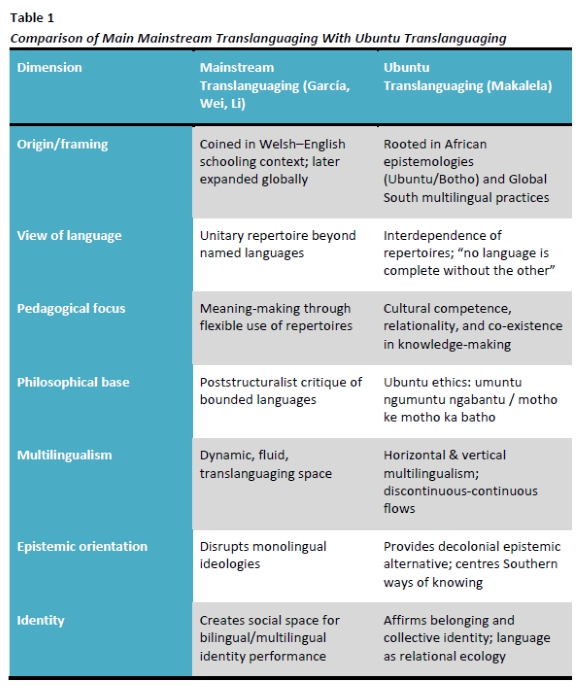
In an integrative review of translanguaging studies, Chaka (2020) identified seven theoretical orientations: humanising pedagogy, socially just pedagogy, coloniality, decoloniality, Southern frameworks, autoethnography, and Ubuntu translanguaging. A unifying thread across these frameworks is the critique of neocolonial ideologies that perpetuate the subjugation of Southern theories (Pennycook & Makoni, 2018). While all are valuable, this study focuses specifically on contrasting mainstream translanguaging theory with the Ubuntu translanguaging framework.
Translanguaging, as theorised by García (2009) and Li (2018), has gained global traction for conceptualising how bi/multilingual speakers mobilise their repertoires as unitary semiotic resources. Wei (2011, cited in Wei, 2018) described it as creating a social space where dimensions of history, experience, ideology, and capacity converge in coordinated performance. While this framing is important, Ubuntu translanguaging goes further by grounding the practice in an African epistemological paradigm that resists named and hierarchised languages (Makalela, 2016, 2017, 2019).
Ubuntu translanguaging advances an ontological and epistemological shift rooted in Ubuntu/Botho-captured in the adages umuntu ngumuntu ngabantu (isiZulu) or motho ke motho ka batho (Sesotho)-which emphasise relationality, interdependence, and co-existence (Makalela, 2016). Within this paradigm, no language is complete without the other; languages are fluid, overlapping, and interdependent. This creates conditions for what Makalela (2016, 2019) termed discontinuous-continuous and horizontal-vertical multilingualism, which moves beyond fixed boundaries of language towards dynamic flows of meaning-making.
For this study, Ubuntu translanguaging provides a relevant and robust theoretical grounding for understanding the tutorial system in a South African university. It enables us to see tutorials as pedagogical sites where access to learning is created not by privileging one language, but by valuing interdependence across repertoires. At the same time, it recognises tutorials as spaces of identity affirmation where belonging is fostered through acknowledgement of students' multilingual realities.
Importantly, this framework also guides the analysis of tutor attitudes. Attitudes towards translanguaging may be positive, negative, or contradictory, reflecting implicit and explicit value judgements about languages. Ubuntu translanguaging offers tools to interpret these tensions within a transformative paradigm that disrupts hierarchies and centres inclusive meaning-making. In doing so, it frames the tutorial system as a space of systemic curricular transformation where multilingualism is re-imagined as horizontal and vertical, fluid and interdependent. Whereas mainstream translanguaging highlights the fluidity of repertoires for meaning-making, Ubuntu translanguaging extends this by situating access to learning and recognition of identity within an African epistemological paradigm of interdependence and belonging (see Table 1).
Methodology
The study follows a qualitative approach to explore tutors' attitudes/perceptions toward the integration of translanguaging pedagogy into the tutorial system at a South African university. The design was selected to enable context-specific and rich insights into tutors' experiences, practices, and perceptions. This qualitative approach was consistent with a research paradigm that reflects and emphasises authentic experiences of the participants in order to discover patterns on how tutors experienced, practised, and perceived the integration of translanguaging pedagogy in the tutorial space.
Participants
Twelve tutors drawn from five faculties participated in this study. Participation was voluntary; an open invitation email was sent to tutors across seven faculties and, despite several reminders, only 12 tutors responded. Of these, five were from the Faculty of Education, three from the Faculty of Humanities, and two from the Faculty of Natural and Agricultural Sciences, while the Faculties of Law and Theology were each represented by one tutor. Data were collected through focus group discussions with eight tutors, and semi-structured interviews with the remaining four.
Sampling Procedure
A voluntary sampling design was employed to recruit participants for both focus group discussions and semi-structured interviews. Twelve tutors who had received training on translanguaging in multilingual tutorials volunteered to participate. The sample included both first-time tutors and those with more than one year of experience. Focus group discussions and interviews were scheduled in consultation with participants based on their confirmed availability.
Data Collection Process
The study employed two qualitative approaches for data collection: focus group discussions and semi-structured interviews. The twelve tutors participated on a voluntary basis. Focus group discussions were conducted with eight tutors to capture shared experiences, collective dynamics, and points of convergence across faculties. Semi-structured interviews were held with four tutors to allow for deeper individual reflection on their practices and perspectives. Data collection took place after the tutors had completed training and engaged in tutoring sessions, ensuring that they could draw on both the training and their lived tutoring experiences when responding.
Data Analysis
This study employed thematic analysis as primary analytic approach, providing a systematic procedure for moving from qualitative data to meaningful themes (Braun & Clarke, 2006). Data from focus group discussions and semi-structured interviews were audio-recorded, transcribed, and carefully examined to generate codes and broader thematic categories. Thematic analysis is particularly suited for identifying patterns of meaning in participants' accounts, enabling both description and interpretation of experiences (Braun & Clarke, 2006). The analysis proceeded through six iterative phases: familiarisation with the data through repeated reading, systematic coding of significant features, grouping codes into potential themes, reviewing and refining these themes against the dataset, defining and naming the final themes, and producing the analytical narrative (Braun & Clarke, 2006).
Ethical Considerations
The study forms part of the broad research project that has obtained ethical clearance from the General/Human Research Ethics Committee. The participants were provided with a detailed information leaflet that explained the aim, objectives, and right to withdraw at any time and all submitted their informed consent form to partake in the study. The participants were informed of the confidentiality of what they said during the interviews or focus group discussions, and that their details would be anonymised with pseudonyms throughout the study.
Findings
The analysis generated three main themes: challenges of integrating translanguaging pedagogy in the tutorial system, tutors' translanguaging practices in the tutorial system, and the role of tutor training in enabling translanguaging pedagogy. Each of these themes is further elaborated below through sub-themes that reflect specific patterns in the data.
Integrating Translanguaging Pedagogy in the Tutorial System
This theme addresses the challenges tutors faced when attempting to apply translanguaging pedagogy within tutorials. Although the value of translanguaging was widely acknowledged, tutors' experiences revealed tensions between its theoretical promise and the practical realities of implementation.
Limited Knowledge of African Languages
This sub-theme captures tutors' accounts of the difficulties they encountered when attempting to integrate translanguaging into tutorials. While tutors recognised the value of translanguaging for learning access and identity affirmation, many described a lack of proficiency in African languages as a significant constrain. This is illustrated in the excerpts below:
I would say for me, I do not really know a lot of languages, which makes it difficult for me to understand if someone is talking in Sesotho or isiZulu or whatever African languages . . . . because I speak Afrikaans and English. (T1)
I would say the one that I observed mainly was just based on how law is very Latin based, and concepts are very complex in the sense that at times we would not have a word in, like in, different language for me to frame it . . . because I realised that we would have certain concepts where you ask, "Okay guys what is this in your language?" and get a lot of people like, "No man we don't have such as word in our language" right, that became difficult in a sense. And also in regard to explaining certain concepts, and when it comes to explaining those concepts, ensure that like, the meaning is intact, you know, because a simple word nje, just like let's say uhm . . . "ubulele" in isiXhosa it means a variety of things (were you sleeping? did you kill? uhm, did you say thank you")-all in one word. So, you can easily lose the students that you are speaking to, or students can easily, in fact, lose you in terms of them basically translating. That is main issue that I saw in terms of translanguaging. (T2)
The excerpts reveal a tension between tutors' perceptions of language proficiency and the underlying principles of translanguaging pedagogy. Tutor T1, who speaks Afrikaans and English, expressed concern about her inability to understand other African languages, which view assumes that effective translanguaging requires the tutor to know and understand the languages of all tutees. However, translanguaging pedagogy does not rest on the tutor's multilingual proficiency but rather on their ability to create a translanguaging space that legitimises and enables students to draw from their full linguistic repertoires (Li, 2018). The tension here highlights a key challenge-while tutors recognise the multilingual realities of their classrooms, their own perceptions of language knowledge may limit their capacity to facilitate translanguaging practices effectively.
Tutor T2, who teaches a law module, raised concerns about the difficulty of rendering legal concepts into African languages. He explained that some terms do not have readily available equivalents, a challenge confirmed by his students. Reflecting on these experiences, he argued that such ambiguities risk confusing students and disrupting communication between tutors and tutees.
However, while T2 perceived this as a limitation, the example resonates with the Ubuntu translanguaging principle of incompletion. As Makalela (2026) explained, African multilingual practices-including code-switching, co-assembling, and fluid translation-are inherently guided by Ubuntu, and reflect advanced epistemic strategies. From this perspective, the semantic flexibility T2 observed is not a shortcoming but a resource; it affirms African ontologies of relationality, where meaning is always co-constructed and never fully contained in a single linguistic form.
Perceptions Towards English in the Tutorial System
Another challenge identified in integrating translanguaging pedagogy relates to the role of English in tutorials. The data suggest two interconnected issues: tutors' own limited proficiency in English and students' resistance to English-only interactions.
I can work from the front explaining and she will go to the tables explain to them in English or in their own languages because English is also not my best language, so I forget words . . . I have minimal wording . . . so sometimes my English does not work, sometimes it does. (T3)
This reflects both the tutor's limited command of English and her reliance on other languages to support students. Similarly, T4 observed:
Most of the students do not like speak in English.
T5 echoed this by reporting complaints from students:
There is so too much English.
These excerpts suggest that students prefer to use their own languages-Afrikaans, Sesotho, Sepedi, isiZulu, isiXhosa, and Venda-to engage with content and tutors.
As observed from the data presented above, the findings highlight how the dominance of English poses challenges to both tutors and students. For tutors, limited proficiency can hinder communication, while for students, English-only tutorials risk alienating them from fuller participation. From an Ubuntu translanguaging perspective, such resistance is not a deficit but a call to reimagine tutorials as multilingual spaces where diverse repertoires are legitimised and actively mobilised. In this way, moving beyond English-only practices becomes central-not only for access to learning but also for the recognition of identity in the tutorial system.
Tutors' Translanguaging Practices
This theme explores how tutors enacted translanguaging pedagogy in their tutorials. The findings reveal that translanguaging not only enhanced comprehension but also fostered collaboration, flexibility, and inclusivity in the tutorial system. One of the most prominent practices was the use of paired tutoring.
Translanguaging Enhances Paired Tutoring
Strategy
Paired tutoring was identified as a valuable strategy for integrating translanguaging into tutorials across different disciplines. Tutors explained that working in pairs allowed them to complement each other's linguistic strengths and provide support to students in multiple languages. As T3 explained:
I will explain it in English, and then when someone does not understand it, they know from the first few tutorials that [my fellow tutor] can talk the language, so then she will go to each table and ask those who don't understand to explain to them in their own language . . . so it makes it two times easier. Then I don't need to repeat myself in English. It works-it is a very good strategy to implement.
Similarly, T7 described how translanguaging was intentionally incorporated into their practice:
We decided to incorporate translanguaging in the tutorials, be it how we explain, be it how we ask questions. We try to phrase them in different languages. Even with the icebreakers, we try to use different languages . . . to get a feel or good sense of who speaks what language and who will be comfortable with certain languages.
These accounts highlight several important dimensions of translanguaging practices. First, co-facilitation enabled tutors to rely on one another's language strengths, ensuring that students who struggled with English could still access content in familiar languages. Unlike in Theme 1, where English was perceived as a barrier, here English was treated as a resource that could be combined with African languages for fuller comprehension. Second, tutors used translanguaging not only for content delivery but also for community building, as shown in the use of multilingual icebreakers to establish students' linguistic biographies and create inclusive spaces. Thus, paired tutoring supported access to learning by reducing language barriers and ensuring comprehension while also fostering the recognition of identity by validating students' linguistic repertoires and encouraging them to participate in their preferred languages.
Constructing a Comfortable Learning Space
Tutors consistently linked translanguaging with the creation of a more inclusive and supportive tutorial environment. Unlike lecture halls-where English dominates and students are often reluctant to ask questions-tutorials offered opportunities for freer engagement when translanguaging was encouraged. T8 reflected:
I think translanguaging used in the tutorial sessions is the best thing ever, because when you go to the lectures . . . they speak English . . . students are scared to ask questions. But when they get to tutorials, they see someone almost on the same level, so they're open because the environment is already inclusive depending on how the tutor is inclusive and how he uses strategies. Starting with translanguaging in tutorials is the best for me. I think this is the most inclusive environment.
Other tutors echoed this view. T9 observed:
If you are comfortable to communicate in your language [it] creates a healthy environment . . . there will never be a dull moment in tutorial sessions.
Similarly, T10 described how shifting languages transformed participation:
Once you started communicating in different languages then the environment started changing in the sense that people begin to feel more comfortable and relate with you. When I moved from speaking English to Sesotho, people eased up and it became easier to engage.
Together, these accounts illustrate how translanguaging pedagogy fosters a climate of trust, openness, and active participation. By validating students' linguistic repertoires, tutorials become spaces where learners feel comfortable to ask questions, share perspectives, and engage in dialogue that would otherwise be constrained in English-only settings. This finding aligns with previous research that identified translanguaging as a socially just pedagogy for building inclusive learning environments (Ramafikeng, 2024). Ultimately, creating a comfortable tutorial space through translanguaging advances both access to learning and the recognition of identity.
Tutor Training in Enabling Translanguaging Pedagogy
One of the key factors in implementing translanguaging pedagogy within the tutorial system is the preparation of tutors. Training provides not only strategies for managing multilingual tutorials but also opportunities for reflection on how best to support students' learning and engagement. While the training received by tutors in this study was considered useful, participants emphasised that it represented only an introductory step and called for a more tailored, in-depth approach.
The Value and Limits of Current Training
T11 reflected on the strengths and limitations of the training:
It was a good introduction in terms of the whole process of translanguaging, in terms of what we can do and how far we should limit it, what we need to take into consideration. . . . I will say it needs to go deeper in a sense that it is more specific to faculties. In EMS [Economic and Management Sciences] courses it is easier to explain numbers in different languages because numbers are more constant . . . whereas when you move to theory-based courses it becomes quite tricky because meaning can be lost. Having a more structured, faculty-based approach would be very useful.
This excerpt shows that while T11 appreciated the training as an orientation, he recognised the need for more discipline-specific strategies. Translanguaging is not uniformly applicable across all subjects, and tutors require guidance that speaks to the linguistic and conceptual demands of their own faculties. By contrast, T12 highlighted the immediate benefits of the training:
The training provided useful strategies for integrating learners' home languages alongside English to enhance comprehension and participation. I also appreciated the interactive approach, which allowed me to reflect on my own teaching practices and explore ways to bridge language barriers effectively.
Here, T12 points to the practical impact of training, particularly in enabling tutors to value students' home languages and to adjust their pedagogical practices to foster inclusion.
Synthesis
Together, these accounts suggest that tutor training is central to embedding translanguaging pedagogy in the tutorial system. Training equips tutors with strategies to support multilingual participation and prompts reflection on their teaching identities. At the same time, tutors argue that future training should be more faculty-specific and in-depth in order to address the varied epistemological demands of different disciplines. Strengthening tutor training in this way would not only enhance access to learning but also ensure that tutorials become sites for the recognition of identity, where students' full linguistic repertoires are valued as resources for knowledge-making.
Discussion
The aim of this study was to explore tutors' attitudes towards integrating translanguaging pedagogy into the tutorial system across different disciplines. The findings reveal three broad areas of insight: the challenges tutors experienced, their translanguaging practices, and the role of tutor training in enabling translanguaging pedagogy.
The first area of insight concerned tutors' perceived lack of knowledge of African languages. For example, T1, who is bilingual in Afrikaans and English, expressed difficulty in understanding tutees who used isiZulu or Sesotho. This perception reflects a common misconception that tutors themselves must be multilingual in order for translanguaging to occur. However, translanguaging pedagogy positions tutors as facilitators who create spaces for students to mobilise their own repertoires, and not as experts in all languages (Li, 2018). This finding echoes García and Wei (2014) and Creese and Blackledge (2010) who cautioned against equating translanguaging with translation or code-switching.
Another challenge was raised in a disciplinary context. T2, working in law, illustrated how isiXhosa terms such as "ubulele" can have multiple meanings ("did you kill?" "were you sleeping?" "did you say thank you?"). While this tutor viewed semantic multiplicity as a difficulty, the Ubuntu translanguaging framework (Makalela, 2016, 2026) interprets such linguistic flexibility as an epistemic resource-an enactment of incompletion where meaning emerges relationally. This finding extends previous work (Heugh et al., 2022) by showing how law tutorials can expose the limits of direct equivalence and the potential of translanguaging to affirm African epistemologies.
A further challenge was linked to English. One bilingual tutor admitted that her limited proficiency in English sometimes hindered communication. Yet, paradoxically, English was also viewed as a valuable resource when paired with African languages. This aligns with Ngidi and Mncwango (2022), who showed that English dominance in higher education is both enabling and excluding, depending on context. Here, tutors' reflections highlight the tension between English as a gatekeeping language and English as a shared resource in multilingual tutorials.
Despite these challenges, tutors demonstrated creative practices to facilitate learning-the second area of insight. One strategy was paired tutoring, where tutors drew on each other's linguistic strengths. As T3 described, one tutor explained concepts in English while the other clarified them in students' home languages. This collaborative practice supports Ngwabe et al. (2025), who argued that co-facilitation enables translanguaging to be systematically embedded in tutorials.
Tutors also used translanguaging in planning and delivery, from phrasing questions in multiple languages to introducing multilingual icebreakers (T7). These practices resonate with Maphalala and Mpofu (2020), who found that intentional translanguaging scaffolds comprehension and affirms students' linguistic biographies. In this study, such strategies not only improved content access but also validated students' identities in multilingual classrooms.
Another important finding was that translanguaging helped construct comfortable and inclusive tutorial spaces. T8 described tutorials as "the most inclusive environment" compared to lecture halls where English dominates. T9 and T10 similarly emphasised that translanguaging created a "healthy environment" in which students became more confident to participate. These findings confirm Ramafikeng (2024) and Motaung (2024), who showed that translanguaging fosters belonging and relational engagement, reducing the alienation often felt in monolingual academic spaces.
The third area of insight highlights the role of training. Tutors reported that introductory training provided useful strategies for incorporating students' home languages alongside English and for reflecting on their own practices. However, they also emphasised the need for more discipline-specific, in-depth training, as illustrated by T11's example of differences between EMS courses (where numbers are constant across languages) and theory-based subjects (where meaning can be more fluid). This echoes calls by García and Kleyn (2016) for teacher preparation that is tailored to specific disciplines and contexts.
Training was also experienced as a reflective space. T12 noted that it allowed her to reconsider her pedagogical approaches and identify ways to bridge language barriers effectively. This supports the findings of Canagarajah (2011) and Wei (2018), who argued that translanguaging pedagogy requires not only technical strategies but also a shift in educators' orientations toward language and identity.
In sum, the findings confirm and extend previous scholarship on translanguaging in higher education. They confirm earlier work showing that misconceptions about translanguaging (as requiring multilingual mastery) and the dominance of English remain barriers to its implementation. At the same time, they extend the literature by showing how the tutorial system-as a distinct pedagogical space-offers unique opportunities for translanguaging practices such as co-facilitation, multilingual planning, and creating inclusive learning environments. Finally, they highlight the importance of structured, faculty-specific training in embedding translanguaging pedagogy sustainably. By drawing attention to these dynamics, this study demonstrates how translanguaging tutorials can advance both access to learning and the recognition of identity-two principles that are central to inclusive higher education in multilingual contexts.
Conclusion
This paper examined tutors' attitudes towards the integration of translanguaging pedagogy into the tutorial system across different disciplines. The findings reveal that translanguaging pedagogy holds considerable promise in creating tutorial spaces that are more comfortable, inclusive, and participatory. Tutors indicated that enabling students to draw on their diverse linguistic repertoires not only enhanced comprehension of disciplinary content but also fostered a sense of belonging. Thus, the study affirms previous research showing that translanguaging pedagogy legitimises the multiple resources students bring into the classroom and disrupts monolingual norms that continue to dominate higher education (García, 2009; Makalela, 2015).
However, the findings also highlight enduring challenges. Tutors expressed concerns about their lack of proficiency in African languages and, in some cases, about their own limited competence in English. These perceptions reveal a misinterpretation of translanguaging as requiring mastery of all languages represented in the classroom when, in fact, the pedagogy positions tutors as facilitators of spaces where students themselves mobilise their repertoires. Such challenges were most evident in disciplinary contexts like law, where conceptual translation is complex and contested. These findings suggest that greater clarity and training are required if tutors are to move beyond deficit views of their own language knowledge towards embracing translanguaging as a practice of facilitation.
The study also demonstrated that tutors actively found ways to address these challenges. Co-facilitation emerged as an important strategy, where tutors were able to draw on one another's linguistic strengths to better support students. Equally, practices such as multilingual questioning and the deliberate use of icebreakers in different languages show how translanguaging can be embedded into tutorial planning. Perhaps most importantly, tutors recognised that translanguaging transformed tutorials into comfortable and inclusive spaces, distinct from lecture halls where English-only practices prevail and student participation is often constrained. These findings align with recent studies that highlight translanguaging as a socially just pedagogy, capable of cultivating belonging and fostering student engagement in multilingual university classrooms (Motaung, 2024; Ramafikeng, 2024).
From a practical perspective, the study points to several areas that require strengthening. Tutor training emerged as foundational but currently insufficient because participants described it as providing only an introductory layer. While training helped tutors to reflect on their practices and experiment with strategies, they also called for deeper, discipline-specific preparation that would respond to the varied epistemological demands of different fields. Institutions therefore need to move beyond generic workshops towards structured, contextually relevant programmes that equip tutors to engage meaningfully with translanguaging pedagogy. Furthermore, the benefits of co-facilitation highlight the importance of institutional support for paired tutoring models that allow tutors to complement one another's linguistic strengths and expand students' access to learning.
Future research is also necessary to build on these insights. This study was based on a small cohort of 12 tutors at one institution, and further studies with larger and more diverse samples are required to capture broader trends. Mixed-method approaches would be especially useful to triangulate qualitative accounts with measurable data on student engagement, success, and retention. In addition, discipline-specific studies could provide greater insight into how translanguaging functions in areas such as law, economics, and professional programmes, where the translation of abstract or technical concepts presents unique challenges. Longitudinal studies could also assess the sustained impact of translanguaging tutorials on students' academic trajectories.
In conclusion, this study has demonstrated that translanguaging pedagogy offers a powerful means of transforming the tutorial system into a site of both access to learning and recognition of identity. Yet, for this potential to be fully realised, institutions must provide tutors with the resources, training, and structural support needed to implement translanguaging in systematic and sustainable ways. In so doing, tutorials can become not only supplementary spaces for learning but also central platforms for advancing epistemic justice in South African higher education.
References
- Amor, M. I., Villamil K. V. S., & Dios, I. (2021). Assessing university guidance and tutoring in higher education: Validating a questionnaire on Ecuadorian students. PLOS ONE 16(6), 1-10. https://doi.org/10.1371/journal.pone.0253400
- Arco-Tirado, J. L., Fernández-Martín, F. D., & Miriam Hervás-Torres, M. (2020). Evidence-based peer-tutoring program to improve students' performance at the university. Studies in Higher Education 45(11), 2190-2202. https://doi.org/10.1080/03075079.2019.1597038
- Baker, C. (2011). Foundations of bilingual education and bilingualism (5th ed.). Multilingual Matters.
- Braun, V., & Clarke, V. (2006). Using thematic analysis in psychology. Qualitative Research in Psychology, 3(2), 77-101. https://doi.org/10.1191/1478088706qp063oa
- Canagarajah, S. (2011). Translanguaging in the classroom: Emerging issues for research and pedagogy. In Li Wei (Ed.), Applied linguistics review (Vol. 2, pp. 1-27). De Gruyter Mouton.
- Cenoz, J., & Gorter, D. (2021). Pedagogical translanguaging. Cambridge University Press. https://doi.org/10.1017/9781009029384
- Chaka, C. (2020). Translanguaging, decoloniality, and the Global South: An integrative review study. Scrutiny2, 25(1), 6-42. https://doi.org/10.1080/18125441.2020.1802617
- Da Re, L., Clerici, R., & Álvarez Pérez, P. R. (2017). The formative tutoring programme in preventing university drop-outs and improving students' academic performance. The case study of the University of Padova (Italy). Italian Journal of Sociology of Education, 9(3), 156-175. https://doi.org/10.14658/PUPJ-IJSE-2017-3-7
- Department of Higher Education and Training. (2020). Language policy framework for higher education. https://www.gov.za/sites/default/files/gcis_document/202011/43860gon1160.pdf
- Department of Higher Education and Training. (2024). Statistics on post-school education and training in South Africa: 2022. https://www.dhet.gov.za/Information%20Systems%20Management/Statistics%20on%20Post-School%20Education%20and%20Training%20in%20South%20Africa.%202022.pdf
- Faroa, B. D. (2017). Considering the role of tutoring in student engagement: Reflections from a South African university. Journal of Student Affairs in Africa, 5(2), 1-15. https://files.eric.ed.gov/fulltext/EJ1164779.pdf
- Faroa, B. D., Rowe, M., Rhoda, A., & Adebiyi, B. (2025). Tutoring for success: Tutors' experiences of a tutoring programme in a health sciences faculty. Perspectives in Education, 43(1), 62-81. https://doi.org/10.38140/pie.v43i1.7771
- García, O. (2009). Bilingual education in the 21st century: A global perspective. Wiley/Blackwell.
- García, O., & Kleyn, T. (2016). Translanguaging theory in education. In O. Garcia & T. Kleyn (Eds.), Translanguaging with multilingual students: Learning from classroom moments (pp. 9-33). Routledge.
- García, O., & Wei, L. (2014). Translanguaging: Language, bilingualism, and education. Palgrave MacMillan.
- Heugh, K., French, M., Arya, V., Pham, M., Tudini, V., Billinghurst, N., Tippett, N., Chang, L., Nichols, J., & Viljoen, J. (2022). Multilingualism, translanguaging and transknowledging: Translation technology in EMI higher education. AILA Review, 35(1), 89-127. https://doi.org/10.1075/aila.22011.heu
- Leach, N. (2015). Social development theory: A case for multilingual tutorials in Law. The Independent Journal of Teaching and Learning, 10(1), 51-68.
- Li, W. (2018). Translanguaging as a practical theory of language. Applied Linguistics, 39(1), 9-30. https://doi.org/10.1093/applin/amx039
- Madiba, M. (2014). Promoting concept literacy through multilingual glossaries: A translanguaging approach. in L. Hibbert & C. van der Walt (Eds.), Multilingual universities in South Africa: Reflecting society in higher education (pp. 68-87). Multilingual Matters.
- Makalela, L. (2015). Translanguaging as a vehicle for epistemic access: Cases for reading comprehension and multilingual interactions. Per Linguam, 31(1), 15-29. https://doi.org/10.5785/31-1-628
- Makalela, L. (2017). Bilingualism in South Africa: Reconnecting with ubuntu translanguaging. In O. García, A. Lin, & S. May (Eds.), Bilingual and multilingual education (pp. 297-310). Springer.
- Makalela, L. (2018). Shifting lenses: Multilanguaging, decolonisation and education in the Global South. Centre for Advanced Studies of African Society.
- Makalela, L. (2019). Uncovering the universals of ubuntu translanguaging in classroom discourse. Classroom Discourse, 10(3/4), 237-251. https://doi.org/10.1080/19463014.2019.1631198
- Makalela, L., & da Silva, K. (2023). Translanguaging and language policy in the Global South: Introductory notes. Revista Brasileira de Linguística Aplicada, 23(1), 1-4. https://doi.org/10.1590/1984-6398202333203
- Makalela, L. (2026). Ubuntu translanguaging blueprint: A Southern epistemology for education transformation. In K. A. da Silva & L. Makalela (Eds.), The Routledge handbook of translanguaging in the Global South (pp. 277-297). Routledge.
- Makalela, L., & da Silva, K. (2026). Reclaiming translanguaging for transformative education in the Global South. In K. A. da Silva & L. Makalela (Eds.), The Routledge handbook of translanguaging in the Global South (pp. 344-357). Routledge.
- Maphalala, M. C., & Mpofu, N. (2020). Examining first-year students' experience of being tutored: A South African case study. Issues in Educational Research, 30(3), 10251039. https://www.iier.org.au/iier30/maphalala.pdf
- Motaung, L. B. (2024). Translanguaging as a pedagogical practice in the tutorial programme at a South African university. International Journal on Language Studies, 18(1), 81-104. https://doi.org/10.5281/zenodo.10468213
- Motaung, L. B., & Makombe, R. (2021). Tutor experiences of online tutoring as a basis for the development of a focused tutor-training programme. The Independent Journal of Teaching and Learning, 16(2), 101-117.
- Munley, V. G., Garvey, E., & McConnell, M. J. (2010). The effectiveness of peer tutoring on student achievement at the university level. The American Economic Review, 100(2), 277- 282. https://www.aeaweb.org/articles?id=10.1257/aer.100.2.277
- Mwaniki, M. (2016). Translanguaging as a class/lecture-room language management strategy in multilingual contexts: Insights from autoethnographic snapshots from Kenya and South Africa. Southern African Linguistics and Applied Language Studies, 34(3), 197-209. https://doi.org/10.2989/16073614.2016.1250357
- Ngidi, S. A., & Mncwango, E. M. (2022). University students' perspectives on an English-only language policy in higher education. The Journal for Transdisciplinary Research in Southern Africa, 18(1), 1-5. https://doi.org/10.4102/td.v18i1.1189
- Ngwabe, A., Tototbayo, B., & Tembani, N. (2025). The impact of a tutorship development programme on tutors' professional transformation: A case of a university in South Africa. Interdisciplinary Journal of Education Research, 7(1), 1-15. https://doi.org/10.38140/ijer-2025.vol7.1.20
- Pennycook, A., & Makoni, S. B. (2018). Innovations and challenges in applied linguistics from the Global South. Routledge. https://doi.org/10.4324/9780429489396.
- Roscoe, R. D., & Chi, M. T. H. (2007). Understanding tutor learning: Knowledge-building and knowledge-telling in peer tutors' explanations and questions. Review of Educational Research, 77(4), 534-574. https://psycnet.apa.org/doi/10.3102/0034654307309920
- University of the Free State. (2023). Language policy. https://www.ufs.ac.za/docs/default-source/policy-documents-documents/language-policy-of-the-university-of-the-free-state.pdf?Status=Master & sfvrsn=b7af3120_3
- Wei, L. (2018). Translanguaging as a practical theory of language. Applied Linguistics, 39(1), 9-30. https://doi.org/10.1093/applin/amx039