Reclaiming TVET as a Humanising Space: Reflective Insights from South Africa's First Advanced Diploma in Technical and Vocational Teaching1
Abstract
Despite its critical role in addressing youth unemployment, South Africa's technical and vocational education and training (TVET) sector is hampered by structural inequities, social stigma, and a banking model of instruction. While policy reforms target technical competencies, a significant gap remains in lecturers' professional development, which frequently neglects the relational, reflective, and pedagogical practices necessary for transformative practice in Global South contexts. This research investigates how a pedagogical intervention can be collaboratively designed and implemented within an Advanced Diploma in TVET to support lecturer professional development and the cultivation of transformative agency. The study employs a design-based research (DBR) approach, positioning the researchers as active participants in iterative cycles of analysis, design, implementation, and reflection. Data were generated through collaborative self-reflection, including learning diaries, narrative free writing, and paired dialogues, and were analysed using thematic analysis to track pedagogical and ontological shifts over time. Results indicate that humanising TVET practice requires a relational praxis grounded in dialogical engagement and mutual vulnerability, which disrupts traditional classroom hierarchies. Furthermore, findings reveal that a contact-synced live blended architecture can bridge geographical divides while maintaining human-centredness. The intervention fostered critical consciousness, enabling lecturers to transition from passive policy implementers to African activists who localise knowledge and promote entrepreneurial agency. This study makes a methodological contribution to the field by positioning DBR as a transformative design logic uniquely suited for decolonial, contextually grounded transformation in the Global South.
Lecturer Professional Development; Design-Based Research; Reflective Practice; Technical and Vocational Education and Training (TVET)
Introduction and Background
The South African technical and vocational education and training (TVET) sector is vital for the country's socioeconomic growth, aiming to equip youth with practical skills to tackle high unemployment and skills gaps (Powell et al., 2025). Yet, it faces structural and social challenges that weaken its effectiveness and reputation. A key concern is the shortage of qualified, experienced lecturers in industry (Rudman & Meiring, 2018). Many lack formal pedagogical training specific to vocational education, while others have limited technical exposure. This tension affects practical skills training, worsened by difficulties in recruiting and retaining skilled staff, especially in technical fields where industry pay is more competitive.
Many TVET colleges face ageing infrastructure, outdated workshops, and limited access to modern technologies. This hampers students' industry readiness and reflects inadequate funding affecting maintenance, curriculum, staff, and support services (Adebola & Hoffman, 2026). These systemic issues occur amid South Africa's high youth unemployment, pressuring the TVET sector to produce employable graduates and expand economic pathways. Despite its importance, TVET is socially viewed as a second-choice option to university, fostering stigma, low motivation, and a perception of low prestige. The sector must fix internal weaknesses and change public attitudes toward vocational education.
Lecturer professional development is a key driver for institutional change (Nduna, 2026). While systemic issues like funding require long-term policies, growth in the lecturer workforce offers an immediate, sustainable way to improve (Odondi et al., 2022). Lecturers shape classroom experiences, student engagement, curriculum, and teaching culture. Investing in their development can lead to broader institutional and sectoral transformation. The idea of transforming one lecturer at a time recognises that real change in the TVET sector depends on human relationships, teaching methods, and professional agency (Rudman & Meiring, 2018). Supported lecturers can adopt innovative approaches, incorporate industry knowledge, respond empathetically to students, and foster environments that encourage success and dignity (Rudman & Meiring, 2018). Professional development also enhances lecturer reflection, helping them critically engage with the social realities of vocational education and become active agents in institutional renewal rather than passive policy implementers (Maluleke, 2022). Lecturer development initiatives can counter negative perceptions of TVET education by empowering skilled, confident lecturers (Maluleke, 2022). This improves teaching quality and student outcomes, boosting the sector's credibility and attractiveness. It is a strategic investment in the long-term sustainability, humanisation, and transformation of South African TVET education.
The South African TVET sector faces structural and pedagogical challenges that hinder its ability to respond to the needs of vocational education and youth development (Powell et al., 2025). Policy reforms aim to improve the sector, but little attention is given to lecturer professional formation and teaching cultures. Professional development often focuses on compliance, curriculum, or technical skills, with less emphasis on relational, reflective, and human-centred approaches (Maluleke & Harley, 2016). Many lecturers are underprepared for the social, emotional, and educational complexities of diverse classrooms. Interventions are needed to enhance pedagogical practice while promoting dignity, care, dialogue, and critical reflection.
This study created an intervention for TVET lecturers in the format of an advanced diploma, encouraging critical reflection on teaching, identities, and student relationships through collaborative, relevant learning. It viewed lecturer development as a participatory, transformative process rooted in vocational education that aimed to professionalise South African TVET lecturers. The first author, a lecturer, engaged participants, while the second, a facilitator and instructional designer, helped with conceptualisation, structuring, and refinement. Their collaboration combined pedagogical practice, reflective inquiry, and design thinking. To achieve these aims, the study used a design-based research (DBR) approach, which enables iterative design, implementation, analysis, and refinement of educational interventions in real-world settings while generating theoretical knowledge. Through cycles of design and reflection, the study examined how a humanising pedagogical intervention could be developed and adapted to the complexities of TVET education. The paper outlines the conceptual foundations, discusses the DBR methodology, presents the intervention's design and implementation, analyses key findings, and concludes with implications for lecturer development and future TVET research.
Theoretical Framework
Critical pedagogy provides an axiological foundation that reconceptualises vocational education as inherently political and socially just, moving beyond the mere transmission of technical competencies. Within the South African TVET landscape, this paradigm requires a rigorous departure from the traditional banking model of instruction towards a transformative praxis, a dialectical synthesis of theoretical reflection and deliberate action to dismantle entrenched systemic inequities (Majola & Geduld, 2025). By foregrounding agency and critical inquiry, this lens empowers lecturers to move from passive policy implementers to transformative intellectuals who foster humanising environments that restore dignity and intellectual autonomy to students often marginalised by socioeconomic stigma (Freire, 1992). Ultimately, critical pedagogy provides the conceptual tools to interrogate dominant ideologies and cultivate a workforce that is not only technically proficient but also socially conscious and committed to challenging the status quo.
Complementing this critical orientation, Bakhtin's (1981) concept of the chronotope offers a sophisticated analytical lens for understanding the intrinsic connectedness of temporal and spatial dimensions within the pedagogical act (Ritella & Ligorio, 2016). Far from being neutral backdrops, these space-time configurations are socially constructed relationships that profoundly shape the scope of participant agency and the co-construction of meaning (Ritella, 2018). In the context of TVET colleges, often stifled by antiquated infrastructure and rigid historical legacies, a chronotopic perspective enables researchers and lecturers to actively reconfigure the conditions of learning, bridging the gap between students' lived pasts and their imagined professional futures (Gilje, 2024). By recognising learning as a non-linear, contextual, and relational process, this framework supports the intentional design of environments that disrupt traditional hierarchies, thereby facilitating more equitable engagement with the evolving demands of industry and the broader knowledge economy (Jacobs, 2023).
Humanising pedagogy is a transformative framework in vocational education, disrupting the traditional banking model in which knowledge is merely deposited into passive students (Majola & Geduld, 2025). Based on Freirean and Africanist scholarship, it reclaims TVET as a site of epistemic and pedagogical struggle, emphasising relational learning, dialogue, and conscientisation. This pedagogy involves relational praxis with dialogical engagement and mutual vulnerability, in which facilitators act as co-creators of knowledge, recognising learners' skills and histories (Sathorar, 2018). Fostering dignity and autonomy helps lecturers become transformative intellectuals and African activists capable of localising knowledge and fighting systemic inequities. Overall, humanising pedagogy balances technical skills with social justice and holistic development in the Global South.
This literature review examines scholarship on the structural, pedagogical, and socio-political challenges shaping the South African TVET sector. The review is organised around three interrelated themes: employability and systemic reform, critiques of traditional vocational education and its second-choice status, and the emergence of humanising pedagogies and participatory methodologies as transformative responses within TVET. Collectively, the literature highlights the need for contextually responsive approaches to lecturer development.
Employability, Equity, and Systemic Reform in South African TVET
Nduna (2026) investigated the persistent issue of TVET colleges producing graduates who remain largely unemployable despite the strategic inclusion of work-integrated learning within institutions. The study employed a qualitative approach, which indicated that best practices in work-integrated learning, specifically student preparation, placement, monitoring, assessment, and the maintenance of partnerships, are significantly hindered by structural barriers related to institutional leadership, funding shortages, and a lack of policy coherence (Nduna, 2026). Therefore, while structural reforms remain important, the findings point to the critical role of lecturer agency and professional development in translating policy aspirations into effective vocational teaching and learning practices.
Angela et al. (2026) examined gender inequalities in access, participation, and outcomes within TVET systems across sub-Saharan Africa, noting that women remain excluded from high-value technical fields. Their methodology comprised a systematic literature review of empirical and review studies published between 2019 and 2025, employing thematic and comparative analyses to synthesise evidence across African countries. Their findings showed that African TVET systems often reinforce gendered occupational segregation because of gender-insensitive environments, socio-cultural norms that prioritise boys' technical education, and intersecting disadvantages such as poverty and disability. The authors recommended integrating gender-responsive budgeting, expanding leadership development for women, and strengthening inclusive industry partnerships to create safer learning environments.
Adebola and Hoffman (2026) identify a persistent theory-practice gap in South African TVET tourism education, driven by obsolete curricula, limited resources, and insufficient professional development for lecturers, which ultimately undermine graduate employability. Their study calls for curriculum renewal aligned with industry needs, highlighting the need for systemic reform alongside strengthened lecturer capacity and more practice-oriented, humanising approaches to teaching. Similarly, Majola et al. (2026) critique the sector's narrow economic focus, showing how structural constraints limit the development of students' human capabilities and civic agency, even as students actively exercise agency through peer learning and collective organisation. These studies collectively underscore that addressing persistent challenges in South African TVET education requires integrated systemic reform and strengthened lecturer development that not only bridges the theory-practice divide but also advances more humanising, capability-driven approaches that support both graduate employability and student agency.
Sleymane Mohamed & Bao (2026) examine how colonial and neoliberal paradigms persist in Global South TVET systems, favouring foreign models over local relevance. Using a four-dimensional framework-knowing, doing, being, and feeling-the researchers analysed policies and initiatives. Their findings show that despite reclaiming epistemic sovereignty, these institutions face challenges such as uneven funding, digital divides, and hierarchical knowledge systems that favour the Global North. An important recommendation relevant to this article is to include Indigenous knowledge, promote recognition of regional qualifications, and leverage inclusive digital transformation. Sleymane Mohamed & Bao argue for a reimagining of TVET systems that moves beyond externally imposed models towards contextually relevant, human-centred approaches that value local knowledge, agency, and capability development, reinforcing the need for lecturer development initiatives grounded in the realities of the Global South.
Critiques of Traditional TVET and the "Second-Choice" Perception
Gaffoor (2018) examined the critical issue of low programme completion and high failure and dropout rates at South African TVET colleges. The study used a cross-sectional mixed-methods design, employing quantitative attitude rating scales and qualitative self-completion questionnaires. What is important for this study is that Gaffoor's findings indicated that a lingering stigma around TVET and negative student perceptions significantly contribute to poor retention, alongside interdependent factors such as socioeconomic conditions and institutional support. Gaffoor recommends that TVET colleges focus on internal factors within their control to improve student throughput. This perspective supports the current study's emphasis on lecturer professional development as a practical and sustainable mechanism for enhancing teaching quality and driving institutional change within the TVET sector.
Groener & Andrews (2019) investigated how students exercise agency to overcome barriers as they navigate pathways from TVET colleges to universities. This qualitative study involved semi-structured interviews with 30 students who had completed a National Certificate (Vocational) in Educare. The findings showed that students often use TVET colleges as an alternative pathway or detour after being denied direct access to university due to structural barriers such as matriculation results (Groener & Andrews, 2019). The study highlights student agency as a key factor in sustaining educational aspirations despite significant structural barriers and recommends strengthening recognition of prior learning pathways for TVET graduates. This emphasis on agency aligns with the current study's critical orientation, which positions lecturers as facilitators of learning environments that empower students to navigate challenges and pursue meaningful educational futures.
Powell et al. (2025) studied factors shaping student performance in South African TVET colleges using a mixed-methods design based on the realist capability approach. They surveyed 1,042 students across all 50 public TVET colleges, and identified four dimensions influencing success: institutional endowments, student endowments, the skills system, and socioeconomic context. Many students entered TVET not as a first choice but due to limited options, often being redirected into other programmes after their preferred courses were full, perpetuating TVET's image as a second choice. Despite strong aspirations and resilience, students faced structural barriers including poor facilities, delayed NSFAS funding, language barriers, and a lack of support (Powell et al., 2025). These findings highlight the need for lecturer development initiatives that equip lecturers to respond to the complex social, economic, and educational realities facing TVET students.
Humanising Pedagogy and Transformative Praxis in South African TVET
Rudman and Meiring (2018) explore the transformation of vocational education through lecturers' professional development. Using a qualitative case study, lecturers in a vocational education orientation programme reflected on changes over two years. Results show improved practice, better student relationships, and adoption of student-centred strategies. They suggest integrating humanising pedagogy into teacher qualifications to challenge negative views of vocational students. This work is particularly significant because it represents a foundational starting point for TVET lecturer development at Nelson Mandela University (NMU), where the Faculty of Education began to recognise the need for a more structured, humanising, and contextually responsive intervention. It provides an early empirical basis for the Advanced Diploma in Technical and Vocational Teaching (Adv Dip TVT) by highlighting the transformative potential of lecturer professional development.
Following the work of Rudman and Meiring (2018), Yassim et al. (2019) called for a radical revisioning of TVET to move beyond outmoded paradigms that reduce vocational education to a service to the economy. Their paper outlines a curriculum development journey for the Adv Dip TVT, utilising humanising pedagogy and the capabilities approach as responsive alternatives to standard frameworks. Key findings indicate that traditional banking models of education must be replaced by transformative teaching that values students' lived histories and human dignity. It is critical to note that Yassim et al. and Rudman and Meiring made more emancipatory approaches to TVET teaching available to us within the intervention.
Majola and Geduld (2025) critically examine the implementation of humanising pedagogy in South African TVET colleges, identifying structural and pedagogical barriers, including rigid curricula, inadequate lecturer preparation, and entrenched socioeconomic inequalities, that limit student agency and critical consciousness. They argue for integrating Freirean praxis with the capabilities approach to advance epistemic justice, participatory learning, and students' holistic development beyond narrow forms of content transmission. In a complementary but more system-focused account, Selane and Odeku (2024) position TVET institutions as key drivers of South Africa's developmental agenda, while highlighting persistent constraints including weak financial management, insufficient teaching quality, and infrastructural deficits that undermine effectiveness. They recommend stronger collaboration between colleges and industry to enhance curriculum relevance and graduate employability. Both studies collectively underscore that meaningful TVET transformation requires aligning humanising pedagogical approaches with the systemic strengthening of institutional capacity, lecturer development, and industry engagement to enable both emancipatory learning and economic empowerment.
Majola (2025) investigates the reimagining of TVET through the lenses of student agency, conscientisation, and a Freirean pedagogy of transformation. The study employed a participatory action research approach with graduates from the Eastern Cape, using life-narrative interviews and learning cycle group meetings as dialogical spaces. Critical findings reveal profound disillusionment among graduates, stemming from the perceived gap between educational promises and employment realities, as well as pedagogical alienation in rigid classroom environments. In our view, Majola not only foregrounds the emotional and existential consequences of misaligned TVET pathways but also reinforces the need for humanising, dialogical pedagogies that actively bridge epistemic, institutional, and labour-market divides.
DBR as a Participatory Methodology: Bridging the Theory-Practice Gap Through Collaborative Innovation
Ngoveni et al. (2025) examined how TVET students struggle with abstract financial mathematics concepts due to a lack of real-world context and traditional rote-learning methods. Using a qualitative DBR approach guided by situated learning theory, two student cohorts helped develop and refine instructional prototypes. Those researchers suggest incorporating contextualised learning and DBR methods into curricula to better meet student needs and further conclude that DBR cycles are crucial for linking theory and students' financial realities. In our view, the study demonstrates that DBR's iterative, context-responsive cycles are essential for bridging abstract disciplinary knowledge and learners' lived financial realities in TVET contexts, thereby enhancing conceptual understanding and pedagogical relevance.
Buhl et al. (2022) discuss the risk that DBR becomes fragmented into a toolbox of methods, threatening its participatory nature. They analyse how DBR's evolution reveals tensions between intervention ideals and stakeholder collaboration reality. Often, external agendas from policymakers or tech developers co-opt DBR, reducing practitioners and students to test subjects rather than co-creators of solutions. They recommend pairing DBR with ongoing critical reflection and deep engagement with practitioner knowledge during problem-setting. They conclude DBR remains a strong framework for research and development if it stays true to its collaborative, situated approach. Therefore, we are of the strong opinion that the study underscores that DBR's transformative potential is contingent on sustained participatory integrity and critical reflexivity, without which it risks being reduced to a methodological toolkit detached from collaborative knowledge production.
Getenet (2019) examined how educational research often doesn't connect with classroom practice, with practitioners not recognising research relevance. Using a mixed-methods DBR approach, it fostered collaboration between researchers and practitioners to co-design a professional development programme for technology-integrated mathematics teaching. Results showed that this collaboration led to practical, context-specific solutions such as informal professional development and team formations, boosting teachers' confidence and student engagement. The study emphasises that DBR centres researcher-practitioner collaboration, enabling shared expertise beyond traditional barriers. What is relevant for us as researchers is that Getenet's findings affirm DBR as a powerful bridge between research and practice, enabling co-constructed, context-sensitive interventions that strengthen practitioner agency and improve educational outcomes through sustained collaboration.
Tinoca et al. (2022) examined how DBR is used in teacher education, reviewing 163 papers from 2013 to 2020. They found that DBR effectively links theory and practice, but many studies report their iterative processes, data collection, and the ways findings guide subsequent cycles poorly. They suggest that future reports should thoroughly document cycles to improve replication and adaptation. Truly a critical point for this paper as Tinoca et al. highlight that while DBR effectively connects theory and practice in teacher education, its impact is limited by inconsistent methodological reporting, underscoring the need for greater transparency in documenting iterative cycles.
Stockless & Brière (2024) used a DBR methodology in a project on unconscious bias, involving community organisations as co-participants in a social laboratory to co-construct knowledge and interventions. Their findings present DBR as an inclusive, decolonial approach that enables marginalised stakeholders to influence every stage of the research process. Stockless and Brière concluded that DBR can reduce power inequalities and adapt research to community needs. Overall, the study positions DBR as a participatory methodology that redistributes epistemic authority by enabling stakeholders to co-shape both knowledge production and intervention design.
Research Gap
While scholarship has documented challenges in South Africa's TVET sector, such as inadequate infrastructure, a weak curriculum, lecturer shortages, and social stigma, less attention has been paid to the pedagogical and relational aspects of lecturer development (Powell et al., 2025; Yassim et al., 2019). Most studies focus on systemic policy reform or student outcomes, rarely exploring how lecturers experience and enact transformation. Theoretical responses, such as humanising pedagogy and Freirean praxis, are often discussed conceptually but lack empirical operationalisation in lecturer training programmes (Majola & Geduld, 2025). Although DBR is recognised as a collaborative methodology with the potential to bridge theory and practice (Mundy et al., 2023), its use in South African TVET lecturer development is limited. Existing DBR studies mainly focus on curriculum, technology, or student interventions, with few tracking pedagogical evolution over time (Oh & Reeves, 2010). This gap hinders understanding of how humanising pedagogies can be designed, enacted, and sustained in practice (Jacobs & Sathorar, 2025). This study addresses this by offering a collaborative, DBR-informed account of the development of a pedagogical intervention in South Africa's first Adv Dip TVT, providing practical and theoretical insights into humanising vocational education in the Global South.
Guiding Research Questions
This study was guided by questions exploring how a humanising pedagogical intervention could support the professional development and transformative agency of TVET lecturers within the Adv Dip TVT programme. The research sought to investigate the following:
1. In what ways do TVET lecturers experience and make meaning of dialogical engagement, mutual vulnerability, and reflective practice during the intervention?
2. What pedagogical, relational, and technological design principles emerge from the intervention's iterative implementation and reflection cycles?
3. How does DBR facilitate decolonial, contextually grounded transformation in TVET lecturer development practices in the Global South?
Methodology: A DBR Approach
Justification for DBR
This study employs DBR, a methodology uniquely suited to educational inquiry because it bridges the credibility gap between theoretical research and everyday classroom practice (Campbell, 2019; Lim et al., 2021; Ustun & Tracey, 2020). Unlike traditional experimental methods that isolate variables in artificial settings, DBR focuses on the messiness of real-world practice (Bernsteiner et al., 2025; Chen & Oakley, 2020; Guerra et al., 2017; Tinoca et al., 2022). The justification for using DBR in this study is fourfold:
• It addresses complex, real-world problems in their natural context.
• It leads to the development of usable knowledge and contextually sensitive design principles.
• It allows for flexible, iterative revision of the intervention based on participant feedback.
• It has a transformative agenda, seeking to improve learning environments while simultaneously advancing theoretical understanding.
Description of the Intervention
The TVET sector in South Africa has long required a robust intervention to address systemic challenges, including outdated 1980s curricula that were fundamentally unresponsive to industry needs (Terblanche, 2017). This lack of professionalisation and specialised pedagogical training for lecturers created a significant gap because historical reforms often resulted in a methodological deafness to the lived experiences and professional voices of vocational educators (Maluleke & Harley, 2016). The Adv Dip TVT was introduced as an essential national intervention to address these deficiencies, aiming to equip current and prospective lecturers with the pedagogical expertise needed to enhance the quality of post-school education (Maluleke, 2024). This qualification serves as the definitive instrument for professionalising the sector by focusing on teacher agency and long-term career growth, which had previously been neglected in institutional development models (Maluleke, 2024).
NMU positioned itself at the forefront of this national imperative, becoming a pioneering provider by offering the NMU diploma programme from 2019 (Maluleke, 2024). In response to the sector's urgent need for professionalisation, the Faculty of Education at NMU launched the first programme of its kind to serve lecturers across various provinces, including the Eastern Cape, Limpopo, and Gauteng (Maluleke, 2024). By initiating this programme, the university proactively addressed the critical skills gap and provided a structured pathway for lecturers to gain essential competencies while improving their professional status within the TVET college sector (Maluleke, 2024; Terblanche, 2017). This institutional response directly aligns with national mandates to improve student success rates and employability by ensuring that vocational educators are adequately qualified and industry-responsive (Maluleke & Harley, 2016; Terblanche, 2017).
Researchers' Positionality and Dual Roles
Following DBR principles, the researchers served as both lecturers and investigators (Getenet, 2019; Ngoveni et al., 2025). This approach blends empirical research with theory-driven learning environment design, requiring researchers to act as intervention architects while studying outcomes (Buhl et al., 2022; Ngoveni et al., 2025; Stockless & Brière, 2024). Being involved in designing, implementing, and refining pedagogical environments, we constantly reflected on our assumptions, choices, and interpretations to improve credibility and account for how our experiences and theories influenced the research. In line with DBR principles, the participants in this study were the two authors, both of whom served as lecturers within the programme under investigation and as researchers engaged in the systematic study of their own pedagogical practice (Getenet, 2019; Ngoveni et al., 2025). This dual role reflects a core characteristic of DBR, in which researchers are not detached observers but active participants who design, implement, evaluate, and refine educational interventions within authentic learning environments (Buhl et al., 2022; Stockless & Brière, 2024). Consequently, our involvement in the study extended beyond data collection to include the ongoing development and refinement of the pedagogical intervention itself.
As architects of the intervention, we immersed ourselves in the educational context, engaging in cycles of enactment, reflection, analysis, and redesign. This situated approach let us see how the intervention unfolded in practice while considering the complex social, spatial, and temporal realities shaping our teaching experiences (Buhl et al., 2022; Getenet, 2019). Instead of distancing from the setting, the study adopted a collaborative, reflective approach where practitioner knowledge provided valuable insight for understanding and improving educational practice. The primary data sources comprised our collaborative self-reflections, learning diaries, narrative free-writing activities, and paired dialogues generated throughout the intervention. These reflective artefacts documented our experiences as lecturers, our interpretations of emerging challenges and opportunities, and our evolving understanding of the pedagogical design.
Through ongoing dialogue and critical reflection, we interrogated our assumptions, decisions, and interpretations, allowing reflective inquiry to serve as both a mechanism for professional learning and a source of empirical data. Recognising our dual role as participants and researchers, we maintained reflexivity, continually examining assumptions, documenting decisions, and reflecting on the process (Getenet, 2019; Stockless & Brière, 2024). Instead of trying to eliminate subjectivity, we used reflexivity to deepen engagement with pedagogical complexities. Explicit positioning and documenting iterations aimed to improve transparency, credibility, and trustworthiness of the findings.
DBR Phases Applied in This Study
The following four paragraphs outline the DBR phases for the development and implementation of the Adv Dip TVT at NMU.
Analysis and Exploration
The analysis and exploration phase of the DBR process examined the contextual challenges and needs of the TVET sector to inform the design of the NMU diploma curriculum. Multiple stakeholders, including NMU and three local TVET colleges, engaged in an 18-month consultation to identify the realities of lecturer development and to establish a responsive intervention that involved lecturers, managers, and sector representatives. The analysis examined the profile of the existing TVET lecturer workforce and found that many had entered the profession via occupational pathways with limited formal pedagogical preparation.
Concurrently, the introduction of the DHET policy on lecturer professionalisation provided an important policy context for exploring sector needs. Evidence from stakeholder consultations and prior initiatives, particularly the vocational education orientation programme, was analysed to identify approaches that had shown potential to support lecturer transformation. These analyses revealed a need for a curriculum that moved beyond narrow vocational and economic imperatives towards humanising pedagogies, student agency, critical reflection, and broader human development. The findings from this phase, therefore, established the design requirements that guided the subsequent development of the NMU diploma intervention.
Design and Construction
DBR turns principles into practical tools and curricula to address educational challenges (Buhl et al., 2022). During the design and construction phase, findings from the analysis and exploration phase shaped the development of the NMU Adv Dip TVT. Following DBR principles, the qualification was collaboratively designed through an iterative process with university academics, curriculum specialists, TVET college representatives, and sector stakeholders. These discussions focused on defining the qualification's purpose, identifying competencies for TVET lecturers, and creating a curriculum aligned with sector realities and professional needs. Guided by humanising pedagogy and the capabilities approach, stakeholders developed the qualification structure, learning outcomes, modules, and assessments. Special attention was given to developing vocational pedagogy knowledge, skills, values, and dispositions, leading to modules like Philosophical Perspectives in Education that promote critical reflection. This process integrated theory, policy, and stakeholder views into a coherent, context-responsive qualification, which was then implemented and evaluated in the next DBR cycle.
Implementation and Iteration
The initial implementation phase focused on launching the first NMU Adv Dip TVT and implementing the intervention in an authentic educational setting. Following DBR principles, it aimed to see how the curriculum worked in practice and gather insights for refinement. NMU launched it in 2019 with a blended learning design; early experiences showed the need for greater flexibility and accessibility for lecturers in diverse locations while managing professional duties. The delivery model was then adapted to a more online-focused approach, reflecting iterative refinements informed by contextual realities. Digital tools like mobile polling, online discussions, and video resources were used to support engagement. This process tested the qualification's practicality, responsiveness, and accessibility, providing evidence to guide ongoing improvements within the DBR cycle.
Evaluation and Reflection
The evaluation and reflection phase analysed the effectiveness of the NMU Adv Dip TVT and generated evidence for ongoing improvement. According to DBR principles, data from programme implementation were used to assess how well the qualification met TVET lecturers' professional learning needs and addressed sector demands (Zhao et al., 2021). This process critically evaluated strengths, limitations, and relevance, focusing on lecturer development, pedagogical innovation, and sector responsiveness. The findings identified successes and areas for refinement, particularly in industry alignment, employability, continuing professional development, and the integration of teaching technologies (Maluleke, 2024). These insights led to reflection on design assumptions and future enhancements. As part of DBR's iterative process, evidence was used to improve the programme and its underlying theory.
Data Sources and Analysis
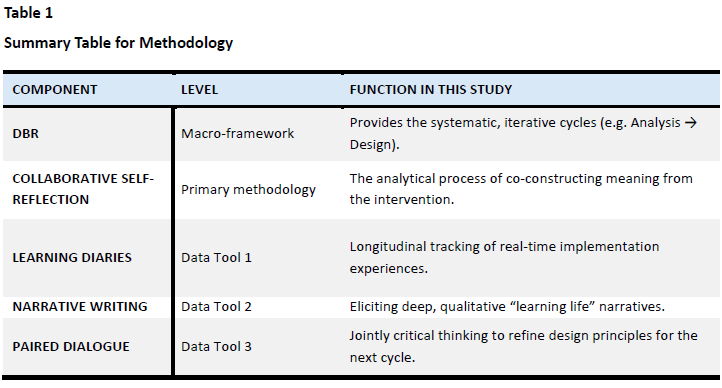
Within the broader DBR framework, the data collection instruments served as reflective micro-tools supporting iterative inquiry, design refinement, and knowledge generation. DBR involves cycles of enactment, reflection, analysis, and redesign, requiring mechanisms that enable participants to engage critically and generate data. In this study, learning diaries, narrative free writing, and paired dialogue acted as the reflective engine, enabling participants to document, interrogate, and reconstruct experiences across contexts. These tools captured evolving perceptions, emotional responses, pedagogical decisions, and interactions, generating rich data and actively contributing to learning, aligning with DBR's aim to improve educational practice through reflection and design cycles. Table 1 summarises the relationship between the macro-framework of DBR and the specific reflective methodologies used.
Qualitative studies ensure objectivity and validity through triangulation of multiple data sources and perspectives, establishing trustworthiness and a comprehensive understanding of complex human experiences. Gathering diverse data helps provide rich descriptions that support transferability and applicability across settings. Systematic data collection and recursive analysis, as in scoping reviews, minimise bias and reflect participants' reported realities (Creswell & Creswell, 2018; Skeggs et al., 2025).
Within the DBR framework, collaborative self-reflection (CSR) served as the primary method. Instead of individual reflection, CSR emphasised social interaction and collaborative meaning-making, allowing participants to critically engage with experiences, identities, and pedagogical practices through dialogue. CSR operationalised the theoretical framework of this study by bringing together Freire's (1992) concept of dialogical praxis and Bakhtin's (1981) notion of the chronotope. Blending Freire and Bakhtin provided opportunities for participants to question assumptions, negotiate meaning, and reflect across different contexts. Primary data sources included collaborative self-reflection activities and learning diaries where participants recorded daily activities, locations, and emotional responses. These diaries facilitated timely meaning-making, minimised detail loss, and supported longitudinal analysis of changes, learning paths, and perspectives. As reflective micro-tools within DBR, the diaries provided rich accounts of lived experiences, aiding ongoing reflection, dialogue, and pedagogical inquiry. CSR was the primary analytical resource for understanding how participants constructed and negotiated meaning within the intervention, linking theoretical goals to practical educational applications.
The methodology included narrative free writing, allowing participants to share qualitative insights about their learning through reflective writing. This solo reflection was paired with structured dialogue in which participants discussed their teaching experiences, successes, challenges, and future ideas. These co-reflection activities promote critical thinking and collective knowledge through social interaction. All data were analysed using thematic analysis, which identifies patterns across narratives and dialogues (Ary et al., 2010; Manfra & Bolick, 2017). Researchers immersed themselves in the data to develop codes that highlight recurring themes, cultural models, and patterns of spatial and temporal organisation. A reflexive approach allows the treatment of subjectivity as an analytical resource for exploring latent meanings (Studd, 2024). This coding clarifies how participants interact and how different orientations shape the learning journey.
Ethical Considerations
Ethical clearance was obtained from the ethics committee. The study's collaborative, self-reflective approach meant researchers acted as both investigators and participants. Ethical considerations focused on reflexivity, transparency, and responsible sharing of experiences. The authors reflected critically during the study to examine their assumptions, interpretations, and positionalities, enhancing trustworthiness. Participation in reflective activities was voluntary and mutually agreed upon, with ongoing negotiation on the inclusion and interpretation of reflective accounts.
To uphold ethical standards, care was taken to ensure that personal reflections and narratives were represented accurately and respectfully. All reflective data, including learning diaries and narrative writings, were securely stored and managed in line with institutional ethical guidelines. The researchers remained attentive to confidentiality concerns where reflections referenced colleagues, institutions, or professional contexts, and any identifying information was anonymised or omitted during reporting. Through this reflexive and collaborative approach, the study sought to balance scholarly rigour with ethical responsibility in the co-construction and presentation of knowledge.
Trustworthiness of the Inquiry
The study enhanced trustworthiness through methodological triangulation across data sources, including diaries, free writing, and dialogues, yielding layered insights (Creswell & Creswell, 2018). Diaries tracked identity over time, narratives provided interpretations, and dialogues helped co-construct meaning. The authors' dual roles as facilitator/observer and instructional designer fostered engaged scholarship (Bernsteiner et al., 2025). Deep immersion allowed critical interrogation, enhancing reflexivity and aligning interpretation with practical realities. To ensure dependability, an audit trail documented all phases, including pedagogical decisions, design rationales, contextual changes, and reflections. This tracked how theory translated into practice, challenges faced, and revisions justified (Kanuka & Anderson, 2007). Artefacts such as self-reflections, diaries, and dialogues made the development, implementation, and refinement traceable, thereby strengthening the study's dependability through a clear record of the methodology and decisions (van Zyl & Karsten, 2022).
Confirmability, transferability, and reflexivity were maintained through a rigorous qualitative strategy involving systematic analysis, thick description, and self-interrogation (Sauvé & Houben, 2022). Confirmability was strengthened by structured data collection and thematic analysis of diaries, narratives, and dialogues, reducing bias and anchoring interpretations. Subjectivity was a resource for exploring latent meanings through reflexive engagement. Transferability was supported by a detailed description of the South African TVET setting, aiding readers in assessing its relevance to other Global South contexts. Reflexivity involved critically examining the lecturers' roles as researchers, avoiding personal assumptions, and embracing vulnerability as co-learners.
Findings
The following thematic findings emerge from a critical reflection on the NMU Adv Dip TVT programme. Data sources are identified as learning diaries (LD, participant number), narrative writing (NW, participant number), and paired dialogue (PD, participant number), where the abbreviation indicates the mode of data generation and the number refers to the specific participant contributing the excerpt.
Relational Praxis: Dialogical Engagement and Mutual Vulnerability
This section discusses Research Question 1 by showing how TVET lecturers experienced dialogical engagement, mutual vulnerability, and reflective practice as relational and pedagogical processes.
Relationship Building
Relational praxis in this context is defined by a deliberate departure from didactic, teacher-centred instruction towards a model that prioritises the lived experiences of adult learners. Establishing trust requires the facilitator to reposition themselves as a co-creator of knowledge, acknowledging the professional repository of skills and histories that participants bring into the pedagogical space.
That human aspect was also important. (PD, 2)
I would go into the class not necessarily positioning myself as the sole source of knowledge but rather construct the lesson by extracting information from their experiences, bringing that into the classroom. (NW, 1)
The importance of acknowledging that your students in the class come into that class with experience, with some knowledge of what you are going to be talking about. (PD, 2)
One of my main focuses in that class was to show the importance of relationship building. (LD, 1)
You need to know who's sitting in front of you, what they bring into the class, what it is that you need to teach them. (PD, 2)
These excerpts demonstrate that relationship building is not merely a social adjunct but a foundational pedagogical requirement for humanising TVET practice. By intentionally drawing on participants' existing professional identities, the facilitator validates students' voices. This shift facilitates relational trust, which is essential for establishing a safe environment for subsequent critical inquiry.
Mutual Vulnerability
Mutual vulnerability serves as a pedagogical catalyst that disrupts traditional classroom hierarchies. It requires a reciprocal openness where the facilitator models intellectual and positional uncertainty, thereby granting participants the psychological safety to engage with difficult concepts and share their own professional struggles:
Vulnerability, and for the student to be vulnerable in what they are doing . . . you can't have transformative terminal pedagogy without vulnerability. (PD, 1)
One of the things that I just sort of, as I was talking. . . . That was really important for me as a lecturer on the programme was. . . . Mutual vulnerability. (PD, 2)
Going into a space, an unknown space, for the first time, you have to make yourself vulnerable, you know, to say that I don't know everything. (PD, 2)
We will work together to, you know, co-construct our understanding of what it is that we have to know and to take forward. (PD, 2)
Some of the students were vulnerable in the class, but you get a much deeper level of vulnerability when we mark the assignments because of what they would share and how they would share. (PD, 1)
The data suggests that vulnerability is a prerequisite for emancipatory knowledge co-construction. When facilitators admit they don't know everything, they dismantle the banking model of education and invite students into a collaborative learning journey. This reciprocal openness allows for deeper engagement, as evidenced by the "deeper level of vulnerability" in paired dialogue.
Communities of Practice
The formulation of diverse communities of practice provides the structural vehicle for social cohesion and collective knowledge construction. These spaces allow participants to transcend individual professional silos, leveraging diverse linguistic and racial backgrounds to reconcile historical dispositions through shared academic inquiry:
What was nice was that you saw this community forming amongst the students. (PD, 2)
There was that whole community of practice aspect . . . and it was good to see that some of the groups that formulated were diverse in terms of linguistic abilities and racial abilities. (LD, 2)
Collectively, you develop their understanding of the concepts that you want to teach them. (NW, 1)
Group activities where they had to discuss scenarios in small groups in the classes, again, drawing on that dialogical practice . . . where they talk about the experiences, their knowledge. (PD, 2)
There was a lot of interplay within that community . . . they could express themselves, and they could do it as a group opportunity. (LD, 1)
These communities of practice function as dialogical spaces that facilitate collective meaning-making. The diversity within these groups is recognised as a significant source of hope and transformation, particularly as it enables lecturers to collaborate to address real-world pedagogical challenges. This collaborative environment ensures that knowledge is not a static commodity but a shared achievement, strengthening the professional in the TVET sector through mutual support and peer learning.
Mediated Agency: Blended Architectures and Entrepreneurial Reorientation
This section explores Research Question 2 by analysing how pedagogical, relational, and technological principles were developed through iterative implementation and reflection. It highlights how blended delivery and entrepreneurial agency served as instructional strategies and evolving design frameworks that redefined teaching, mediated engagement, and shifted vocational education toward more human-centred, contextually grounded, and transformative professional practices.
Blended Delivery
Blended delivery in this study transcends simple digitisation, representing a contact-synced live architecture that bridges geographical divides while necessitating profound ontological shifts in instructional practice. The analysis reveals that the transition to a technologically mediated space required both practitioners and learners to move beyond traditional classroom rhythms to embrace a human-computer interaction philosophy that prioritises the human element over technical artifice:
It was contact learning, but it was contact-synced live because we were recording, and then we were all in a venue together. And then the different sites that had people were in different venues, and they were in class at the same time, and they had a facilitator there with them. (LD, 1)
The technology was a concern whether we would be able to do that, but it was also. . . . People's willingness to embrace the technology, because your lecturers, like myself, had to be aware that you were not just talking to the people sitting in front of you. (LD, 2)
We also had to, you know, make that mind shift that it was not just that you were teaching to the people sitting in front of you. It impacted the way we spoke; it impacted the way we positioned ourselves. (LD, 1)
The students actually needed capacity to work online in a blended learning environment because it was contact learning via distance. (NW, 1)
They, for example, had to respond in a voice note, record themselves the answer to the questions that we posed, and they had to upload that onto Moodle. That was a strategy that we said you can go and use with your own students to get their voice into the space. (NW, 1)
We took the principles of a humanising pedagogy, and it enforced how we brought technology forward into the class, almost like a human, in terms of human-computer interaction; the human was always put at the forefront. (PD, 2)
What is important regarding time when we plan the sessions is that there should be a discussion about how we make sure that we always put the human in front of the computer. (NW, 1)
Synchronous blended scaffolding must account for contact learning via distance, requiring facilitators to adapt their physical agency (e.g. camera-fixed positioning) to maintain relational equity across multiple sites. The principle of human-centred technological integration dictates that digital tools, such as digital voice notes, should be employed as voice-amplification mechanisms rather than mere content-delivery systems. This ensures that technology serves as a conduit for humanising assessment.
Entrepreneurial Agency
Entrepreneurial agency emerged as a vital teleological reorientation of the vocational mission, shifting the focus from preparing job seekers to cultivating job creators. This transition is rooted in a pedagogy of hope and resilience, whereby lecturers and students localise technical knowledge to navigate socioeconomic landscapes characterised by limited formal employment:
Entrepreneurship was a big aspect that was brought up in this is what the sector needs. (LD, 2)
You should not be teaching your students to become job seekers, but rather job creators. So that's where the entrepreneurship comes in. (PD, 2)
How do you teach to encourage students to have hope? You know, give them alternatives. Tell them they shouldn't look to others for income or a way out. And that's through the entrepreneurship. (PD, 1)
Specifically, for this programme, we needed to have the goal of . . . critical consciousness as well as entrepreneurship that they can take it back with them. (LD, 2)
We need Africanised ways of doing, and knowledge within the entrepreneurship wing, as well as the critical consciousness, is not to question things as a Western liberal thinker, but perhaps to question them. As an African. (LD, 1)
I teach baking, and when the students bake, they start their own business. Another motor mechanic says, "Yes, they start servicing their own cars." And they start charging people for service, even to the point that they would ask me, "Sir, if you need your car brakes, you can come to the TVET. We'll change your brakes for you." (PD, 1)
Ontological reorientation counters deficit views by training students to become self-reliant economic agents (e.g. students starting baking or mechanical businesses). Contextual localisation suggests that entrepreneurial design must be Africanised and decolonised. This involves moving beyond Western liberal economic models to validate Indigenous problem-solving and the generation of local livelihoods.
Epistemic Struggle: Decolonisation and Critical Professional Agency
This section addresses Research Question 3 by examining how DBR, through iterative cycles of reflection and redesign, enables TVET lecturers to navigate epistemic struggle as a site of transformation, fostering critical consciousness and decolonial curriculum practices that reconfigure professional agency within contextually grounded Global South realities.
Critical Consciousness
Critical consciousness within this inquiry is framed as a political awakening necessitated by the historical marginalisation of the TVET sector. This sub-theme highlights the transition from a deficit view of adult learners toward a critical awareness of structural inequality and professional agency:
The only . . . way that you are going to make somebody realise that they have a deficit view is to make them conscious of that. (LD, 2)
They specifically spoke about the students sitting in their classes and if they would go into their classes and follow this approach, that the students didn't respond. You know, because the students expect them to provide the information. (NW, 1)
It could have been seen as an awakening . . . that pedagogical design of the programme, because within that pedagogical design, we had that critical dialogue and they could come. And then once they started speaking, well, they wouldn't stop speaking. (PD, 1)
Now that you have spoken about this, can you see that these things-these challenges are caused, you know, by . . . an outside party perhaps. What do we do in terms of that? How do we address that? (PD, 2)
Critical consciousness is to be aware of oppressive powers and things that are done in a way that they shouldn't be done or that, you know, and for them to give them enough agency to talk out about. (LD, 2)
The module Philosophical Perspectives wanted them to question what they are doing. The way they are teaching, the way they present themselves in class, the activities that they give to their students, are those activities . . . appropriate for the students that are sitting in front of them to create hope and bring about transformation and change? (PD, 1)
During the evaluation and reflection phase, participants realised that pedagogical challenges like student passivity or deficit views weren't personal failings but signs of systemic oppression and structural barriers. Critical dialogue helped lecturers shift from passive policy implementers to active agents questioning dominant pedagogies in their local contexts. This change in awareness results from the iterative DBR process, which promotes ongoing questioning of real-world practice.
Decolonising the Curriculum
Decolonisation in this context is re-envisioned as the localisation of knowledge, a process that challenges the epistemic hegemony of the Global North in vocational training. This sub-theme highlights the epistemic struggle involved in validating African knowledges and indigenous problem-solving strategies, moving toward a curriculum that is both culturally resonant and economically responsive to the South African landscape:
How did we bring forward the themes of Africanisation and decolonisation to the forefront? Because this was in those years that the decolonisation of education debate became front and centre. (LD, 1)
The way we teach and what we teach is still informed, you know, by the Global North and the West. And a lot of them actually did not see anything wrong with that because remember they were schooled in that way as well. (PD, 2)
We were brainwashed to believe that that is the right way and that we shouldn't, you know, acknowledge anything that, you know, comes from Africa. (NW, 1)
We need Africanised ways of doing and knowledge within the entrepreneurship wing . . . not to question things as a Western liberal thinker, but perhaps to question them as an African. (PD, 1)
Decolonisation is a swear word . . . and it's just about saying, let's not take everything, you know, that's given to us in a textbook that comes from the global move . . . as the only. . . . Yes. About this particular topic. (PD, 2)
The localisation of knowledge. And it's a big thing, and I think that's a future direction, wanting to localise local knowledges for the impact of technical and vocational teaching. (PD, 1)
Not about throwing out everything that we already have, but rather to just look at it critically and to say that it's not the only truth about this topic. that there is also other knowledge that we've ignored. (PD, 2)
The findings suggest integrating Indigenous knowledge and Africanist perspectives during the construction and redesign phases. Participants reveal that decolonisation faces resistance due to colonial-era curricula framing African knowledge as backwards. Emphasising knowledge localisation as a design principle encourages practitioners to act as African activists, bridging the gap between Global North theory and Global South reality.
Discussion on Findings
The findings of this study position the South African TVET landscape not merely as a conduit for industrial skills but as a profound site of epistemic and pedagogical struggle. The intervention provides empirical evidence of what transformative praxis looks like in a vocational context. In practice, this humanisation is enacted by repositioning the lecturer as a co-learner who embraces intellectual uncertainty, thereby disrupting traditional classroom hierarchies and creating a safe space for critical inquiry. This shift is fundamentally chronotopic because the contact-synced live architecture of the blended programme reconfigures the temporal and spatial dimensions of learning, bridging geographical divides while imposing new constraints on physical agency. These findings advance critical pedagogy in the Global South by demonstrating that a humanistic approach to TVET in higher education requires a deliberate ontological reorientation, in which technology is used as a voice-amplification mechanism rather than a mere delivery tool, ensuring that the human remains at the forefront of the digital space.
This research offers a conceptually grounded contribution to TVET lecturer development by reframing professional growth as the cultivation of critical professional agency rather than the mere acquisition of technical competencies. The study strengthens the case that lecturer agency is the central engine of TVET reform; it is the mechanism through which passive policy implementation is transformed into active institutional renewal. Although the intervention focuses on transforming one lecturer at a time, the findings suggest systemic and scalable implications. By fostering communities of practice that transcend individual silos and linguistic backgrounds, the programme creates a model for institutional change that can be adapted across diverse TVET colleges to restore dignity for students and staff alike. This professionalisation process empowers lecturers to act as African activists who localise knowledge and integrate entrepreneurial agency, shifting the vocational mission from producing job seekers to cultivating self-reliant job creators within their local socioeconomic realities.
Finally, the study offers significant contributions to DBR scholarship by positioning DBR not only as a methodology but as a transformative design logic. The iterative cycles of analysis, construction, and reflection served as the primary means of bridging the credibility gap between abstract theory and real-world TVET practice. In practice, these cycles generated usable knowledge in the form of design principles attuned to the sector's unique constraints. Theoretically, the DBR process facilitated a decolonial transformation by enabling researchers to track the curriculum's pedagogical evolution in real time. This approach demonstrates that DBR is suited to Global South contexts because its participatory nature redistributes epistemic authority, enabling practitioners to co-shape both the knowledge produced and the interventions implemented.
Recommendations of Emergent Design Principles
This study suggests a key design principle: integrating dialogical pedagogy into vocational learning, where lecturers act as facilitators of collective meaning-making. It involves creating structured opportunities for students to share experiences, reflect critically, and solve problems collaboratively. Additionally, blended learning should prioritise human-computer interaction over technological determinism. Institutions must provide digital literacy support, facilitator training, and inclusive assessments that amplify student voice through multimodal, reflective engagement.
A key design principle highlights localisation, decolonisation, and critical consciousness in TVET curriculum development. The study advises moving beyond passive acceptance of Global North epistemologies to incorporate African-centred and community-responsive knowledge in teaching, learning, and assessment. This involves encouraging lecturers and students to critically examine dominant assumptions about vocational education while valuing local practices, Indigenous problem-solving, and workplace realities. Additionally, entrepreneurial agency should be integrated into curricula to build economic resilience and self-reliance, especially in areas with high unemployment and social inequality. Instead of solely preparing students for formal jobs, TVET curricula should promote innovation, adaptability, and sustainable livelihoods within local communities.
The study emphasises the need for DBR as a framework for innovative teaching and lecturer growth in TVET. DBR promotes iterative cycles of implementation, reflection, redesign, and evaluation, helping institutions adapt to complex educational realities. It positions lecturers as reflective practitioners and co-researchers, fostering continual pedagogical refinement. Promoting diverse communities of practice enhances collaboration, cohesion, and knowledge sharing across campuses. Overall, these ideas support a TVET model that is relational, critically aware, inclusive, and socially transformative, aiding the reimagining of vocational education in South Africa and the Global South.
Funding
This work is based on the research supported in part by the National Research Foundation of South Africa (Ref Number: NFSG240430216772)
References
Literature Review
- Adebola, O. O., & Hoffman, G. T. (2026). Bridging the gap between theory and practice: TVET lecturers' views on tourism education and labour market readiness in South Africa. Journal of Education and Learning Technology, 7(2), 251. https://doi.org/10.38159/jelt.20267216
- Angela, G., Lubega, M. K., & Amongi, A. (2026). Gender inequalities in technical and vocational education and training in sub-Saharan Africa: Institutional, social, cultural drivers and emerging interventions. British Journal of Education Learning and Development Psychology, 9(1), 85. https://doi.org/10.52589/BJELDP-BA0IQHA9
- Ary, D., Jacobs, L. C., & Sorensen, C. (2010). Introduction to research in education (8th ed.). Cengage Learning.
- Bakhtin, M. (1981). The dialogic imagination: Four essays. University of Texas Press.
- Campbell, A. (2019). Design-based research principles for successful peer tutoring on social media. International Journal of Mathematical Education in Science and Technology, 50(7), 1024-1036. https://doi.org/10.1080/0020739X.2019.1650306
- Chen, K. Z., & Oakley, B. (2020). Redeveloping a global MOOC to be more locally relevant: Design-based research. International Journal of Educational Technology in Higher Education, 17(1). https://doi.org/10.1186/s41239-020-0178-6
- Creswell, J., & Creswell, J. (2018). Research design (5th ed.). SAGE.
- Freire, P. (1992). Pedagogy of hope: Reliving pedagogy of the oppressed. Bloomsbury.
- Gaffoor, A. (2018). Factors influencing programme completion of National Certificate (Vocational) students at a college in the Western Cape, South Africa [Unpublished doctoral dissertation]. Cape Peninsula University of Technology.
- Getenet, S. (2019). Using design-based research to bring partnership between researchers and practitioners. Educational Research, 61(4), 482-494. https://doi.org/10.1080/00131881.2019.1677168
- Gilje, Ø. (2024). Digital pedagogy in educational chronotopes: Didactical choices for teaching, learning, and assessment. Pedagogies, 19(3), 439-455. https://doi.org/10.1080/1554480X.2024.2379789
- Jacobs, J., & Sathorar, H. (2025). Designing for dialogue: A position paper to humanise digital learning spaces at Nelson Mandela University. In L. Gómez Chova, C. González Martínez, & J. Lees (Eds.), ICERI2025 Proceedings: 18th Annual International Conference of Education, Research and Innovation (pp. 5770-5777). IATED Academy. https://doi.org/10.21125/iceri.2025.1592
- Kanuka, H., & Anderson, T. (2007). Ethical Issues in qualitative e-learning research. International Journal of Qualitative Methods, 6(2), 20-39. https://doi.org/10.1177/160940690700600203
- Lim, F. V., Thu, T., & Nguyen, H. (2021). Design-based research approach for teacher learning: A case study from Singapore. ELT Journal, 76(4), 452-464. https://academic.oup.com/eltj/article/76/4/452/6316630
- Majola, E. (2025). Reimagining TVET in South Africa: Student agency, conscientisation, and a Freirean pedagogy of transformation. Journal of Vocational Education and Training. https://doi.org/10.1080/13636820.2025.2585513
- Majola, E., & Geduld, D. (2025). The challenges of implementing a humanising pedagogy in technical vocational education and training colleges in South Africa. Education as Change, 29. https://doi.org/10.25159/1947-9417/18342
- Majola, E., Geduld, D., & Rangana, N. (2026). Hearing and listening to the voices from below: TVET students' praxis in a Freirean context. Scholarship of Teaching and Learning in the South, 10(1), 1-22. https://doi.org/10.36615/9qh55627
- Maluleke, L. (2022). Rethinking our understanding of career decision making: The views of students at a selected South African TVET college on what influences their career decisions [Doctoral dissertation, Nelson Mandela University]. Handle System. http://hdl.handle.net/10948/2041132
- Maluleke, L. (2024). Exploring the perspectives of South African public TVET colleges lecturers on their career development [Research proposal]. Nelson Mandela University. https://doi.org/10.13140/RG.2.2.17645.70880
- Manfra, M. M., & Bolick, C. M. (2017). The Wiley handbook of social studies research. John Wiley & Sons.
- Mundy, C. E., Potgieter, M., & Seery, M. K. (2023). A design-based research approach to improving pedagogy in the teaching laboratory. Chemistry Education Research and Practice, 25(1), 266-275. https://doi.org/10.1039/d3rp00134b
- Nduna, N. (2026). Barriers preventing best practice of work integrated learning in South African colleges. South African Journal of Higher Education, 40(1). https://doi.org/10.20853/40-1-6378
- Odondi, W., Arisa, K., & Wangari, V. (2022). Digital literacy capabilities of TVET institutions for the future of work. Africa Journal of Technical and Vocational Education & Training, 7(1), 43-51. https://doi.org/10.69641/afritvet.2022.71138
- Oh, E., & Reeves, T. C. (2010). The implications of the differences between design research and instructional systems design for educational technology researchers and practitioners. Educational Media International, 47(4), 263-275. https://doi.org/10.1080/09523987.2010.535326
- Powell, L., Muronda, F., & Tini, S. (2025). Reframing student performance in South African technical and vocational education and training colleges: A realist capability approach. Journal of Vocational, Adult and Continuing Education and Training, 8(1), 20. https://doi.org/10.14426/jovacet.v8i1.488
- Ritella, G. (2018). Chronotope: An investigation of the spatial and temporal organization in technology-mediated collaborative learning [Unpublished doctoral thesis]. University of Helsinki.
- Rudman, N., & Meiring, L. (2018). Transforming vocational education: One lecturer at a time. Journal of Vocational, Adult and Continuing Education and Training, 1(1), 88-103. https://doi.org/10.14426/jovacet.v1i1.305
- Sathorar, H. H. (2018). Exploring lecturer preparedness to apply a critical approach to curriculum implementation: A case study [Unpublished doctoral thesis]. Nelson Mandela University.
- Selane, C., & Odeku, K. O. (2024). An analysis of how TVET is playing a significant role in fostering students' skills and competencies in South Africa. Journal of Educational and Social Research, 14(3), 293-305. https://pdfs.semanticscholar.org/60cc/20dc6c9db9685fc03bda50178fa757a3f106.pdf
- Skeggs, A., Mehta, A., Yap, V., Ibrahim, S. B., Rhodes, C., Gross, J. J., Munson, S. A., Klasnja, P., Orben, A., & Slovak, P. (2025, April 26). Micro-narratives: A scalable method for eliciting stories of people's lived experience. Proceedings of the 2025 CHI Conference on Human Factors in Computing Systems, Article 1034, 1-26. https://doi.org/10.1145/3706598.3713999
- Sleymane Mohamed, Y., & Bao, R. (2026). Decolonizing skills formation and TVET in the Global South: A re-exploration of frameworks, governance, and digital futures. Vocation, Technology & Education, 3(1). https://doi.org/10.54844/vte.2025.1082
- Stockless, A., & Brière, S. (2024). How to encourage inclusion in a qualitative research project using a design-based research methodology. International Journal of Qualitative Methods, 23. https://doi.org/10.1177/16094069241227852
- Studd, H. (2024). Exploring self-reflection as a collaborative process. Companion Publication of the 2024 ACM Conference on Computer-Supported Cooperative Work and Social Computing, 13-16. https://doi.org/10.1145/3678884.3682045
- Terblanche, T. (2017). Technical and vocational education and training (TVET) colleges in South Africa: A framework for leading curriculum change [Doctoral dissertation]. Stellenbosch University. https://scholar.sun.ac.za
- Tinoca, L., Piedade, J., Santos, S., Pedro, A., & Gomes, S. (2022). Design-based research in the educational field: A systematic literature review. Education Sciences, 12(6). https://doi.org/10.3390/educsci12060410
- Ustun, A. B., & Tracey, M. W. (2020). An effective way of designing blended learning: A three-phase design-based research approach. Education and Information Technologies, 25(3), 1529-1552. https://doi.org/10.1007/s10639-019-09999-9
- Yassim, K., Rudman, N., & Maluleke, L. (2019). Enabling vocational lecturer capacities towards sustainable human development: towards radical revisioning. In R. Maclean & S. Jagannathan (Eds.), Handbook of vocational education and training: Developments in the changing world of work (pp. 1-18). Springer https://doi.org/10.1007/978-3-319-49789-1_6-1
- Zhao, L., He, W., & Su, Y. S. (2021). Innovative pedagogy and design-based research on flipped learning in higher education. Frontiers in Psychology, 12. https://doi.org/10.3389/fpsyg.2021.577002