Parents' and Teachers' Views on the Use of Mother Tongue for Learning and Teaching in a Quintile 1 Primary School
Abstract
This paper reports the parents' and teachers' views on the use of mother tongue for learning and teaching in a Quintile 1 primary school in Gauteng, South Africa. Current research indicates that parents generally prefer English as the language of learning and teaching (LoLT) for their children's primary education. However, there is paucity of research on how parents and teachers in Quintile 1 schools view and perceive the use of mother tongue for teaching and learning in the early stages of their children's education. In this study, a qualitative approach was employed, using semi-structured interviews with ten parents and ten teachers. Some South African language policies were also consulted to ascertain if the stakeholders understood them. Findings from the interviews with the parents indicated that even though parents were aware of the benefits of using a mother tongue for teaching and learning, there was preference for English as LOLT. In respect to language policies, while teachers understood the implications of the prescribed language policies for schools, parents seemed to be unsure about these. Future research should focus on how best the school governing bodies and teachers could expose parents to information regarding the benefits of existing language-related policies.
glocalisation; language policy; mother tongue learning; Quintile 1 schools
Introduction
In South Africa as well as elsewhere in the world, teaching learners in mother tongue or vernacular languages remains topical and highly contested. This topicality and contestation may be due to various reasons like colonisation, politics, globalisation, and migration to name a few. These factors have had implications for policies and practices relating to language learning and teaching in different contexts. On the issue of language and globalisation, Quan et al. (2024, p. 267) opined that the hegemony of use of the English language in education in South Africa, and indeed in most African countries, is entrenched by several factors such as colonial legacies (within the Anglophone countries), globalisation, and access to the global marketplace because English proficiency is considered "cultural capital" instrumental for "social integration and upward mobility." It is arguable that globalisation could also be the main driver in parents' choice of languages of instruction for their children. This is reflected in Phindane (2015), who investigated parental perceptions in the Eastern Cape and found that parents preferred English as a language of learning for their children's Foundation Phase education. Webb (1999) also pointed out that over time, there has been a shift in the attitudes of parents towards mother tongue as a language of learning in education.
There seem to be different views about mother-tongue education in South African primary, secondary, and tertiary education. While one view proffers an optimistic perception of mother tongue instruction as a saviour for addressing learners' poor academic performance, the pessimists see mother tongue as sounding the death knell for quality education (Magocha et al., 2019). In a study conducted by Nyarigoti & Ambiyo (2014) on the mother tongue instruction situation in Kenya, the parents who participated in the interviews expressed that, if students wish to succeed academically, they must speak and be proficient in English. Conversely, Tizza et al. (2016) opined that when mother tongue is implemented as the medium in primary instruction, the learner ends up being a better thinker and better learner in both first and second language. These researchers further noted that teachers realised that parents, along with the other stakeholders, play a significant role in the implementation of mother tongue instruction. In the South African context, policies like The South African Schools Act of (Republic of South Africa, 1996) and the Basic Education Laws Amendment (BELA) Bill (Republic of South Africa, 2021), which was signed into law in 2024, consider parents to be key role players in the determination of the school's language of learning and teaching (LoLT). According to van der Walt & Oosthuizen (2021), BELA brought two key aspects of schooling to the surface: the right of parents to determine the type of schooling that their children should enjoy, and the question of whether the concept of state schools can be justified. Additionally, BELA provided for a provincial Head of Department to compel a public school to change its language policy and to adopt more than one LoLT (van der Walt & Oosthuizen, 2021). Against the backdrop of these two policies, in this paper, we would like to understand how parents and teachers in a Quintile 1 primary school view mother tongue as LoLT. This study fills the gap involving contestations around the use of mother tongue instruction, particularly in less advantaged primary schools.
When looking at the situation of the parents who are regarded as having a voice in determining the language situation in the schools, and the educators who are viewed as custodians of the curriculum, it was crucial to establish how the language preferences of these stakeholders have influence at the primary school where the research was conducted. The context of the research site was a Quintile 1 public school in a township in Pretoria, South Africa. All public schools in South Africa are divided into five quintiles following the recommendations of the Department of Basic Education (DBE), using indicators such as total household income, literacy levels, and unemployment rates of a community to calculate a school's quintile ranking. Schools that fall under the first three quintiles are "no fee paying" schools whilst "fee paying" schools fall under Quintiles 4 and 5 respectively. The primary school used for this research is a Quintile 1 public school, which denotes that the surrounding community is faced with challenges related to low-income levels, low literacy, and low employment rates. We considered it would be useful to understand how the parents and teachers from this community perceive the use of languages use in relation to glocalisation.
South Africa's Linguistic Ecology
The historical linguistic backdrop of South Africa is characterised by a complex interplay of colonial powers, Indigenous opposition, and apartheid legislation. Scholars such as Alexander (2000) and Heugh (2009) argued that language laws and policies have historically entrenched linguistic hierarchies, with English and Afrikaans privileged at the expense of African languages. The democratic transition in 1994 marked a significant shift, with the promulgation of policies geared towards righting historical wrongs and promoting linguistic variety. The enactment of the Constitution of the Republic of South Africa in 1996, recognises and encourages learning in 11 official languages, with the recent addition of South African sign language as the 12th official language (Republic of South Africa, 2024), reflecting the vast linguistic varieties of South Africa. Furthermore, the language in education policy (LiEP; DoE, 1997) advocated the use of these languages in schools as media of instruction. Lastly, Curriculum and Assessment Policy Statement (CAPS), the national curriculum that is used in schools was also introduced by the DBE (2012). CAPS aims at addressing historical disparities in education and ensuring equitable access to learning opportunities, including language education. It acknowledges the cognitive significance of home languages and advocates for their use in learning and teaching where feasible. Yet, as Kamwangamalu (2016) noted, despite progressive legislation, structural inequalities and societal attitudes continue to sustain English dominance in most educational domains.
Learning in a Mother Tongue
Research across Africa consistently demonstrates the benefits of mother tongue-based education. Cummins (2000) and Heugh (2013) emphasised that home language instruction enhances cognitive development, literacy acquisition, and higher-order thinking skills. In the South African context, scholars such as Desai (2016) and Probyn (2006) showed that learners taught in their mother tongue in early schooling exhibit stronger conceptual understanding and improved academic performance in later years. Beyond cognitive advantages, mother-tongue education strengthens cultural identity and fosters a sense of belonging (Nishanthi, 2020). Conversely, neglecting home languages may lead to alienation and poorer educational outcomes (Wadesango et al., 2015). These findings form the basis for this paper's central argument, which points out that promoting mother tongue use in schools is not merely a matter of cultural preservation, but of educational equity and academic success. It is recommended that the learner's mother tongue should be used for learning and teaching wherever possible (DoE, 1997). This is particularly important in the Foundation Phase (Grades R-3) where children learn to read and write, and make a transition from their mother tongue to an additional language (DBE, 2013).
However, the use of South African vernacular languages is still largely discouraged in many South African schools through schools' language policy implementation activities (Probyn, 2006), which still greatly favour English. One of the reasons for this marginalisation may be that parents in South Africa are gravitating towards the opinion that their children should be taught in English. Research has shown that many parents in South Africa associate English with ascent and global opportunities, resulting in resistance to mother tongue instruction (Taylor & von Fintel, 2016). Teachers, too, may feel constrained by limited resources, lack of training, and perceptions of African languages as academically inadequate (Probyn, 2006). Therefore, the views, attitudes, and perceptions of parents and teachers toward mother-tongue education are frequently confounded by this linguistic dynamic, the effects of globalisation, and urbanisation. The movement of parents in and out of cities results in the interconnection of languages, political, cultural, and economic activities. Languages such as English function as common lingua francas across linguistically diverse communities in South Africa, often dominating African languages in many domains, even though these African languages are spoken by the majority of South Africans. According to research by Safitri & Tari (2025) and Mweli (2019), parents and teachers are frequently identified as the primary influencers impacting the language learning environment. For example, in the South African context, parents may push for their children to be educated in English, even when research shows that learners benefit cognitively and academically from mother tongue instruction (Desai, 2016; Taylor & von Fintel, 2016). A parent might, for example, deliberately choose an English-medium school over a local isiXhosa-medium one because of the belief that English ensures access to higher education and employment opportunities. Similarly, a teacher may avoid using isiZulu in class, even if all the learners speak it at home, reinforcing English dominance and undermining the policy intention of the language in education Policy (DoE, 1997). Thus, children's learning and subsequent academic performance are significantly impacted by these stakeholders' attitudes toward home mother tongue learning and language in education policies.
Stakeholders' awareness of the function of mother-tongue languages in schools is a critical component of their attitudes. Alexander (2000) noted that cognitive, cultural, and socio-political purposes are served by language in education and by mother tongue instruction. This is supported by Areo (2019), who emphasised that greater conceptual understanding and higher order thinking abilities are among the cognitive advantages of mother tongue instruction. The use of vernacular languages in the classroom can further enhance students' sense of self-worth and sociocultural belonging given that language is such an important part of cultural identity. Studies have shown that affirming learners' mother tongue fosters stronger self-esteem and academic engagement (Cummins, 2000; Probyn, 2009; Brock-Utne, 2007). As language impacts social interactions and access to possibilities, the socio-political component of language in education is particularly significant. However, as Wadesango et al. (2015) noted, it is possible that parents and teachers do not fully comprehend these positive attributes of language, which results in their preference for some languages over others.
The Selection of a LoLT in Schools
According to Kamwangamalu (2000) and Brock-Utne (2007), the predominant factors that influence language selection are economically and socially related. For example, languages that are viewed as more economically beneficial or socially prestigious may be preferred by parents and teachers. On this issue, Halimi et al. (2020) and Heugh (2013) agree that such preferences may influence a child's motivation, academic success, and the formation of their sociocultural identities. As Taylor & von Fintel (2016, p. 77) noted, "English is widely perceived to be the language of upward mobility, and this leads to a preference for instruction in English from as early as possible." However, this is ironic given that contrasting evidence in many language studies such as Desai (2016) showed that there is a small number of pupils from township schools who write adeptly by the time they complete their school careers.
In addition, learners struggle to grasp concepts in other subjects taught in English because they find it difficult to read with comprehension (Robertson and Graven, 2020). This was confirmed by the Progress in International Reading Literacy Study, 2021 (DBE, 2023) results, which showed that learners' reading performance deteriorates as they progress to higher grades. The Annual National Assessment of numeracy and literacy of learners from Grades 3 to 9 has also shown that learners' literacy levels in South Africa have declined instead of improving since the implementation of Curriculum 2005 (DBE, 2013). For example, South African Grade 6 learners performed below the mean in the Southern and Eastern Africa Consortium for Monitoring Educational Quality (SACMEQ, 2011), when compared to learners in the same age groups in other countries
Conceptual Framework
Based on the aim of this paper to explore parents' and teachers' views on the use of mother tongue for learning and teaching in a Quintile 1 school in Gauteng, the concept of glocalisation is a fitting anchor to help contextualise their views within the thinking about local languages and the broader global space. Several researchers with an interest in glocalisation (e.g. Robertson, 2021; Roudometof, 2016) understand it as the adaptation of global phenomena to local contexts, resulting in unique, localised expressions. In similar vein, Tryzna (2023) regarded glocalisation as a linguistic blend of "globalisation" and "localisation." The term denotes the principle of "think globally, act locally" (Qenai & Wright, 2025, p. 23). Essentially, it signifies the interconnectedness of global and local domains and the correlation between local occurrences and global occurrences. Other researchers regard glocalisation as a significant educational method for equipping and instructing students to become global citizens (Pacho, 2020). However, glocalisation in education focuses on recognising that education is not limited to a single national or cultural context but should be tailored to the unique needs of different communities (Hocutt & Brown, 2018).
The picture of glocal classrooms painted by Qenai & Wright (2025) is that which is characterised by cultural diversity, the inclusion of local, cultural traditions and values, and the consideration of the personal, social, and historical experiences of those involved. This characterisation has relevance for the school under study considering its geographical location and social background. Furthermore, this school community may share diverse individual and group goals and interests that are legitimate in glocalised teaching and learning, thus allowing for different interpretations of the common good. The common good in this case may include, among others, raising awareness of local ecological issues, the need to teach children their heritage language, or the use of local epistemologies when teaching how to work with learners with their specific educational needs. In the view of Wright (2025), glocalisation should be culturally relevant and balanced between global and local considerations, ultimately aiming to create a culturally relevant educational experience for students. She further shared the following principles of glocalisation:
• Glocalisation should be culturally relevant and balanced between global and local considerations, ultimately aiming to create a culturally relevant educational experience for students.
• Glocalisation requires contextual adaptation. Effective language learning goes beyond the mere transmission of linguistic knowledge; it involves fostering meaningful engagement and connections with the target language and culture.
• Glocalisation includes language variations and the use of all semiotic resources for developing language proficiency. Thus, it requires recognition and acceptance of language variations, including the incorporation of students' native languages through code-switching and translanguaging practices. (Wright, 2025, p. 9)
We selected to underpin this study on the concept of glocalisation to explore the views of the parents and teachers on the perceived opportunities of using mother tongue as LoLT. This is in line with many studies that have highlighted the benefits of teaching learners in the mother tongue (Quan et al., 2024; Sahin, 2018).
Research Methods
The key focus of this paper was to explore the parents' and teachers' views on the use of mother tongue for learning and teaching in a Quintile 1 primary school. The research sought to answer the following question: "What are parents' and teachers' views on using mother tongue as LoLT in a Quintile 1 primary school?"
The study used a qualitative explanatory design to investigate an existing topic with the aim of providing a better understanding of the phenomenon (Swedburg, 2020). This research approach was preferred because the researchers sought to understand "why" parents and teachers preferred certain languages to be used for teaching and learning. By reviewing the literature and conducting in-person interviews with parents and teachers, the researchers intended to delve deeper into the dimensions of the research problem to understand "why things are the way they are" regarding mother tongue learning in education.
This paper is part of a master's degree obtained at the University of South Africa. To that end, an ethical clearance certificate was obtained from the University and written consent was also obtained from the DBE, the school principal, and the school governing body. An application letter was sent to the district director and the school principal requesting permission to conduct research at the specific school. A face-to-face meeting was conducted with the principal of the school to explain the nature of the study. Upon approval, the school was contacted and the arrangement of dates and assistance with sampling were discussed. A letter was sent to the selected parents and teachers to inform them of the intended research. The researcher informed these participants about the aims of the study, the nature of the study, the possible risks involved throughout the study, and research participants' right to opt out of the study. It was imperative for the research participants to be sufficiently informed about the research because this strengthened trust and confidence throughout the process. Thereafter, participants signed a consent form prior to the interviews. The participants were reassured that their responses would be kept confidential, and that anonymity would be maintained throughout the study. They were also assured that their responses would not be traced back to them.
For trustworthiness, a thick description of how data were collected was provided. Stahl and King (2020, p. 26) describe these thick descriptions as "texts so rich in details that the event or the object of description is palpable." For example, the study employed two techniques to increase the credibility of the results. Firstly, triangulation through a combination of different sources such as the South African Schools Act (Republic of South Africa, 1996), Language in Education Policy (DoE, 1997), CAPS (DBE, 2012), the BELA bill (Republic of South Africa, 2021), and interviews with participants were used to strengthen credibility. Secondly, member checking was employed by going back to the participants and confirming whether the findings had been accurately captured.
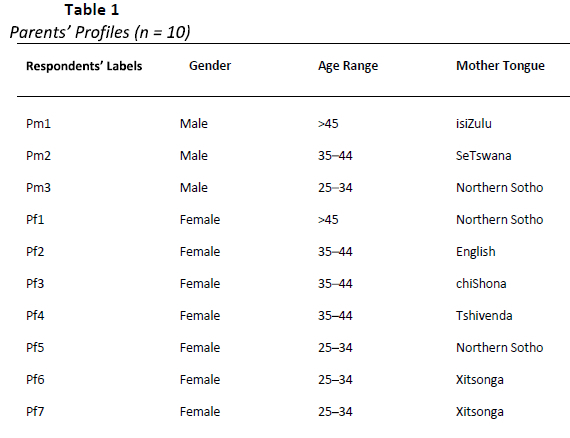
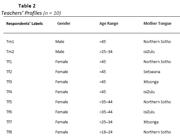
The study used the purposeful sampling technique to choose participants. Ten parents (comprising three men and seven women) and 10 teachers (two men and eight women) participated in semi-structured interviews. This gender classification may be consistent with the situation in primary schools where there are usually more female compared to male teachers. For example, a study by McGrath & Sinclair (2013), which has highlighted the need for more male primary school teachers. Furthermore, the participants were purposefully selected because they were directly involved as stakeholders in the school either as parents or teachers of the learners in this primary school. One-on-one interviews with both teachers and parents were also conducted at the school, outside of teaching time to avoid disrupting the teaching and learning schedule. Participants' profiles appear in Tables 1 and 2.
Data Analysis
In this research, thematic analysis was used to manage and interpret the data. Thematic analysis is a technique for analysing qualitative data in which the researcher carefully analyses the data to find recurring themes, topics, notions, and patterns of meaning (Caulfield, 2022). The researchers analysed the data in this study using the five steps proposed by Friedman (2012, p. 191); while there are several ways to go about thematic analysis, the most popular method involves these steps as indicated below:
1. Thinking about how data relates to the research purpose.
2. Categorising the data.
3. Reflecting on the process of analysis.
4. Organising the data to look for patterns and themes.
5. Connecting emergent themes to larger concepts and theories, and collecting more data afterwards.
Based on the steps mentioned above, the researchers familiarised themselves with the data by reading the transcripts and subsequently asking relevant questions that arose. Afterwards, the researchers developed codes according to their interpretation of the data, and then grouped related codes under broader headings, which led to the formation of themes (Boyatzis, 1998). Finally, the researchers abbreviated each theme and assembled the data materials under each respective theme. These themes were reviewed and reworked to produce a structured report of analysis. Following this process as proposed by Friedman (2012) led to an extensive interpretation of data.
Limitations
The main limitation is that the study includes only a few parents of learners and the teachers from one Quintile 1 primary school in Mamelodi, South Africa. Therefore, the findings of this research cannot be generalised beyond the research population. In future, it would be beneficial to conduct a longitudinal study involving more schools within a similar school category to broaden the findings. However, this study is still useful in providing a glimpse of the mother-tongue situation in schools within a similar environment.
Findings and Discussion
The findings of the data collected from semi-structured interviews with teachers and parents that were analysed to uncover the participants' views on mother tongue instruction will be presented. The data of the parents' interviews (n = 10, see Appendix A) will be presented first, followed by the data from teachers' interviews (n = 10, see Appendix B). The responses of parents and teachers towards home language instruction were used to extract emerging themes and patterns from the data.
Theme 1: Language Use at Home
The first set of questions (Appendix A) sought to understand the language practices in the homes of the learners and parents given that this was likely to influence their attitudes and perceptions towards home language instruction. Because the background and setting of each parent differed, the responses were also varied. One of the questions posed in the parent interviews was "What other languages can you speak fluently, besides your home language?" While all parents indicated that they spoke one or more vernacular South African language in addition to their home language, what was notable was that these parents stated that they could also speak English fluently. Examples of some of the parent respondents' responses are indicated below:
I can speak isiZulu, Sesotho, Sepedi. And I'm fluent in English. (Pf3)
English, Setswana, Sepedi and the other one is isiSwati. (Pf7)
I speak English and SeSotho sometimes. (Pf1)
The responses above indicate that parents of learners at the school are multilingual speakers and are fluent in more than one vernacular South African language, including English. Learners at this school are therefore exposed to multiple languages due to their environment at home. It was also curious to note Parent Pf3's emphasis on the ability to speak English fluently as if to drive a point home to the researcher about the importance of being fluent in English. This is in line with research that highlights the hegemonic status that English continues to enjoy in many classrooms (Naidoo, 2012). In another vein, Zano (2024) observed that some parents bring up their children speaking both a home language and an additional language, English.
A follow-up question was posed to establish the language of communication between parents and children at home. In this regard, parents were asked to identify the language that was spoken with their children in their home, and to indicate their views about communicating in English at home. The following question was posed: "Which language do you use to communicate with your children at home and why?" in this context, most parents reported that they used a combination of their home language and additional languages, which could include a second vernacular language or English. However, a few parents indicated that they communicated with their children solely in their mother tongue. For example, Parent Pf1 commented as follows:
I use my language, isiNdebele, because they understand me easily when I speak to them.
Upon examination of the parents' responses, it became evident that most parents use vernacular languages to communicate with their children at home. The ease with which children understand their parents' instructions when communicating in their own language was highlighted by Parent Pf1, as indicated above. On the other hand, some parents' responses indicate that their approach in communicating with the learners was more of a strategy to empower the child with the home language and support them on their language studies. A good example of this approach is reflected in the following response from Parent Pf3:
I use Swati and Zulu most of the time because she's [the child] doing Zulu at school and then at home we are Swati but we're trying to communicate with her more with Zulu so that she can be fluent with the language.
An interesting comment was raised by Parent Pf5 regarding the language she used to communicate with her child at home. Neither parent's home language is Setswana, yet they chose to use the language.
As indicated earlier, parents have a voice in determining the language situation in the schools and in this case, the language preference of this parent was due to personal reasons related to a sense of belonging within a geographic context:
I communicate with my child in Setswana simply because both my husband and I, we grew up in a community where we were speaking in Setswana language. So, we brought that into our house as well. (Pf5)
In this regard, it is arguable that most parents use their home language and other comprehensible vernacular languages to ensure that they are clearly understood by their children when they express themselves or direct children in any given situation. In Moganedi's (2024) study in which she sought to find out the attitudes of the parents' and teachers' attitudes to home language learning the research findings also revealed that parents use a combination of their home language and additional languages for communication with their children at home. It is also debatable that the respondents' choice of languages could have been influenced by factors such as cultural heritage, academic needs, and geographic context. Another example in Moganedi's research findings was that most parents stated that they spoke Sepitori [Mamelodi pidgin] as a home language because it was the language of the local community, while others emphasised the importance of maintaining their home language as a means of preserving cultural identity. These findings shed light on the critical role of parents in fostering the use of mother tongue for learning in primary schools.
Theme 2: Mother Tongue Use in the Classroom
Prior to informing the parents about the school's language policy, they were asked to provide their opinion on how home languages should be used in the classroom. Their responses indicated that parents preferred vernacular language at home but viewed them as unsuitable for classrooms due to diversity and communication barriers. As shown in Theme 1, it is arguable that the parents' approach in this case could be that of the "think globally, act locally" aspect of glocalisation (Qenai & Wright 2025, p. 23). For most parents, English is more significant and more meaningful and should be the main language of communication in the classroom while the mother tongue should only be used for socialising and during the mother tongue periods. It may be that participants Parent Pf1's and Parent Pf5's adverse view of mother tongues stem from their association of English as a language of economic and social mobility. Such parents have chosen to retain their mother tongue in everyday family and social contexts but not for formal use. One parent's sentiment was as follows:
It should be used outside the classroom. You know now with the mixed language school; I think English is a common language for everybody. Imagine they are speaking many different languages; they don't even understand each other. I believe English is best in the classroom. (Pf2)
After referring parents to information about official language policies that state learners can receive education in the language of their choice, parents were further asked to share their thoughts about the idea of learners being taught in their mother tongue from Grades 1 to 12. Surprisingly, most parents' responses supported the notion of mother tongue. They asserted that teaching learners in their mother tongue would have a positive impact in their education. Parent Pf3 expressed the following:
Learners will produce good grades. Children understand their home language from day one and they speak everything in their home language. They won't have to switch to English when studying subjects like accounting. Nothing will be difficult for them. It will always be easier for them to adjust.
Parent Pf7 also noted that mother tongue can now be used in broader economic spaces:
We live in a democratic world. It will be much better for our kids because when we grew up, we were told that we supposed to know English and Afrikaans because when you go to interviews, they will talk to you in English or Afrikaans. But we live in a democratic world where you can even talk in your home language in an interview. So, home languages will be useful.
Examining these answers, it is evident that parents' views were conflicted after being referred to the information about the policies. For example, parents such as Parent Pf3 perceived specific benefits of teaching learners in their mother tongue, while some parents showed disapproval for mother-tongue education. According to Parent Pf3 and Parent Pf7, one of the benefits of learning in the home language is that it eliminates the need to constantly switch between English and the mother tongue. As per these parents' observations, learners exert considerable effort in translating subject matter from English to their home language, particularly in specialised subjects such as accounting. Learning in their mother tongue would negate this challenge. However, some parents believe that the current bilingual approach to language learning, where learners are exposed to both English and their mother tongue, remains the better option. It is arguable that all the arguments are valid considering that glocalisation in education recognises that learning should adapt to the needs of diverse communities beyond any single national or cultural context (Hocutt & Brown, 2018).
Parents were asked to weigh in on the potential effects of mother tongue instruction on learners' academic achievement. Most parents concurred, based on the results that teaching learners in their mother tongue would improve their grades. For example, one participant's response was as follows:
Yes. I think learner grades will improve because he would understand more compared to when they are taught in English. If you look at our children's performance, home language is better than English. (Parent Pf7)
Such issues mirror wider linguistic conflicts, in which the functional use of a language often clashes with its integrative or cultural value (Fishman, 2001). It is also worth noting that other parents strategically prefer English as LoLT to support their children's academic language proficiency, which cannot be ignored. This point further cements the concept of glocalisation, which focuses on the integration of global language practices with local linguistic resources, including code-switching and translanguaging (Wright, 2025). Notably, Parent Pf3's response aims to support the child's learning, with a focus on isiZulu, whereas others emphasise English-an approach that may be viewed as fostering glocalisation. In this regard, these findings underscore the complex nature of language use within households, environment, and the diverse motivations driving language choices.
Theme 3: Language of Learning and Teaching
To establish teachers' attitudes toward mother tongue as LoLT, teachers were asked if the learners at the school were currently being educated in their mother tongue, and to share whether they felt that it was the right decision. The responses from most teachers indicated that they had a positive attitude toward using mother tongue only during the home language lesson but not across all learning areas. Teacher Tf6 commented as follows:
Learners are only taught in their home language during the home language period. I feel that's right.
The statement by Teacher Tf6 gives the impression that some teachers have accepted that home languages should only be taught during the home language period. Further responses from other teachers confirmed that learners were not educated in their home language. Teachers did their jobs accordingly because this approach was what was expected of them. This is confirmed by Teacher Tm1 below who indicated that some teachers do not believe that teaching learners in English is right, however, they see English as a suitable language for teaching and learning in a multilingual context:
Learners are educated in English because let me say, in Grade 7, they are doing nine learning areas. Eight learning areas are being taught in English because that is the language of teaching and learning. So, they [learners] should be taught in English so that they can be conversant with this language. Because obviously, from primary and beyond, they will be taught in that language. So, they must get used to that language from this primary level. It is not right but I think English is appropriate for teaching and learning.
To add to the sentiment stated above, teachers acknowledged that they rely heavily on code-switching due to the abrupt language change that learners experience from Grade 3 to Grade 4. Code-switching refers to the utilisation of two languages during a single dialogue exchange to promote mutual understanding between learners and teacher (Shinga & Pillay, 2021). Teacher Tf1 expressed that the transition between Grade 3 and Grade 4 was not smooth:
For example, I'm [also] teaching mathematics in Grade 4. We have a problem because they are teaching mathematics in Sepedi in Grade 3. When they get to Grade 4, I'm teaching them in English. They taught them how to use the term "hiakantsha" to refer to "addition." When they go to Grade 4, we say "addition." That's where the problem lies. It becomes worse when it comes to problem solving. When they have to deal with numbers which include words.
The views expressed by Teacher (Tf1) reiterated the challenge faced by teachers who are non-native English speakers. Learners have limited vocabulary in the English language. It is crucial to remember that the shift from the mother tongue to the first additional language must be orderly and steady. In addition, it is also worth noting that from parents' responses in Theme 1, parents and learners communicated more in vernacular languages at home, therefore, an introduction to a new language such as English should be gradual, with proper support.
Regarding language use in the classroom, teachers were asked if learners were free to use their language of choice during the learning process. Most teachers confirmed that learners were free to use their language of choice when the teachers are not around. Furthermore, the languages that were used by learners for interaction were a combination of English and their home languages. In this light, the responses by participant teachers below were not clear given that one suggested that learners were allowed to use their language choice freely, while the other two sounded as if they expected the learners to speak English even though that was not the case in some instances. Furthermore, Teacher Tm2's response implied that learners were not free to use their language of choice in their teachers' presence.
Presently, learners use their language of choice in all classes, especially if there are no teachers. They make a noise in their home language. (Teacher Tm2)
Children are free to use their language of choice in the classroom. (Teacher Tf8)
Yes, but if we permit them to use their own language, the problem will be in writing. (Teacher Tf3)
The response above by Teacher (Tm2) may also suggest that learners use their mother tongue express their opinions liberally, and this happens in the absence of teachers who might expect them to express themselves in English. It can therefore be concluded that learners use their mother tongue to foster collaboration and understanding as they interact freely around others who comprehend the vernacular languages spoken amongst them. While teachers at this primary school acknowledge the importance of mother tongue in the classroom, challenges in language proficiency and academic performance seem to prompt a shift towards English instruction, thus undermining the CAPS emphasis on mother tongue as the medium of instruction in the Foundation Phase. Thus, the preference by certain teachers for using mother tongue as LoLT is justified since it necessitates that the LoLT should be aligned with the language that the learner brings into the classroom. However, in the view of Desai (2012), most learners from township schools are faced with issues related to decoding the language before grasping the content, and this demonstrates the inequalities relating to language use in South African schools.
Conclusion
The investigation of the Quintile 1 primary school parents' and teachers' views on the use of mother tongue for learning and teaching has provided a glimpse into the controversies associated with mother tongue instruction in primary schools. The views of these teachers and parents confirmed the belief that English is associated with opportunities and a better future for children. Although the cultural and cognitive advantages of learning a mother tongue are widely acknowledged in literature, there remain conflicting views on how best this can be implemented without challenges in primary schools. In many cases, teachers may understand the benefits of teaching in the mother tongue, but parents may still prefer their children to be taught in the language that they believe exposes their children to better opportunities in the glocal space, and upward mobility in their careers. These further cement the relevance of glocalisation as the underpinning conceptual framework in this study, which demonstrated the parents' preference for English as the LoLT while some of them acknowledged the need for teaching the children in their mother tongue. As for the teachers, they demonstrated their awareness of the importance of teaching the learners in the languages that they best understood even though this presented its own challenges for the teachers. One may conclude that the views of the parents and teachers are aligned with the principles of glocalisation. Future research should focus on equipping the parents with more knowledge on blending local and global trends in language learning.
Disclosure of Interest
There is no conflict of interest to declare.
References
Alexander, N. (2000). Educating for empowerment: The politics and practice of knowledge in South African schools. Juta & Co.
Areo, G. (2019). Cognitive and academic benefits of bilingual education for English language learners. Research Gate. https://tinyurl.com/49khztuv
Boyatzis, R. E. (1998). Transforming qualitative information: Thematic analysis and code development. SAGE.
Literature Review
- Brock-Utne, B. (2007). Learning through a familiar language versus learning through a foreign language: A look into some secondary school classrooms in Tanzania. International Journal of Educational Development, 27, 487-498. https://doi.org/10.1016/j.ijedudev.2006.10.004
- Caulfield, J. (2022). How to do thematic analysis: Step-by-step guide & examples. Scribbr. https://www.scribbr.com/methodology/thematic-analysis/
- Cummins, J. (2000). Language, power, and pedagogy: Bilingual children in the crossfire (Vol. 23). Multilingual Matters.
- Department of Basic Education. (2012). Curriculum and assessment policy statement (CAPS): Grades 4-6. English home language. https://www.education.gov.za/Portals/0/CD/National%20Curriculum%20Statements%20and%20Vocational/CAPS%20IP%20%20HOME%20ENGLISH%20GR%204-6%20°%20WEB.pdf?ver=2015-01-27-160412-720
- Department of Basic Education. (2013). Incremental introduction of African languages (IIAL) policy. https://www.education.gov.za/Portals/0/Documents/Reports/IIAL%20Policy%20September%202013.pdf?ver=2014-04-09-162048-000
- Department of Basic Education. (2023). PIRLS 2021: South African preliminary highlights report. https://pirls2021.org/wp-content/uploads/2022/10/South-Africa.pdf
- Department of Education. (1997). Language in education policy. https://www.education.gov.za/Portals/0/Documents/Policies/GET/LanguageEducationPolicy1997.pdf
- Desai, Z. (2012). A case for mother tongue education? [Unpublished doctoral dissertation]. University of the Western Cape. https://tinyurl.com/wsc6c4r8
- Fishman, J. A. (2001). From theory to practice (and vice versa): Review, reconsideration and reiteration. In J. A. Fishman (Ed.), Can threatened languages be saved? (pp. 451-483). Mouton de Gruyter.
- Friedman, D. A. (2012). How to collect and analyse data. In A. Mackey & S. M. Gass (Ed.). Research methods in second language acquisition: A practical guide (pp. 180-202). Blackwell.
- Heugh, K. (2009). Literacy and bi/multilingualism in Africa. In B. Street & N. H. Hornberger (Eds.), Encyclopedia of language and education (2nd ed., pp. 29-41). Springer.
- Hocutt, D., & Brown, M. (2018). Glocalizing the composition classroom with Google Apps for Education. In R. Rice & K. St. Amant (Eds.), Thinking globally, composing locally: Rethinking online writing in the age of the global Internet (pp. 320-339). Utah State University Press.
- Kamwangamalu, N. (2016). Language policy and economics: The language question in Africa. Palgrave Macmillan.
- Kamwangamalu, N. M. (2000). Language policy and mother-tongue education in South Africa: The case for a market-oriented approach. In J. E. Alatis, H. E. Hamilton, & A.-H. Tan (Eds.), Linguistics, language, and the professions: Education, journalism, law, medicine, and technology (pp. 119-134). Georgetown University Press.
- Moganedi, K. T. (2024). The attitudes and perceptions of parents, teachers and school governing body towards home language as a language of learning and teaching in a primary school in Mamelodi, South Africa [Unpublished master's thesis]. University of South Africa.
- Mweli, P. (2019). Grade four teachers' language attitudes and lived teaching experiences in KwaZulu-Natal schools, South Africa [Unpublished doctoral dissertation]. University of KwaZulu-Natal.
- Naidoo, J. (2012). The hegemonic position of English as a medium of instruction at primary school level in KwaZulu-Natal, and its impact on parents' preferences of schooling for their children [Unpublished doctoral dissertation]. Durban University of Technology.
- Pacho, T. O. (2020). Impact of globalisation on Africa and its implications to education. Social Science, Humanities and Sustainability Research, 1(1), 81. https://doi.org/10.22158/sshsr.v1n1p8.
- Probyn, M. (2006). Language policy and education in South Africa: An alternative view of the position of English and African languages. https://tinyurl.com/x7jsxbh5
- Qenai, R., & Wright, N. (2025). Connecting the local to the global: Promoting interconnectedness within Kuwaiti classrooms. In N. Wright (Ed.), Glocalising approaches to learning and teaching English: Voices from periphery (pp. 21-40). Springer.
- Quan, G. M., Fambasayi, R., & Ferreira, T. (2024). Transforming education through mother tongue language as a language of instruction in South Africa. African Human Rights Law Journal, 24, 264-291. http://dx.doi.org/10.17159/1996-2096/2024/v24n1a12
- Republic of South Africa. (1996). South African Schools Act 84 of 1996. https://www.gov.za/documents/south-african-schools-act
- Republic of South Africa. (2021). Basic Education Laws Amendment Bill (Government Gazette No. 45601). https://www.gov.za/sites/default/files/gcis_document/202112/45601gen706.pdf
- Republic of South Africa. (2024). Basic Education Laws Amendment Act. Law Library. https://lawlibrary.org.za/akn/za/act/2024/32/eng@2024-09-16
- Robertson, R. (2021). Glocalization self-referential remembrances. Glocalism: Journal of culture, politics and innovation, 3. https://doi.org/10.12893/gjcpi.2020.3.17.
- Southern and Eastern Africa Consortium for Monitoring Educational Quality. (2011). Primary school performance in Botswana, Mozambique, Namibia and South Africa. http://www.seacmeq.org/?q=sacmeq-projects/sacmeq-iii
- Swedberg, R. (2020). Exploratory research. In C. Elman, J. Gerring, & J. Mahoney (Eds.), The production of knowledge: Enhancing progress in social science (pp. 17-41). Cambridge University Press.
- Taylor, S., & von Fintel, M. (2016). Estimating the impact of language of instruction in South African primary schools: A fixed effects approach. Economics of Education Review, 50(1). http://dx.doi.org/10.1016/j.econedurev.2016.01.003
- Tizza, M., Navarro, T., Abao, E., Bacus, R., & Alda, R. (2016). Mother tongue-based instruction: Policy to practice. International Journal of Education and Research, 4(3). https://www.researchgate.net/publication/360994736_Mother_Tongue-Based_Instruction_Policy_to_Practice
- Tryzna, M. M. (2023). Intercultural content in EFL materials at secondary schools in Kuwait and Saudi Arabia. In M. Wyatt & G. El Gamal (Eds.), English as a medium of instruction on the Arabian Peninsula (pp. 13H50). Routledge.
- Webb, V. (1999). Multilingualism in democratic South Africa: The over-estimation of language policy. In L. Limage (Ed.), Comparative perspectives on language and literacy: Selected papers from the work of the Language and Literacy Commission of the 10th World Congress of Comparative Education Societies, Cape Town 1998 (pp. 65-86). UNESCO.
- Wright, N. (2025). Glocalising approaches to learning and teaching English: Voices from periphery. Springer.