'I do have a place here': The writing centre as a site of belonging and epistemic justice in a South African university
Abstract
Belonging is central to student success and wellbeing yet unevenly experienced in the everydayness of students navigating historically unequal and linguistically stratified universities. This qualitative case study examines the writing centre as a site of belonging and epistemic justice in a South African university. Drawing on a reflective, practitioner-based approach and informed by Tinto's theory of student integration and the academic literacies framework, the study explores how writing centre practices shape students' sense of belonging. Interview data from undergraduate students and writing centre practitioners show that belonging is fostered through relational, dialogic, and linguistically affirming pedagogies that position students as legitimate knowers. Writing centre engagement shifts students from alienation and deficit views to confidence and epistemic affirmation. However, practitioners navigate tensions between enabling access to dominant academic norms and resisting epistemic hierarchies that marginalise diverse ways of knowing. This study advances writing centre scholarship by framing belonging as an epistemic, relational process essential to socially just academic participation.
academic literacies; belonging; epistemic justice; relational pedagogy; writing centres
Introduction
As a practitioner working within the writing centre space, I have come to appreciate the profound impact that students' perceptions of their writing abilities have on their broader university experience. Writing centres are widely recognised as vital academic support structures in higher education, primarily positioned as sites for the development of writing, critical thinking, and communication practice (Namakula, 2024; Sefalane-Nkohla & Mtonjeni, 2019). However, much of the existing writing centre literature continues to centre skills development and academic performance, with comparatively limited attention paid to how engagement with writing support shapes students' sense of belonging and their recognition as legitimate knowers within academic spaces. This gap is particularly pronounced in South African higher education, where historical inequalities, linguistic hierarchies, and deficit discourses continue to structure students' experiences of academic inclusion and exclusion. Responding to this gap, this study argues that writing centres do more than support writing development; they function as critical pedagogical spaces that can foster students' sense of belonging, particularly among those who perceive themselves as struggling writers or who have previously felt marginalised in academic contexts.
Within higher education contexts marked by epistemic inequality and socio-linguistic diversity, students' sense of belonging is shaped not only by social integration, but also by whether their ways of knowing, speaking, and writing are recognised as legitimate within academic spaces (Nendauni, 2025). When dominant academic norms privilege particular linguistic repertoires and epistemological traditions, students whose identities and knowledge practices fall outside these norms may experience exclusion, self-doubt, and a diminished sense of academic belonging. Against this backdrop, writing centres have increasingly been positioned not merely as remedial units, but as critical spaces that centre student agency, cultivate academic literacies as social practice, and create opportunities for epistemic recognition. Though conducted in different contexts, recent South African writing centre studies demonstrate that these spaces do not only support academic writing, but also mediate students' encounters with dominant academic norms in ways that can foster inclusion, confidence, care, and a strengthened sense of belonging (Khumalo, et al., 2024; Namakula, 2024; Nendauni, 2025).
Belonging is widely recognised as central to student success and wellbeing in higher education. Tinto's (1993) theory of student integration emphasises that students are more likely to persist when they experience meaningful academic and social integration, while Strayhorn (2012, 2018) conceptualises belonging as a fundamental human need tied to learning, identity, and wellbeing. For students who struggle to meet dominant academic writing expectations, however, these integrative processes are often disrupted. Research shows that such students frequently experience writing-related anxiety, isolation, and a sense of inadequacy, particularly when their linguistic and educational backgrounds are positioned as deficient (Lea & Street, 1998; Prat-Sala & Redford, 2012; Woods, 2024). These experiences are not merely affective; they are frequently rooted in epistemic injustice, whereby students' knowledge, voices, and ways of meaning-making are systematically devalued within academic spaces (Fricker, 2007). In this sense, belonging is inseparable from epistemic recognition.
Epistemic justice refers to fairness in the recognition and valuation of individuals as knowers, particularly in contexts where power shapes whose knowledge is taken seriously (Fricker, 2007). In higher education, epistemic injustice is often enacted through monolingual and Eurocentric academic norms that marginalise students' linguistic resources and epistemological traditions. When students perceive that their knowledge and identities are misrecognised or rendered invisible, their sense of belonging is often undermined. Within writing centre contexts, fostering epistemic justice therefore becomes central to cultivating belonging, as it involves not only supporting students to navigate academic expectations, but also affirming their identities, languages, and experiential knowledges as legitimate contributions to academic discourse (Boughey & McKenna, 2021).
Accordingly, in this qualitative study conducted at a South African university, I examine the writing centre as a site of belonging and epistemic justice; two interrelated concepts that speak to the student experience in deeply affective and intellectual terms. Drawing on student and practitioner narratives, institutional discourses, and theoretical perspectives, I explore how the writing centre creates conditions for marginalised students to feel acknowledged, and to be intellectually affirmed and emotionally supported. In terms of students, the focus is on students who have engaged with the writing centre, especially those who initially perceived themselves as academically underprepared or deficient in writing. The following research questions are explored:
How do students describe changes in their sense of belonging over time through engagement with the writing centre?
What strategies do writing centre practitioners use to foster a sense of belonging and to challenge epistemic hierarchies?
What challenges do practitioners encounter when fostering belonging and epistemic justice through writing support?
This study contributes to scholarship that positions writing centres as transformative pedagogical spaces by showing how writing support can enhance students' academic confidence, agency, and sense of belonging. More broadly, the findings speak to theoretical debates that conceptualise belonging as an epistemic and relational process shaped by recognition and misrecognition in academic spaces. At a policy level, the study engages ongoing discussions in South African higher education on language, access, and transformation, highlighting the need to move beyond monolingual and deficit-oriented approaches to academic development in pursuit of more inclusive and socially just forms of student success.
Understanding belonging in higher education
The term 'belonging' commonly refers to students' sense of connection, value, support, and inclusion within the university (Strayhorn, 2018). In writing-intensive academic contexts such as writing centres, belonging is not only a social or emotional experience but is also shaped by students' interactions with institutional norms, pedagogical practices, and forms of academic recognition. While definitions of belonging vary, the literature points to common threads, particularly its relational and processual nature. In this study, 'belonging' is understood as a gradual and evolving process shaped by students' social networks and relationships with peers and academic staff, including writing centre practitioners (Guyotte, et al., 2023; Raaper, 2021). It is closely linked to how students engage in academic spaces where their contributions are acknowledged and their identities are respected (Hoffman, 2018; Strayhorn, 2018). In this regard, identity plays a central role, as students' educational backgrounds and evolving self-perceptions shape how they experience, negotiate, and position themselves within academic spaces such as the writing centre (Groves & O'Shea, 2019). In this study, identity is understood not as a fixed attribute but as students' evolving self-positioning in relation to academic norms, recognition, and legitimacy (Archer, 2008; Groves & O'Shea, 2019). Belonging, therefore, is intimately tied to identity work, as students come to see themselves, and be seen by others, as credible participants in academic knowledge-making.
Belonging has been recognised as a central factor in student retention and academic success, with scholars such as Tinto (1993) and Strayhorn (2012) emphasising its role in enabling students, particularly those from marginalised groups, to persist through strong institutional connections and everyday interactions with staff, peers, and structures like writing centres. The literature suggests that belonging manifests as a complex, layered experience across various dimensions of university life (De Sisto, et al., 2021).
Building on these ideas, research by Meehan and Howells (2017), Guyotte, et al. (2023), and Raaper (2021) sheds light on how students experience belonging throughout their university journey. More recent studies propose more flexible ways of understanding belonging, highlighting its personal and diverse nature (Graham & Moir, 2022; Gravett & Ajjawi, 2022). Fairchild, et al. (2024) introduce 'mattering', drawing on relational pedagogy, to explore how meaningful interactions with staff help students feel seen, supported, and valued. Mattering builds on belonging by focusing on active relationships that confirm students' value beyond simple inclusion. This offers a dynamic way to examine how writing centre sessions build epistemic recognition and help students stay on course.
In practice, students who find academic writing difficult often feel disconnected from the academic community, as observed in practitioner reflections and empirical studies (Nendauni, 2025; Woods, 2024). Such disconnection lowers students' confidence and sense of inclusion, yet writing centres play a key role in countering this by not only improving writing practice but also fostering a sense of university membership. These centres provide welcoming spaces where students can engage in academic writing practices as socially situated forms of meaning-making and grow in confidence as active members of the university environment.
Epistemic justice and the role of writing centres
In my understanding, epistemic justice refers to fairness in the recognition, valuation, and sharing of knowledge, with epistemic injustice occurring when individuals' knowledge is devalued or their credibility undermined (Fricker, 2007). In academic writing, this manifests when Western-shaped styles are privileged as the standard, marginalising students' oral traditions, narrative forms, or culturally grounded reasoning as less 'academic' despite their valuable insights (Nendauni, 2026).
Language plays a major role in epistemic justice, as English dominance in South African universities marginalises students more comfortable in other languages, obscuring their capabilities when assessed against monolingual norms rather than idea strength (Madiba, 2014). This linguistic marginalisation undermines students' sense of belonging by devaluing their epistemic identities, positioning their knowledge practices as deficient within academic spaces.
Writing centres have long been recognised as vital spaces for student support, but they offer far more than writing assistance. They arguably provide personalised guidance, foster a sense of belonging, and create opportunities for academic growth. I have witnessed many shifts from uncertainty to self-assurance not only in students' writing but in how they engage with academic life. Lea and Street's (1998) view of writing as a social practice is particularly relevant here, as it reframes writing centres as transformative rather than merely supportive spaces. In these interactions, students critically engage with the expectations of academic writing, and I believe this is where writing centres can actively resist epistemic injustice by affirming diverse writing styles, supporting translanguaging practices, and challenging the notion that there is only one 'correct' way to write (Siziba & Maseko, 2023).
The development of writing centres in South Africa is closely linked to efforts to expand access to higher education after apartheid. From the 1990s onwards, writing centres began to support students, many of whom were Black and from under-resourced schools, who faced structural barriers to academic success (Sefalane-Nkohla & Mtonjeni, 2019). These centres evolved from focusing purely on academic literacy to becoming spaces where marginalised students develop greater confidence in articulating their ideas within academic discourse (Vundla, 2020). These developments now inform epistemic justice debates by demonstrating how writing centres can validate diverse knowledges against dominant norms.
However, I remain aware of the tension between supporting students and operating within systems that may still reinforce dominant academic norms (Namakula, 2024). This calls for a pedagogy of care; one that views students as whole individuals with emotional, social, and academic needs. In this sense, writing centres are no longer remedial spaces but play a vital role in advancing institutional goals around inclusion, retention, and success. There is also a noticeable growing focus on wellbeing literacy in academic writing spaces (Lemon, et al., 2024), which I welcome in the writing centre. Wellbeing literacy is the intentional use of language to promote both individual and collective wellbeing. When academic and emotional support are integrated, students are more likely to feel that they belong (Namakula, 2024).
Through this study, I intend to explore how writing centres can promote epistemic justice and help students, particularly those who feel unsure about their academic writing, develop a stronger sense of belonging. While much of the existing literature draws on experiences from the Global North, my aim is to contribute grounded insights from the South African context to ongoing global conversations on inclusive and socially just higher education. This recalls, decolonialising pedagogies and its impact on academic literacies, as discussed in the subsequent section.
Decolonising pedagogies and academic literacies
The broader decolonisation movement in South African higher education highlights how university practices favour Eurocentric knowledge while marginalising African perspectives (Heleta, 2016). This prompt writing centres, embedded within these structures, to adopt critical academic literacies approaches that validate diverse epistemologies and resist dominant norms through decolonial pedagogies. Yet their potential remains limited unless institutions commit to dismantling Eurocentrism and supporting multilingual, inclusive practices.
Drawing on the work of Lea and Street (1998), I recognise that academic writing is not a neutral or purely technical skill, instead, it is deeply shaped by relations of power. This means that writing support should not be limited to grammar and structure. Instead, we must create spaces where students are encouraged to question the academic norms they are expected to follow. For Luckett and Hunma (2014), this includes affirming Indigenous and African knowledge systems, supporting multilingual expression, and avoiding deficit assumptions about students from marginalised backgrounds.
The present study extends on earlier South African studies that suggest writing centres have the potential to advance social justice and foster a sense of belonging, although this potential is realised unevenly across contexts (Rambiritch, 2018; Namakula, 2024). For instance, at the Durban University of Technology, the writing centre collaborated with the nursing department to redesign consultations and workshops in more accessible and inclusive ways (Khumalo, et al., 2024). Writing centres in other institutions advocate overtly for inclusive language policies and assessment practices, framing support as transformative rather than remedial (Nichols, 2020). However, scholars caution that writing centres may also function as sites of assimilation when success is narrowly defined in terms of conformity to dominant linguistic and rhetorical norms, in so doing limiting the recognition of diverse ways of knowing and being (Lillis & Turner, 2001; Boughey & McKenna, 2021). This tension highlights the need to critically examine how writing centres negotiate access to academic discourse while simultaneously valuing epistemological, linguistic, and cultural diversity.
While South African writing centre scholarship has consistently challenged deficit framings and positioned writing centres as dialogic, relational, and socially situated pedagogical spaces oriented towards equity and inclusion (Archer, 2008; Boughey & McKenna, 2021; Namakula, 2024; Sefalane-Nkohla & Mtonjeni, 2019), much of this work has centred academic development, access, and literacy mediation. Entering dialogue with this body of scholarship, the present study centres belonging as an epistemic process rather than primarily as an affective or retention-oriented outcome, demonstrating how everyday writing centre practices actively reconstitute students as legitimate knowers and thereby extend debates on epistemic justice in South African higher education. Conceptualising writing centres as critical pedagogical spaces rather than sites of textual correction, the study adopts a qualitative, practitioner-based methodology that prioritises students' and practitioners' lived experiences and reflective narratives as legitimate sources of knowledge, aligning the research design with the relational and epistemic commitments articulated in the literature.
Theoretical framing
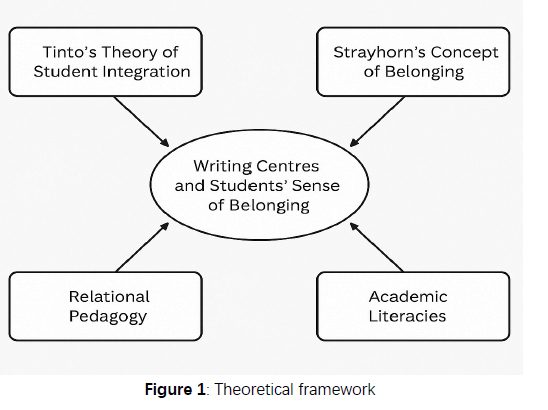
In this study, I draw on several interrelated theoretical perspectives to examine how writing centres contribute to students' sense of belonging and epistemic justice in higher education. A multi-theoretical approach is necessary because these experiences are complex and cannot be adequately explained through a single lens. Students' engagement with writing centres involves academic integration, emotional experiences, interpersonal relationships, and encounters with dominant knowledge practices, all of which shape how belonging is formed or disrupted. So, a multi-theoretical approach enables me to capture both the relational and structural dimensions of writing centre work. Figure 1 illustrates the selected theoretical lenses selected for this study.
Firstly, I draw on Tinto's (1993) theory of student integration, which suggests that students are more likely to persist in higher education when they experience a strong sense of academic and social integration. In the context of writing centre practice, integration occurs through sustained, low-stakes interactions with academic staff and peers that help students navigate academic expectations and feel connected to institutional support structures. Writing centres provide regular opportunities for such engagement through one-to-one consultations, peer learning, and dialogue around academic practices, particularly for students who may feel alienated or academically underprepared. I therefore use Tinto's theory to examine how engagement with the writing centre supports students' integration into academic communities and contributes to their sense of belonging within the university.
Secondly, I draw on Strayhorn's (2012) conceptualisation of belonging as a fundamental human need that is essential to student learning and wellbeing. Strayhorn highlights that students, especially those from underrepresented or marginalised backgrounds, should feel that they are accepted, valued, and included to thrive in academic spaces. His work informs my understanding of how students' feelings of connectedness and recognition within the writing centre can influence their broader experience of university life.
In addition to these foundational perspectives, I incorporate the concept of relational pedagogy (Waghid, et al., 2019), which emphasises the significance of care, trust, and meaningful interpersonal relationships in the learning process. In the context of writing centres, this pedagogical approach is particularly relevant, as writing consultations often involve close one-to-one engagement. While Tinto's theory helps to explain students' structural and social integration into the university, relational pedagogy offers a more nuanced account of the interpersonal and affective dimensions through which such integration is experienced in practice. I am therefore interested in how writing centre practitioners' use of empathetic and dialogic approaches may help students to feel seen, respected, and supported, as these strengthen their sense of academic belonging.
Moreover, I draw on the academic literacies model developed by Lea and Street (1998), which views writing as a social practice rather than a purely technical skill. In this study, the academic literacies model functions as an analytical lens through which students' and practitioners' accounts are examined, enabling attention to issues of identity, power, and culture in academic writing practices. This perspective challenges deficit-oriented approaches by centring how writing expectations are socially constructed and unevenly valued within higher education. Through this lens, the writing centre is positioned as a space where students negotiate entry into academic discourse communities, and where their linguistic and cultural resources may be either validated or marginalised.
These theoretical perspectives work together to help me understand how writing centres shape students' sense of belonging. Tinto's theory of student integration shows that academic success depends on students feeling connected to their institution. Strayhorn builds on this by highlighting that belonging is not just academic it is also an emotional need, especially for students from marginalised backgrounds. Relational pedagogy fits well here, as it focuses on the importance of trust, care, and meaningful relationships in learning, something I often see in one-on-one writing consultations. The Academic Literacies model adds a critical layer by showing that writing is shaped by social and cultural contexts, and not just about following rules. Together, these theories help me explore how the writing centre supports students academically, values their identities, and creates a more inclusive space for learning. This combined approach gives me a well-rounded way to look at both the emotional and structural sides of belonging in the university.
Methodology
In this study, I adopted a qualitative case study design located within a reflective, practitioner-based approach, which enabled me to explore how students and practitioners experience and make meaning of writing centre engagement in relation to belonging and epistemic justice. A reflective practitioner stance is epistemologically suited to this study because it recognises knowledge as situated, relational, and co-constructed through practice, rather than as detached or purely objective. I was particularly interested in understanding shifts in students' sense of belonging, the strategies practitioners employ to nurture belonging and challenge epistemic hierarchies, as well as the challenges encountered by practitioners in this process.
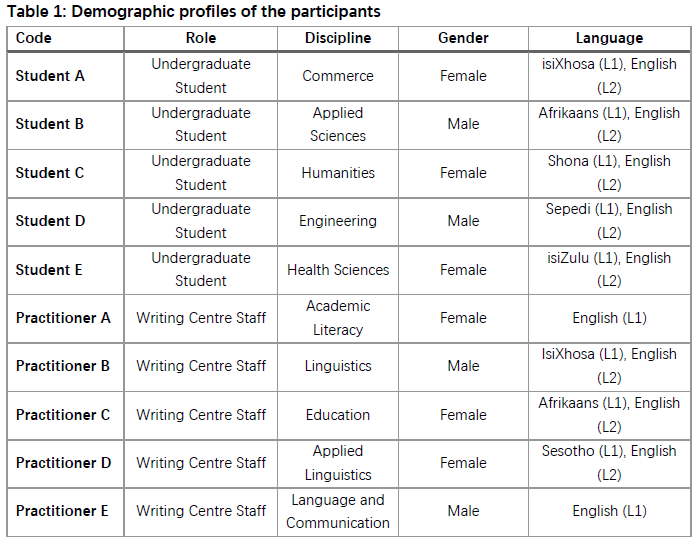
The study was conducted at a South African university with a well-established writing centre that offers individual and group consultations, workshops, and peer writing initiatives. The writing centre is staffed by five full-time practitioners, the majority of whom are postgraduate students with training in academic literacy and language-related disciplines. The centre serves approximately 6000 students per semester across undergraduate and postgraduate levels. The student participants in this study were all undergraduates, ranging from first- to third-year, a factor that is significant given the transitional nature of belonging in early university study. I used purposive sampling to identify participants who had engaged meaningfully with the centre's services. The sample included five students from diverse academic disciplines and backgrounds, as well as five writing practitioners employed at the centre. Participants were recruited via direct invitation and informal networks, with the intention of capturing a range of linguistic, racial, and educational identities. All participants had engaged with the writing centre for at least one academic semester and provided written informed consent prior to participation.
Data was gathered through semi-structured interviews, which allowed for in-depth exploration while maintaining consistency across key areas of inquiry. Interviews were conducted in English, either face-to-face or via online platforms, depending on participant preference. Each interview lasted between 30 and 35 minutes and was audio-recorded with the participants' permission. Verbatim transcripts were produced for analysis, and I kept reflective field notes to document emerging patterns, tensions, and insights. Table 1 below summarises the demographic profiles of the participants:
I analysed the data using thematic analysis following Braun and Clarke's (2006) Six-phase model: familiarising myself with the data, generating initial codes, searching for themes, reviewing themes, defining and naming themes, and producing the report. My coding process was both inductive, allowing themes to emerge from the data, and theory-informed, drawing on concepts such as academic literacies, student integration, and relational pedagogy. I then coded and organised the data. To enhance trustworthiness, I engaged in peer debriefing with a colleague experienced in qualitative research, maintained an audit trail of analytical decisions, and used participants' quotations to illustrate key themes and provide thick description.
It is vital to highlight that as a member of the writing centre staff; I recognise that my insider position shaped both the conduct and interpretation of the research. While this positionality allowed for deeper access and relational trust, I remained critically reflexive throughout the process to minimise potential bias. I made it clear to participants that they were free to share both affirming and critical perspectives, and I treated all accounts with equal seriousness. Lastly, all participants were informed of their right to withdraw at any stage without consequence. Codes (e.g., student 1 or practitioner 1) have been used throughout the paper, and any identifying details have been removed to ensure confidentiality and anonymity.
Findings and discussion
The findings of this study comprise three major themes. These themes are: (1) Evolving perceptions of belonging, (2) Practitioner strategies in fostering belonging and challenging epistemic hierarchies, and (3) Challenges in fostering belonging and epistemic justice within writing support contexts. These themes collectively show that the process of fostering a sense of belonging and epistemic justice through writing centre support is dynamic, influenced by evolving student perceptions, strategic practitioner interventions, and a range of challenges. Each theme contributes to a complex understanding of how academic support services can function as both a catalyst for personal transformation and a site of complex interaction between institutional structures and student's needs. The findings are discussed thematically, drawing on student and practitioner narratives and situated within the broader literature on academic literacies, relational pedagogy, student integration, and decolonial pedagogies. The first theme is explored below.
Theme 1: Evolving perceptions of belonging
The data reveal that students' sense of belonging is neither static nor immediate but evolves throughout their academic journey, often beginning with feelings of disconnection and gradually transforming into experiences of inclusion and validation through support mechanisms such as the writing centre. This trajectory reveals belonging not as a static state but as a process shaped by affective, academic, and institutional encounters. Below are sub-themes that emerged:
Initial sense of disconnection
Several students reported an initial feeling of alienation during their early encounters with university life and academic writing conventions. For instance, one student remarked:
In my first semester, I honestly felt like I didn't belong here. I struggled to understand what was expected in academic writing, and it seemed like everyone else knew what they were doing except me. (Student A)
This sentiment aligns with the literature suggesting that the transition into higher education can be marked by uncertainty and self-doubt, particularly when students are unfamiliar with academic discourse norms (Archer, 2008). Tinto's (1993) theory of student integration underlines that without meaningful engagement, students may feel disconnected from academic communities, and this compromises persistence and success. Another student articulated reluctance to seek help, believing that academic support structures were reserved for high-achieving students:
I was nervous to even ask for help. I felt like the writing centre was only for 'top' students, not someone like me who is just trying to pass. (Student B)
This account complicates common assumptions that writing centres are perceived primarily as spaces for 'at-risk' students. Instead, Student B's response suggests that the writing centre was imagined as an elite academic space reserved for high-achieving students, a perception that produced feelings of inadequacy and self-exclusion. Such perceptions can be understood as the result of deficit discourses operating in reverse: Rather than seeing the writing centre as a remedial service (Lea & Street, 1998), the student positioned it as a site of academic excellence to which they did not feel entitled. This illustrates how writing centres may inadvertently become sites of othering, not only through associations with deficiency, but also through perceptions of exclusivity that deter students who already doubt their academic legitimacy. A third participant, reflecting on their international background, noted:
Coming from a different education system in a different country, I felt out of place, my writing style didn't fit what lecturers here wanted, and that made me feel like I wasn't good enough. (Student C)
Such narratives centre how academic literacies are situated within specific cultural and institutional expectations (Lea & Street, 1998), and how deviation from these expectations may be read as deficiency rather than difference. Strayhorn's (2012) conceptualisation of belonging as a basic human need is particularly relevant here, especially for students from diverse educational and cultural backgrounds who must navigate unfamiliar norms while seeking inclusion and recognition.
Post-engagement integration and validation
Contrasting with initial alienation, students described a growing sense of academic self-efficacy and personal validation after sustained interaction with writing centre staff. For example, student D stated:
After a few sessions at the writing centre, I started realising that I am actually capable. They helped me understand the expectations, and I began to feel like I belonged academically. (Student D)
This narrative aligns with research on writing self-efficacy (Prat-Sala & Redford, 2012), where increased confidence in writing ability correlates with academic engagement. Through sustained interaction, students begin to perceive themselves as legitimate participants in academic discourse communities (Tinto, 1993; Guyotte, et al., 2023). Another student expressed the affective dimension of this support:
The writing centre didn't just help me improve my writing, it made me feel seen. I wasn't just a student number anymore. They listened, and that helped me believe that I do have a place here. (Student E)
Here, the concept of mattering (feeling valued and acknowledged) becomes crucial (Fairchild, et al., 2024). Feeling "seen" denotes more than academic recognition; it reflects a pedagogical ethos grounded in care and humanisation (hooks, 1994). In the writing centre, feeling "seen" means belonging on several levels. It means belonging emotionally (cared for, visible), socially (personal staff interactions), and academically (valid scholars). It arises from relationships blending emotional and academic affirmation. This mirrors Strayhorn's (2018) framing of belonging as an affective and social experience, particularly important for students from underrepresented backgrounds. This finding resonates with the broader literature that conceptualises belonging as a relational, evolving, and identity-shaped process (Raaper, 2021; Groves & O'Shea, 2019).
This theme shows that students' sense of belonging developed gradually through sustained engagement with the writing centre. Students moved from initial alienation and self-doubt towards increased confidence and academic legitimacy, driven less by technical improvement than by experiences of recognition and relational support. The writing centre thus enabled students to renegotiate deficit self-positionings and to see themselves as credible participants in academic knowledge-making.
Theme 2: Practitioner strategies in fostering belonging and challenging epistemic hierarchies
Practitioners within the writing centre serve as key agents in fostering students' sense of belonging and challenging epistemic hierarchies, not only through their pedagogical choices but also through their underlying ethos of care, inclusion, and relational engagement (Namakula, 2024; Nendauni, 2025). The findings show that these practitioners use a mix of emotional, academic, and relational strategies to achieve this. These efforts help students build trust, develop confidence, and feel recognised in a university space that can often seem impersonal and demanding. Below are sub-themes that emerged:
Deliberate cultivation of a welcoming space
Practitioners are aware of how important the first contact with a student could be. They make deliberate efforts to make the writing centre feel warm, respectful, and student friendly. As Practitioner A observed:
Creating a sense of belonging starts with how we receive students. At our centre, we intentionally create a welcoming environment, from the physical layout to how we speak to students... I often say, 'You belong here because your story matters'. (Practitioner A)
This view aligns closely with a pedagogy of care (Noddings, 2003), which centres kindness, listening, and respect as central to teaching and learning. In the writing centre context, care is not only relational but also epistemic, as it shapes how students are positioned as knowers within academic spaces. By deliberately rejecting deficit-based discourses and centring students' narratives, practitioners enact forms of epistemic justice that affirm students' knowledge, experiences, and linguistic resources as worthy of recognition (Archer, 2008; Yosso, 2005). To put it plainly, practitioners do not approach students merely as individuals in need of remediation, but as legitimate contributors to knowledge-making processes. Further, the facilitation of peer writing groups by senior students extends the centre's commitment to fostering community, as Practitioner A further stated:
We run peer writing groups facilitated by senior students, which builds community and reduces feelings of isolation. (Practitioner A)
This approach supports research by Boud and Cohen (2014), who reports that peer learning builds confidence and encourages students to see themselves as active participants in learning. Here, peer facilitation serves not only to demystify academic discourse but also to create affinity spaces where students can recognise themselves in others' academic journeys.
Relational pedagogy and language affirmation
Practitioners stress the importance of developing real relationships with students. These relationships are not based on academic judgement but on mutual respect and understanding. One explained:
I believe in relational pedagogy. When I work with students, I prioritise listening, really listening to their concerns and writing struggles...I affirm their home languages and encourage translanguaging practices, it validates their identities. (Practitioner B)
This approach resonates with the growing body of scholarship advocating for linguistically inclusive pedagogies (Heugh, 2015) and epistemic justice (Fricker, 2007). The practitioner's emphasis on listening as a central pedagogical act reflects the notion of dialogic engagement (Freire, 1970), wherein students are treated as co-participants in knowledge-making rather than passive recipients. The encouragement of translanguaging, meanwhile, signals a departure from monolingual norms of academic literacy towards a more expansive, socially just understanding of communication and identity in higher education (Makalela, 2019). According to Van Rooy and Coetzee-Van Rooy (2015), many students in South Africa enter university with good literacy practice in African languages but may be assessed only in English or Afrikaans. Emphasising monolingual norms (English as the language of learning and teaching) perpetuates epistemic injustice and exclude non-dominant ways of knowing or expressing knowledge (Meighan, 2023).
Epistemological access and co-constructed knowledge
Practitioners share that they do not see themselves as the only sources of knowledge. Instead, they encourage students to co-create meaning and build their understanding of academic writing together. For Practitioner C, belonging is not merely spatial but fundamentally epistemological:
Belonging is about access not just physical access to the writing centre, but epistemological access to the discourse of academia. Our feedback is dialogic rather than directive because we want students to feel like co-constructors of knowledge. (Practitioner C)
Here, "epistemological access" refers to students' ability to understand, engage with, and participate in the ways of thinking, reasoning, and communicating valued in academic discourse. In this context, this concept emphasises students' active engagement with the knowledge and conventions that define academic literacy. This perspective advances the argument that true inclusion should extend beyond entry into academic spaces to encompass access to the norms, values, and discursive practices that underpin academic success (Morrow-Gholson, 2016; Boughey & McKenna, 2021). Dialogic feedback positions the student as an active agent, and this challenges traditional hierarchies of knowledge and fostering a sense of intellectual ownership.
Normalising academic struggle
Another key strategy is making it clear that academic writing is difficult for everyone, even experienced scholars. Practitioners use examples of past students' journeys to show that struggle is normal, and that progress is possible:
We openly share with students that academic writing is challenging even for published scholars ... We curate anonymous excerpts from past students who overcame writing anxieties, so they see themselves reflected in the centre's history. (Practitioner D)
This practice aligns with pedagogies of hope and possibility (Hooks, 2017), which reject the ideal of effortless academic success and instead acknowledge struggle as intrinsic to learning. Through sharing anonymised stories of students' progress, the writing centre challenges the idea that success is only based on merit and helps to build a sense of academic community across generations.
Strengths-based and participatory approaches
Several practitioners explain that they start consultations by focusing on what the student has done well before pointing out what can be improved. They also include students in shaping how the centre works: Practitioner E stated:
During consultations, we begin by identifying what the student did well before addressing areas for growth. We also provide regular feedback surveys and co-design aspects of our programmes with students especially marginalised voices. (Practitioner E)
This strengths-based approach is important in shifting away from the idea that students are deficient or in need of fixing (Yosso, 2005). It also shows a commitment to participatory practice, where students are not just recipients of support but co-creators of educational spaces (Cook-Sather, 2006). It is important for writing centres in South Africa to amplify marginalised voices, challenge the dominance of English, and promote culturally and linguistically responsive academic engagement. At the same time, it is important to balance affirmation with academic rigour. While recognising students' strengths fosters confidence and agency, it is equally essential to maintain high academic standards, ensuring that constructive critique supports genuine learning and the development of scholarly competence.
This theme highlights how practitioners actively fostered belonging through relational, dialogic, and strengths-based practices. Strategies such as translanguaging, peer learning, and collaborative feedback affirmed students' identities and positioned them as co-constructors of knowledge. In doing so, practitioners challenged deficit framings and epistemic hierarchies while supporting students' access to dominant academic practices.
Theme 3: Challenges in fostering belonging and epistemic justice within writing support contexts
While writing centre practitioners are clearly committed to fostering belonging and epistemic justice, they also share several challenges that make this work difficult. These challenges are not due to individual attitudes or failures, but rather to broader institutional norms and structures that shape how students experience academic support. The findings show that even in caring and inclusive spaces, systemic barriers related to language, representation, and dominant academic expectations continue to limit full belonging. The emerging sub-themes are discussed below:
Balancing academic norms with student voice
One of the key challenges is how to support students in meeting academic standards without silencing their personal or cultural identities. Practitioner A draws attention to a critical pedagogical dilemma:
Students from historically marginalised backgrounds often enter the centre already feeling 'othered' by the dominant academic discourse.... I find myself constantly reflecting: how do we scaffold students into dominant discourse norms without silencing their voice, you know? (Practitioner A)
This reflection captures a recurring tension experienced by writing centre practitioners as they work within institutional environments shaped by dominant academic norms. While practitioners' accounts describe the practical challenges of supporting students without silencing their voices, the tension itself points to a broader critique of institutional language expectations that privilege Eurocentric ways of writing and knowing. Universities often require students to adopt particular academic conventions, yet these expectations may marginalise students' home languages, cultural knowledge, and rhetorical traditions. Practitioners' concerns about overemphasising grammar or structure therefore reveal not individual uncertainty, but the constraints imposed by normative academic standards that risk delegitimising students' voices. This analysis aligns with Montgomery's (2024) and Porto's (2022) arguments about the power relations embedded in language correction and emphasises the need for critical literacy approaches that support students to navigate dominant norms without requiring full assimilation.
Language politics and institutional constraints
Practitioners also raise concerns about the gap between the university's language policy and the multilingual realities of their students. Although South African universities promote access, many still operate largely in English and Afrikaans, especially in assessment (Lasagabaster, 2025). Practitioner B noted:
Many feel that their language identity is not fully welcome or respected. When students ask, 'Can I write in isiXhosa?' and the institutional policy says 'no', it becomes a moment of disconnection. (Practitioner B)
This scenario illustrates a tension between linguistic inclusion and institutional monolingualism in academic literacy. Despite discourses of diversity, language policy in South African higher education often remains inflexibly aligned with English, positioning it as the de facto language of epistemic access (Mompei, 2021). The resulting dissonance undermines students' sense of linguistic belonging and reinforces symbolic violence (Bourdieu, 1991). The practitioner's struggle to affirm students' identities within such a constrained policy framework speaks to the limits of practitioner agency and the urgent need for more inclusive, context-responsive language planning.
Stigma and the deficit thinking
Another significant challenge is the negative perception some students have of academic support spaces. Contrary to Student B under Theme 1, who thinks that writing centre is for elite and good performing students, several practitioners say that students often arrive at the centre already feeling embarrassed, as if they have failed in some way:
Students often come in already ashamed... we are fighting a system that labels certain students as 'deficient' from the outset. (Practitioner C)
This concern connects to the ongoing presence of deficit discourses in South African higher education (Boughey, 2007), where students-particularly from working-class or under-resourced backgrounds are seen as lacking rather than capable. Even when writing centres use affirming language, the broader institutional message may still suggest that needing help is a sign of weakness. This perception can limit students' willingness to seek support and further isolate those who most need inclusive academic spaces.
Epistemic injustice and the Eurocentric academy
Another deeply embedded issue is the narrow definition of what counts as knowledge in many university contexts. This aligns with what I discussed earlier Theme 2, wherein participants expressed that they engage in co-creation as a way of acknowledging students as valid scholars with valid knowledge. One of the participants uttered:
The university still privileges Western standards of argumentation and structure...I have had students write strong essays based on their own ways of knowing, but they were told it's 'not academic'. (Practitioner D)
This reflects what Fricker (2007) terms epistemic injustice, that is the systematic exclusion of certain ways of knowing and reasoning from being recognised as valid. Although writing centres may encourage students to bring their experiences into their writing, formal academic assessments often penalise students for using narrative, metaphor, or indigenous knowledge systems. This disconnect reinforces feelings of alienation and limits the university's transformation agenda. As Mbembe (2016) argues, real transformation requires valuing diverse epistemologies, not simply increasing access to existing norms.
Representation and relational disjunctures
Finally, the issue of representation within writing centre staffing emerges as a critical barrier to fostering belonging. Some practitioners note that students are more likely to feel comfortable and seen when they interact with staff who share similar backgrounds. One practitioner reflected:
Students are more likely to feel they belong when they see themselves reflected in the practitioners. But our team has struggled with diversity. (Practitioner E)
This highlights the importance of representational belonging, which is the extent to which students see their identities and experiences mirrored in those who support them. For instance, when writing centre staff are predominantly white, middle-class, and monolingual, students of colour and multilingual students may experience relational disjuncture, even in otherwise supportive environments. This concern is echoed in wider scholarship on racialised mentoring and institutional transformation, which calls for intentional recruitment and retention strategies that diversify the academic support workforce (Du Plessis & Sefotho, 2018).
This theme forefronts the institutional constraints shaping writing centre work. Despite inclusive intentions, dominant language policies, deficit discourses, and narrow definitions of academic legitimacy limited the recognition of diverse ways of knowing. Practitioners navigated ongoing tensions between supporting institutional expectations and resisting assimilationist pressures that undermine student voice and belonging.
Synthesis of the findings and way forward
The findings of this study indicate that fostering a sense of belonging within writing centre contexts is a relational process shaped by broader institutional and political conditions. For student participants, belonging was not experienced as assimilation into dominant academic norms, but as feeling recognised, respected, and supported in spaces where they had previously experienced uncertainty or exclusion. Through sustained engagement with writing centre practitioners and peers, many students came to reposition themselves as capable and legitimate participants in academic knowledge-making. This trajectory aligns with Tinto's (1993) emphasis on academic and social integration and Strayhorn's (2018) understanding of belonging as a dynamic experience produced through repeated relational encounters.
A central synthesis across the findings is the strong association students make between the writing centre and care. Students described the centre not as a site of correction, but as a space characterised by listening, affirmation, and relational support. This affective labour played a significant role in reshaping students' academic self-perceptions, enabling shifts from anonymity and self-doubt towards confidence and recognition. As one student's reflection that they were "not just a student number anymore" illustrates, belonging was enacted through everyday pedagogical interactions that affirmed students' intellectual and personal value (hooks, 1994).
The findings further show that practitioners actively produce belonging through intentional pedagogical strategies. Practices such as peer writing groups, strengths-based feedback, and translanguaging created spaces in which students' linguistic and experiential resources were acknowledged rather than marginalised. These approaches align with Yosso's (2005) concept of community cultural wealth and reinforce Strayhorn's (2018) argument that belonging is strengthened when students' identities and resources are affirmed within institutional spaces. By focusing on students' strengths, writing centre work shifts academic development away from judgement and towards partnership.
At the same time, the study highlights the structural limits within which writing centres operate. Despite practitioners' commitment to inclusive practice, writing centres remain embedded in institutional contexts shaped by dominant language norms, deficit discourses, and persistent inequalities. These conditions continue to constrain belonging, particularly for students whose linguistic and cultural identities fall outside dominant academic frames, echoing Ahmed's (2017) critique of institutional diversity work.
While writing centres alone cannot dismantle these systemic constraints, the findings suggest that they play an important role in naming and mediating them. Three recommendations emerge: diversifying writing centre staffing and mentorship to enhance recognition; challenging deficit-oriented labels such as "at-risk" or "underprepared" in favour of developmental framings; and formally recognising the emotional and relational labour central to writing centre work. Overall, the study positions the writing centre as a space of possibility where belonging is cultivated through relational, epistemic, and pedagogical practices. Its transformative potential, however, depends on sustained institutional commitment and a willingness to confront the structural conditions that continue to shape unequal participation in higher education.
Conclusion
This study has examined the writing centre as a key site for fostering student belonging and epistemic justice within a South African higher education context, particularly for students who have been historically marginalised. The findings show that relational, affirming, and linguistically responsive pedagogical practices play a significant role in shaping students' academic self-perceptions and sense of legitimacy within the university. At the same time, the study submits that writing centres cannot, on their own, redress the structural conditions that continue to undermine belonging and epistemic inclusion. Rather, the practices observed within the writing centre point towards the need for broader institutional transformation that recognises and values students' diverse linguistic resources, experiential knowledges, and epistemological traditions. In this regard, the writing centre offers not a solution in isolation, but a heuristic for reimagining academic support and participation across the institution, with belonging understood as a central condition for meaningful and equitable higher education.
Declaration of Generative AI and AI-assisted technologies in the writing process
During the preparation of this work the author used Perplexity (free version) to identify flaws, gaps and repetitions in his argument. After using this tool, the author reviewed and edited the content as needed and takes full responsibility for the content of the publication.
References
- Ahn, M.Y. & Davis, H.H. 2020. Four domains of students' sense of belonging to university. Studies in Higher Education, 45(3): 622-634.
- Ahmed, Y. 2017. Language, rhetoric, and politics in a global context: A decolonial critical discourse perspective on Nigeria's 2015 presidential campaign. Unpublished PhD dissertation, Michigan Technological University.
- Archer, L. 2008. Younger academics' constructions of 'authenticity', 'success' and professional identity. Studies in Higher Education, 33(4): 385-403.
- Boughey, C. 2007. Educational development in South Africa: From social reproduction to capitalist expansion? Higher Education Policy, 20(1): 5-18.
- Boughey, C. & McKenna, S. 2021. Understanding Higher Education: Alternative Perspectives. Stellenbosch: African Minds.
- Bourdieu, P. 1991. Language and Symbolic Power. Harvard: Harvard University Press.
- Braun, V. & Clarke, V. 2006. Using thematic analysis in psychology. Qualitative Research in Psychology, 3(2): 77-101.
- Cook-Sather, A. 2006. Sound, presence, and power: "Student voice" in educational research and reform. Curriculum Inquiry, 36(4): 359-390.
- De Sisto, M., Huq, A. & Dickinson, G. 2022. Sense of belonging in second-year undergraduate students: The value of extracurricular activities. Higher Education Research & Development, 41(5): 1727-1742.
- Díaz, A. 2018. Challenging dominant epistemologies in higher education: The role of language in the geopolitics of knowledge (re)production. In I. Liyanage (Ed.)., Multilingual Education Yearbook 2018: Internationalisation, Stakeholders & Multilingual Education Contexts. London: Springer, 21-36.
- Fairchild, N., Gravett, K. & Taylor, C.A. 2024. Pedagogies of mattering in higher education: Thinking-with posthumanist and feminist materialist theory-praxis. In Towards Posthumanism in Education. London: Routledge, 123-136.
- Fricker, M. 2007. Epistemic Injustice: Power and the Ethics of Knowing. Oxford: Oxford University Press.
- Graham, C.W. & Moir, Z. 2022. Belonging to the university or being in the world: From belonging to relational being. Journal of University Teaching and Learning Practice, 19(4): 1-17.
- Gravett, K. & Ajjawi, R. 2022. Belonging as situated practice. Studies in higher education, 47(7): 1386-1396.
- Groves, O. & O'Shea, S. 2019. Learning to 'be'a university student: First in family students negotiating membership of the university community. International Journal of Educational Research, 98: 48-54.
- Guyotte, K.W., Flint, M.A. & Latopolski, K. 2023. Cartographies of belonging: Mapping nomadic narratives of first-year students. In Contemporary Dynamics of Student Experience and Belonging in Higher Education. London: Routledge, 7-22.
- Heleta, S. 2016. Decolonisation of higher education: Dismantling epistemic violence and Eurocentrism in South Africa. Transformation in Higher Education, 1(1): 1-8.
- Heugh, K. 2015. Epistemologies in multilingual education: Translanguaging and genre-companions in conversation with policy and practice. Language and Education, 29(3): 280-285.
- Hoffman, E.M. 2018. Racial climate and belonging: Experiences of black students at traditionally white liberal arts colleges. Unpublished PhD dissertation, University of Illinois at Chicago.
- hooks, b. 1994. Teaching to Transgress. New York: Routledge.
- Hooks, M. 2017. A case study: Retaining quality teachers with longevity and exploring teachers' perception of their impact on student achievement in a rural setting. Unpublished PhD dissertation, Texas Tech University.
- Jackson, K.A. 2023. Unveiling the influence of intersectional identity, racialised experiences, and sense of belonging on the persistence of black school psychology students: A mixed methods exploration. Unpublished Master's thesis, University of California, Riverside.
- Khumalo, N. P., Naidoo, D. & Bhengu, T. J. 2024. An interdisciplinary collaboration of the writing centre support and the nursing department on the development of academic research writing. African Journal of Inter/Multidisciplinary Studies, 6(1): 1-12.
- Lasagabaster, D. 2025. "Because guess what? I don't even want to speak English": English as an obstacle for the development of multilingualism at a South African institution. Language Policy, 24(2): 209-243.
- Lea, M.R. & Street, B.V. 1998. Student writing in higher education: An academic literacies approach. Studies in Higher Education, 23(2): 157-172.
- Lemon, N., Francis, J. & Baker, L.M. 2024. Well-being literacy in the academic landscape: Trioethnographic inquiry into scholarly writing. Brock Education Journal, 33(1): 27-48.
- Lillis, T. & Turner, J. 2001. Student writing in higher education: Contemporary confusion, traditional concerns. Teaching in Higher Education, 6(1): 57-68.
- Luckett, K. & Hunma, A. 2014. Making gazes explicit: facilitating epistemic access in the Humanities. Higher Education, 67(2): 183-198.
- Madiba, M. 2014. Promoting concept literacy through multilingual glossaries: A translanguaging approach. In Hibbert, L. & Van der Walt, C. (Eds.)., Multilingual Universities in South Africa: Reflecting Society in Higher Education. Bristol: Multilingual Matters: 68-87.
- Makalela, L. 2019. Uncovering the universals of ubuntu translanguaging in classroom discourses. Classroom Discourse, 10(3-4): 237-251.
- Mbembe, A.J. 2016. Decolonising the university: New directions. Arts and Humanities in Higher Education, 15(1): 29-45.
- Meehan, C. & Howells, K. 2019. In search of the feeling of 'belonging' in higher education: Undergraduate students transition into higher education. Journal of Further and Higher Education, 43(10): 1376-1390.
- Meighan, P.J. 2023. Colonialingualism: Colonial legacies, imperial mindsets, and inequitable practices in English language education. Diaspora, Indigenous, and Minority Education, 17(2): 146-155.
- Montgomery, D.P. 2024. Doing (it) right: Writing centre consultants' re-entextualisation of language ideologies. Unpublished PhD dissertation, Michigan State University.
- Mompei, M.G. 2021. Governance and deliberative democracy at independent schools in South Africa: An education law perspective. Unpublished Master's thesis, North-West University.
- Morrow-Gholson, W.J. 2016. Key factors that contribute to alternative high school diploma graduates' college success. Unpublished PhD dissertation, Capella University.
- Namakula, H. 2024. Supporting first-year student academic literacy development and emotional well-being through a pedagogy of care in South African writing centres. Critical Studies in Teaching and Learning (CriSTaL), 12(2): 103-121.
- Nendauni, L. 2025. The politics of space in South African writing centres: Whose knowledge is centred? International Journal of Educational Development in Africa, 10: 1-19.
- Nendauni, L. 2026. Towards a decolonial approach to academic writing in South African multilingual universities. Education As Change, 30: 1-22.
- Nichols, T.P. 2020. Innovation from below: Infrastructure, design, and equity in literacy classroom makerspaces. Research in the Teaching of English, 55(1): 56-81.
- Noddings, N. 2003. Happiness and Education. Cambridge: Cambridge University Press.
- Porto, M. 2022. Critical language education. In From Critical Literacy to Critical Pedagogy in English Language Teaching: Using Teacher-Made Materials in Difficult Contexts. Singapore: Springer Nature Singapore, 19-38.
- Prat-Sala, M. & Redford, P. 2012. Writing essays: Does self-efficacy matter? The relationship between self-efficacy in reading and in writing and undergraduate students' performance in essay writing. Educational Psychology, 32(1): 9-20.
- Raaper, R. 2021. Contemporary dynamics of student experience and belonging in higher education. Critical Studies in Education, 62(5): 537-542.
- Sefalane-Nkohla, P. & Mtonjeni, T. 2019. 'We are not a fix-it shop': The writing centre as a uniquely configured learning space. Stellenbosch Papers in Linguistics Plus, 57(1): 1-23.
- Siziba, L. & Maseko, B. 2023. Mainstreaming translanguaging pedagogy through language policy: Opportunities and challenges in a South African university. Language, 99(3): e135-e152.
- Sefotho, M.M. & Du Plessis, A.H. 2018. Paradigms, theoretical frameworks and conceptual frameworks in educational research. Philosophy in Education and Research: African Perspectives, 17-36.
- Tinto, V. 1993, Leaving College: Rethinking the Causes and Cures of Student Attrition. 2nd ed., Chicago: University of Chicago Press.
- Tinto, V. 1997. Classrooms as communities: Exploring the educational character of student persistence. The Journal of Higher Education, 68(6), 599-623.
- Tinto, V. 2012. Leaving College: Rethinking the Causes and Cures of Student Attrition. 3rd edn. Chicago: University of Chicago press.
- Van Rooy, B. and Coetzee-Van Rooy, S. 2015. The language issue and academic performance at a South African university. Southern African Linguistics and Applied Language Studies, 33(1): 31-46.
- Vundla, C.N. 2020. Improving reading comprehension in English first additional language speakers. Unpublished PhD dissertation, University of the Free State.
- Woods, B.T. 2024. Taking time out of a study programme: An investigation of student interruptions of study using Archer's critical realist theory of structure and agency. Unpublished PhD dissertation, University College London.
- Yosso, T.J. 2005. Whose culture has capital? A critical race theory discussion of community cultural wealth. Race Ethnicity and Education, 8(1): 69-91.
- Waghid, Y., Waghid, Z. & Christie, P. 2019. Towards a Philosophy of Caring in Higher Education. London: Springer International Publishing.

Accepted: 20 April 2026