At the water table: Seeking the trace in research writing
This paper describes a process of concept development, written in memory of Elmarie Costandius, who I learnt from in a series of workshops to reconfigure scholarship. Elmarie's humble way of working with concepts in art-based inquiry, with a strong commitment to social justice, widened and deepened my interest in the relationship between knowledge-making and writing - a great interest to me after decades of facilitating writers' circles for postgraduate scholars. Involvement in the writers' circle, and the inspiration of Elmarie and the scholars around her, alert me to the possibilities of more responsive, situated, tentative ways of knowing that honour the traces of knowledge-making. These traces are an alternative to the limitations imposed by omniscient, conquest notions of knowledge and how they are inscribed in conventional genres of research.
Concept development; writing as inquiry; water table; trace archive; writers' circle
At the water table: Seeking the trace in research writing
Lucia Thesen
University of Cape Town
ABSTRACTThis paper describes a process of concept development, written in memory of Elmarie Costandius, who I learnt from in a series of workshops to reconfigure scholarship. Elmarie's humble way of working with concepts in art-based inquiry, with a strong commitment to social justice, widened and deepened my interest in the relationship between knowledge-making and writing - a great interest to me after decades of facilitating writers' circles for postgraduate scholars. Involvement in the writers' circle, and the inspiration of Elmarie and the scholars around her, alert me to the possibilities of more responsive, situated, tentative ways of knowing that honour the traces of knowledge-making. These traces are an alternative to the limitations imposed by omniscient, conquest notions of knowledge and how they are inscribed in conventional genres of research.
Keywords: Concept development; writing as inquiry; water table; trace archive; writers' circle
'In a very modest way...'
This paper describes a process of concept development that was inspired by learning from Elmarie Costandius at a series of workshops to reconfigure scholarship. This conceptual journey widened and deepened my interest in the relationship between knowledge-making and writing - a great interest to me after decades of facilitating writers' circles for postgraduate scholars. The paper explores how thinking with water - specifically the notion of the water table - has alerted me to the possibilities of a more tentative way of knowing - an alternative to the limitations imposed by omniscient, conquest notions of knowledge and how they are inscribed in conventional genres of research.
I begin with a small comment - an aside - that Elmarie made at a workshop1 where a group of academics came together to explore the possibilities for doing academic work differently. We were academics from across the four universities in the Western Cape, drawn to the opportunity for time and space to re-think the way we approached doing research on teaching and learning.
At the first workshop I attended, I was not the only one to feel anxious, and a little sceptical, initially as Elmarie took us through a process of thinking/writing/drawing as we explored concepts that we had chosen to work with. In a paper describing her approach to these workshops, and in the guidelines shared with participants, Elmarie eased us into activities with the encouragement that we would be working with concepts 'in a very/modest way ... 'to open up new thoughts and engagements' (2019: 3). We were introduced to Deleuze and Guattari's approach to philosophy through the development of concepts from the thought flow (1994) and their applications for post-qualitative research (Jackson & Mazzei, 2012; Taguchi & St Pierre, 2017).
Elmarie wanted to introduce new ways of thinking to address the defensiveness and stagnation in academic inquiry that was sharply felt at the time of the #RhodesMustFall and #FeesMustFall protests in 2015. With their calls to decolonize curriculum and teaching and learning, these movements had a profound effect on South African campuses. Elmarie's work was timely, offering fresh approaches to social justice through an art-based process of inquiry to challenge the hegemony of the view that knowledge is most valuable when it is universal. This fixation with knowledge as universal is an important issue raised by the #MustFall protests. Achille Mbembe notes the effects of the universalizing move in the 'western' epistemic tradition on knowledge-making: this move, underlined by a separation between mind and body, has the effect of reifying objectivity: the 'knowing subject peeks out at a world of objects to produce supposedly objective knowledge of those objects', making it necessary for the subject to 'know the world without being part of it' (2016: 32-33). We are blind to - are cut off from - our bodies, locations, beliefs, and feelings about relations to 'others', broadly beyond the narrow definition of human. This has serious consequences for knowledge.
The socially just pedagogies with decolonial, feminist, post-qualitative underpinnings that Elmarie drew from in the design of these workshops earthed us in specifics of context and moment, while at the same time freeing us to venture out in a playful way. At the time of the protests when there was a deep need for creative engagement, we seemed to be bankrupt of resources. Where would the ideas, the imagination, the leadership, for this process, come from?
The #MustFall protests came at a time when my university in particular had become smug and self-satisfied about its status. It was, according to the flawed system of global rankings, 'foremost in Africa', particularly for its research. I came, through the workshops, and my contact with colleagues from the range of universities in the Western Cape, to understand this elitism as a form of blindness, of uncaring - what Joan Tronto calls 'privileged irresponsibility' (Tronto, 1993; Zembylas, et al., 2014).
In an intellectual milieu of grandiose but anxious certainties, where time-is-money, and the clock of commodification ticks loudly, Elmarie's encouragement to travel 'in a very modest way', resonates and comforts as an alternative to certainties and arrogance as they play out in an academic space. Elmarie notes above that it is a 'slow and evolving process to develop concepts'. There are no quick fixes: through being playful, we are allowing ourselves to nurture the conditions for creative knowledge-making.
Elmarie writes about the challenge of getting stuck when researchers over-commit to a particular theory or approach that involves 'digging in the same hole' (2019: 3), whether using the same theory or approach to methodology over time as we write our research. For most of us, the activities were challenging and way out of our comfort zones. Somehow, we trusted her as she created an environment for creative rethinking that has the power to disrupt the hegemony of the status quo at a point where the challenge to sedimented coloniality in the university was being taken seriously.
In the spirit that Elmarie established in the workshops, where she conveyed the utmost regard for how to hold a complex inquiry, I unfold a conceptual journey. I no longer wanted to 'dig in the same hole'. I was searching for more than the frameworks that had served me well enough up to this point. I felt the limitations of approaches to literacy research for the work I was doing at the time: these approaches felt more or less adequate to describe existing or even emergent practices but seemed unable to ask new questions to unlock the potential of what might be, now and in the future. The quest was not for encampments or certainties, but for concepts and styles apt for an open-ended journey of discovery. I was restless for approaches that might carry the seeds of new possibilities, to 'convey something of the vivacity of the topic' rather than to seek objectivity at all costs through 'dead disciplinary reckoning' (Massumi, 2015: viii) while still in a qualitative research paradigm deeply informed by quests for objectivity, correspondence and causal certainties. But I also resisted some kind of conversion to a post-qualitative approach: I had taken to heart Foucault's analysis of how the production of discourse works, including in academic disciplines (1970/1981). Thou shalt not mix or be incoherent. I wanted instead to straddle, to explore and create an 'epistemic assemblage' - 'a temporary assemblage of thought and action that come together at particular moments' (Pennycook, 2018: 129) that would help me understand the relationship between writing and knowledge-making. I also felt that post-qualitative approaches have blind spots about linguistic ideologies in postcolonial settings - expressed in McKinney's concept of Anglonormativity (2017).
The way I represent this conceptual journey in this paper is not a straight line. It veers between different resources for thinking, trying to find the cracks and folds where thought might flow and pool. My restlessness, and search for new forms, draws from different places as the terrain of this inquiry changes.
Finding water
I see, with hindsight, that I was starting to think about the connection between literacy and water - most strongly through the concept of surface tension - that emerged from my engagement with research writing. Initially, only interested in writing pedagogy and the writing lives of the postgraduate scholars who came to the group, over time I also became interested in writing as method of inquiry, as it applied to my own research process. Surface tension is a concept for describing behaviours at the interface of different phases of matter - gas, liquid, and solid. It is an integral part of the physical sciences, playing out across different scales, influencing all situations in which interfaces are relevant. It is most visible in the interface between air and water, as in the way a soapy bubble holds its shape, or how an insect walks on water, or a drop of rain is held on a nasturtium leaf.
The conceptual journey continues in this paper as I embrace the interfaces and relational qualities of water. The thought flow leads me to groundwater - so hard to see or to know, yet so vital to all that is earth bound. I draw links between the writers' circle and a local aquifer - the Cape Flats Aquifer - that came to public attention during the city's 'Day Zero' water crisis of 2018. Aquifers are reservoirs, below the surface, manifesting on the surface in crucial ways in the shifting interface that is the water table, the barely visible interface between sodden and relatively dry ground. The notion of the water table opens a path for thinking about the unconscious - both individual and collective - as a reservoir that is hard to know, but vital to knowledge-making.
Working with the idea of literacies as liquid, as like water, keeps front of mind ways in which language, and writing, can bring us into a relationship with what is on the edge of the unknown - as vast, as scarce, capable of changing state (even as the glaciers melt), as alternating between flowing and stagnating, as always in relation to something - to land, air, exploitation, climate. Writing, like water, is always an interface where surface tension is at work. For writing, the interface is between self (the writer) and other (what is in the world in the aboutness of the writing, and in audiences - both imagined and actual). For water, it is between rock, soil, concrete and air, as interfaces at the molecular level enable vital elasticity in the interplay. In exploring the two phenomena of the interface (research writing and the water table) I hope to re-fresh and re-imagine the energies at the interface in relation to writing pedagogies, and to the writing of research as a methodology. I return to Elmarie at the end of the paper, to the idea of the water table, how it is a reminder of a gentler both-and relationality - at the shifting interface between saturated earth below the earth's surface and unsaturated land above. The water table is dynamic, rising in response to rainfall and falling during periods of drought or resource exploitation. It is an index, sensitive to vital exchanges of difference. In this sense, it is an invitation to engage.
Learning from the circle
In this section, I introduce the work I was doing when I met Elmarie, as participant/facilitator in a postgraduate writers' circle: I elaborate on the importance of the experiential, processual life of this circle, and how it alerted me to re-thinking the relationship between writing and knowledge-making and to value and seek and share the traces left behind - what we don't see in the final product that is published or placed in the library.
When I met Elmarie, I was starting to work on a manuscript inspired by an extended involvement with a postgraduate writers' circle. The writers' circle, initiated in 2005, slowly evolved practices that continue to underpin it to this day. As a radically open, multidisciplinary space, the circle met once a week, with a fluctuating collection of postgraduate scholars. There was little hierarchy in how we engaged with text. It functioned with no compulsion, with some simple principles that came to characterize it: when a scholar feels ready, they offer to share their work and bring a scrap of fragment of their work, a notional two pages, to the circle to be read 'live', in real time. This means there is no homework, and no shame about not having done the reading in advance, as we do it together, live in the room. The writer/author introduces their work, framing the reading for others in the room. After an open discussion about the two pages, readers hand their scribbles on the printed pages back to the author. Participants share their research processes and passions with disciplinary outsiders, who bring an open-minded rigour to the critique.
Being part of the circle - sometimes as participant and later as facilitator2 - was a wonderful experience, as unsettling as it was inspiring. The circle flowed and stuttered, surviving (and possibly thriving?) through decades that included the #RhodesMustFall student-led protests against the coloniality of the university experience, and the Covid 19 pandemic. I felt that there was something really important at the heart of the experience of being part of the writers' circle
- something that invited life in, with the intense affect of uncertainties, shame, resistance, vulnerability, as well as laughter and joy, rather than screening vitality off and writing it out of existence in the name of objectivity.
This something felt precious, needing to be held gently in cupped hands, so as not to interrupt it, while trying to understand it and learn from it. There was something in the phenomenon of the circle that made me want to write differently. I was drawn to the flickering, flowing, emergent qualities of the circle, aware of where things slipped through quickly, where they got stuck, where the lightning struck, where the sun came through. Some participants came once and never again; others participated readily, encouraging others and making comments on their work, while seeming to make no progress in their own writing. As facilitator, I often felt out of my depths as participants tried to find a common language across disciplines. Laughter and delight, anger and embarrassment were never far away. These emergent qualities were precious
- an antidote to the prevailing managerial discourse that over-defines research experience. What matters in the measured university, and the time-is-money culture of research outputs, where the most important thing in creating researcher credibility is the accumulation of 'outputs' (Lillis & Curry 2010). Our practice in the circle worked against the grain of the measured university, inviting a feminist reading of writing pedagogy, as explored in Bosanquet, et al.'s 'An intimate circle' (2014).
Surface tension: Two archives, in touch
In thinking about the circle and the emergent qualities that I could not ignore, the idea of what Geoffrey Bowker calls the trace archive became important (2005, 2010). The circle drew attention to the rough, unfinished, undomesticated aspects of the writing process and its creative, trial-and-error milieu. Some of the talking, smudged writing, tentative starts and re-turns, settles in written published (theses and articles) that end up in the formal archive. I wanted to change the status of this affectively charged, experimental space with its traces of practice where postgraduate scholars can try out their commitment to ideas and styles, in contrast to the cleaned up, formal archive where completed theses and articles come to rest. This formal archive exerts an 'invisibly exclusionary' force (Bowker 2005: 14) in that it 'does away with doubt' (Mbembe, 2002: 21). For teachers of writing, process is usually seen as a path that leads one way to an acceptable product, from rough to smooth, from experiential to codified knowledge. We are cautioned not to linger too long in the world of process while the clock is ticking.
In a desire to give the traces more credibility, I borrowed from Bowker the idea that the seemingly-ephemeral, feeling-rich world of the trace could be thought of as an archive. I imagined the two archives as touching each other, visible in the writers' circle, potentially making a whole, expanded archive. Where they touch, I imagine surface tension at work: in physical sciences, a relational excess of energy at the interface between phases - gas, liquid, solid -between air and water, water and concrete. The edge - where water touches air, or the leaf, is alive, dynamic, adjusting to variables around. From its meaning in the sciences, I extrapolated surface tension as a concept-in-motion, as a form of interference, interrupting any neat alignments between ends and means in the writing of research.
An important feature of the two archives is that they are in touch, but in a problematic way that enacts a form of epistemic violence. The formal archive, in the sense of an imaginary that reifies objectivity and certainty, doing away with doubt, is invisibly exclusionary in that it supresses the experiental archive and its traces. The trace archive is felt, more readily than it is named with any certainty, as 'scientism' wants us to do in the imaginary that 'all scientists produce neutral, transcendent, natural knowledge of the world that is permanently and totally separate from society, regardless of context' (Green, 2020: 38). In the status that goes with the formal archive, a set of associations is created so that when we think of knowledge, we imagine it as derived from the formal archive, working backwards from expensive, published settled texts that accumulate value as they shed their contexts. This creates the imaginary that knowledge can only exist within its confines. In the shadow, the trace archive functions as a kind of haunting, the other (occluded) part of the binary, that 'doesn't quite go away' (Butler, 1993, in Prinsloo, 2022: 92).
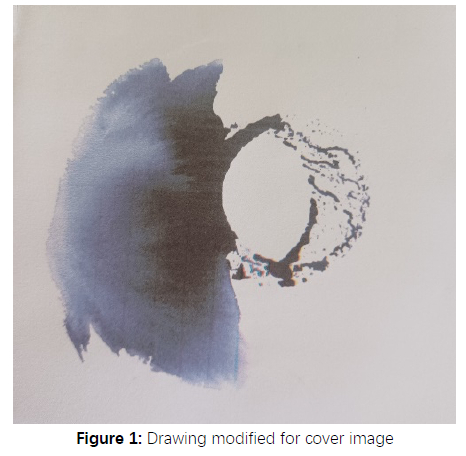
The two archives, one dominant and hegemonic, and the other nascent and hidden, perhaps feared for its unruliness, are explored in an image I drew while writing the book (See Figure 1). This image was modified for the cover of the book I wrote as a product-for-now from my inquiry (Thesen, 2024). It was important in my initial thinking about two archives. On the left is a watery wash from an inkblot. In its darkest part, it touches on the edge of a circle, made through an imprint of the base of a glass jar and then sliding it across the surface for the dynamic trailing effect moving to the right. Where the two spheres are in contact, in relation to one another, something is happening, something like the circle. There is an intensity.
It is important to emphasise that I am interested in the notion of an expanded whole - an archive of the new and the possible, where the bringing together of the two creates something that wasn't seen before, thus widening and deepening our notion of the archive, with the whole more than the sum of its parts. I am interested in a reconnection, perhaps a reconciliation, between trace and formal archives - a re-sizing of the formal to make way for what has been locked out and not allowed to be seen. This making a whole from the two archives has the potential to open up new possibilities beyond the reification of objectivity and the split in the writer's world - the requirement that we know the world without being part of it, that was important to student protests and calls to decolonize knowledge. I return to this image later in this paper in thinking about groundwater, aquifers and the water table.
The problem with writing research in the measured university
In this section, I pause on how notions of language and literacy inscribe the power of the formal archive, with its certainties, now given further impetus by the commodification of knowledge through citation counts. Language, and writing with its promise of permanence, is the location where knowledge is inscribed. One of the most striking practices that enact the hegemonic pull of the formal archive is seen in the pressure to publish, and to finish projects in minimum time. What I am most interested in is the impact on writing pedagogies and practices, and behind these practices, what notions of language and languaging underpin these practices. Getting as many publications as possible in the shortest possible time commodifies knowledge, which comes packaged in semiotic codes expressed in writing, numbers, and images. Researchers are under pressure to approach these texts in formulaic ways. These conventional forms are useful, but like fast foods, they just make us hungrier in the long term.
A particular kind of text written in the genre of the research article has a powerful impact on how knowledge is packaged for completion and publication. The characteristic shape -Introduction, Methods, Results, Discussion (IMRAD) - what genre theorist John Swales calls the RA (Research article), creates familiar places that researchers can go to in the writing of articles and theses. The RA structure is enacted in the CBS (Clarity - Brevity - Sincerity) discursive style that is valued in the Anglophone academy (Barnard, 2014). This style gives shape/breath to a discursive value system that does not value digressions, ambiguity, and complexity, all of which have to be closed down.
The implications of this standardisation and channelling of language have important effects on the teaching of writing. In a desire to give access to valued 'powerful knowledge', there is a strong drive in writing pedagogies to adopt what Lillis and Scott (2007) call 'identify and induct' pedagogies that prioritise induction and reproduction. These imitative pedagogies reinforce what is commonly called 'the deficit discourse', leading to an emphasis that 'tends overwhelmingly to be on what student writers don't or can't do in academic writing rather than on what they can (or would like to)' (Lillis, et al., 2015).
The emphasis on catching up, on what students struggle with, favours a pedagogy over-invested in identifying the text types and working back from them. The notion that genres are settled and all we need to do is help emerging scholars to imitate them is insidious as while it may provide limited access, it does so at a cost: it reifies the status of the products that settle in the formal archive as an imaginary. This imitative, plug-and-play view of pedagogy requires us, as supervisors and teachers of writing, to bring students into this 'divine discourse' that many scholars are challenging, as they innovate with form and function. There is a wave of writing that challenges the strictures of academic discourse. To single out a few: the publication ALT DiS (Schroeder, et al., 2002) broke new ground in the composition/applied language studies field in the US; Taylor and Benazzo playfully mess with the 'machinations of the academic-writing-machine' to expose the serious consequences of how academic writing traps us in a style and politics (2023: 920); in the heart of mainstream publishing, Choi, et al. (2020)'s 'Critical methods for the study of world politics: Creativity and transformation' has vivid examples of writing differently to bring diverse forms of knowing into the public sphere. Kate Cadman asks that we examine our assumptions about the criteria for a good thesis or journal article. She writes that the imaginary of what good writing has to look like functions as a kind of divine discourse, that 'does not recognise, and therefor cannot know, the limitations of its own, taken for granted, almost sacred, understandings of what constitute 'knowledge' and its expression in the English language' (2003: 1).
The metaphor of the pipeline seems more and more to structure thinking about postgraduate research support. While on the one hand it is used to argue for bringing historically excluded students into the academy, on the other it offers a reductive, managerialist approach to how postgraduate scholars become knowledge-makers. The bureaucratic interest in getting people to the end of the tunnel/pipe/conduit as efficiently as possible finds a ready companion in the conduit metaphor of communication (Reddy, 1979). Language is seen as a tube along which communication passes untroubled like a physical object from point a. to point b. This is apparent not only in nouns such as pipeline, deliverables and product, but in the deeper metaphorical structure of language, including prepositions, through the root metaphors that frame how we make sense of things (Johnson, 1980). These container-like frameworks for thought about communication are everywhere in phrases like 'putyour thoughts down' and 'your ideas don't come across clearly'. Struggles to write for whatever reason become leaks (wastage) in the system.
Kevin Leander and Gail Boldt critique the effects of the way literacies pedagogies with their emphasis on settled, ratified genres and their forms limit possibilities for engaging with emergence and necessary complexity and possibilities for the new. Drawing on Deleuze and Guattari (1987), they ask instead for approaches that keep open to the way literacy branches off, working rhizomatically to take root in unlikely places. In stepping back from conventions and universals, they argue that literacy is also unbounded, that the 'domestication' of literacy does harm, arguing for a non -representational approach to literacy-related action, 'not as projected towards some textual endpoint but as living its life in the ongoing present, forming relations and connections across signs, objects, and bodies in often unexpected ways' (2013: 13).
This is where Elmarie's 'modest way' becomes important, as a tentative and exploratory way of knowing, rather than a rigid one. Powerful knowledges, argument as war, language as conduit, all bolster the idea of language as fixed, as finite, and as easily counted and commodified.
Writing as a method of inquiry
In addition to the view of the pedagogy of research literacies that emerged from my experience with the writers' circle, I came to think about my own writing of research differently and to appreciate how the act of writing can be thought of as a method of inquiry. Writing about the pedagogy of the circle raised many ambiguities and ethical dilemmas as I tried to live up to the life in the circle. In the deep ethnographic dive into experience and memory, I became aware of the possibilities of trying out writing as a method of inquiry. Drawing on work such as Richardson and St. Pierre (2005) and Rosi Braidotti (2014) in feminist post-qualitative philosophy and Anna Gibbs (2005, 2015) in creative writing/fictocriticism, I tried out the idea of surface tension. Surface tension is most evident in water, and that's how it first came to me. I stayed with the idea, working and honing it into a concept that could travel across the inquiry.
I explored what emerges if we think of writing as a form of surface tension. There's the tension between what's inside the writer's head, and what's outside, in the world. In Rachel Cusk's novel, I read 'If there's one thing I know, it's that writing comes out of tension, tension between what's inside and what's outside, Surface tension - isn't that the phrase?' (2014: 47). Writing is a subtle membrane between inside and outside, between self and other, an ethical encounter between the two. Writing 'organizes a chaotic world into familiar form' (Gibbs, 2018: 244). In this process, writing asks political, ethical and aesthetic questions: What will make it to the page? What is best left off? What styles are most apt? What is at stake? In wanting to write in depth about the circle, I also had to reckon with how I show up in the circle and in the world.
By acknowledging that the writing 'I' is always a 'we' as we struggle to represent the complexity of the worlds we are researching, writing can be glimpsed as deeply relational and rich in affect, as well as technical. Rosi Braidotti says it well: 'Writing is living intensively and inhabiting language as a site of multiple others ... not just (or even) an instrument of communication, but rather an ontological site of constitution of our shared humanity' (2014: 164). All writers experience this, as we grapple with the need to do no harm and the desire to be heard.
In the next section, I turn to water, to explore what it is about water that might help us to think about knowledge, language and writing differently.
Liquid literacies
Thinking with water takes attention away from certainties and universals about knowledge and its expression in language. I was drawn to water imagery in Deleuze and Guattari's 'The water point is reached only in order to be left behind' (1987: 380), which became a point of reference for thinking about the function of the postgraduate writers' circle. The passage below on language brings to mind liquid flows, expressed here as spreading 'like a patch of oil', as alternative to the arboreal thought of the discipline of linguistics with its preference for tree-like classification:
There is no language in itself, nor are there linguistic universals, only a theory of dialects, patois, slangs and specialized languages [...] There is no mother tongue, only a power takeover by a dominant language within a political multiplicity, language stabilizes around a parish, a bishopric, a capital. It forms a bulb. It evolves by subterranean stems and flows, along river valleys or train tracks; it spreads like a patch of oil. (1987: 7)
Language finds a capital L when it stabilizes around an institution, when it is classified and channelled. When it becomes a named language that can both divide and unify. When it is commodified in paint-by-numbers templates. We have lost touch with its truest life, in flowing, evolving by 'subterranean stems and flows, along river valleys or train tracks'. It is on the move. Everything changes.
As I travel with water as a companion in my thinking, it seems to grow in function. No longer simply a metaphor - water is like language - it seems to have agency, to become a teacher, to offer explanations and deeper meanings.
By chance, I am sent Astrida Neimanis' chapter 'Water and knowledge' (2017). The serendipity of this reading opens up further thought, pushing me to think about water in less binary and innocent ways (pipelines are bad; flows are good). Like imaginaries of knowledge as residing in formal archives that are countable and stable, our imaginaries of water tend to be idealized and stripped of complexity. 'And just as we imagine that [water's] uncanny flows will clean up all of our messes, we also somehow imagine it as quantitatively inexhaustible' says Neimanis (2017: 52). What stays with me is their argument about water and unknowability which challenges my notion of water as precious, as benign and nourishing. Drawing parallels between water and knowledge, she asks a compelling set of questions about knowledge that resonate with my questions about how writing requires us to grapple with questions of politics, ethics and aesthetics:
What does it mean to want knowledge? What is the goal of knowledge? What is the relationship between the knower and what she knows, or the obligation of the knower to what she knows? Is everything meant to be known? What do we need to know urgently, and what knowledge is better left unknown? What might water teach me about these questions? (Neimanis, 2017: 55)
Taking on the idea that water is unknowable is humbling, and therefore a challenge to the hubris of conquest paradigms of what it is to know from above (what Haraway 1998 calls 'the god trick' - the illusion that we can see everything from nowhere). Taming, channelling in concrete pipelines. Neimanis' analysis is illuminated by working with Gayatri Spivak's (1994) reflections on the silencing of the subaltern voices that Spivak noticed in the dynamics of a conference to discuss a 'Flood Action Plan' for the flooding of the delta region at the confluence of rivers in Bangladesh. Neimanis hopes, through thinking with water, to 'imagine and cultivate a much-needed epistemology of unknowability' (2017: 58) to enter into conversation with dominant paradigms of knowledge that enact mastery:
I start to understand Neimanis as part of a bigger flow of work, a resistance and disruption to the way 'progressive neoliberalism' (Fraser, 2017) has limited climate justice and other forms of the social through recognition politics that resonates with right wing populism. My horizons are changing, reaching out to explore the uncanny convergence of 'watery' scholarship in new constellations such as the Blue Humanities (Mentz, 2024; Opperman, 2023), Hydrofeminism (Shefer, et al., 2023), the Oceanic Humanities in the Global South (Hofmeyr's 2022 concept of Hydrocolonialism) as the environmental crises intersect with fast science, crying out for a new form of scholarly engagement.
This work on knowledge, water and climate justice resonates with long-standing debates about language as system or use, as commodity or resource3 and concerns for how these views of language impact on how we understand knowledge. Also illuminating is work in Applied Linguistics that is committed to 'southernise' applied linguistics, to re-visit relationships between geography and knowledge and to see 'entanglements everywhere' as Sinfree Makoni puts it in a transcribed interview with Waqar Ali Shah (2024).
I feel the surge of energy where feminist and southern literacies scholars challenge the orthodoxies of the knowledge factory with its foundations in the dominant paradigms of the northern academy.
What lies beneath: Groundwater
Returning to Deleuze and Guattari's description of language 'spreading like a patch of oil': it could be motor oil made from fossil fuels, stubborn on tarmac. Or it could be olive oil to light a lamp or prepare food. Whether oil or water, liquid literacies travel along the pathways and footprints that creatures make. This is always in relation to landscapes, air, human interventions, politics, love, pollution, climate, tides that mutually shape the ways in which the water can flow or sink below to form the vast networks of groundwater that are so hard to visualize. Water transforms, changing its state from liquid to solid to gas and back again.
I am frightened of the sea and its vastness and the endless horizon.
Imagine a footprint on dry land; a shower of rain squalls across the landscape, briefly filling the imprint left by a foot or a falling branch with water. Depending on soil, temperature, wind, the water may be held, pooled, in the footprint, for a while, or it will leave dimples formed by drops which re-arrange the particles of soil or sand; the water may evaporate very quickly, or pool to sink through the sand to form precious groundwater, invisible to the eye.
My thought stream flows, or trickles, to groundwater.
What does groundwater look like? I know from very limited, and scary, experience of underground caves. A search of Google images shows that the main representations of groundwater are stratigraphic, geological drawings showing the layers underneath the surface of the earth. These classifications have a name for everything.
How can we come to know groundwater? At what cost?
The bodies of surface water evaporate or permeate down into the underworld. Moving very slowly, pooling, trickling, permeating, dripping to form stalactites and stalagmites. Always in relation to rock and sand, and the material that it moves through, and the microspaces between.
Our ancestors dug wells. How did they know where to place them?
There are other ways of knowing, in the gift of divining groundwater. The downward tug as the presence of water pulls the cleft stick vertical to the stubborn earth, the suburban lawn.
What does water do where there is no light? What does it look like?
The Groundwater Dictionary maps the landmass I am familiar with in tiny veins.
Groundwater does not respect the nation state.
Is there more groundwater below the sea?
Thinking about groundwater brings to mind the drawing on the cover of my book - the trace archive that is inextricably linked to the formal archive, yet it is denied (Figure 1).
What if the image is tilted 45 degrees? Then the circle rests on the groundwater. If I invert the image, then the inky, unformed but fertile loamy stuff is underneath. Now language kicks in with metaphors about what is underneath: above and below, resting on, the unconscious with its forms that come into being when things are touching. These prepositions structure thought. Under i s weaker than over. It is darker, harder to know.
The underworld. How to imagine the unconscious?
For Deleuze and Guattari, the unconscious is the stuff of possibility, potentially part of an assemblage for knowledge-making. There are no layers, like stratigraphy, there are no master signifiers, but we see everything all at once, everything is connected, in multiplicities, on a plane of immanence. Everything is possible, in dreams or waking.
If the unconscious knows nothing of negation, it is because there is nothing negative in the unconscious, only indefinite moves toward and away from zero, which does not at all express lack but rather the positivity of the full body as support and prop. (1987: 31)
While a rhizome acts on desire and creativity, when that stalls or fails, it inevitably 'climbs a tree', though this is seen as a kind of death: 'Whenever desire climbs a tree, internal repercussions trip it up and it falls to its death' (1987: 14). Perhaps it isn't either-or, but both-and. We should rather focus on where there are 'knots of arborescence in rhizomes and rhizomatic offshoots in roots' (1987: 20)
Thinking about the unconscious takes me to aquifers, to where water pools in huge reservoirs under the surface of the earth.
Thinking with groundwater draws attention to the mostly-invisible waterscape that lies under the surface. The ancients have always known that wells could become contaminated, that they are integrally linked to what happens on the surface. A well is a portal between an aquifer and the life on the surface.
My thoughts settle on the aquifer, and specifically, a local aquifer. During the extreme 'Day Zero' time in 2018 when the City gave the official warning that we were running out of water, access to groundwater became a crucial issue. In the panic about running out of water, attention turned to groundwater. New rituals quickly formed as people queued to capture precious mountain spring water in 5-liter plastic bottles. This water is filtered through soil and sand to aquifers, large pools and lakes under the surface of both land and sea. The Cape Flats Aquifer is crucial to the 5 million people of greater Cape Town. The existence of the Philippi Horticultural Area (PHA) depends on it. This unpaved zone on the urban fringe in a spatially segregated city, a natural recharge zone for quality water, providing fresh vegetable and grazing, and employment, is also culturally significant in contestation about land and history. Lesley Green (2020) writes about the PHA struggle in a much bigger history of the struggle for access to water in the city. The status and wellbeing of the PHA has long been contested, coming to a head in an application to re-zone the PHA from horticultural use to a large-scale housing development, later overturned in a landmark court ruling judged in favour of retaining the PHA, acknowledging the broader context of climate emergency and water scarcity. In the words of Nazeer Sonday, farmer, activist and author of a newspaper article, "How 'Day Zero' drought and active civil society saved the Cape Flats Aquifer":
In the long struggle to protect the Cape Flats Aquifer and its symbiotic twin, the Philippi Horticultural Area, it was the devastating "Day Zero" Cape drought and water crisis of 2018 that ultimately, like divine intervention, brought the value of the aquifer into the consciousness of Cape Town. (2022)
In concluding the article, he writes, 'We all have a right to the sweet water of the aquifer, and that right comes with a responsibility of care. Which in turn gives effect to the rights of the aquifer over all of us'.
Sonday speaks the language of activism and of love. A devastating water crisis is the catalyst for change. In Green's words, '[t]hat's ontology, right there: looking at how you look; what you name; what matters to you' (2020: 16) as a counter to the way reification over the grand gestures of divine discourse, overlayed by the knowledge supermarket, want to speed things up and shout down all possible 'ands' and 'buts'. Sonday takes the account of the PHA's successful challenge out of the language of pipelines, development protocols and efficiency indicators, and into a heteroglossic register that includes the grace of 'sweet water' and a 'responsibility of care'. The discourse of human rights is reconfigured with the rights accorded to the aquifer with all its entanglements. I think Neimanis would describe this as the 'of me yet beyond me' way of thinking of holistic and interconnected 'planetarity' in which we become the 'curious custodians' of water:
Water as planetarity also suggests to me an epistemology that is engaged, embedded, embodied; a way of knowing that is somewhere, situated, implicated-but this is also a form of knowledge in which that location will always exceed my bounds (as even this "my" leaks out of my watery body beyond the realms of any knowability). The water that we are is first of all planetary. We are its curious custodians rather than its masters. (2017: 64)
What if we think of language in planetary terms? We become its curious custodians, paying attention in different ways at different times. It doesn't come to us pre-wrapped in named languages, genres and text types. Language, like water, bursts the banks, leaks from the pipeline, rusts the tap.
At the water table
This writing journey has taken me to the politics of a local aquifer that I have been only vaguely aware of, and to the people who have fought for it in a powerful assemblage of affect and strategy, an inspiring 'knot' where rhizomatic activism and institutions meet productively.
The aquifer has a water table, where we can discern what's going on underneath. I know the water table rises and falls as an index of saturation and changes in the level of groundwater. The reasons for these changes are complex, ranging from land use to the lie of the land, the geology beneath, local weather, climate and even, in very subtle ways, the pull of the moon (Rau, et al., 2017), if we de-centre the human further.
The water table opens up ways of thinking about knowledge, water and writing in profoundly relational ways, extending the idea of surface tension to what is below the surface. We can discern it, and to some extent predict, but the vastness of what is in the earth and how it relates to big time and space asks new questions about what we know about water, how we know, and what's at stake. The possibilities narrow down when we start thinking about language, unless, again, we de-centre the human. The language of science, in the named language of English, gives us the concept of the water table, a subtle index to hydrological dynamics that links us to climate politics.
But language also offers concepts like table, that most domestic of words - itafile in isiXhosa, tafel i n Afrikaans - roots and branches of the same deep idea, going back through the centuries and flowing, then pooling, and moving again, like water. A piece of sturdy furniture to gather round to eat, work, write. We came together round a table for the writers' circle; we came together at a workshop which is where I met Elmarie. It is in these pedagogic moments that we feel the hum of knowledge and of knowledge-making, the possibilities and the pain.
These interactions leave traces that I am exploring here. These traces may be hard to bring into language, like trying to put my finger on affect, on a 'feel' that alerts us to power relations in what's going on and how it positions us. These attempts are on the edge of understanding, a back and forth at the water table. Through small acts of creation, the writer may be able to look closely at what is there, what seems to be there, what is not there and what might be there. Thinking with water keeps the hope alive. Air, water, fire.
In closing
Elmarie's intervention sustained me through a process of exploring concepts to understand the writers' circle and in the process, to imagine different ways of knowing and writing. Her workshop gave me the permission, reassurance, and crucially the tools - both practical and theoretical - to approach knowledge-making in an oblique way during an inquiry into my long-term involvement with a postgraduate writers' circle. This encouragement seeped into my practice as a writer of research, helping me to return to notions of literacy as emergent, fluid, capable of much more than the bounded, but empty, approaches that haunt pedagogy.
I am left wondering what Elmarie meant by 'in a modest way'. As resistance to the hubris of the zero point - the god trick? As being humble with theory? As holding knowledge more gently? As resistance to over-committing to a theory, but not to a politics? As making small claims? As being self-effacing? Is modesty a gendered term? It's a small word, but an interesting one.
I am looking for Elmarie, trying to retrieve the traces of our engagement. I hardly knew her, spent time with her in two workshops where she was a teacher and a colleague. I can't find the handout she shared at the CHEC workshop: my memory is that her words in the workshop when she invited us to participate 'in a humble way', rather than 'a modest way'. Perhaps this was what she wrote in the handout, but in her journal article describing the workshops that she gave, it is indelibly 'in a modest way'. Memory slips through my fingers, like water. The traces of our engagement are not primarily in the formal archive of publications that remains of her work. They are to be retrieved from her practice as a teacher, in her presence, her voice, the way she leaned forward, from the immense care that she radiated as she enabled this writer to re-turn, to try to make sense at the water table, where what is on the surface permeates the familiarity of the ground to meet what is below.
It has taken me a long time to reach this concept of the water table. As Elmarie said, developing concepts is a 'slow and evolving process'. I like that the concept of the water table was reached through this chance to remember Elmarie. Both water and Elmarie were my teachers, water in its hard-to-knowness and Elmarie in elusive memory. Elmarie offered a portal that is relational, like the idea of the water table, at the intersection between water seen and known on the surface, and water underneath, where surface water meets ground water.
Elmarie offered the best kind of containment - a form of channelling and shaping, but in a slow, open-ended way, where the pathways of thought are multiple and gently held. The table symbolizes generosity, sharing, and communion. In its multiple meanings as a noun and as a verb, it also has hard edges and a politics. To table is to put something on the agenda.
I can ask others who worked with her, and I can read, and write. For now, I will settle on 'in a modest way' as being in the world, for the other, at the water table.
References
- Barnard, I. 2014. Upsetting Composition Commonplaces. Denver: University Press of Colorado.
- Bosanquet, A., Cahir, J., Huber, E., Jacenyik-Trawoger, C. & McNeill, M. 2014. An intimate circle: Reflections on writing as women in higher education. In Aitchison, C. & Guerin, C. (Eds.). Writing Groups for Doctoral Education and Beyond: Innovations in Theory and Practice. London: Routledge, 204-217.
- Bowker, G. 2010. The archive. Communication and Critical/Cultural Studies, 7(2): 212-214.
- Bowker, G. 2005. Memory Practices in the Sciences. Massachusetts: MIT Press.
- Braidotti, R. 2014. Writing as a nomadic subject. Comparative Critical Studies 7(2): 212-214.
- Cadman, K. 2003. Divine discourse: Plagiarism, hybridity and epistemological racism. In May, S Franken, M. & Barnard, R. (Eds.). LED, Ist International Conference on Language, Education and Diversity. Refereed Proceedings and Keynotes. University of Waikato.
- Choi, S., Selmeczi, A. & Strausz, E. (Eds.). 2020. Critical Methods for the Study of World Politics: Creativity and Transformation. London: Routledge.
- Costandius, E. 2019. Fostering the conditions for creative concept development, Cogent Education, 6(1): Article 1700737.
- Cusk, R. 2014. Outline. London: Vintage.
- Deleuze, G. & Guattari, F. 1987. A Thousand Plateaus: Capitalism and Schizophrenia, trans. B. Massumi. Minneapolis: University of Minnesota Press.
- Fraser, N. 2017. From Progressive Neoliberalism to Trump-and Beyond. American Affairs, 1(4).
- Gibbs, A. 2005. Fictocriticism, affect, mimesis: Engendering differences. TEXT, 9(1): 1-10.
- Gibbs, A. 2015. Writing as method: Attunement, resonance and rhythm. In Timm Knudsen, B. & Stage, C. (Eds.). Affective Methodologies: Developing Cultural Research Strategies for the Study ofAffect. London: Palgrave Macmillan, 222-236.
- Gibbs, A. 2018. Vivarium. In Brien, D.L. & Eades, Q. (Eds.). Offshoots: Contemporary Life Writing Methodologies and Practice. Perth: University of West Australia.
- Green, L. 2020. Rock / Water / Life: Ecology & Humanities for a Decolonial South Africa. Durham: Duke University Press & Wits University Press.
- Haraway, D. 1998. Situated knowledges: The science question in feminism and the privilege of partial perspective. Feminist Studies, 14(3): 575-599.
- Hofmeyr, I. 2022. Dockside Reading: Hydrocolonialism and the Custom House. Durham: Duke University Press.
- Jackson, A. & Mazzei, L. 2012. Thinking with Theory in Qualitative Research: Viewing Data across Multiple Perspectives. London: Routledge.
- Leander, K. & Boldt, G. 2013. Re-reading 'A pedagogy of multiliteracies': Bodies, texts and emergence. Journal of Literacy Research, 45(1): 22-46.
- Lakoff, G. & Johnson, M. 1980. Metaphors we live by. Chicago: University of Chicago Press.
- Lillis, T. & Curry, M-J. 2010. Academic Writing in a Global Context: The Politics and Practices of Publishing in English. London: Routledge.
- Lillis, T. & Scott, M. 2007. Defining academic literacies research: Issues of epistemology, ideology and strategy. Journal of Applied Linguistics and Professional Practice, 4(1): 5-32.
- Lillis, T., Harrington, K., Lea, M.R. & Mitchell, S. 2015. Working with Academic Literacies: Case Studies towards Transformative Practice. Colorado: The WAC Clearinghouse and Parlor Press.
- Massumi, B. 2015. The Politics of Affect. Polity Press.
- Mbembe, A. 2002. The power of the archive and its limits. In Harris, V., Hamilton, C., Taylor, J., Pickover, M., Reid, G. & Saleh, R. (Eds.) .Refiguring the Archive. London: Springer, 19-26.
- Mentz, S. 2024. An Introduction to the Blue Humanities. London: Routledge.
- McKinney, C. 2017. Language and Power in Post-Colonial Schooling: Ideologies in Practice. London: Routledge.
- Neimanis, A. 2017. Water and knowledge. In Christian, D. & Wong, R. (Eds.). Downstream: Re-imagining water. Waterloo: Wilfred Laurier University Press, 51-68.
- Oppermann, S. 2023. Blue Humanities: Storied Waterscapes in the Anthropocene. Cambridge: Cambridge University Press.
- Pennycook, A. 2018. Applied linguistics as epistemic assemblage. AILA Review, 31(1): 113-134.
- Prinsloo, M. 2022. Moving dirt: Relationality and complementarity of domestic workers. Journal of Postcolonial Linguistics, 7: 89-107.
- Rau, GC., Acworth, I., Halloran, L. & Cuthbert, M. 2017. Squeezed by gravity: How tides affect the groundwater under our feet. The Conversation, 5 April. Available at: https://theconversation.com/squeezed-by-gravity-how-tides-affect-the-groundwater-under-our-feet-74928 (Accessed: 5 January 2025).
- Reddy, M. 1979. The conduit metaphor. Metaphor and thought, 2: 285-324.
- Richardson, L. & St. Pierre, E. 2005. Writing: A method of inquiry. In Denzin, N.K. & Lincoln, Y.S. (Eds.). Handbook of Qualitative Research. 3rd edition. London: Sage, 959-978.
- Shah, W.A, & Makoni, S. 2024. Rethinking Applied Linguistics in the Global South: A conversation with Sinfree Makoni. Journal of Education, Language, and Ideology, 2(1): 219-230.
- Shefer, T., Bozalek, V. & Romano, N. 2023. Hydrofeminist Thinking with Oceans: Political and Scholarly Possibilities. London: Routledge.
- Sonday, N. 2022. How 'Day Zero' drought and active civil society saved the Cape Flats Aquifer. Daily Maverick, 31 March. Available at: https://www.dailymaverick.co.za/article/2022-03-31-how-day-zero-drought-and-active-civil-society-saved-the-cape-flats-aquifer/ (Accessed: 15 December 2024).
- Spivak, G. 1994. Responsibility. Boundary 2, 21(3): 19-64.
- Spivak, G. 2003. Death of a Discipline. New York: Columbia University Press.
- Taguchi, H. & St Pierre, E. 2017. Using concept as method in educational and social science inquiry. Qualitative Inquiry, 23(9): 643-648.
- Taylor, C.A. & Benazzo, A. 2023 Im/Probabilities of Post/Authorship and Academic Writing Otherwise in Postfoundational Inquiry. Qualitative Inquiry, 29(8-9): 914-921.
- Tronto, J. 1993. Moral Boundaries: A Political Argument for an Ethic of Care. New York: Routledge.
- Thesen, L. 2024. Knowledge-Making from a Postgraduate Writer's Circle: A Southern Reflectory. Bristol: Multilingual Matters.
- Zembylas, M., Bozalek, V. & Shefer, T. 2014. Tronto's notion of privileged irresponsibility and the reconceptualization of care: Implications for critical pedagogies of emotion in higher education. Gender and Education, 26(3): 200-214.

Accepted: 5 March 2025
Author biography
Lucia Thesen is associate professor emerita at the University of Cape Town, with an enduring interest in the relationship between writing and the politics of knowledge. Her most recent publication is Knowledge-Making from a Postgraduate Writers' Circle: A Southern Refiectory published by Multilingual Matters.
1 The workshop I attended was one of a series offered by the Cape Higher Education Consortium (CHEC), one of a suite of courses convened by Vivienne Bozalek on reconfiguring scholarship.
2 I alternated facilitator roles with my colleagues, Clement Chihota, who initiated writers' circles in 2006, and Aditi Hunma, who is still offering the circle, meeting online on a weekly basis.
3 I came to the debate about language as system or use in contrasting structural linguist Saussure (system) with anthropologist Dell Hymes (use), to the idea of language as resource through southern African scholars such as Kathleen Heugh who showed convincingly that 'northern' views of language and multilingualism, when applied to the language classroom, would not allow most children to thrive.