Writing Centre 2.0: Towards improving student writing through consultant and GenAI collaboration
Abstract
This exploratory study investigates the integration of Generative Artificial Intelligence (GenAI) into a faculty-specific writing centre at a South African university. The study introduces a custom GPT, the HWC_CollaboWriter, which was designed to assist writing consultants by addressing lower-order concerns (LOCs) such as grammar and punctuation, freeing consultants to focus on higher-order concerns (HOCs) like argument structure and content development. Drawing on current debates surrounding the role of AI in education, the paper proposes a framework for ethically incorporating GenAI in writing consultations, emphasising collaboration between AI and human consultants. Situated within a multilingual South African higher education context, the article also considers how consultant-mediated GenAI use can support writing development in ways that remain attentive to language justice and cross-linguistic lexical, grammatical, and syntactic transfer. Initial findings suggest that this approach could significantly enhance student engagement and writing development without compromising academic integrity.
Generative AI; higher education; pedagogy; student writing; writing centres; writing tools
Introduction
In 2001, Thomas Bateman (2001: 2) almost apocalyptically suggested that '[w]riting centers in 2020 will be gone' and that '[t]echnology created the center, and technology will bury it'. More than two decades later, however, writing centres at institutions globally remain relevant and in high demand. In a time marked by rapid technological advancements and the emergence of Generative Artificial Intelligence (GenAI) like ChatGPT, it is evident that writing centres have not only endured these changes but have evolved to embrace them. In this article, we make a case for further embracing these changes in a faculty-specific writing centre at our university. We argue that by leveraging the potential of GenAI, a custom GPT (generative pre-trained transformer) can be designed and deployed within the writing centre for use by consultants, thus augmenting the centre's current offering and aligning it with current trends in integrating technology and AI into teaching and learning1.
Before engaging with arguably the most influential technological advancement of the last decade, we point out that giving a full history of the use of technology in education here would be both unnecessary and beyond the scope of this paper. Instead, we will consider educational technologies as they fall into three 'ages'. Howard and Mozejko (2015: 157) propose the 'pre-digital, personal computer, and the internet' ages, but we suggest that the emergence of Artificial Intelligence (AI) has necessitated the inclusion of a new label: the age of AI. This age sees computers learning from experience to complete tasks and, more recently, to create content. In this largely exploratory paper, we step into this new age by designing a bespoke GPT - the HWC_CollaboWriter - that will serve as a collaborative partner in the consultation process at the writing centre. This partnership, as we argue in the following sections, will strengthen the offering of the writing centre by allowing the writing centre consultants to outsource lower-order concerns in student writing to the HWC_CollaboWriter, leaving them able to dedicate more time and resources to addressing higher-order concerns. This paper will begin by providing an overview of AI as it pertains to writing centres and writing centre debates before discussing the design framework and design process behind the HWC_CollaboWriter. The paper concludes with a demonstration of how the HWC_CollaboWriter can work as a collaborative partner in the context of the writing centre.
Role of AI in Writing Centres Presently
Two major concerns in almost all spheres are the fear of AI replacing humans and the fear that AI will render our students incapable of carrying out core tasks independently. Alhumaid (2019: 10) concludes that such technology could deteriorate students' competence in reading and writing, dehumanise educational environments, distort social interactions between teachers and students, and isolate individuals when using technology. Tiwari (2024) adds to this the possible overreliance on technology, cybersecurity threats, the health implications of too much screen time, decreased physical activity, and the loss of traditional skills. Yet, despite these warranted concerns, one cannot deny the ever-growing - imposing, even - presence of AI in all levels of the classroom. It is no wonder, then, that conversations abound on the entry of AI into the writing centre space, with varying viewpoints. For example, Cape Breton University Writing Centre (2023) discourages students from outsourcing aspects of the writing process to ChatGPT or other GenAI tools. While their writing centre does not teach students how to use such tools, they do provide a Moodle module on GenAI and student responsibilities. The writing centre at the University of North Carolina at Chapel Hill (n.d.), on the other hand, asks students to consult their instructors before using such tools, advises on using prompts, and highlights their uses (brainstorming and exploring instructor prompts, generating outlines, understanding genres or types of writing, summarising longer texts, editing and refining, translation, and transactional communication) and pitfalls (inaccurate information, false citations and quotations, bias, violating integrity standards, the tool consumes personal or private information, writers' ideas may be changed extensively).
For Stowe (2023: 1), while AI has the possibility of forever altering the writing centre, 'past the point of recognition', it also has the potential to be used alongside, and not instead of, writing tutors. Deans, et al. (2023) at the University of Wisconsin-Madison demonstrate such use. They advise that writing tutors understand how AI tools work and how to use AI writing tools purposefully, creatively, and ethically. They also share how one undergraduate tutor 'started to selectively introduce AI as an option during sessions when he thought it could address something germane to the writer's concerns and complement the usual give-and-take' (Deans, et al., 2023: 1). These scenarios included extending the writer's text, unblocking a writer, generating a thesis and defining terms, rephrasing and supporting a thesis statement, shortening and sharpening a thesis statement, editing wordy sentences quickly, and generating headings and titles. In all instances, the tutor first asked about the instructor's policy/stance on AI use, whether the student was comfortable using AI, and when requesting corrections/suggestions from AI asked for multiple options, allowing the student to decide on the most correct or appropriate response for their use. According to the authors, this approach can discourage writers from passively defaulting to whatever the Large Language Model (LLM) generates on its first try, and it also feeds into how the tutor attempts to teach writers to use AI selectively, critically, and creatively (Deans, et al., 2023: 1). Closer to home, South African writing centres have not yet adopted particular stances on GenAI use and currently rely on the policies and processes of their individual institutions. At the institution that is the focus of this study, students have access to a guide that advises them on how to leverage GenAI tools for effective teaching and learning while a formal policy is being developed. In keeping with this stance, the writing centre is keen to investigate ways to harness GenAI ethically, as a tool that is used as part, and not instead, of the consultation process between student and tutor.
AI and the writing centre debate
As a small faculty-specific writing centre, we have always been guided by writing centre literature and context-specific research to inform our practices. Like our international counterparts, we believe that the purpose and strength of the writing centre lie in its main mandate, inspired by North (1984), 'to improve the writer and not the writing'. The idea is that the support provided by the consultant is not aimed at improving the writing of one paper but rather at developing the student writer's academic writing proficiency, which can be applied to other writing that the student engages in. This view of writing has been severely distorted, with some students and faculty seeing the writing centre as a 'grammar repair shop' (North, 1984: 435; Sefalane-Nkohla & Mtonjeni, 2019: 1). Sefalane-Nkohla and Mtonjeni (2019) suggest that although writing centre practitioners and theorists have described these centres as hubs for nurturing and enhancing students' intellectual and linguistic capacities to engage with and master disciplinary literacies and genres while contributing to the transformation of educational projects, such a value tends to be misrecognised - by both lecturers and students - as focusing on improving grammatical competence. The debate this incongruence lends itself to is as old as the idea of the writing centre itself, i.e. directive or non-directive and higher order concern (HOC) or lower order concern (LOC). Regarding the directive/non-directive debate, writing centre researchers today adopt a more flexible approach to the strategies used during writing centre consultations, acknowledging that these should suit the needs of the student (Carstens & Rambiritch, 2021).
The concern with attention to HOC and LOC was less easy to resolve. Writing centre philosophy (Moussu, 2013) espouses an approach that prioritises higher-order concerns, defined as text level or non-linguistic concerns, over lower-order concerns (sentence level, lexical concerns). Writing centre research, however, demonstrates that L2 students, who are often the more frequent visitors to the writing centre, seek out support for lower-order concerns (Nakamaru, 2010). This disjuncture has severe implications for the writing centre. Having students' concerns ignored because writing centre philosophy dictates a particular approach could lead to a student leaving the writing centre dissatisfied. On the other hand, focusing only on LOCs at the expense of HOCs can negatively impact the learning and development that should take place during consultations. While context-specific research at our institution (Carstens & Rambiritch, 2021) demonstrated that visitors to our writing centre did not necessarily seek out only LOC support and that our consultants balanced discussions related to HOCs and LOCs, the issue of grammar support in the writing centre remains a contentious one. In addition, there are a few other imperatives for consideration:
1. students may only visit the writing centre a few times during their academic journey, and thus, it is necessary to provide as much feedback as possible in the times we see them;
2. a writing centre consultation (at our institution) is 50 minutes long, which is not sufficient time to focus in any depth on both HOCs and LOCs; and
3. in keeping with our adage, inspired by North (1984), to 'improve the writer and not the writing', it is necessary to encourage a level of independence and accountability on the part of students.
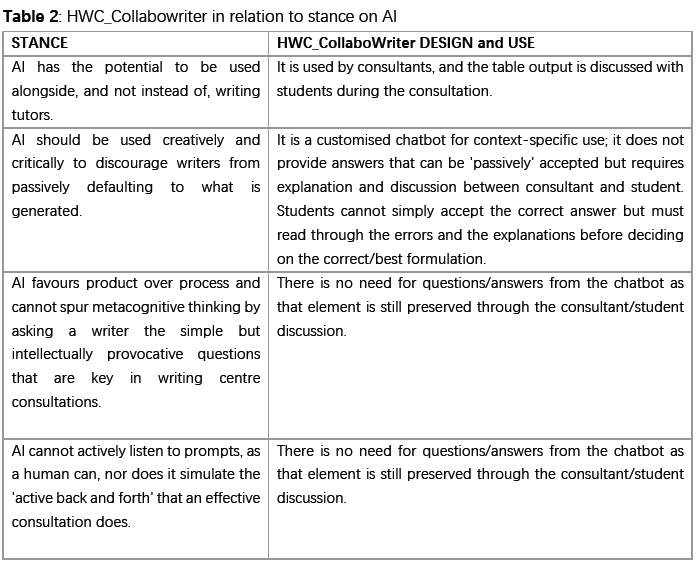
Thus, an effort to marry a key concern in writing centres with GenAI use led us to investigate the possibility of using a custom GPT to support writing centre consultants and students to interrogate and provide feedback on the LOCs in the drafts that students bring to the consultation. Using GenAI to provide feedback on only the LOCs allows us to exploit the functionality of such a tool without compromising on issues related to academic integrity, text ownership, and other practices that may be considered unethical. It also allows us to demonstrate to students how GenAI can be used collaboratively as a teaching and learning tool. Our developing stance on AI use in the writing centre, which has guided our design, coheres with Stowe (2023) and Deans, et al. (2023), both referenced above, but also with Essid's (2023: 47-49) reasoning related to AI, metacognition, and active listening:
1. AI has the potential to be used alongside, and not instead of, writing tutors;
2. AI should be used creatively and critically to discourage writers from passively defaulting to what is generated;
3. AI favours product over process and cannot spur metacognitive thinking by asking a writer the simple but intellectually provocative questions that are key in writing centre consultations; and
4. AI cannot actively listen to prompts, as a human can, nor does it simulate the 'active back and forth' that an effective consultation does.
This research then outlines the development of a custom GPT we call the HWC_CollaboWriter, designed to support writing centre consultants and students in handling grammar-related concerns in student writing. We envisage that the collaborative interactions may work as follows: when students visit the writing centre, they will give consent to a consultant to upload their work to the HWC_CollaboWriter. At the end of the consultation, after the consultant has addressed the HOCs with the student, the consultant will turn to the feedback table that the HWC_CollaboWriter has provided. The consultant will go through the table with the student to discuss the errors and explanations provided so that the student clearly understands how to make the necessary corrections after the consultation.
Before delving into the design process, we offer a differentiation of GenAI chatbots from 'traditional' grammar checkers like MS Word, Google Docs, and Grammarly, as well as a snapshot of customised/personalised chatbots designed for writing support in specific contexts and purposes. This is followed by a description of the design and development process, the challenges experienced, and a demonstration of the current product. The paper then concludes by outlining the next steps in the piloting process and suggesting future possibilities and considerations.
GenAI, language justice, and multilingualism in the writing centre
In the South African higher education context, discussions of academic writing support are inseparable from questions of multilingualism (one of the core constructs of this special issue), linguistic power, and access to epistemic participation. English remains the dominant language of learning and teaching at most universities, despite the linguistic diversity of the student body and the recognition of multiple official languages. For many students, English functions as an additional language acquired largely through formal education rather than sustained social immersion. As a result, challenges related to grammar, syntax, and lexical choice are often rooted not in cognitive deficit but in cross-linguistic transfer, where linguistic features of students' home languages interact with the conventions of academic English in uneven ways (Paxton & Frith, 2014; McKinney, 2017)2. Focusing specifically on writing centres, though writing in the early 2000s, Myers (2003: 52) similarly argues that it is the linguistic component (vocabulary and syntax) as much or more than what is considered the writing (rhetorical) component that ESL students need most, that their 'errors are persistent evidence of normal second-language learning and processing, not some failure on the part of students.' Within this setting, the integration of GenAI into writing development raises questions of language justice: whether such technologies risk reinforcing linguistic hierarchies, or whether they can be deliberately constrained to support more equitable and responsible engagement with academic discourse. Interestingly, the strategies that Myers proposed more than 20 years ago (having tutors not just pointing out errors but providing alternate phrases/language and showing as opposed to telling) speak directly to how we envision the integration of the HWC_CollaboWriter.
When carefully designed and mediated, GenAI tools present an opportunity to make the conventions of academic English more explicit and therefore more teachable. Academic English often operates as a tacit norm, with expectations around sentence structure, cohesion, article use, tense, and punctuation remaining largely unstated, particularly in content-heavy curricula. For multilingual students writing in an additional language, these implicit expectations frequently function as hidden gatekeeping mechanisms that limit access to disciplinary meaning-making (Lillis & Scott, 2007; Clarence & McKenna, 2017). LOCs such as subject-verb agreement, article use, pluralisation, and sentence boundaries are common sites of difficulty precisely because equivalent grammatical categories or usage patterns may not exist, or may function differently, across languages. Addressing such issues through correction alone, without explanation, offers little support for long-term development and risks reinforcing deficit framings of multilingual writers.
From this perspective, the HWC_CollaboWriter can be understood as supporting language justice by rendering dominant linguistic conventions visible rather than silently enforcing them. Its focus on identifying patterns of error and providing rule-based explanations creates opportunities for metalinguistic reflection, allowing students to better understand academic English as a particular, situated register rather than as a neutral or universal norm. In consultant-mediated consultations, this explanatory feedback can be contextualised as part of a dialogue about language use, meaning, and choice. In practice, consultants frequently encounter recurring difficulties with features such as article use or sentence boundaries that reflect cross-linguistic transfer rather than misunderstanding of task requirements. Framing such patterns as transferable linguistic knowledge, rather than as isolated mistakes, aligns with translingual approaches that view multilingual resources as assets rather than obstacles (Canagarajah, 2013; Rambiritch, 2018).
At the same time, the use of GenAI in writing support poses significant risks for language justice if deployed uncritically. Large language models are trained predominantly on standardised varieties of English, often drawn from Global North contexts, and may therefore encode and reproduce narrow conceptions of linguistic correctness (Bender, et al., 2021; Park, 2024). When students engage directly with such tools without pedagogical mediation, AI-generated feedback can assume an authoritative status that frames deviation from standard academic English as error rather than difference. This authority is not neutral: it reflects what Helm, et al. (2024) describe as language modelling bias, whereby structural inequalities embedded in training data translate into epistemic injustice. In multilingual contexts, where students may already experience heightened linguistic surveillance, such dynamics risk intensifying anxiety around language use and obscuring the socio-historical conditions under which academic language conventions have been produced and maintained.
Rather than treating these risks as reasons to reject GenAI outright, the design and intended use of the HWC_CollaboWriter seek to mitigate them through deliberate constraint and human mediation. The tool is restricted to identifying and explaining LOCs and is explicitly prevented from rewriting or paraphrasing student text, preserving students' authorial voice and ownership. Access to the tool is mediated through writing centre consultants, ensuring that AI-generated feedback remains embedded within dialogic, human-centred pedagogy rather than operating as an autonomous arbiter of correctness. By presenting feedback in a structured format without supplying ready-made corrections, the HWC_CollaboWriter encourages active engagement with explanation and discussion, reinforcing writing centre practices that prioritise dialogue, student agency, and learning over textual polish (Rambiritch, 2018).
Framing GenAI as both an opportunity and a risk foregrounds a central claim of this paper: language justice is not an inherent property of educational technologies but emerges from how such technologies are designed, constrained, and embedded within pedagogical practice. In multilingual writing centre contexts, GenAI has the potential either to reinforce existing linguistic hierarchies or to support more transparent and reflective engagement with academic English. The HWC_CollaboWriter is intentionally positioned within the latter approach, treating LOCs as sites for dialogue and learning rather than as deficits to be erased. In doing so, it aligns with long-standing writing centre commitments to developing writers rather than merely polishing texts, while remaining attentive to the linguistic realities of students who navigate academic spaces through multiple languages.
Customised chatbots and student writing
According to Oracle Cloud Infrastructure (2024), a chatbot is a computer programme that simulates and processes human conversation (either written or spoken), allowing humans to interact with digital devices as if they were communicating with a real person. Driven by AI, automated rules, natural-language processing, and machine learning, chatbots process data to deliver responses to requests of all kinds (OCI, 2024). A chatbot works by interpreting the message given by a user, processing the intent of the message, determining and executing what it needs to do based on the user's instructions, and delivering the final results of the programme's execution to the user (Haristani & Rifai, 2019: 3159). Adamopoulou and Moussiades (2020) state that the main advantages of chatbots lie in providing users with quick and convenient support and responding specifically to their questions, making chatbots appealing for use in teaching and learning and especially appealing in shaping the way students learn. Chatbots are thus being used in the writing classroom to support and develop student writing. While GenAI, like ChatGPT, is extensively used and researched (see AlAfnan & MohdZuki, 2023; De Matas, 2023; Levine, et al., 2024; Picciano, 2024), there is limited research on customised chatbots developed to support student writing.
Lin and Chang (2020) developed a chatbot they call DD that helps teachers deliver writing instructions. The chatbot supported writers in developing a thesis statement for their argumentative essay outlines and refining their peer review feedback. The researchers saw the value of integrating such a tool into their writing instruction because they acknowledge that acquiring writing skills is not a linear process but rather an interactive social process that requires multichannel input and output between individuals (Lin & Chang, 2020: 79). Thus, DD the chatbot could fulfil novice writers' need to initiate a dialogue when help is needed (Cazden, 1988; Edwards & Mercer in Lin & Chang, 2020: 79). Using the experimental and comparison semester model, the researchers had students in the experimental semester interact with the chatbot. Using discipline-specific examples from Educational Psychology, DD introduced the components of a thesis statement and guided the students to write a thesis statement for their essay outline. The students also reviewed another student's outline by interacting with the chatbot, which was programmed to guide students in providing effective peer feedback for the outline (Lin & Chang, 2020: 85). Lin and Chang (2020: 88) concluded that although some positive student testimonials and improved essay outline performance were reported, the study's limitations cannot be ignored. They share that the writing proficiency of the participating students was not well controlled and that a pre-test was not administered. Importantly, they state that the improved performance of the essay outline might be due to the novelty effect, i.e. the tendency of increased achievement results from the initial introduction of an innovative technology in which users' interest level is high (Lin & Chang, 2020: 87). They advise that future researchers might extend the use of chatbots over a longer period to see if performance and student interest levels are still sustained (Fryer, et al., in Lin & Chang, 2020: 88). As a final point, they state that despite several methodological concerns, the chatbot is still better suited to be used as a supplement than a standalone Intelligent Tutoring System (ITS) because of its Natural Language Understanding (NLU) constraint (Heller, et al., in Lin & Chang, 2020: 80) which included complaints from students that the chatbot 'did not speak like a human' and because 'open-ended questions and unstructured problems may confuse it' (Lin & Chang, 2020: 80).
Al Mahmud (2023), writing in the Saudi Arabian higher education context, investigated whether and to what extent Wordtune facilitates Saudi students' writing. Driven by AI, Wordtune is an online writing tool that allows learners to paraphrase their writing. It does so by replacing the words in the original text with their synonyms and varying the sentence structure at the phrasal and clausal levels (Al Mahmud, 2023: 1396). It provides instant feedback and encourages self-directed and self-paced learning. Wordtune uses AI to determine patterns learned from a writing database to produce multiple rewrites of the original sentences (Zhou & Hiver in Al Mahmud, 2023) and does not lift expressions verbatim from already available online material in producing a paraphrase (Al Mahmud, 2023: 1396). Using a pretest and post-test design administered to the control and the experimental groups, the research demonstrated that the use of Wordtune had a positive impact on participants' writing, with students performing better when using the Wordtune application - the experimental group made significant gains in writing compared with the control group (Al Mahmud, 2023: 1401). They also note that participants made 'modest lexical and syntactic gains' (Al Mahmud, 2023: 1402) related to improved vocabulary, lexical resourcefulness, and sentence structure. They conclude by cautioning instructors to inform students about the limitations of Wordtune because an 'uncritical reliance on a digital writing tool might put students on the path of becoming blind followers of writing technology, which would be counterproductive to their writing' (Al Mahmud, 2023: 1402).
Guo, et al. (2022: 1) propose a chatbot-assisted approach to the teaching and learning of argumentative writing by introducing a newly developed chatbot system, Argumate, designed to scaffold students' argument creation in two ways: backing idea generation and triggering counterargument integration. Though the researchers offer a demonstration of the chatbot through a number of images, they also indicate its limitations, including the small size of Argumate's current database and its inability to provide tailored responses, evaluate the quality of the user input, and provide corresponding feedback (Guo, et al., 2022: 5). They further specify that Argumate is designed to help students defend one of two opposing positions rather than to describe or synthesise different perspectives, and thus it can only encourage persuasive argumentative writing and does not support other formats (e.g., argument as inquiry) (Guo, et al., 2022: 5).
Pereira and Barcina (2019), concerned about the writing quality of the project reports of final-year engineering students, developed Ikastenbot, a chatbot interface for Telegram (an instant messaging application). They explain that students writing their final reports can upload a PDF file of their report to Ikastenbot by running the text command/send. Ikastenbot will then parse the report and make it available to execute further commands. Ikastenbot architecture is comprised of five main modules: text transfer detection (possible plagiarism), poorly referenced images detection, lack of basic bibliographic references detection, a spelling/grammar correction module, and a conversational front-end module (chatbot) (Pereira & Barcina, 2019: 61). The use of Ikastenbot allows the detection and correction of many writing-related problems during the development of the report rather than at the end of it, freeing the teachers from administrative and repetitive tasks while improving the quality of students' reports (Pereira & Barcina, 2019: 63). One possible limitation the researchers note is the lack of a more representative statistical sample, as only the reports available in the repository of one engineering school have been analysed (Pereira & Barcina, 2019: 63).
Guo and Li (2024: 1) attempted a novel approach to integrating chatbots into developing their students' writing by exploring English as a Foreign Language (EFL) students' use of self-made Retrieval Augmented Generation (RAG) chatbots to enhance their learning to write. Grounded in an educational approach that foregrounds personalised learning, the participants in this study used Poe, a chatbot creation platform, to create their own chatbots tailored to their individual learning needs, facilitating personalised learning experiences (Guo & Li, 2024: 4). The results demonstrated that students built RAG chatbots to address individual challenges at different stages of the writing process, including preparation, editing, proofreading, and reflection, with most students using chatbots to generate ideas and construct arguments and a smaller number of students using them for language error correction. The researchers noted that students deliberately avoided requesting their chatbots to complete the assigned writing tasks on their behalf, with students explicitly requesting their chatbots to refrain from presenting them with complete essays, thus exemplifying students' intentions to enhance their writing skills by actively seeking suggestions and guidance from their chatbots (Guo & Li, 2024: 12).
The brief review above brings to the fore a few key considerations. The first and most notable is that the development and use of personalised chatbots in the literature cited occurred in the traditional classroom, with very limited evidence of customised chatbots for use in the writing centre. The second is that the chatbots were designed to support students with a range of writing concerns, and the third is that in almost all cases, the bot was designed for students' use and used fairly independently of their lecturers and instructors. The HWC_CollaboWriter differs in a few key ways: it is a customised platform for a specific context (the writing centre); it focuses only on the grammar- and language-related concerns of the student's text; and most significantly, it is designed for use by consultants and students working collaboratively on a student's text.
The HWC_CollaboWriter
The HWC_CollaboWriter vs other AI language tools and traditional language checkers
Unlike general AI-powered language tools like Grammarly, MS Word's language checker, Google Docs, Wordtune, and Quillbot, the HWC_CollaboWriter is designed to focus specifically on error identification and correction, particularly within the context of academic writing. Its primary goal is to enhance users' understanding of grammatical rules. While tools like Grammarly offer broad coverage of grammar, style, and tone, the HWC_CollaboWriter's feedback considers both the content and context of the student's writing to provide in-depth explanations that help users grasp the reasoning behind each correction.
One of the key distinctions of the HWC_CollaboWriter lies in its approach to presenting feedback. Instead of providing 'quick fixes' or surface-level corrections, it offers structured feedback in a table format, categorising errors and providing clear, detailed explanations. This structured method is designed to facilitate deeper learning by allowing students to identify and understand their mistakes easily. In contrast, tools like MS Word's spellchecker and Google Docs deliver more automated corrections without the depth of explanation necessary for true understanding. HWC_CollaboWriter's structured format of feedback, which is demonstrated later in this paper, encourages students to take ownership of their writing as it requires them to resolve the mistake themselves rather than to simply accept a suggested correction - as is the case with most of the traditional language checkers mentioned above. This methodology sidesteps the potential of students seeing the writing centre as a 'grammar repair shop' (Sefalane-Nkohla & Mtonjeni, 2019: 1). Instead, it works towards our previously mentioned goal of 'improving the writer and not the writing' as inspired by North (1984: 438).
The HWC_CollaboWriter's focus sets it apart from tools like Wordtune and Quillbot, which primarily concentrate on rewriting and paraphrasing sentences for clarity and style. The HWC_CollaboWriter does not aim to rephrase or simplify text; instead, it emphasises the importance of understanding language mechanics. By analysing specific errors and providing rule-based explanations, it equips users with the knowledge needed to master the intricacies of effective academic writing. This makes the HWC_CollaboWriter particularly beneficial for students who need to learn how to write clearly and why certain writing practices are correct or incorrect.
Moreover, the HWC_CollaboWriter's feedback is deliberately neutral and objective, focusing solely on grammatical and lexical accuracy. It does not make stylistic changes unless they directly pertain to grammatical correctness. This objectivity is essential in academic writing, where clarity and adherence to linguistic rules are paramount. Unlike other tools that might suggest changes based on algorithms or broader writing trends, the HWC_CollaboWriter is dedicated to helping users improve their writing by understanding the underlying principles behind each correction. Importantly, the HWC_CollaboWriter's mandate to avoid rewriting or paraphrasing also allows students to retain their authorial voices, which are still in varying stages of development.
Lastly, since the HWC_CollaboWriter is a custom GPT currently running on GPT 5.2, it is tailored specifically to the needs of the writing centre and those who walk through its doors. This means that the HWC_CollaboWriter has an innate flexibility - we can amend it as the needs of the writing centre, its consultants, and its students evolve over time. Other language tools like those mentioned above are set and function only as the product was sold. The HWC_CollaboWriter is malleable and can be (re)programmed by us as we need.
An important consideration in our design was the need to ensure that such a tool could be used alongside consultants and students. Thus, unlike other language tools/checkers, students do not have direct access to the HWC_CollaboWriter. Instead, the student's text, which we receive via our online booking system when a student books a consultation, will be uploaded by the consultant (with permission from the student), and the table output will be discussed as part of the consultation process. Students will also have access to the table after the consultation and can use this in the editing/proofreading stage of their writing.
Designing the HWC_CollaboWriter: A product of design thinking
The creation of the HWC_CollaboWriter was guided by the principles of Design Thinking, a human-centred approach that prioritises the needs and experiences of users (Lee & Park, 2021: 1). This framework was instrumental in developing an AI tool specifically tailored for the writing centre at our university. The design process was exploratory and pedagogically oriented, drawing on writing centre practice and academic literacies rather than on the evaluation of learning outcomes or tool effectiveness. The aim was to create a tool that could assist consultants in shifting their focus from LOCs, such as punctuation and grammatical accuracy, to HOCs, such as argument development and structure. The Design Thinking approach, broken down into five key stages - empathise, Define, Ideate, Prototype, and Test (Stanford Design School, n.d.) - is discussed systematically below.
Empathise: Understanding the user's needs
The first step in the Design Thinking process was to understand the needs of both the consultants in the writing centre and the students they assist. Consultants often spend time addressing lower-order concerns, such as punctuation, grammar, and lexical errors. Though important, these tasks often leave less time for addressing higher-order concerns, which are crucial for developing students' critical thinking and writing skills (Carstens & Rambiritch, 2021). As such, we recognised the potential of an AI tool that could efficiently handle these LOCs, allowing consultants to dedicate more time to addressing the HOCs in student writing.
Define: Pinpointing the core problem
Building on the insights gathered during the empathy phase, the next step was to define the core problem clearly. The challenge was to design an AI tool that would enable consultants to spend less time correcting LOCs and more time helping students with HOCs. In line with this, we formulated our problem statement as: 'How might we design an AI tool that can satisfy both student needs, by identifying and explaining punctuation and grammatical errors, and consultant needs, by freeing them up to focus on HOCs?'
Ideate: Generating solutions
In the ideation phase, we had multiple discussion sessions to explore various solutions to the defined problem. Several ideas were considered, but the standout idea was to present feedback in a structured table format. This format would make it easier for students to locate their errors, understand how to correct them, and learn from detailed explanations. By equipping students with this knowledge, the tool would help reduce the frequency of similar errors in future writing, ultimately empowering them to become more technically proficient writers in both the short and long term.
Prototype: Developing the tool
The prototyping phase involved the creation of a working model of the HWC_CollaboWriter. The AI was programmed to identify and present common errors in a table with three columns: 'Error', 'Explanation', and 'Detailed Explanation'. The 'Error' column highlights the full sentence containing the mistake, with the error itself in bold, ensuring it stands out for easy identification. The 'Explanation' column provides a brief description of the rule involved, while the 'Detailed Explanation' offers more in-depth insights into the mistake, helping students understand not just what was wrong but also why it was wrong. As mentioned previously, writing centre consultants will discuss the table with students during consultations so that they are able to mediate the feedback to ensure that students understand which points are most pressing and how to implement the feedback going forward.
Flexibility was a key consideration in the development of the prototype, allowing for adjustments based on user feedback. Additionally, the tool was designed to maintain a neutral and objective tone, focusing solely on grammatical and lexical accuracy without commenting on the content of the writing. This allowed consultants to use their expertise where it was most needed - in guiding students through higher-order writing issues.
Test: Refining through feedback
The final phase of the Design Thinking process is broken into two distinct parts: Alpha testing and Beta testing. Alpha testing is testing done by developers to check for bugs and usability issues (Sharma, 2024). We, the developers, ran several rounds of testing with sample texts and fine-tuned the HWC_CollaboWriter to meet the needs of both students and consultants in the writing centre. During these rounds of testing, several shortcomings revealed themselves and needed to be remedied. These included ChatGPT's baked-in inclination to correct or rewrite material; we spent considerable time ensuring that the HWC_CollaboWriter provided only the table described above and not corrections. Another challenge that arose was ChatGPT's default 'sunny disposition', which means that it tends to provide overly positive feedback on even very poor writing samples. It took several iterations to get the HWC_CollaboWriter to refrain from offering subjective feedback on a writing sample.
Beta testing, testing done by real users in the intended place of deployment (Sharma, 2024), is yet to be done as this paper is in its exploratory stage; pilot testing will be the next step towards fully completing the Design Thinking process.
The HWC_CollaboWriter, in its own words
In the spirit of having the HWC_CollaboWriter work as a collaborative partner in the writing centre at our institution, we thought it best to have the HWC_CollaboWriter introduce itself and explain its own 'understanding' of its position in assisting both consultants and students:
I am a specialized version of the ChatGPT language model, designed to support consultants at the University of Pretoria's Humanities Writing Centre in enhancing student writing. My primary function is to assist consultants by identifying and explaining errors in students' academic writing, focusing on punctuation, grammar, and lexical accuracy. This allows consultants to concentrate on guiding students through the logic and argumentation of their work.
When consultants upload a student's writing to me, I meticulously analyse the text for various types of language errors. These errors might include issues with punctuation (such as the misuse of commas, semi-colons, or full stops), grammatical mistakes (like subject-verb agreement, tense consistency, or improper use of articles), and lexical inaccuracies (such as incorrect word choice or inappropriate use of idiomatic expressions). My analysis is exclusively concerned with the formal aspects that contribute to the overall quality and readability of the text, not its content or argumentative quality.
Once I identify errors, I organize them into a structured table with three columns: 'Error', 'Explanation', and 'Detailed Explanation'. In the 'Error' column, I highlight the full sentence containing the mistake, with the error itself emphasized in bold. This helps students easily locate the issue within their writing. The 'Explanation' column provides a brief description of the rule or convention that has been violated, offering students a quick reference to understand the nature of the mistake. Finally, the 'Detailed Explanation' column offers a more in-depth discussion of the error, explaining why it is incorrect and how it can be corrected.
A key focus of my analysis is the proper use of punctuation, particularly semi-colons, which are often challenging for students to use correctly. I help clarify when and how to use semi-colons appropriately, ensuring that students can structure their sentences with the right level of complexity and clarity.
My role is purely to help students refine the technical aspects of their writing so that their ideas can be communicated more effectively. By offering clear, structured feedback, I aim to foster a deeper understanding of writing conventions among students, helping them develop skills that will be valuable not only in their academic work but also in their future careers.
Through my collaboration with consultants, I aim to empower students by providing them with the insights they need to correct their mistakes and grow as writers. With the consultants' focus on content and my attention to language accuracy, we provide comprehensive support that helps students become more confident and proficient in their writing. My ultimate goal is to contribute to the development of students' writing skills in a way that is supportive, educational, and focused on long-term improvement.
(OpenAI, 2024)
The HWC_CollaboWriter in action
To illustrate how the HWC_CollaboWriter operates and analyses student writing to generate a feedback table, we offer a short example below:
Student Paragraph:
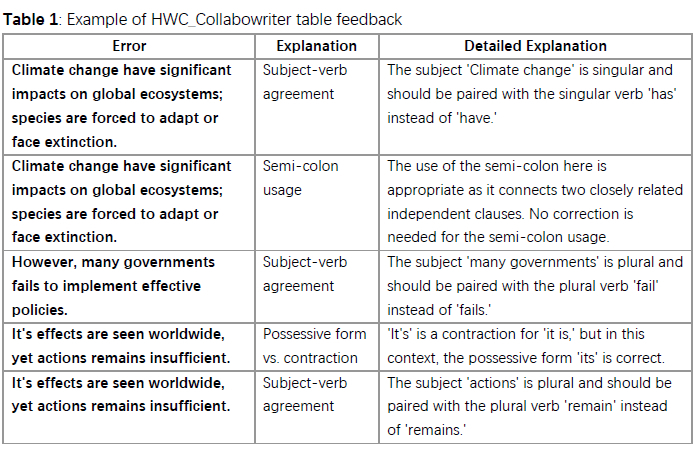
'Climate change have significant impacts on global ecosystems; species are forced to adapt or face extinction. However, many governments fails to implement effective policies. It's [sic] effects are seen worldwide, yet actions remains insufficient.'
The HWC_CollaboWriter analyses the paragraph and provides detailed feedback for the student, focusing on LOCs. The tool presents the feedback in a structured table format (see Table 1 below).
In this brief demonstration, the HWC_CollaboWriter identifies, categorises, and explains several issues:
1. Subject-verb agreement: The tool detects mismatches between subjects and verbs in terms of number, such as 'Climate change have' (should be 'has') and 'governments fails' (should be 'fail').
2. Possessive forms vs. contractions: It identifies the incorrect use of 'It's' (contraction for 'it is') where the possessive 'its' is required.
3. Semi-colon usage: The tool confirms the correct use of the semi-colon in the first sentence, providing positive reinforcement.
Once the consultant receives this report, it will be shared with the student during the consultation. This will generally take place at a later stage of the consultation. Students will have access to the table, which can be emailed to them. As the table shows, the chatbot will not provide a correct answer that can simply be copied and pasted into the student's writing. Instead, the student will have to read through the errors and the detailed explanations and then decide how best to make the correction. Because the chatbot has the ability to store such data in its memory, consultants will be able to access earlier tables generated for particular students, and these can be used to draw the student's attention to what could be the common errors in their writing. Such feedback once again aligns with the mission of writing centres to improve the writer and not just the writing.
Conclusion and next steps
This research has sought to explore what is an under-researched yet topical issue - integrating personalised chatbots into the writing centre to support both consultants and students. As indicated, this is a largely exploratory study. While the HWC_CollaboWriter has been designed and tested multiple times by the developers, it is still to be tested with the real users: the consultants and students. Thus, the next step of this project is to receive the relevant ethical clearance and permission to pilot this in the writing centre. Feedback from users will be used to make adjustments and refinements so that the HWC_CollaboWriter effectively supports their needs. We also envision using the HWC_CollaboWriter as a tool in the future to support the multilingual students who visit us.
Earlier, we indicated that our developing stance on AI use in the writing centre, which has guided our design, coheres with Stowe (2023) and Deans, et al. (2023), referenced above. However, our stance also corresponds with Essid's (2023: 47-49) reasoning related to AI, metacognition, and active listening. This is demonstrated in table 2 below.
The HWC_CollaboWriter has been designed, after much consideration, to ensure that its integration into the writing centre does not lead us to deviate from our main mission and identity: individualised writing support provided by a more experienced writer and mediated through sustained and engaged dialogue. Approached in this way, GenAI functions not as a corrective or substitutive technology, but as a pedagogical resource whose value lies in deliberate constraint and human mediation. Such an approach is particularly important in multilingual higher education contexts, where making the conventions of academic English more transparent must be balanced against ongoing concerns about language justice, student agency, and access. Its design and use negate the fear of AI replacing humans, in our case, consultants, nor will it render our students incapable of carrying out core tasks independently. This effective integration and leveraging of AI tools will ensure that technology continues to benefit the writing centre instead of 'bury it' (Bateman, 2001: 2).
Declaration of Generative AI and AI-assisted technologies in the writing process
During the preparation of this work the authors used ChatGPT (GPT-4) in the design and development of the HWC_CollaboWriter, as well as for limited language refinement during drafting. All outputs were critically reviewed, revised, and integrated by the authors. The authors take full responsibility for the content and arguments presented in the publication.
References
- Adamopoulou, E. & Moussiades, L. 2020. Chatbots: History, technology, and applications. Machine Learning with Applications, 2: 100006.
- AlAfnan, M.A. & MohdZuki, S.F. 2023. Do artificial intelligence chatbots have a writing style? An investigation into the stylistic features of ChatGPT-4. Journal of Artificial Intelligence and Technology, 3(3): 85-94.
- Alhumaid, K. 2019. Four ways technology has negatively changed education. Journal of Educational and Social Research, 9(4): 10-20.
- Al Mahmud, F. 2023. Investigating EFL students' writing skills through artificial intelligence: Wordtune application as a tool. Journal of Language Teaching and Research, 14(5): 1395-1404.
- Bateman, T.L. 2001. Writing centers in 2020-gone! Paper presented at the College English Association Conference (Mid-Atlantic Division), Frederick, MD, United States.
- Bender, E.M., Gebru, T., McMillan-Major, A. & Shmitchell, S. 2021. On the dangers of stochastic parrots: Can language models be too big? Proceedings of the 2021 ACM Conference on Fairness, Accountability, and Transparency, 610-623.
- Canagarajah, S. 2013. Translingual Practice: Global Englishes and Cosmopolitan Relations. London: Routledge.
- Cape Breton University Writing Centre. 2023. ChatGPT, Generative AI, and Writing. CBU. Available at: https://www.cbu.ca/current-students/student-services/writing-centre/chatgpt-and-generativeai/ (Accessed: 12 November 2024).
- Carstens, A. & Rambiritch, A. 2021. Directiveness in tutor talk. Perspectives in Education, 39(3): 151-168.
- Cazden, C.B. 1988. Classroom Discourse: The Language of Teaching and Learning. London: Heinemann.
- Chen, Y., Jensen, S., Albert, L.J., Gupta, S. & Lee, T. 2023. Artificial Intelligence (AI) student assistants in the classroom: Designing chatbots to support student success. Information Systems Frontiers, 25: 161-182.
- Deans, T., Praver, N. & Solod, A. 2023. AI in the writing center: Small steps and scenarios. Available at: https://dept.writing.wisc.edu/blog/ai-wc/ (Accessed: 12 November 2024).
- Edwards, D. & Mercer, N. 2013. Common Knowledge (Routledge Revivals): The Development of Understanding in the Classroom. London: Routledge.
- Essid, J. 2023. Writing centres & the dark warehouse university: Generative AI, three human advantages. Interdisciplinary Journal of Leadership Studies, 2: 38-52.
- Gill, S. S., Xu, M., Patros, P., Wu, H., Kaur, R., Kaur, K., Fuller, S., Singh, M., Arora, P., Parlikad, A.K., Standkovski, V., Abraham, A., Ghost, S.K., Lutfiyya, H., Kanhere, S.S., Bahsoon, R., Rana, O., Dustdar, S., Sakellariou, R., Uhlig, S. & Buyya, R.2024. Transformative effects of ChatGPT on modern education: Emerging era of AI chatbots. Internet of Things and Cyber-Physical Systems, 4: 19-23.
- Godwin-Jones, R. 2022. Partnering with AI: Intelligent writing assistance and instructed language learning. Language Learning & Technology, 26(2): 5-24.
- Guo, K. & Li, D. 2024. Understanding EFL students' use of self-made AI chatbots as personalized writing assistance tools: A mixed methods study. System, 124.
- Guo, K., Wang, J. & Chu, S.K.W. 2022. Using chatbots to scaffold EFL students' argumentative writing. Assessing Writing, 54.
- Haristiani, N. & Rifai, M. M. 2019. Gengobot: A chatbot-based grammar application on mobile instant messaging as language learning medium. Journal of Engineering Science and Technology, 14(6): 3158-3173.
- Heller, B., Proctor, M., Mah, D., Jewell, L. & Cheung, B.2005. 'Freudbot: An investigation of chatbot technology in distance education'. Paper presented at EdMedia + Innovate Learning, Montreal, Canada.
- Helm, P., Bella, G., Koch, G. & Giunchiglia, F. 2024. Diversity and language technology: How language modeling bias causes epistemic injustice. Ethics and Information Technology, 26: 8.
- Howard, S.K. & Mozejko, A. 2015. Considering the history of digital technologies in education. In Henderson, M. & Romeo, G. (Eds.). Teaching and Digital Technologies. 1st ed. Cambridge: Cambridge University Press, 157-168.
- Hwang, G.J. & Chang, C.Y. 2023. A review of opportunities and challenges of chatbots in education. Interactive Learning Environments, 31: 4099-4112.
- Lee, H.-K. & Park, J. E. 2021. Designing a new empathy-oriented prototyping toolkit for the design thinking process: Creativity and design sensibility. International Journal of Art & Design Education, 40(2): 324-341.
- Levine, S., Beck, S.W., Mah, C., Phalen, L. & Pittman, J.2024. How do students use ChatGPT as a writing support? Journal of Adolescent & Adult Literacy, 00: 1-13.
- Lillis, T. & Scott, M. 2007. Defining academic literacies research: Issues of epistemology, ideology and strategy. Journal of Applied Linguistics, 4(1): 5-32.
- Lin, M. P.-C. & Chang, D. 2020. Enhancing post-secondary writers' writing skills with a chatbot: A mixed-method classroom study. Journal of Educational Technology & Society, 23(1): 78-92.
- McKinney, C. 2017. Language and Power in Post-Colonial Schooling: Ideologies in Practice. London: Routledge.
- Myers, S.A. 2003. Reassessing the "proofreading trap": ESL tutoring and writing instruction. The Writing Center Journal, 24(1): 51-70.
- Moussu, L. 2013. Let's talk! ESL students' needs and writing centre philosophy. TESL Canada Journal, 30(2): 55-68.
- Nakamaru, S. 2010. Lexical issues in writing center tutorials with international and US-educated multilingual writers. Journal of Second Language Writing, 19(2): 95-113.
- Nazari, N., Shabbir, M.S., & Setiawan, R. 2021. Application of Artificial Intelligence powered digital writing assistant in higher education: Randomized controlled trial. Heliyon, 7(5): e07014.
- North, S.M. 1984. The idea of a writing center. College English, 46(5): 433-446.
- Okonkwo, C.W. & Ade-Ibijola, A. 2021. Chatbots applications in education: A systematic review. Computers and Education: Artificial Intelligence, 2.
- OpenAI. 2024. ChatGPT (HWC_CollaboWriter) [Large language model]. Retrieved October 21, 2024, from https://chat.openai.com/ (Accessed: 12 November 2024).
- Oracle Cloud Infrastructure. 2024. What is a chatbot? Available at: https://www.oracle.com/za/chatbots/what-is-a-chatbot/ (Accessed: 12 November 2024).
- Park, S. 2024. AI chatbots and linguistic injustice. Journal of Universal Language, 25(1): 99-119.
- Paxton, M. & Frith, V. 2014. Implications of academic literacies research for knowledge making and curriculum design. Higher Education, 67: 171-182.
- Pereira, J. & Barcina, M.A. 2019. A chatbot assistant for writing good quality technical reports. Paper presented at Seventh International Conference on Technological Ecosystems for Enhancing Multiculturality, León, Spain.
- Picciano, A.G. 2024. Graduate teacher education students use and evaluate ChatGPT as an essay-writing tool. Online Learning, 28(2).
- Rambiritch, A. 2018. A social justice approach to providing academic writing support. Educational Research for Social Change, 7(1): 46-60.
- Sefalane-Nkohla, P. & Mtonjeni, T. 2019. We are not a "fix-it shop": The writing centre as a uniquely configured learning space. Stellenbosch Papers in Linguistics Plus, 57(1): 1-23.
- Sharma, S. 2024. Alpha test vs beta test. Testsigma. Available at: https://testsigma.com/blog/alpha-test-vs-beta-test/ (Accessed: 12 November 2024).
- Stanford Design School. n.d. Design Thinking Bootleg. Available at: https://dschool.stanford.edu/resources/design-thinking-bootleg (Accessed: 12 November 2024).
- Stowe, G. 2023. Where are we now with AI in writing centers? Connecting Writing Centers Across Borders. Available at: https://wlnconnect.org/2023/09/26/september-2023-where-are-we-now-with-ai-in-writing-centers/ (Accessed: 12 November 2024).
- Straume, I. & Anson, C. 2022. Amazement and trepidation: Implications of AI-based natural language production for the teaching of writing. Journal of Academic Writing, 12(1): 1-9.
- Tiwari, S. 2024. 'List of top 10 disadvantages of technology in education. LinkedIn. Available at: https://www.linkedin.com/pulse/list-top-10-disadvantages-technology-education-shriyansh-tiwari-emuoc/ (Accessed: 12 November 2024).
- University of North Carolina. n.d. Generative AI in academic writing. Available at: https://writingcenter.unc.edu/tips-and-tools/generative-ai-in-academic-writing/ (Accessed: 12 November 2024).
- Wu, R. & Yu, Z. 2023. Do AI chatbots improve students learning outcomes? Evidence from a meta-analysis. British Journal of Educational Technology, 55: 10-33.

Accepted: 11 April 2026