Exploring an alternative access route to higher education in South Africa: A human development and social justice analysis
Abstract
Widening access to higher education is one of the key policy priorities for many countries and institutions globally. While the concern has been to increase the number of young people entering university, there has also been interest in the diversity of people entering university, such as women, working students, and those from rural communities. This paper builds on that body of knowledge by combining ideas from the capability approach and social justice to understand what widening access may mean through a human development lens in contexts of historical injustice and inequality. It draws on the University Preparation Programme (UPP) and the Extended Programme (EP) provided by one of the universities in South Africa as a route to expand access and participation for students who might otherwise not access university. In doing so, it presents empirical and theoretical contributions to the multidimensionality of inequalities and how these influence higher education opportunities.
access; capabilities; higher education; human development; inequalities; social justice
Introduction
Widening access to higher education is a strategic priority in developed countries (Malatji, et al., 2017) and has also evolved to be considered important for human and educational development in the global South. As Hinton-Smith (2012) notes, widening participation in higher education has become a modern-day social issue and a key policy concern in national contexts (also see Burke, 2016). Key policy concerns often pertain to providing an inclusive and equitable education system that also serves the public good of the broader society (Burke, 2016; Leibowitz & Bozalek, 2014). Admission requirements at the university level can also function as an essential policy lever to enable equity or reproduce privilege (UNESCO, 2017). Nonetheless, even though policy mechanisms are an intentional attempt to increase the numbers of young people entering higher education, particularly those from under-represented groups, the widening of access to higher education is still marked by social inequalities (Burke, 2016; Leibowitz & Bozalek, 2014; UNESCO, 2017; Walker, 2018). Globally, poor students, ethnic minorities, and indigenous groups fall through the cracks (UNESCO, 2017), thereby constraining the possibility of social mobility opportunities. For example, across 76 countries, 20 percent of the wealthiest 25-29 year-olds had completed at least four years of higher education, compared to less than one percent of the poorest (UNESCO, 2017). In South Africa, widening access has come in different strategies, such as encouraging Online Distance Learning (ODL), increased government funding through schemes such as the National Student Financial Aid Scheme (NSFAS), and growing the number of further education and technical colleges (FETs) (see Nkomo, et al., 2007; Mzangwa, 2019; Mkwananzi & Mukwambo, 2019). This focus on widening access demonstrates the recognition of the importance of higher education in determining life chances (Calitz, 2019). Therefore, concerned with redressing the under-representation of some groups of society, widening access seeks to create a more socially just higher education system (Burke, 2016). The scope of this article permits merely a brief sketch of the considerable body of international research on access, which is helpful for the case of South Africa.
This research has investigated how working-class and middle-class students make different choices about higher education (Reay, et al., 2005), revealing a complex intersection of personal aspirations, parents' education, and economic capital (Hart, 2013). Ball, et al. (2002) suggest that in families where one or more members have been to university, it is assumed that others will follow - an effect of parental level of education that is confirmed by Oliveira and Zanchi (2004). More broadly, and even accepting that there are wide variations amongst the club of well-off countries, the Organisation for Economic Cooperation and Development (OECD; 2013: 3) reported that amongst its member countries, students from a more educate d family are 'almost twice' as likely to attend university than their peers.
Reay, et al. (2005: 85) comment that for most 'non-traditional' students choosing to go to university and to which university, 'involve[s] either a process of finding out what you cannot have, what is not open for negotiation and then looking at the few options left, or a process of self-exclusion'. The authors argue that what appears to be an individual choice is a social process structured and informed by one's social position and educational background. For many, this means only one choice rather than many possible pathways. Spiegler and Bednarek (2013) further affirm that decisions about which subjects to study at school,1 what degree to aim for, which universities to apply to, and so on, are influenced by social class background and the type of secondary school attended. Moreover, the affluent are simply more skilled at playing the access and admissions game, loading the dice with their own cultural capital (Pitman, 2015: 290; Stevens, 2007), thus rendering the access terrain neither equitable nor fair.
We are therefore interested in how alternative pathways to higher education can advance human development (Ul Haq, 2003) and can be social justice friendly, not least as they aim to address the inclusion of groups who would otherwise be left out. We understand human development as enlarging people's instrumental and intrinsically valued freedoms and genuine choices so that development at any level concerns itself with 'essential freedoms [capabilities] enabling people to lead long and healthy lives, to acquire knowledge, to be able to enjoy a decent standard of living and to shape their own lives' (Alkire, 2010: 43).
This paper presents a South African case study on alternative access pathways to university to make a case for the potential contribution of access programmes in expanding individual student capabilities to choose a life each person has reason to value (Sen, 2009), thereby redressing inequalities and advancing social justice. Our capabilities lens further proposes a multidimensional approach to address diverse dimensions of inequality. In our context, widening access to higher education in low-income contexts also goes beyond expanding individual capabilities to those of the community from which the person comes.
Widening access to higher education in South Africa
In South Africa, the widening of participation has been a matter of redress, given that exclusion is based on race and social class and deeply rooted in poverty (see Waetjen, 2006; Milner, 2013). The commitment to extend participation is meant to be inclusive of a wider populace of South African students, regardless of background. Despite the concerns raised on the effectiveness of the widening participation agenda (Malatji, et al., 2017), to date, inequalities still stand in the way of many disadvantaged groups, structured predominantly along intersections of gender, family status, income and race (Mathebula, 2019). These structural inequalities continue to appear either through access, transitions or experiences in higher education, or across all of these 'moments'. The need for access as redress post-1994 has thus been grounded not only in a transformation and equity discourse (DOE, 1997), but also higher education's potential contribution to social, cultural and economic development.
Backed by the 1996 Constitution, frameworks such as the White Paper on Education and Training (DOE, 1997), the Higher Education Act (Act 101 of 1997), the 2001 National Plan for Higher Education, and the National Development Plan 2030 were put in place to provide policy direction for widening access. The 1997 White Paper highlights the need to transform the higher education system to serve a new democratic social order and to address the needs and interests of all citizens. It emphasises the need to promote equity of access and to redress past race-based inequalities so that student profiles reflect the demography of the country (DOE, 2001). The National Development Plan's (NDP) 'Vision for 2030' sustains this equity commitment albeit less comprehensively. Consequently, public universities have adopted strategies in line with various policy mechanisms. Given that universities do not have space for all the students that qualify for mainstream entry to university (see Fengu, 2017), creating access programmes for those who do not qualify suggests intentional efforts to address past and current injustices. In addition, to support access, government policy provides loans and bursaries to many (but not all) students from low-income families, and, from 2018, first-time entering low-income students have not had to pay university fees. However, Paterson (2021) highlights that this does not come without challenges as it has resulted in a burgeoning student debt crisis.
To evaluate inclusion and justice, we build on the work of Case, et al. (2018) to understand the actual experiences of students and their agency, their day-to-day realities in making decisions and getting into university or forming and sustaining their aspirations for social mobility. We therefore focused on one university and its University Preparation Programme (UPP) and Extended Programme (EP) to consider how an alternative route can widen participation and expand opportunities for students from low-income households. Such programmes have resulted in an increase in enrolment, leading to what has increasingly become known as the 'massification of higher education' (see Malatji, et al., 2017). Because of an interplay of various institutional and personal student factors, we acknowledge that widening access to higher education does not always result in successful completion of the qualification that students enrol for. Yet, from a capability perspective, what remains important is providing the 'opportunity' to access higher education, whether one will successfully complete the programme or not. The subject of completion becomes one of the higher order concerns which takes into account the education system, such as curriculum, pedagogy and students' agency. Limited by the purposes of this paper, we do not analyse the interplay of these factors and their subsequent impact on throughput.
From a human development and social justice perspective, we view the UPP and EP as a relevant strategy in advancing the capability to access higher education for those groups who would otherwise not qualify as a result of various background factors, which are the black, previously disadvantaged communities. As a result, this places most rural and township schools on an unequal footing with their Model C2 or private school counterparts in the types of students they prepare for university education.
Complementary lenses for wide and fair access
As Sen (2009: 18) reminds us, 'justice cannot be indifferent to the lives that people can actually lead'. The capability approach (Robeyns, 2017; Sen, 2009) enables us to think about higher education access in terms of expanding people's capabilities ('freedoms') to access a university and programme of their choice. The actual exercise of capabilities to make choices would enable the person's options to 'function', that is, actual achievements like access, getting a degree, and so on. Converting a bundle of resources into capabilities and capabilities into functionings is shaped by 'conversion factors', including structures of race and social class. Thus, according to Robeyns (2017), the capability approach points to the effect of: 1) (adequate) resources as the means to achieve (income, schooling, etc.); and, 2) general conversion factors (structural constraints such as social norms, other people's behaviours, race, class, etc.) which shape each person's capability set, in this case, to achieve access. Fair university access should then focus on the extent to which people have the same opportunities, with capabilities as the informational basis for interpersonal and comparative evaluations. No single conversion factor works on its own, and intersecting conversion factors shape but do not over-determine life chances in the face of agency. It is nonetheless fair to say that material resources, especially access to income, is foundational to opportunities in the face of severe income and wealth inequalities. The approach is thus normatively concerned with the freedoms individual agents have to achieve beings and doings that they have reason to value (Sen, 2009). This grounding offers a justice-based lens for education in which real lives, access to resources and social structures are considered.
However, we strengthen the capability approach with social justice, given that Ball (2013) highlights that social justice allows for a broad conceptualisation of issues to do with equity, opportunity and justice. Working with social justice signals how oppression can work in a variety of ways and can impact people in different ways through factors such as gender, social class and race, and how these intersect with one another. However, Ball (2013) notes that social justice lacks theoretical precision, and thus to navigate this we used the capability approach as a partial theory of justice, complemented by Fraser's (2009) redistribution and recognition, and Young's (1990) positional justice. As Walker and Mkwananzi (2015) note, failure to address disadvantage is a form of injustice and, in the context of higher education, it may lead to the persistence of reduced access to higher education for multiply disadvantaged young people.
Widening access to higher education through programmes such as the UPP and EP is in line with the capability approach, which advocates the creation of opportunities and freedoms to pursue a good life. So, while we recognise that a redistributive approach to justice may not work the same way in diverse contexts, its contribution to this project is that it acknowledges individual, societal and class differences amongst groups in society, which is of importance in a context like South Africa. Here, Young's (1990) concept of positional difference is helpful. Concentrating on structural inequality, positional difference attempts to level positions regarding access opportunities. To address inequalities, it is essential to identify differences amongst groups in society and decide on how these will be resolved, e.g. taking intentional action to address opportunities for excluded youth. Young (1990: 158) insists on the importance of context and that 'equality as the participation and inclusion of all groups sometimes requires different treatment for oppressed or disadvantaged groups'. In this case, the students are the disadvantaged group based on factors that affect their access to higher education. For the students in our study, the key defining factor of their positional difference is low income, although in South Africa race and class correlate very closely (Boughey & McKenna, 2021). Bentley and Habib (2008: 345) also point out that, given the overlap between race and class in South Africa with its black majority population, redress, if constructed on class foundations, 'could thus not but have the net effect of privileging black citizens'.
Connecting social justice, access and value of higher education
Individuals place different intrinsic and instrumental values on accessing higher education, making the connection between access and value difficult. Even though the ultimate goal of accessing higher education for many young people is to obtain a degree and gain decent employment, the process of access leads to exposure and participation in higher education. Participation itself, in addition to the degree that may be acquired, is a just cause since it allows students to access a system to which they would not otherwise have access.
Access project
At the university where the study was conducted, the UPP is offered at one of the university's campuses. One of the main roles of the specific campus is to draw in students who previously would not have been able to attain higher education. The UPP enables students to access the EP after passing one year of the preparation courses. Through this opportunity, students who might otherwise have fallen through the cracks get access to developing their potential in education. Most of the students are often academically underprepared as a result of the poor-quality schools they attended. According to Wangenge-Ouma (2013), schools serving the poor generally lack a sound educational infrastructure, have high student-teacher ratios, and few resources, resulting, in South Africa, in 25 per cent functional schools and 75 per cent dysfunctional schools (Leibowitz & Bozalek, 2014: 94). Extended Programmes (EPs) require an additional year of study; effectively the first year of the degree is taken over two years with additional support in place such as academic literacy and study skills courses (Wangenge-Ouma, 2013).
The UPP provides prospective students who have Admission Point (AP)3 scores of 18 to 24, the opportunity to work towards the required entry-level recognition (i.e. a degree normally requires 30+ points). Upon successful completion, students gain access, with credit recognition, to further degree studies. The EP caters for students who have AP scores of 25 to 29, and who have the Grade 12 endorsement for degree studies. For example, the Bachelor of Commerce EP is compulsory for students with an AP score of between 25 and 29 compared to a minimum of 30 points for the mainstream programme. As noted earlier, while access to university through these programmes is open to students from all backgrounds, most students (some 95 per cent) who access the university via the UPP and EP are those who were disproportionately excluded in the past, i.e. black students from low-income households.
Methods
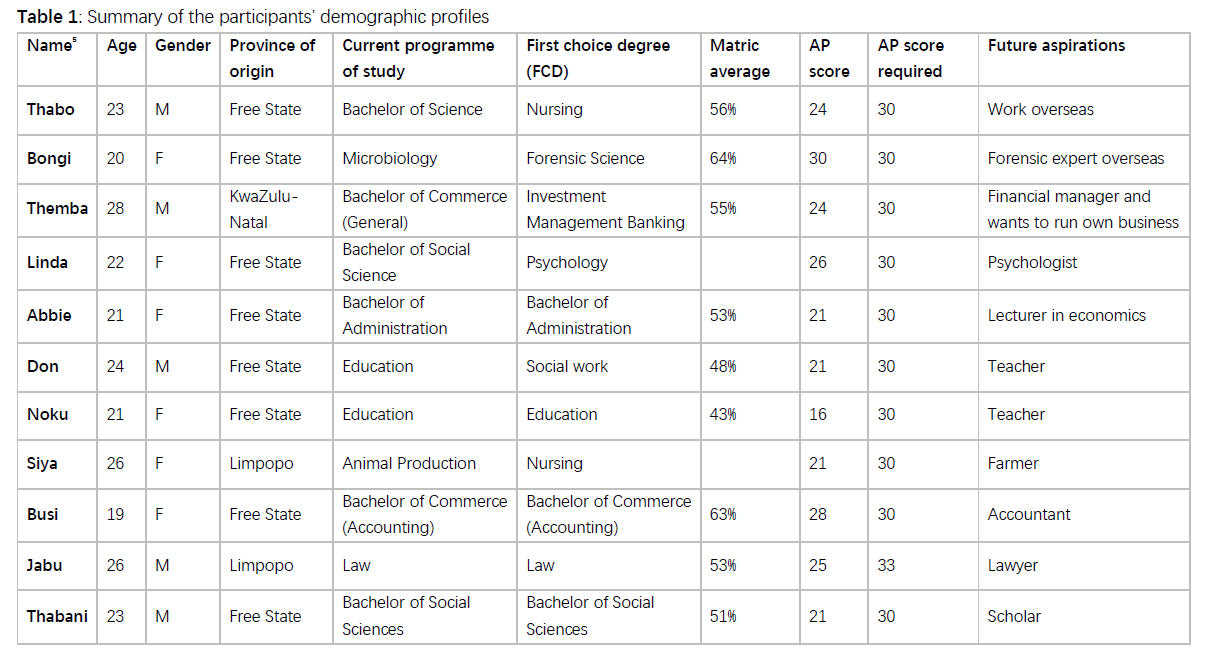
We draw on data from 11 first-year students who participated in a photovoice project focused on access at one South African university in 20174. Using a list provided by the university, we called each student to explain the project until we had the desired number. Six women and five men made up the final group, and they were from rural and/or low-income township high schools and had not acquired the required Grade 12 points for mainstream access. The project's objective was to understand the underlying complexities of higher education decision-making, choices and admission processes with the aim of understanding how students choose university, decide on a programme of study and their experiences once at university. In order to engage the youth and disrupt power hierarchies in our project, we used photovoice, as noted earlier (see Martinez-Vargas, et al., 2020). This paper does not focus on the photovoice process but rather on the stories that students told during their post-project individual interviews. The interviews took place two months after the participatory process. At the time of interview in October 2017, some of the students were still busy with, and some had already completed their first year of the UPP or EP. They were from various faculties including Humanities, Economic and Management Sciences and Natural and Agricultural Sciences. The student demographics are summarised in Table 1.
Opportunities and choices to expand valued capabilities and functionings
Common foundational capabilities were identified from the data. All the capabilities intersect with the structures or conversion factors that concern Sen (2009). For example, when they applied to university, most students were not aware of the financial implications of being at university, but those who were aware did not let financial challenges deter them from pursuing the opportunity. They took things one day at a time, first securing a place as a student at the university, finding the upfront registration fee, then finding the money to pay their fees. Most were exposed to different funding opportunities only once they had arrived at the university. Here they learnt that they could apply for loans and bursaries from funders such as the government's national student financial aid loans (NFSAS) and Funza Lushaka, which funds students in teacher education. This was not information they had access to in high school, so they entered university hoping for the best.
The capability to go to university
Students' choice of university was based on a number of factors, including proximity to home, affordability and, for some, programme availability. For example, Bongi wanted to study forensic science, and to her knowledge, the university in question was the only institution that provided this programme at graduate level. Some students did not have information about other universities, but because most students were from within the province, they were more familiar with the few that were within their proximity. For others, a teacher had given them information about the university.
Students were aware that they had to get 30 points to gain access to the university, but they had no information about the EP and UPP. We can view limited access to reliable information about higher education as a capability deprivation with regard to decision making about one's future life. However, not all students had negative experiences in thinking about higher education. A few noted that they had had career visits from various universities and, for some, teachers would encourage good students to work hard. Despite this, they all ended up in either the EP or UPP:
In 2015 I was looking for a school to apply to. Thien I thought of [this university]. I saw the application form, but I wasn't sure whether I would qualify or not, so I just applied. I applied straight for [mainstream access] but then Simon called me, and he told me that 'you don't qualify [for mainstream access], but then we are going to put you to the extended programme '. To me that was the moment because I was just trying my luck; I knew exactly that I didn't qualify and I didn't know about the extended programme at that point I basically applied because there was no application fee. (Themba)
Everything went smoothly in my matric [Grade 12]year [but]... my results were not that great, so it was a setback for me. I had to go [for the extended programme]. (Bongi)
Bongi is in the Social Sciences EP studying criminology and psychology in order to gain the required points, after which she aims to pursue studies in social work because she enjoys working with people. Similarly, Noku is passionate about working with people, but was not accepted for social work. She is now studying education because it is closely related to working with people. While Thabani wanted to study forensics, he did not achieve sufficiently in the science subjects, yet still managed to be accepted into the Social Sciences EP, majoring in criminology and psychology. According to him, this programme is closest to his aspiration to do the work he desires. From a capabilities point of view, such opportunities for the realisation of educational aspirations provide young people with the freedoms to develop to their full potential, a foundation for lifelong learning and expanded economic opportunities.
Most of the students viewed the UPP and EP as an opportunity they would not have had considering their social and economic circumstances and poor Grade 12 results. Although some may not be able to pursue their degrees of choice, they are grateful that they have the opportunity to be at university. Although they had not been accepted for mainstream access, starting with the UPP was seen as an achievement; they have been put in a position where they can complete a degree and be better placed for employment.
The capability to access information about university
Most of these young people had attended high schools that had not provided them with information about the UPP and EP. It is not clear whether schools and teachers were themselves aware of these programmes. Students noted that they were encouraged to work hard and work towards meeting the university entry requirements. While this on its own is key in supporting students to utilise their full potential in preparation for university, the unavailability of information is a concern. For example, Abbie noted that, while she had known that she would not be able to gain entry to university, she did not know about the access programme. In the same way, Themba highlighted how he had gained access into the UPP purely by chance.
In addition, low-income students do not have easy access to the internet; they do not own computers, their schools do not have computers and very few own smart phones (for which mobile data is expensive). Most of their families have little experience of higher education and cannot provide appropriate advice or guidance. This aligns with most students' first-generation status playing a role in relation to access to university in South Africa. This information gap is emphasised by Walker (2018) who states that, while alternative pathways to higher education are available and accessible and might widen access, students first need to know that such programmes exist. Thus, students valued access to this kind of information, but did not have the opportunity to get the information they needed.
The capability to aspire
Drawing on Themba's earlier extract, we see that widening access provides space for young people to realise their aspirations. While the participating students had the capability of choice, i.e. choosing to go to university although their Grade 12 results limited the programmes they could select, being at the UPP campus was an opportunity that advanced other capabilities beyond access, and which might not have been expanded if they had not attended the access programmes. This capability expansion was related to the exposure to new opportunities, particularly in relation to the diverse programmes on offer. Thus, in addition to capability expansion, widening access to education also provided an environment in which the students' aspirations were fostered. While students held aspirations from their high school years, being at university provided them with the opportunity to re-evaluate and develop new aspirations.
Upon completion of high school, some of the students' aspirations were reviewed in the light of their eligibility to gain mainstream access to higher education. For example, Siya had aspired to study to become a nurse, but because of her low marks was accepted to do an EP in Animal Production. Now, Siya aspires to be a farmer, based on the access opportunities that were available to her, and notes that:
I re-planned my future plans. Actually, I see myself being many things. An agriculture adviser because I come from rural areas where they do agricultural applications with their general knowledge. So, if I come with my knowledge that I learnt from university it will help them and fight the insecurity of food, as you know it's a bigger problem in our areas. Secondly, as a teacher or a lecturer, helping learners. (Siya)
For Abbie, although in the EP, she is pursuing her high school aspirations of studying for a Bachelor of Administration degree. Her experience at the university has led her to rethink her aspirations and she now wants to become an economics lecturer. This reconsideration of aspirations came because of her engagement with the modules she attended as part of her course work. This is despite how non-mainstream access programmes are often viewed as inferior, leading to the stigmatisation of students who access them. For example, during focus groups with students at the University of KwaZulu-Natal, Essack and Quayle (2007) found that although most of them considered the Access Programme (AP) to be beneficial and legitimate in preparing them for their degree studies, there were some negative outcomes such as stigmatisation and perceptions of inferiority associated with racial homogeneity and isolation of AP students from mainstream students. The stigmatisation of such programmes risks overshadowing their powerful ability to advance the capabilities of students who would otherwise remain without a higher education.
So, we see that widening access exposes students to new possibilities that allow them to reframe their aspirations, even in contexts where such information was not available in their high school setting. Programmes that seek to widen participation need to go beyond expanding access opportunities to creating new possibilities that would otherwise not be imagined.
As noted earlier, students reported having high school aspirations but that some of these aspirations had changed once they got to university and had achieved their initial access aspiration. We split the students' transition from school to university and their university experiences as having separate effects on students' aspirations. This is because the transition experience emerged to be more personalised, while the university experience was more institutionally informed, e.g. the different programmes available at the university, some of which the students were not previously aware of. The transition experience relates to individual experiences such as fitting in, making friends, and managing time and workload. Widening access affects how student aspirations evolve over time, which could be associated with their experiences regarding the transition from high school to university, relationships formed at university, new knowledge acquired, and generally being aware of other possibilities that exist in the world.
Challenges that constrain capabilities
Despite the steps that have been taken to embrace wider participation and access, there are challenges that remain for students from low-income backgrounds. Leibowitz and Bozalek (2014) suggest that, although there is a degree of movement towards transformation regarding access to higher education, there has been less improvement regarding success. Access does not necessarily mean that students will flourish and succeed in higher education institutions. While students ultimately adjust - many through individual agency and determination to overcome obstacles and setbacks - some students continue to experience transition challenges. These challenges are seen in a wide range of spheres: social, economic and adjustment to the university culture. Scott (2018) suggests refocusing the goals in higher education so that student success becomes the end goal of the educational mission. This would address some of these issues.
Other social challenges noted by students in the study related to fitting in with regard to background and income, making new friends, and peer pressure. These were within the control of students, as they mobilised their agency to navigate the higher education space. Surprisingly, they did not strongly identify race as an obstacle. Students explained that, while at the extended programme campus, they had not experienced racial issues, as most of the students were black and they had integrated with ease. Lecturers were reported to be supportive of all students. While they experienced challenges with social integration on the main campus with its greater diversity (but with a black student demographic of over 80 per cent), they did not report race as a hindrance to their learning. Major challenges that were reported by all the students were associated with their economic position. Economic challenges related to not having enough financial resources to pay for the cost of being at university, as illustrated below:
Had it not been for the funding from NSFASI really don't know how I was going to fund my school. I also stay at home, so I only pay for transport and tuition, so I don't have to pay for accommodation and food. With the funding I get, I am able to buy textbooks. I have a laptop at home; the thing is, data is very expensive. (Bongi)
I had to work. I did work for two years, and after that, I applied. Some of my relatives helped me with the registration fees. Also, my parents did. I need books and a laptop, that's what I need, but I can't afford them. I rely on the study guide. (Linda)
De Klerk and Dison (2022) provide an assessment of structural and material constraints within the higher education sectors, and funding is one of the limitations identified. With the cost of university going far beyond tuition and accommodation (De Klerk & Dison, 2022), students therefore need more than information on access opportunities in order to maximise the opportunities that come with alternative access routes. For those like Linda, with limited resources (e.g., lacking a laptop of her own), their university experiences are constrained. There is limited space in the computer labs on campus and travelling to and from the university after dark is not safe, this in addition to the transport costs unaffordable to students. Thus, while government may widen participation in higher education for those previously marginalised, this does not necessarily mean that all inequalities have been addressed. Siya noted:
Last year I failed computers because I don't have a computer at home and I don't have money to come to campus every day to practice. (Siya)
Broadly, the economic challenges were associated with fears about future possibilities in getting employment. Thus, the concern that comes with the agenda of widening access is the creation of jobs for graduates in the long term:
My aunty is the one who went to university from my parents ' family. She went to college to study education, but it took her 15 years, not working, but she still insisted for us to go and study. Now she has been in employment for four years. So, despite her challenges gaining employment, she is still interested in continuing with her studies. She says she will continue studying knowing that one day she will get a job. (Siya)
According to Dhliwayo (2023), Statistics South Africa released data in May 2023 indicating a total of 4.9 million unemployed individuals aged 15-34 years. This reflects a 1.1% increase from the last quarter of 2022, bringing the unemployment rate for this demographic to 46.5% in the first quarter of the current year. A closer analysis of the data reveals that within the youth category, those aged 15-24 years and 25-34 years experienced the highest unemployment rates, reaching 62.1% and 40.7%, respectively (Dhliwayo, 2023). Considering the higher youth unemployment and graduate underemployment figures in South Africa, the agenda of widening participation, therefore, should not be pursued in isolation. As with many other intervention strategies to address social and economic ills, it is multidimensional. Siya's extract highlights the need for further interventions focusing on the assimilation of successfully graduated students into the labour market or supporting them in taking up entrepreneurial activities. The intended consequences of widening access to higher education are generally aimed at providing opportunities to groups that would not normally have access to higher education. In so doing, the human development goal is to expand the capabilities of individuals and communities. For instance, for those students who succeed in becoming entrepreneurs, they would create opportunities for both social and economic development in their communities. Those who get into employment will be able to provide for the basic needs of their families. Not foregoing the non-economic intrinsic importance of higher education and its contribution to critical thinking, confidence, and participation in political activities, amongst other things, the instrumental value of education for people living in poverty and in a country with high unemployment is understandable. Some of the students in our study also shared that their parents and family members encouraged them to study in order to achieve a better life. Therefore, the attainment of higher education ought to come with tangible employment benefits.
Discussion
A collaborative strategy among relevant education stakeholders, including government policy units and university-led programmes such as the UPP and EP, has the potential to dismantle existing structural inequalities and prevent the reproduction thereof. The collaborative approach is important considering Boughey and McKenna's (2021: 133) observation that structures require complementary cultures to be effective. However, as we indicated in the beginning, addressing inequalities requires an approach which focuses on the multifaceted impact of social injustices. Because of the government's drive to redress past irregularities and exclusionary practices in the education system, most dominant groups in the UP and EPP programmes are black students. The reason for this dominance may be attributed to the continued unconducive learning environment from which many of the black students come, as highlighted earlier. Until such a time when previously disadvantaged schools are well resourced, programmes such as the UPP and EP will remain necessary intervention strategies to expand the opportunities of the disadvantaged to access higher education.
Furthermore, from both a human development and social justice standpoint, we acknowledge that there ought to be a holistic assessment of the process and consequences of widening access not only on the students but also for the institutions and the teaching staff, which has been beyond the remit of this paper. This is particularly important considering the long-term agenda of making higher education accessible to wider society as noted in both the White Paper on Education and the National Development Plan 2030.
Young's (1990) view of positional injustices is demonstrated in this case by the inequalities experienced by the students (and their families) as a result of past inequalities and deliberate policy that segregated social groups from one another. Even in situations where students may be agentic in pursuing their aspirations of accessing higher education, low income puts them in a position of disadvantage. Economic inequality, level of education and occupation status are a result of past structural exclusions. When the inequality persists, there is a risk that it will become intergenerational and lead to systematic poverty. As a result, one of the ways to break such a cycle is widening access to higher education by alternative routes. Students from low-income households attend free public schools because they cannot afford well-resourced schools. The educational functionings from their schools are sometimes not sufficient to grant them access to universities via mainstream routes, largely because they lack knowledge, social and economic capital, and often their subject choice is contradictory to their aspirations (see Walker & Mkwananzi, 2015). In our context, the UPP and EP, as alternative routes to higher education for students who would otherwise have fallen by the wayside as a result of their disadvantage, are an effective mechanism to redress inequalities and positional injustice.
This means that, in an effort to transform such social and economic disparities, which are also evident in institutional structures, redistributive justice is necessary (Fraser, 2009). The redistribution of educational opportunities that offer economic and social mobility is instrumental in the South African context to advance social mobility and to recognise the contribution of low-income students to higher education. It may be that the capability and functioning of social mobility are architectonic. Long-term impacts of widening access would be visible in inclusive higher education, decent social and economic standards of living, and better positions in society. All these contribute to human development in various ways. For the broader community and society, the benefits of widened participation are often through the direct instrumental benefits to families as a result of decent jobs and secure family income.
Thus, our data and analysis on what alternative access routes may do for human development and social justice illustrate both the opportunities and the challenges that come with widening access to higher education for students. Firstly, our capability-informed analysis highlights that alternative access pathways to higher education enable students to redefine their aspirations, acquire new opportunities, expand their capabilities and, ultimately, address social justice. Students gain skills necessary for their future functioning in diverse environments, thereby highlighting that access to higher education is one of the significant ways in which young people's capabilities and valued actions are enabled. Higher education offers not only instrumental economic opportunities, but also broader goods of personal development and social participation which are all necessary for addressing historical and current inequalities.
Conclusion
Young (1990) asserts that addressing social justice goes beyond gaining access to institutions and involves participation and empowerment, which in turn require structural changes. In this paper, we have aimed to show how alternative access to higher education addresses one dimension of a social justice agenda. In our other work (Walker, et al., 2020), we highlight how the participation of students once at university builds upon additional capabilities necessary to address societal inequality.
At the beginning of the paper, we highlighted that our normative grounding was based on the premise that, in pursuing social justice, there is a need for a multidimensional approach to addressing the diverse dimensions of inequality. We have provided a case of widening participation in higher education by using the capability approach and the concepts of redistributive (Fraser, 2009) and positional justice (Young, 1990). Such policy strategies on access have the potential for capability enhancement and provide an environment for aspirations. Our data show that access to higher education provides opportunities for capability expansion and the reformulation of aspirations. There are still students who remain at risk of missing out on these access opportunities because of persistent inequalities. So, our concern is how knowledge about the existence of such programmes may reach all communities.
Finally, while ours has been a small-scale research project, it gives us a starting point to think about how pathways to higher education can contribute to the dismantling of inequalities. While we do not suggest that these routes are the only solution to addressing inequalities in accessing higher education, we acknowledge that pursuing a human development agenda requires recognising the disparities that exist between groups and then working practically towards eliminating the exclusions that result from these disparities. Future longitudinal studies that track the progress of students may help in understanding the progress toward eliminating such disparities.
Author BiographiesFaith Mkwananzi is a researcher at the Centre for Development Support at the University of the Free State, South Africa. Her work is primarily in [higher] education, migration, youth, and international development in Sub-Saharan Africa. She is interested in operationalising human development and applying more creative participatory methodologies,
Carmen Martinez Vargas is a transdisciplinary scholar whose work is focused on the politics of knowledge and knowledge inequalities embedded in Higher Education practices, focusing on participatory research and the capability approach. Her expertise includes educational studies, critical participatory methodologies praxis, applied philosophy, political philosophy, and global development ethics,
Acknowledgments
We are grateful to the students who participated in the project, and the Lead Investigator, Professor Melanie Walker, for making this work possible. We are also thankful to the SARCHI chair/NRF (grant number 86540) for funding the research.
References
- Alkire, S. 2010. Human development: Definitions, critiques and related concepts. (Human Development Research Paper 2010/01). New York: UNDP.
- Ball, S. 2013. Education, justice and democracy: The struggle over ignorance and opportunity. Available at: https://www.brighton.ac.uk/_pdf/research/education/education-justice-and-democracy-(stephen-ball).pdf. (Accessed: 16 March 2023).
- Ball, S., Maguire, M. & Macrae, S. 2002. Choice, Pathways and Transitions Post 16. London: Routledge.
- Boughey, C. & McKenna, S. 2021. Understanding Higher Education: Alternative Perspectives. African Minds.
- Burke, P.J. 2016. Access to and widening participation in higher education. Encyclopedia of International Higher Education Systems and Institutions, 1-6.
- Calitz, T.M.L. 2019. Enhancing the Freedom to Flourish in Higher Education: Participation, Equality and Capabilities. Abingdon, Oxon: Routledge.
- Case, J.M., Mogashana, D., Marshall, D. & McKenna, S. 2018. Going to University: The Influence of Higher Education on the Lives of Young South Africans. African Minds.
- De Klerk, D. & Dison, L. (2022). Demystifying the work of South African academic advisors: An exploration of students' structural and material constraints. Journal of Student Affairs in Africa, 10(2): 129-147.
- Department of Education [DOE]. 2001. National Plan for Higher Education. Pretoria: Government Printers.
- Dhliwayo, R. 2023. Harnessing the Employability of South Africa's Youth. Available at: https://www.undp.org/south-africa/blog/harnessing-employability-south-africas-youth#:~:text=Mr%20Shipokosa%20Paulus%20Mashatile.,first%20quarter%20of%20the%20ye ar. (Accessed: 24 October 2023).
- Essack, Z. & Quayle, M. 2007. Students' perceptions of a university access (bridging) programme for social science, commerce and humanities. Perspectives in Education, 25(1).
- Fengu, M. 2017. Matrics, take note: Most universities are already full, 1 July. News24. Available at:https://www.news24.com/SouthAfrica/News/matrics-take-note-most-universities-arealready-full-20170107 (Accessed: 12 February 2020).
- Hinton-Smith, T. 2012. Introduction: Inclusion, exclusion: Issues in widening participation. In Hinton-Smith, T. (Ed.). Widening Participation in Higher Education: Casting the Net Wide? Basingstoke, Hampshire: Palgrave MacMillan, 3-21.
- Leibowitz, B. & Bozalek, V. 2014. Access to higher education in South Africa: A social realist account. Widening Participation and Lifelong Learning, 16(1): 91-109.
- Mathebula, M. 2019. Recognising poor black youth from rural communities in South Africa as epistemic contributors. Critical Studies in Teaching and Learning (CriSTaL), 7(1): 64-85.
- Milner, H.R. 2013. Analyzing poverty, learning, and teaching through a critical race theory lens. Review of Research in Education, 37: 1-53.
- Mkwananzi, F. & Mukwambo. P. 2019. Widening participation in higher education for marginalised migrant youth through flexible teaching and learning mechanisms. Widening Participation and Lifelong Learning, 21(2).
- Malatji, K.S., Makhanikhe, J., Marhaya, L. & Wadesango, N. 2017. Widening of access in South African higher education institutions: Implications for teaching and learning, Ponte, 73(11)
- Nkomo, M., Akoojee, S. & Motlhanke, S. 2007. Between the rock and the hard place: Understanding the balance between access and efficiency in South African higher education. Journal of Asian and African Studies, 42(5): 399-413.
- Oliveira, T. & Zanchi, L. 2004. Participation in higher education in Britain: The effect of ability and parental income. Leeds: University of Leeds Business School. Available at: http://www.le.ac.uk/economics/to20/heeea.pdf (Accessed: 23 January 2020).
- Paterson, M. (2021). Institutional viability threatened by student debt crisis. University World News:AfricaEdition.Available at: https://www.universityworldnews.com/post.php?story=20210512182820424 (Accessed: 11 September 2023).
- Pitman, T. 2015. Unlocking the gates to the peasants: Are policies of 'fairness' or 'inclusion' more important for equity in higher education? Cambridge Journal of Education, 45(2): 281-293.
- Reay, D., David, M.E. & Ball, S. 2005. Degrees of Choice: Social Class, Race and Gender in Highier Education. Stoke-on-Trent: Trentham Books.
- Robeyns, I. 2017. Wêllbeing, Freedom and Social Justice: The Capability Approach Re-Examined. Cambridge, UK: Open Book Publishers.
- Scott, I. 2018. Designing the South African higher education system for student success. Journal of Student Affairs in Africa, 6(1): 1-17.
- Sen, A. 2009. The Idea of Justice. Oxford: Oxford University Press.
- Spiegler, T. & Bednarek, A. 2013. First-generation students: What we ask, what we know and what it means: An international review of the state of research. International Studies in Sociology of Education, 23(4): 318-337.
- Stevens, M.L. 2007. Creating a Class: College Admissions and the Education of Elites. Cambridge, MA: Harvard University Press.
- Ul Haq, M. 2003. The human development paradigm. In Fukuda-Parr, S. & Shiva, A.K. (Eds.), Readings in Human Development. Oxford: Oxford University Press.
- UNESCO. 2017. Six ways to ensure higher education leaves no one behind'(Policy Paper No. 30). Available at: http://unesdoc.unesco.org/images/0024/002478/247862e.pdf (Accessed: 29 January 2020).
- Waetjen, T. 2006. Measures of redress: Defining disadvantage in a university access programme. South African Review of Sociology, 37(2): 200-217.
- Walker, M., Martinez-Vargas, C. & Mkwananzi, F. 2020. Participatory action research: Towards (non-ideal) epistemic justice in a university in South Africa. Journal of Global Ethics, 16(1): 77-94.
- Walker, M. 2018. A multi-dimensional approach to fair access. In Ashwin, P. & Case, J.M. (Eds.), Pathways to the Public Good: Access, Experiences and Outcomes of South African Undergraduate Education. Cape Town: African Minds, 135-159.
- Walker, M. & Mkwananzi, F. 2015. Challenges in accessing higher education: A case study of marginalised young people in one South African informal settlement. International Journal of Educational Development, 40: 40-49.
- Wangenge-Ouma, G. 2013. Widening Participation in South African Higher Education. Pretoria: University of Pretoria.
- Young, I.M. 1990. Justice and the Politics of Difference. Princeton: Princeton University Press.

 @faithgagisa, @MartinezVargas

Accepted: 25 March 2024
2 Used to describe former whites-only schools in South Africa.
3 A credit system that determines whether a student is eligible for university admission in South Africa
4 Ethical clearance to conduct the study was obtained from the university.
5 All participants were co-researchers on the project, and names appear on the website. In subsequent interviews, however, confidentiality was maintained. Therefore, we have referred to the quotes from these interviews using pseudonyms.