Homage to a gentle giant: Concepts, creativity, and collaboration in our flowing with Elmarie Costandius
Abstract
This paper revisits our collaborative process of concept development through the use of the Flow process, introduced to us by Elmarie Costandius. We track and trace her influence on our lives as we re-member1 and honour how she shaped our intellectual and personal journeys in higher education. Using post-humanist pedagogy and new materialist frameworks, we explored how the Flow process encouraged non-linear thinking, sensory engagement, and experimentation in collaborative learning environments. Our methodology incorporates Jackson and Mazzei's zigzag concept and Derrida and Barad's notion of hauntology to analyse how past influences continue to shape present and future pedagogical practices. Through collective re-membering and diffractive analysis of notes and artefacts, we documented how this approach promoted awareness and created new possibilities for knowledge creation. Results demonstrate that the Flow process successfully facilitated anti-disciplinary thinking and the assemblage of multiplicities, leading to innovative teaching practices across different disciplines. Ultimately, this paper pays homage to Elmarie and affirms how the collaborative, creative process of concept development can both honour intellectual legacies and open new avenues for innovation and critical engagement in higher education teaching and learning.
concept development; diffraction; flow process; hauntology; higher education; multimodality; post-humanism; re-membering
Introduction
In this paper, we explore our collective journey of concept development and meaning-making, inspired and guided by the work of Elmarie Costandius, whose innovative Flow process emerged as a response to uncertainty and change in higher education. We engage with its potential to address challenges in South African higher education through collaborative, multi-modal, and interdisciplinary methods that prioritise relationality and creativity. We track and trace her influence on our lives as we re-member and honour how she shaped our intellectual and personal journeys.
Our exploration is grounded in post-humanist pedagogy and draws upon the theoretical frameworks of new materialism and post-qualitative research. We engage with both Derrida's (1994) and Barad's (2017) interpretation of hauntology to examine the entanglements of past, present, and future in our academic becoming with Elmarie. By drawing on Jackson and Mazzei's concept of 'plugging in' as well as what they term 'Deleuze's zig-zag concept' (2012: vii), we engage in a methodological approach that allows us to weave together diverse texts, experiences, and artefacts in our meaning-making process. The Flow process developed by Costandius (2019) opens spaces for bodily and cognitive engagements through multi-modality and challenges traditional, linear approaches to concept development. In this context, diffraction (Barad, 2007; 2014) offers a lens for understanding how Elmarie's Flow process allows for the generative reconfiguration of concepts, where new possibilities emerge through the iterative entangled interplay of the cognitive, material, and affective. This encouraged experimentation and exploration through transdisciplinary and trans-modal creation of new possibilities. We examine how this approach allows for the re-imagining of concepts through multi-modal experiences and theoretical integration, to deepen our understanding of the complexity of relationality in the world.
Through a multi-modal and multi-relational encounter of re-touching notes, artefacts, and collective re-membering, we revisit the influence of Elmarie Costandius on and re-turning to our memories of our scholarly development. We explore how her work continues to shape our pedagogical practices and conceptual understanding, even after her untimely passing. This process of re-membering allows us to engage with the entanglement of life and death, and to imagine new possibilities for future flourishing in higher education.
By employing Deleuze's zig-zag concept (cited in Jackson & Mazzei, 2012: vii), we navigate the unpredictable interplay of ideas, emphasising creation, anti-disciplinarity, and the assemblage of multiplicities. The zig-zag is the 'lightning bolt spark of creation and the crosscutting path from one conceptual flow to another'; by using the zig-zag path, we trace 'provisional connections among them [ideas], to present them in ways that gesture toward what has come, and what has been, toward a "becoming"' (Jackson & Mazzei, 2012: vii). This approach enables us to explore the non-linear progression of our ideas and the creative meaning-making that emerges when we move beyond traditional methodologies.
This paper contributes to the ongoing discourse on transformative pedagogies in higher education by demonstrating how innovative approaches to concept development can foster creativity, critical thinking, and collaborative knowledge creation. It offers insights into how educators can create spaces for embodied learning experiences that challenge conventional academic boundaries and respond to the complex demands of a changing educational landscape.
Methodology
Our ontological and epistemological stance is grounded in a post-humanist new materialist paradigm. Ontologically, this approach embraces a worldview in which humans, non-humans, and material entities are all entangled in complex networks of becoming (Haraway, 2016). Here reality is understood as emergent and relational. Matter itself is agentic, influencing and co-constructing the world alongside human actions and thoughts (Barad, 2007). Epistemologically, knowledge is not seen as something produced solely by humans, but rather as co-constituted through the intra-action of human and non-human agents and artefacts. Karen Barad's (2007) concept of "intra-action" captures this notion of co-construction whereby knowledge results not from interactions between isolated human subjects, but from dynamic interactions between multiple entities and forces, many of which are not human. This paradigm suggests that data and learning emerge from the material-discursive more-than-human entanglements within an environment. As noted by Bozalek and Zembylas (2016), a new materialist approach reframes how knowledge is produced and emphasises these entanglements' ethical and political dimensions. From this perspective, we reconsider agency and responsibility and how material conditions shape our experiences and their outcomes with a particular focus on higher education teaching and learning and issues of justice.
Our methodological approach is informed by the notion of hauntology, introduced by Jacques Derrida (1994) and developed by Barad (2017) and other scholars. As well as the concepts of re-membering (Barad 2017) and Jackson and Mazzei's (2012) zig-zag. Derrida (1994) introduced the notion of hauntology in Spectres De Marx. Barad (2017) then developed and expanded this concept and approach. Numerous scholars have drawn on this concept and approach to consider aspects of teaching and learning in higher education (Bozalek & Hölscher, 2021; Bozalek, 2022b; Costandius, et al., 2023; Furman, 2022; Ramirez, 2024; Woodhouse, 2023).
Lorek-Jezinska and Wiçckowska (2017:15) assert that for Derrida (1994), hauntology is 'fundamentally linked to a disruption of the conventional means of measuring time and space, as well as all kinds of dichotomous conceptualizations, including 'the sharp distinction between the real and the unreal, the actual and the inactual, the living and the non-living, being and non-being' (Derrida, 1994: 11). Davis describes hauntology as 'replacing the priority of being and presence with the figure of the ghost as that which is neither present nor absent, neither dead nor alive' (2005: 373). Barad notes that for Derrida 'hauntings are matters of injustices and untimeliness, matters of time out of joint' (2023: 26). They elaborate drawing on the work of Derrida:
It is necessary to speak of the ghost, indeed to the ghost and with it. ... No justice seems possible or thinkable without the principle of some responsibility, beyond all living present ... Without this non-contemporaneity with itself of the living present, ... without this responsibility and this respect for justice concerning those who are not there, of those who are no longer or who are not yet present and living, what sense would it be to ask the question 'where?' 'where tomorrow?' 'whither?' (Derrida cited in Barad, 2023: 26).
Lorek-Jezinska and Wiçckowska assert that hauntology 'helps us to understand and define our relation to the past, responsibility for the others, and imaginings of the future' (2017: 16). They define hauntology as:
A study of spectrality and spectres-that is, entities and processes that exceed any definite categorization; accordingly, it inevitably questions the established notions of being, thereby transforming the status of the objects and subjects of knowledge and contesting the possibility of objectivity (Lorek-Jezinska & Wiçckowska, 2017: 15).
Davis (2005; 2007) asserts that hauntology merges the ideas of 'haunting' and 'ontology,' and explores the interconnectedness of the past, present, and the 'lost future as well as those neither present nor absent as we address issues of justice' (Davis, 2005; 2007). Loevlie argues that:
We are always caught up in invisible and intangible webs of the past, of the Other, of the future, of death. Our existence is therefore always in-between, defined of course by the materiality of our present being, but also by this immaterial flux that surrounds and situates us. (2013:337)
We invoke the concept of hauntology as a way to re-turn to, honour and extend the intellectual legacy of Elmarie Costandius, whose untimely passing created a significant void in our lives and academic community. We draw on Derrida's (1994) notion of hauntology to explore our connection with Elmarie in the past, in our present, and what this holds for us in future as we address issues of social justice in higher education. Barad's work (2017) and that of other South African scholars (Bozalek & Hölscher 2021; Bozalek, 2022; Costandius, et al., 2023) have helped to deepen our understanding of hauntology as we re-connect ourselves and our students to those historical and material spaces that inform our re-membering of our colonial pasts and neo-colonial present and futures.
Bozalek defines re-turning as 'turning over and over again the ghosts that have been forgotten' (2022b: 2). Through this lens, we explore how Elmarie's ideas and presence continue to shape and influence our teaching and learning processes. Hauntology thus helps us acknowledge that her influence transcends time; she is not confined to the past but remains present in our creative and scholarly practices, influencing both our current and future engagements. Through hauntology, we recognise that the past is not static or frozen in time, but exists as an ongoing influence on the present and future (Barad, 2017). Bozalek et al. (2021), as cited in Costandius, et al., also relate hauntology to 'engaging with historical ghosts' (2023: 2) to challenge fixed narratives of the past and reimagine different futures. This dynamic interplay of past, present, and future continues to inform our research, allowing Elmarie's intellectual presence to guide and inspire us.
In her article "Troubling time/s and ecologies of nothingness: Re-turning, re-membering, and facing the incalculable" Barad (2017) engages with the concept of re-membering and more specifically embodied re-membering which requires us to rethink the notion of the void. Here Barad (2017) understands the void in terms of Derrida's (1994) sense of hauntology, where the void is not a gap or an end, as in a Newtonian sense of spacetime, but holds for Barad (2017: 56) and Derrida (1994) 'the yearning and the imagining of what might yet have been, and thus also the infinitely rich ground of imagining possibilities for living and dying otherwise'.
An embodied re-membering Barad identifies as working towards being:
open for an embodied re-membering of the past which, against the colonialist practices of erasure and avoidance and the related desire to set time aright, calls for thinking a certain undoing of time; a work of mourning more accountable to, and doing justice to, the victims of ecological destruction and of racist, colonialist, and nationalist violence, human and otherwise - those victims who are no longer there, and those yet to come. (2017: 56)
We draw on Barad's (2017) notion of an embodied re-membering of Elmarie as we explore the 'void' of her passing. We do this through collective engagement in a multi-modal and multi-relational encounter, recalling our relationships and learning with Elmarie, re-touching notes, artefacts, and texts. This collective re-membering, re-turning to hold artefacts, and re-reading of glowing texts reconnect us with a visceral sense of Elmarie in our lives and our own processes of scholarly becoming - an acknowledgement of the entanglements and intra-action of life and death and new life to come. Barad's (2007) notion of intra-action emphasises that entities, whether human, non-human, or discursive, do not pre-exist in their relations but emerge through them.
Barad reminds us that an integral part of an embodied re-membering:
is not about going back to what was, but rather about the material reconfiguring of spacetimemattering in ways that attempt to do justice to account for the devastation wrought as well as to produce openings, new possible histories by which time-beings might find ways to endure. (2017: 63)
We feel a deep need to acknowledge and re-member the role Elmarie played and plays in our own lives and professional development. We do this through turning-into our memories, work and histories as Barad states, as 'something so tangible, so visceral, that it can be felt in our individual and collective bodies' (2017: 57). Through this, we hope to honour Elmarie's present/ presence and what is to come.
Following the concept of zig-zag, or conceptual flow (Jackson & Mazzei, 2012), we connected our experiences, memories, and artefacts, in a collective meaning-making process. This re-membering reflects the unpredictable interplay of concepts and experiences, mirroring the dynamic flow that Elmarie emphasised in her work. Jackson and Mazzei's (2012) notion of "plugging one text into another" informed this approach, as did Barad's (2017) concept of hauntology, which encouraged us to re-turn to and re-member both Elmarie and our own processes of becoming.
Taking inspiration from MacLure (2013), we consider how data is not a passive entity controlled by researchers but rather an active force that 'glows,' revealing itself in unexpected ways. As MacLure states, there are moments when 'agency feels distributed and undecidable as if we have chosen something that has chosen us' (2013: 661). Our approach to data generation and analysis, therefore, resists hierarchical structures in which the researcher dominates the data. Instead, we allowed data to guide us, unveiling connections and insights that emerge organically through the research process.
We adopt a diffractive approach to analysis, inspired by Barad (2007; 2014), in which data is read through and experienced through one another, allowing new patterns and understandings to surface. This offers a framing for understanding how meaning emerges not through linear causality or hierarchical structures but through patterns of difference that emerge from entangled intra-actions. In a diffractive methodology, agency is not located solely within the human researcher but is distributed across the material-discursive entanglements of the research process. This approach aligns with our hauntological framework, recognising how past influences continue to shape our present understandings and interactions with the data. Diffraction disrupts traditional academic practices of binary distinctions of past and present, human and non-human, or material and immaterial (Bozalek, 2022). Diffraction invites a reading of data that foregrounds the entangled traces of the past, the resonances of the absent, and the potentialities of the future-concepts central to hauntology (Dixon-Román, 2017). Applying a diffractive and hauntological approach in the context of higher education reframes teaching and research as inherently entangled practices shaped by historical, material, and discursive forces.
Our data sources include personal memories, reflections on past workshops led by Elmarie, collaborative discussions, and engagement with theoretical texts central to her work. Much like hauntology, this diffractive method transcends linear structures, encouraging us to recognise the interconnectedness of all elements in the research process.
Through merging diverse concepts and practices, our analysis uncovers multiple possibilities and unexpected potentials, often leading us in surprising directions. We shift from individual to collective consciousness, fostering a deeper engagement with the processes that emerge through creative practices. This methodology acknowledges the entanglement of being, environment, and doing - emphasising how all aspects of the research process influence one another.
Flow process
Elmarie's Flow process came about during a time of student protests and uncertainty when the higher education landscape in South Africa was both confronted and paralysed by issues of social transformation and decolonisation. In response to the 2015/6 Fallist student movement, Elmarie created a series of workshops that 'served as an experimental space where lecturers and students engaged in serious conversations, but in a playful manner' (Costandius, 2019: 1). The workshops opened up spaces for bodily and cognitive engagements and became a way to 'be/think/act differently, which opened up new possibilities to move forward' (Costandius, 2019: 1). By fostering unexpected connections between ideas, materials, and bodies, the Flow process enables participants to rethink ontology and epistemology as entangled, creating conditions for new meanings and knowledge to emerge.
As a group, we had the privilege to engage with these workshops, where the Flow process was instrumental in unblocking the challenges and obstacles we experienced in our own research at the time. What stood out for us was how this Flow process of concept development provided conditions to move beyond linear thinking and traditional methodologies, allowing for experimentation, exploration, and the creation of new possibilities that can lead to new knowledge and understanding.
Hauntology's disruption of linear time and binary thinking is mirrored in the Flow process' embrace of non-linear, experimental methodologies, which opened possibilities for engaging with the past while imagining alternative futures. The integration of sensory and material engagements within the workshops aligns with Barad's concept of intra-action, where human and non-human elements collectively shape meaning, echoing hauntology's acknowledgement of distributed and undecidable agency. It does this by allowing one to consider a concept not from a mind-only perspective but from a body-in-context and other-than-body perspective.
The Flow process introduced structured flexibility that comprises several components such as sensory engagement where we were encouraged to think with our senses, moving beyond purely cognitive approaches. We shifted our thinking to embrace difference by making unexpected relationships between elements, ideas, and materials. By engaging with various materials, we started forming a better understanding of materiality and Barad's concept of intra -action and we started grappling with propositions to rethink ontology and epistemology as intermingled in what Barad (2003) terms "onto-epistemology". The sharing of ideas was continuously encouraged throughout the process, emphasising the value of collaborative awareness in the creative process of making new and unexpected meanings.
Of special value was the introduction of 'serious play' incorporated into artistic practice that 'could become fundamental to all scholarly and pedagogical practice' ... 'play reminds us that we can imagine differently' (Costandius, 2019: 3). In a playful academic space, we are unshackled by expectations and the output-driven consciousness that persists in higher education. We experienced a sense of freedom, creativity, and purpose that was seldom recognised or celebrated as the foundation for new and often unexpected concepts and thoughts to emerge.
One of the stages of the Flow process is to consider and physically interact with unrelated words and text in the form of redundant library books, topographical cadastral maps, and prescribed readings (by cutting words, tearing sheets, rewriting texts, highlighting, colouring). Cutting words and tearing sheets intended to disrupt and deconstruct traditional, linear learning modes by encouraging embodied, sensory engagement with materials. It invites new ways to imagine by being both tactile and reflective. From a pedagogical perspective, cutting and tearing represent a dismantling of our preconceived ideas of justice and our role in injustices of the past, present and future.
It resonates with what Ulmer describes as her experimental process (based on Barad's 2007 notion of agential cuts) of physically cutting words apart that led her to richer encounters with concepts and the role of prepositions and prefixes in creating concepts (2017: 5). Plugging in seemingly unrelated things or 'cutting words apart could create conditions in which something new is produced or seen from a new perspective' (Costandius, 2019: 4). This zig-zag process of plugging in reminds us that imprints from our past are not separate from the present; there is a continuous shaping and re-shaping, backward and forwards. The Flow process allows us to plug thoughts, embodiments, memories, and materiality into each other to enable 'the creative, material, tangible and embodied process and not only the I (cognitively) alone that creates concepts' (Costandius, 2019: 3). As such the Flow process is a socio-material approach as it 'makes visible the material dynamics in a situation - the moving relationships among bodies, substances, objects, technologies and settings as well as symbols and desires, human interactions and emotions' (Fenwick & Edwards, 2017:14).
Concept development
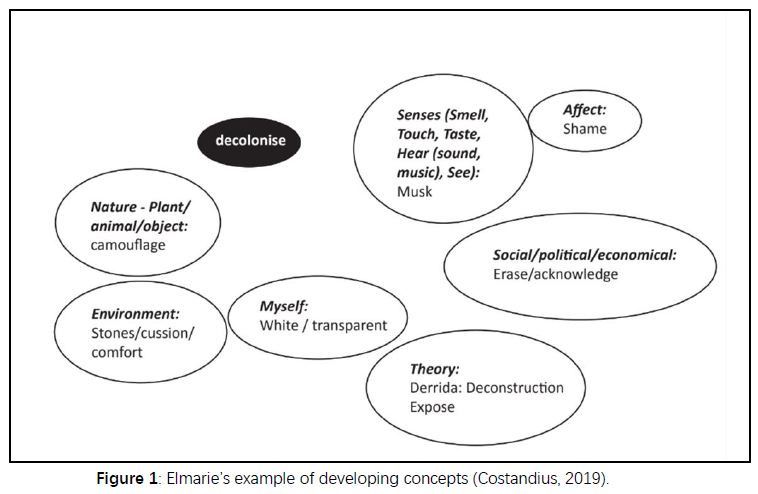
Elmarie introduced us to a new way of engaging with concept development by emphasising the linking of different elements (see Figure 1) to explore our own concepts and, through a collective process, to form connections between them. This approach drew on Deleuze and Guattari's concept of a 'line of flight', which refers to a rupture or escape from fixed systems of thought, enabling the movement toward new possibilities and creative conceptualisation (Deleuze & Guattari, 1987). A line of flight represents a departure from rigid, hierarchical structures, moving toward dynamic, open-ended processes of becoming. It is not merely an escape but a way to reconfigure connections and produce something new by breaking from pre-existing relations. Elmarie applied this principle to concept development, enabling us to extract 'variable singularities from lived experience' and to create 'non-pre-existent relations between these variables to make them function together in a singular and non-homogeneous whole' (Smith, 2014: 187). This resonates with Jackson and Mazzei's zig-zag process (2012), which underscores the iterative and non-linear movement of thought, emphasising the unpredictable interplay of ideas. The zig-zag process involves plugging one text into another to disrupt conventional thinking and open new ways of understanding. Elmarie's approach mirrored this by encouraging us to move back and forth between concepts, materials, and disciplines, creating unexpected connections that fostered a collective reimagining of possibilities. Aligned with Barad's notion of 'thinking a certain undoing of time' (2017: 56), through this process, we embraced the non-linear development of concepts, letting past ideas inform present actions and future possibilities.
This method offered a powerful metaphor for breaking free from established thought patterns and creating new conceptual territories. By integrating philosophy with other disciplines, particularly the arts, Elmarie demonstrated how Deleuze's conceptual flow and the zig-zag process could be used as tools for interdisciplinary exploration. The combination of these ideas allowed for an emergent and collaborative approach to concept development, aligning with the posthumanist and new materialist paradigms central to her work.
The aim was to use an artmaking process to inspire the creation of new concepts that can influence how we think, act, and approach research. During the workshop, Elmarie inspired our thinking, making and creating by introducing us to post-qualitative and new materialist research that shifts qualitative research from rigid methodologies to more experimental and concept-driven approaches. She argues for a more emergent approach that allows for the creation of new concepts and entanglements with non-human forces (Costandius, 2019).
We used the elements depicted in Figure 1 to create our concepts by selecting an idea (the black text bubble) relevant to our teaching or research using large maps to link the idea to our senses. We were encouraged to play and create with various materials to let the associations flow freely without trying to be logical as a 'continuous process of making and unmaking' (Jackson & Mazzei, 2012: 262).
Linking the idea, theory, material and self, took us on various potential paths, often 'sideways' as Elmarie would remark. This opened up new meanings, deliberately linking things subconsciously to other things. Through the use of clay, we were able to explore how interaction with different materials can bring us new concepts and understandings. The process we followed became more important than the result. By working with the material, we unintentionally influenced the concepts that formed in our minds and brought us to new understandings of our own challenges and issues.
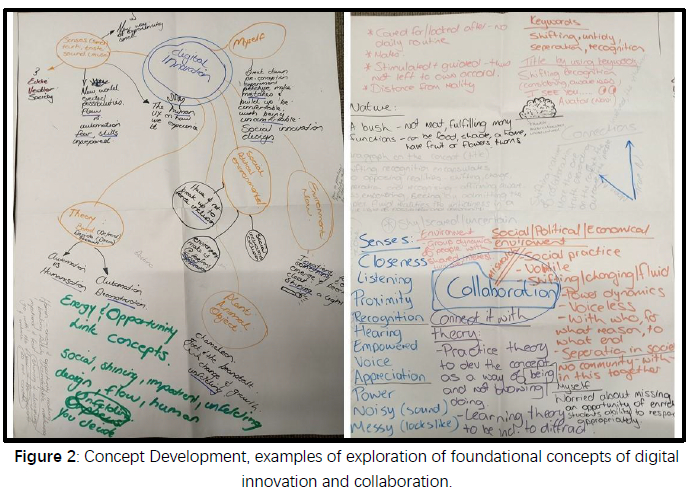
By plugging into the zig-zag concept (Jackson & Mazzei, 2012) we followed a flow process by making spontaneous links between the idea and other concepts, experiences, or objects. This process formed an assemblage of connections between multiplicities, encouraging the exploration of complexity through words, images, and materials. This approach emphasised a deep engagement with the processes, shifting from individual to collective consciousness in creative practices. It encouraged knowing through being, environment, and doing, recognising the entanglement of all elements within concepts. We were guided in letting associations emerge in a non-linear way, not shying away from the often bizarre or humorous outcomes to create a mind map linking new connections. See Figure 2 for examples of our maps.
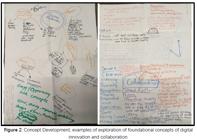
This process of concept development was explored through our engagement with nature, feelings, senses, and socio-political connections. This allowed for the re-imagining of concepts through multi-modal experiences and theoretical integration. By linking theory, material, and self, we discovered new meanings, highlighting the entanglement of concepts and the complex relationality that deepens our worlding.
Our experience and exposure to multimodal pedagogies opened up opportunities for finding new mediums and ways of thinking that are both creative and lateral. (Belinda, reflective notes, 2025)
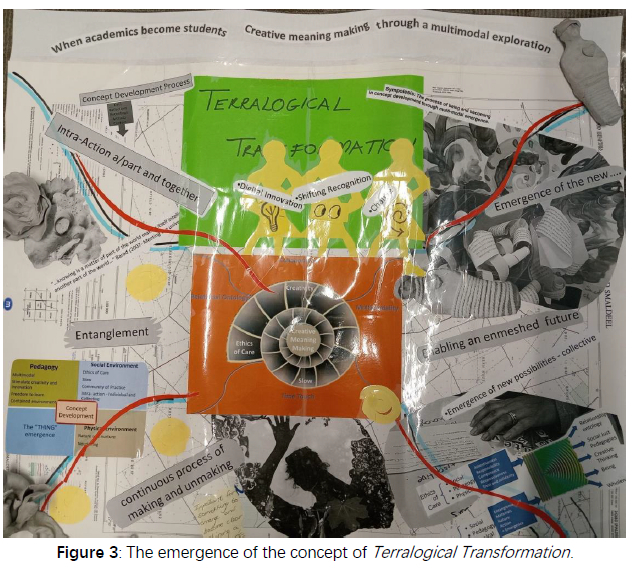
We took the process a step further by diffracting our three concepts through one another to see what would emerge as a new concept (Barad, 2007; 2014). Multiple possibilities and unexpected potentials emerged as seemingly unrelated ideas created new phenomena. This generated new patterns of thought and practice, where differences were not merely acknowledged but actively engaged with, thus producing meaningful shifts in how we relate to the Earth. We called our new concept Terralogical Transformation, the process of reimagining and reshaping our relationship with the Earth (terra) by integrating our concepts of creativity, digital innovation, and collaboration to drive change. This concept provided new possibilities for how we live, work, and interact with the environment.
Creativity allows us to think beyond conventional solutions, incorporating artistic, imaginative, and interdisciplinary approaches to addressing global challenges like climate change, sustainability, and social justice. The concept of digital innovation opens new possibilities to enable Terralogical Transformation to design sustainable systems to empower communities to share knowledge and co-create solutions. Here, digital technologies do not function in isolation but diffract through the creative processes and collaborative efforts of those involved. Digital tools engage with material practices and human creativity to open new pathways for sustainable development. The outcomes should produce something unforeseen and transformative rather than simply replicating old solutions. Collaboration in this context is more than just the sum of multiple contributions; it is an ongoing diffractive process where different voices, experiences, and disciplines come together-apart, enacting changes through their entanglements. This fosters partnerships across sectors and geographies, encouraging global and local stakeholders to work towards common goals.
In this context, Terralogical Transformation can be seen as the convergence of human creativity, technological innovation, and collaborative action, all directed towards regenerating the Earth and promoting sustainable, equitable futures for all. The transformative potential lies in the entangled, agential cuts that emerge from these interactions, offering new ways to regenerate the planet and promote sustainable, equitable futures. Rather than merely reflecting existing knowledge, this process fosters a diffractive practice that respects ecological balance and promotes social progress by engaging with the material consequences of these interactions. Over the last four years, this concept has shaped our learning, teaching, research and community engagement, as can be seen by pedagogical innovations in the section 'Re-membering, Pausing and the Way Ahead'. See Figure 3 for an illustration of this collective process.
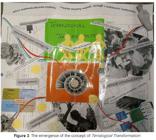
By embracing multimodal experiences, theoretical integration, and collective meaning-making, we created a rich tapestry of ideas that pushed the boundaries of our understanding. The Terralogical Transformation concept that emerged from this process exemplifies the potential for innovative thinking when diverse perspectives are brought together in a fluid, creative environment. Costandius argues that 'the creation of concepts opens up new avenues to understand issues from more perspectives in our own context' (2019: 2).
Re-membering, pausing, and the way ahead
As we recall our journey with Elmarie, several significant aspects informed our past and continuous practices. We experienced the Flow process and concept development workshops as transformative moments, individually and collectively. This process of sharing our stories culminated in the writing of poems. The poems below reflect our deep connections to our surroundings, our past-present-futures, each other, our colonial past and aspects of enslavement and a striving towards freedom and social justice.
Tied and tethered
Row upon marched row
Contouring the mountain
Pressed, pushed, and prodded
to produce
The earth, trampled, shaped,
replanted, re-reaped
Covered over, covered up,
Streams channeled,
captured - damned
Connecting between the rows
Roots stir to ancestral calls
High on the mountain slopes
Wild fynbos fly free
Out of reach - untether able
(Karen, CHEC, 2018: 20)
The Flow process that included topo-cadastral maps opened a space for us to shift our thinking. This evoked a deep connection to ancestry, land, and identity by tracing our links to the African soil and the making of our historical and geographical imprints. We were touched by the sensitive way that Elmarie took us through the process of working with and re-membering our histories and location as academics in higher education. It was a powerful way to grapple with themes of memory, displacement, and belonging in a land marked by both ancestral struggle and contemporary social tension.
Fire brings you to a place and the stories of your ancestors;
some stories long forgotten and others yet to be told.
The old woman takes the ashes and scatters them into the wind and they
from the stars that guide her clan back to the hearth
The struggle for land, our land the land of our ancestors is written in
the trees that are burnt to ashes and scattered in the wind.
But am I not part of the other, indifferent or unconscious in the social struggle?
What are my stories?
Am I part of the land or an imposter pretending to be equal in this postcolonial rhetoric?
My fire tells a different story, where I am trying to be free from guilt
and where I am part of this land following the ashes back to the hearth.
(Caro, CHEC, 2018: 21)
I was able to re-connect to my own colonial past and acknowledge both places of pain and shame in my colonial ancestry and reconnection with my own response-ability in addressing issues of social justice and decoloniality in my role as an academic in higher education. (Karen, reflective notes 2024)
We explored identity, our place as female academics, and the higher education context in which we found ourselves. Being able to share a generative space, as the one created by Elmarie and colleagues, meant that we could safely explore our challenges and obstacles with no concern for falling short of expectations (of which there are many in the neoliberal HEIs).
My time with Elmarie pushed me as much as it held me. This seemingly contrasting space is fertile ground for venturing beyond what you think is possible. (Belinda, 2024: Reflective Notes)
The following poem reflects the importance of having an academic space developed with the single purpose of creating a safe, caring space for academics to reconnect with nature, themselves, each other and our entangled histories. By facilitating and holding such a space, Elmarie allowed us to think deeply about higher education's complex and entangled challenges and our lives and histories in South Africa.
I share a room with the mountain
I cannot shut it out, not dim the light
It is all present, hugging me, holding me
For a moment my world is in suspension - covered in a blanket of care
Every view and every vista, wherever I turn, its presence
It is making itself known to me
Calling out to invite it in
Receiving its embrace, opening the door, the windows
Opening my eyes, it was there all along
Closing my eyes to see it clearly
(Belinda, CHEC, 2018: 20)
Examples of pedagogical innovations
The authors have engaged with several pedagogical innovations that flow from Elmarie's workshops and the new concepts we developed there.
Pedagogical Innovation 1: As remembered by one of the authors: Elmarie's introduction of multi-modal processes and experiences of concept development through the Flow process helped to enrich my own pedagogical practice in critically and creatively exploring concepts and their link to our lived experiences, worldviews and imaginations. She argues that the artmaking process encourages 'the development of concepts that might shift or influence our being/thoughts/actions and ultimately our research endeavours' (Costandius, 2019: 2). In teaching my Honours courses on aspects of educational leadership, I drew on my own rich experience of working both with Elmarie and my CHEC Mates group in exploring concepts and ideas. I have used these processes in several of my classes to explore concepts and their relationships in a more nuanced and dynamic way. For example, in one of my classes, students were introduced to a course on educational change and each other, by using the Flow process. This allowed us to explore and experience the concept of change in embodied ways that connected us all to each other and our complex life histories. This process supported a deeper and embodied understanding of the complexity of change.
Pedagogical Innovation 2 One author continuously incorporated the Flow process of concept development into her subject matter by focusing on foundational disciplinary concepts that have lost their relevance. Urban planning is a discipline that is tasked with community engagement, empowerment and upliftment of especially marginalised communities. The tool most often used is public participation, which, in the South African context, is written into numerous sections of the Constitution of South Africa (Republic of South Africa, 1996) and all other relevant pieces of legislation. As such, public participation has developed into a highly prescriptive and non-nuanced activity. The learning intervention, as described and evaluated in Verster (2024), tasked the students with using the Flow process over several iterations to rethink participatory planning and public participation. Student groups developed new contextually relevant concepts, such as 'Co-creative power' (power of creating together) and 'Invisibility' (making visible the individual components of a collaborative or participatory process) ... 'These concepts are creative, bold and responsive to our Southern context' (Verster, 2024: 236).
Pedagogical Innovation 3 For two of the authors, the value of embodied, collaborative, and materially-engaged thinking in addressing complex social and environmental challenges inspired them to integrate our concept of Terralogical Transformation into student projects and research. This concept allowed us to generate new patterns of practice that continue to influence our research, learning, and teaching. Students are tasked with developing digital social innovations within poor, marginalised communities through an interdisciplinary (Urban Planning and Information Systems) project. The emphasis is on the intra-action of multiple perspectives and disciplines to generate solutions that respond to societal challenges in unexpected ways to produce new, emergent patterns of thinking. These connections allow students to address complex issues by creatively reconfiguring their understanding of the local and global context (Van den Berg & Verster, 2022; 2023; 2025).
By intra-acting with different cultural and disciplinary backgrounds, students use technology not as a linear tool but as a medium that adapts to new forms of expression, social impact, and sustainability. Digital innovation becomes an entangled force for change, shaped by the diverse experiences of the students, the communities and other stakeholders to contribute to unique insights. By bringing community knowledge into conversation with academic theories, the project creates new meanings and solutions that honour the differences and particularities of marginalised communities.
By engaging with Terralogical Transformation our interdisciplinary project has fostered a creative, innovative, and collaborative environment that continuously generates new ways of understanding and addressing real-world challenges. It encouraged us to move beyond disciplinary boundaries, consider the agency of materials, and value collaborative, embodied forms of knowledge creation. Perhaps most significantly, it demonstrated how creative, materially-engaged processes can open new avenues for addressing pressing social and environmental issues, offering a path forward in times of uncertainty and change. These processes have enabled our students and ourselves to reimagine our roles as agents of change, transforming how we approach learning, teaching and research, and our relationship with the world.
Conclusion
This paper reflects our collaborative and diffractive process of re-membering Elmarie as a colleague and friend and her influence on our academic practice and pedagogy. Drawing on Barad's notion of hauntology, Elmarie's Flow process embodied a deeply entangled way of engaging with time, space, and memory shaping the past, present and future. Through the creative interplay of diffraction and conceptual flow, her methods enabled us to cross disciplinary boundaries, exploring the entangled relationships between ontology, epistemology, and pedagogy. Elmarie's introduction of embodied, multi-modal approaches, grounded in Deleuze's concept of a "line of flight" and expanded through the zig-zag processes of Jackson and Mazzei, opened pathways for creative experimentation and the generation of new conceptual territories. These approaches were instrumental in helping us reimagine teaching, research, and engagement beyond linear or traditional frameworks. We recollect how this journey with Elmarie created spaces where, as academics, we could engage in genuine creative and critical exploration in nurturing environments. Furthermore, we recount how these processes generated new frameworks for understanding complex societal challenges connected to our complex histories. Re-membering helped us to reconnect with past influences and their role in inhabiting and shaping present and future possibilities.
This work suggests several directions for future pedagogical practice and research. First, there is a need to cultivate spaces that nurture creative, collaborative, and embodied ways of engaging with knowledge and the world. Such spaces foster the kind of experimental, interdisciplinary learning that Elmarie championed. Second, the integration of multi-modal approaches in teaching and research deserves further exploration, particularly in addressing complex societal challenges. By incorporating natural environments and multi-modal experiences, the Flow process can guide academics to reconnect with themselves, their histories, and their role in addressing social justice and decolonial practices in higher education. This approach has particular relevance in contexts marked by social transformation and uncertainty. Finally, it reinforces the transformative potential of maintaining collaborative networks that support continuous experimentation and shared learning. In honouring Elmarie's legacy, we carry forward her commitment to doing pedagogy differently, embracing the creative and transformative potential of working at the intersections of disciplines, histories, and perspectives. Her work reminds us that education can be a force for reimagining and reshaping the world, rooted in collaboration, care, and a commitment to justice.
Reference List
- Barad, K. 2003. Post humanist performativity: Toward an understanding of how matter comes to matter. Signs, 28(3): 801-831
- Barad, K. 2007. Meeting the Universe Halfway: Quantum Physics and the Entanglement of Matter and Meaning. Durham: Duke University Press.
- Barad, K. 2014. Diffracting diffraction: cutting together-apart. Parallax, 20(3): 168-187.
- Barad, K. 2017. Troubling time/s and ecologies of nothingness: Re-turning, re-membering, and facing the incalculable. New Formations, 92(92): 56-86.
- Barad, K. 2023. Nuclear hauntings & memory fields, for the time-being(s). Apocalyptica, 2(1): 2439.
- Bozalek, V. & Zembylas, M. 2016. Critical posthumanism, new materialisms and the affective turn for socially just pedagogies in higher education: part 2. South African Journal of Higher Education, 30(3): 193-200.
- Bozalek, V. & Hölscher, D. 2021. Higher education hauntologies and space time mattering: Response-ability and non-innocence in times of pandemic. In Bozalek, V., Zembylas, M., Motala S. and Holscher, D. (Eds.). Higher Education Hauntologies: Living with Ghosts for a Justice-to-come. London: Routledge, 171-186.
- Bozalek, V.G. 2022a. Doing academia differently: Creative reading/writing-with posthuman philosophers. Qualitative Inquiry, 28(5): 552-561.
- Bozalek, V. 2022b. Uncertainty or indeterminacy? Reconfiguring curriculum through agential realism. Education as Change, 26(1): 1-21.
- CHEC. 2018. Reconfiguring scholarship: Doing academic writing, publishing and reviewing differently. Quality Teaching in Higher Education CHEC. Unpublished workshop proceedings.
- Costandius, E. 2019. Fostering the conditions for creative concept development. Cogent Education, 6(1): 1700737.
- Costandius, E., De Villiers, G. & Van Rooi, L. 2023. Hauntological engagements: Visual redress at Stellenbosch UniversityjLingxoxo ngeHauntology: Ulungiso lwembonakalo kwiYunivesithi yaseStellenbosch. Journal of Student Affairs in Africa, 12(1): 1-15.
- Davis, C. 2005. Hauntology, spectres and phantoms. French Studies, 59(3): 373-379.
- Davis. C. 2007. Haunted subjects, deconstruction, psychoanalysis and the return of the dead. London: Palgrave Macmillan.
- Derrida, J. 1994. Specters of Marx: The State of the Debt, the Work of Mourning and the New International. London: Routledge.
- Dixon-Román, E. 2017. Toward a hauntology on data: On the sociopolitical forces of data assemblages. Research in Education, 98(1): 44-58.
- Furman, C.E. 2022. Welcoming entanglements with ghosts: Re-turning, re-membering, and facing the incalculable in teacher education. Contemporary Issues in Early Childhood, 23(3): 253-264.
- Haraway, D.J. 2016. Staying with the Trouble: Making Kin in the Chthulucene. Durham: Duke University Press.
- Lorek-Jezińska, E. & Więckowska, K. 2017. Applied hauntologies: spectral crossings and interdisciplinary deconstructions. Avant, 8(2).
- MacLure, M. 2013. The wonder of data. Cultural Studies ↔ Critical Methodologies, 13(4): 228232.
- Ramirez, C. 2024. Entangled with the past in Norwegian academia. Gender and Education, 36(1): 70-85.
- Smith, D.W. 2014. Concepts and creation. In Braidotti, R. & Pisters, P. (Eds.). Revisiting Normativity with Deleuze. London: Bloomsbury, 175-188
- Ulmer, J. 2017. Composing techniques: Choreographing a postqualitative writing practice. Qualitative Inquiry, 24(9): 728-736.
- Van den Berg, C. & Verster, B. 2022. Exploring interdisciplinary collaborative online learning spaces through sociomateriality in Cape Town, South Africa. The Electronic Journal of e-Learning, 20(4): 467-482.
- Van den Berg, C. & Verster, B. 2023. Integrating education for sustainable development into a sustainable-smart transdisciplinary learning framework. Independent Journal of Teaching and Learning, 18(2): 8-28.
- Van den Berg, C. & Verster, B. 2025. Bridging local realities and global goals: Exploring student-led sustainable-smart innovation projects in a marginalised community. In Gundu, T., Gcaza, N. & Calitz, A. (Eds.). Annual Conference of the Southern African Computer Lecturers' Association. London: Springer, Cham., 51-66.
- Verster, B. 2024. A paradigm shift in collaborative learning: insights from the theory of collaborative advantage for inclusive and engaging pedagogical design. South African Journal of Higher Education, 38(6): 226-245.
- Woodhouse, C. 2023. Re/Imagining time, space and identity through qualitative narrative research with teachers: "These ghosts came back to haunt me". Educational Studies: 115.

Accepted: 3 March 2025
Author biographies
Karen Collett is a senior lecturer in school leadership and management at the University of the Western Cape. Her work spans school development and curriculum leadership, teacher well-being, Collaborative Online International Learning (COIL), student academic literacies and social justice pedagogy. She co-initiated an Erasmus Plus project on teacher well-being and language diversity with partners in Norway, Denmark, and Ireland.
Belinda Verster is a professional urban planner, senior lecturer, and researcher at the Department of Urban and Regional Planning at the Cape Peninsula University of Technology. With more than 30 years of experience, she specialises in participatory planning, sustainable urban development, technology for Planning and innovative methodologies and pedagogies. Most recently, she has focused on transdisciplinary research in sustainable-smart cities, particularly on vulnerable and marginalised communities in Sub-Saharan Africa. Her research emphasis on the sustainability agenda in the local context has seen her be the co-project lead for numerous national and international research endeavours. Dr Verster is recognised for her academic rigour by being appointed to numerous journal and conference editorial boards and scientific review committees as an external postgraduate examiner, as well as supervisor and panel chair for industry and academic conversations.
Carolien van den Berg is the Chair of the Department of Information Systems at the University of the Western Cape. Prof. van den Berg's areas of specialisation encompass digital inclusion, digital sustainability, inclusive innovation, entrepreneurship, ethics and Artificial Intelligence. Her interdisciplinary approach allows her to explore the intersection of technology, business, and society in pursuit of sustainable solutions within the African context. She is also involved with local and international researchers in projects related to the societal impact of digitalisation, AI innovation, digital inequalities, digital skills and digital inclusion policies. She has been a keynote speaker and panelist on several forums addressing digital inclusion and sustainability topics.
1 We include the hyphen to evoke hauntology in re-membering the entanglement of time with Elmarie in the present, past and future.