Integrating decolonial theory through signature pedagogies in design education
Abstract
This paper explores the challenges of integrating decolonial theory into design pedagogy within higher education. A case study approach was employed to collect qualitative data from 31 design educators and 23 design students across public and private higher education institutions in South Africa. Based on the findings of the case study, I argue that advancing decolonial design education requires greater engagement with the concepts of belonging and cultural representation, which are recurring themes in the work of Elmarie Costandius. To support this engagement, I propose a matrix that maps conceptions of belonging and cultural representation, as expressed by design educators and students, in relation to Ndlovu-Gatsheni's (2015) decolonial perspectives and Shreeve's (2016) signature pedagogies of design. The aim of the paper is to provide a practical tool for design educators seeking to integrate decolonial perspectives in their teaching, with broader implications for other disciplines striving to decolonise their pedagogical practices.
decoloniality; design education; signature pedagogies; cultural representation
Introduction
As my supervisor for both the MA in Visual Arts (Art Education) (Botes, Costandius & Perold, 2015) and PhD in Visual Arts (Botes, 2023), Elmarie Costandius profoundly shaped my identity as an academic. Elmarie's ability to subtly encourage me to trust my instincts, often saying, 'Let's try it and see where it goes', has been a guiding principle in my academic journey. She provided subtle guidance that fostered trust in the processes we were following, even when, at times, it required deleting many hours of work. Reflecting on this, I now understand that enabling students to explore and learn through their mistakes is a key pedagogical principle when aiming to advance social justice. Elmarie's pursuit of social justice is evident in all her work - her ability to integrate social justice theory and thinking into everyday tangible experiences is what inspires my academic work. I was shown how to humbly engage with research that could make a tangible difference in the lives of people. After the #FeesMustFall movement, Elmarie advocated that 'We therefore encourage lecturers to experiment with decolonising the spaces at HEIs' (Costandius, et al., 2018: 83). To heed this call and to continue her legacy, this paper focuses on the problem of design educators at universities grappling with broad-based transformation.
One aspect of this broad-based transformation is the design educator's ability to integrate decolonial theory into classroom practice. For this paper, decolonial theory engages in the discussion of the coloniality of being, knowledge and power (Ndlovu-Gatsheni, 2015). The coloniality of being acknowledges the denial of Africa's potential contribution and the global dehumanisation and degradation of people. The who and how of knowledge development are factors involved in the coloniality of knowledge from an epistemological and power perspective. Coloniality of power centres on the establishment of political and economic power dynamics through the framework of the Colonial Matrix of Power and the ideology of modernity that promotes ideas of progress, development, and rationality, often positioning Western knowledge, culture, and social structures as superior to others. Quijano (2007: 168) describes the Colonial Matrix of Power as a 'global power' that using violence, has amassed the world's resources and wealth to serve the interests of a privileged minority primarily situated in Western Europe and North America.
Decolonisation is viewed as a political and geographical endeavour, whereas decoloniality is considered an epistemological and ideological project (Morreira, et al., 2020). It can be argued that as an expression of capitalist-imperial strategy (Ansari, et al., 2018) design education and modernist design perpetuate colonial thinking (Tunstall, 2023) and thus conflict with the aims of decoloniality. Furthermore, design is also often taught by industry professionals who still need to gain expertise in educational theory, which complicates the notion of developing decolonial design education. As part of a larger study (Botes, 2023), I determined that design educators and students emphasised the concepts of belonging and cultural representation when engaging in the decolonial debate. A case study research methodology facilitated the collection of qualitative data on the design sector in South African higher education. The case study was framed in a community of practice, which broadens its relevance to a global audience.
This paper aims to integrate decolonial theory into design pedagogy for design educators. For this integration, signature pedagogies in design (Shreeve, 2016) is used in a matrix to plot aspects of belonging and cultural representation that could facilitate decolonial design education. Traditional design curricula often emphasise Eurocentric perspectives, making it challenging to integrate diverse cultural viewpoints. Design educators must critically assess and revise studio practice to include non-Western design principles and histories. For design practitioners who are teaching with industry knowledge, this kind of revision will require extensive research and collaboration with scholars from various cultural backgrounds. With the proposed matrix, design educators can now access a structured framework of actions, themes, and guiding questions to integrate decolonial teaching practices. The matrix could also prompt design educators of the tools available to them through the signature pedagogies in design and the three aspects of coloniality of being, power and knowledge that are implicated in these activities. Educators from other creative disciplines in higher education could possibly use this method to map out issues relevant to their specific disciplines on a matrix of signature pedagogies from their discipline that could then be framed in a decolonial perspective.
Decolonial theoretical perspectives
Decolonisation encompasses diverse perspectives, reflecting differing priorities and understandings depending on the speaker and context. As it seeks to address deep-seated anxieties and privileges shaped over millennia, debates about its meaning and implementation often arise (Andreotti, et al., 2015). Some perspectives embrace plurality, aiming to decentre Eurocentric worldviews through anti-colonial thought and envisioning new forms of universality (Bhambra et al., 2020). Decoloniality, as articulated by scholars like Mignolo and Walsh (2018), challenges the dominance of Western rationality by promoting pluriversality-a world where diverse epistemologies coexist (Ndlovu-Gatsheni, 2015). Central to this critique is the colonial matrix of power (CMP) (Quijano, 2007), which sustains colonial control through interlocking systems of economy, authority, gender norms, and knowledge production. Within this context, Ngügï wa Thiong'o's (1981) concept of the 'cultural bomb' captures the psychological impact of colonialism, which erodes Indigenous identity and self-worth. Overcoming this requires epistemic disobedience-a conscious delinking from colonial worldviews and a reclamation of indigenous knowledge systems (Mignolo, 2011). This act of resistance, however, extends beyond knowledge into lived experiences, encompassing critiques of the coloniality of gender, the trauma of the colonial wound, and the need for decolonial healing (Jivraj, et al., 2020). Furthermore, concepts such as white innocence, which absolves colonial complicity, and decolonial aesthetics, which uses art and design to resist colonial narratives, highlight the cultural dimensions of decoloniality. Together, these currents of decolonial thought not only confront the legacy of colonial oppression but also envision alternative futures grounded in justice, inclusivity, and the coexistence of multiple ways of knowing and being (Jivraj, et al., 2020: 452).
Coloniality of power, knowledge, and being
Decoloniality, as articulated by Ndlovu-Gatsheni (2015), addresses the interconnected systems through which colonialism continues to shape modern life. This framework is built around three interrelated aspects: coloniality of power, which examines how colonial structures continue to dominate political and economic relations; coloniality of knowledge, which critiques how knowledge production has been shaped and controlled by Western epistemologies; and coloniality of being, which highlights the ongoing dehumanisation and erasure of non-Western identities and experiences. Together, these dimensions form the backbone of the Colonial Matrix of Power (CMP), a concept developed by Quijano (2007) to describe how colonial domination persists through interconnected spheres of control, including politics, knowledge, and identity. This framework is critical for understanding how decolonial theory applies to design education, where colonial legacies continue to shape curricula, methodologies, and epistemologies.
Coloniality of power: Systems of domination and control
The coloniality of power refers to how colonial systems of domination continue to structure global political, economic, and social relations. Central to this concept is Quijano's (2007) notion of the Colonial Matrix of Power (CMP), a transnational system through which colonial powers accumulated wealth and control by exploiting the Global South. Ndlovu-Gatsheni (2013) identifies four key components of the CMP: the dominance of Western economies, the destruction of indigenous power structures, the imposition of Western norms around gender and education, and the epistemic belief in Western superiority. These components continue to shape modern institutions, including design education, which often privileges Western design histories, theories, and methodologies while marginalising indigenous and local design practices.
In contemporary design education, the CMP manifests through Eurocentric curricula that position Western design movements as universal benchmarks while excluding design contributions from the Global South. The commodification of design education under neoliberal policies reinforces the dominance of capitalist values, prioritising industry-ready skills over critical engagement with social and cultural issues. Addressing the coloniality of power in design education requires dismantling these hierarchies and integrating local, indigenous, and nonWestern design practices into the curriculum.
Coloniality of knowledge: Epistemic hegemony and resistance
The coloniality of knowledge critiques how colonial power structures have shaped the production, dissemination, and validation of knowledge. Modernity, which emerged alongside colonial expansion, constructed a hierarchy of knowledge that privileged Western scientific, rational, and empirical methods while discrediting indigenous and local epistemologies (Mignolo, 2011). Fry (2011) argues that modern design practices rooted in industrialisation and consumerism exemplify this colonial logic, often prioritising technological solutions over social and ecological sustainability.
In design education, this epistemic dominance manifests through curricula that focus on Western design methodologies while neglecting indigenous knowledge systems. Scholars like Abdulla and Canli (in Schultz, et al., 2018) caution against tokenistic approaches to decolonisation that co-opt the language of inclusion without meaningful structural change. For example, 'sustainability' in design has often been absorbed into neoliberal agendas that promote eco-friendly consumerism without addressing deeper issues of social justice or indigenous ecological knowledge.
A decolonial approach to design education demands epistemic disobedience (Mignolo, 2011)-a deliberate departure from Western frameworks to engage with and value knowledge from the Global South. This includes teaching design methodologies from indigenous traditions, such as African weaving patterns or Andean design symbolism, which challenge the dominance of linear, Eurocentric design processes. Additionally, design educators should foster 'border thinking'-a term coined by Mignolo (2013) to describe learning from the margins, embracing in-between spaces, and breaking down binary oppositions such as traditional vs. modern or local vs. global.
Coloniality of being: Ontological erasure and human dignity
The coloniality of being explores how colonialism has dehumanised colonised peoples by denying their identities, experiences, and contributions to humanity. Ndlovu-Gatsheni (2013) describes this as the world's refusal to acknowledge the cultural and intellectual contributions of Africa, perpetuating the ontological myth that only Western knowledge is authoritative. The Black Lives Matter (BLM) movement exemplifies how the coloniality of being persists, highlighting the global nature of anti-Black violence and systemic racism rooted in colonial ideologies of racial hierarchy.
Dei (2006) critiques the Eurocentric understanding of knowledge, which positions itself as universal while dismissing indigenous ways of knowing as primitive or irrelevant. This ontological violence is deeply embedded in educational systems, where indigenous identities are often rendered invisible. In the context of design education, the coloniality of being is evident in how Western design ideals shape notions of beauty, functionality, and innovation, often at the expense of local cultural expressions and identities. For example, African design aesthetics, which are rich in symbolic meaning and community narratives, are frequently excluded from mainstream design curricula, reinforcing the idea that valuable design comes only from the West.
A decolonial approach to design education must, therefore, address ontological erasure by recognising and valuing diverse ways of being and designing. This can be achieved by incorporating projects that engage students with local communities, encouraging them to design solutions informed by indigenous practices and cultural contexts. Additionally, educators should introduce students to decolonial aesthetics-an approach to design that resists colonial aesthetics and embraces plural, non-Western forms of expression (Jivraj, et al., 2020).
Signature pedagogies as a theoretical perspective
The concept of 'signature pedagogies' offers a valuable framework for examining design education because it highlights the distinct teaching methods that shape how students think, act, and perform within their professional discipline. According to Shulman (2005), signature pedagogies are the characteristic forms of teaching that define how knowledge is transmitted, and professional identity is formed within a field. These pedagogies are more than just teaching techniques-they embody the values, norms, and ways of thinking that are central to professional practice. For example, in design education, signature pedagogies teach students not merely how to create but also how to think critically, solve problems, and engage with design processes as reflective practitioners.
Building on Shulman's theory, Shreeve (2016) identifies six signature pedagogies that are central to design education: studio pedagogy, projects and briefs, materiality, dialogue, critique, and research. Each of these pedagogies plays a distinct but interconnected role in shaping design students' learning experiences and professional development:
• Studio Pedagogy: The studio is a cornerstone of design education, providing a space where students learn through making, experimentation, and iteration. It fosters a community of practice where students develop their creative identity through peer interaction, mentoring, and reflective practice (Schön, 1983; Wenger, 1998).
• Projects and Briefs: Design projects simulate real-world challenges, requiring students to apply their skills to solve practical problems. Briefs provide a framework but often leave room for interpretation and creativity, which nurtures students' ability to manage ambiguity and complexity.
• Materiality: Engaging with materials is central to design practice. Through hands-on exploration, students learn to understand materials' properties and how they influence form, function, and aesthetics. This tactile knowledge is a vital part of developing material literacy and intuition in design.
• Dialogue: Conversations between students, peers, and educators facilitate collaborative learning and critical reflection. Dialogue fosters an exchange of ideas, enabling students to articulate their design choices and receive feedback, which helps them refine their concepts.
• Critique (Crit): The crit is a distinctive feature of design education, where students present their work for feedback from peers and educators. This process encourages students to defend their decisions, receive constructive criticism, and incorporate feedback into their revisions, fostering resilience and professional discourse.
• Research: Research in design encompasses both theoretical inquiry and practice-based investigation. It helps students contextualise their work, explore user needs, and engage with cultural, social, and historical perspectives. Research cultivates a deeper understanding of design's impact and relevance in society.
The concept of signature pedagogies is particularly valuable for examining and improving design education because it reveals how these teaching methods shape not only students' technical skills but also their ways of thinking, making, and interacting with the world. Analysing these pedagogies through a decolonial lens can also uncover where colonial, Western, or Eurocentric biases persist and where there are opportunities to integrate indigenous knowledge systems, local cultural practices, and alternative epistemologies. For example, studio critiques can move beyond Western formalist approaches to incorporate community-based feedback or indigenous storytelling methods, offering students a broader, more inclusive understanding of design practice. Signature pedagogies are more than instructional techniques; they are powerful vehicles for socialising students into the values and practices of the design profession. By critically examining and evolving these pedagogies, educators can ensure that design education is inclusive, culturally responsive, and relevant to contemporary societal challenges, ultimately producing designers who are not only skilled practitioners but also critical citizens and agents of change.
Methods
The empirical data used to develop the matrix in this paper are sourced from the results obtained from my doctoral thesis, which was supervised by Elmarie Costandius. The thesis explored critical citizenship and decolonisation as a framework for design education in South Africa (Botes, 2023). A case study research design was used to identify themes in decolonial theoretical perspectives that could contribute to design education within the South African context. As I am intrinsically involved in the design education context, an intrinsic case study approach was taken. As such, restraint from myself as the researcher was needed to not focus on self-interest but to be open to the critical aspects found in the case (Stake, 1995: 4). As a white male researcher conducting critical and decolonial studies, I recognised the importance of adopting a 'settler harm reduction' approach, as outlined by Tuck and Yang (2012: 21). This approach aimed to minimise harm and avoid 'moves to innocence' - attempts to absolve oneself of colonial complicity - while acknowledging that such efforts are not solutions, but rather contributions to an ongoing dialogue shaped by the reader's interpretation. The study was conducted within a cross-cultural research context, as I, a white male researcher, engaged with participants predominantly from Black African cultural backgrounds. To enhance the credibility of my findings, I sought an independent peer review of my data and analysis from a Black female design educator, promoting transparency and critical reflection in my research process.
This case study was situated within the field of design education at higher education institutions in South Africa. Data were collected from 54 participants via:
• 2020: Online survey (21 design educators)
• 2021: Telephonic interviews (23 students) and online interviews (10 educators)
Participants were selected through purposive sampling, ensuring diversity across gender, race, and institutional affiliation. The sample (20 females, 34 males; of which 33 black, 15 white, 4 Indian, 2 coloured) prioritised representation from historically marginalised voices, with 41 participants from Universities of Technology. Through this purposive sampling approach, the trustworthiness of the data was increased (Campbell, et al., 2020). South African design educators at higher education institutions are intrinsically involved in design pedagogy, and South African design students are the future designers the study focuses on.
The online design educator survey posed six open-ended questions that covered aspects of design citizenship and social justice, which were aspects of the larger study. My interest in critical citizenship was ignited by Elmarie in the MAVA Art Education and our subsequent book on educating citizen designers (Costandius & Botes, 2018). Participants were specifically asked how they think design educators can decolonise design education and if they have any examples of where they did that. The qualitative data collected from the design educator survey was coded through inductive qualitative content analysis and synthesised with the theoretical perspectives in June 2020. The emerging themes guided the lines of enquiry that were followed in the 2021 student and educator interviews. The lines of enquiry included questions related to socio-cultural issues, politics, social justice, dialogue and power relations. The 2021 interviews purposefully targeted black, coloured, and Indian participants to address the lack of diversity in the 2020 online design educator survey. The power dynamics between the researcher and student participants were mitigated through gatekeeper permission and oversight from a lecturer of the students.
After the interviews were transcribed, the entire data set, including lecturer surveys, student interviews and lecturer interviews, were read repeatedly, coded and categorised into themes. Using AtlasTi, data analysis followed an inductive, multi-stage coding process to ensure transparency in theme development.:
• Open coding: Identified recurring patterns.
• Axial coding: Grouped related codes into categories.
• Selective coding: Synthesised categories into core themes.
The study's credibility was enhanced by data triangulation, achieved through the collection of three data sets over two years. Transferability was strengthened by gathering data from what is considered a teaching community of practice (Wenger, 1998). Drawing from Wenger's theory, I argued that the participants represent a spectrum of 'more widely held, though not unanimous, views on teaching' (Shreeve, et al., 2010: 127). Thick descriptions (Lincoln & Guba, 1985) were achieved through verbatim interview transcriptions that were shared with participants for validation, extensive qualitative survey responses, and reflective writing on my experiences throughout the research. Consequently, transferability is not proposed in terms of generalisability but rather through the insights that design educators, as a community of practice, may draw from within their contexts. Transferability also contributes to the reliability of the findings, as the community of practice forms the foundation of purposive sampling used to select participants likely to meaningfully contribute to the study's aims.
In the findings of my doctoral thesis (Botes, 2023), aspects of belonging and cultural representation emerged as the most frequently referenced themes by educators and students when discussing decolonial design education. Humans have a deep-seated need for belonging; it enables us to make sense of and give purpose to our lives (Healy, 2020: 120). The violence of denying humans a sense of belonging is placed in context by Kuurne and Vieno (2022: 280), who state, "Human beings need belonging to survive. Exile and isolation have historically been among the most severe forms of punishment". The central position of culture in the decolonial design curriculum came to the fore in that design education should focus on assisting students to grasp the value of their own cultural capital.
Exploration
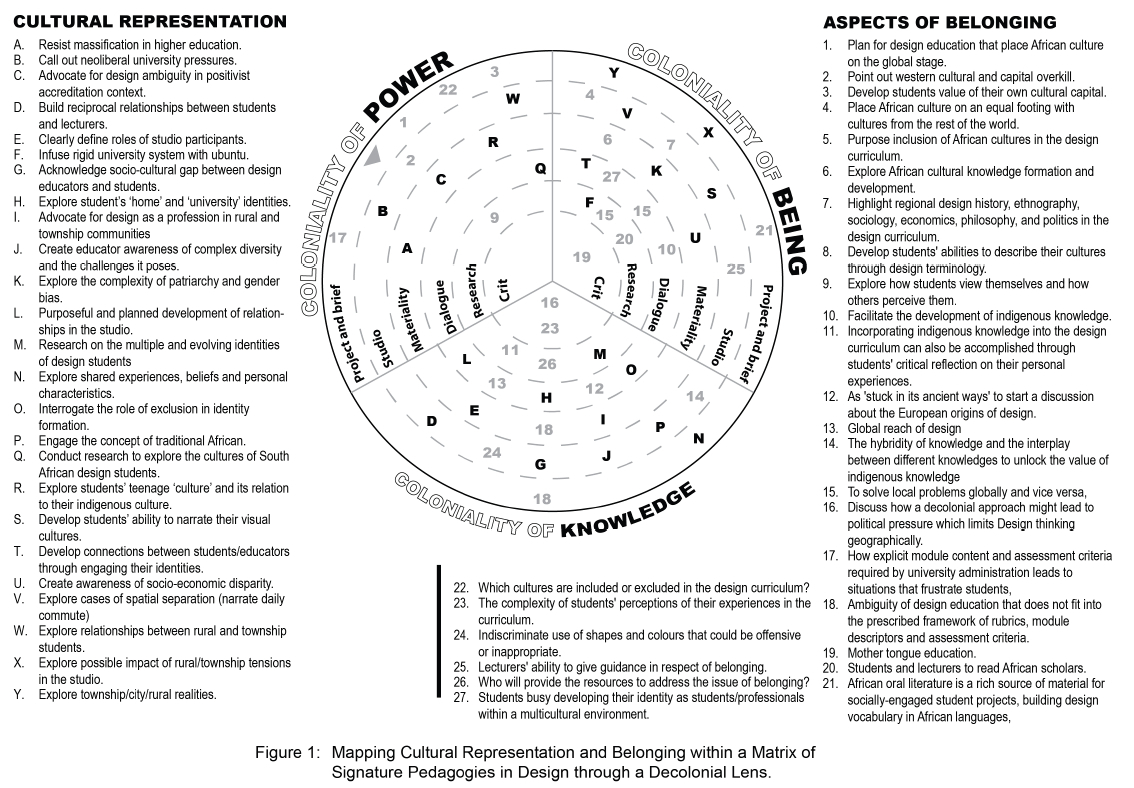
In this section I explore the design educators' and students' views on belonging and cultural representation on a matrix of design pedagogies and how the three aspects of coloniality of being, power and knowledge are implicated in these pedagogies.
In Figure 1, the aspects of belonging and cultural representation are plotted on the decolonial theoretical matrix of coloniality of being, coloniality of power and coloniality of knowledge. The plotting of the identified aspects was done based on the activities involved and the intended outcomes of each pedagogy. The intention is that the matrix could also be used by design educators to plot their own interpretation of the aspects and pedagogies involved. The proposed matrix is, therefore, to be used as an ideation tool that could advance decolonial pedagogical practice in design. I argue that the true validation of the proposed matrix lies in the reflective engagement of design educators, whose exploration of the matrix should foster pluriversal configurations-multiple, diverse interpretations that enrich its meaning. The matrix should be viewed as a dynamic, ever-evolving framework continuously shaped by critical reflection and diverse pedagogical experiences.
For example, I have mapped Point A from the cultural representation list (resisting massification in higher education) to the Materiality signature pedagogy within the Coloniality of Power section of the matrix. This placement allows educators to facilitate debates and actions that critically examine how massification in higher education, driven by neoliberal, profit-oriented agendas, impacts access to materials and tacit resources essential for meaningful design education.
Another example of how the matrix can be used in the design of curricula is Point 1 from the Belonging list (Pian for design education that places African culture on the global stage) that I mapped to the Project and brief signature pedagogy within the Coloniality of Power section of the matrix. We introduced a banner design project in the first year that required students to design visual representations of their Indigenous cultures (together with other similar projects and modules). Three years later, students are winning international design competitions based on their interpretations of their indigenous visual cultures in game design. The seed was planted in the first year when students were made aware that their individual lived experiences could counter hegemonic trends in design.
Studio pedagogy
In my view, studio pedagogy is a space where theory, practice, and critical reflection converge, allowing students to develop their creative voice through dialogue, experimentation, and collaboration. I see the studio as more than a classroom; it is a learning community where knowledge is co-created through iterative cycles of feedback and self-reflection. However, the challenges of increased student numbers, bureaucratic pressures, and neoliberal demands resonate deeply with my own concerns about how these factors dilute the studio experience and hinder meaningful mentorship. In particular, the pressures of neoliberalism often shift studio learning from a space of exploration to one driven by outputs, metrics, and accreditation, which stifles creativity and reduces learning to a transactional process.
Shreeve explains studio pedagogy through the lens of Schon's reflective practice (1983) and Wenger's (1998) communities of practice. Shreeve (2016) argues that the challenges posed by increasing student numbers in higher education could be addressed through technological solutions. According to Muratovski (2016), studio pedagogy seeks to blend theory, practice, and research. Malouf (2011) notes that studio effectiveness is hindered by an emphasis on evaluation over criticism. Educators also struggle to maintain the high levels of expertise required in the studio (Boling & Smith, 2014). The bureaucratic demands of accreditation and systemic reviews reduce the time educators can spend in one-on-one studio consultations with students (Dineen & Collins, 2005). The stress and lack of personal fulfilment experienced by creative academic staff are also stifling studio learning (Swann, 2002).
In thinking with the coloniality of power, belonging can be impacted by the challenges of neoliberal university pressures, which may undermine students' experiences. It is important to explore through studio pedagogy the relationships between students from different backgrounds, such as those from rural and township areas, to foster inclusivity. Furthermore, the dominance of Western cultural and capitalist narratives in education needs to be critically addressed to ensure cultural representation within studio pedagogy.
Coloniality of being is relevant as it pertains to how students perceive their belonging within the educational environment. Studio pedagogy should encourage students to narrate their visual cultures and articulate experiences related to spatial separation, such as daily commutes, to reflect their lived realities. Additionally, the studio pedagogy must position African culture on equal footing with other world cultures by integrating regional elements like history, ethnography, and philosophy. Educators need to be prepared and able to provide guidance in this respect, ensuring a richer and more inclusive learning experience.
The coloniality of knowledge also plays a significant role in studio pedagogy. Reciprocal relationships between students and lecturers should be fostered, acknowledging the socio-cultural gaps that may exist between them. Educators need to develop an awareness of the diversity within the student body and understand the challenges posed by this diversity. Cultural representation must also be considered carefully, avoiding the inappropriate use of visual elements that could be offensive. Recognising the hybridity of knowledge and valuing the interplay between different types of knowledge is crucial in unlocking the value of Indigenous knowledge alongside other perspectives. This decolonial approach in studio pedagogy seeks to create a more inclusive and effective studio learning environment that addresses issues of belonging, representation, and knowledge.
Project and brief pedagogy
Shreeve (2016) describes the function of the project as giving focus through a brief that is industry-directed with a fair amount of ambiguity that must be contended with. Lee (2009) describes the project as Problem-Based Learning, which allows for the connection of the project with educational theory in Problem Based Learning. Heller (2008) outlines three key characteristics of successful student design projects. Design projects should push, educate, and inspire students through their structure, while the information conveyed should include enough uncertainty to enable unexpected results. He also observes that successful projects seldom become outdated; instead, they often achieve legendary status and are frequently discussed. The project should foster a sense of community among students and bring attention to the individual strengths and weaknesses of those involved. Heller emphasises that for any project to be valuable, it must be rooted in the actual experiences of students; otherwise, the project risks becoming irrelevant, overly predictable, and unnecessary (Heller & Talarico, 2008).
In the context of coloniality, several aspects intersect with the design of projects and briefs. In thinking with the coloniality of power, the content and assessment criteria imposed by university administration may lead to frustrating experiences for students, particularly when these expectations are inappropriate or do not align with their cultural experiences. Design education, within a decolonial framework, must intentionally aim to elevate African culture and knowledge to the global stage by showcasing its rich diversity, depth, and relevance. This involves incorporating African lived experiences, symbolism, art, and cultural narratives, to name just a few, into the curriculum. By doing so, design education can foster an environment where students learn to value and confidently draw upon their own lived experiences and cultural heritage. This approach not only promotes African relevance but also challenges Western-centric perspectives, creating a platform for African voices, traditions, and innovations to shape global conversations in design. It empowers students to see their culture as a source of inspiration and authority, paving the way for a more inclusive and pluralistic design landscape. Decoloniality of being is reflected in how projects can foster a sense of belonging by exploring the impact of rural, township, and urban tensions within the studio environment. Recognising township, city, and rural realities in project briefs can help bridge the gap between different student experiences and contexts. In terms of cultural representation, African oral literature is highlighted as a rich source of material that can be used in socially engaged projects to build design vocabulary in African languages. This approach allows students to connect more deeply with their cultural heritage.
In thinking with the coloniality of knowledge, the new decolonial projects should encourage students to explore shared experiences, beliefs, and personal characteristics, thus building a stronger sense of community. Engaging with concepts rooted in traditional African culture helps to broaden the scope of design education, allowing it to move beyond Western paradigms. Additionally, the ambiguity inherent in design education can be an asset, though it does not always align neatly with institutional frameworks such as rubrics, module descriptors, and assessment criteria. The design studio environment thrives on open-ended briefs, iterative processes, and critiques that value multiple perspectives. Ambiguity in project briefs encourages students to explore unconventional solutions, fostering creativity and innovation. However, this open-endedness conflicts with structured rubrics and predefined learning outcomes, which favour measurable outputs. Addressing these misalignments is essential for a truly decolonial approach to design education that values diverse forms of knowledge and expression.
Materiality pedagogy
Shreeve (2016) stresses the significance of materiality in design education, framing it as the tacit experience essential to the act of creation. Shreeve (2016: 87) thus highlights the tangible outcome of the design process through understanding the significance of understanding the materials used in the design process, such as paper and ink, arguing that 'evidence exists in a material form which can be subject to scrutiny'. Shreeve's concept of materiality aligns with that of Bestley and Noble (2018), who view it as the connection between the physical characteristics of created objects, their intended audience, and their presentation. Bestley and Noble (2018) also discuss materiality in the context of digital works, which, though intangible, retain materiality through their content. In design, materials are acknowledged for their historical, social, or technological significance; the choice of materials communicates meaning and can provoke desired responses when used intentionally (Nimkulrat, et al., 2016).
In thinking with the coloniality of power, moving to decolonial belonging involves resisting the massification of higher education that materially impacts the tacit experience of students and advocating for design ambiguity within the context of positivist accreditation systems. It is also important to explore students' teenage culture and its connection to their indigenous culture to enhance their sense of belonging. In terms of the coloniality of being, the emphasis on belonging should include examining the complexities of patriarchy and gender bias, as well as creating awareness of socio-economic disparities. These considerations ensure that materiality within design is understood in a broader socio-cultural context. Additionally, exploring African cultural knowledge formation and development helps to ensure cultural representation within design practices.
In thinking with the coloniality of knowledge, fostering decolonial belonging involves clearly defining the roles of studio participants and advocating for the recognition of design as a profession within rural and township communities. These efforts help to demystify the design profession and its materials and make it more accessible. In terms of cultural representation, developing students' ability to describe their own cultures through design terminology is crucial, as it empowers them to use their cultural heritage as a foundation for their design work. This comprehensive approach to materiality ensures that design education acknowledges the socio-cultural significance of materials while encouraging an inclusive and contextually relevant practice.
Dialogue pedagogy
Shreeve (2016) frames education as a conversation between educators and students, where knowledge is co-constructed rather than transmitted. In design education, this dialogue occurs through critiques, feedback sessions, and collaborative projects, highlighting that learning is a participatory and iterative process rather than a linear transfer of knowledge. She shows that dialogue makes the tacit aspects of design education, which intrinsically is student-centred, visible and tangible. Volakos argues that students need less 'fault-finding' (which could be a central feature of a critique session) and a more explorative dialogue in a 'professional and social environment' (2016: 215). Dialogue in design pedagogy will primarily be focused on discussing designed artefacts that enable dialogue (Swann, 2002; Polaine, 2011). The value of dialogue in design pedagogy is determined by the quality of questions asked by the parties involved; new approaches and solutions can only be achieved through probing with the 'right questions' (VandeZande, et al., 2015).
In the context of decoloniality, dialogue plays an important role in shaping belonging and cultural representation. Regarding the coloniality of power, facilitating dialogues on the cultures of South African design students can foster an understanding of their diverse backgrounds and promote a sense of belonging. The coloniality of being, particularly with respect to belonging, is enhanced when dialogue is used to develop connections between students and educators through an exploration of their identities. Dialogue can also contribute to cultural representation by strategically including dialogue about African cultures in the design curriculum, facilitating the development of Indigenous knowledge, and supporting students in developing their personal and professional identities within a multicultural environment.
In thinking with coloniality of knowledge, dialogue can be used to purposefully develop relationships in the studio, acknowledging the multiple identities that students might hold between their 'home' and university environments. Furthermore, interrogating the role of exclusion in identity formation is essential to fostering a supportive and inclusive atmosphere. Cultural representation in the coloniality of knowledge involves using dialogue to challenge existing narratives, such as discussing the European origins of design and its global influence. This encourages critical engagement with the historical and cultural roots of design, fostering a more inclusive understanding that considers diverse perspectives and contributions from around the world.
Crit pedagogy
Shreeve describes the crit in relation to its function as a response to a project brief. The aim is to evaluate and achieve appropriate levels of design thinking and standards. The aim of the crit is to allow for the development of critical analysis skills together with the necessary language to induct the student into the discipline. Issues around the transparency, consistency and efficacy of the crit are also raised by Boling and Smith (2014). Despite the possible negative impact that the crit can have on students due to the power relations in studios, the prevalence of 'low-level procedural questions' instead of critical reflection remains a popular method of teaching and evaluation in studio-based programmes (Healy, 2016). The lack of 'pedagogical training' in design educators has also been identified as a barrier to the efficacy of the crit (Doloswala, et al., 2011: 419).
In the context of coloniality, the crit plays an important role in shaping cultural representation within design education. Under the coloniality of being, the use of mother tongue education during critique sessions is highlighted as a way to ensure that students can engage meaningfully and express their ideas with clarity, thus supporting a more inclusive learning environment.
In thinking with the coloniality of knowledge, there are concerns that adopting a decolonial approach might introduce political pressures that limit the scope of design thinking to specific geographical areas, thereby reducing diversity in creative expression. However, acknowledging the complexity of students' perceptions of their experiences within the curriculum is critical in developing an inclusive and culturally representative design education.
Research pedagogy
Research is an extensive requirement for undergraduate design students, serving as a crucial foundation for their project work. However, it is often noted that there is a lack of associated pedagogical practices to effectively teach students how to conduct research. The current approach tends to be a directive to go and do research without providing structured guidance or methodologies to support their learning process. In terms of the coloniality of power, research can play a role in cultural representation by encouraging students to explore how they view themselves and how they are perceived by others. This self-reflective practice helps to uncover identity dynamics and addresses the influence of societal perceptions on students' work.
From the perspective of the coloniality of being, research is also essential for fostering a sense of belonging. This could be achieved by infusing the rigid university system with the principles of 'ubuntu,' an African philosophy that emphasises community, empathy, and interconnectedness. Additionally, research should engage students and lecturers with the work of African scholars and focus on finding solutions to local problems with global implications, and vice versa, which reinforces the importance of cultural representation in education. Regarding the coloniality of knowledge, research should aim to explore the multiple and evolving identities of design students, acknowledging that identity is not fixed but shaped by ongoing experiences. Incorporating indigenous knowledge into the design curriculum is crucial for fostering culturally relevant and socially conscious design practices. This can be achieved by encouraging students to critically reflect on their personal experiences, identities, and community histories, thereby connecting their lived realities with indigenous knowledge systems, such as local crafts, languages, and storytelling traditions. This reflective process not only deepens their understanding of decolonial design principles but also nurtures their ability to address societal challenges through contextually meaningful and inclusive design solutions. However, a question remains about who will provide the mainstream resources necessary to address these issues, highlighting the challenges associated with equitable access to educational materials.
Conclusion
This paper has explored the integration of decolonial theory into design pedagogy through the use of signature pedagogies, with a focus on aspects of belonging and cultural representation. The findings emphasise that fostering a sense of belonging and cultural representation in the design studio is crucial for achieving a truly decolonial approach to design education. The proposed matrix of signature pedagogies offers a practical tool for design educators to incorporate decolonial principles into their teaching. Pedagogical practices such as studio, projects and briefs, materiality, dialogue, critique, and research serve as key avenues to challenge traditional power dynamics, bridge cultural gaps, and recognise diverse knowledge systems. These approaches can help design students not only to value their own cultural capital but also to engage critically with the broader global context of design. However, the study also highlights the significant constraints imposed by the neoliberal university context on these decolonial efforts. Neoliberal policies, which prioritise market-driven outcomes, often reduce design education to vocational training, focusing on industry-ready skills at the expense of indigenous knowledge integration. Rigid assessment frameworks, driven by standardised rubrics and measurable outcomes, undermine the dialogical and iterative nature of ambiguous design pedagogy, limiting opportunities for deep reflection and experimentation. This paper contributes to the ongoing discourse on decoloniality in design education by providing a matrix that design educators can use to critically reflect on and transform their teaching practices. While this study focuses on the South African context, the methods and insights presented have broader relevance, offering pathways for educators across disciplines and geographies to navigate and implement decolonial pedagogies. Ultimately, decolonial design education requires an ongoing commitment to inclusivity, critical reflection, and the recognition of diverse voices in shaping the future of design.
Acknowledgements
I sincerely thank the reviewers of this journal for their insightful feedback and thoughtful recommendations, which have significantly enhanced the quality of this article from its original submission.
References
- Andreotti, de O., V., Stein, S., Ahenakew, C. & Hunt, D. 2015. Mapping interpretations of decolonization in the context of higher education. Decoionization: Indigeneity, Education & Society, 4(1): 21-40.
- Ansari, A., Kiem, M., Pradode, L., Martins, O. & Vieira De Oliveira, P.J.S. 2018. Three Perspectives on Decolonising Design Education. PARSE. (8). Available at: https://parsejournal.com/article/three-perspectives-on-decolonising-design-education/ (Accessed: 17 August 2024).
- Bhambra, G.K., Nişancioğlu, K. & Gebrial, D. 2020. Decolonising the university in 2020. Global Studies in Culture and Power, 27(4): 509-516.
- Boling, E. & Smith, K.M. 2014. Critical issues in studio pedagogy: Beyond the mystique and down to business. In Hokanson, B. & Gibbons, A. Design in Educational Technology: Design Thinking, Design Process, and the Design Studio. Switzerland: Springer, 37-56.
- Botes, H., Costandius, E. & Perold, K. 2015. Exploring critical citizenship and globalization discourse to conscientize industry expectations of design education at Universities of Technology. Masters thesis. Stellenbosch University.
- Campbell, S., Greenwood, M., Prior, S., Shearer, T., Walkem, K., Young, S., Bywaters, D. & Walker, K. 2020. Purposive sampling: complex or simple? Research case examples. Journal of Research in Nursing, 25(8): 652-661.
- Costandius, E., Blackie, M., Nell, I., Malgas, R., Alexander, N., Setati, E. & Mckay, M. 2018. #FeesMustFall and decolonising the curriculum: Stellenbosch University students' and lecturers' reactions. South African Journal of Higher Education, 32(2): 65-85.
- Dei, G. & Asgharzadeh, Au. 2006. Indigenous knowledges and globalization: An African perspective. In Abdi, A.A., Puplampu, K.P. & Dei, G.J.S. (Eds.). African Education and Globalization: Critical Perspectives. Lanham: Rowman and Littlefield, 53-78.
- Dineen, R. & Collins, E. 2005. Killing the goose: Conflicts between pedagogy and politics in the delivery of a creative education. Journal of Art & Design Education, 24(1): 43-52.
- Doloswala, K.N., Thompson, D. & Toner, P. 2011. Digital based media design: the innovative contribution of design graduates from vocational and higher education sectors. International Journal of Technology and Design Education, 23(2): 409-423.
- Fry, T. 2011. Design as Politics. Interiors, 2(3), 376-377.
- Healy, M. 2020. The other side of belonging. Studies in Phiiosophy and Education, 39(2): 119133.
- Heller, S. & Talarico, L. 2008. The Design Entrepreneur Turning Graphic Design into goods that sell. Beverly, Massachusetts: Rockport Publishers.
- Jivraj, S., Bakshi, S. & Posocco, S. 2020. Decolonial trajectories: Praxes and challenges. Interventions, 22(4): 451-463.
- Mbembe, A. 2016. Decolonizing the university: New directions. Arts and Humanities in Higher Education, 15(1): 29-45.
- Kohn, M. & McBride, K.D. 2011. Political Theories of Decolonization Postcolonialism and the Problem of Foundations. Oxford: Oxford University Press.
- Kuurne, K. & Vieno, A. 2022. Developing the concept of belonging work for social research. Sociology, 56(2): 280-296.
- Lee, N. 2009. Project methods as the vehicle for learning in undergraduate design education: A typology. Design Studies, 30(5): 541-560.
- Lincoln, Y.S. & Guba, E.G. 1985. Naturalistic Inquiry. Beverly Hills, Calif.: Sage Publications.
- Malouf, D. 2011. Design education of the future. In Bennett, A.G. & Vulpina, O. (Eds.). ICOGRADA Design Education /Manifesto, International Council of Graphic Design Associations. 98-103. Available:https://www.theicod.org/storage/app/media/resources/Icograda%20Documents/IcogradaEducationManifesto_2011.pdf (Accessed: 6 March 2024).
- Mignolo, W.D. 2011. The Darker Side of Western Modernity: Global Futures, Decolonial Options. Durham: Duke University Press.
- Mignolo, W.D. 2013. Geopolitics of sensing and knowing: On (de)coloniality, border thinking, and epistemic disobedience. Confero, 1(1): 129-150.
- Mignolo, W.D. & Walsh, C. 2018. On Decoloniality: Concepts, Analytics, Praxis. London: Duke University Press.
- Morreira, S., Luckett, K., Kumalo, S.H. & Ramgotra, M. 2020. Confronting the complexities of decolonising curricula and pedagogy in higher education. Third Word Thematics: A TWQ Journal, 5(5): 1-18.
- Muratovski, G. 2016. Research for Designers: A Guide to Methods and Practice. London: Sage Publications.
- Ndlovu-Gatsheni, S.J. 2013. Coloniality of Power in Postcolonial Africa: Myths of Decolonization. Dakar: CODESRIA.
- Ndlovu-Gatsheni, S.J. 2015. Decoloniality as the future of Africa. History Compass, 13(10): 485496.
- Ngũgĩ wa Thiong'o. 1981. Decolonising the Mind the Politics of Language in African Literature. Harare: Zimbabwe Publishing House.
- Nimkulrat, N., Seitamaa-hakkarainen, P., Pantouvaki, S. & De Freitas, N. 2016. Experience, Materiality and Articulation in Art/Design and Research Practices. Studies in Material Thinking, 14. Available: https://materialthinking.aut.ac.nz/sites/default/files/papers/0176_SMT_V14_P00_FA.pdf (Accessed: 6 November 2024).
- Noble, I. & Bestley, R. 2018. Visual Research: An Introduction to Research Methods in Graphic Design. London: Bloomsbury.
- Polaine, A. 2011. Design Research - A failure of imagination? In Bohemia, E., de Mozota, B.B. & Collina, L. (Eds.). Researching Design Education 1st International Symposium for Design Education Researchers CUMULUS Association//DRS SIG on Design Pedagogy, Cumulus Association, 41-51.
- Quijano, A. 2007. Coloniality and modernity/rationality. Cuttural Studies, 21(2-3): 168-178.
- Schön, D.A. 1983. The Reflective Practitioner: How Professionals Think in Action. New York: Basic Books.
- Schön, D.A. 1983. The reflective Practitioner. New York: Basic Books.
- Schultz, T., Abdulla, D., Ansari, A., Canli, E., Keshavarz, M., Kiem, M., de O. Martins, L.P. & Veira de Oliveira, P.J.S. 2018. What is at stake with decolonizing design? A roundtable. Design and Culture, 10(1): 81-101.
- Shreeve, A. 2016. Signature Pedagogies in Design, in Tovey, M. (Ed.). Design pedagogy: Developments in art and design education, Routledge Taylor & Francis Group, 83-92.
- Shreeve, A., Sims, E. & Trowler, P. 2010. "A kind of exchange": Learning from art and design teaching. Higher Education Research) and Development, 29(2): 125-138.
- Shulman, L.S. 2005. Signature pedagogies in the professions. Daedalus. 134(Summer): 52-59.
- Stake, R.E. 1995. The Art of Case Study Research. Thousand Oaks, Calif: Sage Publ.
- Swann, C. 2002. Nellie is Dead. Art, Design & Communication in Higher Education, 1(April): 5058.
- Tuck, E. & Yang, K.W. 2012. Decolonization is not a metaphor. Decolonization: Indigeneity, Education, and Society, 1(1): 1-40.
- Tunstall, E. 2023. Decolonizing Design: A Cultural Justice Guidebook. Cambridge, Massachusetts: The MIT Press.
- VandeZande, R., Bohemia, E. & Digranes, I. 2015. LearnxDesign Proceedings of the 3rd International Conference for Design Education Researchers. In VandeZande, R., Bohemia, E. & Digranes, I. (Eds.). LearnxDesign Proceedings of the 3rd International Conference for Design Education Researchers, vol. 2, Chicago, 1-488.
- Volakos, V. 2016. Dialogic enquiry and aspects of interaction in architectural design review of undergraduates classification of principal oral feedback typologies. Unpublished PhD diss., Cardiff University.

Accepted: 24 February 2025
Author Biography
Herman Botes is the Head of the Department of Visual Communication (Motion Picture Production, Commercial Photography and Communication Design) in the Faculty of Arts and Design at the Tshwane University of Technology. His research interests include design education, decoloniality, critical pedagogy, critical citizenship and transdisciplinary design.