A New Materialist approach to exploring minoritised undergraduate students experience of university systems and processes
Abstract
Drawing on a collaborative, student-led research project at a UK university, this study adopted a diffractive methodology (Barad, 2007) to investigate how minoritised students experience the relational, material, and institutional flows of higher education. Through entangling artefact-making, spatial mapping, and collective reflection (Haraway, 1997), five key diffractive patterns shimmered through the inquiry: feedback and assessment, data sharing, relationships, space, and mentoring. Through tracing affective intensities and moments of blockage and flow, the study contributes to literature discussing how minoritised students navigate and reshape their educational landscapes. Anchored in New Materialist theory, and guided by an ethics of care (Noddings, 2013), this article foregrounds student voice not as testimony, but as an active force for institutional insight (Tronto, 1993). It argues that transformation begins not with largescale overhaul, but with attuned practices, ways of listening, noticing, and acting that reimagine belonging as something co-constituted, embodied, and alive.
belonging; diffraction; New-Materialism; student experience; university
Introduction
Generating a sense of belonging at university is seen as central to student success (Ahn & Davis, 2020) and reflects a basic human need of mattering (Flett, 2018). Scholars of relational pedagogy, such as Gravett and Ajjawi (2021: 1), tell us that belonging can be framed as a 'situated, relational, and processual' phenomena that is always being renegotiated 'depending upon our context and what interaction we are having'. Belonging is thus a complex phenomenon, never static but constantly in a state of perpetual (re)creation. For minoritised students, that sense of belonging is co-created by wider social structures. Indeed, Universities have been described as sites that reproduce inequalities from colonial legacies (Arday & Mirza, 2018; Maringe & Chiramba, 2022), perpetuating white middle-class values (Croziera, et al., 2019), cis-heteronormativity (Seal, 2021), and patriarchy (Fox, 2021) thus reinforcing inequalities. To be successful, these students often must assimilate into structures not always designed to meet their needs (Bourdieu, et al., 1994; Crozier, et al., 2019). This small-scale UK based study aimed to identify positive actions for change that minoritised students believe should be made. For the purposes here, minoritised students are defined as any student with at least one protected characteristic defined by the UK Equality Act (Gov, 2010) and any student who comes from the most deprived quintile as defined by the Indices of Multiple Deprivation (IMD) (Gov, 2019). Systems and processes include (but are not limited to) induction, enrolment, seeking student support, teaching and learning, academic regulations, timetabling, and assessment.
Whilst there is a growing body of work exploring posthumanism and new materialism in Higher Education (HE) (e.g. Bozalek & Zembylas, 2016; Gravett, 2022; Knox, 2016; Leibowitz, et al., 2017; Ross, 2021; Taylor & Bailey, 2019), there is a paucity of research that engages with new materialist thought to explore the experience of minoritised students in HE, a notable exception being Allen, et al. (2020) who draw upon new materialist philosophies to explore how campus environments operate as safe-un-safe spaces for LGTBQ+ students. Whilst acknowledging the gap, we focused on the situatedness of minoritised students within the distinctive ecology of a small, campus-based English university. Rather than treating their experiences as abstract or easily generalisable across contexts, we attended to how these experiences are produced through the particular material, affective, spatial, and procedural entanglements that shape everyday academic life. What elements, relations, and forces converge to generate blockages and flows in students' engagements with institutional systems and processes, and how might instances where systems flow, where support, recognition, and belonging are enacted, be used to reconfigure practice in ways that reduce blockage and enhance equity? By foregrounding these situated entanglements, we aimed to illuminate how minoritised student experiences are continuously made and remade within specific socio-material conditions.
Theoretical orientations
Under the broad umbrella term of New Materialism, we adopted a diffractive methodology, reading insights from posthuman and agential realist perspectives through notions of belonging and the activities undertaken across a one-day workshop.
Coole and Frost (2010: 28) describe New Materialism as an eclectic and generative mix of approaches concerned with the emergent materialities of contemporary coexistence. Together, these approaches reassert the significance of matter, materiality, values, and power within global biopolitics and political economies (Coole & Frost, 2010: 6). Although New Materialism challenges assumptions about the ontological primacy of discrete entities, this sensibility is not entirely "new". Indigenous worldviews have long conceptualised the world as constituted through dynamic relations. For instance, Māori thought positions objects as living entities that participate in an entangled human-more-than-human world (Jones & Hoskins in Taylor & Ivinson, 2013). Likewise, Ash, et al. (2022) describe Aboriginal Law as a kin-based political ontology through which humans, animals, stones, and plants co-constitute the lifeforce of Country. While resonant with these relational traditions, new materialisms emerge alongside, rather than from Indigenous thought, shaped by developments in quantum physics and growing dissatisfaction with dominant Western scientific paradigms. In this disruption, New Materialisms unsettle the binary logics that, as St. Pierre (2016) argues, underpin both positivist traditions rooted in replication and increasingly procedural forms of phenomenology (Kuby & Bozalek, 2022: 110).
New materialisms decentre the human and foreground distributed agency across human and more-than-human forces, shifting attention from stable structures to relational flows and assemblages (Coole & Frost, 2010; Fox & Alldred, 2017). Rather than treating knowledge as solely intersubjective exchange, these approaches attend to the micropolitics of affect, capacity, and constraint as they emerge in situated collectivities. In this view, the world is heterogenous and self-organising, with meaning and action arising through dynamic relations among bodies, materials, and practices. Following Fox and Alldred (2017), our study draws diffractively on Deleuze and Guattari, Braidotti, and Barad, not to rehearse discrete canons, but to orient analysis toward relational ontology and non-representational accounts of practice. Across these lines of thought, agency is an emergent effect of relations; subject/object distinctions are unsettled; and research attends to how material-discursive arrangements bring worlds into being.
Deleuze and Guattari (1987) emphasise the productive capacities of matter through relational assemblages and affect. Entities do not pre-exist their relations; they are produced within them. For example, an author is not an autonomous subject but an emergent effect of assemblages involving technologies, bodies, cultural forces, and institutional arrangements. Assemblages persist through flows of affect, such as tensions or capacities generated through relational encounters which create rhizomatic, non-linear processes of becoming (Deleuze, 1988: 256). Agency is therefore not individual but an emergent effect of these affective flows (Fox & Alldred, 2017: 17-18). Identity is similarly non-fixed, shaped by ongoing micropolitical interactions, and opened to multiplicity through nomadic thought (ibid).
Braidotti's posthumanism resonates strongly with these views, arguing for a non-dualistic understanding of the nature-culture continuum (Fox & Alldred, 2017: 22). She critiques the dominance of the humanist, typically male subject and foregrounds the self-organising capacities of living matter (Braidotti, 2013: 3). Drawing on nomadology, Braidotti proposes the "non-unitary subject," grounded not in discursive construction but in the materiality of the living body (Braidotti, 2010: 201-218). The body becomes a transformative site of multiple micropolitical assemblages (ibid, 210). Agency, in this view, is relational, ecological, and anti-individualistic, connecting human and non-human life in an affirmative 'eco-philosophy of becoming' (Braidotti, 2012: 33-34, 104). Barad extends these ideas through "agential realism", drawing on quantum mechanics to argue that entities do not pre-exist their relations but emerge through intra-action; a mutual constitution within phenomena (Barad, 2007: 3) where subject and object, nature and culture, are co-produced through material-discursive practices. Agential realism rejects the privileged role of language as mediator of reality, instead positioning matter as an active participant in world-making (Barad, 2007: 133-136). Meaning arises from "agential cuts" that momentarily differentiate aspects of phenomena for the purposes of action or understanding (139-140). Agency is thus not a possession but an ongoing articulation of mattering; the iterative production of difference that shapes causal relations and forms commitments across human and non-human bodies (137, 392, 140-141, 150-151). Barad's agential realism, read alongside Deleuzian becoming and Braidotti's nomadic ethics, underpins our diffractive methodology.
Bennett's account of distributive agency or "thing-power" complements this stance by emphasising matter's lively capacities and the political-ethical stakes of how we think-with materials (Bennett, 2004; 2010). Read with Barad's notion of intra-action, agency appears not as a property but as an effect of entanglement: bodies and objects do not pre-exist relation; they take form through it. This orientation guides our attention to how workshop artefacts, spaces, and tools actively shaped what could be sensed, said, and done.
Diffraction as methodology
Barad's (2007) concept of diffraction, central to agential realism, provides both an ethico-onto-epistemological stance and a methodological practice. Borrowing from quantum physics, Barad contrasts diffraction with reflection, where reflection presumes mirroring and sameness. Diffractive practice instead attends to how differences are produced through entangled intra-actions. Methodologically, diffraction invites researchers to trace the patterns that arise as concepts, materials, and experiences which are read through one another, noticing tensions, overlaps, and exclusions as they emerge.
Barad (2007: 89) extends this physical account into a broader philosophical argument: diffraction is a way of attending to how differences materialise within phenomena that are always already entangled across past and future states. Nothing pre-exists its relations; even the rock that blocks or channels a wave is part of the diffraction pattern that results, simultaneously shaping and being shaped by the ongoing production of the world. Diffractive methodology therefore moves away from representationalism and the assumption that knowledge reflects a pre-existing reality. Instead, Barad (2007) treats knowledge-making as part of the world's material becoming, emphasising that research practices are never external to the phenomena they study. As a methodology, diffraction calls researchers to trace the entanglements through which specific configurations of the world emerge. Rather than looking for stable categories, linear causation, or thematic coherence, a diffractive methodology reads insights, concepts, materials, and experiences through one another, attending to the patterns that arise from their interference. It is a method attuned to tensions, overlaps, silences, and unexpected relation, those "differences-in-the-making" that illuminate how phenomena come to matter; an ethico-onto-epistemological orientation that recognises that ethics, being, and knowing are not separate domains but are always already entangled (Barad, 2007). For this study, we as researchers needed to acknowledge the agential cuts enacted within our research practice; the decisions, boundaries, and exclusions that shape what becomes visible and knowable.
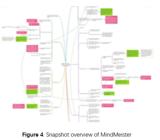
Our diffractive methodology therefore foregrounds response-ability, insisting that we remain attentive to how our theoretical tools, methodological choices, and material conditions co-produced the phenomena under investigation. In this sense, rather than positioning our research as a neutral act of observation, we affirm that knowledge is not found but made with-in-through the world: students were not conceived as subjects to be studied, but as co-participants in an unfolding entanglement of meaning-making in which conversations, artefacts, spaces, and technologies all mattered (Sheridan, et al., 2020). As such, every intra-action, every moment of listening, noticing, creating, and responding, was of both an epistemic and ethical importance: The room layout, the digital platform (MindMeister1), the pens, sticky notes, and student-created artefacts were not passive tools but co-actors in the unfolding research assemblage (Alvarez, et al., 2022). Intra-actions with these materials were significant, not as background detail but as part of the ethico-onto-epistemological process. As such, each conversation, artefact, and encounter were treated not as isolated data but as an affective-material event, charged with meaning, possibility, and responsibility.
This entangled approach required a methodological attunement to what Braidotti (2012) terms nomadic ethics, a non-universalising, situated and relational practice that foregrounds accountability without recourse to fixed moral positions. Nomadic ethics invites the researcher to remain mobile, responsive, and attentive to difference, acknowledging that the research process is not a linear journey from question to answer, but a becoming-with those involved. In this study, such ethics were not simply applied to the work but lived through it. We recognised ourselves as always already implicated in the intra-actions that shaped the knowledge produced; we were not outside the phenomenon but part of its ongoing co-constitution (Carter, 2022). We committed ourselves to remaining open to what Haraway (2016) calls staying with the trouble, refusing premature closure and instead lingering in complexity, contradiction, and entangled becoming. In practice, this meant responding to the often messy, unpredictable, and affectively charged nature of our shared exploration, while resisting the temptation to neaten its contours for the sake of clarity (Holman & Harris, 2021). What emerged were not simply 'findings' in the traditional sense, but resonant affective-material patterns, what might be called pulses, blockages, and flows that illuminated the systemic conditions shaping student experiences of success, friction, and possibility (Coole & Frost, 2010). These included the affective charge of timetable clashes, the spatial politics of access to information and staff, and the tensions between technological platforms and student voice. The artefacts produced by students functioned as material interventions, sites of visioning and critique (Wakkary, et al., 2015), that made visible both the lived realities of navigating university life and speculative possibilities for reimagining institutional practice.
In attending to these patterns, we offer a practice-oriented contribution, not a set of fixed recommendations, but more a collection of invitations, and openings into student blockages and flows. The outcome of our research is entangled, emergent, and alive; inviting educators and practitioners to tune in differently, to listen with curiosity, to notice the everyday textures of institutional life, and to respond with care (St. Pierre, 2019). By foregrounding the intra-active, processual nature of belonging, we contribute to a growing body of work that embraces socially just approaches to educational inquiry and the reimagining of HE as a space of possibility.
Context
This research was conducted within the specific institutional ecology of a small, teaching-focused university in the West Midlands of England. The university's mission centres on accessible, values-led higher education, underpinned by commitments to social justice, equity, and respect. These commitments were articulated within the university's Access and Participation Plan (APP) which outlines targeted actions to address continuation rates and reduce awarding gaps for minoritised students.
The student population is marked by a diverse wealth of lived experiences. APP data shows that 96.5% of students commute, are disabled, from global majority ethnicities and/or mature learners; 70% are first-generation university students, 87% from the most socio-economically deprived quintiles (1 - 3), versus a national average of 63.4%. These demographic characteristics entangle across people, places, and practices that shape the institutional context.
For students from minoritised backgrounds, the pursuit of belonging within these systems often occurs in spaces that reproduce inequality (Maringe & Chiramba, 2022). Structural legacies of colonialism (Arday & Mirza, 2018; Bhambra, et al., 2018), white middle-class norms (Crozier, et al., 2019), cis-heteronormativity (Seal, 2021), and patriarchal assumptions (Fox, 2022) continue to shape the cultural and institutional landscape of higher education. These dynamics frequently position students as outsiders, implicitly requiring them to assimilate into academic norms and practices not designed with their identities or experiences in mind (Bourdieu, et al., 1994). The pressures of contemporary student life add further complexity. The impact of neoliberalism in higher education (Giroux, 2014; Accioly & Macedo, 2021) intensifies the challenges faced by many in this group (Edgar, et al., 2024). These conditions often compromise students' ability to fully engage with their studies, access support, and sustain a sense of well-being and belonging (Standing, 2021).
In response to this context, our study positions itself not as an investigation into individual student deficits, but as an inquiry into the problems of situated practice (Thomas, et al., 2017). It aligns with a growing body of work that seeks to understand how institutional structures shape, constrain, or enable the experiences of minoritised students in higher education. We explore how students' interactions with university systems and processes produce what we term blockages and flows. These concepts are used to articulate the fluid and intersecting forces that shape a student's capacity to engage, succeed, and feel that they matter within the institutional environment (Flett, 2018). These patterns are not merely obstacles or enablers, but indicators of how institutional life is being lived and navigated in real time. Our work thus set out not to fix systems from the outside, but to step inside the tangle, to listen, notice, and feel what moves, what sticks, and what pulses beneath the surface of student experience. We explore how belonging, and participation is allowed to flow, or is blocked, through the messy, lively entanglements of bodies, policies and spaces. Anchored in New Materialist commitments to multiplicity, relationality, and more-than-human agency, the study offers a fresh lens for tracing how student experiences take shape within the shifting landscapes of contemporary higher education.
Belonging
Belonging has emerged as a central concern in HE, particularly in relation to student success and retention (Thomas, 2012; Ahn & Davies, 2020). Models of retention acknowledge the range of environments and activities that students might intra-act with. For example: both physical and virtual Information Technology and/or eLearning departments; libraries and other learning resources; students' unions including support services, socio-cultural events, and networks; accommodation and catering services; academic service departments such as registry, quality, or exams and assessment, and student support areas such as study skills, welfare, or disability (Parkes, et al., 2014: 5). Drawing on Gravett and Ajjawi (2021: 1), belonging can be understood as a contextual, relational and unfolding phenomenon that is continually reshaped by the specific situations and interactions in which it occurs. Indeed, Carruthers-Thomas (2016) identifies an assumed understanding of belonging that consequently fixes individual and group identities through relationships of power (Mee & Wright in Carruthers Thomas, 2016), while Probyn (in Quinn, 2010: 64) suggests that there are 'different modes of belonging [that] fold and twist in the fabric of social life', where belonging can often be an active and positive choice in students (Guyotte, et al., 2019). These can be framed as either an emotional connection (Gravett & Ajjawi, 2021), the sense of 'feeling at 'home' (Quinn, 2010: 87), or safe as well as 'an act of self-identification or the identification by others' (Yuval-Davis in Gravett & Ajjawi, 2021: 2) that reflects a basic human need of mattering (Flett, 2018). These perspectives underscore the profound psychological, social, and institutional dimensions of belonging, dimensions that are not evenly distributed across student populations. This study therefore approaches belonging not as a fixed state or an endpoint, but as a processual, always-in-the-making phenomenon as asserted by Gravett and Ajjawi, perpetually (re)created through the intra-actions of context, bodies, discourses, materialities, and interactions. From this perspective, belonging is not something students either have or do not have, but something that is co-produced through the circulating affective negative and positive powers that simultaneously both potentially transform and/or oppress with-in-through institutional spaces, pedagogical practices, and wider structural conditions. The university thus becomes both a potential site of belonging and a site of struggle, a terrain where students continually encounter blockages and flows. These are the thresholds and affordances that mark the daily realities of negotiating institutional life: from intra-actions with digital systems and timetabling protocols to spatial exclusions and the politics of academic recognition. Thinking diffractively with Barad (2007), such moments are not simply obstacles or enablers in isolation, but entangled phenomena that shape and are shaped by broader socio-political forces.
Our study began not with a blueprint of what belonging should be, but with the students themselves. Their everyday realities, affective textures, and creative capacities to make meaning in complex institutional worlds. In response, we treat belonging not as a fixed destination but as lively, politically charged, material entanglement that calls to be decolonised, pluralised, and re-tuned to the full, vibrant spectrum of student experience. It takes seriously the call of Bhambra, et al. (2018) to reimagine the university as a space open to the plurality of knowledge, histories, and embodied ways of being. Through its New Materialist orientation, the study does not attempt to fix or resolve belonging, but to trace its movements, affects, and possibilities, to map how it pulses through systems, spaces, and stories, and to make visible the blockages that interrupt its flow. Ultimately, the aim is not simply to document where belonging is lacking, but to consider what institutional shifts are required for such possibilities to take root and thrive. Attending to belonging in this way requires not only new institutional practices but also a rethinking of how we come to know, be, and relate within the research process itself, an entangled ethic that sits at the heart of this study's ethico-onto-epistemological commitment.
The process
Ethical approval was gained from the university for a full day generative workshop designed to foster co-creation within it between ourselves as the research team and the student participants. Participants were recruited to the project once ethical approval had been given. This was conducted through announcement via our virtual learning environment, casual conversations with students and word of mouth.
To begin, we had a set of intentions for the workshops to bring about the intra-relational aspects without predetermining the nature or focus of the discussions. The intentions centred on their experience as minoritised students, with the activities within the workshops themselves generating topics and themes for further exploration during the day. Consent initially at the start of the workshop was in terms of agreeing what informed consent meant, the right to withdraw and protecting anonymity. This was done through an exploratory talking circle drawing respectfully on the legacy of such methods (Brown & Di Lallo, 2020). After each activity, we returned to the notion of consent for further consideration and clarification in an ongoing process. For example, before each activity participants were reminded that they are free to share as much or as little of their experience as they felt comfortable too.
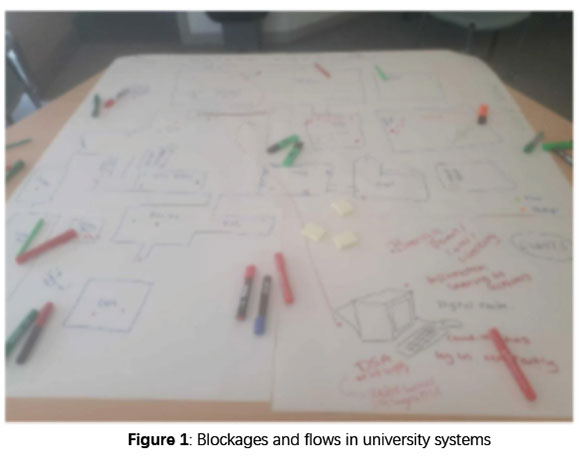
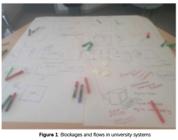
The one-day participatory workshop involved three facilitators and seventeen undergraduate students from minoritised backgrounds. Underpinned by our diffractive methodology, the process was designed to invite students into collaborative, multi-textual, and more-than-verbal modes of expression. The workshop began with a spatially grounded activity. Students were presented with a large floor plan of the university and invited to locate and annotate experiences of either blockages or flows in their engagement with university systems and processes. Using red, amber, or green dots, participants marked specific sites, physical or symbolic, where they had encountered friction, partial movement, or ease (See figure 1 below). These included spaces of timetabling, access to information, navigation of support services, and interpersonal or digital encounters. These visual cues acted as catalysts for rich group discussions that followed, opening collective reflections on how belonging was shaped (or constrained) (Kersting and Jazcilevich (2020) by the material, social, and institutional environment.
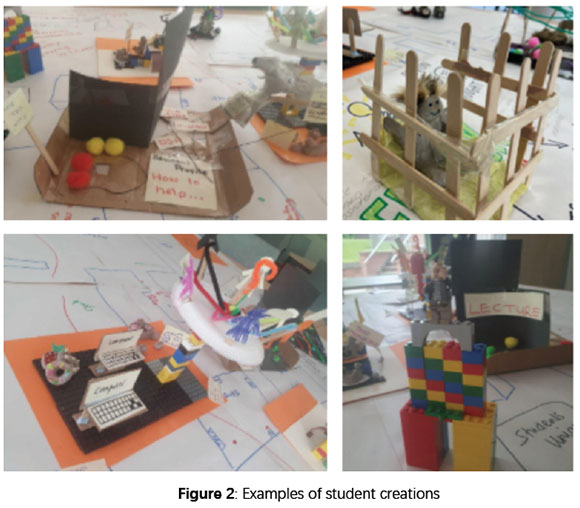
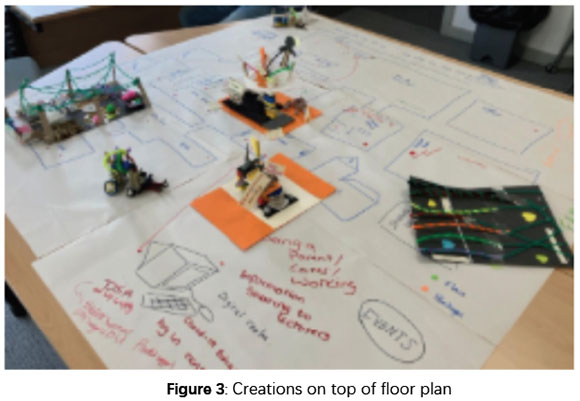
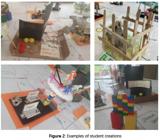
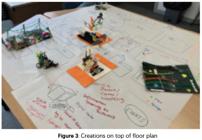
Following this, students engaged with multi-textural materials (clay, Lego, fabric, craft tools) to create artefacts as interventions for identified blockages, drawing on matter's vibrancy (Bennett, 2010; Barad, 2007). These were shared and placed on the floor plan, sparking material conversations between space, experience, and vision (Figures 2-3), functioning as both symbolic and practical offerings, blueprints of what a more responsive, inclusive, and navigable institution might look and feel like.
Data analysis unfolded iteratively within the workshop itself, emerging through conversations, artefact-making, spatial mapping, digital reflections, and our revisits to student-generated materials. We introduced participants to diffractive principles and to key ideas from new materialist and post-human scholarship, for example, the agency or 'thing power' of objects (Bennett, 2010) and their active role in shaping experience. Knowledge here developed through relational entanglements rather than linear coding.
Rather than applying a prescribed sequence of methods, we followed what St. Pierre (2018) calls an "unending consideration" of epistemological and ontological commitments. Such moments enable knowledge to be produced differently (St. Pierre, 1997), unsettling dominant interpretive traditions that echo colonial logics (Kuby & Bozalek, 2022). Diffractive practice challenged the dominance of language as the primary sense-making tool. Haraway warns that language can flatten complexity into a 'same elsewhere' (in Bozalek & Zembylas, 2017: 111), while Barad (2007: 30) describes diffraction as 'reading insights through one another' to illuminate emergent differences and their exclusions.
Guided by Bozalek and Zembylas (2017), we did not aim to decode participants' meanings but to stay with the generative mess of the workshop and attend to what surfaced. Diffractive reading, as Dolphijn and van der Tuin suggest, invites 'inventive provocations', where matter and meaning co-compose (cited in Bozalek & Zembylas, 2017: 115). These commitments animated each stage of the workshops, asking us to read across unfolding threads of inquiry (Cho & Ardichvili, 2024). The process was less a sequence than a weaving: storytelling, making, discussing, and reflecting continually fed into one another, generating a constellation of affective-material insights (Fox & Alldred, 2014).
The initial mapping activity, where students used colour-coded markers to trace flows and blockages across a university floor plan, produced more than logistical information. It generated spatial stories of belonging and constraint; affective fields entangled with architecture, policy, and everyday student life. Such multisensory mappings resonate with Powell's (2010) argument that mapping can be an embodied mode of inquiry attuned to emotion and movement.
Material-making extended these insights. Through clay, Lego, ribbon, and other tactile tools, students responded not only with words but with gestures, textures, and forms. These artefacts did not simply represent ideas; they shaped them, enabling forms of thinking that might remain inaccessible in more conventional modes (McGowan, et al., 2022). This material work folded back through the maps and conversations, opening alternative imaginings of institutional life.
Group discussions wove these threads further, as artefacts were returned to the map and new resonances emerged. Meaning moved in the tensions and atmospheres between people, materials, and moments (Di Mascio, et al., 2020). Final reflections, captured collectively in an evolving MindMeister map, continued this diffractive process where ideas were echoing, entangling, and being re-traced.
As researchers, we recognised ourselves as part of this diffractive apparatus, not as distant observers but as situated, responsive participants. Our reflections and affects formed part of the analytic process. Diffraction thus became not only a mode of analysis but an ethico-onto-epistemological orientation; one that privileges partiality and responsiveness (Murris, 2022). By lingering in the overlaps between stories, artefacts, space, and reflection, diffractive analysis enabled a richer understanding of minoritised students' experiences, not as problems to be fixed but as affective-material becomings that help reimagine what higher education might yet become.
Generated knowledge
Post workshop, the facilitators diffracted across the stories, artefacts, spatial mappings, and collaborative reflections. From this, five key diffractive patterns began to shimmer to the surface. Rather than emerging through a rigid process of categorisation, these diffractive patterns glowed with affective charge (MacLure, 2013) drawing attention not only by volume or frequency but by their capacity to disturb, resonate, and stay with us. These were not simply topics students mentioned, but sites of intensity that flickered with possibility. What follows, then, are the constellations that shone most brightly through our entangled process of inquiry.
Feedback and assessment
Students expressed a strong desire for more relational, dialogic, and consistent approaches to assessment, particularly where feedback was concerned. Concerns were raised around variability between departments and staff, which created uncertainty around expectations and fairness. The institutional tendency toward blind marking practices was seen as alienating and disempowering, reinforcing a sense of being "done to" rather than engaged as co-participants in the learning process. These concerns echo findings by Ardill (2025), who highlights that peer feedback in UK higher education is most effective when students engage dialogically, promoting critical thinking and self-reflection. They also reflect concerns about anonymous marking, with Pitt and Winstone (2018) finding that it can erode feedback's learning potential and weaken the student-lecturer relationship, which is central to relational learning. One student commented:
Sometimes you get feedback, but it doesn't speak to you ... it doesn't feel like it was meant for you. Then you wonder, was I even seen in this work?
This resonates with Freire's (2017) critique of the banking model of education, where students are treated as passive recipients of knowledge and evaluation, rather than active contributors. Within such a model, feedback becomes a transmission rather than a conversation, further distancing students from ownership of their learning. The experience of depersonalised and disconnected feedback in this study reflects this model in action.
Participants instead advocated for more democratised, participatory approaches to assessment, including peer-to-peer assessment, negotiated criteria, and dialogic feedback practices. These ideas echo recent calls to reframe assessment as an inclusive, student-centred process (Enow, 2023) and align with Black and Wiliam's (1998) distinction between assessment of and assessment for learning. For many students, the emotional tone and perceived intention of feedback were as significant as its content, suggesting that assessment is a key site where belonging and exclusion are materially and effectively negotiated.
This echoes growing calls to treat assessment not just as a pedagogic checkbox, but as a deeply political and ethical practice, one with the power to either prop up or prise open the structures of inequality in higher education (Tai, et al., 2022). From students' perspectives, assessment often came across as a curious paradox: a tool designed to support learning that sometimes made them feel unseen, unheard, and unsure. They described it as both a potential flow and a frequent blockage (Cramp, 2011). When feedback was vague, criteria unclear, or approaches varied wildly between modules, it created what one participant called
a guessing game with high stakes.
But students didn't just critique, they imagined otherwise. They called for assessment practices that were less about passing judgement and more about opening conversation. Feedback, in their view, should feel like an invitation, not a verdict. Practices rooted in care, clarity, and co-creation flickered through the data, offering glimpses of what's possible. When assessment becomes something we do with students rather than to them, it can become a site not just of academic development but of belonging, recognition, and relational trust (Carless & Boud, 2018).
Data sharing
Students raised powerful concerns about the ways their personal information, especially related to disability, health, and support needs, flowed (or didn't flow) through the university. Many described a system that felt both fragmented and impersonal, where the responsibility for disclosure fell squarely on their shoulders, again and again. One student said:
It's like the elephant in the room ... I have to explain myself over and over. I just wish it was something the staff already knew, or at least asked about properly.
Despite formally disclosing their needs during enrolment or through support plans, students often found themselves caught in a loop of re-explaining, re-negotiating, and re-justifying their support. This was described as not just inconvenient; it was emotionally draining. As another student shared:
Every time I walk into a new module, I have to brace myself for that conversation. It's exhausting before I've even started learning.
They expressed a strong wish for a system in which a single, sensitive disclosure could travel with them, intelligently, ethically, and usefully, across departments. Not to mark them as a problem to manage, but to affirm their right to equitable and seamless support. Their vision was one of shared responsibility: where academic and pastoral staff would not only be aware of support needs, but would see this awareness as an ordinary part of relational, inclusive practice.
This is not a new challenge. Research has long noted that poor communication between support services and teaching teams undermines inclusion (Morton & Haines, 2022; Vickerman & Blundell, 2010). The Higher Education Policy Institute (HEPI, 2022) and Office for Students (OfS, 2021) both cite fragmented systems as a structural barrier to equity. Meanwhile, Pearson and Riddell (2021) highlight that the labour of managing one's own reasonable adjustments often contributes to a sense of marginalisation, especially for disabled and neurodivergent students.
But again, students weren't only pointing out cracks, they were sketching blueprints. They imagined support data not as a cold, administrative file, but as something more relational: a quiet gesture of care, passed along the corridors of the institution. Within a New Materialist frame (Barad, 2007), this is more than a policy tweak, it's an invitation to see support information as affective matter, pulsing through systems, shaping encounters, and deserving of ethical attention (Drake, 2021). To respond, institutions must move beyond siloed systems and commit to joined-up infrastructures, where academic and pastoral staff are not simply informed after the fact, but meaningfully included in a shared, anticipatory approach to student support (Hughes, et al., 2021). When disclosure becomes a collective, well-held act rather than a solitary burden, the university begins to feel a little more human, and a lot more just.
Relationships - An ethic of care
The centrality of relationships, academic, peer, and community-based, shimmered throughout the data as a vital thread in students' experience of higher education. Again and again, participants pointed not to policies or procedures, but to people: the ones who listened, noticed, remembered their name. What students longed for was not more intervention, but more connection, more moments of genuine recognition within a system that often felt procedural and distant. This was particularly clear in discussions about the Academic Personal Tutor (APT) system. While the APT role is designed to support holistic student development, many students described it as transactional or mismatched, something done to them rather than with them. One student reflected:
You can't just allocate care, it has to be relational, not transactional. If we could choose tutors based on where we connect, it would feel more real.
This quote cuts to the heart of a deeper critique: that institutional care cannot be standardised. It echoes the work of Noddings (2013) and Tronto (1993), who argue that ethical care is not simply about provision but about attentiveness, responsiveness, and trust. Similarly, Zembylas (2012) reminds us that care, when wielded as a policy instrument without affective investment, can become a soft form of control. Students here weren't asking for more check-ins, they were asking for more attunement.
Relationships with peers were also described as a critical source of support, especially those that cut across disciplines and year groups. Students expressed a desire for more structured opportunities to mix across subject areas and stages of study, arguing that diverse social learning spaces enriched not just their sense of belonging but their critical engagement too. This resonates with Felten and Lambert's (2020) call for relational learning communities that foster shared inquiry and communal knowledge-building.
Beyond the university, students imagined expanded relational constellations, with alumni, local networks, and research collectives. These desires were not framed as extra-curricular perks, but as central to meaningful learning. In a New Materialist sense (Braidotti, 2013), we might think of these as calls for broader affective flows, energetic exchanges that carry ideas, confidence, and care across human and non-human actors (Bennett, 2010), during and post student studies.
Taken together, students revealed both the fragility and the transformative potential of relationship-making in higher education. Where meaningful relationships bloomed, students spoke of trust, motivation, and mutual accountability, echoing research (Hughes, et al., 2021) that connects relational engagement with increased academic persistence and sense of belonging (Lizzio, 2006). Where these connections were absent or imposed, blockages formed, marked by disengagement, isolation, or frustration. Students offered practical ideas to foster better relational flow: allowing students to choose their tutors, building cross-cohort learning communities, and structurally embedding care within staff development. This aligns with findings by Miller and Naidoo (2023), who show that tutor-student matching based on shared interests and values supports deeper connection. As one participant succinctly put it:
I just want to feel like someone's got my back.
Spaces
Students reflected critically on the spatial politics of university life, highlighting how the design, use, and unspoken expectations of physical environments directly impacted their capacity to belong, to think, and to be well. They spoke of a need for spaces that enabled sensory regulation, rest, and contemplation, particularly in response to mental health challenges and overwhelming academic expectations (Samra, et al., 2023). As one participant noted:
Sometimes you need a place to breathe, not just a place to work.
These reflections echo Freire's (2017) call for learning spaces that support critical consciousness and liberation, not merely passive consumption. They also align with Noddings' (2013) ethics of care, which foreground the moral imperative to design educational spaces that foster wellbeing, not burnout. Across conversations, students identified how certain environments seemed to carry an 'implied pedagogy', that is, a hidden curriculum embedded in spatial design. Some spaces, like the library or lecture theatre, were described as formal and hierarchical, silently scripting how students should behave. Others, like the university bar, were seen as socially coded in ways that excluded those who did not align with dominant cultural norms. Bennett's (2010) concept of thing-power becomes helpful here: these spaces didn't just host student life, they acted, shaping feelings, behaviours, and even the possibility of belonging through their affective charge.
The critique did not stop with physical space. Lecture theatres were often described as spatially and pedagogically inflexible, echo chambers that reinforced passivity and distance (Swinnerton, 2021). Students called for dynamic, adaptable environments where learning could unfold collaboratively. This included accessible digital infrastructure, quiet rest zones, and cross-purpose communal areas. These suggestions resonate with work by Le Grange (2020), who advocates for ecopedagogical spaces that allow for plurality, relationality, and embodied knowing. As students in this study noted, belonging does not just happen in timetabled sessions, it emerges in corridors, nooks, chat windows, and the ambient space between.
Finally, students nudged the university to pay closer attention to the real stuff of student life, the messy, shifting, and often precarious conditions they navigate daily. For those balancing part-time jobs, care responsibilities, and housing insecurity, space is not just about ambience or architecture, it concerns access, survival, and feeling like you belong in the first place. Standing's (2021) reflections on the rise of the academic precariat ring loudly here, reminding us that inequality often wears a very practical disguise. If higher education is serious about inclusion, then its spaces must do more than look good on a brochure. The Matter that matters to the student's journey must flex, breathe, and bend, multimodal, sensorially attuned, and ready to welcome the many ways of being a student (Papaioannou, et al., 2023).
Mentoring
Particularly peer and alumni mentoring was described by students as a profoundly relational and stabilising form of support, integral to their sense of belonging and purpose. Students spoke not only of receiving guidance, but of the reciprocal benefits of mentoring others, describing it as emotionally affirming, identity-shaping, and motivating (Nabi, et al., 2024). One student shared:
I feel the benefit of working with students who are older than me ... because they have had different life experiences, they are able to give me advice, and I am able to give it back
Another student reflected on its impact on well-being:
(Having a good mentor) means that I haven't really had to access mental health support ... I feel supported in other areas.
Peer mentoring emerged as a form of community care, one that both reflects and enables a sense of belonging (Gravett, 2022). These organic systems of support align with hooks' (2003) vision of communities of hope, where knowledge is not transmitted vertically but shared dialogically in ways that affirm life experience and foster collective flourishing. Students also noted how the act of mentoring brought meaning to their university journey:
Peer mentoring works both ways … I'm really excited for my mentees [when they get high grades] ... it has given me a purpose this year.
This idea of relational and developmental mentoring resonates with Bronfenbrenner's ecological model, where academic, emotional, financial, and social systems interact fluidly to shape the student experience (Bronfenbrenner, 1979). Students in this study emphasised that mentoring does not simply work by existing, it must be visible, well-timed, and safe to access. Crucially, they pointed to transition points, such as course entry, final year, and graduation, as moments when scaffolding was most needed. Mentoring at these junctures was seen not just as supportive, but transformative: helping students shift from uncertainty to a sense of readiness.
This emphasis on timing finds support in Collings, et al. (2016), who observed that while peer mentoring uptake is initially high, engagement often drops after just ten weeks, suggesting the need for sustained, rather than episodic, connection. Likewise, Hodgson, et al. (2023) highlight how near-peer mentoring schemes thrive when institutions remain actively involved, ensuring timely promotion and clear staff support. Taken together, these insights point to mentoring not as a standalone fix, but as part of a relational infrastructure, one that must be carefully tended if it is to nurture belonging, confidence, and purpose across the student journey. As one student summarised:
So, by the end we are ready to face the world.
Thomas, et al. (2021) remind us that mentoring is most impactful when it's both structured and supple, able to flex with the shifting contours of student identities, experience, and need. It is not a one-size-fits-all intervention but a practice that flourishes when designed with care, context, and continuity in mind. Likewise, Collings, et al. (2016) emphasise that mentoring operates most powerfully as a relational infrastructure. When thoughtfully enacted, it becomes a socially just practice, quietly stitching together the spaces where more formal systems fall short and offering something deeply human in the gaps. Taken together, these mentoring narratives shimmer with potential. They invite us to see support not as a mechanised procedure but as a living, breathing, relational act. What emerged in this study was not mentoring as a box to tick, but as a connective tissue that loops gently through the everyday messiness of student life. It threads through belonging, resilience, identity and care. And like all the diffractive patterns explored here, its impact rests not only in what is provided, but in how it is offered, how it is received, and how it is carried forward, through time, through relationship, and through the small, intentional acts that let students know they matter.
Next steps
Whilst acknowledging the gap around minoritised student experience of systems and processes in higher education adopting a New Materialist approach, we focused on the situatedness of minoritised students within the distinctive ecology of a small university. Rather than treating their experiences as abstract or easily generalisable across contexts, we attended to how these experiences are produced through the particular material, affective, spatial, and procedural entanglements that shape everyday academic life. Through a series of diffractive patterns, we have explored how minoritised student experiences are created through their entanglements with, in and through systems and processes. Key findings include how students advocated for more democratised, participatory approaches towards assessment which are designed in such a way as to not meet the needs of minoritised students. This could help address unequal practices and the higher stakes faced by minoritised students exposed to assessment and wider educational norms (Bourdieu, et al., 1994) not designed to meet their divergent needs. An awareness of this is crucial for higher education educators to respond in supportive and equitable educational ways, co-creating with their students to ensure all equally have a chance to thrive. Furthermore, a more 'joined up' relational approach could relieve minoritised students of additional burdens related to explaining personal needs and adaptive practice requirements that other students do not typically have to disclose or consider.
There was a palpable desire for greater belonging from students, to counteract feelings of isolation and promote critical engagement and authentic connection (Gravett & Winstone, 2022) which can be especially acute with LGBTQ+ students who are more likely to feel welcome in higher education (Greathouse, et al., 2018) than their cisgender, heterosexual peers. One of the most salient proposals was through greater attention to peer and alumni mentoring to facilitate the emerge of this 'community of care' (Gravett, 2022).
Rather than treating the findings of this project as fixed conclusions, we have approached them as ongoing diffractions, ripples and reverberations that continue to intra-act with institutional life, pedagogical practice, and student possibility. The diffractive patterns explored; assessment and feedback, data sharing, relationships, space, and mentoring, have not been shelved as past insights, but carried forward as affective provocations and guides for institutional change.
One further key development has been the continuation of our discussions as a research team, carrying forward the key themes that have arisen from students. The introduction of talking circles to both staff and students, have offered a relational, low-barrier space for disclosure, support and continuing narrative for institutional change. Framed through an ethics of care (Noddings, 2013), these have created opportunities for staff and students to speak into and with their lived experiences, without the pressure to justify or relive them in isolation. Early evaluations, such as Brown and Di Lallo (2020), suggest that talking circles foster trust, deepen listening, and create socially safe spaces where reflection and change can begin, not as policy mandates, but as shared human practice.
Reflections on assessment have sparked new lines of action within staff development and course design. Through dialogue and artefact making, practices are being reimagined through a dialogic and co-constructed lens, with emphasis on clarity, relational feedback, and closing awarding gaps, particularly by engaging with anti-racist pedagogies and student-led marking criteria pilots (Lepanez, et al., 2024). These actions move assessment from a mechanism of judgement toward a shared site of care and belonging.
In response to students' call for intentional relationships, efforts are underway to make the Academic Personal Tutor system more flexible, embedded into student modules and to include the exploration of student-informed matching models (Boulton, et al., 2022). Likewise, the theme of space has contributed to institutional conversations about the sensory, affective, and architectural dimensions of learning. Considerations arising from this project include auditing existing social and study spaces through a belonging lens (Temple, 2008), investing in quiet zones and restorative areas, and for staff to acknowledge spatial access as a matter of modular design and integration, not just for recreational use.
Meanwhile, insights around mentoring have shaped proposals for scaffolded support at key transitions within courses, with new structures for alumni-student mentoring being trialled in partnership with programme teams. A student-led peer mentoring network is ongoing and continues to build on the foregrounding reciprocal care and fostering community (Dawson, et al., 2014) across all study levels. Beyond the university, this work has also begun to travel. In June 2025, the project was presented at the British Sociological Association (BSA) Annual Conference, where it sparked generative discussions around relational methodologies and institutional critique.
Finally, these insights have shaped our own practices: informing doctoral studies, modular designs, and pedagogical decisions. As educators and researchers, we are reminded that inquiry does not end at publication, it folds back into the very assemblages that made it possible. What began as an inquiry into blockages and flows has become a living invitation: to listen diffractively, act ethically, and imagine university life otherwise.
Declaration of generative AI and AI-assisted technologies in the writing process
The authors did not use any generative AI or AI-assisted technologies in the preparation of this manuscript. Grammarly has been used to check spelling and grammar, without the AI function.
References
- Accioly, I. & Macedo, D. (Eds.). 2021. Education, Equality and Justice in the New Normal : Global Responses to the Pandemic. London: Bloomsbury Academic.
- Ahn, M. & Davis, H. 2020. Four domains of students' sense of belonging to university. Studies in Higher Education, 45(3): 622-634.
- Allen, L., Cowie, L. & Fenaughty, J. 2020. Safe but not safe: LGBTTIQA+ students' experiences of a university campus. Higher Education Research & Development, 39(6): 1075-1090.
- Alvarez, R., Van Krevelen, D., Crisp, C., Mavenga, G. & Karpova, E. 2022. From technology to community: The role of artefacts in teaching and learning during COVID-19. Teaching in Higher Education, 27(3): 281-299.
- Arday, J. & Mirza, H.S. 2018. Dismantling Race in Higher Education: Racism, Whiteness and Decolonising the Academy. Cham: Palgrave Macmillan.
- Ardill, N. 2025. Peer feedback in higher education: student perceptions of peer review and strategies for learning enhancement. European Journal of Higher Education, 15(4): 696-721.
- Ash, J., Bradley, J., Mialanes, J., Brady, L., Evans, E., Barrett, D., David, B., Wesley, D., Dotte-Sarout, E., Rowe, C., Urwin, C. & Manne, T. 2022. Marra philosophies of stone, and the stone artefacts of Walanjiwurru 1 rockshelter, Marra Country, northern Australia. Journal of Anthropological Archaeology, 68: 101456.
- Barad, K. 2007. Meeting the Universe Halfway: Quantum Physics and the Entanglement of Matter and Meaning. Durham, NC: Duke University Press.
- Bennett, J. .2004. The force of things: Steps toward an ecology of matter. Political Theory, 32(3): 347-372.
- Bennett, J. 2010. Vibrant Matter: A Political Ecology of Things. London: Duke University Press.
- Bhambra, G.K., Gebrial, D. & Nişancıoğlu, K. (Eds.). 2018. Decolonising the University. London: Pluto Press.
- Black, P. & Wiliam, D. 1998. Assessment and classroom learning. Assessment in Education: Principles, Policy & Practice, 5(1): 7-74.
- Boulton, C., Mycock, L. & Bennett, K. 2022. Personal tutoring practice in UK higher education: Toward relational, context-responsive models. British Educational Research Journal, 48(5): 1085-1103.
- Bourdieu, P., Passeron, J.C. & De Saint., M 1994. Academic Discourse: Linguistic Misunderstanding and Professiorial Power. Education Sociology/ Theory and Methods. Stanford University Press.
- Bozalek, V. Zembylas, M. 2016. Critical posthumanism, new materialisms and the affective turn for socially just pedagogies in higher education : Part 2 - Editorial. South African Journal of Higher Education, 30(3): 193-200
- Braidotti, R. 2010. The politics of 'life itself. In Coole, D. & Frost, S. (Eds.). New Materialisms: Ontology, Agency and Politics. Durham and London: Duke University Press, 201-218
- Braidotti, R. 2012. Nomadic ethics. In Smith, D. & Somers-Hall, H. (Eds.). The Cambridge Companion to Deleuze. Cambridge: Cambridge University Press, 170-197.
- Braidotti, R. 2013. The Posthuman. Cambridge, UK: Polity Press.
- Bronfenbrenner, U. 1979. The Ecology of Human Development: Experiments by Nature and Design. Cambridge, MA: Harvard University Press.
- Brown, K. & Di Lallo, A. 2020. The impact of restorative circles on student perceptions of school climate and social connection. Educational Action Research, 28(4): 705-722.
- Carless, D. & Boud, D. 2018. The development of student feedback literacy: enabling uptake of feedback. Assessment & Evaluation in Higher Education, 43(8): 1315-1325.
- Carter, S.P. 2022. Nomadic ethics: Attending to the ghosts we cite. Art/Research International: A Transdisciplinary Journal, 7(1): 29-46.
- Caruthers Thomas, K. 2016. Part-time spaces: Rethinking belonging in higher education. Enduring Inequalities and New Agendas for Widening Participation in Higher Education, Leeds, 27 July. Paper presented at conference
- Cho, J. & Ardichvili, A. 2024. Appreciative inquiry as an ethnographic method: A generative approach to qualitative research. International Journal of Qualitative Methods, 23: 1-12.
- Collings, R., Swanson, V. & Watkins, R. 2016. Peer mentoring during the transition to university: Assessing the outcomes for mentors and mentees. Journal of Educational Psychology, 108(3): 374-385.
- Coole, D. & Frost, S. (Eds.). 2010. New Materialisms: Ontology, Agency, and Politics. Durham, NC: Duke University Press.
- Cramp, A. 2011. Developing first-year engagement with written feedback. Active Learning in Higher Education, 12(2): 113-124.
- Croziera, G., Reay, D. & Clayton, J. 2019. Working the Borderlands: Working-class students constructing hybrid identities and asserting their place in higher education. British Journal of Sociology of Education, 40(7): 922-937
- Deleuze, G. 1988. Spinoza: Practical Philosophy. Translated by Robert Hurley. San Franscisco: City Light Books.
- Deleuze, G. & Guattari, F. 1987. A Thousand Plateaus: Capitalism and Schizophrenia. Translated by B. Massumi. Minneapolis: University of Minnesota Press.
- Di Mascio, T., Nebbia, G. & Trevisan, A. 2020. Scripting, situating, and supervising: The role of artefacts in designing collaborative practices. Sustainability, 12(16): 6407.
- Drake, J. 2021. The Energetic Dimension: Understanding Relational and Affective Pedagogies. London: Routledge.
- Edgar, A., Johnson, B. & Dixon, S. 2024. "A debt on your heart": Exploring the impact of student precarity on Education Studies students at a UK university. Educational Futures, 15(2): 61-83.
- Enow, L. 2023. Democratising assessment: A student-led approach. Warwick Journal of Education, 3(1): 45-58.
- Felten, P. & Lambert, L.M. 2020. Relationship-Rich Education: How Human Connections Drive Success in College. Baltimore, MD: Johns Hopkins University Press.
- Flett G. 2018. The Psychology of Mattering: Understanding the Human Need to be Significant. Academic Press.
- Fox, A. 2021. Folklore and fraudulent collegiality: Perpetuating patriarchal culture in women-majority academic departments. Taboo: The Journal of Culture and Education, 20(1)
- Fox, N.J. & Alldred, P. 2014. New materialist social inquiry: Designs, methods and the research-assemblage. International Journal of Social Research Methodology, 18(4): 399-414
- Fox, N. & Alldred, P. 2017. Sociology and the New Materialism. London: Sage.
- Freire, P. 2017. Pedagogy of the Oppressed. 4th edn. London: Bloomsbury Academic.
- Giroux, H.A. 2014. Neoliberalism's War on Higher Education. Chicago, Illinois: Haymarket Books.
- Gov. 2010. The Equality Act. Available at: https://www.legislation.gov.uk/ukpga/2010/15/contents (Accessed: 6 February 2026)
- Gov. 2019. English indices of deprivation 2019. Available at: https://www.gov.uk/government/statistics/english-indices-of-deprivation-2019 (Accessed: 1 May 2025).
- Gravett, K. 2022. Belonging in Higher Education: Making the Invisible Visible. London: Bloomsbury Academic.
- Gravett, K. & Ajjawi, R. 2021. Belonging as situated practice. Studies in Higher Education, 47(7): 1386-1396.
- Greathouse, M., BrckaLorenz, A., Hoban, M., Huesman, R., Rankin, S. & Stolzenberg, E.B. 2018. A meta-analysis of queer-spectrum and trans-spectrum student experiences at US research universities. Evaluating Campus Climate at US Research Universities, 49-75
- Guyotte, K., Flint, M. & Latopolski, K. 2019. 'Cartographies of belonging: mapping nomadic narratives of first-year students', Critical Studies in Education, 62(5): 543-558.
- Haraway, D. 2016. Staying with the Trouble: Making Kin in the Chthulucene. Durham/London: Duke University press.
- Higher Education Policy Institute (HEPI). 2022. Support for Disabled Students in Higher Education in England. Available at: https://www.hepi.ac.uk/2022/04/07/support-for-disabled-students-in-higher-education-in-england (Accessed: 22 June 2025).
- Hodgson, Y., Shields, R., O'Sullivan, J. & Sadler, R. 2023. Design and sustainability of near-peer mentoring programmes in medical education: A UK case study. Medical Teacher, 45(2): 156-164.
- Holman, S. & Harris, A. 2021. Placing the poetic: Mess, meaning and affect in post-qualitative research. International Journal of Research & Method in Education, 44(5): 432-443.
- hooks, b. 2003. Teaching Community: A Pedagogy of Hope. New York: Routledge.
- Hughes, G., Panjwani, M., Tulcidas, P. & Byrom, N. 2021. Student Mental Health: The Role and Experiences of Academics. London: Student Minds.
- Iorwerth, H. 2020. Cynefin and sense of belonging in Welsh Higher Education. Wales Journal of Education, 22(2): 121-140.
- Iorwerth, H. .2020. Exploring Cynefin as a place-based pedagogy in higher education: A Welsh perspective. Journal of Higher Education Policy and Management, 42(6): 607-621.
- Kersting, K. & Jazcilevich, D. 2020. Objects in focus groups: Materiality and shaping multicultural encounters. Qualitative Research, 20(6): 702-719.
- Knox, J. 2016. Posthumanism and the Massive Open Online Course: Contaminating the Subject of Global Education. United Kingdom: Routledge,
- Kuby, C. & Bozalek, V. 2022. Research. In Murris, K. (Ed.). A Glossary for Doing Postqualitative, New Materialist and Critical Posthumanist Research across the Disciplines. London: Routledge, 110-111.
- Leibowitz, B., Bozalek, V. & Kahn, P. (Eds.). 2017. Theorising Learning to Teach in Higher Education. London: Routledge, 2017
- Le Grange, L. 2020. The need for eco-pedagogy in the Anthropocene. Educational Philosophy and Theory, 52(3): 309-319.
- Lepañez, I., Brown, A. & Smith, K. 2024. Co-designing assessment tasks with students in tertiary education: Scoping review and exploratory co-creation framework. Assessment & Evaluation in Higher Education, 49(2): 215-230.
- Lizzio, A. 2006. "Being there": student participation in teacher preparation. Higher Education Research & Development, 25(4): 411-428.
- Maringe, F. & Chiramba, O. 2022. Disruptions in higher education: Mitigating issues of access and success in the Covid-19 Pandemic. South African Journal of Higher Education, 36(4): 6-20.
- Maclure, M. 2013. The wonder of data. Cultural Studies - Critical Methodologies, 13(4): 228-232.
- McGowan, G., Hoffstaedter, G. & Creese, J. 2022. Three approaches to haptic knowledge making: Tactile artefacts in learning anthropology. Teaching Anthropology, 11(1): 27-40.
- Miller, D. & Naidoo, V. 2023. Understanding student-tutor relationship characteristics that support engagement in first-year university students. Teaching in Higher Education, 28(1): 58-74.
- Morton, M. & Haines, S. 2022. Exploring experiences of disclosure and support among disabled students in higher education. Disability & Society, 37(8): 1301-1320.
- Murris, K. 2022. A Glossary for Doing Postqualitative, New Materialist and Critical Posthumanist Research Across Disciplines. London: Routledge.
- Nabi, G., Walmsley, A., Mir, M. & Osman, S. 2024. The impact of mentoring in higher education on student career development: a systematic review and research agenda. Studies in Higher Education, 50(4): 739-755.
- Noddings, N. 2013. The Ethics of Care: Personal, Political, and Global. Berkeley, CA: University of California Press.
- Office for Students (OfS). 2021. Mental Health and Wellbeing. Available at: https://www.officeforstudents.org.uk/advice-and-guidance/student-wellbeing-and-protection/mental-health-and-wellbeing/ (Accessed: 22 June 2025).
- Papaioannou, G., Volakaki, M.-G., Kokolakis, S. & Vouyioukas, D. 2023. Learning spaces in higher education: A state-of-the-art review. Trends in Higher Education, 2(3): 526-545.
- Parkes, S., Blackwell-Young, J., Cleaver, E. & Archibald, K. 2014. Academic and Professional Services in Partnership Self-Assessment Toolkit. Available at: https://s3.eu-west-2.amazonaws.com/assets.creode.advancehe-document-manager/documents/hea/private/resources/prof_service_partnerships_toolkit_final_201214_updated_1568037078.pdf (Accessed: 12 June 2014).
- Pearson, C. & Riddell, S. 2021. Navigating disclosure: disabled students' experiences of negotiating identity and support in higher education. Studies in Higher Education, 46(11): 2344-2356.
- Pitt, E. & Winstone, N. 2018. The impact of anonymous marking on students' perceptions of fairness, feedback and relationships with lecturers. Assessment & Evaluation in Higher Education, 43(7): 1183-1195.
- Quinn, J. 2010. Learning Communities, and Imagined Social Capital: Learning to Belong. London: Continuum.
- Ross, N. 2021. My octopus teacher, posthumanism, and posthuman education: A pedagogical conceptualization. Journal of Curriculum Theorizing, 36(2): 1-15
- Samra, R., França, A.B., Lucassen, M.F.G. & Waterhouse, P. 2023. A network approach to understanding distance learners' experience of stress and mental distress whilst studying. International Journal of Educational Technology in Higher Education, 20(1): 1-24.
- Seal, M. 2021. No homo: Reactions to the interruption of heteronormativity on a youth and community work course. Journal of LGBT Youth, 18(4): 459-489.
- Sheridan, M.P., Lemieux, A., Do Nascimento, A. & Arnseth, H.C. 2020. 'Intra-active entanglements: What posthuman and new materialist frameworks can offer the learning sciences. British Journal of Educational Technology, 51(4): 1011-1025.
- Standing, G. 2021. The Precariat. London: Bloomsbury
- St. Pierre, E.A. 1997. 'Methodology in the fold and the irruption of transgressive data. International Journal of Qualitative Studies in Education, 10(2): 175-189.
- St. Pierre, E. 2016. The empirical and the new empiricism. Cultural Studies-Critical Methodologies, 16(2): 111-124.
- Standing, G. 2021. The Precariat: The New Dangerous Class. 3rd Edn. London: Bloomsbury Academic.
- Swinnerton, B. 2021. Collaborative lecture theatres: does redesign of teaching space impact on pedagogy? Journal of Learning Spaces, 10(3): 1-10.
- Tai, J., Ajjawi, R., Bearman, M. & Boud, D. 2022. Reframing feedback in higher education: A matter of identity. Assessment & Evaluation in Higher Education, 47(4): 527-539.
- Taylor, C. 2016. Edu-crafting a cacophonous ecology: Posthumanist research practices for education. In Taylor, C. & Hughes, C. (Eds.). Posthuman Research Practices in Education. London: Palgrave Macmillan, 5-24.
- Taylor, C. 2021. Knowledge matters: Five propositions concerning the reconceptualisation of knowledge in feminist new materialist, posthumanist and postqualitative approaches. In Murris, K. (Ed.). Navigating the Postqualitative, New Materialist and Critical Posthumanist Terrain across Disciplines: An Introductory Guide. London: Routledge, 22-42
- Taylor, C. & Ivinson, G. 2013. Material feminisms: New directions for education. Gender and Education, 25(6): 665-670.
- Temple, P. 2008. Learning spaces in higher education: an under-researched topic. London Review of Education, 6(3): 229-241.
- Thomas, L. 2012. Building Student Engagement And Belonging In Higher Education At A Time Of Change, What Works? Student Retention & Success. HE Academy. Available at: https://www.heacademy.ac.uk/system/files/what_works_final_report_0.pdf (Accessed: 12 January 2013).
- Thomas, L., Hill, M., O' Mahony, J. & Yorke, M. 2017. Supporting Student Success: strategies for institutional change. Paul Hamlyn Foundation, Action on Access, Higher Education Academy. Available at: http://www.phf.org.uk/wp-content/uploads/2017/04/Full-report-Final.pdf (Accessed: 11 September 2017).
- Thomas, L., Hill, M., Linton, D. & Hovdhaugen, E. 2021. Supporting Student Success: The Role of Personal Tutors and Peer Mentors in Higher Education. York: Advance HE. Available at: https://www.advance-he.ac.uk/knowledge-hub/supporting-student-success-role-personal-tutors-and-peer-mentors-higher-education (Accessed: 22 June 2025).
- Tronto, J.C. 1993. Moral Boundaries: A Political Argument for an Ethic of Care. New York: Routledge.
- Wakkary, R., Odom, W., Hauser, S., Hertz, G. & Lin, H. 2015. Material speculation: Actual artifacts for critical inquiry. CoDesign, 11(3-4): 199-215
- Zembylas, M. 2012. Pedagogies of strategic empathy: Navigating through the emotional complexities of anti-racism in higher education. Teaching in Higher Education, 17(2): 113-125.

Accepted: 17 April 2026