International engagement: Exploring best teaching practices in two different geographical contexts
Abstract
Transnational knowledge mobilities and connections without physical travel can make internationalisation in higher education more inclusive and equitable, moving beyond elitist trends that privilege those who can afford to travel abroad. To this end, a recent small-scale research project utilised digital tools for virtual communication between South African and Norwegian pre-service teachers. This article suggests that international engagement between pre-service teachers from the global south and global north can promote decolonisation by highlighting these teachers' lived experiences in diverse contexts. Employing empathetic-reflective-dialogical re-storying as a research methodology aligns with a decolonial approach, framing the process as participants focus on best teaching practices. Crossing geographical boundaries, pre-service teachers from two geographical contexts potentially reshaped their prior conceptions of best teaching practices.
Best teaching practices; decolonisation; empathetic-reflective-dialogical re-storying; internationalisation
Introduction
In this article, best practices in teaching means striving for academic and social transformation in school and classroom settings, regardless of context or resources. It involves teachers continuously pursuing lifelong learning to strengthen their professional identities (Faulkner & Latham, 2016) and improve their ability to provide optimal learning experiences for learners (Mart, 2013). Teachers in the 21st century are expected to be tech-savvy (Oldknow, 2016; Boholano, 2017) and proficient in fostering higher-order thinking, problem-solving skills, and practical knowledge application in real-life situations. Best practices also emphasise promoting collaborative student work and teacher inclusivity in diverse classrooms, considering language, culture, academic strengths/weaknesses, learning styles, and creating equitable learning environments (Bhagat, et al., 2015; Li & Ruppar, 2021). As opposed to what Freire (1970) refers to as the banking model of education, the promotion of critical thinking, problem-posing, and dialogue with students is favoured. Banking education is a traditional form of education where knowledge is seen as a deposit by the teacher, as an authority figure, into the minds of passive students. In this model, students are expected to memorise and reproduce this information without critical thinking or questioning. This very technicist approach undermines the notion of praxis, which refers to integrating theory and practice and the active engagement of students in critical thinking, problem-solving, reflection and reflexivity. Reflection involves deeply analysing practical issues, generating new insights, and improving practice (Fleming, 2007). This empowers individuals to question and enhance their self-understanding, boosting confidence in social participation (Fook & Askeland, 2007). In teaching, continuous self-evaluation is vital for professional development, regardless of the teaching context (Taole, 2018). It also supports teacher collaborations and innovative teaching methods (Sellars, et al., 2018) while promoting discussions on best practices, contributing to internationalisation and cross-contextual dialogues (Khoza, 2019). This process aligns with Reid's (2016) concept of reflexivity, involving inner reflection, self-awareness, understanding narratives, and adaptability in evolving pedagogical approaches.
Transcending disciplinary and geographical boundaries can encourage reflection and reflexivity among pre-service teachers in two different geographical contexts, namely South Africa and Norway. Doing so can also challenge the perception of inferiority in the Global South. There is a compelling sense that the Western/global north standard in all spheres, including education, has stood the test of time and is, therefore, superior. European is synonymous with global, while the African is deemed parochial (Tikly, 2022) This can be addressed by 'the foregrounding of local and indigenous knowledge and experiences in curricula content, thereby downplaying or eradicating Eurocentric or Global North experiences which have dominated curriculum contents for centuries' (Fomunyam & Teferra, 2017: 197). We set out to explore something of this in our international engagement, making the colonised visible in this arena of the Western superiority/African inferiority complex (Nukunah & Eccles, 2021; Tikly, 2022), raising consciousness of teaching-learning in the South African context. Mindful of the 'diverse ways through which different people view and make sense of the world (the paradigm of pluralism/globalectics/pluriversality)' (Ndlovu-Gatsheni, 2021:79) (also, Escobar, 2018; Ngugi wa Thiong'o, 2012; Reiter, 2018), we were agreed that the global south had something to offer the global north.
Literature Review: Internationalisation and decolonisation
Internationalisation is closely linked to globalisation, connecting countries, people, and cultures (Czaika & de Hass, 2015; Jibeen & Khan, 2015; Knight, 2015; Hassi & Storti, 2012; Maringe, 2010). In higher education, it is seen as a way to enhance educational quality. Humanising international education can be realised through recognising and validating diverse perspectives, experiences, and ways of building knowledges that students bring to the classroom (Marangell & D'Orazzi, 2023; Montgomery & Trahar, 2023; Sperduti, 2019; Tran, 2013). This enables international education to move away from privileging Western knowledge and dominant ways of thinking, doing and being in the curriculum. Joy and Kolb (2009) stress the importance of recognising contextual and cultural differences. Internationalising teacher education can equip students and teachers with skills for a globalised, diverse society (Abraham & Von Brömssen, 2018; McGregor & Volckmann, 2013; Nopas & Kerdsomboon, 2024). Setting internationalisation and decolonisation alongside each other may enable an understanding of, for example, knowledge production. Mbembe (2019: 17) provides a helpful definition of decolonisation as it relates to the internationalisation of higher education:
bringing as equitably as possible everybody, every person and every text, every archive and every memory in the sphere of care and concern. It has to do with proximity instead of insulation, with the invention in-common of a shared inside, a shared roof and a shared shelter.
Adopting this stance, we endeavoured to foster transnational knowledge mobilities and connections without physical travel to make internationalisation in higher education more inclusive and equitable, moving beyond elitist trends that privilege those who can afford to travel abroad. Across the global South, the proximity and access to the international and global are linked to the ability to import knowledge from the global North (Ndlovu-Gatsheni, 2021). We were hopeful that the pre-service teachers in the global north (in this case, Norway) would learn something from/about the global south, which has been side-lined (Acharya & Buzan, 2019). The international engagement would counter the hegemonic Eurocentric universality and encourage universality (Ndlovu-Gatsheni, 2021; Mignolo, 2005), a space where diverse knowledge and worldviews coexist and contribute to new ways of knowing and thinking (Santos, 2014, 2018).
A critical examination of decolonisation scrutinises global power imbalances, particularly the global north-south divide, encompassing theoretical, epistemological, and practical dimensions (Ndlovu-Gatsheni, 2019; Sium, et al., 2012; Tight, 2022). Ndlovu-Gatsheni (2013) refer to three dimensions of coloniality, namely, the coloniality of power (the broader historical political economy context against which education systems in the global South have emerged), knowledge (drawing attention to the broader discursive context based on Eurocentric and Western thinking), and being (which considers how the effects of the coloniality of power and knowledge has become embodied in teachers' work).
Colonial education was instrumental in embedding colonial curricula and textbooks promoting Western knowledge. In this way, it contributed to the marginalisation of indigenous religions, cultures and languages (Ngugi wa Thiong'o, 1986). It led to a split between educated, often urban elites who had access to Western education and the majority, predominantly rural population. Schooling under colonialism also reflected wider inequalities with opportunities to access education stratified along class, racial, ethnic, and gender lines.
A decolonial lens is helpful for contextualising the perspectives of teachers in the global South. The lived experiences and material conditions of these teachers are often neglected in dominant discourses. It is essential to situate teachers' perspectives in an understanding of local contexts and realities. Often missing from global literature is an understanding of teachers' perspectives, experiences, and conditions in formerly colonised, low- and middle-income countries. Western, Eurocentric understandings are promoted at the expense of more localised and indigenous understandings/perspectives (Mignolo, 2007) that take account of the scale and diversity of populations within the global South and pose a challenge to universalistic conceptions (Batra, 2020). Much can be learned about teacher professionalism from teachers in the global south and developing understandings sensitive to diverse and dynamic socio-cultural and political contexts. A decolonising approach seeks to foreground the diverse contexts, perspectives and lived experiences of teachers in the global south (Yee Yip & Chakma, 2024). This is pivotal for promoting knowledge pluralisation through diverse interactions, challenging existing relationships, and addressing inequalities through education, dialogue, communication, and actions (Martinez-Vargas, 2020).
Methodology
In 2016, two visiting academics from Bergen and Stord, Norway, met with two academics from Durban, in South Africa. This informal meeting and discussion led to collaborative work across academic traditions and geographical, gender, language, and ethnic boundaries. More recently, motivated by their respective Higher Education Institutions' (HEIs) directives to promote internationalisation, the colleagues, realising that physical exchange programmes would only be the privilege of a few, decided on a virtual international engagement between pre-service teachers in both global south and global north context. This study involved students from two Higher Education Institutions (HEIs) in South Africa and Norway within the Faculty of Education. Purposive sampling, was employed, inviting pre-service teachers to whom we had access in our education modules, to participate in the small-scale research project. Together with eight Social Sciences in Education Honours students representing nine disciplines (South Africa), nine Religion Education undergraduate students (Norway) participated in the project. The SA participants were black Africans, with one Asian participant. The Norwegian students were all white. There was a mix of males and females in both contexts. The ethical protocols and requirements set by both tertiary institutions' ethics committees were adhered to. We were also obligated to complete a notification form to obtain approval from the Norwegian centre for research data. Each participant was provided with a written description of the project and a research consent form for consideration. The students signed consent forms, and their anonymity was protected by using pseudonyms when citing their responses.
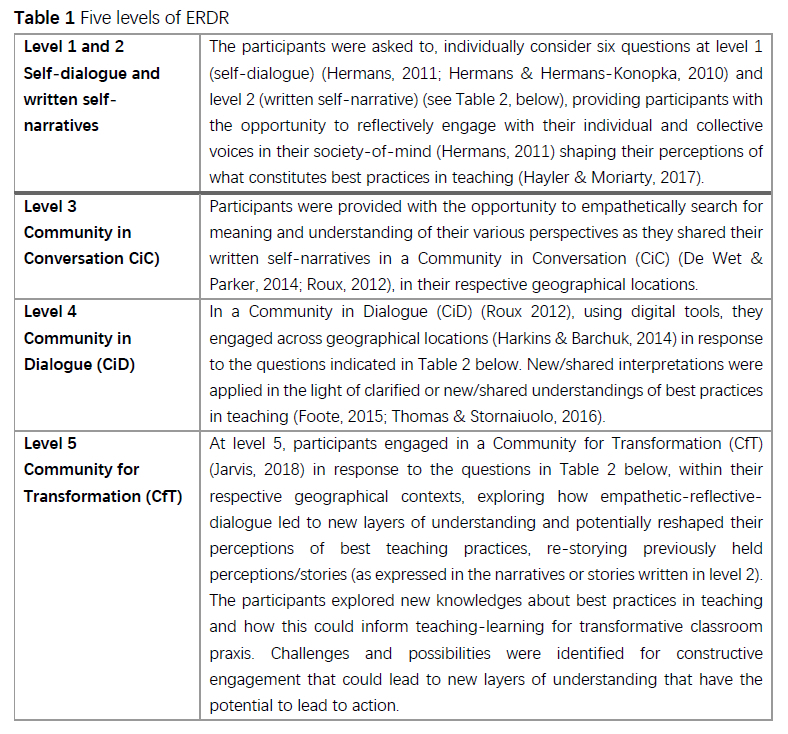
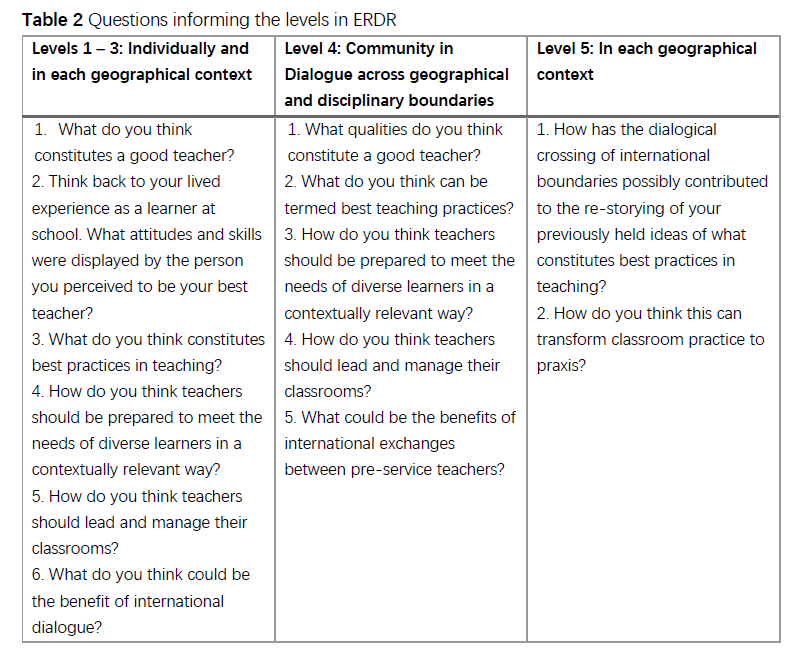
Empathetic-reflective-dialogical re-storying (ERDR) as a research methodology (Jarvis, 2018), was employed to enable participants to gain a deeper understanding of their subjective experiences (Newman, 2011; Silverman, 2010) and to consider transformative changes (Hayler & Moriarty, 2017) to their teaching practices after engagement with their other in the global north/south. This aligns with decolonial goals (Gupta & Vegelin, 2016), reshaping teaching-learning and engaging with the persistence of colonial othering in diverse contexts. ERDR facilitated this international engagement, opening the possibility of learning from the other (Ipgrave, 2003) about what constitutes best practices in teaching. The five levels of ERDR are presented in Table 1. Table 2 reflects the questions that informed each level.
The CiC, CiD, and CfT provide the opportunity for seeking to know the other in a re-search context that is figuratively safe and in which all the participants take responsibility for the generation of new knowledges, and by doing so, become agents of their own learning. Chilisa refers to these communities as akin to an indigenous methodology, namely, 'Talking Circle[s]' (2012: 212). We did not play an active role in the CiC nor the CiD, but rather facilitated the dialogue. In the CfT, we played a more active role in the dialogue by asking probing questions during the conversation. The CiD and CfT were audio-recorded.
Findings and discussion
The pre-service teachers' narratives were analysed thematically, and responses from all five levels of the ERDR engagement were incorporated. The data from level 2 and the audio-recorded dialogues at levels 4 and 5 were crystallised (Maree, 2007) to enhance credibility and authenticity. Pseudonyms were used to protect participant anonymity following ethical considerations.
The international engagement yielded two broad themes: firstly, the notion of best practices in teaching and, secondly, the value of international exchanges using ERDR.
Best practices in teaching
The findings on instructional practices revealed some commonality between the two educational contexts, challenging any inherent superiority of the global north over the global south in terms of best teaching practices. The South African participants valued their education program for its exposure to diverse teaching environments, in particular, well-resourced and under-resourced schools. They saw this as contributing to a holistic understanding of educational contexts. International conversations provided all participants in both geographic contexts, space for exploring diverse meaning of internationalisation and decolonial relationships in establishing a clear consensus on the importance of inclusive classrooms, where all learners, regardless of their diverse abilities and challenges, are treated equitably and without discrimination (Tight, 2022; Montgomery & Trahar, 2022; Garba, et al., 2015).
Participants stressed that proficient teachers should actively embrace learner diversity (Bhagat, et al., 2015; Fry, et al., 2009; Martinez-Vargas, 2020). Tone (Norway) said the following:
One of thie roles of teachiers is to include diversity in all its forms in our practice in different subjects in schiools. Thiese may include diversity in cultures, ethinicities, languages, gender, sexual orientation, belief systems/worldviews, contexts.
Diverse interactions can promote knowledge pluralisation and challenge existing relationships by addressing inequalities. Participants stressed that in pursuit of best practices, effective teaching requires diverse ways of knowing, inclusivity, with no exclusion of any learners. This can empower learners to believe their voices and perspectives are relevant (Diemer, et al., 2016). The use of different classroom strategies can foster inclusivity by catering for those that learn orally and/or visually, those that are academically weak or alternatively, gifted. Kari (Norway) said that at her HEI the focus is mainly on the weaker pupils and not those who are gifted. She said:
Thiere is a need to prepare pre-service teachiers better to cater for learners whio require extension academically. Pre-service teachiers need to be better prepared by heir HE Is to manage diversity in thie classroom ( Kari, Norway).
The participants recognised that teaching goes beyond possessing subject content knowledge. It involves proficiently using contextually relevant teaching methods to convey robust content knowledge, manage diverse and inclusive classrooms, and engage in reflection and reflexivity to bridge the gap between merely banking education (Freire, 1970) and effective classroom praxis. Samu (SA) and Sandra (SA) confirmed this saying:
Thie international engagement using ER DR provided us withh a dialogical opportunity to reflect on our own and international teachhing practices.
Thiese engagements also hielped us to consider hiow, as teachiers could bring chiange to learners and heir communities.
To understand their learners, the participants agreed that teachers should exhibit practical management skills that extend beyond the classroom, including fostering positive relationships with learners' parents or guardians, promoting a shared sense of values and commitments for all to resolve developmental challenges, and determining their own lives (Diemer, et al., 2016). It is therefore important for teachers to have a sound knowledge of the context or specific community in which the school is situated. Thus, international conversations at a decolonial lens, offer pivotal opportunities to engage with historical and contextually-dependent understandings of internationalisation, a chance for change for best practices in teaching (Tight, 2022; Tikly, et al., 2022). Moreover, competent teachers should build networks with various community stakeholders, such as law enforcement agencies, social workers, healthcare facilities, and community organisations. These partnerships facilitate the provision of essential psychosocial support to address the complex challenges learners face in the classroom. Participants expressed this as follows:
...understanding the society/community where the school is situated help one to therefore understand how to engage learners and curriculum (Jabu, SA).
I would like to link with stakeholders here at home - not work in isolation. For an example, schools can work as communities where a township school can work with an ex-model C school or an Indian school on certain curricular topics or issues that are common, to improve results or solve such challenges (Mthokozisi, SA).
The importance of language was highlighted as key in any relationship and for better connection whether in class, community and globally, emphasising the importance of language as a tool for promoting socially inclusive classrooms and managing diversity. The concern about the South African education system, which uses English as the language of instruction (whereas there are eleven official languages of which English is one), was highlighted as a barrier to teaching-learning. Black African learners, in particular, struggle to understand content that is not presented in their mother tongue and this makes it difficult for teachers to adhere to the curriculum schedule. Nozi (SA) said that
...even for classroom rules or classroom code of conduct, using both languages [English and isiZulu, in particular], will be necessary as a way to manage behaviour
Participants agreed that foregrounding of local and indigenous knowledges and experiences in curricula content (Heleta & Chasi, 2023; Yee Yip & Chakma, 2024) is characteristic of a shared vision of an exemplary teacher, emphasising the importance of building meaningful professional relationships with learners to cultivate trust and create a conducive environment for effective teaching-learning. They stressed that relationship-building in the classroom plays a crucial role as it allows for easy and flexible conversations. Nozipho (SA) said that good teaching is about
knowing learners you have in class as individuals and that they come to school with individual needs.
Teachers should continually enhance their pedagogical and learning skills, not only for personal development but also for the benefit of their learners, primarily through effective communication. Anne (Norway) expressed this as follows:
Always hiave pupils as priority no. 1 in your mind as a teachier. Manage and guide the class without being authoritative, at the same time help them build their self-confidence...
She speaks about the importance of knowing learners and their individual needs and how it is important to be approachable. Kristel (Norway) concurred as follows:
A good teacher should understand that learners are different, care for all learners, and make them feel accepted.
While the qualities of a good teacher include facilitating learning and actively engaging in teaching, teachers' behaviour both within and outside the classroom is also important. Teachers are expected to hold the teaching profession in high regard and conduct themselves with the utmost professionalism. Nozipho (SA) says:
...respect yourself your profession and the environment/context where you teach.
Participants stressed the importance of professional teachers engaging in self-reflection and critically evaluating their instructional practice. This principle aligns with existing literature (Li & Ruppar, 2021; Bhagat, et al., 2015; Diemer, et al., 2016; Freire, 1970) that underscores the importance of deliberate reflection in teacher education, described as a cyclical, dynamic, and participatory process. The initial steps of ERDR, self-dialogue and self-narrative, are crucial for teachers to undertake reflective and critical examination of their pedagogical approaches and the need to respect themselves and the profession as expected. Gugu (SA), Shay (SA), and Kari (Norway) expressed this as follows:
...respect yourself your profession and the environment/context where you teach-listen and question our thoughts about our role as teachers (Gugu).
Teachers should always remember their roles in the society-they should be in a position to meet the needs of diversity in their classrooms (Shay).
The teacher should model respect for all the pupils and diversity within the classroom and that of the society (Kari).
The concept of mutual respect was highlighted as a pivotal value in effective classroom management. During discussions, participants explored various methods to promote respect among both learners and teachers, including using innovative teaching methods from diverse cultural backgrounds. They spoke about creating a classroom code of conduct, emphasising the significance of verbal expression in promoting respect and establishing a democratic classroom environment. Learners would also be made aware of the consequences associated with specific behaviours. This was articulated by one of the participants in the following way:
I think hhaving classroom rule/code of conduct developed by both) the class teacher and learners and displayed in classroom--this can be helpful such that learners understand the consequences thereof of any transgressions and be responsible for their actions whether positive or negative (Nozipho, SA).
The principle of respect and the preservation of human dignity were evident in both educational contexts, extending beyond legal frameworks like the South African Constitution (Republic of South Africa, 1996). This underscores a decolonial approach to teaching-learning, emphasising the universal importance of these values and perpetuating power distribution among teachers, learners and communities. In a similar vein, learners should experience an educational environment characterised by a sense of safety and warmth, both physically and by fostering a classroom that is free from judgment. In such a space, every learner should be free to actively listen and for their voice to be heard. South African participants, in particular, emphasised the importance of democratic classroom management, aiming to create a space where learners are liberated from autocratic teaching styles, allowing them to express themselves freely.
Participants stressed the importance of teachers valuing their own culture and mother tongue. They acknowledged the perception that the Western/global north standards in education have stood the test of time, and are therefore considered superior (Fleming, 2007; Fook & Askeland, 2007). This misperception can be addressed by engaging with indigenous knowledges in the global south acknowledging difference without relegating it to inferior (Ndlovu-Gatsheni, 2021). The participants did acknowledge, however, that without a shared language, English, in this case, effective communication between the South African and the Norwegian students would not have been possible. For example, Sipho (SA) said:
...an international language to communicate is a necessity and is indeed emancipatory. While I learnt that Norwegians used their own language for teaching and learning, we sometimes do the same in SA - use code-switching. Importantly, this is meant for learners to understand the content knowledge and to include all of them, hence we don't ignore the importance of an international language.
The value of international engagements using ERDR
The potential for teacher collaboration through international conversations being highly advantageous (Arnold & Mundy, 2020; Fry, et al., 2019) was realised in the CiD which facilitated the exchange of insights concerning the essence of best practices in teaching. It could pave the way for reflective and reflexive classroom praxis. This is evidenced with what Samu (SA), Mthokozisi (SA), and Pamela (Norway) highlighted about how the international dialogue helped to identify a commonality despite different geographical contexts:
At first, I thought they have their own ways of doing things and we have ours -that we are different... We have the same values of becoming teachers and to transform learners and communities by giving them tools to fight for their future (Samu).
I realised that actually we are the same. We are in fact a global community and as student teachers we do almost the same to become teachers. My view changed-...-the world is the same, but challenges are mainly context-based'(Mthokozisi).
After our dialogue, I felt that they have the same practices we do and we engage in the theories we learn are taught in the same way. Seemingly, the world is the same and challenges are the same and the way children are... is the same (Pamela).
While the use of the English language, a global lingua franca for enhanced communication, raised concerns among most participants, it also proved to have decolonising implications, particularly for South Africans with a history of oppression. Sipho (SA) said:
As much as we can use our own [indigenous] languages wherever we are, a language of communication for internationalisation is required, like English, which has become a common language - which in our dialogue placed us at an advantage over the Norwegians whose English was less proficient than ours, and made us to be confident that we are not at all inferior to other countries from the north as it would have been expected.
Participants realised that challenges in education are a global phenomenon (Nopas & Kerdsmboon, 2024). Nozipho (SA) spoke about the importance of being aware of global activities 'so that you realise as a country that you do not exist in isolation'. While the challenges identified could be common to both geographical contexts, local solutions would need to be sought.
The South African participants initially searched for differences between the Norwegian and South African contexts that could foster an 'us-versus-them' mentality. The recurring pattern of othering, which creates divisions and discrimination, eroding empathy and dialogue, became evident. However, as the CiD progressed, the ERDR approach played a vital role in mitigating this, leading to a collective identity of we as teachers. This was met with relief among the participants. Jabu (SA) and Anne (Norway) expressed it this way:
I feel the 'sense of relief' that they are a lot like us and we are a lot like them. But ultimately, we should be striving towards our forging engagements and drive forward the idea of human identity and-together we can achieve (Jabu).
We're in Norway and they are in South Africa, but we are all teachers and we have a common task and responsibility in the community and society... we have a lot in common despite cultural, and language differences (Anne).
Both the South African and Norwegian participants emphasised the significance of minimising the them and us divide for classroom and community transformation while recognising individual dignity (Li & Ruppar, 2021). The findings suggest that embarking on a collective transformative journey fosters a safe and supportive learning environment conducive to meaningful praxis. They stressed the need for fostering global relationships to facilitate mutual learning among teachers. This is expressed by Sipho (SA) who says:
We are all teachers and ours is to learn from each other and improve our practice which is our common responsibility. They can learn from us - our culture and context and we learn from them as well.
The CfT allowed participants to reflect on their international engagement. They agreed that ERDR provided a substantial platform for meaningful discussions. A decolonial lens shows how definitions of internationalisation developed in the global North are limiting to understand challenges and complexities of the global South (Heleta & Chasi, 2023). Thus, redefining internationalisation and engaging in an international dialogue made participants feel connected to a global community of teachers, enabling them to collectively tackle educational challenges, identify issues, and devise solutions. Despite recognising the contextual differences in educational systems, the participants unanimously stressed the importance of international dialogue and the need to build global connections and relationships for knowledge sharing. Nozi (SA), Gugu (SA), Sandra (Norway), and Marit (Norway) articulated this perspective as follows:
International dialogue gave us chance to learn from others ...we can reflect upon own and other's practice, creating understanding of different cultures and building relationships (Nozi).
International dialogues has a possibility to help us grow professionally (Gugu).
International conversations can open up new perspectives, give inspiration to each other, the possibility to reflect upon own and other's practice creating understanding of different cultures (Sandra).
The greatest strength is that you get a wider perspective on practice. You get knowledge from other countries which give you a tool in meeting students from other countries, then you hiave background knowledge, what sort of classrooms they come from--we can use this in our meeting with students and people... (Marit).
The participants discussed how ERDR as a methodology was instrumental in fostering reflection and the critical development of pre-service teachers. The international experience was particularly empowering for the South African participants during the CiD. Initially, apprehensive about engaging with perceived more proficient Norwegian participants, they felt a sense of liberation and empowerment (Diemer, et al., 2016; Sellars, et al., 2018; Taole, 2018). They moved from feeling excluded to actively engaging as valued group members. Nozi (SA) said:
When we finished with ERDR, I was so excited, and I shared all of my experiences with other students at my residences. It was empowering to note that our spoken English language was better compared to Norwegian students, which made me realise that despite all contextual challenges in South Africa and more so in Africa, we are better than the countries from the north. They can learn a lot from us.
Despite their distinct geographical and cultural contexts, engaging in this international endeavour allowed them to find common ground as well as fresh perspectives regarding best teaching practices. Participants noted that their horizons had been broadened as preconceived notions about internationalisation were challenged, thereby serving a decolonial agenda (Montgomery & Trahar, 2023). The decolonial approach thus foregrounded teachers' diverse contexts, perspectives, lived experiences, and realities in the global south to recognise contextual and cultural differences (Yee Yip & Chakma, 2024; Martinez-Vargas, 2020). While internationalisation is perceived as another form of colonialism that perpetuate power imbalances between different countries and cultures economically, politically, and culturally; decolonial engagements prioritise the knowledge, values, and practices of indigenous communities.
The South African participants highlighted ERDR's decolonisation potential, particularly in addressing historical racial tensions within diverse contexts (Sellars et al., 2018; Taole, 2018). They believed that ERDR could effectively navigate deeply entrenched positions in the realm of education and contribute to transformative and decolonising approaches. Shay (SA) said:
I see it [ERDR] can be translated to leadership within our schools in SA where racial segregated still persist. School management teams could interact and learn from each other, for example, school A work with school B on how to deal with life - reflect on common challenging issues, change attitudes - for school improvement.
Participants reflected on the effectiveness of ERDR, considering each step of the process, and contemplating potential shifts in their initial perspectives. The consensus among both the Norwegian and South African participants was that Levels 1 and 2 were most significant, saying that any reflection must commence with an individual. They did not view ERDR as a linear process, but rather as cyclical. They suggested adding a Level 6 taking the participant back to Level 2 so as to consider possible re-storying of previously held narratives. This could lead to new knowledges. While the use of the English language, a global lingua franca for enhanced communication, raised concerns among most participants, it also proved to have decolonising implications, particularly for South Africans with a history of oppression Sipho (SA) said:
As much; as we can use our own [indigenous] languages whierever we are, a language of communication for internationalisation is required, like English), whiichi has become a common language - which in our dialogue placed us at an advantage over the Norwegians whose English was less proficient than ours, and made us to be confident that we are not at all inferior to other countries from the north as it would have been expected.
Crossing geographical boundaries is a positive tool for preparing both students and researchers for participation in a globalised and multicultural world (Wimpenny, et al., 2021. Nozi (SA), who otherwise may never have interacted with her counterparts in Norway, appreciated the use of digital tools saying:
... although we used online platform, but it was interesting to see them and was also helpful. This level accelerated relational connectedness.
This research project instilled confidence, empowerment, and gratitude in the participants, who expressed appreciation for living in a diverse society. This transformative experience can spark a desire in the students to establish more international connections and cultivate meaningful relationships using decolonial and inclusive approaches that seek to dismantle power imbalances and learn from each other's experiences and culture.
They emphasised that engaging with this strategy significantly contributed to their personal growth and professional development as teachers. They concluded that ERDR could be used as an effective teaching-learning strategy in South African classrooms, which have a history of grappling with segregation and racial dynamics.
Conclusion
This article highlights the importance of international conversations between pre-service teachers from the global south and global north, without physical travel. Adopting a decolonial approach, the participants' perspectives became situated in an understanding of local contexts and realities, foregrounding the diverse and dynamic socio-cultural and political contexts shaping teachers' lived experiences in the global south. Facilitated by ERDR, participants grew in sensitivity and awareness of the impact of colonialism in the global south. Conversations commenced with 'them and us'; however, the CiD led to participants together, realising that there are many commonalities when it comes to understandings of best practices in teaching. As opposed to merely banking education, this transformative journey led the participants to develop an empathetic and globally inclusive understanding of teaching praxis characterised by reflection and reflexivity.
Author biographiesDr Ncamisile P. Mthiyane is a Senior Lecturer and Academic Leader in the School of Education, University of KwaZulu-Natal, South Africa. Her research interest covers a range of topics related to psychosocial wellbeing, human rights issues, and transformative and visual pedagogical strategies in Higher Education. She engages in collaborative projects nationally and internationally,
Dr Janet Jarvis is a Senior Lecturer in the School of Education, University of Kwa-Zulu Natal. She teaches undergraduate and honours modules and supervises post-graduate students. Her research interests include Teacher Identity, Human Rights Education and Decoloniality. She has presented conference papers, and has published journal articles and book chapters both nationally and internationally,
References
- Abraham, G.A. & von Brömssen, K. 2018. Internationalisation in teacher education: student teachers' reflections on experiences from a field study in South Africa. Education Inquiry, 9(4): 347-362.
- Acharya, A. & Buzan, B. 2019. Thie Making of thie Global International Relations: Origins and Evolution of IR at its Centenary. Cambridge: Cambridge University Press.
- Arnold, J. & Mundy, B. 2020. Praxis pedagogy in teacher education. Smart Learn. Environ. 7(8).
- Batra, K., Singh, T.P., Sharma, M., Batra, R. & Schvaneveldt, N. 2020. Investigating the psychological impact of COVID-19 among healthcare workers: A meta-analysis. International Journal of Environmental Research! and Public Health), 5(17): 9096.
- Bhagat, A., Vyas, R. & Singh, T. 2015. Students' awareness of learning styles and their perceptions to a mixed method approach for learning. International Journal of Applied & Basic Medical Research,, 5(1): S58-S65.
- Boholano, H.B. 2017. Smart social networking: 21st century teaching and learning skills. Research) in Pedagogy, 7(1): 21-29.
- Chilisa, B. 2012. Indigenous Research! Methiodologies. London: SAGE Publications.
- Czaika, M. & de Haas, H. 2015. The globalization of migration: Has the world become more migratory? International Migration Review (IMR), 48(2): 283-323.
- De Wet, A. & Parker, G. 2014. Communities in conversation: Opportunities for women and girls' self-empowerment. Gender and Development, 22: 109-125.
- Diemer, M.A., Rapa, L.J., Voight, A.M. & McWhirter, E.H. 2016. Critical consciousness: A developmental approach to addressing marginalization and oppression. Child Development Perspectives, 10(4): 216-221.
- Escobar, A. 2018. Designs for the Pluriverse: Radical Interdependence, Autonomy, and the Making of Worlds. Durham: Duke University Press.
- Faulkner, J. & Latham, G. 2016. Adventurous lives: Teacher qualities for 21st century learning. Australian Journal of Teacher Education, 41(4).
- Fleming, P. 2007. Reflection: A neglected art in health promotion. Health Education Research, 22(5): 658-664.
- Fook, J. & Askeland, G.A. 2007. Challenges of critical reflection: 'Nothing ventured, nothing gained'. European Journal of Social Work, 12(3): 287-292.
- Foote, L.S. 2015. Re-storying life as a means of critical reflection: The power of narrative learning. Christian Higher Education Journal, 14(3): 116-126.
- Freire, P. 1970. Pedagogy of the Oppressed. Michigan: Seabury Press.
- Fry, H., Ketteridge, S. & Marshall, S. 2009. Understanding student learning. In Fry, H., Ketteridge, S. & Marshall, S. (Eds.). A Handbook for Teaching and Learning in Higher Education: Enhancing Academic Practice. London: Routledge, 8-27.
- Garba, S.A., Byabazaire, Y. & Busthami, A.H. 2015. Toward the use of 21st century teaching- learning approaches: The trend of development in Malaysian schools within the context of Asia Pacific. International Journal of Emerging Technologies in Learning, 10(4): 72-79.
- Gupta, J. & Vegelin, C. 2016. Sustainable development goals and inclusive development. International Environmental Agreements, 16: 433-448.
- Hassi, A., & Storti, G. 2012. Globalization and Culture: The Three H Scenarios. In Cuadra-Montiel, H. (Ed.). Globalization: Approaches to Diversity. Intech Open.
- Hayler, M. & Moriarty, J. 2017. Self-Narrative and Pedagogy: Stories of Experience within Teaching and Learning. Rotterdam: Sense Publishers.
- Harkins, M.J. & Barchuk, Z. (Eds.). 2014. International Conversations of Teacher Educators: Teaching and Learning in a Global World. Faculty of Education, Mount Saint Vincent University Halifax.
- Heleta, S. & Chasi, S. 2023. Rethinking and redefining internationalisation of higher education in South Africa using a decolonial lens. Journal of Higher Education Policy and Management, 45(3): 261-275.
- Hermans, H. 2011. The dialogical self: A process of positioning in space and time. In Gallagher, S (Ed.). The Oxford Handbook of the Self. Oxford: Oxford University Press.
- Hermans, H. & Hermans-Konopka, A. (2010). Dialogical Self-theory: Positioning and Counter - Positioning in a Globalizing Society. Cambridge: Cambridge University Press.
- Ipgrave, J. 2003. Dialogue, citizenship and religious education. In Jackson, R. (Ed.). International Perspectives on Citizenship, Education and Religious Diversity. London: RoutledgeFalmer.
- Jarvis, J. 2018. Restorying for transdisciplinarity: A proposed teaching learning strategy in a context of human rights education. The Journal for Transdisciplinary Research in Southern Africa, 14: a483.
- Jibeen, T. & Khan, M.A. 2015. Internationalisation of Higher Education: Potential Benefits and Costs. International Journal of Evaluation and Research in Education (IJERE), 4(4): 19-199.
- Joy, S. & Kolb, D.A. 2009. Are there cultural differences in learning styles? International Journal of InterculturalRelations, 33(1): 69-85.
- Kerkhoff, S.N. 2017. Designing global futures: A mixed methods study to develop and validate the teaching for global readiness scale. Teaching and Teacher Education, 65: 91-106.
- Khoza, S.B. 2019. Lecturers' reflections on curricular spider web concepts as transformation strategies. In Chaunda, L., Scott, L & Ivala, E.N. (Eds.). Transformation of Higher Education Institutions in Post-Apartheid South Africa. London: Routledge.
- Knight, S. 2015. Realising the benefits of reflective practice. Nursing Times, 111 (23-24): 17-19.
- Li, L. & Ruppar, A. 2021. Conceptualizing teacher agency for inclusive education: A systemati and international review. Teacher Education and Special Education, 44(1): 42-59.
- Marangell, S. & D'Orazzi, G. 2023. Students' changing conceptualizations of university internationalizationin Australia. Higher Education Research & Development, 42(5): 1230-1246.
- Maree, K. 2007. First Steps in Research. Cape Town: Van Schaik.
- Maringe, F. 2010. The Meanings of Globalisation and Internationalisation in HE: Findings from a World Survey. In Maringe, F. & Foskett, N. (Eds.). Globalization and Internationalisation in Higher Education,. London: Continuum, 17-34.
- Mart, Ç.T. 2013. A passionate teacher: Teacher commitment and dedication to student learning. International Journal of Academic Research in Progressive Education and Development, (2)1.
- Martinez-Vargas, C. 2020. Decolonising higher education research: from a university to a pluriversity of approaches. South African Journal of Higher Education, 34(2): 112-128.
- Mbembe, A. 2019. Thoughts on the Planetary: An Interview with Achille Mbembe. In Barnard- Naude, J. (Ed.). Decolonising the Neoliberal University: Law, Psychoanalysis and the Politics of Student Protest. London: Routledge.
- McGregor, S.L.T. & Volckmann, R. 2013. Transversity: Transdisciplinarity in Higher Education. In Hampson, G. & ih-Tolsma, M. (Eds.). Leading Transformative Higher Education. Olomouc: Palacky University Press
- Mignolo, W.D. 2007. Introduction: Coloniality of power and de-colonial thinking. Cultural Studies, 21(2-3): 155-167.
- Montgomery, C. & Trahar, S., 2023. Learning to unlearn: Exploring the relationship between internationalisation and decolonial agendas in higher education. Higher Education Research & Development, 42(5): 1057-1070
- Ndlovu-Gatsheni, S.J., 2021. Internationalisation of higher education for pluriversity: A decolonial reflection. Journal of the British Academy, 9(1): 77-98.
- Newman, W. 2011. Social Research Methods. New York: Pearson.
- Ngugi wa Thiong'o 2012. Globalectics: Theory and the Politics of Knowing. Boston: Colombia University Press.
- Nopas. D. & Kerdsomboon, C. 2024. Fostering global competence in teacher education: Curriculum integration and professional development. Higher Education Studies, 14(2).
- Nukunah, C. & Eccles, N. 2021. Western superiority complex/African inferiority complex as impediments to decolonising management education. In Goldman, G. (Ed.). Critical Management Studies in South Africa Directions and contexts. Durbanville: AOSIS Publishing.
- Oldknow, A. 2009. ICT bringing mathematics to life and life to Mathematics. Electronic Journal of Mathematics and Technology, (3): 137-148.
- Quinlan, O. 2014. The Thinking Teacher. Carmarthen: Independent Thinking Press.
- Reid, H.L. 2016. Introduction to Career Counselling & Coaching. London: Sage, 241-259.
- Reiter, B. (Ed.). 2018. Constructing the Pluriverse: The Geopolitics of Knowledge. Durham: Duke University Press.
- Republic of South Africa. (1996). The Constitution Act No. 108 of the Republic of South Africa, 1996. Government Printers
- Roux, C. 2012. A social justice and human rights education project: A search for caring and safe spaces. In Roux, C. (Ed.). Safe Spaces: Human Rights Education in Diverse Contexts. Rotterdam: Sense Publishers.
- Santos, B. de S. 2014. Epistemologies of the South: Justice Against Epistemicide. Colorado: Paradigm Publishers.
- Santos, B. de S. 2018. The End of the Cognitive Empire: The Coming of Age of Epistemologies of the South. Durham; Duke University Press.
- Sellars, M., Fakirmohammad, R., Buit, L., Fishetti, J., Niyozov, S., Reynolds, R., Thapliya, N., Smith, Y. & Ali, N. 2018. Conversations on critical thinking: Can critical thinking find its way forward as the skill set and mindset of the century? Education Sciences, 8(4): 205.
- Silverman, D. 2010. Doing Qualitative Research. London: Sage.
- Sium, A., Desai, C. & Ritskes, E. 2012. Decolonization: Indigeneity. Education & Society, 1(1): i-xiii.
- Sperduti, V.R. 2019. Internationalization as Westernization in higher education. Journal of Comparative & International Higher Education, 9(Spring): 9-12.
- Taole, M.J. 2018. Reflective experiences of Post Graduate Certificate in Education students during teaching practice. Research in Higher Education Journal, 17: 1-14.
- Thomas, E.E. & Stornaiuolo, A. 2016. Restorying the self: Bending toward textual justice. Harvard Educational Review, 86(3): 313-338.
- Tight, M. 2024. Decolonization and higher education: A critical review of a contemporary concern, policy and theory. High) Education Policy, 37: 59-72
- Tikly, L., Barrett, A., Batra, P., Bernal, A., Cameron, L., Coles, A., Juma, Z., Mitchell, R., Nunes, N., Paulson, J., Rowsell, J., Tusiime, M., Vejarano, B. & Reda, N.W. 2022. Decolonising Teacher Professionalism: Foregrounding the Perspectives of Teachers in the Global South. UNESCO Background paper. Bristol Working Papers in Education. Available at: https://doi.org/10.5281/zenodo.7097105 (Accessed: 25 June 2024).
- Tran, L.T. 2013. Teachhing International Students in Vocational Education: New Pedagogical Approachies. Camperwell: ACER Press.
- Wimpenny, K., Hagenmeier, C., Jacobs, L. & Beelen, J. 2021. Decolonisation through inclusive virtual collaboration. University World News- Africa Edition. Available at: https://www.universityworldnews.com/post.php?story=20210121054345601 (Accessed: 17 July 2023).
- Yee Yip, S. & Chakma, U. 2024. The teaching of Indigenous knowledge and perspectives in initial teacher education: a scoping review of empirical studies, Journal of Furthier and Highier Education, 48(3): 287-300.

Accepted: 17July 2024