Disrupting monolingual practices: The role of multilingualism as a pedagogy of possibility in Writing Centres
Abstract
Monolingual practices that dominate university spaces can contribute to othering, resulting in the marginalisation and exclusion of students who are less competent in the dominant discourse. These limitations must be addressed to create a more inclusive learning space that accommodates all students regardless of their social, economic, educational, and linguistic backgrounds. This paper explores how peer tutors in writing centre leverage their South African indigenous language repertoire to help students access disciplinary content knowledge and improve their academic writing practices. This paper discusses the findings from two focus group discussions with peer tutors at the Wits School of Education Writing Centre (WSoE WC). We explore how peer tutors' integration of multilingualism during writing consultations can inform a new writing centre pedagogy. We also leveraged the principles of wayfinding to navigate and orient peer tutors within a complex university space, which challenges the university's stated educational transformation with a concrete proposition. Data analysis shows how peer tutors and students collaboratively explore and map out academic writing using familiar languages to navigate the rigid structure of academic writing in a manner that respects and incorporates students' linguistic backgrounds. Through wayfinding, peer tutors disrupt monolingual practices and by doing so, increase student participation and chances of success in higher education. Writing centres, as wayfinding spaces, are instrumental in championing the adoption of multilingual pedagogies, thus disrupting dominant monolingual practices in higher education.
Monolingual; multilingualism; pedagogy; Writing Centre
Introduction and background
The dominance of English as the primary language of teaching and learning in many higher education institutions presents significant challenges for students, especially non-native speakers. The language debate in South Africa has been contentious, reflecting historical inequalities and ongoing socio-political tensions (Mayaba, et al., 2018). While English is seen as a gateway to opportunities and social mobility, it also tends to marginalise those who are not proficient, further widening educational inequalities among different racial groups (Ranjan, et al., 2024; Wilmot et al. (2024). This situation has led to calls for urgent implementation of multilingual policies that acknowledge and embrace the linguistic diversity of the country, thereby promoting inclusivity and equality in the academic setting (Joubert & Sibanda, 2022; Mayaba, et al., 2018).
South African universities have adopted multilingual policies; however, progress in implementing these policies has been slow, thus maintaining English as the preferred language for teaching and learning across the country (Mayaba, et al., 2018). This ongoing preference for English as the medium of instruction not only undermines students' right to be taught in their mother tongue (Ngidi & Mncwango, 2022) but also has implications for their academic performance and success (Munyaradzi & Manyike, 2022). This exacerbates broader issues of social inequality and exclusion, which are deeply rooted in South Africa's colonial and apartheid past. Costandius and Bitzer (2014) highlight how universities, as microcosms of society, often perpetuate these historical divisions through ingrained perceptions and attitudes that resist change. According to Ranjan, et al. (2024), the preference for the English language could potentially lead to the erosion of local cultures and identities, as native languages and cultural narratives are marginalised, resulting in a homogenisation of cultural identities influenced by western norms. Thus, these persistent monolingual practices, such as using English in universities, reflect broader historical and systemic inequities where indigenous languages are often undervalued (Ranjan, et al. 2024). There is, consequently, a concerning disconnect between students' linguistic identities and the academic expectations placed upon them. Costandius and Bitzer's (2014) work on critical citizenship education emphasises the need for educational spaces that actively confront and address these legacies of conflict, promoting social justice through inclusive pedagogical practices. Writing centres could be spaces that promote not social justice but epistemic justice by transforming and adopting inclusive pedagogical practices.
The challenges that students face in academic reading and writing are well-documented (Angu, 2013; Bharuthram, 2017; Lea & Street, 1998; Lillis, 2001; Khumalo & Reddy, 2021; Wingate, 2012). These challenges often arise from a complex range of factors, including the historical impact of colonialism and apartheid, which have resulted in poor schooling experiences, linguistic barriers for non-native English speakers, and limited access to academic support, which have resulted in the marginalisation of certain groups of people (Eybers, 2018). Consequently, the ongoing prioritisation of English over other languages in university settings runs the risk of perpetuating linguistic injustices, undermining the diverse linguistic realities of the student population in many South African universities (Boughey & McKenna, 2021).
In this paper, we argue for a multilingual pedagogical approach in the writing centre as it promises students access to academic discourses and, consequently, increases the chances of students' success in higher education. We believe that incorporating Indigenous languages into academic spaces, such as writing centres, can create a more inclusive and fair learning environment. This entails reimagining writing centre pedagogies and the role of peer tutors as facilitators and cultural and linguistic wayfinders, assisting students in navigating the complex academic landscape using familiar linguistic repertoires. We position this paper within the broader theme of the special issue, 'Doing Pedagogy Differently', which advocates for innovative pedagogical approaches that challenge conventional norms and practices in education.
In this context, our exploration of how multilingualism can be a transformative tool in enabling students to gain access to discourses speaks directly to the need for pedagogical change. By disrupting the monolingual norms and practices that dominate academic spaces, we propose a new way of thinking about language and learning in higher education. In addition, Elmarie Costandius's work also resonates with the need for innovative pedagogical approaches that disrupt dominant monolingual norms in academic spaces. Her emphasis on using art and creative processes as tools for social change (Costandius, et al., 2018) aligns with our argument for reimagining writing centre pedagogies that leverage multilingualism to create more inclusive and dynamic learning environments. In this paper, we seek to extend her ideas by exploring how multilingualism can create a more inclusive and dynamic learning environment in Writing centres.
Writing centre pedagogical approacties to academic literacy development
Writing centres aim to help students develop academic literacy practices that enable them to navigate and cope with academic discourse and demands and, in the process, acquire epistemic access to knowledge (Sekonyela, 2023). In South Africa, writing centres have evolved into vital spaces where students engage in content knowledge and academic literacy conventions (Clarence, 2019; Dison & Kadenge, 2023; Namakula, et al., 2023). These centres focus on inducting students into the academic community. However, as Costandius (2019) argues, transformative spaces like Writing centres can also become spaces for engaging students in critical dialogues about social transformation and decolonisation. Writing centres serve dual roles in this case - supporting student academic literacy development while challenging dominant monolingual practices.
Researchers have shown that academic literacy development is more effective when reading and writing practices are embedded within disciplinary curricula (Rambiritch & Drennan, 2023; Namakula, 2021). This involves collaborative pedagogy between academic literacy specialists and lecturers to design activities that teach reading and writing in the context of specific disciplinary conventions and knowledge (Rambiritch & Drennan, 2023; Dison & Moore, 2019). Costandius (2019) highlights the need for collaborative and embodied engagement, suggesting that spaces like Writing centres could adopt a more integrated and creative approach to literacy, including critical engagement with disciplinary knowledge (Biscombe, et al., 2017). Such collaboration aligns with socio-constructivist approaches, emphasising the need for disciplinary writing to be scaffolded and supported through collaborative pedagogies (Carstens & Rambiritch, 2020). As Carstens and Rambiritch (2020) argue, adapting writing centre theories to local and historical contexts ensures that these practices remain relevant in the South African context, where multilingualism and complex socio-political dynamics are integral to academic success (Carstens & Rambiritch, 2020). As a result, students are better equipped to navigate their discipline's specific academic demands, enhancing their understanding and ability to produce disciplinary-appropriate texts. For students to have 'the ability to communicate competently in an academic discourse community' (Wingate, 2015: 6), they need to develop 'an awareness of the epistemology of a discipline, the socio-cultural context and the norms that govern each discipline' (Maldoni, 2017: 104) and activities can be used to scaffold students into acquiring competency and awareness to participate in the disciplines fully.
While embedding literacy within disciplinary curricula can equip students with essential academic literacy skills, the challenge in South Africa is that many students enter higher education with varying levels of proficiency in the necessary academic literacies for success (Dison & Moore, 2019). Many students come from backgrounds with low command of English, the primary language of teaching and learning (Clarence, et al., 2013). This creates challenges for lecturers tasked with supporting students with disciplinary knowledge and the critical reading, research, thinking, and writing skills required for academic and professional success. Furthermore, writing centres must adapt their practices to local contexts, recognising the need to move beyond Global North theories and incorporate frameworks suited to the unique challenges faced by South African institutions, such as socio-political and monolingual approaches (Carstens & Rambiritch, 2020). The added pressure of mastering complex disciplinary content and academic literacy in a second or third language can be overwhelming for students, often resulting in slower academic progress and difficulties in meeting the expectations of higher education (Boakye & Liden, 2018). Thus, various collaborative approaches, including dialogue that respects identity and diversity, are features of writing centre pedagogy (Carsten & Rambiritch, 2020). Collaborative, discipline-specific approaches in writing centres are crucial for addressing these challenges, helping students navigate academic literacies in their context and contributing to epistemological access (Dison & Moore, 2019).
While writing centres are known as transformative spaces, they often perpetuate monolingual norms, where the dominant language, typically English, is the primary mode of facilitation and engagement (García, et al., 2018). This linguistic hegemony can create significant barriers for multilingual students, who may struggle to express themselves effectively in the expected academic discourse (Pistone, 2010). We argue that to disrupt this exclusionary dynamic, writing centre peer tutors and students can leverage their multilingual abilities and experiences to create more inclusive and equitable spaces for collaborative learning.
The role of peer tutors in implementing writing centre pedagogies
Peer tutors are instrumental in writing centres because they implement the pedagogies and are positioned to introduce students to university academic practices. Peer tutors 'have an intimate knowledge of the course experience, as well as the demands of the tasks' (Dison & Mendelowitz, 2017: 196). As such, they 'can draw on not only the explicit fund of knowledge that is the course content but also other second-space funds of knowledge and discourses, including official academic literacy practices which they as senior students with good academic records have already mastered to a significant extent' (Namakula & Prozesky, 2019: 45). Clarence (2016) argues that one key advantage of having peer tutors as facilitators is that their positions as students make them relatable and approachable to students. While the writing centre defines the peer tutor's role, they also have the agency to decide how to engage as tutors.
For this reason, Clarence (2016) explains that peer tutors should be recognised as learning and teaching partners to lecturers and students and require training and professional development opportunities to support students effectively. As facilitators and mentors, peer tutors support students in gaining epistemological access to dominant discourses (Namakula & Prozesky, 2019). Through their interactions with students, peer tutors gain valuable insights into the nuances of student writing and the pedagogical approaches that effectively support students in engaging with academic discourses. In this case, peer tutors can provide valuable support by helping students develop knowledge that can aid them to succeed.
The above discussion also shows that peer tutors serve as facilitators, providing academic and emotional support to students. Their role then extends beyond assisting students with reading and writing tasks; they offer a 'pedagogy of care' (Pistone, 2010:10) that helps students feel comfortable and supported, especially in overcoming challenges related to academic literacy. Peer tutors help students build confidence in their writing, often sharing their experiences and struggles, making them relatable and approachable.
A multilingual pedagogical approach to support student academic literacy development
Multilingualism has become important in academic contexts, as universities are often spaces for cultural and linguistic convergence (De Villiers, 2021). However, multilingualism is not merely the ability to speak languages other than English, or to match peer tutors' languages with students' languages. Instead, it involves fluid and dynamic practices that transcend rigid boundaries between named languages (Guzula & McKinney 2024). Translanguaging, a concept central to multilingual pedagogies, refers to the use of students' full linguistic repertoire to make meaning and engage in academic discourse (Brinkschulte, et al., 2018; Lytra, et al. 2020). García and Wei (2014) argued that translanguaging disrupts monolingual ideologies and repositions multilingualism as a resource for knowledge construction rather than a deficiency. This nuanced understanding of multilingualism is especially relevant in the South African higher education context, where colonial-language ideologies have historically marginalised African languages and privileged English (McKinney & Guzula, 2024; Abdulatief & Guzula, 2024). For instance, Marshall (2020) demonstrated how students in first-year literacy courses in Canadian higher education draw on multiple languages in and around their learning and the efficacy of switching between languages to engage with academic English.
In this case, translanguaging, or the deliberate and strategic use of more than one language in meaning-making, emerges as a transformative pedagogical approach that legitimizes the linguistic resources of marginalised students (McKinney & Guzula, 2024). Thus, this perspective challenges simplistic assumptions that equate multilingualism to merely speaking a home language alongside English. Especially in the context of the purposes of a Writing Centre, translanguaging can be effective in a way that forms "third spaces" allowing the development of student academic literacy (Namakula & Prozeskey, 2019). Such spaces allow for the legitimisation of students' linguistic resources, creating opportunities for meaning-making that draws on their entire semiotic repertoire (Guzula, 2021). In the case of translanguaging in science classrooms, Abdulatief and Guzula (2024) show how planned, systematic translanguaging pedagogies can shift from teacher-led to student-centered interactions, promoting biliteracy and affirming multilingual identities. Such practices go beyond oral code-switching to include written translanguaging to deepen students' involvement in academic content, as explained by Abdulatief and Guzula (2024). In the case of writing centers, collaborative activities that incorporate translation, multimodal forms of communication, and exploratory talk are crucial for helping students think critically and articulate complex ideas across languages.
In South Africa, the dominance of anglonormative ideologies has created significant barriers to the implementation of multilingual pedagogies (Abdulatief & Guzula, 2024). The 1997 Language-in-Education Policy (LiEP) theoretically supports bi/multilingual education but is undermined by systemic practices that prioritise English as the language of learning and teaching (LoLT). This early shift to English often alienates African language-speaking students and blocks epistemic access (Abdulatief & Guzula, 2024; Kerfoot & Bello-Nonjengele, 2023). Writing centres, as adaptive translanguaging spaces, have the potential to address this challenge by providing students with tools and support to engage with academic literacies in ways that respect their linguistic and cultural backgrounds. Disrupting the dominance of English challenges linguistic hegemony and creates spaces that promote epistemic justice (Dison and Kadenge 2023). As observed in multilingual literacy clubs such as the Stars of Today Literacy Club, students' engagement with multiple languages and modalities fosters a richer, more meaningful academic experience (Guzula, 2021). Decolonisation and language policy are central to these discussions. The persistence of Anglonormativity in South African universities has limited the implementation of progressive multilingual policies (Nomlomo, et al., 2018). Guzula (2021) advocated the use of indigenous languages and knowledge systems as decolonial strategies in education. Translanguaging, in this sense, is not just a pedagogical tool but also a political act that challenges colonial hierarchies and affirms linguistic diversity as central to academic success (McKinney & Tyler, 2024).
Furthermore, Marshall (2020) cautioned against idealising multilingualism without considering its complexities. Speaking to students in their home languages or simply enabling language switching do not automatically ensure access to academic discourse or improved throughput. In South African universities, the historical marginalisation of African languages necessitates a critical approach to multilingual pedagogy. Educators must actively challenge the colonial legacy of monolingualism by recognising African languages as legitimate academic resources (Abdulatief, et al., 2021). This involves unlearning deeply entrenched ideologies that construct African languages as "less developed" or unsuitable for academic purposes (McKinney & Guzula, 2024). To fully engage with the complexities of multilingualism, writing center peer tutors must adopt a translanguaging stance that acknowledges the sociocultural, political, and historical contexts of language use. As McKinney (2017) noted, translanguaging pedagogies can disrupt colonial language ideologies by legitimising hybrid language practices and fostering epistemic justice. This aligns with Canagarajah's (2024) call for a decolonial approach to academic writing, which views literacy as a relational embodied practice interconnected with social and material environments. By encouraging students to utilise their full linguistic repertoires, writing centres can contribute to broader efforts to decolonise the higher education and language policies in South Africa.
Thus, in this study, we aimed to highlight the transformative potential of a multilingual pedagogical approach in writing centres. We argue that this requires integrating translanguaging strategies to create a learning environment that respects students' linguistic and cultural identities. This contribution aligns with ongoing discussions on decolonisation and language policies in South African universities. However, more work is needed to address the systemic barriers that limit the implementation of multilingual pedagogies and explore their impact on academic success and equity in higher education. By critically engaging with multilingualism and translanguaging, it highlights the importance of adopting nuanced and context-sensitive approaches to academic literacy development. Writing centres, as spaces of possibility, are well positioned to lead these transformative practices, demonstrating that multilingual pedagogies are not merely idealistic but necessary for achieving equity and inclusion in higher education.
Research questions
Because of the hegemony of English, the use of local indigenous languages in higher education teaching and learning spaces has not been promoted (Kumalo, 2022). This study explores the use of multilingualism within the WSoE writing centre, and we aimed to learn and understand the potential of this multilingual writing centre pedagogy in enabling students access to disciplinary content knowledge and academic literacy. To guide this inquiry, we asked the following research questions:
1. How do peer tutors use multilingualism in their interactions with students during consultations?
2. What are the implications of employing a multilingual pedagogy in a writing centre?
This paper is structured into several sections. The background focuses on the literature on multilingualism as a pedagogical approach and situating our work within the broader field of writing centre studies. Then, the theoretical framing of the study discusses the idea of wayfinding. The methods section outlines the research design, including the data gathering instrument of focus group discussions with peer tutors. The next section of the paper focuses on the findings of the study, which presents key insights from the data, focusing on how peer tutors utilised multilingualism during writing centre consultations. Lastly, the discussion and conclusion sections reflect on the implications of these findings for writing centre pedagogy and propose directions for future research and practice.
Theoretical Perspective: Wayfinding
Our understanding of peer tutors' pedagogy in the writing centre leans on and learns from Elmarie Costandius's process and values for 'Doing pedagogy differently'. Professor Costandius challenges traditional pedagogical approaches with a perspective of possibility, embodied learning, and critical citizenship that ensures equity, inclusivity, and epistemic justice in higher education. Building from Costandius's framing, this study espoused Wayfinding to explore peer tutors' unique multilingual pedagogy at the WSoE writing centre. Using Wayfinding as an analytical lens and as a metaphor, this study shows how multilingualism disrupts monolingual practices in a writing centre and offers possibilities for enhanced student access to and success in academic disciplinary bodies of knowledge.
Wayfinding
People move from one place to another by 'structuring and identifying the environment' (Lynch, 1960: 3). This vital ability is determined by following various environmental cues. Lynch, who first coined the term (De Villiers, et al., 2022), says there is no 'mystic instinct of wayfinding' (Lynch, 1960: 3). Rather, individuals orient themselves with definite sensory cues given by the environment to find their way to a destination, even if the setting is familiar or unfamiliar (Farr, et al., 2012). Lynch states that individuals may not become completely lost because they can be supported by others and by special wayfinding devices, such as maps and route signs. However, Farr, et al. (2012) offer caution. They state that the term's ubiquity, especially in spatially related research, gives the impression that Wayfinding is a straightforward process of moving oneself from the current location to a desired destination. Multiple aids to assist in movement may appear to simplify Wayfinding. The action of Wayfinding and the principles and factors needed to reach a destination are a complex set of processes with many variables (Farr, et al., 2012). Wayfinding involves individuals' processes and tools to orient themselves in complex environments and reach their goals.
Wayfinding is influenced by physical objects in space and the imperceptible, such as thinking and speaking. Lynch states that Wayfinding is 'a product both of immediate sensation and of the memory of the past experience, and it is used to interpret information and to guide action' (1960: 4). This makes Wayfinding a 'multidimensional experience operating at the complex intersections of socio-political, cultural, economic, and linguistic issues' (De Villiers, et al., 2022: 31). In co-opting Wayfinding as a theoretical framework in the investigation of the physical space at Stellenbosch University (de Villiers, et al., 2022) show the affordances of Wayfinding in creating an inclusive system that is equitable and accessible to diverse users. This co-opting means that Wayfinding, as an inclusive and enabling approach, considers how users can 'negotiate uneven power relations in a space... , allowing the majority of users to actively participate in the space' (De Villiers, et al., 2022: 34).
Process and values for 'Doing pedagogy differently'
Perspective of possibility
Costandius's frames Wayfinding as a perspective of possibility that embraces inclusivity and challenges deficit notions of learning. The perspective involves trust and curiosity. To develop "new thinking," she encourages us to allow the world to lead, and with "tools and materials," individuals engage their agency (Costandius, 2019). To open to new thinking, actors need to be open to possibilities. She asks, what if scholars would "intra-act" with Global North concepts so as to "diffract" and develop our own African concepts? (Costandius, 2019: 2). To this end, the perspective of possibility is a useful way to think about peer tutors moving beyond established pedagogical traditions and develop new thinking, by way of 'constantly shifting among multiple positions' that are not 'solely locked into familial and predictable roles' (Gribich, 2013: 172). Thus, generating new knowledge and engaging with concepts in the writing centre needs to be understood as having layered and multiple meanings that 'can change over time and are always in a process of becoming' (Costandius, 2019: 2). With this stance, peer tutors shifting teaching and learning language barriers further explains that writing centre pedagogy does not have a 'fixed identity' and therefore we can develop a multilingual pedagogy through experimentation and openness to spontaneity. The perspective of possibility underscores the possibilities of a multilingual pedagogy as a creative process of making links and "zigzag engagements" that would challenge exclusionary monolingual pedagogies.
Embodied learning and Critical Citizenship
Costandius (2019) emphasises the importance of imagination and creative experiences in education, arguing that these experiences can reorient thinking. For her, embodied learning is a creative experience that combines theory and practice. The process provides the affordances of creative expression such as the expression of emotions and ideas. These non-linear expressions and explorations define wayfinding through dialogue in community and provides new connections through a 'creative, material, tangible and embodied process' (Costandius, 2019: 3). Engaging with academic texts and discourses using unconventional languages can be a creative pedagogical stance especially when considering the level of student participation and engagements that follow this unconventional approach to pedagogy. 'Creativity is often enhanced when unconventional things (these can be a material object, subject, existing concept or theory) are forced together to form new meanings' (Costandius, 2019: 8). A frictional encounter between seemingly unrelated or unconventional concepts can create new meanings and new pedagogies. She further notes that 'the unconscious mind' is about continually 'making unusual connections' (Costandius, 2019: 4). Therefore, Costandius's embodied learning, informed by relational thinking, can help students overcome their fears of engaging with academic texts. As such, affect involving the body and the mind, can be 'more effective than cognitive learning alone, and is a powerful motivator for critical citizenship (Costandius & Alexander, 2018: 10).
Critical citizenship is a value and the goal of Costandius's pedagogical process and transformation (Costandius & Alexander, 2019; Bitzer & Costandius, 2018). Her commitment to addressing social injustice underpins her approach to teaching and learning, which needs to result in critical citizenship. A multilingual pedagogy has the potential to redress 'othering' (Biscombe, et al., 2017), and 'shaming' (Costandius & Alexander, 2019) and create hospitable, welcoming, yet challenging spaces for students to learn.
Epistemic Justice
Discussions on epistemic justice are invariably linked to educational transformation and the "conceptual 'jungle' of the decolonisation of higher education" (Maringe, 2023: 1). To understand epistemic justice, which is one among many descriptors of decolonisation, requires scholars first to reveal instances of epistemic injustice (Fricker, 2007). Fricker (2007) coins the term epistemic injustice and notes that exploring the different forms of epistemic injustice leads to an understanding of epistemic justice. Epistemic injustice can be understood as 'a wrong done to someone specifically in their capacity as a knower or as an epistemic subject' (Fricker, 2007: 1). Therefore, by tracing the 'relentless experience of cognitive violence' (Maringe, 2023: 10), we are reminded that the imposition of English took away the advantages of cognitive access and development of learners who lacked the linguistic capital needed to understand concepts in class. Despite the recognition that English as a medium of instruction disadvantages many learners, English is still promoted in the Global South as a gateway to attaining social capital that comes with being conversant in English (Milligan, 2022). Epistemic injustice is, thus, a form of exclusion and silencing of an individual's contribution to knowledge and a harm done to people in their capacities as knowers (Kidd, et al., 2017).
In relation to multilingual environments, epistemic justice requires the 'universal participation of all inquirers' (Milligan, 2022: 935). Milligan states that justice could be achieved by recognising the learning gained when learners are able to draw on their own languages as a resource in an English medium environment. Recognising students' linguistic capital-having, multiple languages and communication skills-as sources of relevant epistemic knowledge contributes to epistemic justice (Mathebula, 2019). In the context of the writing centre, which works to clear barriers to learning, peer tutors become wayfinders who aim to acknowledge the knower as a purveyor of knowledge regardless of what language they use. In this sense, wayfinding is underpinned by epistemic justice as it aims for an inclusive environment that ensures equity and access for diverse students (De Villiers, et al., 2022). Additionally, using various languages, peer tutors disrupt the "othering" of some students (Biscombe, et al., 2017: 3) because of the prevalence of monolingual practices.
Wayfinding in academic writing contexts
Wayfinding was originally developed to help with navigation and positioning people in physical spaces. The principles of physical navigation and orientation have been adapted and adopted in various academic disciplines, including professional writing and academic writing instruction (Alexander, et al., 2020; Whithaus, et al., 2022). As a concept to theorise writers' experiences, wayfinding shows how writer agency enables individuals to continue writing after college and in different jobs with unexpected work demands (Whithaus, et al., 2022). Wayfinding suggests that writing instruction and development happen across domains, including the classroom, extracurricular events, community activities, and professional and leisure contexts (Lunsford, et al., 2024). Wayfinding is a useful framework for mapping the complex and unexpected sources of writing knowledge and ability (Lunsford, et al., 2024) because people may follow well signposted pathways or they can serendipitously find new ways of achieving their goals (Whithaus, et al., 2022).
Writing as 'a site of intellectual, moral and civic development ... unleashes language into the world, [and] encourages people's sense of power and responsibility' (Brandt, 2024: 162). Considering writing instruction in an initial teacher course through a wayfinding framework encompasses embodied experiences (mind, body, cognition, and emotions) in the context of sociocultural information systems (Trinick & Allen, 2024). In the context of writing centres, Wayfinding helped explain how multilingual peer tutors and students navigate different languages to meet the university's academic expectations of writing and academic conventions. In this case, peer tutors use their multilingual ability and act as wayfinders, guiding students through the complexities of academic writing in a second or additional language. They help students orient their thinking within the academic environment, drawing on their experiences and linguistic knowledge. As a multilingual context, the writing centre allows peer tutors to transgress the borders between languages. Jusslin, et al. (2022) recognise this crossing of language borders as an embodied approach contributing to a growing trend in language education. The peer tutors' use of multiple languages creates a multidimensional experience that enhances the cognitive, cultural, and social dimensions of learning in their interaction with their students.
Methodological approach
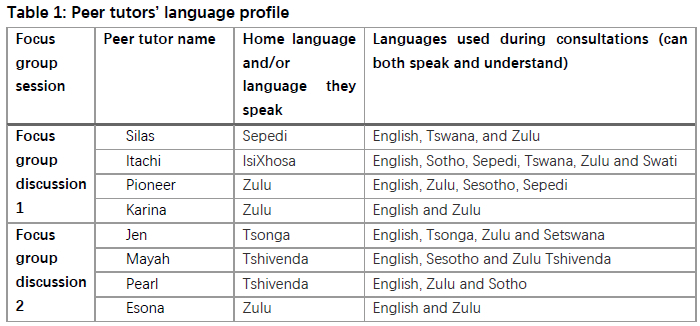
Language use is a social phenomenon, and to investigate how peer tutors employed multilingualism as a pedagogical tool, we decided on an epistemology and ontology that accepts knowledge and how we study it as social. In this worldview, mostly assumed by qualitative researchers, we believe that 'social phenomena are sustained through social practice' (Barbour, 2018: 34). A phenomenological research approach was, thus, adopted for this study as we were interested in peer tutors' interactions, with students and amongst themselves, and their active construction of meaning as they discussed their experiences of using multiple languages in consultations. We employed the focus group discussion as a social context for data generation. A total of 8 peer tutors participated in this study. Two focus group discussions were conducted and each group had peer tutors who had a multilingual language background. To ensure anonymity, participants were given the opportunity to select their own pseudonyms at the time of completing consent forms. Below is a table showing the language profiles of peer tutors who participated in this study:
Rather than merely elicit participants' views, we conducted the two focus group discussions in such a way that what was said was as important as how it was said. Thus, we intently listened and observed exchanges between peer tutors as they co-constructed perspectives and responses (Barbour, 2018). We encouraged participants to interact amongst themselves and avoid directly responding to the moderator. In that way, we managed to create a lively social interaction where peer tutors were able to debate, contest, agree, concur, and modify ideas and meanings exchanged in dialogue. Consequently, this was instrumental in generating rich data as we witnessed multilingualism at play during the focus group discussions as peer tutors, at times, explained their views in their most comfortable language. To ensure that intended meanings were retained as well as preserve the trustworthiness of the research findings, we cross-referenced through conducting robust discussions between participants and the research team. Such cross-referencing, as put by Yunus, et al. (2022), has the advantage of ensuring that accurate meanings are assigned from the various languages used to English.
We adhered to the ethical guidelines of qualitative research throughout the data generation process. We sought and obtained ethical clearance from the ethics committee of the University of the Witwatersrand. Thereafter, we thoroughly explained the purpose of our study to peer tutors. Those who agreed to participate in the study did so by way of written consent. To protect the identity of participants, pseudonyms are used throughout this study.
Findings
The peer tutors' ability to achieve their goals in tutoring their fellow students is not a straightforward and deliberate process. While we have organised our findings into three distinct chronological phases: processing environmental cues, making decisions, and executing plans, this may not have happened as neatly. Since Passini's (1981) work on wayfinding, his conceptual framework has been consistently regarded as the foundational or standard model for understanding wayfinding. Over time, researchers and practitioners have used his framework as a general reference point when developing specific strategies to address different wayfinding challenges. Even when wayfinding strategies are tailored to specific problems or contexts, they are often still rooted in Passini's original conceptualisation (De Villiers, et al., 2022).
Processing of environmental cues
The peer tutors process the cues based on their own past and present experiences. This theme shows how peer tutors adapt their pedagogical practices to match students' language needs, which indicates that language is a key environmental cue in shaping interaction. The excerpts below focus groups 1 and 2 capture tutors' reflections on their tutoring practices and linguistic accommodations. For example, Pearl and Esona's comments highlight how they employ multilingualism as a strategy to ensure an accessible and interactive learning environment in which students can use the languages of their choice while being actively engaged in academic discussions. In contrast, Itachi in focus group 2 showed how they intentionally used code-switching to encourage participation, particularly when students were hesitant to speak.
What I try to do is I could switch when trying to make an exampe or probably lighten the mood... because the issue with my students is that they're too quiet. So, in order for me to bring them into the interaction, I need to actually speak in a manner that they will understand, and they'll be free so that they can also share some ideas (Itachi: Focus Group 2).
Peer tutors' comments reflect their ability to adapt their teaching strategies based on their interpretation of the environment cues. For example, Itachi's ability to use different languages demonstrates his/her sensitivity to students' communication challenges.
If it's easier for them to explain things to me in Zulu, I don't mind because I understand. So yeah, I do. I do allow them to use them, but then I always try to either reply in Zulu or Sotho if I do know like words that I can say in other languages, but then mostly I will reply in English, and they will conversate with mainly Zulu, and I'll be fine with it (Pearl: Focus Group 1)
I use that sort of as an entry point... it's important to get them speaking and to get them as comfortable as they can. I think they appreciated it; it offers space good space for interaction and communication. (Esona: Focus Group 1).
Pearl and Itachi's comments above highlight the importance of multilingualism in academic spaces to build rapport with students. This is also evident in Silas' comment below which shows how languages act as environmental cues to respond to students' academic needs.
Even though the languages differ, I do understand most of them, and if someone is answering in their own language, I can take that and translate it, making it available for everyone....I allow them to use their own in order for me to see that they understand this part of content and writing structure and the problems they are having (Silas: Focus Group 1).
Peer tutors' narratives highlight the importance of multilingualism as a pedagogical tool to facilitate students' understanding of disciplinary discourse. The findings suggest that peer tutors identify their students' challenges with use English and switch to a local language to enable students to navigate complex disciplinary concepts and undertake tasks in academic writing. Through their narratives, peer tutors highlight how their awareness of students' struggles with the language of teaching and learning forced them to make engage decisions to create a "comfortable" learning environment in which students can more readily with the disciplinary content using their home languages. Using local languages creates a more inclusive environment in which students may feel understood and help them feel more connected to their cultural identity and to their peers, fostering a sense of belonging and community. Costandius' perspective of possibility is evident as a 'crosscutting path from one conceptual flow to another' that sparks creativity and is unpredictable (2019: 3). The multilingual pedagogy allows the peer tutors to be creative by making links and developing "zigzag engagements", moving between English and local languages that ultimately challenges the traditional and exclusionary monolingual pedagogies.
Making decisions and developing plans
This theme highlights how peer tutors use cues they have observed and experienced to determine their course of action. The course of action was aimed at a specific task. For example, Itachi's comment below indicates how he/she uses students' home language to ease them into the academic discourses and circumvent English as a barrier.
So, I do use, and I do allow students to use their home languages and engage with them in languages...because I use that as an entry point, you know. You have first-year students who have no understanding of how the university works. They have been plunged into a metropolitan city such as this one from very diverse contexts. So, I find that if we are going to enable any type of learning, even in terms of writing, it's important to get them speaking and as comfortable as they can. And I'm privileged... I speak both Sotho and IsiXhosa, which means that I can understand Sepedi, Tswana, and Zulu and Swati (Itachi: Focus Group 1).
In recognising his/her ability to speak various language is a privilege, this peer tutor embodies critical citizenship. Critical citizenship involves being aware of social issues, valuing diversity, and actively contributing to the community. By recognising their multilingual ability as a privilege, the peer tutor demonstrates an awareness of social inequalities and uses their skills to help the students. The peer-tutor empathises with the students' possible fears and lostness, as they are "plunged" in the metropolitan city. The peer-tutor considers the students need to find their way in the literal lostness - the physical state of not knowing their way in the city - and the metaphorical lostness - with feelings of confusion - in using academic language. By using different languages, the peer-tutor provides a sense of orientation.
Similarly, Silas, Mayah, and Jen make deliberate choices using multiple languages to clarify complex concepts and guide students through unfamiliar disciplinary content.
I think most of the time, I use other languages besides English. This is simply how I make them understand the content I think that's why even with them, they get to explain things in their own language. Things that are hard to explain in English. So, I think that's the most part that is being used in terms of multilingual in the consultations and in the sessions that's what they do. (Silas: Focus Group 1)
I use other languages in order to understand their articulation of ideas. So, they might give me an example in English, and I might not understand it. I ask them to explain it in their language so I can better grasp what they are trying to say. (Mayah: Focus Group 2)
I think with the examples sometimes we use our language. So that's when we dive into either my home language or others, or we draw on some cultural stuff they might relate to. (Jen: Focus Group 2).
Peer tutors' comments reflect how they decide to switch languages: to develop rapport and cultural connection with their students and enable access to content knowledge. These decisions reflect how multilingualism helps peer-tutors meet their pedagogical goals. The use of multiple languages is considered a strategy to facilitate a deeper understanding of complex ideas before transitioning to English. Peer tutors use their multilingual abilities to connect with students on a deeper level. Their practice, using their embodied selves-language skills, cultural knowledge, and personal experiences-may enhance the learning process. The possible facilitation of access to content knowledge through multilingualism, shows peer tutors are actively working to reduce educational inequalities This theme highlights how tutors actively plan and make strategic choices based on their students' linguistic backgrounds.
Transforming decisions and executing plans
Findings suggest that peer tutors executed their decisions into practice by choosing to use their languages to help students bridge the gaps in disciplinary content. For example, peer tutors translate complex concepts from local languages into English and vice versa to ensure students grasp content and articulate it in their writing. This is evident in comments by Silas and Jen noting that using local language to explain concepts to students takes time but nonetheless enables students understanding.
You would explain It to them In the local language... I will translate for everyone... So that's why we try to maintain English so that everyone can understand. (Silas: Focus Group 1)
Silas acknowledges the importance of using local languages to ensure that all students understand the material. By translating into English, Silas ensures that everyone, regardless of their primary language, has access to the same information. This practice promotes fairness and inclusivity in the learning environment.
What I've decided to do is that you know what, tell me in Tswana, and I'll try to break it down into English... It is time-consuming, but it's honestly worth it in the end because they know they go into writing their essays having understood the text. (Jen: Focus Group 2)
Jen's approach of allowing students to express themselves in Tswana and then translating the students' vernacular into English enables the students to understand the content before they are assessed. This approach respects the students' linguistic backgrounds and provides them with a relatively fair opportunity to succeed academically. This embodies the principles of epistemic justice. Peer tutors' comments show that translating between languages helps students bridge the gap between their spoken ideas and the expectations of academic writing. This reinforced the theme of wayfinding in navigating academic expectation.
Before we start the session, we get to have certain conversations about their experiences at university. I make certain jokes in Zulu, so they feel more relevant and comfortable. (Itachi: Focus Group 2)
Itachi uses Zulu to create a comfortable and relatable environment for students. By acknowledging and incorporating students' cultural and linguistic backgrounds, Itachi fosters a sense of belonging and respect. This practice helps the students feel valued and understood, which is a key aspect of epistemic justice. The peer-tutors show how the use of local languages and cultural sensitivity in their pedagogical practices can promote epistemic justice by ensuring that all students have relatively equitable access to knowledge and feel respected in their learning environment.
Unresolved tensions
These findings highlight the ongoing challenges related to language and identity in academic settings. Peer tutors observe that despite efforts to incorporate students' home languages, there is a tension between students' desire to master English and institutional pressures linking English proficiency with intellectual credibility. Consequently, students feel compelled to conform to academic norms, sometimes leading to anxiety and discouraging linguistic diversity. This tension reveals a discrepancy between fostering a multilingual environment and an academic system that privileges English, indicating a systemic issue in which language use can both empower and marginalise students. This tension is reflected in the following comments.
I think the whole policy of language and how they choose Sesotho, Zulu and sign language to be their language.... I think they were just being careful with the issue of politics around the language. So, remember... [it] is not only limited to South African learners; there are learners from other countries as well, right? So, if they going to accommodate everyone, then Imagine what will happen if now they have to bring Hindu as a competency language, right? And the other issue is who are you gonna hire to teach to teach that Hindu language? (Karina: Focus Group 2)
The theme of shifting from what's this... being in Africanisation and trying to move towards Africanisation. I don't think it's something whereby we ever get to a point where we say now we fully have Africanised everything because what if we say if we African ise something, then whose language is it going to be dominant so having a variety of language, it's against the whole notion of Africanising everything. And the other thing with English is that we can't cancel English because English is part of history, and there's a saying I can't remember the writer saying that you can't recreate (Karina: Focus Group 2)
I explain everything, and if [a student] didn't hear it in English... I still have to repeat information for her slowly so that she understands. (Pioneer: Focus Group 2)
People often see fluency in English as a measure of intelligence... So, some students feel pressure to portray themselves as intelligent, and it makes them anxious when they can't express themselves fluently in English. (Jen: Focus Group 2)
The unresolved tensions highlight the persistent and complex tensions surrounding language, identity, and academic success in higher education. While peer tutors strive to create inclusive, multilingual environments that honor their college-mates' linguistic and cultural backgrounds, the privileging of English as a marker of intellectual ability continues to exert significant pressure on students. The narratives illustrate how students navigate these conflicting pressures-on the one hand, striving to maintain their linguistic identities, and on the other, feeling compelled to conform to institutional norms that prioritise English. This tension not only affects students' confidence and engagement but also reveals deeper systemic challenges in achieving true linguistic inclusivity. Without structural changes that genuinely value and integrate diverse languages, the push for multilingualism risks being symbolic rather than transformative. Addressing these unresolved tensions requires a shift in institutional policies and attitudes, fostering a learning environment where language is seen not as a barrier but as a resource for academic success.
Discussion
The peer tutors use a multilingual approach that adopts a 'wayfinding pedagogy' to explore academic concepts and enable access to academic content. Ideally, African languages should provide them with access to English. The assumption is that even though students still need to access and write in English, familiarity with academic concepts may facilitate understanding in English.
Multilinguistic practices disrupt monolingual practices and pave the way to grounding pedagogical practice for writing centre peer tutors. According to peer tutors, using students' familiar language creates a more inclusive and fair learning environment. The multilingual approach appears to provide access to academic concepts and English content. By drawing on different languages, peer tutors enable access to academic English, foster a sense of belonging, and ultimately contribute to epistemic justice. The tutors' integration of multilingualism during writing sessions, can inform a new multilingual decolonised writing pedagogy.
While there appears to be an empowering learning environment that identifies with the individual, there is also unresolved tension as to what happens beyond the writing consultation and to what extent students access academic discourses that are all in English. Peer tutors engage in a creative process that forces frictional encounters between various languages, English, and educational content in English. The seemingly "unconventional" encounter of languages has generated an unresolved tension. The unresolved tension - to determine if the use of various languages provide access to English and educational content and ultimately foments epistemic justice - in of itself has formed new meanings in writing centre pedagogy Leveraging the principles of wayfinding to navigate and orient peer tutors within the complex university space (De Villiers et al., 2022), and informed by Costandius' (2019) creative process of "linking exercises and zigzag engagements" the exploration challenges the university's stated educational transformation with a concrete proposition. Leveraging Costandius's (2019) art transformative process we identify that the writing centre peer tutors expose students to diverse aesthetic experiences that foster imagination and critical reflection and disrupt monolingual practices. The peer tutors appear to have asked "What would happen if they experimented with the diverse language material?" They appear to have also asked "What if we allowed the world around the students' specific environment to provide the clues to multilingual and decolonised writing consultation and create a disrupting pedagogy?"
Tutoring sessions provide opportunities for creative and imaginative engagement with languages. Peer tutors and students can experiment with different languages and styles by appreciating the aesthetic qualities of diverse linguistic forms. In a writing centre, writing and revising become an embodied learning experience, where students and peer tutors use their own and students' languages not just as a tool for communication, but as a medium for creative expression. This perspective shifts the focus from mere correctness to a more holistic view of writing as an art form where the beauty and complexity of multiple languages are celebrated. The tutors deliberately draw on contextualised knowledge emanating from their immediate environments to disrupt normalised generic thinking (Jacobs, 2021).
The wayfinding, aesthetic, and embodied learning process offers writing centres creative spaces in which students are encouraged to explore and express their entire linguistic and cultural identities. The potential of a multilingual pedagogy displayed by peer tutors at the WSoE can inform programme planners of the need to be responsive to changes in higher education and professional contexts, especially attending to their biases towards particular philosophical, political, and other preferences (Bitzer & Costandius, 2018). This would require dialogue with communities, particularly with students. Because universities aim to develop graduates who consider their role for the wider public good, the academy needs to develop context-specific programmes that engage staff and students in dialogue that encourage critical consciousness. Dialogues with communities would identify barriers to critical citizenship. Barriers to developing critical citizens, including power structures, prejudice, and whiteness, can be overcome through dialogue, community interaction, and reflection (Costandius & Alexander, 2018). Costandius and her co-authors recommend critical dialogue to challenge the "othering" and "shaming" experienced by students in South African universities resulting in discomfort and injustice (Costandius & Alexander, 2019; Costandius & Alexander, 2018). Tackling barriers to critical citizenship requires education that promotes democracy and social justice. This means reflecting on and working out the 'radical equality' (Costandius & Alexander, 2018:16) and the 'radical changes' (Bitzer & Costandius, 2018:7) needed to tackle problematic curriculum issues, such as power, inclusion, exclusion, and relevance and addressing issues of language use in teaching and learning is good place to start.
Even though wayfinding has provided a framework to analyse peer tutors' multilingual pedagogy, Alexander, et al. reminds us that wayfinding has been a 'colonialist co-option' (2020: 125). Wayfinding is evident in popular culture, particularly in Disney films, which portray the exotic nature of empire-building colonialists. However, the ubiquity of this 'generative metaphor' (Alexander, et al., 2020: 125) needs to be considered in a multidimensional manner to counter the racialised nature of the terms. In our co-option of wayfinding with epistemic justice, our intention is to address the 'othering' that colonial languages have imposed on contemporary education.
Conclusion
Costandius' pedagogical process, values, and practices are infused by trust in a process that enables social and epistemic justice. In our study, we trust that peer tutors' multilingual practices not only achieve a sense of belonging to the students but also enable access to content and ultimately epistemic justice. The next step would be to conduct research with students to assess the extent to which their expectations and trust in the practice and process have been realised. We hope that these are the first steps taken to challenge and disrupt monolingual practices. Importantly, this study calls for a more nuanced and systemic approach to language policy in higher education. While multilingual pedagogies and translanguaging practices offer promising avenues for fostering inclusivity and epistemic justice, they must be supported by institutional commitments to address the underlying power dynamics that privilege English. This includes rethinking assessment practices, providing adequate resources for multilingual education, and challenging the deeply ingrained ideologies that equate English proficiency with intellectual ability. Only by addressing these systemic issues can universities truly create spaces where linguistic diversity is not only tolerated but celebrated as a vital resource for learning and knowledge production.
However, even if change occurs sometime in the near or distant future, the awareness created about the possibilities inherent in a multilingual pedagogy in a writing centre is a valuable outcome. Affirming and recognising peer tutors' wayfinding is one way, among others, of contributing to broader and ongoing discussions about decolonisation and language policies in South African universities.
References
- Abdulatief, S. & Guzula, X. 2024. Crossing the frontier from oral to written translanguaging for epistemic access in natural science. Readding & Writing, 15(1): Article 507.
- Abdulatief, S., Guzula, X., Kell, C., Lloyd, G., Makoe, P., McKinney, C. & Tyler, R. 2018. How are we failing our children? Reconceptualising language and literacy education. bua-iit: Language andd Literacy Collective. Available at: https://bua-lit.org.za/wp-content/uploads/2018/11/bua-lit-language-literacy-education.pdf (Accessed: 4 December 2024).
- Abdulatief, S., Guzula, X. & McKinney, C. 2021. Delinking from colonial language ideologies: Creating third spaces in teacher education. In Bock, Z. & Stroud, C. (Eds.). Language and Decoloniality in Higher Education: Reclaiming Voices from the South. London: Bloomsbury 1-26.
- Angu, P. 2013. The academic writing challenges of undergraduate students: A South African case study. International Journal of Higher Education, 3(1): 1-11.
- Bharuthram, S. 2017. The reading habits and practices of undergraduate students at a higher education institution in South Africa: A case study. The Independent Journal of Teaching and Learning, 12(1): 50-61.
- Biscombe, M., Conradie, S., Costandius, E. & Alexander, N. 2017. Investigating "othering" in visual arts spaces of learning. Education as Change, 21(1): 137-154.
- Bitzer, E. & Costandius, E. 2018, Continuous programme renewal and critical citizenship: Key items for the South African higher education curriculum agenda. Transformation in Higher Education, 3(0): Article 37.
- Boakye, N.A.Y. & Linden, M.M. 2018. Extended strategy-use instruction to improve students' reading proficiency in a content subject. Reading & Writing, 9(1): Article 212.
- Boughey, C. & McKenna. S. 2021. Understanding Higher Education: Alternative Perspectives. Cape Town: Africa Minds.
- Boughey, C. & McKenna, S. 2016. Academic literacy and the decontextualised learner. Critical Studies in Teaching and Learning, 4(2): 1-9
- Brandt, D. 2014. The Rise of Writing: Redefining Mass Literacy. Cambridge: Cambridge University Press.
- Brinkschulte, M., Grieshammer, E. & Stoian, M.E. 2018. Translingual academic writing at internationalised universities: Learning from scholars. Journal of Academic Writing, 8(2): 150-160.
- Canagarajah, S. 2023. Decolonizing academic writing pedagogies for multilingual students. TESOL QUARTERLY,8(1): 280-306.
- Carstens, A. & Rambiritch, A. 2020. Theoretical grounding of writing centre practices: a foundation for tutor training. Journal for Language Teaching /Ijenali Yekufundzisa Lulwini / Tydskrff vir Taalonderrig, 54(1): 235-251.
- Clarence, S. 2016. Peer tutors as learning and teaching partners: a cumulative approach to building peer tutoring capacity in higher education. Critical Studies in Teaching and Learning, 4(1): 39-54.
- Clarence, S. 2019. Exploring the gap between what we say and what we do: Writing centres, 'safety,' and 'risk' in higher education. Stellenbosch Papers in Linguistics Plus (SPiL Plus), 57: 117-130.
- Clarence, S., Albertus, L. & Mwambene, L. 2013. Building an evolving method and materials for teaching legal writing in large classes. Higher Education, 67: 839-851.
- Costandius, E. & Alexander, N. 2019. Exploring shame and pedagogies of discomfort in critical citizenship education. Transformation in Higher Edducation, 4: a73.
- Costandius, E. 2019 Fostering the conditions for creative concept development. Cogent Education, 6(1): 1-10.
- Costandius, E. & Alexander, N. 2018. Exploring barriers and strategies for critical citizenship education: A reflection on practice. In E. Costandius & H. Botes (Eds.)., Educating Citizen Designers in South Africa. Stellenbosch: SUNPress, 1-23.
- Costandius, E. & Bitzer, E. 2014. Opening spaces for social transformation: Critical citizenship education in a post-conflict South African university context. Education, Citizenship and Social Justice, 9(2): 128-139.
- Costandius, E., Blackie, M., Nell, I., Malgas, R., Alexander, N., Setati, E. & Mckay, M. 2018. #FeesMustFall and Decolonising the Curriculum: Stellenbosch University students' and lecturers' reactions. South African Journal of Higher Education, 32(2): 65-85.
- De Villiers, G., Costandius, E., Brazier, K. & Perold-Bull, K. 2022. Towards linguistic inclusivity: An exploration of the wayfinding system at Stellenbosch University, South Africa. Interdisciplinary Journal of Signage and Wayfinding, 6(2): 31-42.
- Dison, L. & Kadenge, E. 2023. Developing resilient pedagogy: New questions for writing centre practice at the Wits School of Education Writing Centre. In Rambiritch, A. & Drennan, L. (Eds.). Reimagining Writing Centre Practices: A South African Perspective. Pretoria: ESI Press, 195-218.
- Dison, L. & Moore, J. 2019. Creating conditions for working collaboratively in discipline-based writing at a South African university. Per Linguam: A Journal of Language Learning, 35(1): 1-14.
- Dison, L. & Mendelowitz. B. 2017. Reflecting on writing centre practice through students' experiences of a contextualised writing centre. In Dison, L. & Clarence, S. (Eds.). Writing Centres in Higher Education: Working in and Across the Disciplines. Bloemfontein: Afrisun Media, 193-208.
- Eybers, O. 2023. Afrocentricity and decoloniality in disciplinarity: A reflective dialogue on academic literacy development. Critical Studies in Teaching and Learning, 11(2): 48-64.
- Eybers, O. & Dewa, N., 2024. Developing an inclusive African theory of academic literacy. The International Journal of Literacies, 32(2): 53-74
- Farr, A. C., Kleinschmidt, T., Yarlagadda, P. & Mengersen, K. 2012. Wayfinding: A simple concept, a complex process. Transport Reviews, 32(6): 715-743.
- Fricker, M. 2007. Epistemic Injustice: Power and the Ethics of Knowing. Oxford: Oxford University Press.
- García, O., Seltzer, K. & Witt, D. 2018. Disrupting linguistic inequalities in U.S. urban classrooms: The role of translanguaging. In Van Avermaet, P., Slembrouck, S., Van Gorp, K., Sierens, S. & Maryns, K. (Eds.). The Multilingual Edge of Education. London: Palgrave Macmillan, 4166.
- García, O. & Wei, L. 2014. Translanguaging: Language, bilingualism and education. Translanguaging: Language, Bilingualism and Education. Basingstoke: Palgrave Macmillan.
- Guzula, X. 2021. Constructing a pedagogical third space with multilingual children: A case study of the bilingual Stars of Today Literacy Club# (STLC#). Unpublished PhD diss., University of Cape Town.
- Guzula, X., McKinney, C & Tyler, R. 2016. Languaging-for-learning: Legitimizing translanguaging and enabling multimodal practices in third spaces. Southern African Linguistics and Applied Language Studies, 34(3): 1-16.
- Gribich, C. 2013. Qualitative Data Analysis: An Introduction. London: Sage.
- Jacobs, C. 2021. Contextually responsive and knowledge-focused teaching: disrupting the notion of 'best practices'. Critical Studies in Teaching and Learning, 9(SI): 1-14.
- Jusslin, S., Korpinen, K., Lilja, N., Martin, R., Lehtinen-Schnabel, J. & Anttila, E. 2022. Embodied learning and teaching approaches in language education: A mixed studies review. Educational Research Review, 37: 100480.
- Kerfoot,C., & Bello-Nonjengele B.,O.(2023). Towards epistemic justice: Constructing knowers in multilingual classrooms. Applied Linguistic. 44(3),462-484
- Khumalo, N. & Reddy, S. 2021. Cross-disciplinary synergy: first-year students' experiences of learning academic writing through integrated writing support at a University of Technology. The Journal for Transdisciplinary Research in Southern Africa. 17(1).
- Kidd, I.J., Medina, J. & Pohlhaus, G. 2017. Introduction. In Kidd, I.J., Medina, J. & Pohlhaus Jr., G. (Eds.). The Routledge Handbook of Epistemic Injustice. London: Routledge, 1-19.
- Kumalo, S. 2022. The place of colonial languages in Decolonial philosophy and practice. In Boucher, D. (Ed.). Language, Culture and Decolonisation. Cape Town: HSRC Press, 113-133.
- Lea, M.R. & Street, B.V. 1998. Student writing in higher education: An academic literacies approach. Studies in Higher Education, 23(2): 157-172.
- Lillis, T. 2001. Student Writing:Access, Regulation, Desire. London: Routledge.
- Lunsford, K., Whithaus, C. & Alexander. J. 2024. Activist orientations: Wayfinding, writing, and how alumni effect change in the world. Rhetoric Review, 43(1): 59-77.
- Lynch, K. 1960. The Image of the City. Cambridge: MIT Press.
- Lytra, V., Tharoo, S., Banfi, E., Chengyan, Z., Costa, C., Eleftheriou-Kaparti, M., Meyer, Z. & Schmid-Ilina, P. 2020. Honouring students' multilingual repertoires and identities: Our languages, our stories. EAL Journal, Autumn: 18-21.
- Maldoni, A.M. 2017. A cross-disciplinary approach to embedding: A pedagogy for developing academic literacies. Journal of Academic Language and Learning, 11(1): A104-A124.
- Maringe, F. 2023. The conceptual 'jungle' of the decolonisation of Higher Education: Contestations, contradictions, and opportunities. In Maringe, F. (Ed.). Colonization and Epistemic Injustice in Higher Education. London: Routledge, 1-22.
- Marshall, S. 2020. Applying plurilingual pedagogy in first-year Canadian higher education: From generic to scientific academic literacy. In Lau, S.M.C. & Van Viegen, S. (Eds.). Plurilingual Pedagogies. Educational Linguistics, vol 42. Cham: Springer, 253-269.
- Mathebula, M. 2019. Recognising poor black youth from rural communities in South Africa as epistemic contributors. Critical Studies in Teaching and Learning, 7(1): 64-85.
- Mayaba, N.N., Ralarala, M.K. & Angu, P. 2018. Student voice: Perspectives on language and critical pedagogy in South African higher education. Educational Research for Social Change, 7(1): 1-12.
- McKinney, C. 2017, Language and Power in Post-Colonial Schooling: Ideologies in Practice, New York: Routledge.
- McKinney, C. & Guzula, X. 2024. (Trans)languaging-for-learning in the South: Innovating with teachers. Reading & Writing, 15(1): a525.
- McKinney, C. & Tyler, R. 2024, Corrigendum: (Trans)languaging-forlearning: A perspective from the South. Reading & Writing, 15(1): a540.
- Medina, C. 2019. Decolonial potential in a multilingual FYC. Composition Studies, 47(1): 73-94.
- Milligan, L.O. 2022. Towards a social and epistemic justice approach for exploring the injustices of English as a Medium of Instruction in basic education, Educational Review, 74(5): 927941.
- Munyaradzi, J. & Manyike, T.V. 2022. Perceptions of lecturers on English as a primary medium of instruction at a selected university in South Africa. Journal for Language Teaching, 56(1): 1-22.
- Namakula, H. & Prozesky, M. 2019. In-between access and transformation: Analysing a university writing centre's academic support programme for education students as third space. Stellenbosch Papers in Linguistics Plus, 57: 39-56.
- Namakula, H. 2021. A social realist analysis of the efficacy of an embedded academic literacy intervention programme in shaping first year B.Ed. Students' academic literacy practices. Unpublished PhD diss., University of Witwatersrand.
- Namakula, H., Kadenge, E. & Blessed-Sayah, S. 2023. 'From "business as usual" to "business unusual": Online academic literacy development for education students during the Covid-19 pandemic'. Perspectives in Education, 41(3): 50-63.
- Ngidi, S.A. & Mncwango, E.M. 2022. University students' perspectives on an English-only language policy in higher education. The Journal for Transdisciplinary Research in Southern Africa, 18(1): Article a1189.
- Nomlomo, V, & Katiya, M. 2018. Multilingualism and (bi)literacy development for epistemological access: Exploring students experience in the use of multilingual glossaries at a South African university. Educational Research for Social Change, 771), 77-93.
- Passini, R. 1981. Wayfinding: A conceptual framework. Urban Ecology, 5(1): 17-31.
- Pistone, R. 2010. Writing centre tutors have the luxury to focus on individual student care giving as opposed to formal classroom settings that are less care centred. English Language Teaching 3(2):: 10-12.
- Rambiritch, A. & Drennan, L. (Eds.). 2023. Reimagining Writing Centres Practices: A South African Perspective. Pretoria: ESI Press.
- Ranjan, M.J., Gladious, S., Lakshmi, C.N.V., Patro, A.S.S. & Kumar, P. 2024. The cultural and linguistic implications of English language dominance in education systems. Educational Admnistration: Theory and Practice, 30(6): 2797-2800.
- Sekonyela, L.M. 2023. Academic writers as interdisciplinary agents in the university access programme. Journal of Ethnic and Cultural Studies, 10(3): 89-102.
- Stellenbosch University. 2023. Prof Elmarie Costandius honoured with TAU Fellows Award. Available at: https://www.sun.ac.za/english/Lists/news/DispForm.aspx?ID=10197 (Accessed: 20th September 2024).
- Trinick, T. & Allen, P. 2024. Wayfinding in an indigenous initial teacher education mathematics programme. ZDM-Mathematics Education, 1-11.
- Whithaus, C., Alexander, J. & Lunsford, K. 2022. When things collide: Wayfinding in professional writers' early career development. Literacy in Composition Studies, 9(1): 1-22.
- Wilmot, N. v., Vigier, M. & Humonen, K. 2024. Language as a source of otherness. International Journal of Cross-Cultural Management, 24(1): 59-80.
- Wingate, U. 2012. Argument!' helping students understand what essay writing is about. Journal of English for Academic Purposes. 11(2): 145-154.
- Wingate, U. 2015. Academic Literacy and Student Diversity: The Case for Inclusive Practice. Bristol, Blue Ridge Summit: Multilingual Matters.
- Yunus, N. A., olde Hartman, T., Lucassen, P., Barton, C., Russell, G., Altun, A. & Sturgiss, E. 2022. Reporting of the Translation Process in Qualitative Health Research: A Neglected Importance. International Journal of Qualitative Methods, 21. https://doi.org/10.1177/16094069221145282

Accepted: 24 February 2025
Author Biographies
Halima Namakula (PhD) is a research fellow at SARChi Teaching and Learning, University of Johannesburg. Her research interest includes academic literacy support and development in higher education, epistemic access and success, gender in education, ICT in education, early childhood development, and translanguaging pedagogies in writing centres in South Africa.
Wacango Kimani (PhD) is a Researcher at the SARCHi Chair for Teaching and Learning, University of Johannesburg. She holds a PhD in Education from the University of the Witwatersrand. Her research interests and publications focus on practices that promote and support the inclusion of all students with a particular focus on teachers' quality of engagement within professional learning communities.
Emure Kadenge (PhD) is a Lecturer in the Curriculum and Social Sciences division at the School of Education, University of the Witwatersrand. She is also the Academic and Research Coordinator at the Wits School of Education Writing Centre. Her research interests are in the field of teacher professional development and academic literacy development and pedagogies in Higher Education. She has produced scholarly papers on pre-service and in-service teacher learning and the nature of opportunities available for teacher learning, growth and development as well as how those opportunities are organised and implemented.