Structured doctoral programmes for developing the scholar and the scholarship: lessons from practice
Abstract
There are growing international calls for doctoral education to embrace more collaborative, structured supervision models. While the uptake of such models has been slow in South Africa, interesting forms of structured models are emerging. This study critically reflects on one such example, highlighting the successes and challenges to provide the field with practical insights of how such a model can be conceptualised. Focusing on a curriculated PhD project in the field of higher education studies, the paper explores the extent to which the project enhanced the development of the scholarship and scholarly dispositions in candidates. Inductive thematic analysis of interviews with 12 doctoral candidates was used in the first phase of analysis to reveal the salient issues in the data. The second phase of analysis drew on Legitimation Code Theory's dimension of Specialization to understand the different kinds of learning afforded by the programme. The findings show how the curriculated programme provided an important bridge into disciplinary knowledge, and it reveals how the collaborative community played a critical role in strengthening students' theoretical and disciplinary knowledge as well as cultivating key scholarly dispositions such as criticality, voice, and collaboration.
doctoral attributes; doctoral education; structured doctoral programmes; supervision models; social learning
Introduction
As higher education continues to expand and diversify, there is an urgent need for more socially-just, inclusive models of doctoral education, particularly in contexts where there are external pressures to exponentially increase doctoral graduates (Cloete, et al., 2015; Grant, et al., 2022). Traditional models of doctoral supervision, notably the master-apprentice or one-on-one model, are increasingly being questioned for their effectiveness and appropriateness for fast-growing postgraduate contexts (ASSAF, 2010; Wilmot & McKenna, 2023). In contrast to these approaches, collaborative structured models are argued to be more responsive to our growing knowledge economy in that they offer a more beneficial learning environment for students (McKenna, 2017; Ngulube & Ukwoma, 2019).
The move towards structured doctoral programmes
In their scoping review of 20 years of international literature on supervision models, McKenna and van Schalkwyk (2023) provide evidence of an international trend towards collaborative and structured doctoral supervision models. The authors explain how this move has been informed by multiple factors including: a growing knowledge economy and a subsequent need for more efficient approaches to doctoral education, internationalisation and the need to provide opportunities for collaborative knowledge-building and networking, and the rise of interdisciplinary research necessitating a more expansive and diverse approach to supervision and understandings of quality (McKenna & van Schalkwyk, 2023).
The authors make an important observation that the uptake and design of these models has not been uniform or homogenous (McKenna & van Schalkwyk, 2023). For example, they highlight how many programmes now include formal coursework (for example, Carr, 2021; Limberg, et al., 2013), or an examination at a particular point in candidature (for example, Maloshonok & Terentev, 2019), while others require students to attend departmental seminars and presentations and/or schedule regular supervision meetings (for example, Salimi, et al., 2016; Skopek, et al., 2022). Despite the differences in offerings, they argue that there is a 'clear trend towards curriculating for more structure and towards more intentional community building' (McKenna & van Schalkwyk, 2023: 5).
The move to more structured approaches does not come without challenges (McKenna & van Schalkwyk, 2023). For example, Guerin and Green (2015), working in Australia, note that students struggle to negotiate feedback from multiple sources. This is similarly noted in the South African context with regards to feedback in cohort supervision models (Ngulube & Ukwoma, 2019). Scholars from Canada, Ireland, and Australia also note that challenges arise when there is a lack of clarity around the different roles played by supervisors (Vanstone, et al., 2013), and that different levels of expertise need to be managed and negotiated while being cognisant of the social hierarchies that different actors bring to the relationship (for example, Timmins, et al., 2014; Robertson, 2017). Other challenges noted include differing rates of student progress in structured programmes in New Zealand (Carr, 2021), coursework being seen to 'slow down' the research trajectory of the doctorate in contexts such as Brazil and Sweden (Bursztyn, et al., 2016; Geschwind & Melin, 2016), and the role of generic coursework in the Swiss context (Baschung, 2016).
Despite the challenges of structured approaches, the benefits are argued to make these models worth pursuing. Collaborative models in particular are seen to lessen feelings of isolation and loneliness associated with the traditional one-on-one model and mitigate the unequal power dynamics between a single supervisor and candidate (De Lange, et al., 2011; Wisker, et al., 2007). When working in a one-on-one model, the pedagogic practice operates in isolation, placing both supervisor and candidate in a potentially vulnerable position (Zeegers & Barron, 2012). Conversely, studies show how collaborative structured models provide opportunities for candidates to engage in peer learning; enabling students to benefit from a collegial support system (Flores-Scott & Nerad, 2012; Wilmot, 2022; Wilmot & McKenna, 2023).
Despite the affordances of such approaches, it is perhaps ironic that the colonial, master-apprentice model persists in many humanities and social sciences contexts in South Africa (ASSAF, 2010; Dominguez-Whitehead & Maringe, 2020; McKenna, 2014; Samuel & Vithal, 2011). This is despite broad agreement that the model is too narrowly focused; that there is a lack of integration across traditional knowledge boundaries; and that it has been implicated in low throughput and completion rates (ASSAF, 2010). The dominance of the one-on-one model is further complicated by the aging professoriate in South Africa (Cloete, et al., 2015), and the subsequent increasing pressure on novice supervisors to take on more students and to start supervising immediately after graduating with a doctorate (Motshoane, 2022; Mouton, et al., 2015). A recent national review of the doctorate by the Council on Higher Education highlights such challenges, particularly with regards to the provision of adequate supervision as well as issues of quality. The review also raises questions regarding the kinds of attributes doctoral graduates should embody (Leitch, et al., 2022).
While there have been successful examples of structured cohort models being adopted in the humanities and social sciences in some South African contexts (see, for example De Lange, et al., 2011; McKenna, 2017; Ngulube & Ukwoma, 2019; Samuel & Mariaye, 2014), structured programmes are not the norm. Furthermore, there is a dearth of literature available that outlines what forms such programmes can take. Working within the confines of our national system that does not recognise coursework for credit (CHE, 2018), this research contributes to these debates by exploring an example of a structured programme within a larger Higher Education Studies Doctoral Programme at a South African university, to which this paper now turns.
The Social Justice and Quality in Higher Education structured PhD project
The Social Justice and Quality in Higher Education1 project (hereafter SJQ project) is a joint doctoral project between Rhodes University (RSA), the University of Venda (RSA) and Lancaster University (UK). Conceptualised and led by Professor Sioux McKenna, the project sits within the broader Higher Education Studies Doctoral Programme (hereafter HES programme) in the Centre for Higher Education Research, Teaching and Learning (CHERTL) at Rhodes University. The SJQ project is funded by the Department of Higher Education and Training in South Africa and comprises 10 funded students and two unfunded2 students. Commencing in 2020, the structured programme included two years of (unaccredited) coursework, it utilised a range of different supervision models (including sole, co, team and panel supervision), and it was embedded within a structured support programme. This included triannual Doc Weeks (Wilmot & McKenna, 2023), a fortnightly work-in-progress seminar series and candidate-led research clusters (Wilmot, 2022). Due to project funding, the SJQ candidates also enjoyed a series of writing retreats. The project will close at the end of 2024.
Drawing on insights from research (for example, Carter-Veale, et al., 2016; Limberg, et al., 2013; McKenna, 2017), the SJQ project was purposely designed with a collaborative, community-centred structure. This ethos and associated set of values were explicitly articulated in the course guide. The values underpinning the project were repeatedly discussed in various group activities. In doing so, the normative agenda of the programme - to cultivate scholarly dispositions espousing social justice, as well as producing research on or about social justice issues in higher education in South Africa - was intentional from the start. This approach aligns with current research that argues that cultivating desired graduate attributes should not be 'incidental', but rather incorporated explicitly into programme design (Jansen & Walters, 2022).
The curriculated programme was delivered predominantly online via our learning management system (LMS), however, we did (and continue to) meet face-to-face for key events, as will be discussed later in the paper. Candidates are supervised primarily by full-time and associate CHERTL supervisors, as well as two supervisors from the South African partner, the University of Venda. All candidates are researching aspects of social justice and/or quality but have constructed projects that utilise different methodologies and theories.
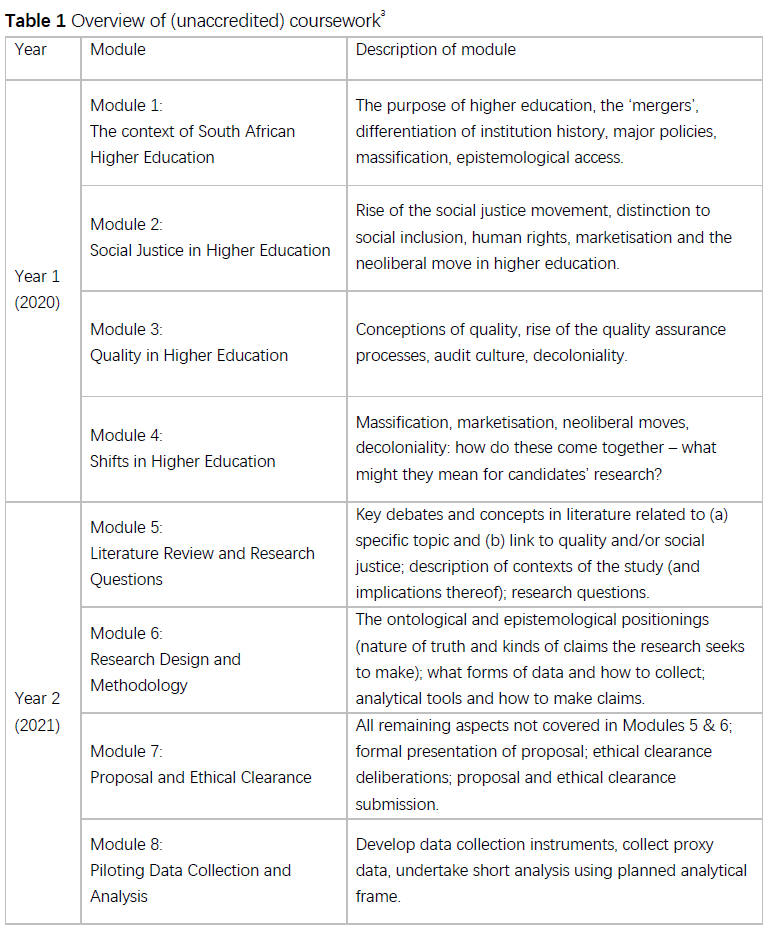
The first two years of coursework each comprised four modules (see Table 1). The first year delved into substantive issues in the field while the second year adopted a more applied focus to support candidates in developing their proposals. Each module ran for approximately eight weeks and included weekly online seminars on Zoom and an associated assignment with explicit deadlines. The supervisory team shared the development and teaching, with module facilitators providing feedback on assignments in the first year and assigned supervisors doing so in the second year. The assignments were not allocated grades; rather, formative feedback was provided to develop candidates' writing and understanding. The modules were writing intensive, with short weekly writing tasks embedded within each module.
In our Faculty of Education where the candidates are registered, the PhD proposal involves compiling a 7600-word document that outlines the intended research including theoretical framework, methodology and research ethics. The proposal is presented by the candidate and then submitted for formal review. Proposal approval marked the first significant milestone in the project, with students required to submit by the end of the second year.
Given that many of our candidates come from diverse disciplinary backgrounds, including gender studies, accounting, physiology, quality assurance, academic development, and business studies, the coursework was intentionally designed to provide access to disciplinary knowledge in the field of higher education studies. This included current debates, seminal literatures, and the wide-ranging research approaches and methodologies commonly adopted in the field. The aim was to build candidates' understandings of South African higher education as a sector and intellectual field, as well as show the various kinds of research that can be undertaken therein. Recordings of workshops and any associated resources were stored in the relevant module site which became a rich repository of materials.
The project also intentionally created a community of practice within the cohort to enable social learning opportunities for candidates. This community was created within the smaller SJQ project through a candidate-only WhatsApp group but also drew on the broader HES programme community through participation in the formal support structures.
Theoretical framework
To elucidate the intentions behind the project design and candidate experiences of the enacted curriculum, this study draws on Legitimation Code Theory as a broad organising framework. Legitimation Code Theory (LCT) is a theoretical framework offering a conceptual toolkit and analytical methodology (Maton, 2014). The theory comprises four dimensions: Specialization, Semantics, Autonomy and Temporality. Of interest to this study is the dimension of Specialization.
Specialization is premised on the notion that everything we do is oriented towards an object and enacted by a subject - i.e., all knowledge practices involve relations to objects and relations to subjects or 'knowers' (Maton, 2014). These are conceptualised as 'epistemic relations' and 'social relations'. All knowledge practices necessarily include both sets of relations; however, by separating them in analysis we can see which are being strengthened and which are being downplayed. These infinite gradations of strengths and weaknesses allow insight into the basis on which any practice is specialised (Maton, 2014). For example, in a doctoral thesis, if the author makes an argument that a particular study's findings are legitimate because a specialist method has been utilised in the analysis, epistemic relations to procedures are being foregrounded. This means that the legitimacy of the findings comes from the specialist procedures that have been used. Alternatively, if the author argues that the findings are legitimate because of their interpretation which has been shaped by their particular life experiences and who they are as a person (e.g., their race, gender, etc.), social relations to a particular kind of knower are being foregrounded as the basis of legitimation (example from Wilmot, 2019).
In this study I wanted to understand the extent to which the structured programme contributed to two different aspects in doctoral studies: the scholarship (i.e., producing the thesis) and the scholar (i.e., developing scholarly attributes). While this learning often happens simultaneously, I used the concepts of epistemic relations and social relations as a framework to identify when the structured programme emphasised the learning of specialist knowledge and procedures relating to research in higher education studies (i.e., when epistemic relations were being foregrounded as the basis of legitimacy), or when it actively cultivated and shaped particular kinds of dispositions in scholars (i.e., when social relations were foregrounded). This framework informs the Findings and Discussion section.
Research design and methodology
The research adopted a qualitative research design to complement and extend existing comprehensive quantitative research on doctoral education and supervision models in South Africa (for example, see ASSAF, 2010; Cloete, et al., 2015). In doing so, the study affords a more nuanced understanding of what a structured doctoral programme can look like and how it was experienced in practice.
Generating the data
I was part of the broader SJQ supervision team and am the current coordinator of the broader HES programme. As such, this paper draws on my first-hand experience of conceptualising and teaching modules, supervising three students in the project, as well as attending international exchange trips and writing retreats with the project cohort. I am also responsible for many of the community-building support initiatives that the SJQ candidates took part in. These experiences inform the critical reflection in the paper.
To balance my own perspective, I sought the experiences of the doctoral candidates themselves. Despite having an open and collegial relationship with the doctoral cohort, power dynamics due to my position as coordinator and supervisor had to be carefully considered. I therefore employed a research assistant who conducted the semi-structured interviews with each candidate in the programme. Participation was voluntary and all the candidates opted to participate. To create anonymity, each candidate chose a pseudonym4 and the recordings were sent directly to an external transcriber. I received the anonymised transcripts only. The interviews took place on Zoom and lasted approximately sixty to ninety minutes.
The intention of the paper is to share understandings of and, most importantly, practical insights into how this curriculated doctoral programme was conceptualised and how it was experienced. It is not the intention of the paper to evaluate the SJQ project, but rather to be useful to others who are considering implementing structured programmes.
Analysing the data
To organise and make sense of my own observations, I first familiarised myself with the interview data to see what salient issues emerged from the candidate perspectives. Guided by the research aims, I undertook an inductive thematic analysis (Thomas, 2006) of the interview transcripts to reveal common experiences (both positive and negative) of learning afforded by the programme. These centred around coursework, supervision, and formal support structures. The themes constructed in this phase of analysis were then analysed using the concepts of 'epistemic relations' and 'social relations' explained in the previous section, to distinguish between learning focused on the development of the scholarship and that associated with the development of the scholar. This distinction and the implications of the different forms of learning inform the Findings and Discussion section.
Findings and Discussion
This section first considers the intentions and associated learning experiences of the two-year coursework component of the project. It then explores the supervision models utilised in the project and the role these played in candidates' learning. Finally, the role of peer learning in formalised support structures and the informal doctoral community are explored.
The role of coursework in a collaborative structured programme
The rationale behind the coursework is that we work in a national context where candidates enter doctoral studies with varying degrees of preparedness (Leitch, et al., 2022), and in a disciplinary context where we accept candidates from multiple disciplinary backgrounds. This meant that there was a need to build a foundation of disciplinary knowledge. In this respect, the coursework was designed to foreground epistemic relations to specialist knowledge and procedures from the field of higher education studies. In doing so, we effectively strengthened the boundaries of what was considered legitimate knowledge for the SJQ project, focusing on social justice and quality. Additionally, the project was underpinned with values that sought to cultivate particular kinds of doctoral scholars. Specifically, it aimed to embed the notion of collaborative knowledge-building as well as cultivate scholarly dispositions informed by social justice values and principles as candidates undertook research on social justice issues in South African higher education. In this sense, we emphasised social relations to particular kinds of knowers through the different offerings.
From a supervisor perspective, the coursework approach worked well. It was much easier to build a knowledge foundation through a structured programme with a cohort of candidates who could engage with one another and the facilitators. Structuring the knowledge into different modules also helped to share the cognitive load between supervisors, with candidates benefitting from their own supervisors' active teaching as well as the other teaching that occurred across the modules.
It appeared that the candidates benefitted from the coursework and that our intentions of strengthening the epistemic relations were well received. For example, Elli explained how the coursework offered an entry point into higher education studies:
I thhink it [coursework] really helped, especially coming from a different discipline than education or higher education. It really helps, I mean, that first module was this higher educational context... to do those readings and to really get into more detail of the discussions going on in the field, difficult words like neoliberalism and managerialism, it just helped to actually have that structured way of accessing a new discipline or a new field, and then to see how you can locate your own study within that field. (Elli, Interview 1)
What was interesting to note in the interviews is how the coursework not only developed insights into the field of higher education studies but, as a result of this insight, shifted some candidates' studies in new directions. This was particularly the case for Lisa:
So, hiaving the course work, it gave me a really broad view of the landscape, besides like the actual focus I wanted to do for my PhD it just like opened my mind to what it actually looks like in higher ed., the different areas, the different things to consider-1 started with one topic but because of the coursework, I actually shifted focus completely, so my PhD is going in a completely different direction than what I initially thought I would do. And that's because I was exposed to things that I wouldn't have been without the coursework. (Lisa, Interview 7).
Another candidate, Michael (Interview 9), explained that the coursework provided a historical context for his study, and that it was helpful to learn about 'issues of everything from the pre- and post-apartheid era, issues of colonialism, neoliberalism, diversification, all those things that have helped shape the sector into what it looks like today'. While these insights are readily available in literature, the coursework provided an opportunity to curate key readings to ensure that specific aspects were covered. In this instance, providing a broader, socio-historical understanding of the sector was an important aim of the programme. It was seen as necessary for contextualising each candidate's research project as well as their future practice as researchers and supervisors. The supervisory team saw their role as not only supporting the specific doctoral projects, but also equipping doctoral candidates with knowledge and practices that would help them supervise post-PhD - an expectation that most will encounter (Motshoane, 2022). An explicit goal is that candidates leave the programme with knowledge beyond their specific topic. Michael's comment gives us an indication that this might be happening.
An aspect of doctoral studies that has become increasingly argued in research (Dominguez-Whitehead & Maringe, 2020) and national level reports (e.g., Leitch, et al., 2022) is that milestones are a useful and necessary mechanism to keep doctoral candidates progressing in their studies. In response to this, the project included module assignments. These were designed to offer explicit milestones in the project and were a useful mechanism through which candidates could receive formative feedback. As a supervision team we grappled with the idea of authentic assessment, and considered how requiring candidates to write assignments that were not necessarily directly contributing to the actual proposal or PhD thesis would be received. Due to the diverse disciplinary backgrounds that candidates brought to the programme we wanted to give them formal writing opportunities to practice the genre of higher education studies and to demonstrate their learning. As such, we thought the potential 'distraction' of assignments was justified.
Despite there being some negative comments at the time of doing assignments, there was broad agreement in the interviews that they played an important role in developing ideas and practicing writing. Some candidates mentioned that they were able to use aspects of the assignments in their proposals, so the value-add was perhaps only evident later in the programme. This is evident in Marie's comment:
Some of them were really ike, "Oh! Do I really have to do this? When it's ike not for marks?" You know, we had that typical student thing, like "I've got to write this thing up and it's not even going to count for anything". But then looking back, when it came to writing my proposal, I could go back to those assignments and pull things through. So, I suppose it was only when I was writing my proposal that I really saw the value of those assignments. (Marie, Interview 4).
Other candidates, such as Sarah, noted that assignment deadlines were at times an issue, particularly if 'you are a working person with a heavy load ... that crunch times becomes a problem' (Interview 10). She went on to add, however, that the deadlines ultimately played a valuable role as without them, she would 'still be waiting to submit assignment one' (Interview 10). In this sense, we mostly achieved our goal of using the assignments to not only develop thinking and writing practices, but also to facilitate and monitor progress.
In terms of monitoring progress, another challenge that we experienced was the pacing of the modules and assignments as it quickly became clear that some candidates were progressing faster than others. This became particularly acute in the second year when the modules adopted a more practical focus, leaving some candidates behind. Differing rates of progress has been noted as a challenge for structured doctoral programmes (McKenna & van Schalkwyk, 2023), with authors highlighting the need for flexibility to accommodate different rates of progress (Carr, 2021). Candidates in our programme acknowledged that it was at times hard to keep up and that levels of engagement in a module were often connected to how relevant the content felt at that point in the journey. This is where the materials repository created in the LMS became invaluable; candidates used the resources and recordings after the modules had been completed and continued to do so well into the programme. For example, Pathuxolo noted that although she wasn't ready to engage with the Data Analysis module content at the time it was offered, she was able to go back and learn at a later stage:
Data analysis (laughs) ... I remember when [facilitator] was explaining that, it was pure Greek. I was like what are you talking about? What are discourses? How do you identify them? Look, I hear your explanations, but I can't make sense of that... And then now when you see it and you 're like, "I remember there was a presentation around this ", and then you go and you listen, and then it sounds so basic (Pathuxolo, Interview 3).
Several candidates made similar comments, highlighting the need for this practice in future iterations of structured programmes. Creating a repository means that candidates can benefit from the structure even if they are not working on the same timeline and it accommodates candidates who are unable to participate in all the offerings due to work or care responsibilities - an important consideration for part-time PhD candidates.
Despite the different speeds of progress, the feedback indicates that the coursework and assignments played a key role in strengthening the epistemic relations to disciplinary knowledge and associated procedures for generating knowledge. This afforded candidates a strong foundation in higher education studies as a discipline. Working in a collaborative cohort-based online environment meant that candidates drew on one another in their learning, not only for understanding the content but also in cultivating particular 'ways of knowing' (i.e., there was evidence of a strengthening of social relations to dispositions). For example, they challenged and supported each other in cultivating a social justice mindset. In more traditional supervision models, candidates would be expected to learn these aspects with little structured support, which can be a significant challenge for them and their supervisor.
The role of supervision in a collaborative structured programme
We have experimented with different forms of supervision models in the broader HES programme to move to more collaborative models. The SJQ project extended these efforts by including co- and team supervision and in some cases, panel5 supervision. Supervisors played a critical role in developing candidates' disciplinary knowledge and know-how (i.e., in mediating the learning of new objects of knowledge and procedures for generating knowledge) and in cultivating doctoral dispositions, such as developing voice, criticality and agency.
As a general principle, we value collaboration in our doctoral programme and see diverse supervision teams as enriching the candidate's learning experience and research work. We also acknowledge the value in having diverse voices engage in collaborative knowledge-building and the social learning this affords. From a supervisor perspective, working with different colleagues can be rewarding, particularly when novice and experienced supervisors team up.
When asked about their supervisory relationships, many of the candidates reflected positively on having more than one person in the team, as described by Olivia:
I've enjoyed it. I thhink supervision is somethhing that historically has been very one -on- one. And it was very healthy and good for me to get different opinions and diverse feedback, and just also to like meet and get to know people who are some of the top academics in our country... I think having a diverse group was really beneficial... The panel supervision is also really nice; it's nice to know that there's a strength in the group. (Oliva, Interview 8).
While the feedback on co- and panel supervision was largely positive in the interviews, in practice it is a model that needs careful management and negotiation, particularly for panel supervision. A few candidates in the group chose not to have panel supervision, for a variety of reasons. For instance, Surprise expressed how they preferred to work with a single supervisor due to pragmatic reasons relating to scheduling meetings and because of their fear of receiving contradictory feedback:
So, you hiave a team of supervisors, and they all give you inputs, and it sounds really great on paper And then you start trying to do it, and then it really is almost unworkable, I would say. Because... people are all over and they're busy with different things and trying to just coordinate your time feedback loop with one supervisor is challenging enough, for them as much as it is for you... perhaps even more for them. But to do it with four or whatever, is too much, and then you also do sometimes find that they squabble with each other and ... when I say squabble, they have an intellectual disagreement about the bigger thing and then, you know, where does that really take you? (Surprise, Interview 12).
The concern over contradictory and overwhelming feedback from a larger supervision team was also noted by Nana, who explained how a panel supervision model would have 'caused a lot of confusion and panic and anxiety to receive twenty feedbacks (laughs)' (Interview 5). Rather, Nana said she preferred working with just two supervisors who consolidated their feedback, making it easier for her to respond. As a supervisor and coordinator, it has been important to understand these concerns and to allow flexibility in programmes to accommodate different preferences.
As noted in research, including multiple supervisors adds to the complexity of the relationship in that differences of opinion and ways of providing feedback need to be carefully managed (Guerin & Green, 2015). However, this complexity is not necessarily a bad thing: in many cases, it can act as a productive mechanism to push thinking forward and provides opportunities for candidates to develop critical thinking and, when supported, to learn how to assert their own voice (Guerin & Green, 2015; Ngulube & Ukwoma, 2019). This productive manner of engagement was evident in some of the feedback. For example, Marie explains how managing her frustrations resulted in her developing a stronger sense of voice:
[M]y supervisors have got quite different perspectives, and they come with different value-adds ... one is very experienced and knowledgeable in this, and the other one is very experienced and knowledgeable in that. So that's been great to have multiple inputs. But at the same time then sometimes you have to balance conflicting inputs. Which I also think is part of the PhD journey because at times I would have one supervisor saying, no, that way. And the other one going, no, go that way. And at first, I got kind of quite frustrated by that, and then I realised it was about going, "What do I choose?" So, okay, you want to go that way, you want to go that way... so I've got to choose. So, it does make you stronger in a way. (Marie, Interview 4)
Similarly, other candidates explained how working with multiple viewpoints enabled them to take up a more active role in the supervision space, rather than being a passive receiver of advice. This is described by Nolusapho:
... for most of my academic life, I've seen a supervisor as this authiority figure that you can't question. This authority figure that controls you... But then with this journey of having that opportunity to be able sit with my supervisor at the dinner table, to be able to sit with my supervisor in an informal setting, and we're just sitting and we're talking about my research, and I am like, "But I don't see it the way that you see it. This is how I want to do it". And having them respect that; at every point you feel like, oh, you know, they actually respect me, they actually respect what I have to say. (Nolusapho, Interview 6)
Literature on structured doctoral programmes note that there needs to be clarity around roles in the supervisory relationship, and that different levels of expertise need to be tolerated to minimise social hierarchies such as supervision experience or academic rank (Robertson, 2017; Timmins, et al., 2014). I found that open communication and space for negotiation was essential for making co- and panel supervisory arrangements work. It was imperative to discuss roles and responsibilities with the candidate at the beginning of the project and allow space for negotiation and shifts as projects progressed. For example, who acts as first reader, who collates feedback, and in one instance, a change between co- and main supervisor due to how the project unfolded. I have also benefitted from working in an environment where there is an explicitly collaborative ethos, where we have a shared understanding of how we want to work.
One way in which we actively cultivated an ethos of collaboration in the programme was by encouraging candidates to talk to their peers and any supervisors within or beyond the project about their research. Nana explains this ethos in the following:
I'm free to talk to each and every supervisor I see in Doc Week about anything that relates to my studies without feeling like, "Oh, I'm overstepping the boundaries of my immediate supervisor which is my supervisor and my co-supervisor". So that is something that is really nice about this programme, having to set up meetings with someone that you just read a paper on and you feel like this is going to be useful to your study, without having the feeling that, "Oh, your supervisors might have a problem with it". (Nana, Interview 5).
Candidates were aware from their own prior experiences or from conversations with peers that there are supervisors who take umbrage with students seeking input from others. The ethos of this project, explicitly addressed in the course guide and reinforced in various seminars, is that knowledge is collaboratively made and that this requires openness, sharing and criticality. As such, candidates were encouraged to engage in multiple conversations and to be open with their supervisors when doing so. Candidates enjoyed the freedom this brought them, as described by James:
I remember when I presented my work-in-progress, and my main supervisor was not there in the last doc week, and the other supervisor ... did not come. There was one supervisor and then ... after my presentation, she said to me, "I'll draft something and give it to you.
I've jotted down some thhings that you were presenting and then I will give you some other input that supports what you presented and some of the input that will give you direction". So, I received that feedback from her. And she cc'd the other two, including the main supervisor. (James, Interview 11).
Working collaboratively in this way was seen to strengthen the academic offering of the broader programme (i.e., understandings of the field and the research applications), and instil an appreciation for diversity of opinions and social learning, reinforcing the idea of collaborative knowledge-building.
As a supervisor, it was helpful for a colleague outside of the supervisory relationship to supplement my advice, particularly when a stalemate had been reached. However, having a collaborative ethos can potentially blur the lines of workload in that some (often more senior) supervisors become heavily relied on and, as a consequence, more junior supervisors can be overlooked and/or underappreciated. This challenge often stems from 'vertical' forms of supervision (Watts, 2010) which accord different power to members of the team depending on experience. We have attempted to mitigate these challenges in the SJQ project by having open lines of communication between supervisors and speaking freely about concerns as and when they arise, before they became problems. Having a project lead has been beneficial in this regard.
Despite the challenges encountered, the different supervision configurations provided much needed guidance for candidates to advance their studies, and afforded a space where candidates were encouraged to engage critically. Such deliberations not only advanced their understandings of their topics and research processes, but they also played a role in developing candidates' sense of voice, agency and critical thinking.
The role of formal support mechanisms In a collaborative structured programme
The SJQ project drew on multiple existing formal support structures in the broader HES programme including triannual Doc Weeks, a fortnightly work-in-progress seminar series and candidate-led research clusters. Drawing on the feedback, it has been interesting to note the important role that these structures have played in supporting the development of disciplinary knowledge through social learning (i.e., a strengthening of epistemic relations), and how they have helped to cultivate scholarly dispositions (i.e., a strengthening of social relations).
Doc Weeks6 provided opportunities for candidates to engage with different guest speakers, supervisors, and peers on various topics in the field of higher education studies. The weeks also included activities where candidates discussed their work. Similarly, the fortnightly work-in-progress online programme came to be seen as a generative space where candidates took up opportunities to present aspects of their research. Lisa explains her experiences of these structures:
I love Doc Weeks. I think it's so nice to feel like a student again where you get to sit in a class and listen to someone speak and engage. I think we get to do that so rarely in the postgrad space... And then also the work-in-progresses... I love those, I love to hear how people's projects have developed but also, especially when you find someone is in a similar space to you, like whether it's literature review or in an analysis, like it's applicable. Even though their study is different you can take something from it. And it's just encouraging. I think it's... it's like motivation. (Lisa, Interview 7).
While the research topics in the group might be quite different, there was broad agreement in the feedback that working through individual projects in the community provided opportunities for candidates to learn from each other.
The research clusters, which comprise smaller groups of candidates who are using the same theoretical framework, were also seen to provide critical spaces where candidates could learn about their chosen theory from more advanced scholars in the group. This learning dynamic is explained by James:
The clusters are so helpful. The clusters are helpful in a sense that as much as somebody presents the theory that you are using, you look into how they present it, to try to think about your own work, how you can present it. So, the cluster it assists quite a lot. (James, Interview 11).
Providing more theory-focused support through these groups has benefitted many of the candidates in the programme. Being a member of a regular cluster group, I can attest to how candidates have grown in confidence and how their disciplinary knowledge has been developed through the engagements with peers (and supervisors) in these groups. Peer learning is often sidelined in doctoral programmes, as the emphasis commonly falls on the 'expert' supervisor, yet research argues that peers play a powerful learning role in doctoral studies (Flores-Scott & Nerad, 2012). The findings from this study support this argument.
The role of community in a collaborative structured programme
As noted in the description of the project, the SJQ programme sought to cultivate particular kinds of doctoral scholars. Cultivating dispositions typically requires interactions with significant others and immersion in practice over time (Maton, 2014). As such, the doctoral community formed a bedrock for the development of scholarly dispositions in the programme.
Feedback from the candidate interviews suggests that 'collaboration' has gone beyond knowledge-building practices and has, in fact, become a core value or disposition in the candidates themselves. For example, Marie explained how sharing and working collaboratively has become the norm in the group:
[T]here's a real spirit of collaboration and sharing with that group. So, nobody's kind of like going, "oh, well, this is how I'm doing it and it really works but I'm not going to share it". Everybody shares what they're doing, they're open, and you learn so much just from being able to have those interactions with those people saying, "Well, I tried this but didn 't work, I tried that, it did work, this made it very easy, let me show you what I'm doing (Marie, Interview 4).
Similarly, the various offerings and activities in the SJQ project and broader HES programme have also appeared to instil a sense of agency in many of the candidates. Often expressed as developing a scholarly voice, many candidates explained how they have grown in confidence as the project has progressed. For example, Olivia (interview 8) observed how she is increasingly able to assert her developing sense of voice in her workplace:
So, when something comes up [at work] that I don't agree with, I can fight back, and I have agency and I can be a little bit more of an activist than I used to be... So, when I get a thing about the performance review, I can question, "Why is it this way?"... So, I think from my practices, by changing the way I think about me and my role as an academic, it has changed my practices. (Olivia, Interview 8)
Developing a scholarly voice and demonstrating agency are key doctoral dispositions (Clarence & van Heerden, 2023). Providing a range of opportunities and mechanisms for candidates to develop their thinking by engaging with knowledgeable others (such as supervisors or guest speakers) is essential for this dispositional learning to take place.
Critical thinking is another salient quality that is often referred to in literature on doctoral attributes and is something that we actively cultivated in the programme, particularly through Doc Weeks, where provocative subjects and perspectives were introduced to create debate and engagement. The act of questioning and not accepting the status quo is a principle we embody, and it was affirming to see this aspect emerge in the feedback. For example, Nolusapho explained how the group values questioning:
The way this group questions stuff I even got to a point where I can question this idea of imposed identities on people. I can question anything because they give you that space. It's not that they give you a voice but they nurture your voice, the voice that you have, so that when you go back to the field, when you go back to your own space, then you are able to use that voice without being scared of being censored by anyone, or being scared of asking that question, of can I ask this? You gain so much confidence from this group that you feel like even if I can go work in another country, I will not be afraid to speak about social justice. (Nolusapho, Interview 6).
Such a comment shows the importance of creating spaces for debate and critique in structured programmes to cultivate dispositions (i.e., to strengthen social relations). It also points to how candidates need to be supported in learning how to engage in such dialogues. Social learning is key to this, as more experienced members of the group model ways of interacting to less experienced members.
The community also played an important role in providing students with psycho-social support often lacking in one-on-one supervision models (De Lange, et al., 2011; Wisker, et al., 2007). In their feedback, candidates spoke about how the doctoral group (including supervisors) have shown care, compassion and collegiality, and how they have motivated and supported each other. The feedback also indicated how being part of a group and gaining emotional support from peers meant that candidates felt less isolated. A range of metaphors were used to describe the group including family ('very humanely ... there's that whole family', Pathuxolo, Interview 3) and 'cheerleading' ('having a squad to do it with ... makes a huge difference', Lisa, Interview 7). The sense of feeling seen and supported came through clearly in the feedback. Nolusapho characterised the programme using the metaphor of a mother hen:
They are those places--you know, in Xhosa we say, "Isikhukukazi, always protects her chicks" ... this programme feels like a mother hen. You know that even if you encounter a hawk around, you know, depression or feeling stuck or whatever, you can always go back into isikhukukazi, and isikhukukazi wiil protect you. (Nolusapho, Interview 6).
This feedback supports the findings of previous studies that argue for the need for collaborative, community-centred doctoral programmes where candidates can engage in peer learning and support one another (Carter-Veale, et al., 2016; Flores-Scott & Nerad, 2012).
The experiences of the SJQ project reveal how important relationships are in a community. However, bringing people together does not necessarily mean that they will find a sense of belonging or community. Building relationships takes time and sustained effort, particularly in a mostly online environment. Bringing the group physically together at regular intervals has helped build and solidify relationships. In this respect, funding becomes particularly pertinent.
Conclusion
In response to calls to reimagine doctoral education and existing supervision models, this paper has offered insight into an innovative structured doctoral project that sought to provide candidates with formalised support in a higher education system where credit for coursework is not recognised. Introducing formal structures, such as coursework, is not a panacea for all challenges in doctoral education. However, as the findings presented in this paper have shown, when embedded within a programme with formalised support mechanisms, structure can play a role in overcoming many of the limitations of the traditional one-on-one model.
Using the framework provided by LCT enables one to make better sense of Green and Lee's (1995: 41) assertion that postgraduate studies is 'not simply a matter of "com[ing] to know" ... it is also a matter of "coming to be", that is, of becoming and being a certain authorised form of research(er) identity' [emphasis in original]. To be successful, a structured programme needs to be cognisant of, and responsive to, both the epistemic relations and social relations of doctoral research. In other words, the structure needs to attend to both the development of disciplinary objects of knowledge and procedures relating to the doing of research and the development of scholarly dispositions and values.
In showcasing these findings, this small-scale qualitative study complements and extends existing research on doctoral education that adopts a more macro, systemic perspective. While the generalisability of the study is limited, the insights gleaned provide a practical starting point for understanding how structured doctoral programmes that attend to both the development of the scholarship and the scholar, can be conceptualised and implemented in the humanities and social sciences.
Author BiographyKirstin Wilmot is the Coordinator of the Higher Education Studies Doctoral Programme at Rhodes University, where she also works as a senior lecturer in academic development. Her research interests lie in academic literacies and disciplinary knowledge, as well as doctoral education more broadly. Kirstin holds a Yl NRF Rating, φ
Acknowledgements
Acknowledgement and sincere gratitude to my generous colleague, Professor Sioux McKenna, the PI of the SJQ project, for allowing me to explore her project in my research. Many thanks to Taryn Isaacs de Vega, who generated the interview data. To the twelve current SJQ scholars, thank you for allowing me to explore and learn from your experiences of the project.
References
- Academy of Science for South Africa (ASSAf). 2010. The PhD study: An evidence-based study on how to meet the demands for higher-level skills in an emerging economy. Consensus Report. Pretoria: ASSAf. Available at: https://www.assaf.org.za/files/2010/11/40696-Boldesign-PHD-small.pdf (Accessed: 20 August 2023).
- Baschung, L. 2016. Identifying, characterising and assessing new practices in doctoral education. European Journal of Education, 51(4): 522-534.
- Bursztyn, M., Maury, M.B. & Litre, G. 2016. Interdisciplinary graduate studies in Brazil: Lessons from sustainability and environmental sciences. Issues in Interdisciplinary Studies, 34: 122-142.
- Carr, S. 2021. Transitioning the team: Supporting distance supervised doctor of business administration students through collaborative online workshops. Journal of Open, Flexible and Distance Learning, 25(1): 13-21.
- Carter-Veale, W., Tull, R., Rutledge, J. & Joseph, L. 2016. The dissertation house model: Doctoral student experiences coping and writing in a shared knowledge community. CBE Life Sciences Education, 15(3): 1-12.
- Clarence, S. & Van Heerden, M. 2023. Doctor who? Developing a translation device for exploring successful doctoral being and becoming. Critical Studies in Teachhing and Learning, 11(1): 96-119.
- Cloete, N., Mouton, J. & Sheppard, C. 2015. Doctoral Education in South) Africa: Policy, Discourse and Data. Cape Town: African Minds.
- Council on Higher Education (CHE). 2018. Higher Education Qualifications Sub-Framework: Qualification standard for doctoral degrees. Pretoria: Council on Higher Education. Available at: https://nr-online-1.che.ac.za/html_documents/3.Doctoral%20Degrees%20Qualification%20Standard_Version%20 1.0_%20%20HEQC%20Approved%208%20November%202018%20(002).pdf (Accessed: 3 February 2023).
- De Lange, N., Pillay, G. & Chikoko, V. 2011. Doctoral learning: A case for a cohort model of supervision and support. South African Journal of Education, 31(1): 15-30.
- Dominguez-Whitehead, Y. & Maringe, F. 2020. A cross-national analysis of PhD models. International Journal of Comparative Education and Development, 22(3): 233-45.
- Flores-Scott, E. & Nerad, M. 2012. Peers in doctoral education: Unrecognised learning partners. New Directions for Highier Education, 157: 73-83.
- Geschwind, L. & Melin, G. 2016. Stronger disciplinary identities in multidisciplinary research schools. Studies in Continuing Education, 38(1): 16-28.
- Grant, B., Nerad, M., Balaban, C., Deem, R., Grund, M., Herman, C., Mrcela, A.K., Porter, S., Rutledge, J. & Strugnell, R. 2022. The doctoral-education context in the 21st century: change at every level. In Nerad, M., Bogle, D., Kohl, U., O'Carroll, C., Peters, C. & Scholz, B. (Eds.). Towards a Global Core Value System in Doctoral Education. London: UCL Press, 18-42.
- Green, B. & Lee, A. 1995. Theorising (Post-)Graduate Pedagogy. Australian Universities' Review, 2(1): 40-45.
- Guerin, C., & Green, I. 2015. 'They're the bosses': Feedback in team supervision. Journal of Furthier and Highier Education, 39(3): 320-35.
- Leitch, A., Burton, S., Ntshoe, I., Kaniki, A. & Ralebipi-Simela, R. 2022. National Review of South African Doctoral Qualifications 2020-2021: Doctoral Degrees National Report. Council on Higher Education.
- Limberg, D., Bell, H., Super, J.T., Jacobson, L., Fox, J., DePue, M.K., Christmas, C., Young, M.E. & Lambie, G.W. 2013. Professional identity development of counselor education doctoral students: A qualitative investigation. Professional Counselor, 3(1): 40-53.
- Maloshonok, N. & Terentev, E. 2019. National barriers to the completion of doctoral programs at Russian universities. Higher Education, 77(2): 195-211.
- Maton, K. 2014. Knowledge and Knowers: Towards a Realist Sociology of Education. Abingdon, Oxfordshire: Routledge.
- McKenna, S. 2014. Higher education studies as a field of research. The Independent Journal of Teaching and Learning, 9: 6-16.
- McKenna, S. 2017. Crossing conceptual thresholds in doctoral communities. Innovations in Education and Teaching International, 54(5): 458-66.
- McKenna, S. & van Schalkwyk, S. 2023. A scoping review of the changing landscape of doctoral education. Compare: A Journal of Comparative and International Education, 1-18.
- Motshoane, P. 2022. The Mechanisms Conditioning Doctoral Supervision Development in Public Universities across South Africa. Unpublished doctoral dissertation. Rhodes University.
- Mouton, J., Boshoff, N. & James, M. 2015. A survey of doctoral supervisors in South Africa. South African Journal of Higher Education, 29 (2): 1-22.
- Ngulube, P. & Ukwoma, S.C. 2019. Mapping supervision trends in doctoral research in Library and Information Science in Nigeria and South Africa: Implications for collective learning. African Journal of Library, Archives & Information Science, 29(1): 1-16.
- Robertson, M.J. 2017. Team modes and power: Supervision of doctoral students. Higher Education Research and Development, 36(2): 358-371.
- Salimi, N., Bekkers, R. & Frenken, K. 2016. Success factors in university-industry PhD projects. Science & Pubicc Polccy, 43(6): 812-30.
- Samuel, M. & Mariaye, H. 2014. De-Colonising international collaboration: The University of Kwazulu-Natal-Mauritius Institute of Education cohort PhD programme. Compare: A Journal of Comparative and International Education, 44(4): 501-21.
- Samuel, M. & Vithal, R. 2011. Emergent frameworks of research teaching and learning in a cohort-based doctoral programme. Perspectives in Education, 29(3): 76-87.
- Skopek, J., Triventi, M. & Blossfeld, H.P. 2022. How do institutional factors shape PhD completion rates? An analysis of long-term changes in a European doctoral program. Studies in Higher Education, 47(2): 318-37.
- Thomas, D. 2006. A general inductive approach for analysing qualitative evaluation data. American Journal of Education, 27(2): 237-46.
- Timmins, F., Timmins, B., O'Rourke, P., Long, S., Ekins, R. & Coyle, E. 2014. Interdisciplinary doctorial supervision: Lessons for nurse education and practice. Nurse Education Today, 34 (11): 1338-42.
- Vanstone, M., Hibbert, K., Kinsella, E.A., McKenzie, P.J., Pitman, A. & Lorelei, L. 2013. Interdisciplinary doctoral research supervision: A scoping review. Canadian Journal of Highier Education, 43(2): 42-67.
- Wilmot, K. 2022. 'Fail early and fail fast': The value of group supervision for doctoral candidates. Highier Education Research! and Development, 41(6): 2108-2121.
- Wilmot, K. 2019. Enacting Knowledge in Dissertations: An Exploratory Analysis of Doctoral Writing Using Legitimation Code Theory. Unpublished doctoral dissertation. University of Sydney.
- Wilmot, K. & McKenna, S. 2023. Collaboration, collegiality, and commitment: Cultivating critical hope in a doctoral programme. In Samuels, M. & Hariaye, H. (Eds.) Transforming Postgraduate Research! in Africa. Pietermartizburg: CSSALL Publishers (Pty) Ltd, 33-56.
- Wisker, G., Robinson, G. & Shacham, M. 2007. Postgraduate research success: Communities of practice involving cohorts, guardian supervisors and online communities. Innovations in Education and Teachhing International, 44(3): 301-20.
- Zeegers, M. & Barron, D. 2012. Pedagogical concerns in doctoral supervision: A challenge for pedagogy. Quality Assurance in Education, 20(1): 20-30.

 @KdWilmot

Accepted: 10 June 2024
2 The funding criteria prescribes that candidates had to be 45 years or younger to be eligible for funding.
3 Descriptions are taken from the project website: https://sites.google.com/ru.ac.za/siqinhephd/
4 The pseudonyms the candidates chose are used throughout the rest of this paper.
5 Panel supervision includes an additional supervisor who meets with the team once a quarter for formal, external input.
6 Doc Weeks are face-to-face research weeks held three times a year where candidates come to campus and engage in a range of research development activities. While voluntary, they provide the only contact learning time in students' candidature and are well attended.