Stay with the trouble: Entangled relations-a tribute to Professor Elmarie Costandius's embodied arts-based practice
Abstract
This paper explores the pedagogical entanglements of embodiment, thinking-through-doing, and visual redress in higher education through a post-qualitative and autoethnographic approach. Engaging with the work of Professor Elmarie Costandius, I reflect on how intra-actions between students, materials, and spaces shape learning in arts-based education. Moving beyond representation, this inquiry considers how embodied arts practices disrupt entrenched binaries, allowing for more relational, emergent ways of knowing. While the discussion is situated within a specific pedagogical context, it also raises larger philosophical and global concerns about inclusive knowledge production and justice-challenging dominant modes of learning that marginalise material, affective, and embodied engagements. In doing so, this paper contributes to ongoing conversations about response-ability in arts-based education, foregrounding the ethical and epistemic stakes of making, knowing, and being in entangled pedagogical spaces.
arts-based practice; embodiment; thinking-through-doing; relationality
Introduction
In this paper, I explore how my teaching practices take shape through ongoing entanglements with Professor Elmarie Costandius's pedagogy. Barad's concept of intra-action, which asserts that 'existence is not an individual affair' (2007: 33), offers a way to understand how Professor Elmarie Costandius's pedagogy continues to shape my teaching. Rather than a linear influence, her work on embodiment, thinking-through-doing, and visual redress in higher education (Fataar & Costandius, 2021) emerges in my praxis through ongoing intra-actions with students, materials, and spaces. Teaching, then, is not a transmission of fixed ideas but an intra-active and continuous process shaped by relational entanglements. Taking a post-qualitative (St Pierre, 2014) and autoethnographic approach (Du Toit, 2014), I engage with these complexities as an active participant in learning alongside human and nonhuman others.
In writing this paper, I engage in diffraction-a method rooted in agential realism. Diffraction is both a physical and conceptual phenomenon that produces the entangled relationality of matter, meaning, and practice (Barad, 2007: 73). Agential realism challenges representationalism, arguing that reality does not consist of separate, pre-existing entities but instead emerges through intra-actions, where the material and discursive are mutually entangled (Barad, 2007: 139). As Barad explains, diffraction serves as both a methodology and a metaphor for reading insights through one another, attending to and responding to the specificities of relations of difference and how they matter (2007: 71). This approach allows for an inquiry that does not merely reflect on fixed meanings but engages with the ongoing material-discursive entanglements that shape learning and teaching.
Reflection, by contrast, often reinforces existing perspectives by mirroring what is already known. It tends to reproduce sameness, affirming dominant frameworks rather than generating new insights (Barad, 2007: 71). Diffraction, however, shifts attention toward relational emergence, tracing how difference materialises through intra-action. Barad illustrates this using the behaviour of waves, which, when encountering obstacles or passing through openings, bend, overlap, and interfere to produce new patterns rather than simply reflecting an image. In research, this means moving beyond representation and reflection toward an engagement with entangled processes, mapping 'minor but consequential differences' that generate new ways of knowing (Barad, 2007: 28).
Diffraction as a method of inquiry enables me to follow these relational shifts, attending to how meaning emerges through encounters rather than through fixed categories or predetermined conclusions. In alignment with post-qualitative inquiry (St Pierre, 2014) and Barad's ethico-onto-epistemology, teaching and research are not separate acts but entangled intra-actions, where human and nonhuman entities co-constitute meaning (2007: 185). Through diffraction, I navigate embodiment, thinking-through-doing, and visual redress as pedagogical encounters rather than fixed methodologies. In this way, diffractive inquiry enacts the very principles of my supervisor's pedagogy-where thinking emerges through doingremaining open to the unexpected and working within the tensions of uncertainty and transformation as a site of critical and creative possibility. This aligns with Haraway's (2016) call to 'stay with the trouble' -to resist the desire for resolution and instead engage with complexity as a generative space.
'Stay with the trouble' encapsulates the essence of Elmarie's pedagogy - a pedagogy rooted in care, curiosity, and attentiveness to the entangled complexities of people, places, and things. This approach is particularly relevant in the context of South Africa's deeply troubled education system (Spaul & Jansen, 2019: 355; Pretorius, 2014: 348), yet its significance extends beyond national borders. Grounded in embodiment, her pedagogy is not confined to art education but speaks across disciplines, offering a way to foster 'meaningful engagement' (Spaul & Jansen, 2019: 365) in an era demanding epistemic justice. While it does not claim to resolve the systemic challenges of post-democratic South African education, it opens spaces for decolonial inquiry (Zondi, 2018) and epistemic freedom by recognising 'various forms of knowledge and knowing' (Ndlovu-Gatsheni, 2018: 5). The 'troublesome state' is not just personal or institutional - it is entangled with national, continental, and global concerns of inequality, redress, and the ongoing precarity produced by extractive colonial legacies (Tuck & Yang, 2012). Haraway's call to 'stay with the trouble' (2016) is not simply about discomfort but about survival - about confronting the enduring structures of colonial violence that continue to shape precarious conditions of life and death (Tuck & Yang, 2012).
The word stay suggests a deliberate choice to linger within uncertainty and discomfort, resisting the urge for quick resolution. It calls for reflective engagement and openness to what may emerge (Costandius, et al., 2020: 108). In contrast to the 'rage for certainty' (Brindley & Marshall, 2015: 46) that often dominates education - where fixed outcomes and bureaucratic compliance take priority (Spaull & Jansen, 2019: 363-365) - staying embraces the unpredictability of learning as a generative space. Trouble points to the tensions and disruptions inherent in real-world situations - issues that are rarely straightforward or easily resolved. For Elmarie, trouble was not a problem to be fixed but a space for engageing with new insights that emerge through embodied attention and relationality (Costandius, et al., 2020: 107).
'Stay with the trouble' embodies a pedagogy that resists quick fixes, rigid methodologies, and predetermined solutions (Costandius, et al., 2020: 108). Elmarie's work held space for complexity, uncertainty, and deep thinking as an ongoing, relational process-an approach that continues to shape my own practice as an art educator. In what follows, I contextualise my entanglement with her work. I then outline the philosophical grounding of this research and elaborate on the method of inquiry that are used. The final section begins with an account of my own art practice before discussing three pedagogical encounters with student teachers.
Tracing entanglements: Situating the influence of Professor Elmarie Costandius
Professor Elmarie Costandius' sudden and unexpected death in January 2024 evokes both sadness and gratitude as I deeply appreciate the impact she had on my becoming art educator. As supervisor for my doctoral studies, Elmarie's compassionate spirit and ability to merge creativity with critical thinking were central influences on my work. Emeritus Professor Ari Sitas aptly notes that 'Elmarie believed the link between creativity and critical thinking is undervalued. She highlighted the transformative power of imagination in making that which does not exist visible and in recognising that which already exists' (Sitias, 2024). Elmarie's pedagogy exemplified integrating theory and practice, continually fostering new understandings through creative imagination and embodied engagement (Booyens, 2023). Her work in projects such as the Shared Humanities initiative at Stellenbosch University brought arts-based practices into cross-disciplinary contexts, emphasising the role of sensory and embodied processes in generating concepts and ideas across faculties and highlighting 'the chance of making the senses more receptive might be better when bodily movement is involved' (Costandius, et al., 2019: 4).
I situate my teaching and research within this lineage, reflecting on how Elmarie's pedagogy of doing - prioritising embodied, experiential processes over disembodied, mind-focused practices - continues to shape my approach. Entanglement in this paper is not just a concept but a condition of learning, making, and knowing. As Barad explains, to be entangled does not mean separate entities coming together but that nothing exists independently (2007: ix). Knowledge does not emerge in isolation; it materialises through relational intra-actions of bodies, materials, spaces, and ideas. This paper takes up that perspective, moving away from the notion of the educator or researcher as an outside observer and instead exploring how meaning unfolds within entangled learning environments.
Elmarie's emphasis on arts-based, contextually relevant methods disrupted the dominance of Eurocentric knowledge systems by prioritising relational and material engagement (Fataar & Costandius, 2023: 71). Drawing from posthumanism, new materialism, and Indigenous Knowledge Systems, her focus on entanglement, embodiment, relationality, and process philosophy (Costandius & Fataar, 2021: 72) challenged traditional educational norms and inspired transformative teaching practices. My engagement with Elmarie's work also informs my ongoing exploration of arts-based methods as 'embodied/entangled experiments' (Costandius & De Villiers, 2023: 2) for transformative learning experiences. The visual redress initiatives at Stellenbosch University inspired the arts-based encounters in my praxis that provide platforms for students to express their embodied and relational voices. These efforts align with her broader commitment to fostering inclusive, socially just educational practices that connect theory and practice, mind and body, and learning and doing.
Over time, I have come to understand the significance of integrating body knowledge into teaching for more inclusive and socially just education. Continually 'doing something-being practical, in an innovative, novel way', as Du Toit (2014: 255) describes, requires engaging actively with the complexities of education to reimagine and reconstruct teaching and learning practices. During my PhD research under Elmarie's guidance1, I explored arts-based methods with education students, focusing on embodied engagement as a means of disrupting the meritocracy and prescriptiveness underscoring curriculum approach and teaching practice in most public schools (Jansen & Farmer-Phillips, 2021: 150; Meiring, 2024: 28; Sobuwa & McKenna, 2019: 14). The arts-based approach, which centres creative material exploration and embodiment continues to guide my post-doctoral praxis.
In this paper, I refer to my initial struggle with mark-making encounters to experience and understand my entanglement and situatedness within the teaching and research process. I also discuss the following students' mark-making encounters -the !Haos and Visual Redress chair project - as examples of pedagogical attempts to bridge the gap between body-mind and theory-practice. Influenced by Elmarie's pedagogy, these projects emphasised how thinking-through-doing can challenge the effects of disembodied prescriptive artmaking processes. Elmarie's constant reminder to return to doing-engaging with materials and creative processes - was pivotal to my PhD research. Her guidance inspired me to embrace innovative methods and informed my teaching approach for generalist student teachers, many of whom were not exposed to artmaking processes during their schooling (Meiring, 2024; Westraadt, 2016). Elmarie's emphasis on embodied practices enabled me to design accessible art education curricula that prioritise creative, exploratory engagement over the formalistic production of art products rooted in the prescriptive School Art Style (Efland, 1976; Gude, 2013) underscored by most public schools in South Africa (Meiring, 2024). This approach challenges the mechanistic worldview that has historically categorised and controlled artistic practice (Bozalek 2023: 27), promoting an environment where relationality, imagination, and embodied interaction take precedence over rigid, prescriptive methodologies.
Elmarie's influence extended beyond individual projects to systemic issues, addressing the marginalisation of art education within the South African public education system, such as the visual redress initiative at Stellenbosch University, which inspired me to integrate principles of visual redress into the art curriculum for student teachers on the Education campus where I teach. I will elaborate on this in the discussion of the !Haos and Visual Redress chair project below. A visual redress requires critically engaging students in rethinking art education as a space for inclusive and embodied learning - one that not only transforms physical spaces but also challenges how we think about knowledge and learning. Discussing embodiment in artmaking is not straightforward. It's easy to slip into ideas that center the individual, as if learning happens in isolation. But embodiment, as Barad (2007), Haraway (2016), and Manning (2016) remind us, is not about a single body or a fixed experience. It is about the ongoing relationships between bodies, materials, and ideas. Instead of seeing embodiment as something personal and contained, it can be though of as something that unfolds through intra-action - with materials, spaces, and with others. This means moving beyond normative divisions of mind/body, human/non-human, knower/known, instead recognising how learning happens in-between. Process philosophy (Whitehead, 1978; Manning, 2016) helps us understand that knowledge is not something we 'own' in our minds, but something that emerges through movement, embodied responses, and engagement. By framing embodiment this way, art education becomes more than just making and reflecting - it becomes a way of thinking and knowing through the body, through materials, and through shared experiences.The following section provides a guide for the philosophical grounding of the paper.
Philosophical grounding: Embodiment, Posthumanism and New materialism in educational context
This section explores embodiment as a dynamic concept, troubled through posthumanist and new materialist perspectives (Barad, 2007; Haraway, 2016; Braidotti, 2013). Moving beyond an individualist, human-centered understanding of the body, embodiment is framed as a relational, process-oriented entanglement of matter, meaning, and agency. It challenges traditional humanist approaches by recognising the role of both human and nonhuman agents in learning.
Barad's (2007) agential realism highlights embodiment as an emergent phenomenon of intra-action, where matter and meaning are co-constituted. Affect theory, tracing back to Spinoza and further developed by Manning (2009; 2016) and Hickey-Moody (2013), similarly disrupts fixed notions of embodiment. Rather than belonging to a self-contained subject, embodiment unfolds relationally, as '[l]earning is a process of becoming, an embodied and affective event that is shared between bodies, objects, and environments' (Hickey-Moody, 2013: 45). This perspective emphasises forces that move across bodies and materials, shaping experience in ways that cannot be reduced to human intention alone. These perspectives reject the idea that embodiment is singular or contained, instead positioning it as an unfolding process shaped by material-discursive flows. In this way, embodiment in artmaking and education is not simply an internalised experience but a dynamic relational field, where human and nonhuman elements intra-act to generate meaning. This shift foregrounds embodiment as an entangled, collective process rather than an individual state, making visible the complex interactions that shape learning and knowledge production.
This approach unsettles the idea of educators as detached observers, instead positioning them as co-constitutive participants in dynamic learning environments. Moving beyond human-centered reflexivity, embodiment in a new materialist sense is not a fixed state but an unfolding process of intra-action between bodies, materials, and spaces. Rather than a bounded entity, the body is porous and enlivened, shaped through sensory and material engagement (Harris, 2016). Knowledge emerges through these entanglements, where cognition, affect, and material forces intra-act (Barad, 2007; Braidotti, 2014). This challenges Cartesian dualism, emphasising becoming over fixed identities and highlighting the interdependence of human and non-human agencies in knowledge production (Motta & Bennett, 2018). Haraway's concept of 'worlding' (2008) further underscores these entanglements, foregrounding the ethical and relational responsibilities embedded in learning as a material-discursive practice.
Process philosophy emphasises the entangled nature of reality, challenging traditional Western metaphysics that perceive existence as composed of fixed entities. Inspired by Whitehead, et al., (1978), Manning explores how process-oriented approaches disrupt predictive, disembodied models of teaching (2014; 2016; 2020). Instead of viewing experience as separate from the unfolding event, process philosophy situates knowing, being, and becoming within continuous relational movement (Manning, 2016: 164).
The arts-based processes discussed in the following sections illustrate how learning emerges through entangled relationships between body, mind, materials, and environment. Dewey's vision of education (as cited in Boydston, 2008: 7-21) aligns with this, advocating for integrated, process-driven approaches that prioritise exploration over fixed outcomesIn arts-based education, embodiment is central to fostering socially just and inclusive learning. Engaging with materials such as fabric and paper invites students to think through doing, where creative exploration and critical reflection become inseparable. This approach embodies what Manning and Massumi describe as 'thought in the act' (2014: 135), resonating with diffraction as a posthuman and new materialist method. As previously mentioned, diffraction, as both a concept and practice, entangles ideas and materials, generating knowledge in unexpected and relational ways (Bozalek & Zembylas, 2017: 123). Embodied engagement is not just about students expressing their personal experiences - it is about how bodies, materials, and spaces co-compose learning in unpredictable ways. Rather than being contained within individual identities, learning happens in the entangled movements between hands and paper, between breath and atmosphere, between sensing and sensing-with. It is a process of worlding (Haraway, 2016), where students, materials, and ideas shape and reshape one another, generating knowledge that is always in motion. Diffraction, as described by Barad (2007), is both a physical and conceptual phenomenon that highlights the entangled relationality of matter, meaning, and practice. Unlike reflection, which reproduces sameness, diffraction emphasises difference and relational emergence.
Embodied arts-based methods disrupt the dominance of verbal and cognitive knowledge, offering alternative ways for students to engage with learning. In these classrooms, bodies, minds, materials, and ideas intra-act, enabling student teachers to explore and express their relational, embodied voices. Braidotti's concept of 'enfleshed materialism' frames the body as an evolving site of meaning and agency, central to rethinking and transforming educational experiences (2002: 5). The next section explores arts-based methods as a mode of inquiry.
Arts-based inquiry
This paper emerges from an arts-based, post-qualitative perspective, unsettling human-centered methodologies that separate ethics, being, and knowing (St. Pierre, 2014; Braidotti, 2013). My autoethnographic voice is embedded within this inquiry, positioning personal experience as entangled with knowledge creation rather than as an external reflection (Du Toit, 2014). Embodied making in teaching and research, explored through blindfolded and fabric-based art processes, activates relational forces that unsettle entrenched educational divisions. Elmarie Costandius's pedagogy, grounded in thinking-through-doing and material engagement (Manning & Massumi, 2014), embodies a post-qualitative ethos of experimentation and relationality (St. Pierre, 2021). Through 'thing power' (Bennett, 2010), she opened possibilities for new ways of becoming in educational spaces (Costandius, et al., 2020), aligning with Santos's (2014) call for cognitive justice, which values sensory and embodied knowledge alongside rational thought.
This inquiry foregrounds relationality over individualism, shifting from a human-centered focus on cognition to emergent, entangled learning processes. Inspired by Elmarie's approach, I strive to center embodied and relational ways of knowing in teaching and research, while remaining critically aware of the complexities and challenges of such shifts.
Embodied learning as research praxis
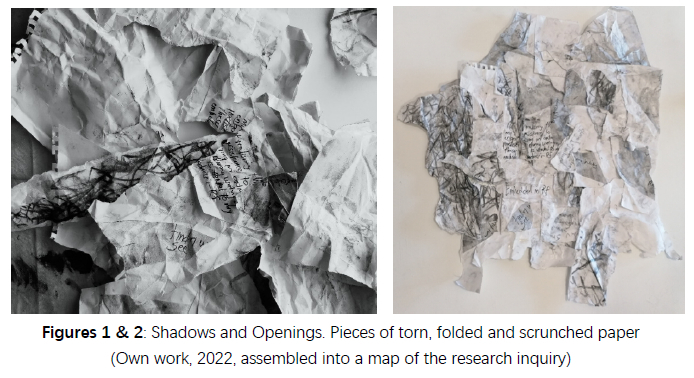
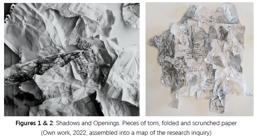
When I first encountered the idea that embodied responses could be sites of legitimate academic research, I resisted it. My training had emphasised cognitive analysis, writing, and theorisation as the primary modes of knowledge production. It was only through my own struggles with mark-making during my PhD inquiry (Meiring, 2023: 274) that I began to recognise how material engagement generates meaning beyond what words alone can express. Engaging with Massumi's (2016) principles of the anarchive, I gradually came to see how experimentation, play, and making were not supplementary to research but integral to its unfolding. Still, my students and I initially hesitated to trust embodied inquiry, reinforcing a Cartesian mind-body dualism deeply embedded in academic culture. During the research process, I noted: 'I can act the part, but I do not know how to be the part!' - a reflection on how academic structures encourage performing research within externally set criteria rather than immersing in an embodied process. Like my students, I sought prescribed certainty rather than embracing the generative precarity of an embodied, diffractive learning process. To challenge this, I engaged in blind mark-making to attune to embodied responses. With eyes closed, I focused, for example, on the tightness in my solar plexus and throat and layering charcoal on the page without premeditation. The dust became tangible under my fingertips, evoking a fog of confusion - a material manifestation of my research anxiety. Using an eraser, I searched for openings beneath the greyness, adding words that emerged, such as embedded, vulnerability, fear, courage, dis/connection, and opening/closing.
Drawing through these muddled emotions allowed them to materialise as affective, relational forces - entangled with the charcoal, paper, and gesture - shaping the research inquiry and mapping uncertainty as an active site of new knowledge production (see Figures 1 & 2). The blindfolded mark-making exercise, discussed in the next section, demonstrates how a material constraint (the blindfold) becomes an enabling condition for attunement to sensory, affective, and proprioceptive awareness. By disrupting habitual reliance on vision, this practice invites a rethinking of relationality and creativity beyond prescriptive norms. Similarly, the !Haos and Visual Redress Chair Projects expand this inquiry by showing how materials, memory, and embodied processes intra-act to generate meaning. These projects highlight how engagement with matter is not merely illustrative of conceptual learning but an active site of knowledge production-one that challenges the dominance of cognitive, text-based epistemologies in education.
Autoethnography, as an intra-active practice, traces the emergent relational dynamics of learning as they materialise through doing and making. Rather than positioning the educator-researcher and students as separate agents, it foregrounds their entanglement within the learning process. Thinking-through-doing is not merely a pedagogical approach but an onto-epistemological engagement that disrupts representational knowledge structures. It invites students and educators into embodied processes of becoming-with materials, histories, and gestures, where meaning emerges through entangled encounters rather than pre-existing categories.
The concept of embodiment is closely linked to play, aligning with Elmarie's belief in 'serious play' (Costandius, 2016: 42) as a site for knowledge production and meaningful engagement. This idea encapsulates her pedagogy and continues to shape and influence my work. Through this lens - of embodied playful doing, of relational intra-actions with material things - I frame the arts-based encounters in this paper. I next discuss the mark-making experiments student teachers engaged with while blindfolded.
Mark-making encounters: The blindfold as enabling constraint for embodied awareness
Blindfolded mark-making emerged in my PhD journey as a method to disrupt normative assumptions of prescriptive, disembodied learning. These encounters engage students in an arts-based process integrating mark-making, memory, imagination, and embodiment. The blindfold, as an enabling constraint (Manning & Massumi, 2014: 93), heightens sensory awareness and emotional engagement while unsettling ingrained beliefs about art education. Extending beyond student contexts, this process has also been used with Directors of the Western Cape Education Department to critically reimagine institutional values through embodied inquiry.
Aligning with Zembylas and Papamichael's (2017) pedagogy of discomfort, the blindfold introduces uncertainty, provoking deeper awareness of how sensory and embodied knowledge contributes to learning. Rather than an obstacle, discomfort becomes a generative force, disrupting Eurocentric, binary distinctions and inviting students to engage with the 'othered' knowledges disregarded in dominant educational frameworks (Grosfoguel, 2007, 2013; Murris, 2022; Santos, 2014). Inspired by Elmarie Costandius's work on embodiment and visual redress in higher education (Booyens, 2023; Costandius & De Villiers, 2023), this practice attunes students to bodily responses as epistemic contributors.
New materialist concepts of vision and power (Haraway, 2016) and relationality (Barad, 2007) provide a theoretical grounding for understanding how mark-making encounters unsettle teacher subjectivity and classroom dynamics. The next section explores students' experiences of blindfolded mark-making, examining how discomfort with blindness illuminated the entanglement of vision, power, and relationality in education.
Discomfort: Blindness and Embodiment
The blindfold provokes discomfort, revealing students' unease with relinquishing visual control in mark-making experiments. Many struggle with uncertainty, reflecting a preference for structured, outcome-driven learning (Meiring, 2024). This mirrors normative educational practices that privilege disembodied, rational knowledge over sensory and affective ways of knowing (Zembylas, 2003). The absence of sight amplifies vulnerability, as students echo Perold-Bull's (2018: 286) observation that sighted individuals experience disorientation when vision is removed.
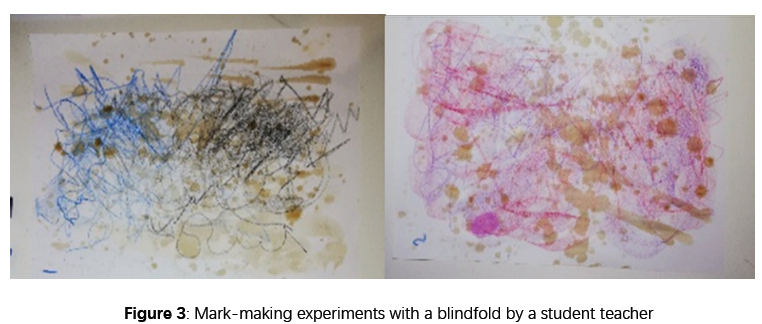
One student described the experience as 'unsettling,' evoking childhood feelings of shyness and nervousness. Others struggled to abandon perfectionism, reflecting an internalised focus on controlled, product-oriented learning. One participant admitted, 'I could not see the value of blindfolded drawing and paying attention to the body's responses,' highlighting resistance to disrupting the normative learning experiences. Another remarked, 'It is nice to sit and make a mess and use my imagination like a child, but I could not see the point of it,' reinforcing skepticism toward serious play (Costandius, 2016: 42) as an exploratory learning method. Discomfort, however, is a generative force. Rather than a barrier, it becomes an opening for questioning normative educational hierarchies, challenging the dominance of visual control, and expanding sensory engagement as a means of rethinking knowledge production.
Vision and Power
Using the blindfold in mark-making encounters disrupts normative visual perception, prompting students to question ingrained beliefs about learning through embodied experience, Haraway emphasises that vision is not neutral but entangled with power and situatedness, shaping perception and action (2002: 680). By removing sight, this exercise becomes both a critique of vision's dominance in education and an invitation to engage with knowing differently. One student reflects: 'The drawing made me realise again how important our eyes are and how much we want to see when we cannot', underscoring the dependency on vision as a primary mode of engagement. This reflects the 'tunnel vision' reinforced by Eurocentric educational norms (Grosfoguel, 2013b).
Western art traditions have long privileged sight and fixed perspective, positioning knowledge as something to be observed from a distance. Renaissance techniques assume a stable, detached observer-mirroring representational knowledge production in research. New materialist and performative pedagogies disrupt this paradigm, shifting from detached observation to embodied participation, where learning emerges through intra-action with materials and ideas.
Dewey critiques this separation in his 'museum conception of art', where art is treated as a passive object rather than a lived experience (1934: 9). Similarly, representational research methodologies position the researcher as distant from the subject. In contrast, performative and new materialist pedagogies foreground participation, where knowledge and art materialise through engagement rather than pre-existing as fixed objects of appreciation.
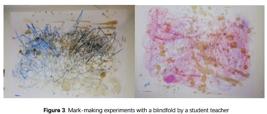
For many students, blindfolded mark-making (see Figure 3) reconfigures perception, attuning them to the body's entanglement in learning as an emergent, intra-active process. The absence of sight unlocks alternative ways of knowing, as reflected in student responses: 'My body is dancing through my hands', and 'Creativity flows without having to do much research ... being aware of your senses is all that is needed to spark creativity. The creativity is already within you'.
These reflections challenge the prioritisation of disembodied cognitive approaches, encouraging students to rethink the role of relationality, embodiment, and emotion in their teaching and learning practices, especially when considering the role of material objects in the relational unfolding of the learning event.
Relationality
Blindfolded mark-making reveals how body, material, and learning intra-act, unsettling assumptions about cognition as separate from sensory and affective experience (Barad, 2007). A student's response - 'When I drew my body, I became completely lost ... My throat tightened, and I could feel my heart beating faster' - illustrates how embodied engagement surfaces discomfort, reinforcing Freire's assertion that 'it is my entire body that, socially, knows' (1993: 105). Discomfort becomes generative, exposing the entangled nature of learning beyond human-centered dualisms.
Elmarie Costandius's work with thing-power (Bennett, 2010) in the Shared Humanity project (Booyens, 2023) highlights how materials hold agency, shaping inquiry through their own vitality. The use of twigs and leaves in the science faculty, for instance, demonstrates that knowledge materialises through relational entanglements of bodies, things, and spaces (Costandius, et al., 2020). Similarly, in mark-making, student teachers learn to engage with embodied, sensory, and material intra-actions rather than fixed outcomes.
Blindfolded mark-making does not simply advocate for body-based education but dissolves distinctions between thinking, sensing, and making (Manning, 2016: 122). Learning unfolds through movement - not just in bodies, but in the material, rhythmic, and affective forces that shape encounters. These intra-relational practices challenge traditional art education's prescriptive norms (Efland, 1976; Gude, 2013) and create spaces for students to redress body, space, and curriculum through lived, embodied experience. The decolonial potential of arts-based processes is further explored in the !Haos project, where educational hierarchies are disrupted through material engagement. Students often resist experimental art, preferring representational certainty (Meiring, 2024). Non-representational methodologies challenge the notion that knowledge exists externally to be observed; instead, they foreground performativity and relationality, positioning the researcher within the entanglement of inquiry rather than as an outsider (Barad, 2007; Manning & Massumi, 2014).
Teaching, as Prof Elmarie Costandius argued, is an embodied, relational practice - not simply a means of self-expression but an attunement to the differences and forces that emerge through making. Barad's response-ability frames knowing as an ethico-onto-epistemological engagement, requiring accountability to the material, social, and historical entanglements shaping education (2007). This extends beyond inclusion or transformation as predefined goals, positioning learning as an ongoing ethical negotiation of what becomes possible in each encounter.
Next, I explore how materials and objects intra-actively shaped student teachers' learning in the !Haos project.
The !Haos encounter
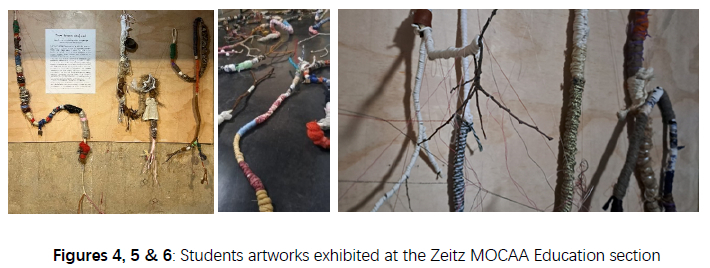
!Haos, meaning 'meeting tree' in Kora (Du Plessis, 2019: 296), engages student teachers in exploring personal histories through art, family research, and filmmaking. This article attends to how students created symbolic tree trunk structures from materials sourced from their places of origin (see Figures 4, 5 & 6). Students' chosen materials embody entanglements of past and present, reflecting family histories and relational becoming through their making process. The project invited students to reflect on the structure and composition of familial relations -expressed not through fixed representations but through intra-actions with materials, memory, and gesture. The tree form emerged through both intentional and accidental engagements, reinforcing relationality, interconnectedness, and material agency. Beyond developing artistic skills, !Haos provided a visual 'voice' for human and non-human elements, making visible the ongoing interplay between materials, histories, and embodied making. By assembling these personal works into a collective installation, the project contributes to campus visual redress while allowing student teachers to experience art as an entangled practice of space, material, memory, and research. The students' artefacts were exhibited at Zeitz MOCAA in Cape Town in September 2024 to commemorate South African Heritage Day and will later be permanently installed on campus as part of a visual redress initiative.
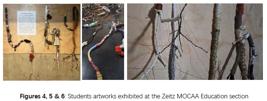
Thinking - through - doing
My use of the phrase thinking-through-doing provides an alternative approach to teacher-centred practices. It draws on Manning and Massumi's (2014: 83) concept of 'thought in the act', which challenges the normative distinction between theory and practice in learning, teaching, and research. The project aimed to challenge the normative formalistic art-making processes mentioned earlier in the paper (Efland, 1976; Gude, 2013; Meiring, 2024: 106). The emphasis on open-ended2 process work inherent in thinking-through-doing provides students with a platform to discover and articulate their own voices within learning and teaching practices. By engaging in making and doing with materials and objects connected to family stories, interviews, and family research, students experienced thoughts and emotions that evolved beyond what prescriptive or cognitive approaches could achieve. Costandius et al. (2020: 100) wrote that '[t]he aim of learning is to have a lasting effect, and the imprint that the combination of mind/body/material/space makes could have a better result than only working cognitively'.
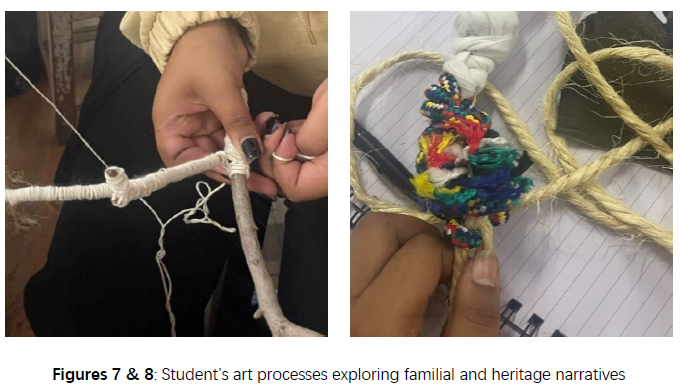
During the !Haos project, students' embodied engagement with materials - through actions like selecting, knotting, binding, and arranging - elicited unexpected emotional, sensory and cognitive responses (see Figures 6 & 7). For example, a student reflected:
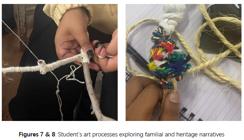
Ek het so in my zone gegaan met die gebind ek het terug gedink aan my oupa se tabak reuk wat in sy bruin leer baatjie vasgesit het, sy sterk harde stem (sic) ... . [As I went into my (sic) zone with the binding, I thought back to the smell of my grandfather's tobacco that clung to his worn leather jacket and his strong, commanding voice ... .].
Another student remarked: 'I begin by folding the material, crumpling it with care. I folded and tied the orange colour neatly as my grandmother was a neat person. Each fold carries intention, a crease for his wisdom, another for his laughter. The threads intersect, forming a lattice of memories'. As a third student comments:
Ek kan nie help om emosioneel te voel nie. ... Elke stukkie materiaal en elke kleur dra 'n storie van ons gesin se reis deur die jare, van ons voorouers se dapperheid tot die liefde en eenheid wat ons vandag deel [I cannot help but feel emotional. ... Every piece of fabric and every colour carries a story of our family's journey through the years, from the bravery of our ancestors to the love and unity we share today].
These responses echo Manning and Massumi's concept of 'thought in the act' (2014: 83), which dissolves the binary between theory-practice and thinking-doing. These examples reveal how the student's cognitive reflections are inseparable from their material engagement; and howntheir thoughts emerge directly from the tactile and sensory experience of working with the fabric. Through diffractive analysis, we can examine how knowledge emerges intra-actively, such as in the student's emotional response to and appreciation for stories of historical hardship and familial bonds. The folds, threads, and textures become more than materials-they become agents of meaning, memory, and emotion, affectively co-creating knowledge and learning experiences with the students. This interplay exemplifies how creative arts-based engagement blurs the lines between doing and thinking, allowing knowledge to surface relationally through material, sensory, and cognitive processes. One way of facilitating the arts-based processes that Elmarie believed in was to allow making and doing with materials to shape the new ideas and emotional thresholds that are activated to continuously 'feed-forward' (Massumi, 2016: 7) into new forms in an ongoing process of moving between that which is known and going beyond the usual ways of organising and interpreting knowledge, experiences, and things. Next, I will explore how material intra-actions generated shifts in perception.
Shifting entanglements of meaning and matter
A student initially viewed the project as 'silly' and unimportant, questioning, 'Why would I do this? Art is no longer important in our schools today, after all'. Such a perspective reflects a broader, well-documented disregard for the value of arts in most public schools despite their inclusion in educational policy (Meiring, 2016:115; Westraadt, 2016). However, the materiality of doing -binding, tying, and reworking fabric to create a symbolic family tree - seemed to shift the entanglement of meaning and matter for students.The student reflected on her engagement with the materials, stating:
Although I still did not fully understand the purpose of the artwork, I knew I wanted to start over because I did not want to portray my family members like that. I untied all the fabric I had previously bound and began again with intention, choosing materials that truly represented what I wanted on my artwork.
Rather than seeing this shift in perception as an individual cognitive transformation, the process can be understood as an entangled event where the student, materials, and unfolding gestures co-created meaning. The skepticism was not just hers - it was present in the tension of hesitation, in the resistance of materials, in the unspoken discomfort of encountering personal history through making. As she arranged and rearranged elements of her family tree, the learning was not simply about representation but about intra-action - where memory, material, and movement shaped the experience in unpredictable ways. Another student described the intra-action with materials as
feel[ing] the fibres, rough wool, smooth silk, against my hands. Each ... folding and wrapping ... of the material is a heartbeat, a breath. I lose myself in the repetitive motion, and time bends.
The students' response makes me wonder what the sounds, stories, and vibrations woven into the textures of fabrics might reveal if they were accessible to our senses. How would these material resonances speak to our embodied perceptions and relational entanglements? If our senses could translate these unseen and unnoticed materialities, how might this reshape our teaching practices and redefine what we consider effective learning? The students' lack of words to verbalise the experience echoes Romano and Bozalek's (2024) description of Prof Elmarie Costandius: 'Speaking was not her mother tongue; her language was more nuanced than words. Her thinking inhabited other modes, other material worlds'. This intra-active approach transcends the measurable confines of normative teaching and assessment and embodies Elmarie's belief in learning as a nuanced, relational practice.
The tactile experience of working with fabric reveals the entangled co-becoming of human and non-human relations-an interplay that remains unacknowledged mainly within traditional educational paradigms. While the !Haos project's visual manifestation through tangible objects might suggest that the primary focus lies in the completed art product; the true essence of its contribution to visual redress resides in the making process. The embodied act of creating -actively bringing past and present voices into tangible form - holds more significant potential for fostering social justice. The active engagement in doing practices enabled embodied learning that affects change in feelings and behaviour. At the same time, the resulting visual tree-like objects serve as powerful markers, reclaiming space and potentially reshaping both the internal and external landscapes of campus life to foster a sense of belonging.
Future directions and interdisciplinary expansion
The !Haos project explores the potential of interdisciplinary collaborations in education, offering a platform for integrating creative practices across disciplines. This approach echoes Emeritus Professor Ari Sita's (2024) commemoration of Prof Elmarie Costandius's work, where he recalled her reflection on reimagining the Humanities in higher education as:
[In] exploring the use of art in educational curricula as a medium of transformation and communication. ... we must think beyond art in a strictly disciplined form, as creative thinking and imagination is crucial in all spheres of life and should be developed widely in education and society, not only as the prerogative of a privileged few.
Arts-based inquiry fosters creative thinking and imagination across the educational spectrum, aligning with Elmarie's vision of challenging normative practices through embodied creative doing. These approaches advance social justice by encouraging innovation and critical engagement. Future research and educational practices could explore embodiment with interdisciplinary methods, such as the !Haos project, which spanned art, history, and filmmaking. Such initiatives demonstrate the power of art processes to meaningfully engage students in addressing complex global and societal issues by integrating diverse knowledge streams (Frodeman, 2017). The next section briefly discusses transforming discarded campus chairs into art, inspired by Elmarie's visual redress initiatives, as a means of reimagining campus spaces through creative processes.
The Visual Redress chair project
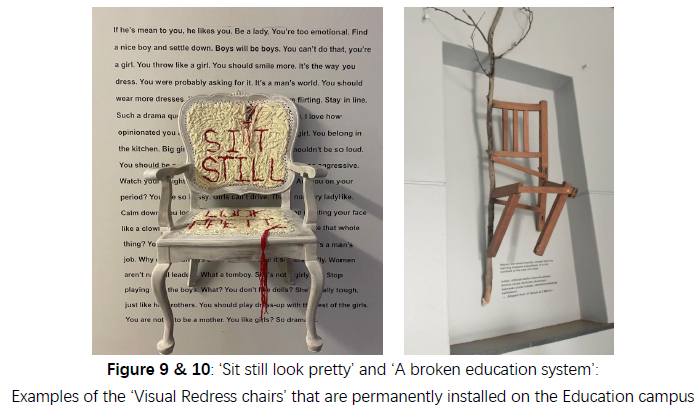
The Visual Redress Chair Project illustrates how arts-based practices foster meaning-making through material-discursive intra-actions. Students transformed discarded campus chairs into public artworks addressing social and educational issues. The materiality of the broken chairs became an enabling constraint, shaping both concept and process. Initially hesitant, students engaged physically-sanding, dismantling, and cleaning - allowing ideas to emerge through material engagement. For instance, frayed cane inserts inspired embroidery, leading to a commentary on female identity and societal expectations (see Figure 9). Another group incorporated a tree branch into a broken chair, symbolising a fractured education system that disrupts natural learning rhythms (see Figures 9 & 10). These examples highlight co-becoming between students, materials, and concepts, demonstrating how embodied engagement transforms learning.
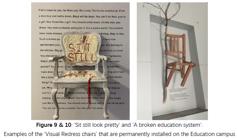
Examples of the 'Visual Redress chairs' that are permanently installed on the Education campus
The chairs, now permanent campus installations, serve as both public artworks and sites of social critique (Fortuin, 2024; Cape Peninsula University of Technology, n.d.). Prof. Elmarie Costandius's vision for visual redress emphasised relational, embodied, and emergent learning, challenging education's fixation on measurability and meritocracy. I next juxtapose Elmarie's belief in the transformative power of the art process with education's persistent focus on measurability and meritocracy mentioned earlier in the paper.
Challenging Measurability and Meritocracy
Costandius, et al. (2020: 108) describe the Shared Humanity project (Booyens, 2024) as prioritising learning as an ongoing, collaborative process rather than a pursuit of fixed, measurable outcomes, emphasising that 'the process itself becomes the product' (Manning & Massumi, 2014: 92). This shift - from seeking answers to fostering generative spaces of exploration - aligns with decolonial efforts to create inclusive, socially just educational practices that embrace diverse knowledge forms. Elmarie resisted prescriptive frameworks, embracing Haraway's (2016) call to 'stay with the trouble' - lingering in uncertainty rather than seeking quick fixes. This stance critiques measurability and meritocracy in education, which prioritise standardised outcomes over meaningful engagement (Spaull & Jansen, 2019: 364). While meritocratic systems reduce teaching to formulas, Spaull and Jansen emphasise that learning emerges through relational engagement, not just efficient use of teaching time (2019: 364).
Biesta critiques 'learnification' for stifling creative and relational teaching (2020: 91). Similarly, Spaull and Jansen argue that educational research often prioritises 'what works' over the complexities of classrooms, leading to overstated findings that ignore lived teaching realities (2019: 359). Embodied learning moves beyond disembodied metrics, attuning to students' lived experiences, emotions, and material environments. By foregrounding the intra-action of human and nonhuman elements, education shifts from oversimplified solutions to a more nuanced understanding of what makes learning meaningful. The reliance on measurability in curricula and research (Spaull & Jansen, 2019; Kincheloe in Serdyukov, 2021) reflects a reluctance to embrace vulnerability and open-ended learning - a resistance that Elmarie actively challenged. In response to these prescriptive tendencies, I developed a material-force conceptual framework, centering embodied material encounters as generative forces in learning.
Material-force conceptual framework
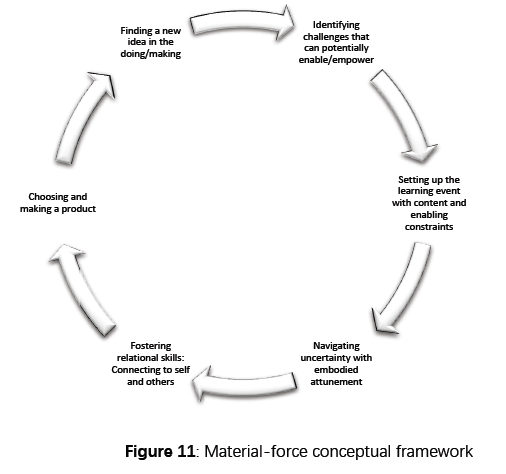
The material-force conceptual framework challenges disembodied learning by centering process-oriented, arts-based practices explored in mark-making, !Haos, and the Visual Redress Chair Project. These encounters reveal how attunement to material engagement generates alternative ways of knowing. Rather than documenting outcomes, the framework foregrounds process ontology and anarchiving, where relational unfoldings in open-ended creative processes continually generate new possibilities (Massumi, 2016: 7-8).
This approach integrates thinking-through-doing into education, shifting lesson planning toward play, experimentation, and material attunement as normative practice. By embedding enabling constraints - such as blindfolded mark-making - the framework fosters embodied responses as epistemic sites, offering an alternative to predictive methodologies.
Represented diagrammatically (Figure 11), it outlines stages of arts-based intervention, including setting constraints, embracing uncertainty, sensory attunement, crafting outputs, and discovering emergent learning opportunities. For instance, blindfolded mark-making exemplifies navigating uncertainty through embodiment. Deprived of visual control, students relied on sensory awareness, shifting from discomfort to a letting-go of perfectionism, revealing uncertainty as generative.
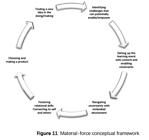
Similarly, in !Haos, student teachers worked with family-linked materials, reconfiguring understandings of relationality through material engagement. These intra-actions illustrate how embodied processes foster relational learning and self-discovery, reinforcing the framework's premise that learning is an evolving, entangled act rather than a prescriptive practice.
Elmarie's ethos of 'staying with the trouble' informs the framework, positioning embodied, arts-based methodologies as transformative alternatives to normative knowledge production.
Conclusion
I explored how entanglement with Professor Elmarie Costandius's pedagogy of embodied, arts-based practices continues to shape my teaching and research. By centring relationality, material engagement, and thinking-through-doing, her approach offers transformative possibilities for education. Through arts-based practices such as mark-making, the !Haos project, and the Visual Redress Chair Project, I demonstrated how these encounters challenge the prescriptive and meritocratic structures of art education, fostering context-driven, socially just, and embodied learning. These interventions hold broader implications for higher education, school art curricula, and learning in general. Arts-led collaborations reconfigure relations-not only among diverse South Africans but also between human and non-human entanglements, reframing education as a relational, material, and affective practice rather than a system of predetermined outcomes. Staying with the trouble requires a commitment to open-ended, uncertain, and affective forms of engagement that resist rigid, solution-driven models of education. Elmarie's work reminds us that discomfort is not an obstacle but a catalyst for rethinking relations, power, and pedagogy. The generative potential of discomfort emerges in learning spaces where students are invited to engage critically with their own assumptions and positionalities, unsettling traditional hierarchies of knowledge. In this way, discomfort moves beyond binaries of self and other, encouraging a diffractive approach to inquiry where learning is shaped by entangled forces rather than individual cognition. Elmarie is no longer with us, but her embodiment and visual redress legacy continue as guiding forces for transforming higher education. She invites us to engage with uncertainty, honour the interconnectedness of learning beyond human-centred frameworks, and embrace teaching as an embodied, ethical, and relational practice. To stay with the trouble is not only to sit with discomfort but to allow it to open possibilities-transforming not just education but the ways in which we think, make, and become with the world.
References
- Barad, K. 2003. Posthumanist performativity: Toward an understanding of how matter comes to matter. Signs: Journal of Women in Culture and Society, 28(3): 801-831.
- Barad, K.M. 2007. Meeting the Universe Halfway: Quantum Physics and the Entanglement of Matter and Meaning. Durham: Duke University Press.
- Bennett, J. 2010. Vibrant Matter: A Political Ecology of Things. Durham: Duke University Press.
- Biesta, G. 2020. Risking ourselves in education: Qualification, socialization, and subjectification revisited. Educational Theory, 70(1): 89-104.
- Booyens, H. 2023. Prof Elmarie Costandius honoured with TAU Fellows Award, 22 September. Stellenbosch University News. Available at: https://www.sun.ac.za/english/Lists/news/DispForm.aspx?ID=10197 (Accessed: 18 October 2024).
- Boydston, J.A. (Ed.). 2008. The later works of John Dewey, Volume 1, 1925-1953:1925, Experience and Nature. Carbondale, Ill: Southern Illinois University Press.
- Bozalek, V. 2024. Feminist new materialism and visual redress. In Costandius, E. & De Villiers, G. (Eds.). Visual Redress in Africa from indigenous and New Materialist Perspectives. (Routledge Research in Art and Politics). London: Taylor & Francis, 25-34.
- Bozalek, V. & Zembylas, M. 2017. Diffraction or reflection? Sketching the contours of two methodologies in educational research. international journal of qualitative studies in education. 30(2): 111-127.
- Braidotti, R. 2002. Metamorphoses: Towards a Materialist Theory of Becoming. Cambridge: Polity Press.
- Braidotti, R. 2014. Writing as a nomadic subject. Comparative Critical Studies, 11(2-3): 163-184.
- Brindley, S. & Marshall, B. 2015. 'Resisting the rage for certainty': Dialogic assessment: A case study of one secondary English subject classroom in the UK. English Teaching: Practice & Critique, 14(2): 121-139.
- Bull, K. 2018. Fourfold - art mentorship, 13 March. Katherine Bull blog. Available at: http://www.katherinebull.co.za/blog/2018/03/13/fourfold-art-mentorship/ (Accessed: 4 July 2020).
- Costandius, E. 2016. Reflecting on critical citizenship in critical times. In Frick, L., Trafford. V. & Fourie-Malherbe, M. (Eds.). Being Scholarly: Festschrift in Honour of the Work of Eli M. Bttzer Stellenbosch: SUN MeDIA, 37-44.
- Costandius, E., Blackie, M., Nell, I., Malgas, R., Alexander, N., Setati, E. & Mckay, M. 2018. #FeesMustFall and decolonising the curriculum: Stellenbosch University students' and lecturers' reactions. South African Journal of Higher Edducation, 32(2): 65-85.
- Costandius, E., Brand, A. & de Villiers, G. 2020. Redress at a higher education institution: Art processes as embodied learning. Critical Studies in Teaching and Learning (CriSTal). 8 (Special Issue): 92-110.
- Costandius, E. & de Villiers, G. (Eds.). 2023. Visual Redress in Africa from Indigenous and New Materialist Perspectives. (Routledge Research in Art and Politics). London: Taylor & Francis.
- Cape Peninsula University of Technology. 2024. Students convert old chairs into vibrant public artworks, 30 October. Media and Events.. Available at: https://www.cput.ac.za/newsroom/news?start=35 (Accessed: 3 November 2024).
- Dei, G.J.S. & Jajj, M. (Eds.) 2018. Knowledge and decolonial politics:A critical reader(Anti-Colonial Educational Perspectives for Transformative Change; Volume 6). Leinden: Brill.
- Dewey, J. 1934. Art as Experience. New York: Minton, Balch & Company.
- Du Plessis, M. 2019. Kora: A Lost Khoisan Language of the early Cape and the Gariep. Cape Town: UNISA & SA History Online. Available at: https://www.sahistory.org.za/archive/kora-lost-khoisan-language-early-cape-and-gariep-menan-du-plessis (Accessed: 29 Nov 2024).
- Du Toit, P.H. 2014. An auto-ethnographic lens on lecturer professional development. In Vandeyar, S. (Ed.). Good Practice in Culture-rich Classrooms: Research-informed Perspectives. Cape Town: University of Cape Town, 254-281.
- Du Toit, P. 2018. Reflecting on more than 20 years of involvement in a postgraduate higher education qualification for academics: May I dare use an auto-ethnographic lens. The Journal for Transdisciplinary Research in Southern Africa, 14(2): 1-12.
- Efland, A. 1976. The school art style: A functional analysis. Studies in Art Education, 17(2): 37-44.
- Fataar, A. & Costandius, E. (Eds.). 2021. Evoking Transformation: Visual Redress at Stellenbosch University. Stellenbosch: African Sun Media.
- Fortuin, J. 2024. Kunsstudente verfraai Wellington kampus. Peninpapier - Cape Peninsula University of Technology. 10th Edition. [Online], November. Available at: https://flipbookpdf.net/web/site/4cd5b0c44de9a490eceaa18e9ca5f1a4e0f65f6c202411.pdf.html (Accessed: 15 November 2024).
- Freire, P. 1993. Pedagogy of the Oppressed. New rev. 20th-Anniversary ed. New York: Continuum.
- Frodeman, R. (Ed.). 2017. The Oxford Handbook of Interdisciplinarity, 2nd edition, Oxford Handbooks.
- Grosfoguel, R. 2013a. Decolonial methods, epistemologies of the South and Fanonian philosophy. Decolonial group's channel, Jan 11 [Video file]. Available at: https://youtu.be/-x68bK-4rN4 (Accessed: 10 April 2020).
- Grosfoguel, R. 2013b. The structure of knowledge in Westernized universities: Epistemic racism/sexism and the four genocides/epistemicides of the long 16th century. Human Architecture, XI(1): 73-90.
- Haraway, D.J. 2002. The visual reader, in Mirzoeff, N. (Ed.). The Visual Culture Reader. 2nd edition. London: Routledge, 677-682.
- Haraway, D.J. 2008. When Species Meet. Minneapolis, MN: University of Minnesota Press.
- Haraway, D.J. 2016. Staying with the Trouble: Making Kin in the Chthulucene. Durham: Duke University Press.
- Harris, A. 2016. Embodiment, in J. L. Jackson (ed.). Oxford Bibliographies Online: Anthropology. Available: https://www.oxfordbibliographies.com/display/document/obo-9780199766567/obo-9780199766567-0151.xml (Accessed: 03 July 2023).
- Hickey-Moody, A. 2013. Youth, Arts, and Education: Reassembling Subjectivity through Affect. London: Routledge.
- Hickey-Moody, A., Palmer, H. & Sayers, E. 2016. Diffractive pedagogies: Dancing across new materialist imaginaries. Gender and Education, 28(2): 213-229.
- Jansen, J.D. & Farmer-Phillips, T. (Eds.). 2021. Teaching in and Beyond Pandemic Times. Stellenbosch: African Sun Media.
- MacLure, M. 2013. Researching without representation? Language and materiality in post-qualitative methodology. International Journal of Qualitative Studies in Education, 26(6): 658-667.
- Manning, E. 2016. The Minor Gesture. Durham: Duke University Press.
- Manning, E. 2020. How do we repair? Theater, 50(2): 47-62.
- Massumi, B. 2016. Working principles. In Murphie, A. (Ed.). The go-to how to book of anarchiving. Montreal: Senselab, 6-7. Available at: https://unsworks.unsw.edu.au/fapi/datastream/unsworks:44048/binc006e9fa-ed71-4b54-82c2-e5f507d256cd?view=true&xy=01 (Accessed: 23 August 2023).
- Meiring, K. 2016. Negotiating power relations in the establishment of an art education programme in Delft, Western Cape. Unpublished MA thesis. Stellenbosch: Stellenbosch University.
- Meiring, J. 2023. Re-imagining learning and teaching art: Redressing ways of seeing through embodied mark-making with foundation phase student teachers at Cape Peninsula University of Technology. Conference presentation at the Visual Redress Conference, Stellenbosch University, South Africa. 7-8 December 2023. Available at: https://visualredress.sun.ac.za/conference/ (Accessed: 23 November 2024).
- Meiring, J. 2024. Re-imagining learning and teaching art: Exploring embodied mark-making with foundation phase student teachers at Cape Peninsula University of Technology. Unpublished PhD diss., Stellenbosch University, South Africa.
- Motta, S.C. & Bennett, A. 2018. Pedagogies of care, care-full epistemological practice and 'other' caring subjectivities in enabling education. Teaching in IHigher Education, 23(5): 631-646.
- Murris, K. 2017. Reconfiguring educational relationality in education: The educator as pregnant stingray. Journal of Education(University of KwaZulu-Natal), 69: 117-138
- Ndlovu-Gatsheni, S. 2018. Epistemic freedom in Africa: Decolonization and Deprovincialization. London: Routledge.
- Perold-Bull, K. 2018. Thinking about, with and through design: A cartography for transformation. Unpublished PhD diss., Stellenbosch University, South Africa.
- Romano, N. & Bozalek, V. (Eds.). 2024. Call for contribution to a special issue 'Doing Pedagogy Differently: In memory of Elmarie Costandius'. Critical Studies in Teaching and Learning (CriSTal). Available at: https://epubs.ac.za/index.php/cristal/announcement/view/13 (Accessed 28 October 2024).
- Romano, N. 2021. Reconfiguring a history of art and design curriculum in a South African university of technology: Becoming-with critical arts-based pedagogical encounters. Unpublished PhD diss. Utrecht University.
- Santos, B. de S. 2014. Epistemoiogies of the South: Justice against Epistemicide. Oxon: Paradigm Publishers.
- Santos, B. de S. 2018. The End of the Cognitive Empire: The Coming of Age of Epistemoiogies of the South. Durham: Duke University Press.
- Serdyukov, P. 2021. Education, Eniightenment, and Progress: Criticai Perspectives on the Educational Paradox. Milton: Routledge.
- Sitas, A. 2024. A note on crayons from far away: Elmarie Costandius, RIP. Nationai Institute for the Humanities and Social Sciences: In Memoriam: Prof Elmarie Costandius. Available at: https://www.nihss.ac.za/node/677 (Accessed: 18 October 2024).
- Sobuwa, S. & McKenna, S. 2019. The obstinate notion that higher education is a meritocracy. Critical Studies in Teaching and Learning (CriSTal), 7(2): 1-15.
- Spaull, N. & Jansen, J.D. (Eds.). 2019. South African schooling: The enigma of inequality: A study of the present situation and future possibilities. Cham: Springer International Publishing.
- St. Pierre, E.A. 2014. A brief and personal history of post-qualitative research: Toward 'post inquiry'. Journal of Curriculum Theorizing, 30(2): 2-19.
- Stellenbosch University (SU). 2024. In Memoriam: Prof Elmarie Costandius, 10 January. Available at: https://www.proquest.com/docview/29156438407pq-origsite=primo&sourcetype=Wire%20Feeds (Accessed: 18 October 2024).
- Therieau, L. 2020. December 14. Representation: The missing backbone of a stellar arts education, 14 December. I paint my mind blog. Available at: https://ipaintmymind.org/blog/representation-the-missing-backbone-of-a-stellar-arts-education/ (Accessed: 23 April 2023).
- Tuck, E., & K. Wayne, Y. 2012. Decolonization is not a Metaphor. Decolonization: Indigeneity, Education & Society, 1(1): 1-40.
- Westraadt, G. 2016. Why taking art education seriously could boost learning, 16 February. The Conversation. Available at: https://theconversation.com/why-taking-art-education-seriously-could-boost-learning-54616 (Accessed: 28 October 2024).
- Whitehead, A.N., Griffin, D.R. & Sherburne, D.W. 1978 [1929]. Process and reaitty: An essay nn cosmology. New York: Free Press. Available at: https://www.worldcat.org/title/process-and-reality-an-essay-in-cosmology/oclc/3608752 (Accessed: 12 September 2022).

Accepted: 18 March 2025
Author biography
Kobie Meiring, PhD (Visual Arts Education, Stellenbosch University), focuses on embodiment and integrating interdisciplinary approaches to enhance teaching and learning. With 30 years' experience, she teaches art education at the Faculty of Education, Cape Peninsula University of Technology. She develops curriculum materials, contributes to academic publications, presents internationally, and supervises postgraduate students.
1 I recognise the central role that Dr Karolien Perold-Bull played as supervisor for my Master's degree in art education (MAVA) and her important contribution as co-supervisor during my PhD studies.
2 The open-ended process according to Costandius, et al. is a learning process where one can experiment and explore ideas without a set of regulations (2020: 94). The art process generates new ideas because it has no specific rules. Following the same rules produces the same knowledge. If there are no rules, new ways of doing can be found by combining often-opposite elements.