Redefining academic literacy assessment with SDG goals, GenAI, and multilingual narratives
Abstract
This study investigates how Generative Artificial Intelligence (GenAI) image generation combined with translanguaging and traditional narrative writing can enhance academic literacy and advance social sustainability through inclusive higher education in South African universities. Focusing on first-year humanities students, the research analyses multimodal data, including AI-generated images, student reflective writing, and translanguaging. The findings indicate that integrating Indigenous languages into academic literacy practices fosters inclusive participation, reduces linguistic barriers, and supports culturally responsive collaboration. However, the study also identified ethical and contextual challenges, particularly Western biases embedded in AI systems and the need for teacher readiness to adopt inclusive pedagogies. By linking technological innovation with decolonial and transformative learning theories, the research proposes a replicable framework that positions GenAI as a supportive tool for equitable, accessible, and socially sustainable teaching and learning in multilingual contexts.
academic literacy; assessment; generative artificial intelligence; social sustainability
Introduction
Academic literacy assessment in colonial and apartheid Africa was not pedagogically neutral but a deliberate tool of epistemic violence, designed to dismantle Indigenous educational systems - communal, applied, and intergenerational - in favour of Eurocentric models that prioritised individualism over collaborative knowledge. While the overt political regime has changed, this legacy persists in contemporary assessment paradigms that continue to privilege monolingual (English/Afrikaans), text-centric, and culturally disembodied forms of knowledge demonstration. This systemic mis-education - now encoded in institutional norms, curriculum design, and standardised testing - actively marginalises the linguistic repertoires and epistemic frameworks of African students. This enduring inequity underscores the urgent need to align with SDG 16, which promotes peace, justice, and strong institutions (United Nations Department of Economic and Social Affairs, 2025), by fundamentally reforming academic literacy assessment as a site of epistemic justice.
Where pre-colonial literacies were embedded in daily life, governance, social organisation, and assessed through community participation, colonial institutions violently silenced ancestral pedagogies, using the law itself to subjugate indigenous cultures (Lepuru, 2023). This epistemic rupture systemically redefined academic literacy in Africa as a tool of control and exclusion, severing learners from their intellectual heritage. The resultant disconnection - between institutionalised forms of knowledge validation and students' cultural and linguistic identities - persists as a foundational barrier to equitable education today.
The erosion of Africa's Indigenous literacy traditions - characterised by the integration of spiritual and material knowledge, communal pedagogies of intergenerational learning, and contextually embedded multiliteracies (oral, visual, performative) - necessitates that contemporary academic literacy developers, especially in higher education, restore these knowledge systems (Ayittey, 2025; Eybers & Dewa, 2025). This epistemic erosion was not incidental but systemic, as colonial projects often devalued African knowledge systems, framing indigenous literacies as impediments to imperial consolidation. This restorative endeavour is foundational to achieving SDG 4 (Quality Education), as it directly addresses the epistemic alienation experienced by formerly colonised students (Chilisa, 2017; Eybers, 2023). By integrating Indigenous literacy traditions into academic literacy development, it mitigates disciplinary disengagement, fosters meaningful connections between universities and their local communities, and harmonises collective knowledge-building with independent critical inquiry. Consequently, as this article demonstrates, academic literacy is reconceived as transdisciplinary praxis of connection - actively weaving local cultural knowledge into institutional academic frameworks to make quality education both inclusive and relevant.
Before examining how generative AI image prompting can enhance academic literacy assessment by integrating SDG aims, we must first contextualise its potential by analysing visual and graphic art's historical role in Africa's Indigenous Knowledge Systems. Africa's communities - particularly those with the most ancient genetic lineages like the Khoi, San (Semino, et al., 2002) and Ethiopians - were among humanity's earliest creators of visual knowledge records. The Khoi and San, re-named Bushmen, Hottentots, and the coloureds by Global North settlers, left a profound legacy of rock paintings and engravings across southern Africa, depicting spiritual beliefs, hunting practices, and social life (Eybers, 2022). These were not merely artistic expressions. Instead, they served as vital repositories and pedagogical tools, encoding and transmitting complex ecological knowledge, social structures, and spiritual narratives across generations. Similarly, Ethiopian visual heritage encompasses both sacred traditions - such as ancient Christian illuminated manuscripts and iconic church architecture - and pre-Aksumite megalithic sites like Tiya, where stellae and other artefacts represent Africa's ancient, pre-colonial multimodality (see Mire, 2020). In these contexts, visual forms were integral to religious instruction, historical record keeping, and the articulation of communal identity, functioning as a primary medium for intellectual and cultural transmission. This deep and diverse historical precedent establishes multimodal, visual meaning-making as an endogenous African intellectual practice. Therefore, contemporary academic literacy assessments that exclude such modalities do not merely disregard tradition; they actively undermine inclusive, quality education (SDG 4) by marginalising African learners' epistemic foundations, thereby perpetuating inequalities (SDG 10).
Centuries before the development of formal writing systems in ancient Kemet around 3200 BCE (Contardi, 2016), African communities employed visual imagery to create, preserve, and adapt their knowledge systems. This point is important because during the pre-colonial era, art in Africa did not function for purely aesthetic reasons. Instead, according to regional epistemologies, African aesthetics equally fulfilled spiritual, social, political, cultural, and ontological purposes (Ikwuegbu, 2012; Ngumah, 2014). Various aesthetic modes, including images, masks, pottery, architecture, and rock paintings, were integral to communities' ceremonies, initiations, hunting, funerals, and storytelling, reinforcing ancestral values and historical memory (Eybers & Dewa, 2025). Multiple lines of evidence demonstrate that visual arts - including images, symbols, and iconography - served integrated, non-binary functions within pre-colonial African epistemologies, operating as repositories of knowledge, mediators of metaphysical experiences, and as instruments of social cohesion.
Colonialism methodically sought to eradicate Africa's polycentric modalities, particularly visual epistemologies, as Eurocentric frameworks weaponised literacy to justify African subjugation, facilitating both enslavement and resource plunder (Angu, et al., 2019). Angu, et al. (2019) demonstrate how colonial education severed Africans from Indigenous languages, epistemologies, and their historical roles in governance, contextualised pedagogy, and ontological growth. Achebe's (1958) novel, Things Fall Apart, symbolises how colonialism disrupts and dismantles Indigenous epistemologies, causing cultural disintegration and social fragmentation under Eurocentric norms. Consequently, the advancement of multimodal academic literacy today aligns with SDG 4, Quality Education, by serving dual aims: as an innovative pedagogical tool and as reparative equity. By rejecting colonial and apartheid-era constraints - particularly restrictive, unimodal assessments like multiple-choice tests - multimodality (see Goodwin, 2010) enables learners to synthesise written, visual, and oral forms of knowledge, fostering inclusive education that rectifies historical exclusions.
By 2025, Generative AI (GenAI) has revolutionised multimodal education, eclipsing the Internet's early transformative role. Contemporary Large Language Models (LMSs) now synthesise text, images, and audio with human-like fidelity, offering tools to advance SDG 16's justice goals by democratising knowledge production and challenging gatekept literacies. South African institutions' prohibitions on digital device usage and restrictions on student digital citizenship expose institutional anxieties about epistemic control. Kim and Danilina (2025) declare that a distinguishing pedagogic feature of GenAI platforms is their capability to facilitate collaborative knowledge construction, authentic disciplinary interactions, and personalised learning trajectories. This approach reflects pre-colonial Indigenous educational systems in Africa, where interdisciplinary knowledge, multiple literacies, and cross-generational community collaboration shaped holistic learning (Eybers & Dewa, 2025). Kim and Danilina (2025) highlight that multilingual and second-language English learners frequently employ GenAI for grammatical refinement - a function that, when applied to academic literacy assessment, empowers scholars to articulate complex ideas with greater accuracy while preserving their epistemic voice. However, the introduction of GenAI into academic literacy is not without debate.
The incorporation of generative artificial intelligence (GenAI) into academic literacy pedagogy faces substantive ethical and epistemological challenges. Scholars with concerns regarding these new technologies contend that AI-assisted synthesis of data and theory risks violating disciplinary integrity, potentially compromising scholarly rigour (Flaherty, 2025). A salient concern is GenAI's alleged propensity to promote lower-order cognitive processes (Gerlich, 2025). These tensions reflect deeper anxieties within the academy. In South Africa, the techno-epistemic shift precipitated by GenAI has exposed institutional gatekeeping mechanisms that mirror historical patterns of exclusion. For instance, prohibitions on digital tools - ranging from GenAI to basic word processors like Microsoft Word echo apartheid-era educational strategies by disproportionately marginalising African students' digital needs. Such regressive practices not only hinder pedagogical innovation but also violate students' rights as digital citizens, reinforcing epistemic injustice under the guise of academic purity. Aligning with SDG 4, Quality Education, this study builds on Isman and Gungoren's (2014) framework of digital citizenship rights to present a case for GenAI image prompting as both an academic literacy tool and quality assurance mechanism in higher education.
Theoretical framework
The article employs two theoretical frameworks to underpin its analysis. The first framework is the African Theory of Academic Literacy as articulated by Eybers and Dewa (2025), complemented by a multimodal grammar theory of artificial intelligence. These frameworks collectively inform the researcher's analysis of students' visual generative literacy narratives, and to advance Sustainable Development Goals (SDGs) 4, 10, and 16 in academic literacy development. Additionally, the theoretical frameworks facilitate the identification and exploration of emergent themes related to the SDGs within students' visual literacy narratives.
The African Theory of Academic Literacy, as developed by Eybers and Dewa (2025), centres contextually grounded, culturally responsive approaches to empower learners as active agents in knowledge production. Its primary purpose is to empower academic literacy educators to ground their teaching, learning, and assessment practices in an Afrocentric paradigm. The theory advocates for inclusive, equitable educational practices, thereby fostering high-quality learning environments, promoting fairness and access, and strengthening the foundational principles of a just society (Eybers & Dewa, 2025). It encourages the integration of Indigenous perspectives and multimodal literacies, fostering critical engagement and social justice with academic disciplines, thus directly supporting the advancement of Sustainability Development Goals.
Cope and Kalantzis' (2024) multimodal artificial intelligence grammar theory provides a robust justification for incorporating GenAI image prompting alongside other communicative modes such as writing, speaking, and interpreting in students' first languages (L1). The theory posits that meaning is constructed through the interplay of multiple semiotic resources - text, image, sound, gesture, and spatial arrangement - rather than through language alone (Cope & Kalantzis, 2024). By recognising the patterned, functional relationships across these modes, the theory highlights the educational value of engaging learners in multimodal composition.
Accordingly, the current article employs a multimodal theoretical lens to argue that GenAI image prompting should not stand in isolation but integrate with writing, oral expression, and L1 (primary language) interpretation - fostering deeper, more inclusive assessment experiences. By integrating GenAI image prompting with writing, speaking, and interpreting students' first languages, the current article operationalises Cope and Kalantzis's (2024) multimodal theory to justify an integrated approach to meaning making in assessment. This multimodal practice ensures that academic literacy assessments are not only more contextually relevant and equitable, but also better aligned with the complex, interconnected forms of communication that define disciplines. Moreover, multimodal theory resonates with the communal and collaborative literacy assessments practiced during the pre-colonial era in Africa (Eybers & Dewa, 2025), reinforcing the value of collective meaning-making and diverse modes of expression in disciplinary contexts.
Methodology
This study employed a qualitative, interpretivist research design to investigate how first-year Humanities students at the University of Pretoria integrated visual literacies - specifically, GenAI-generated images - with traditional narrative writing in the ALL 110 Academic Language and Literacy Course. The interpretivist paradigm guided the research, prioritising participants' subjective experiences and the meanings they constructed through multimodal academic tasks. Reflexivity was central to the research process, as the researcher, who also served as the course instructor, continually considered their own positionality and potential influence on both data collection and interpretation.
This study was designed to address two primary research questions:
1. How do students integrate visual literacies-specifically through text-to-image GenAI tools-with traditional narrative writing?
2. What are the educational opportunities and challenges associated with using text-to-image GenAI visuals in academic literacy development?
Correspondingly, the research objectives were:
A. To investigate how students integrate visual literacies, specifically through text-to-image GenAI tools, with traditional narrative writing.
B. To identify and examine the educational opportunities and challenges of using text-to-image GenAI visuals in academic literacy development.
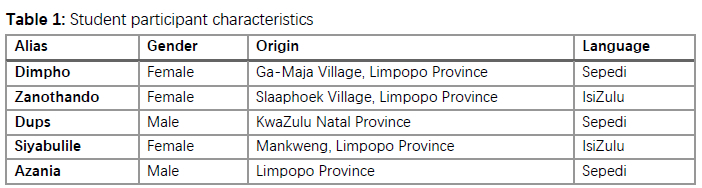
A purposive sample of five rural-origin, culturally diverse first-year students, who had not previously enrolled in ALL 110, was selected for participation. Recruitment was conducted through oral invitations during lectures. Data was collected during the first semester of the 2025 academic year. Each participant completed a reflective writing assignment exploring their emerging disciplinary identity, which required the integration of written narrative and GenAI-generated visual representation. The primary data set comprised these paired written and visual submissions. Narrative analysis was applied to the reflective texts to uncover key themes, patterns, and semiotic nuances, while textual analysis was used to interpret the meanings embedded in the GenAI-generated images, treating them as texts. See Table 1 for an overview of the participants.
The reflective task, which is central to data collection, specifically tasked students with producing a "reflective writing assignment on their perspectives on being disciplinary members of the Humanities Faculty". This assignment explicitly required them to combine two forms of literacy: a written narrative and a GenAI-generated visual representation. The overarching goal of this assessment was to enhance students' awareness and abilities to reflect on their experiences and statuses as emerging disciplinary members, utilising multiliteracies and multilingual communication.
While the assignment prompt did not explicitly mandate the use of L1, the reflective nature of exploring personal disciplinary identity inherently allowed students to draw upon their full linguistic and cultural resources, contributing to the observed integration of L1 texts. This design aimed to foster a deeper engagement with students' emergent academic identities through both textual and visual modalities, ensuring the data captured a rich, multifaceted understanding of their experiences.
Ethical considerations were strictly observed through the study. Informed consent was obtained from all participants, who were fully briefed on the study's aims, procedures, and their right to withdraw at any time. Anonymity and confidentiality were strictly maintained: all personal identifiers were removed from submissions, and participants were invited to select aliases for use in any publications. The researcher addressed potential risks, such as discomfort with reflective or visual tasks, by providing comprehensive guidance and support throughout the process, including optional consultations. All data will be securely stored in the Unit for Academic Literacy's vault for a minimum of ten years, with access restricted to authorised personnel, in accordance with institutional ethical guidelines and the commitment to safeguarding participant wellbeing and privacy.
Results
Students' GenAI-enhanced visual narratives were analysed to uncover key themes, particularly through the frameworks of Sustainable Development Goals, multimodal grammar, and the African Theory of Academic Literacy. Specifically, the narratives provided insights into how students integrated visual and written modes to express their understanding of disciplinary identity. It is within this multimodal space that students were able to embed aspects of their identities and cultures - which inherently value orality and indigeneity - into their conceptualisation and development of disciplinarity. From the perspective of the African Theory of Academic Literacy (Eybers & Dewa, 2025), this process facilitated the emergence of a recurring pattern: the blending of these culturally valued Indigenous oral traditions with disciplinary discourses. All five participants - who come from rural South African communities - exhibited this blending in their reflective narratives and accompanying visual representations, thereby contributing to what can be understood as pluriversal knowledge construction (see Ngalim, 2017) by affirming their diverse epistemic and cultural backgrounds within academic contexts.
Dimpho's analysis
Dimpho states:
I grew up in a small village in Ga-Maja, Limpopo.
By situating her personal background within academic discourse, she integrates her community identity into her learning. Dimpho reinforces this connection by referencing her schooling, stating:
I attended Makgeila Primary School and that's where my earliest memories of reading began.
This illustrates how her pre-university experiences contribute to her academic development. Dimpho further incorporates her rural-based epistemology by including a GenAI-generated image that depicts a young African girl reading contentedly beneath a tree. This visual narrative aligns with her Indigenous knowledge systems, reinforcing the connection between her lived experiences and academic literacy.
Additionally, Dimpho integrates her first language, Sepedi, in her work, writing:
Se ke senepe saka ke dut š i ka fase ga mohlare ke bala puku.
Dimpho's AI image prompt demonstrates her integration of multilingual and multimodal elements to construct pluriversal knowledge, and the image is described as:
An African girl sitting under a large tree, engrossed in reading a book in a peaceful setting, with ample shade and a relaxed, focused demeanour.
Zanothando's analysis
Like Dimpho, Zanothando's narrative engages with rural themes, but whereas Dimpho highlights an enabling academic environment, Zanothando foregrounds hardship, material deprivation, and systemic struggles. For instance, she recounts:
My mother could not afford to buy me [...] educational books.
Additionally, Zanothando describes her school environment as demotivating, recalling one teacher's dismissing response when he sought help:
I tried to ask my literacy teacher for assistance, but she refused, saying I was 'way too old' not to know how to write my name.
This incident highlights the structural barriers Zanothando faced in her literacy development, compounded by his late school enrolment at nine years old due to undisclosed challenges. However, Zanothando's narrative shifts decisively when a new principal transformed her school by establishing a new library. She recounts:
I was very much look forward to [the library] because my mother could not afford to buy me those educational books.
The library became a sanctuary for her learning, as she devoted herself to studying while peers engaged in play:
I spent almost all my time in my books while peers were playing and having the time of their lives.
Zanothando's struggles with literacy and writing are captured through her multimodal expression, both in her GenAI-generated images and her use of isiZulu to articulate her journey. One such image depicts a young girl seeking her mother's guidance while reading, symbolising the intergenerational support that shaped her literacy development.
This visual narrative is enhanced by her isiZulu reflection:
Emabangeni aphezulu ngakwazi ukuthola ithuba lokulingisa kwenye yezinhlelo eyayivela kumakhalekhukwini nokuyiyo eyakwazi ukuthi ithuthukise ikhono lami lokulingisa ukufunda kanye nokubhala.
Interpreted by Zanothando, this reads as:
In high school, I gained opportunities to practice through a program that emerged from challenges-one that ultimately improved my multiliteracies in reading, acting, and writing.
Dups' analysis
Dups hails from Slaaphoek, a rural village in Limpopo province, located 'just outside Polokwane'. He characterises his upbringing as occurring in an environment with limited technological access, stating:
It was not an environment which was technologically exposed at the time.
This technological constraint is mirrored in his school's resource limitations, which Dups describes as fostering a particular literacy orientation:
Everything which was used for our academic success was hard copy, and that really instilled in me a love of reading material.
Paradoxically, these material constraints cultivated robust pre-university literacies, with Dups emphasizing how the absence of digital resources strengthened his engagement with print media. Dups' school also emerges as an unexpectedly enabling environment that creatively promoted literacy through motivational strategies. He recalls with fondness:
We used to do reading orals in class with prizes to be won, and it really made the experience fun as everyone competed for first place. The environment actively encouraged reading-whether school-prescribed texts or other written materials.
Dups highlights the crucial role of intergenerational learning in his literacy development, particularly through his grandmother's emotional and educational support. He recounts:
My grandmother noticed that I loved books. She began reading old stories and the Bible to us. Every day, we would stay with her in the kitchen reading together. My siblings would go to sleep, but I chose to remain with my grandmother.
This home-based literacy practice is visually reinforced in his GenAI-generated image, which depicts a young boy seated safely beside his grandmother as she reads to him - direct reflection of his written narrative. To further root this memory in his cultural-linguistic identity, Dups interprets the image's prompt in his L1, Sepedi.
Koko obe a rata go mpalela dibuka.
The English version of this prompt - 'My grandmother used to read books for me' - mirrors this sentiment, demonstrating how this multimodal narrative bridges personal memory, Indigenous language, and academic literacy reflection.
Siyabulile's analysis
Like her peers, Siyabulile roots her pre-university academic journey 'in a small village in Kwa Zulu Natal', describing it as a place 'where everything revolved around culture and belief'. Siyabulile emphasises the collective nature of her upbringing, recalling:
We were a big family with our grandparents, and parents around the same yard.
This communal environment fostered oral knowledge producing traditions, as Siyabulile explains:
Before we slept, my grandparents would gather all the children around the fire to tell us about our family's history, beliefs, how they used to live and how things have changed in today's life, such as climate change.
Despite this rich cultural-epistemic foundation, Siyabulile faced material constraints in her formal education. She states:
When I started school, reading became important to me, but due to limited resources in my village school I could not get a hold of books.
This scarcity prompted a transformative shift when Siyabulile's parents enrolled her in Johannesburg school. She describes this pivotal transition:
I was mesmerised when I saw the school's library full of books, computers and printer. I devoured all genres.
Siyabulile's narrative bridges rural and urban, traditional, and modern. She maintained strong ties to her cultural heritage, participating in the Zulu reed dance to express [herself] and to promote cultural awareness through singing and dancing.
Siyabulile's GenAI-generated image visually encapsulates this non-binary approach to culture, complemented by her isiZulu prompt: 'Lolu siko ngeke siluyeke kalula', which she interprets as, 'We will not give up this tradition easily'.
Azania's analysis
Like his peers, Azania situates his pre-university journey 'in the rural areas', specifically Mangweng, outside Polokwane. He characterises his school's technological limitations clearly:
It was not an environment which technologically exposed at that time.
This technological constraint shaped his literacy development in specific ways. As a result, Azania's acquisition of literacies was not digitally based.
Everything which was used for our academic success was hard copy, that really instilled my love of reading mainly hard copy material.
Azania provides concrete examples of these traditional literacy practices.
Reading in oral class with prizes to be won [made] the experience fun as everyone was running for the first prize.
He further explains the school's literacy culture:
The environment really encouraged reading either school-based books or other written readable texts.
Azania's GenAI-generated image visually portrays represents an African male learner engaged in reading before his class. The confident demeanour of the depicted student mirrors Azania's characterisation of his school's reading culture as fundamental to his developing academic identity during his pre-university years.
Discussion
The findings reveal a critical engagement by students from rural South African communities with multimodal, multilingual academic narratives supported by Generative AI (GenAI). The assignment and multiliteracies enabled them to illustrate key pre-university moments that shaped and continue to shape their disciplinary identities. These narratives are not only personal reflections but also acts of epistemic reclamation - students use their first languages (L1), visual storytelling, and Indigenous knowledge systems to assert their identities within formal academic spaces. The integration of GenAI tools enables new forms of expression that align with both global and technological trends through the lens of the African Theory of Academic Literacy (Eybers & Dewa, 2009), while situating them within the broader frameworks of the United Nations Department of Economic and Social Affairs Sustainable Development Goals (SDGs) 4, 10, and 16.
SDG 4: Quality education through pluriversal literacies
SDG 4 emphasises inclusive and equitable education for all, calling for epistemic reforms that go beyond access to include meaningful participation and outcomes. The students' narratives exemplify how multiliteracies-based pedagogy, as advocated by Cope and Kalantzis (2024), can contribute to achieving this goal. By allowing students to construct knowledge through transpositional grammar - shifting meaning across modes such as text, image, and design - they engage in deep, reflective learning that transcends rote memorisation or passive consumption.
Siyabulile describes her experience while reading under a tree, accompanied by a GenAI-generated image that visually represents this moment. These narrative strategies resonate with Muthivhi's (2011) argument that integrating every day and formal knowledge enhances scholarly reasoning. Thus, students are not merely narrating their lives; they are constructing pluriversal literacies - literacies that recognise multiple ways of knowing and being. In terms of SDG 4, this approach supports lifelong learning opportunities, by validating diverse epistemologies and fostering critical thinking, which students demonstrated by merging SDG themes and multiliteracies. It challenges monolingual curricula, advocating instead for a model of education that reflects the lived realities of learners and empowers them to be co-creators of knowledge.
SDG 10: Reducing inequalities through epistemic inclusion
SDG 10 seeks to reduce inequalities within and among countries, including those rooted in language, culture, and access to technology. The findings demonstrate how the integration of L1s and GenAI tools disrupts historical patterns of exclusion. As Eybers and Dewa (2025) argue, an inclusive African theory of academic literacy must centre Indigenous voices and practices. Students who write in isiZulu, Sepedi, and English simultaneously challenge the dominance of colonial languages and affirm the legitimacy of African epistemologies.
Dimpho, for instance, used GenAI to generate an image of herself participating in the Zulu reed dance, paired with a written reflection on cultural pride, which she called "Lolu siko ngeke siluyeke kalula". This statement, when interpreted in English, meaning, "We will not give up this culture easily", becomes a political act of resistance against cultural erasure. Her image-text composition also demonstrates what Kress and van Leeuwen (1996) describe as information structure: the strategic placement of elements to foreground certain meanings. Here, the image serves as a visual argument for cultural preservation, while the text articulates its significance.
From the perspective of SDG 10, these narratives represent a form of epistemic justice - the recognition and valuation of marginalised knowledges, including epistemes embedded in students' South African languages that are not included in the classroom. They also highlight the potential of GenAI to co-support students' multimodal knowledge generation when used ethically and intentionally. However, as Cope and Kalantzis (2024) caution, AI tools operate through statistic correlations. Without human oversight, AI-generated images could misrepresent or flatten cultural symbols. This was evident in the current project, where some participants shared images that did not reflect their own cultural orientations.
SDG 16: Peace, justice, institutional reform through critical literacies
The narratives analysed here demonstrate how multimodal narratives, including GenAI imaging and translanguaging, enable students to surface and engage with decolonial themes. These themes notably include epistemic reclamation, linguistic decolonisation, and the cultural affirmation of students' identities. This aligns with SDG's emphasis on institutional reform and participatory governance.
Students like Zanothando and Dups use GenAI to create visual representations of their educational journeys, incorporating metaphors drawn from Indigenous cosmologies. The narratives are not neutral; they critique structural barriers and advocate for change. To illustrate, Zanothando recounts her struggles with a dismissive teacher and material deprivation, highlighting systemic barriers to literacy development, and later celebrates the transformative impact of a new library. Similarly, Siyabulile notes the stark contrast between her urban school's well-resourced library and her underfunded rural school's one and was "mesmerised".
Further underscoring this critical engagement, the students' translanguaging acts as a warrant for integrating Indigenous cosmologies into academic knowledge generation. Zanothando's isiZulu reflection, "Emabangeni aphezulu ngakwazi ukuthola ithuba lokulinguis" (meaning, "In high school, I gained opportunities to practice", and Siyabulile's isiZulu prompt, Lolu siko ngeke siluyeke kalula" (meaning, "We will not give up this tradition easily"), embeds cultural values and experiences into their academic narratives. Similarly, Dups' Sepedi prompt, "Koko obe a rata go mpalela dibuka" (meaning, "My grandmother used to read books for me"), grounds his visual representation in ancestral wisdom, demonstrating how these Indigenous linguistic expressions serve as authentic conduits for pluriversal knowledge, challenge Eurocentric academic norms.
This juxtaposition functions as a critical literacy practice, revealing the disparities that persist in post-apartheid education. It also engages with what Cope and Kalantzis (2023) call interest - the ideological positioning of meaning. By foregrounding issues of access and resource distribution, the students situate themselves within broader discourses of social justice (SDG 4: Quality Education). Moreover, the transmodal composition - moving between writing and visual representation - supports the development of critical agency. As Kress (2009) argues, multimodal texts allow individuals to "re-design" meaning according to their own purposes and contexts. In this way, students become not just consumers of information but active participants in shaping disciplinary discourses - a key component of SDG 16's vision of inclusive institutions.
Integrating visual and textual meaning: A transpositional grammar approach
Cope and Kalantzis' (2021) framework of transpositional grammar offers a robust analytical tool for interpreting the students' multimodal compositions. According to this theory, disciplinary meaning is not fixed to a single mode but shifts across modalities. In the students' work, this is evident in how image and text mutually inform each other, creating layered, interdependent meanings. For instance, Siyabulile's image of herself dancing is not merely illustrative; it interacts with her written reflection to produce a richer, more embodied account of identity. This aligns with Halliday and Hasan's (1985) concept of contextual anchoring, where meaning is stabilised through reference to both textual and extralinguistic cues. The image provides spatial and visual grounding, while the text supplies narrative coherence.
However, as scholars including Tzirides, et al. (2023), and Cope and Kalantzis (2023) observe, GenAI complicates this process. Because Artificial Intelligence lacks semantic awareness, it cannot interpret the contextual or ideological dimensions of multimodal texts. In the present study, GenAI introduced complications in students' integration of GenAI images due to visible biases and students' limited training in effective prompting. For instance, some students' images depicted cultural groups traditionally not historically associated with Africa, reflecting both algorithmic bias and a lack of contextual awareness (Cope & Kalantzis, 2023). GenAI tools may generate images based on prompts, but they cannot understand the symbolic weight of a traditional dance or the emotional resonance of a proverb.
While GenAI image prompting expands students' access to disciplinary knowledge, it must be taught with care - ideally supplementing ontological scaffolding and human moderation (Dwivedi, et al., 2024) and not replacing it. Bias tensions highlight the importance of teaching students both GenAI tools' usage and prompt literacy refinement. In doing so, educators support the development of proficient digital citizens in ethically grounded multimodality - key competencies for engaging in the Fourth Industrial Revolution.
Conclusion
This study demonstrates that Generative AI (GenAI) can serve as a transformative tool in academic literacy assessment when intentionally designed to supplement multilingualism, pluriversal meaning-making, and epistemic justice. By enabling students to articulate their pre-university journeys through multimodal narratives - combining AI-generated visuals, written reflections, and translanguaging in isiZulu, Sepedi, and English - this approach challenges apartheid-era constructs of academic literacy that have historically excluded African epistemologies, marginalised Indigenous languages, and reinforced Eurocentric norms of scholarly expression.
The findings reaffirm the potential of GenAI-mediated assessments to advance SDG-aligned outcomes: promoting equitable evaluation by valuing multilingual meaning-making (SDG 4), surfacing student narratives of marginalisation and resilience to inform inclusive pedagogies (SDG 10), and dismantling colonial paradigms through epistemic inclusion (SDG 16). When students are empowered to draw on their lived experiences, cultural knowledge, and linguistic repertoires, they not only develop critical digital literacies but also reclaim agency in how they demonstrate learning - an essential step toward socially sustainable education systems in Global South universities.
However, the integration of GenAI into academic literacy practices is not without challenges. Institutional resistance to AI, rooted in concerns over academic integrity and pedagogical unfamiliarity, highlights the need for comprehensive staff training and professional development. Framing students as inherently morally suspect or technologically irresponsible impedes the ethical integration of Generative AI into academic literacy, perpetuating exclusionary assessment paradigms rooted in distrust rather than pedagogical empowerment. Equally pressing are disparities in digital access and readiness among students, which risk reproducing existing inequities unless proactively addressed through targeted support and infrastructural investment. To fully harness the decolonial potential of GenAI in academic literacy assessment, we recommend the co-design of AI-enhanced curricula across three key stakeholder groups: academic literacy facilitators, disciplinary faculty, and ethics and policy experts.
This proposed collaborative model ensures that technological integration is pedagogically grounded, ethically sound, and responsive to local epistemic traditions. It also supports the development of assessment frameworks that are both context-sensitive and globally relevant - a vision aligned with the principles of the African Theory of Academic Literacy (ATAL), and Cope and Kalantzis' transpositional grammar. This research positions academic literacy assessment as a decolonial practice - one that fosters inclusivity, affirms pluriversality, and leverages technology not as an end, but to democratise knowledge production. In doing so, it positions assessment reform as foundation to achieving the Sustainable Development Goals in post-apartheid higher education contexts, calling for institutional policies that ensure AI serves the goals of equity, justice, and cultural sustainability.
Declaration of generative AI and AI-assisted technologies in the writing process
During the preparation of this work, CoPilot embedded in Microsoft Word, was used to align the reference list. In addition, as a sole researcher, he occasionally engaged with Large Language Models to iteratively refine the logic of the writing and clarify the intended meaning. After using these tools, I reviewed and edited the content as needed. I take full responsibility for the content of this publication.
References
Literature review
- Achebe, C. 1958. Things Fall Apart. London: William Heinemann Ltd.
- Angu, P.E., Boakye, N. & Eybers, O.O. 2019. Rethinking the teaching of academic literacy in the context of calls for curriculum decolonization in South Africa. International Journal of Pedagogy and Curriculum, 27(1): 1-15.
- Ayittey, G.B.N. 2025. Indigenous African Institutions. 2nd ed. Leiden: Brill.
- Chilisa, B. 2017. Decolonising transdisciplinary research approaches: an African perspective for enhancing knowledge integration in sustainability science. Sustainability Science, 12(5): 813-827.
- Contardi, F. 2016. The emergence of writing and the construction of cultural memory in Egypt. In Nadali, D. (Ed.). Envisioning the Past through Memories: How Memory Shaped Ancient Near Eastern Societies. London: Bloomsbury Academic, 21-36.
- Cope, B. & Kalantzis, M. 2024. A multimodal grammar of artificial intelligence: measuring the gains and losses in generative AI. Multimodality & Society, 4(2): 123-152.
- Cope, B. & Kalantzis, M. 2023. On cyber-social meaning: The clause, revised. International Journal of Communication & Linguistic Studies, 21(2): 1-18.
- Cope, B. & Kalantzis, M. 2021. Pedagogies for digital learning: From transpositional grammar to the literacies of education. In Multimodal literacies across digital learning contexts (pp. 34-54). Routledge.
- Dwivedi, Y.K., Malik, T., Hughes, L. & Albashrawi, M.A. 2024. Scholarly discourse on GenAI's impact on academic publishing. Journal of Computer Information Systems, 09 December..
- Eybers, O. 2025. Co-designing and implementing transdisciplinary academic literacy in higher education. Journal for Educators, Teachers and Trainers, 16(1): 1-13.
- Eybers, O. 2022. Coloniality as ontological appropriation: Insights from South Africa and Ethiopia. Journal of Black Studies, 54(1): 1-17.
- Eybers, O. & Dewa, N.N. 2025. An inclusive African theory of academic literacy. International Journal of Literacies, 32(2): 53-75.
- Flaherty, C. 2025. Experts weigh in on "everyone" cheating in college/ Inside Higher Ed, 20 May. Available at: https://www.insidehighered.com/news/students/academics/2025/05/20/experts-weigh-everyone-cheating-college (Accessed: 24 May 2025).
- Gerlich, M. 2025. AI tools in society: impacts on cognitive offloading and the future of critical thinking. Societies, 15(1): 6.
- Goodwin, C. 2010. Multimodality in human interaction. Calidoscópio, 8(2): 85-98.
- Halliday, M.A.K. & Hasan, R. 1985. Language, Context and Text: Aspects of Language in a Social Semiotic Perspective. Geelong: Deakin University Press.
- Ikwuegbu, F.N. 2012. Significance of visual arts in child education and development, an appraisal. ASA Journal of Modern Nigerian Art, 2: 9-20.
- Kress, G. 2009. Multimodality: A Social Semiotic Approach to Contemporary Communication. London: Routledge.
- Kress, G. & van Leeuwen, T. 1996. Reading Images: The Grammar of Visual Design. New York: Routledge.
- Lepuru, M. 2023. White settler-colonialism and epistemic violence in "post-apartheid South Africa": an Azanian philosophical analysis. Phronimon, 24(1).
- Mire, S. 2020. Divine Fertility: The Continuity in Transformation of an Ideology of Sacred Kinship in Northeast Africa. 1st ed. London: Routledge.
- Muthivhi, A. 2011. 'The cultural context of development: language as a means for thinking and problem-solving', South African Journal of Childhood Education, 1(1): 32-47.
- Ngalim, V. B. 2017. Revisiting the Political Will in Educational Development: The Case of Cameroon. Case Studies Journal, 6(5): 5-18.
- Semino, O., Santachiara-Benerecetti, A.S., Falaschi, F., Cavalli-Sforza, L.L. & Underhill, P.A. 2002. Ethiopians and Khoisan share the deepest clades of the human Y-chromosome phylogeny. American Journal of Human Genetics, 70(1): 265-268.

Accepted 24 March 2026
Oscar Eybers is a Senior Lecturer in the University of Pretoria's Unit for Academic Literacy. His doctorate analysed how social structures, agency, and cultures intersect in argumentation. His current research focuses on developing GenAI educational tools, multimodal academic literacies, and multilingualism. Eybers is enthusiastic about social justice in higher education.